

You've opened two 2026 Alaska cruise tabs. One balcony quote is $1,399, the suite beside it is $2,199, and the fare difference looks arbitrary until you compare the itinerary, inclusions, cabin location, and the equipment you'll need once you leave the ship. A cheaper fare can become less attractive when it requires extra excursion clothing, rain protection, luggage, or paid add-ons.
The smart approach connects cruise pricing and packing from the beginning. Your sailing month affects weather, port availability, excursion conditions, and demand. Your cabin category affects how much time you'll spend outdoors, while itinerary length and route determine how much gear you'll carry. This Alaska Cruise Deals and Packing Guide for 2026 treats those choices as one planning decision, not two separate checklists.
Planning Your 2026 Alaska Cruise the Smart Way
Start with the calendar, then compare fares. Alaska sailings generally operate from May through September in 2026, while broader industry coverage places some departures from late April through early October, with the busiest schedules concentrated from June through August (Alaska cruise season and route guidance). That compressed season creates a sharp trade-off. May and September can bring better pricing and fewer crowds, but you'll want more protection from cool mornings, wind, and rain.
July and August are typically milder but wetter, with July around 52°F to 65°F and August around 50°F to 63°F (Alaska cruise packing guidance). Those conditions favor a breathable layering system rather than a heavy coat. A May or September sailing calls for the same basic system, plus stronger insulation, gloves, and a warm hat.

Match the fare to the trip you actually want
Use three booking horizons:
- Wave season: Early-year promotions often provide onboard credit, reduced deposits, or bundled inclusions. This suits travelers who need fixed dates, connecting cabins, or popular glacier routes.
- Summer into fall: Watch availability as peak demand eases. September can deliver a better fare, but the packing list must prioritize rain and warmth.
- Last minute: This only works if you can accept limited cabin choice, inconvenient flights, and fewer excursion options. It's best for flexible travelers who can leave during the shoulder season.
The itinerary matters just as much. A 7-night Inside Passage round trip from Seattle or Vancouver usually creates a simpler flight plan and less luggage movement. A one-way Gulf of Alaska sailing connecting with Anchorage and a land tour can offer more scenery, but it adds transfers, hotel nights, and land-based gear. A balcony may also earn its premium on a glacier-viewing route, where you can watch from your cabin instead of spending every viewing hour on a crowded public deck.
Your family configuration changes the equation too. Couples can share specialized gear, while families need more footwear, outer layers, and daypacks. Before booking, compare the fare with the cost of what it obliges you to bring. For route inspiration and northern viewing conditions, review this Alaska northern lights viewing guide.
Advisor's rule: The best deal is the fare that leaves you prepared for the itinerary without forcing you to buy emergency gear onboard.
How 2026 Alaska Cruise Pricing Actually Works
An advertised cruise price rarely represents the full trip cost. AlaskaCruises lists September 2026 sailings as low as $768 across 60 cruises, while October 2026 is currently listed at $1,159 for only two cruises. That contrast shows how limited late-season inventory can push prices higher (2026 Alaska cruise pricing). Treat these figures as starting points, not final trip totals.
The lowest fare usually covers the cabin and basic cruise access. Airfare, excursions, gratuities, port charges, specialty dining, and onboard purchases can raise the invoice substantially. A May or September fare may save money, but you will need waterproof layers, gloves, and warmer footwear. July often costs more, while its milder conditions may let you pack fewer heavy cold-weather items. The cheaper fare is not automatically the cheaper trip.
Read each cabin category line by line
Interior cabins suit travelers who plan to spend most daylight hours on deck or ashore. Oceanview cabins add a window. Balcony cabins are usually the Alaska sweet spot when private glacier and coastal viewing matters, particularly if the fare includes value you would otherwise pay for through premium viewing options. Suites provide more space and may bundle better services, but pay for those inclusions only if you will use them.
| Cabin Category | May, Wave Season | July, Peak | September, Late Shoulder | Typical Add-Ons |
|---|---|---|---|---|
| Interior | Lower shoulder-season base fare | Higher peak-season fare | Often discounted late-season inventory | Airfare, excursions, gratuities |
| Oceanview | Value-oriented early-season option | Peak-demand pricing | Potentially attractive late-season rate | Taxes, port charges, shore activities |
| Balcony | Strong value when private viewing matters | Premium peak pricing | Good choice for flexible travelers | Gratuities, excursions, specialty dining |
| Suite | Highest cabin tier | Highest demand pressure | May offer better relative value | Transfers, premium packages, airfare |
Cruise lines may quote port charges, taxes, a non-refundable deposit, and daily onboard gratuities separately or include them in a package. Request three figures before paying: the total due today, the total due before sailing, and the portion that remains non-refundable.
Decode the small-print terms
A guarantee cabin lets the cruise line assign your exact room later. You may receive the selected category without getting your preferred deck, location, or proximity to elevators. An obstructed view balcony can place lifeboats, railings, or structural equipment across part of the sightline. A single supplement raises the effective fare for solo travelers because cruise pricing commonly assumes double occupancy.
“Kids sail free” promotions also need a close review. Eligibility may depend on the sailing, cabin occupancy, age, taxes, port charges, and whether children share the room with qualifying adults. Ask for the complete invoice before treating the promotion as a saving. A fare that includes useful bundles can also reduce the gear you need to buy, while a bare base fare may leave more trip costs, and more packing decisions, with you.
Booking Strategies That Unlock the Best Deals
For most travelers, wave-season offers beat last-minute hunting. Early promotions are more useful when you need a specific ship, balcony location, connecting cabins, Glacier Bay access, or a popular excursion. Last-minute pricing can work for flexible travelers, especially on shoulder dates, but the cabin and flight choices may be poor.
A travel advisor can sometimes access group space, monitor repricing, or add onboard credit. Booking direct can be simpler for travelers who want to manage every change themselves. Neither channel wins automatically. Compare the final fare, cancellation terms, included amenities, and service you'll receive after payment.
| Booking Channel | Typical Savings | Cancellation Flexibility | Best For |
|---|---|---|---|
| Cruise line direct | Promotion-dependent | Clear line-specific rules | Travelers who want direct control |
| Travel advisor | May include group benefits or onboard value | Advisor-dependent support | Complex routes and families |
| Wave-season promotion | Often stronger bundled value | Read deposit restrictions carefully | Fixed-date planners |
| Last-minute booking | Can expose shoulder-date inventory | Limited cabin and flight choice | Flexible travelers |
| Loyalty or status offer | Depends on qualifying program | Usually tied to fare rules | Repeat cruisers |
Use a specialist comparison resource such as cruise deals to scan available itineraries, then verify every promotion directly in the cruise line's fare terms. A lower headline price isn't useful if it removes the balcony, changes the route, or excludes the excursions you planned.
Choose the discount lever that fits your schedule
Senior, military, Alaska resident, and Canada resident fares may exist for eligible travelers, but they require documentation and can be restricted by sailing or occupancy. Ask what proof must be supplied and when. Never assume a qualifying rate can be combined with another promotion.
Paying in full may provide a modest fare advantage with some operators, but it removes flexibility. Don't do it merely to chase a discount unless your travel dates and insurance plan are already secure. Drink packages are another common trap. On a 7-night Alaska sailing, frequent port calls can reduce the time you spend onboard drinking, so calculate actual consumption instead of accepting the bundle by default.
Use a 90-day decision calendar
- 90 days out: Lock the itinerary, compare total fare categories, and check whether the route justifies a balcony.
- 60 days out: Reserve high-demand excursions, confirm travel insurance, and review cancellation rules for helicopter or dog-sled activities.
- 30 days out: Recheck the fare for repricing, order specialty gear only if your existing layers can't cover the route, and download cruise documents.
- 14 days out: Verify passports or other required identification, airline baggage rules, and embarkation transfers.
- 7 days out: Pack according to the booked itinerary, not the weather forecast alone.
The Layered Clothing System for Alaska Weather
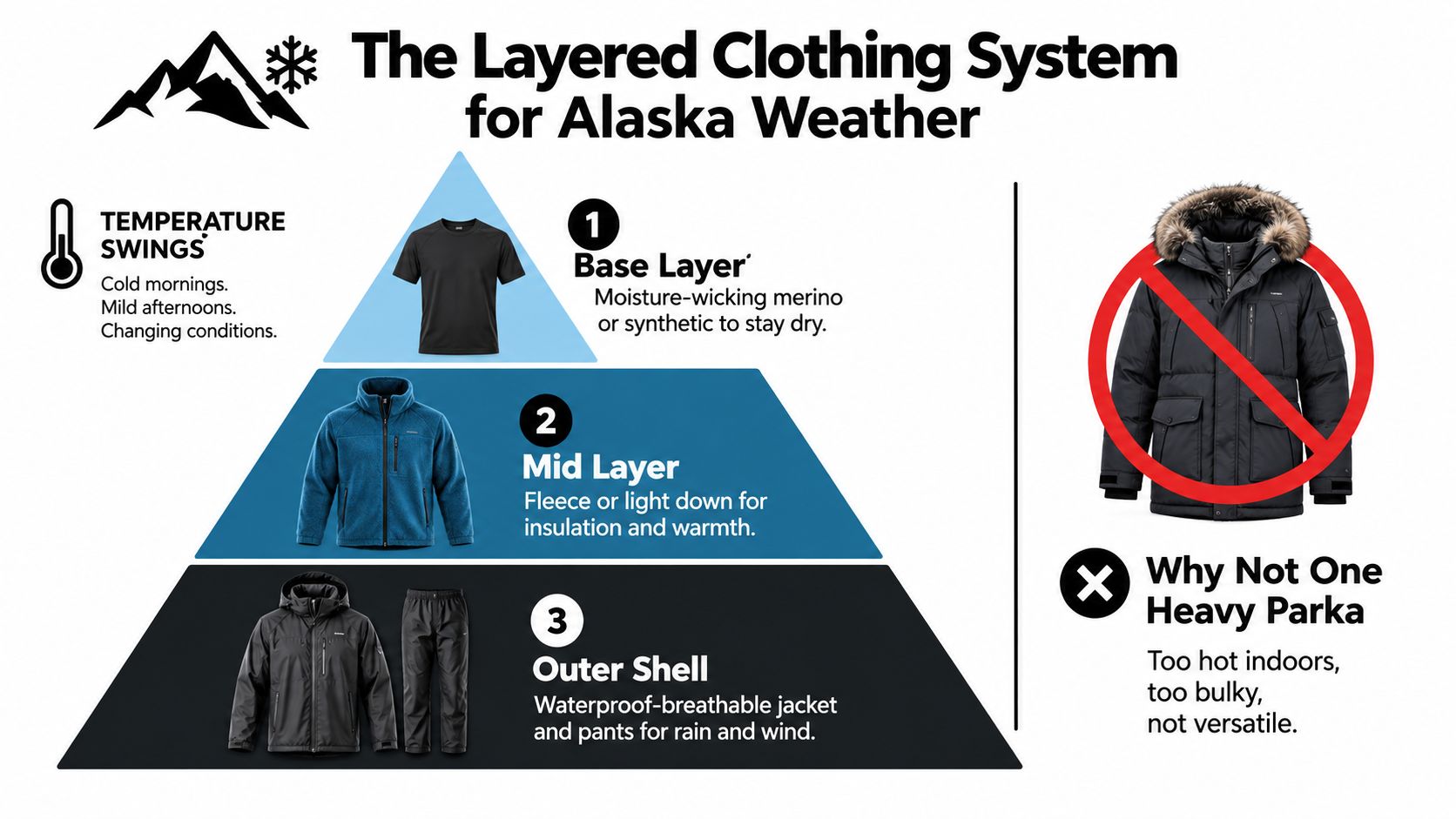
A single heavy parka is the wrong default for an Alaska cruise. You'll move between heated dining rooms, windy observation decks, wet port streets, and active excursions, often within the same day. A three-layer system gives you control without filling a suitcase with bulky insulation.
Build from the skin outward
The base layer manages moisture. Choose merino or synthetic fabric rather than cotton, especially for walking excursions. Pack several thin tops that can be washed or rotated instead of relying on one thick thermal shirt.
The mid-layer provides insulation. A 100 to 200 weight fleece, light down jacket, or packable down vest works well because you can remove it indoors and compress it in a daypack. The outer layer blocks rain and wind. Choose a hooded waterproof-breathable shell with taped seams and a durable water-repellent finish.
This arrangement handles the month-to-month variation described in the earlier pricing section. July and August may feel mild but wet, while shoulder departures demand more warmth. The same shell works for both, so the savings come from versatility rather than buying a separate wardrobe.
Packing principle: Bring one excellent shell, one insulating mid-layer, and multiple thin bases. Don't bring several heavy jackets that solve the same problem.
Don't neglect your lower half
Quick-dry travel pants are more practical than jeans on a wet port day. Jeans stay damp, restrict movement, and take space to dry. Add waterproof shell trousers if your itinerary includes glacier landings, rainforest trails, or extended time outside during rain.
Wear wool-blend socks over cotton-free liners when possible. Your feet need moisture management as much as your torso does. Shoes should be broken in before departure, with enough grip for wet boardwalks and uneven streets.
Packable accessories complete the system:
- Head coverage: A warm hat for deck viewing and a brimmed rain hat for wet port walks.
- Hand protection: Insulated waterproof gloves, with thin liner gloves if you need dexterity.
- Neck protection: A buff or compact scarf that blocks wind without the bulk of a thick winter scarf.
- Optional insulation: A down vest for colder shoulder-season mornings and breezy evenings.
For another destination-specific layering reference, compare this Glacier National Park travel guide. On a seven-night sailing, plan to rewear outer layers and rotate base tops. Use the ship's laundry service or hand-wash quick-dry items when needed, rather than packing a fresh complete outfit for every day.
Port-Day and Excursion Gear That Earns Its Space
The right gear depends on what you'll do after breakfast. A Juneau whale-watching trip needs different equipment from a Skagway rail journey, even though both may begin under the same gray sky.
In Juneau, 8×42 or 10×42 binoculars are the useful middle ground for whales, eagles, and distant shoreline movement. A dry bag protects your phone and wallet on the boat, while a lightweight daypack carries your shell and an extra mid-layer. Don't use cheap binoculars that produce a dim, shaky image. Wildlife viewing is one of the few reasons to spend more on a compact item.
Skagway's rail excursion rewards warm layers and comfortable walking shoes. You won't need technical hiking equipment for the train itself, but you will appreciate a shell, gloves, sunglasses, and a small pack for changing conditions. Ketchikan's rainforest trails call for broken-in waterproof hiking shoes, wool-blend socks, and a rain cover. Rubber boots rented ashore can work for certain tours, but they're less versatile for walking around town.
Sitka's totem walks and forest paths favor traction, a compact umbrella or shell, and trekking poles if uneven boardwalks bother your knees. Glacier Bay is different again. You may spend hours watching from the deck, so keep binoculars, an insulated layer, a waterproof shell, lens cloth, and a warm hat immediately accessible.
| Port-Day Scenario | Essential Gear |
|---|---|
| Juneau whale watching | 8×42 or 10×42 binoculars, dry sac, waterproof shell, warm mid-layer |
| Skagway rail excursion | Broken-in walking shoes, fleece, shell, gloves, compact daypack |
| Ketchikan rainforest trail | Waterproof hiking shoes, wool-blend socks, rain cover, trekking poles |
| Sitka totem walk | Traction footwear, shell, brimmed rain hat, small daypack |
| Glacier Bay deck day | Binoculars, warm hat, gloves, shell, microfiber lens cloth |
Pack for safety without overpacking
Don't carry bulky disposable hand warmers when reusable chemical warmers can serve the same purpose. Replace cotton sweatshirts with packable fleece. Leave large umbrellas behind if your shell has a reliable hood, but carry a pack cover or dry sac for electronics.
For hiking in bear country, follow local guidance and check regulations before carrying deterrent equipment. This guide can help you choose bear deterrent for hiking, but your tour operator's instructions take priority.
Most ships have one or two nicer dinners. Pack one versatile outfit that works with your clean shoes and a layer you can reuse onboard. You don't need a separate formal suitcase unless your cruise line's dress rules specifically require it. For additional route and trail planning, use this Zion National Park hiking guide as a useful comparison for outdoor footwear and daypack decisions.
Electronics, Power, and Data Security Onboard
Cold, moisture, and limited cabin outlets are harder on electronics than most travelers expect. Build your onboard kit around charging, protection, and offline access rather than assuming ship Wi-Fi will solve every problem.
A 20,000 mAh USB-C PD power bank per person provides useful reserve power for long port days and glacier viewing. Pair it with a compact multi-port GaN charger. Bring a North America-compatible outlet strip because cabins rarely offer more than two convenient outlets, and carry a 12V car-style adapter if you use a spotting scope with that power requirement.
Keep batteries warm. Store phones and spare battery packs in an insulated inner pocket, close to your body, rather than in an outside backpack compartment. Cold drains batteries quickly, and a phone that worked at breakfast may be nearly empty by the time you reach a windy observation point.
Protect connections and personal data
Enable travel eSIMs before sailing, while you still have reliable internet access. Download offline maps for each port, save boarding documents locally, and store emergency contacts where you can reach them without a connection.
Use the ship's VPN for financial transactions on shared satellite links. Turn off automatic cloud synchronization and app updates to avoid unexpected roaming or data use. If you must use a public network, avoid entering sensitive credentials unless the connection and security controls are trustworthy.
Carry anti-fog wipes for camera lenses and a microfiber kit for salt spray on the lido deck. Use a dry bag for your phone, camera, and power bank during wet excursions. Keep backups of important photos when practical, but don't let automatic syncing consume your connection.
Before traveling, review your old devices and storage media. This guide to disposing of hard drives before vacation explains why retired drives shouldn't sit unsecured in an office or home while you're away.
Luggage Strategy and Pre-Trip Checklist
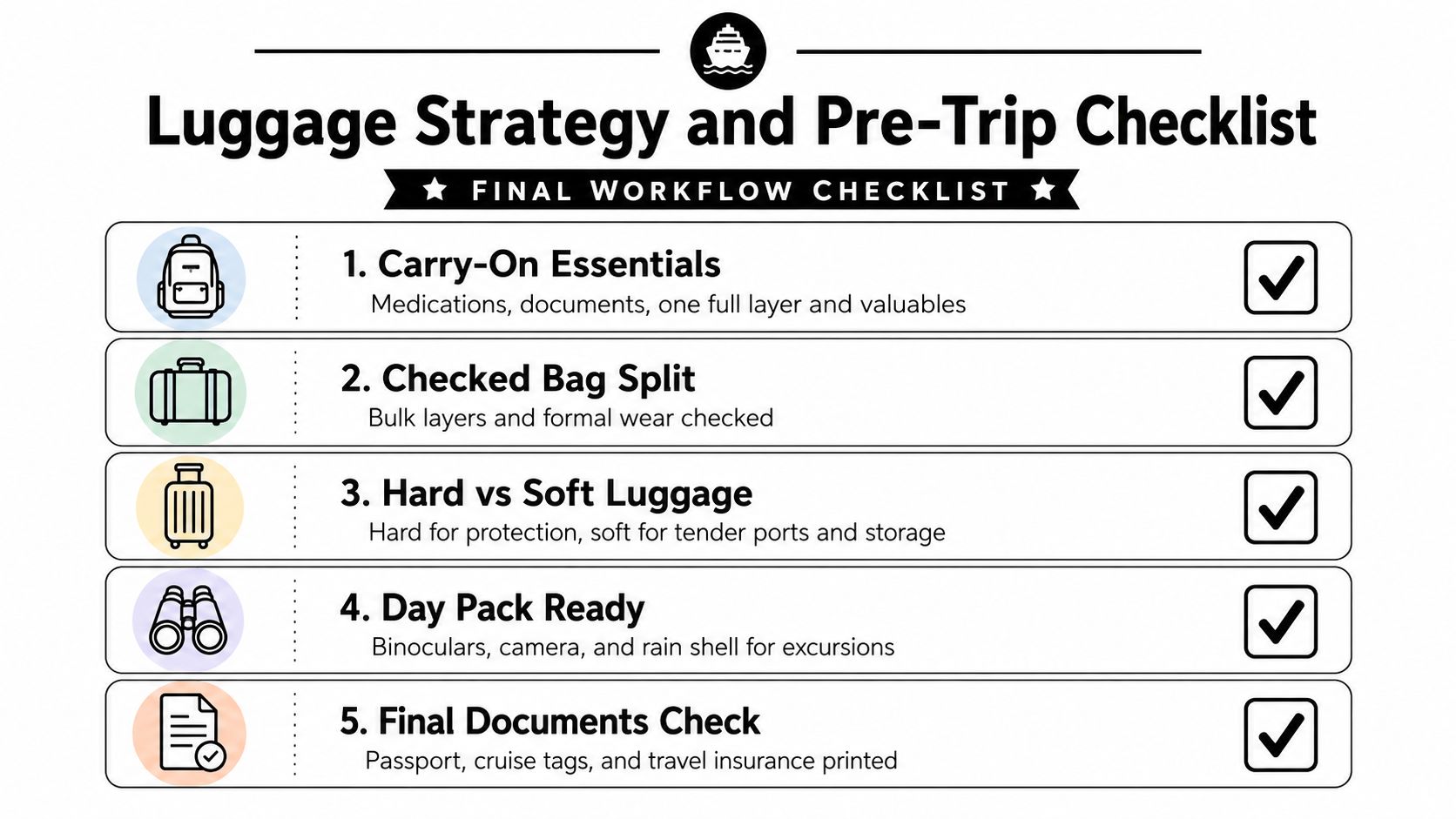
Your luggage should reflect the fare and itinerary you booked. A round-trip Inside Passage sailing from Seattle or Vancouver usually needs less transfer-oriented organization than a one-way route continuing into Anchorage and a land tour. Either way, keep medications, documents, valuables, one complete warm layer, and electronics in your carry-on.
Use checked luggage for bulk layers, shoes, and dinner clothing. Soft-sided luggage is easier to compress into cruise-cabin storage and can handle tender-port transfers without awkward rigid corners. Hard-sided luggage offers better protection for fragile equipment, but it can be less forgiving when cabin storage is tight.
Use packing cubes by function, not just by garment:
- Excursion cube: Base tops, fleece, gloves, socks, and quick-dry pants.
- Rain cube: Shell trousers, spare socks, pack cover, and dry sacs.
- Dinner cube: One versatile evening outfit and compact dress shoes.
- Cabin cube: Sleepwear, slippers, and items you'll want immediately after boarding.
Flying into Seattle, Vancouver, or Anchorage adds another decision. Check the airline's baggage rules before choosing a second checked bag, distribute dense electronics across your carry-on, and leave room for gifts. At an embarkation hotel, keep cruise documents, identification, medication, and your embarkation-day layer together rather than buried in a suitcase.
Print this timed checklist
90 days before departure
- Confirm the route: Check ports, glacier access, one-way transfers, and the cabin category you purchased.
- Review identification: Verify passport validity or REAL ID requirements for every traveler.
- Reserve priorities: Book excursions that require special clothing, footwear, or equipment.
60 days before departure
- Protect the investment: Purchase travel insurance after reviewing excursion cancellation terms.
- Audit your gear: Test binoculars, shells, chargers, power banks, and waterproof bags.
- Check baggage rules: Compare airline allowances with the number of bags your packing plan requires.
30 days before departure
- Download documents: Save cruise confirmations, transfers, hotel details, and offline maps.
- Plan motion control: Pack your preferred motion-sickness remedy and place it where you can reach it.
- Build the dinner plan: Confirm dress expectations and choose one layer that works across evenings.
14 days before departure
- Recheck the forecast: Adjust base layers and insulation, but keep the rain shell.
- Prepare the carry-on: Add medication, identification, documents, electronics, and one full outfit.
- Organize cubes: Separate excursion gear from cabin and dinner clothing.
7 days before departure
- Leave gift space: Don't fill every pocket before you leave home.
- Protect valuables: Keep cameras, drives, memory cards, and important documents with you.
- Match gear to fare: Verify that binoculars for Glacier Bay, dinner clothing, waterproof totes, and other specialized items match the booked route and cabin experience.
For polished cold-weather resort clothing that packs down well, review Pandemonium Millinery's resort layers. Finally, if you're transporting electronics before or after the trip, follow this guidance on how to pack electronics for shipping.
Reworx Recycling helps businesses retire laptops, servers, hard drives, and other outdated electronics through responsible recycling, secure data destruction, equipment pickups, and donation-focused IT asset disposition. Before your Alaska trip or next technology refresh, visit Reworx Recycling to donate old equipment, schedule a business pickup, or build a safer end-of-life plan for your organization.