Your Southside clinic is moving, or your downtown Birmingham office is finally clearing its IT closet. There are laptops that still work, a bulky CRT monitor nobody wants to lift, and a printer with an uncertain service history. Someone suggests taking everything to a recycling drop-off, but the first decision is destination, not branding.
Electronics recycling in Birmingham, Alabama, requires more than finding somewhere that accepts computers. Jefferson County's collection options, Alabama's business-waste rules, and your organization's data-security obligations answer different questions. A workable plan gives facilities a safe handoff, IT a traceable asset list, and sustainability staff evidence of what was reused or recycled.
Where Birmingham Electronics Actually Go
The same Birmingham office cleanout can split across several destinations. Working laptops may suit a small drop-off, while a CRT monitor or printer may be excluded or carry a fee. Route each stream separately.
Birmingham electronics destinations by stream
| Stream | Typical destination | Fee or limit | Fit for a business load |
|---|---|---|---|
| Cell phones, tablets, computers, laptops | Jefferson County outlets, including UAB Recycling Center, 620 11th Street South | Most electronics are free; confirm hours and business eligibility | Small quantities only |
| Televisions and monitors of all types | Jefferson County outlets, if accepted | The county program may exclude or charge for televisions and some monitors; confirm acceptance and any fee before the trip | Awkward in bulk; arrange a pickup |
| CRT monitors and certain printers | County program only if accepted | May be excluded or charged | Keep separate from a free drop-off load |
| Servers, UPS units, networking gear, cables | Business pickup or IT asset disposition partner | Requires a scheduled business handoff | Suitable with a manifest |
| Broken or leaded CRT glass | A recycling route managed under Alabama CRT rules | Not ordinary office trash | Only with appropriate storage and labeling |
The Jefferson County electronics and hazardous-materials program lists phones, tablets, computers, laptops, televisions, and monitors. It identifies the UAB Recycling Center at 620 11th Street South in Birmingham, along with outlets in Homewood and Bessemer. Most electronics are free, but televisions, CRT monitors, and certain printers may be excluded or charged. Confirm hours, item acceptance, and any fee before traveling.
Use the table to sort a load, not as permission to unload a business truck. A collection location may accept a device type without accepting a corporate quantity. It may also lack the loading arrangements or records your organization needs.
Match the destination to the load
A small box of working laptops might fit a staff drop-off if the receiving site confirms it accepts business-origin equipment and the quantity. A floor of servers, UPS units, and mixed peripherals calls for a scheduled business handoff, with packaging, loading access, and records agreed in advance.
For a clinic move, separate the printer and CRT from ordinary laptops before loading. If staff discover an acceptance problem at the destination, the organization may have to transport and store those items again.
Practical rule: A location that accepts computers has not necessarily agreed to accept your entire cleanout.
Ask the receiving contact to confirm device categories, business eligibility, quantity, unloading arrangements, and available documentation. Keep that confirmation with the load inventory so an auditor can follow why the destination was selected.
Collection is only the handoff. Testing, reuse decisions, dismantling, and material processing happen downstream, so the organization still needs an accountable route for the equipment. Learn what happens to recycled electronics.
Mark each stream that is not a straightforward small-electronics drop-off. Those items shape the handling plan and the questions to resolve before booking transportation.
Alabama Rules for Business Electronics and CRTs
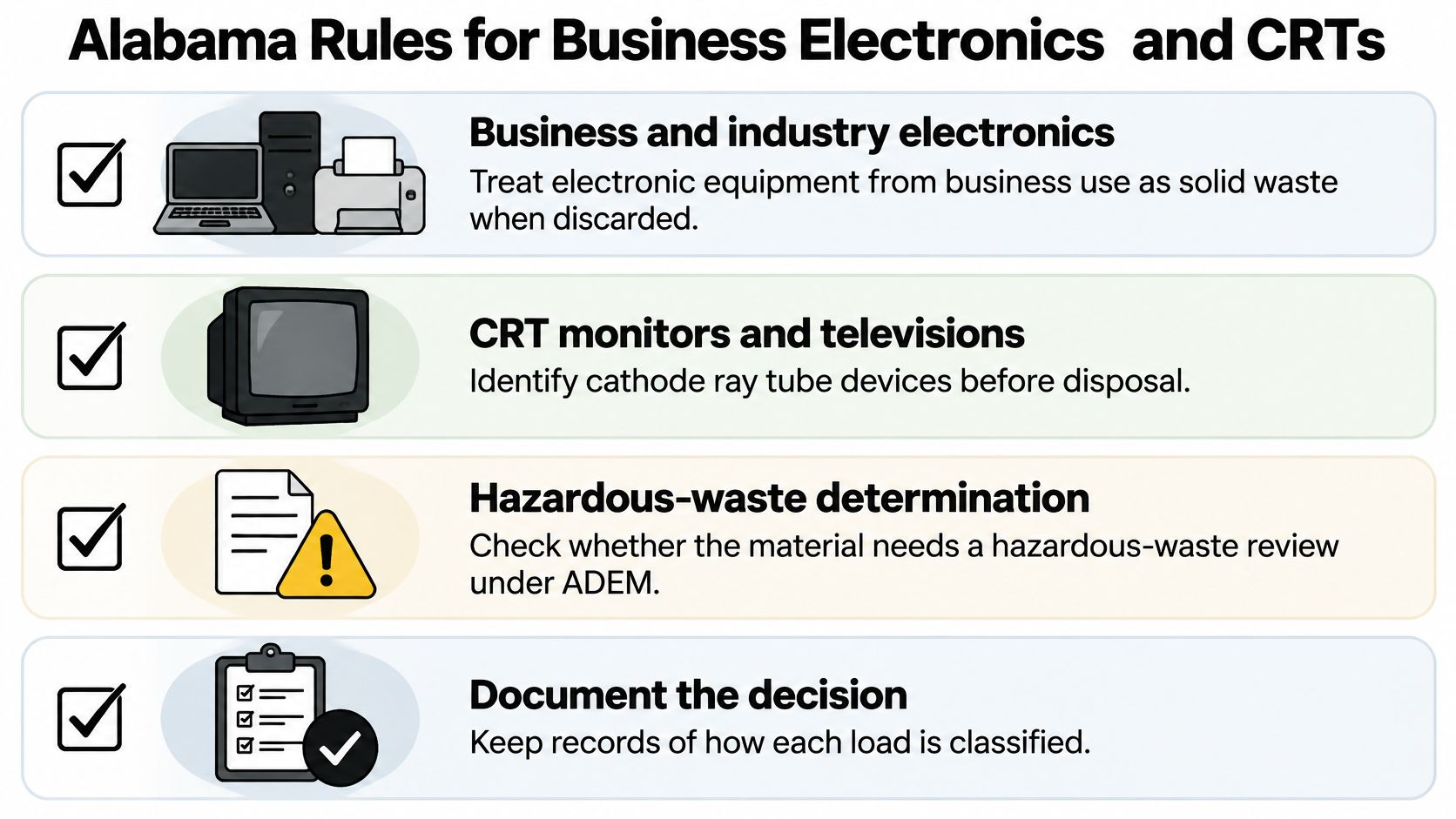
Business electronics aren't automatically ordinary office trash. The Alabama Department of Environmental Management's CRT industry guidance treats business- and industry-generated electronic equipment, including CRT monitors and televisions, as solid waste subject to a hazardous-waste determination under ADEM Administrative Code Rule 335-14-3-.01(2).
That determination asks how the discarded material must be managed. It doesn't mean every obsolete computer is hazardous waste, but it does mean the organization can't replace an evaluation with an assumption that electronics belong in the dumpster.
Understand the limited CRT recycling exception
ADEM provides a limited recycling exception for intact or broken CRTs destined for recycling and not speculatively accumulated. The conditions matter: keeping unwanted monitors indefinitely without a documented recycling route isn't the same as managing a recycling shipment.
Alabama CRT handling checkpoints
| Checkpoint | Requirement | Fails if |
|---|---|---|
| Waste determination | Business electronics, including CRTs, need a hazardous-waste determination under Rule 335-14-3-.01(2) | Units are tossed as ordinary office trash |
| Recycling exception | Intact or broken CRTs destined for recycling and not speculatively accumulated | Units sit indefinitely with no recycler |
| Storage | Broken CRTs must be inside a building with roof, floor, and walls, or in a closed container limiting releases | Broken glass sits on open outdoor pallets or in leaking boxes |
| Primary label | “Used cathode ray tube(s) – contains leaded glass” or “Leaded glass from televisions or computers” | Unlabeled or vaguely marked glass |
| Second statement | “Do not mix with other glass materials.” | CRT glass is combined with bottles or window glass |
The enclosed-building or closed-container storage condition applies specifically to broken CRTs. Keeping that distinction clear helps facilities staff avoid treating every screen identically while still protecting damaged glass from release.
Labels also serve an operational purpose. They tell a cleaner, warehouse employee, or substitute driver that the container isn't ordinary recyclable glass and must stay separate from bottles and window glass.
Apply the rules before the move
Say a Birmingham law firm discovers a pair of analog monitors during an office cleanout. Facilities should identify them as CRTs, assign responsibility for the waste determination, and confirm their recycling destination rather than adding them to a mixed shipment without notice.
A school laboratory presents a different problem if a cracked television sits outdoors in an open cardboard box. Moving day doesn't make that storage suitable. Stop handling that exposes loose glass, restrict access, and have trained personnel arrange appropriate containment and labeling.
An unlabeled bulk box of CRT glass doesn't become acceptable because someone writes “recycling” on the pickup request. Speculative accumulation, missing labels, and mixing CRT glass with other glass can undermine the exception the organization intended to use.
Use ADEM's guidance for the compliance decision, rather than a general city recycling slogan. A service overview of universal-waste handling can help frame vendor questions, but it doesn't replace a stream-specific Alabama assessment.
If any CRT appears in the cleanout, assign an owner, appropriate containment, required labels, and a recycling destination before releasing the rest of the pallet.
How to Prepare and Hand Off a Load
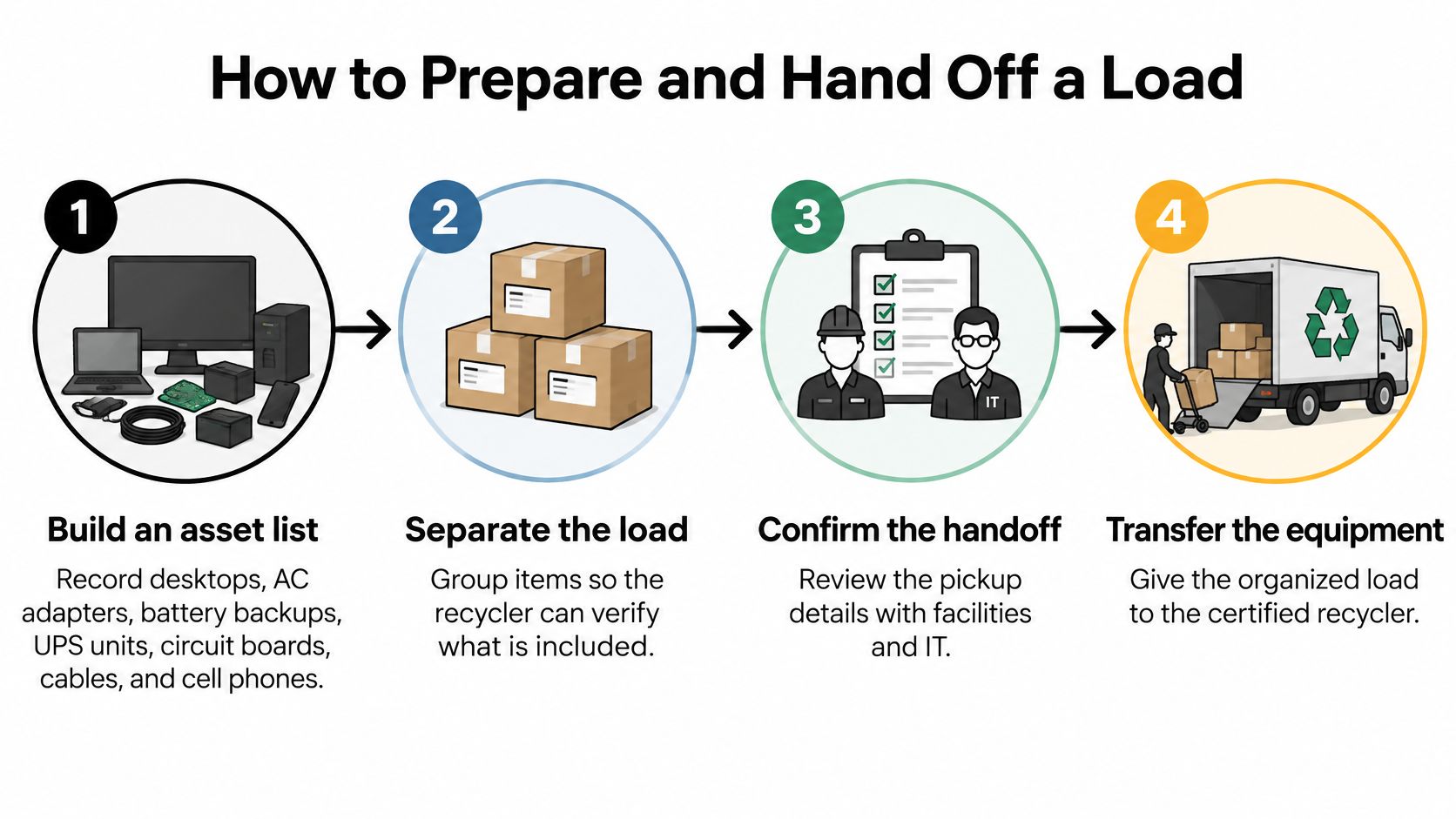
A pallet is ready to leave only when facilities can explain what is on it and IT can show which assets are approved for release. Facilities manages access, packaging, and movement. IT tracks asset identity, retained information, and retirement approval.
The University of North Alabama's discarded-electronics procedure lists a broad mix of equipment, from adapters and UPS units to drives, networking hardware, screens, and batteries. Use that range as a prompt to check accessories and less obvious items against your own inventory.
Prepare the equipment and its evidence together
Build the asset list. Include AC adapters, battery backups and UPS units, circuit boards, cables, cell phones, docking stations, hard drives, keyboards, laptop scrap, networking equipment, personal computers, power supplies, printers, servers, and phone scrap. List broken or scratched flat screens, analog monitors or televisions, alkaline batteries, and NiMH/NiCad batteries separately. Create an inventory slip with each item's category, asset tag, serial number where present, condition, and location.
Protect information before releasing hardware. Back up needed business records and verify that the backup is accessible. Identify data-bearing media for verified erasure or physical shredding. Deleting a folder does not destroy data; printers and network appliances may also need review. Use a data-disposition slip to connect each affected asset with its approved treatment and responsible IT owner.
Separate batteries safely. Trained staff can remove user-removable batteries when it is safe and appropriate. Keep loose batteries off the computer pallet. Do not pry into swollen lithium packs or remove damaged batteries without a qualified procedure. A battery exception slip should identify damaged devices, their isolation location, and the contractor's handling instructions.
Keep special fractions visible. Separate intact CRTs, broken CRT glass, toner, and cracked flat panels so they are not buried under laptops. For medical or laboratory equipment, obtain the appropriate department's decontamination and release approval before collection. Record each segregated stream and any unresolved restriction on a special-handling slip.
Choose and authorize the handoff. Use a confirmed county drop-off for a suitable small stream; arrange business pickup for a broader office cleanout, facility cleanout, or data center decommissioning. Reworx Recycling is a full-service electronics recycling and IT asset disposition partner based in Smyrna, Georgia, offering business pickups, secure hard-drive shredding with data destruction, and equipment buyback options. Record the agreed route on a handoff authorization slip, including whether reusable laptops may be eligible for buyback after data clearance.
Capture the load before loading. Photograph pallet condition, record serial numbers, and weigh or count equipment by category. Make labels readable and connect each pallet identifier to the inventory. The dispatch slip should name the internal approver, collection contact, and categories released, not only the categories requested.
Confirm closeout evidence before departure. Hold release until the vendor confirms that data-destruction and recycling records will identify this load. Write the expected documents and delivery contact on a certificate request slip. A generic recycling letter may not identify which equipment was processed.
Make the slips usable
The slips can be tabs in a shared spreadsheet. Consistent asset and load identifiers let IT, facilities, procurement, and sustainability staff track the same equipment across their records.
Use a company electronics preparation checklist to guide the staging meeting. Before requesting secure data destruction or pickup scheduling, have the inventory and exception slips ready so the collection scope matches what is waiting at the dock.
Costs Buyback and the Records to Keep
Separate service charges, recovered asset value, and donation outcomes before approving a proposal. They're different results, and combining them into a single “recycling savings” figure makes the project harder to evaluate.
A business pickup quote may itemize labor, transport, packaging, data treatment, and difficult-to-handle equipment. Ask the vendor to identify exclusions and explain how an unexpected CRT, battery, or large printer changes the scope. Don't assume a consumer drop-off arrangement establishes corporate pickup pricing.
Newer laptops, desktops, and networking equipment may qualify for buyback after evaluation. Request the valuation basis, testing conditions, and any deductions in writing; an IT equipment buyback overview is a useful starting point for deciding what to submit for assessment.
Treat donation as an outcome, not a cash estimate
Donation-based recycling can direct suitable equipment toward community use once security and functionality checks are complete. That mission outcome isn't equivalent to a guaranteed payment, a guaranteed recipient placement, or an assumed tax benefit.
Ask procurement to distinguish the proposed reuse route from the financial settlement. Finance should record buyback as recovered value and service fees as disposal cost, using its normal accounting policies rather than netting everything into an unsupported environmental claim.
For asset-register planning, Evright Industrial's guide to implementing fixed asset management in 2026 offers useful context for connecting physical equipment to lifecycle records. Apply that discipline at retirement by linking each released asset to its disposal authorization and financial treatment.
Records to keep for each Birmingham load
| Document | Must match | Fails if |
|---|---|---|
| Asset or serial manifest | Every serial and category on the truck | Counts differ from the pallet |
| Photos at handoff | Pallet condition before loading | There are no images of CRTs or batteries |
| Weights or counts by category | The bill of lading and load identifier | Weight cannot be tied to the pallet |
| Bill of lading | Same date and load as the manifest | It is dated for a different month |
| Data-destruction certificate | Serials or seal numbers from the manifest | It is a generic letter with no asset traceability |
| Recycling certificate | What actually left the dock | It covers a different load |
Reconcile before closing the project
Certificates aren't interchangeable receipts. A certificate for a different month, an unexplained weight, or a missing drive serial leaves an evidence gap that a customer, insurer, or internal auditor may challenge.
Have the asset owner review exceptions before marking the project complete. If a device was retained, rejected, or transferred separately, record that outcome rather than forcing the original inventory to match a later certificate.
A collection is complete when the equipment is gone. An asset-retirement project is complete when the records explain where it went.
For Birmingham schools, city departments, and hospital departments, report these results separately:
- Devices collected: Equipment physically transferred under the load identifier.
- Devices reused or donated: Equipment with a documented reuse disposition, not merely a reuse intention.
- Devices recycled: Equipment assigned a documented recycling outcome.
- Items still held: Hazardous or data-bearing equipment awaiting an approved route.
Keep device counts and material weights distinct. A sustainability lead shouldn't have to guess whether a reported total describes laptops, mixed equipment, or packaging.
Choose a Certified Recycler and Book the Load
A Birmingham office clearing out computers has different needs from a household dropping off a few eligible devices. For a business load, choose a provider that can explain how it will handle your equipment, arrange pickup, and document the work. A corporate IT asset disposition (ITAD) program connects asset identity, data treatment, physical handling, and final disposition.
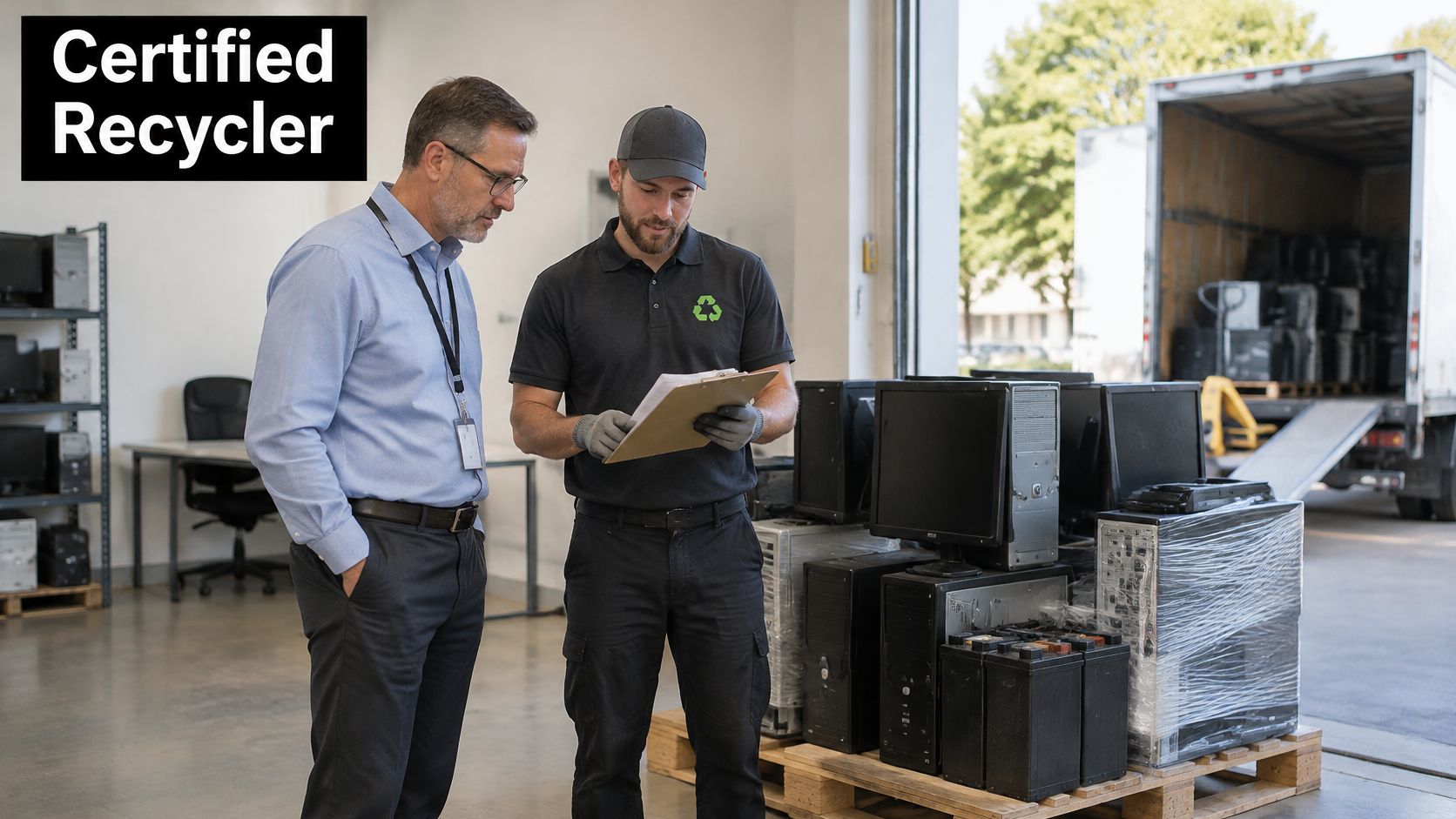
Certification can help you screen providers, but a logo alone does not show which services or facilities it covers. Review electronics recycling certification considerations and request current documentation relevant to your load.
Make the vendor answer practical questions
Name the downstream destinations. Ask which facilities receive computers, displays, batteries, and other separated streams. If transport or processing is subcontracted, ask who handles each step. A landfill-diversion promise alone does not explain whether equipment is reused, recycled for materials, or sent for another treatment.
Verify security evidence and certification scope. Request data-destruction and recycling records that connect to serial numbers or a documented sealed-container chain of custody. Ask which sanitization method applies, including whether the process uses NIST SP 800-88 clear, purge, or destroy terminology. Confirm whether the facility handling your load holds R2 or e-Stewards certification, and check that the certificate covers the relevant location and work.
Ask how equipment is assessed for reuse. Have the provider explain functional testing and how failed devices are handled. Ask how the final report distinguishes equipment reused from items still awaiting assessment. For equipment requiring secure destruction, confirm that the provider can document that service.
Review procedures for hazardous fractions. Ask how the provider handles cracked displays, toner, mercury-containing lamps, and swollen batteries. Confirm who does the work, how materials are contained, and what happens to rejected items. “We take everything” does not explain the handling route.
Confirm commercial and logistical terms. Check insurance, the pickup window, loading responsibilities, and arrangements for unexpected items. If branded goods cannot be reused, ask whether product destruction is available and what proof it produces. Keep that requirement separate from ordinary computer recycling so reusable equipment is not destroyed by default.
Ask about worker protections as well as environmental handling. A University of Birmingham-associated study of UK e-waste facilities examined indoor and outdoor dust sampling. Use that as a prompt to ask about dust control, contained dismantling, and hazardous-fraction procedures, not as an Alabama compliance benchmark.
Separate property clearance from electronics disposition
An office move may include desks, shelving, packaging, and electronics under one project manager. These items can share a schedule, but they may need different handling routes.
Clear It Services commercial clearance describes the broader commercial-clearance service category. A general clearance contract does not replace an ITAD plan for business electronics.
For example, a clearance crew may empty rooms while a separate ITAD provider tracks serialized devices. State that division in the work order so each team knows who handles data clearance and CRT routing.
Before the call: Prepare a device list, flag CRTs and swollen batteries, and decide whether you need serial-level destruction evidence.
Choose the route you can substantiate
Have an approximate count by device type ready, along with access details such as stairs, loading-dock availability, and whether equipment is palletized. Flag unusual items before requesting a quote, especially laboratory systems, medical equipment, or assets with restricted reuse.
For a small household load, confirm that the county outlet accepts each item before drop-off. A corporate retirement may need a scheduled pickup with written handling instructions, asset tracking, and a defined closeout package. Household drop-off is not a substitute for a business program that must address Alabama hazardous-waste determinations and serial-level records.
A suitable recycler should be able to explain its services and the records it will provide. Reworx Recycling offers business pickups, secure hard-drive shredding, equipment buyback, and recycling consultations. To request a pickup, prepare the device list and access details, then ask which services and records fit the load.