The office move is nearly finished, but the retired equipment hasn't moved. Laptops are stacked in a storage room, monitors are waiting near the loading dock, and someone needs to confirm whether the old file servers still contain drives. Facilities wants the space cleared. IT needs proof that nothing leaves with company data intact.
IT asset disposition in Los Angeles, CA, starts with those unresolved decisions, not with a recycling truck. A workable plan identifies what you own, what each device stores, which equipment can safely serve another user, and what evidence must remain after everything leaves.
Why Los Angeles Organizations Treat IT Disposal as a Managed Process
The risk usually isn't finding a truck. It is proving, afterward, which assets carried data, which were safe to resell or donate, and which had to be destroyed because of what they stored or how they were built.
IT asset disposition (ITAD) is the managed path from retirement to reuse, donation, recycling, or destruction, with records at every handoff. The practical work is risk sorting: custody, data security, ownership checks, and environmental routing by device type. A wipe-everything policy can strand resale value, while destroy-everything can turn working laptops, lease returns, and removable drives into avoidable cost.
Los Angeles has public collection channels, but public convenience does not equal business closure. A clinic, studio, school district, or law firm still needs acceptance rules, custody records, and evidence matched to its confidentiality duties.
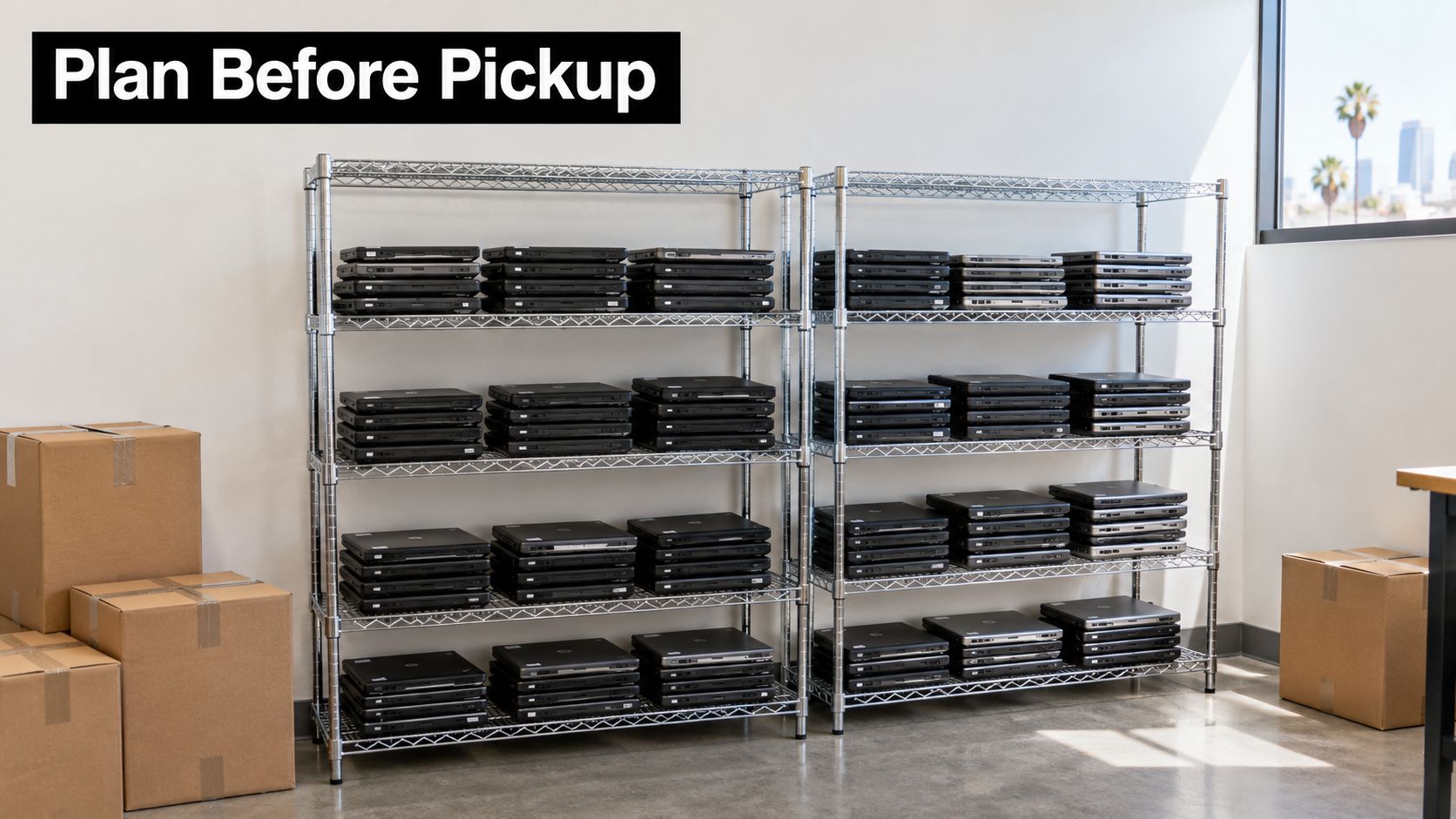
Collection isn't the same as closure
The decision starts before pickup. Separate owned equipment from leased hardware, pull or inventory drives before racks move, and flag devices with embedded batteries early enough to pack and route them under the 2026 battery-embedded device rules. Proof also splits into two files: data security evidence for what was sanitized or destroyed, and downstream recycling records for where non-reusable material went.
That is the level of coordination a documented partner should handle. Reworx Recycling is a full-service electronics recycling and ITAD partner based in Smyrna, Georgia, with business pickups, equipment decommissioning, IT asset management, secure hard drive shredding, equipment buyback, and recycling consultations for offices, schools, and government agencies.
The operational test is simple:
Start with storage, not appearance: Do you hold any retired device that still stores company data?
If the answer is yes, assign its disposition before anyone loads it.
ITAD Services and What Each One Covers
An ITAD proposal should identify the work attached to each asset category. “Electronics recycling” alone doesn't tell you whether the provider will remove equipment, sanitize storage, recover resale value, or deliver an auditable report.
ITAD services, scope and typical buyers
| Service | What It Covers | Typical Buyer |
|---|---|---|
| Pickup and logistics | Scheduled collection, palletizing, locked transport, and route documentation | Offices after a refresh or cleanout |
| Secure data destruction | Wiping, appropriate magnetic-media degaussing, shredding, or drive crushing with documented results | Finance, healthcare, legal, and public agencies |
| Decommissioning | Approved shutdown, removal of servers and racks, storage pulls, and labeling | Data centers and server rooms |
| Asset recovery and buyback | Testing, grading, ownership checks, and payment for eligible working equipment | Companies with leases or recent refresh cycles |
| Recycling | Authorized processing of non-reusable e-waste, CRTs, and batteries through appropriate channels | Any organization with end-of-life hardware |
| Donation | Transfer of eligible working equipment to schools or nonprofits with a receipt | Corporate donation programs and sustainability teams |
| Reporting | Serialized inventories, certificates, exception reports, and downstream recycling records | Audit-driven and publicly funded organizations |
Combine services around the equipment
These services form a chain rather than a menu of unrelated purchases. In a hypothetical laptop refresh, newer devices might qualify for buyback, older working units for donation, and failed equipment for recycling after its storage is addressed.
The right mix preserves useful hardware without relaxing security controls. Buyback and donation recover financial or community value. Destruction and recycling resolve equipment that can't return to service.
Ask who performs each activity and where responsibility changes hands. A logistics contractor might collect equipment without performing sanitization, while a processing facility might outsource specialty materials. Your agreement should identify those handoffs rather than leave them implicit.
Reworx offers donation coordination, secure data destruction services, and business pickup support. Confirm the actual service combination, location, reporting package, and donation eligibility before authorizing collection.
Specialty equipment needs additional screening. Medical equipment disposal and laboratory equipment disposal can involve embedded storage, contamination concerns, or devices that aren't suitable for an ordinary electronics load. Obtain decontamination clearance and acceptance instructions before staging those assets.
Likewise, product destruction isn't synonymous with computer recycling. If prototypes, branded products, or restricted equipment must never return to market, state that restriction explicitly. A donation-first approach shouldn't override contractual restrictions or an approved destruction decision.
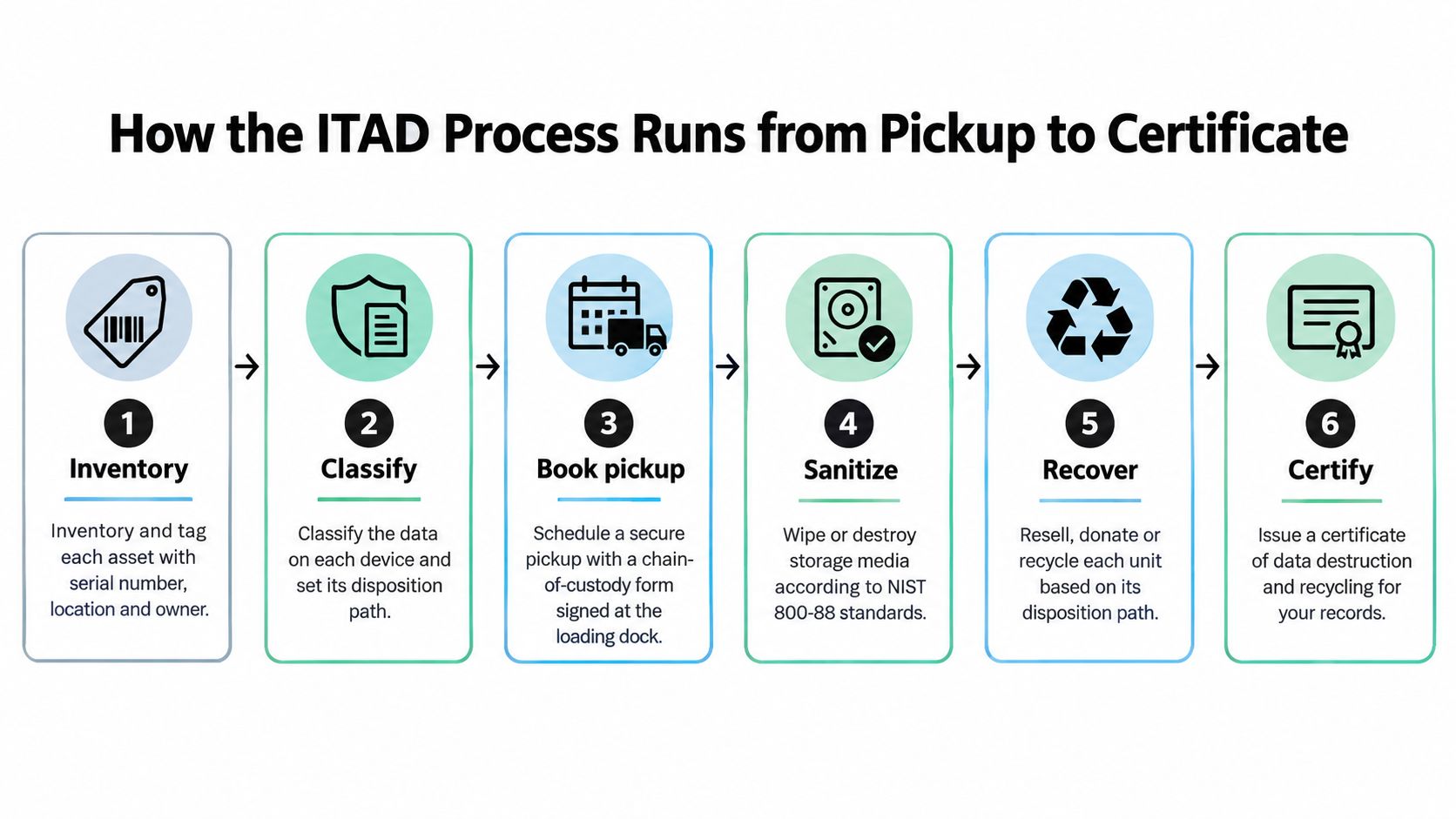
How the ITAD Process Runs from Pickup to Certificate
The process should follow a controlled sequence, with a named owner approving exceptions. A chain-of-custody manifest works much like a hospital medication log: each handoff records what changed hands, who accepted responsibility, and when it happened.
Inventory and tag the assets. Capture the serial number, asset identifier, location, and owner before equipment leaves its working area. Photograph unreadable labels and assign temporary identifiers rather than silently dropping those items from the list.
Classify data and assign a path. Identify storage-bearing devices and approve reuse, donation, recycling, or destruction. Don't assume a disconnected server is empty or a monitor lacks embedded storage.
Book pickup around the building. Provide a named contact, loading instructions, elevator reservations, parking restrictions, and staging details. In downtown Los Angeles, a truck appointment without building access approval isn't a confirmed removal plan.
Seal and transfer custody. Use controlled containers and locked transport under a signed manifest. Record container identifiers and discrepancies before the driver leaves, not after someone notices an empty shelf.
Receive and reconcile. The receiving facility should weigh the load and log assets against the collection inventory. Missing serials, unexpected devices, or broken seals should create exceptions requiring resolution.
Apply the approved treatment. Sanitize storage, physically destroy designated media, or route non-data-bearing material appropriately. A failed procedure must stop the asset from advancing into reuse.
Test eligible working equipment. Check condition and functionality before resale or donation. Remove organizational management restrictions through an authorized process so a usable laptop doesn't become an unusable donation.
Route residual material. Send non-reusable material to an authorized receiving channel and retain transfer evidence. Separate specialty items instead of burying them in a mixed pallet.
Close the inventory and issue records. Reconcile every identifier against its final outcome before accepting the project as complete. Certificates shouldn't conceal unresolved shortages or pending destruction.
Put timing commitments in writing
The following are proposed planning windows to confirm with the vendor, not published industry averages or guaranteed Reworx turnaround times. Processing starts after receipt and intake reconciliation, which may occur after the collection date.
Typical ITAD timelines by project size
| Project Size | Pickup Scheduling | Processing and Documentation | Certificate Issued |
|---|---|---|---|
| Under 25 devices | Next available confirmed collection slot | Agreed intake and sanitization window | Proposed target within 5 business days of processing |
| 25 to 250 devices | Proposed booking allowance of 1–2 weeks | Batch schedule agreed after inventory review | Proposed target within 2 weeks of processing |
| 250 to 1,000 devices or full office cleanout | Reserve after site and loading review | Phased processing with exception checkpoints | Proposed target within 30 days of processing |
| Server racks and data center decommissioning | Book after shutdown and removal approval | Set by drive count, access, and destruction method | Per agreed project schedule |
Unknown storage types, unlabeled racks, inaccessible loading areas, and missing shutdown approvals can delay both removal and documentation. Resolve those dependencies before choosing the final clearance date.
Matching Data Destruction Methods to Each Device Type
Deleting a file is like removing its index card while leaving the book on the shelf. The normal lookup disappears, but that doesn't establish that the underlying information is unrecoverable.
The NIST Guidelines for Media Sanitization define sanitization around making access to target data infeasible for a defined level of effort and align method selection with information confidentiality. That makes sanitization a risk decision, not a universal wipe command.
Clear supports lower-risk reuse by addressing data through an appropriate clearing technique. Purge provides stronger protection against recovery while potentially preserving the medium. Destroy makes reuse unacceptable or impossible through an approved physical process.
Disposition method by device and data sensitivity
| Device or Media | Recommended Disposition | Reusable Afterward |
|---|---|---|
| Magnetic hard drive with non-sensitive data | Clear, then verify | Yes, if resale is approved |
| Magnetic hard drive with confidential or regulated data | Purge, or destroy if reuse is unacceptable | Only after verified purge |
| SSD and flash storage | Verified supported sanitize command, or shred | Only after successful validated sanitization; formatting isn't sufficient |
| USB drives, SD cards, and removable media | Destroy under a conservative mixed-media policy | No |
| Phones and tablets with flash storage | Purge with a validated tool, or destroy | Yes only when the device and tool support validated sanitization |
| Failed or unreadable drive | Escalate to physical destruction | No |
Flash storage needs a different decision
SSDs use wear-leveling and overprovisioning, which can leave data outside the areas an operating system normally reaches. Ordinary file deletion or formatting therefore doesn't establish that all target data has been sanitized.
For an SSD intended for reuse, verify that the selected tool supports the actual device and its sanitization capability. A successful command message alone isn't enough if the process can't validate the result or identify what the command covered.
Degaussing belongs to compatible magnetic media, not flash storage. Crushing also needs scrutiny: visibly damaging a casing isn't the same as applying a destruction process suitable for the storage medium.
A failed sanitization result is a routing decision. Quarantine the device and escalate it, rather than treating the failure as a reporting inconvenience.
For example, a laptop that boots normally but won't complete the approved sanitization process shouldn't enter a donation batch. Its chassis may remain useful after storage removal, but the failed drive needs its own documented outcome.
Define acceptance before collection
Assign the sensitivity class and allowed reuse outcome before pickup. The sanitization record should capture the asset ID, serial number, classification, tool and version, operator, timestamp, verification result, and final disposition.
Ask a prospective provider of secure data destruction in Los Angeles how it handles unsupported media and failed verification. The useful answer describes an exception process, not just a list of available machines.
California Rules That Shape Electronics Disposal in Los Angeles
A display, a magnetic drive, and a swollen battery can leave the same office on the same day and still need three different handling decisions. California's framework follows the device rather than the city, so Los Angeles organizations work under the same statewide rules as everyone else.
The Electronic Waste Recycling Act of 2003 established the covered-electronics system, and qualifying purchases have carried screen-size-based fees of $5, $6, or $7 since January 1, 2017, according to CDTFA's covered-electronic-waste recycling fee guidance. Those fees fund the program at the point of sale. They say nothing about what your organization will pay for pickup, sanitization, or specialty handling, and having paid them years ago settles nothing at retirement.
Match each rule to the device before the truck arrives.
California e-waste requirements by case
| Requirement | Applies To | Practical Action |
|---|---|---|
| Covered electronic waste program | Video display devices over four inches diagonally that DTSC determines are hazardous waste when discarded, per CDTFA's covered-device guidance | Inventory screens by type and size before pickup |
| Off-site e-waste handler notice | Receiving handlers subject to advance-notice requirements | Confirm the receiving facility's applicable notice is on file |
| Collector handling threshold | Collectors accepting qualifying quantities without treatment | Ask for handler status and weight records |
| CRT material payment rate | CRT covered electronic waste has a combined program payment rate of $1.19 per pound from July 1, 2025, according to CalRecycle's payment-rate document | Identify and weigh CRT material separately; that figure is a program reimbursement, not a service price |
| Battery-embedded products | Covered battery-embedded products entered the program on January 1, 2026, under Senate Bill 1215, according to CalRecycle's program update | Screen qualifying products and separate damaged-battery exceptions at intake |
| Authorized e-waste handler | Electronic waste subject to DTSC handling rules | Verify the receiving channel and retain transfer records |
Battery screening changes the loading plan
Products that sat outside the covered category before 2026 may now qualify, so confirm product eligibility and acceptance conditions with the receiving handler for each model. Assuming the program category from the form factor is where intake lists go wrong.
A swollen, damaged, leaking, or recalled battery requires separate assessment before consolidation. Don't charge, puncture, compress, or place it into an ordinary mixed-electronics pallet; have qualified personnel determine safe isolation, packaging, and transportation. One damaged unit handled casually can change the packaging requirements for everything around it.
Program compliance covers routing. A transfer record shows where material went, while sanitization results live in a different file with different evidence. Keep both questions open until both are answered.
For broader federal context, the EPA's electronics donation and recycling guidance is a useful companion to state-specific requirements. Reworx's California electronics recycling information can support initial service planning.
Ownership and return rights belong on a separate checklist. If defective equipment may qualify for a seller remedy, the overview of California refund and Lemon Law rights is useful background for a conversation with counsel; it doesn't decide whether business hardware qualifies.
When a product's status is unclear, get the receiving handler's answer in writing before the shipment leaves your dock.
Chain of Custody Records and Certificates Auditors Expect
Environmental routing and data security require separate evidence. A recycling receipt can establish where equipment went without demonstrating that its storage was sanitized.
CalRecycle's electronics program guidance distinguishes the state's program administration from DTSC's authorized-handler requirements. Neither role, by itself, establishes a serialized record of successful data treatment.
Build a closeout package that answers questions
Serialized inventory, what did we retire? Include organizational asset identifiers, manufacturer serial numbers, device descriptions, and ownership status. Preserve the approved starting list rather than overwriting it with the vendor's received list.
Chain-of-custody manifest, who held it? Record releasing and receiving parties, transfer dates, locations, container identifiers, and discrepancies. Each signature should identify a real custodian rather than an unnamed department.
Sanitization log, did the treatment succeed? Retain the technical evidence behind the disposition decision, using the method-selection and verification fields specified for the work. An asset marked complete without a result deserves investigation.
Certificate of destruction or sanitization, what is being attested? Require device or media serial numbers, the actual method, date, facility, and responsible signer. The document title should accurately distinguish logical sanitization from physical destruction.
Downstream recycling record, where did residual material go? Identify the receiving facility, material categories, shipment reference, and recorded weights. These records support environmental routing, not a substitute claim about data removal.
Exception report, what departed from the plan? Capture failed wipes, missing identifiers, damaged units, unexpected storage, and rerouted equipment. Assign an owner and resolution to every open exception.
Reconcile outcomes, not just totals
A generic certificate describing an approximate bulk quantity doesn't establish which assets were processed. Match inventory identifiers to treatment results and reuse decisions, then associate residual material with the relevant recycling shipment.
Every asset needs a recorded final outcome. If a laptop is reused after drive destruction, link the chassis and removed drive as separate components rather than assigning contradictory outcomes to the same identifier.
Closeout rule: Don't approve the final report while missing assets or failed treatments remain hidden inside a completed batch.
Physical access matters during staging too. Overton Security's discussion of securing critical infrastructure against physical threats provides useful context for controlling access to server rooms and equipment holding areas.
Request a sample chain-of-custody documentation package before contracting. Smaller organizations can obtain defensible evidence without destroying every usable drive, but their security owner must approve the method and acceptance criteria.
Cost Drivers Behind an ITAD Quote
An ITAD quote is a set of service assumptions, not just a price per pound. You can control several of those assumptions by preparing an accurate inventory and separating ready-to-process equipment from unresolved exceptions.
The main cost drivers are:
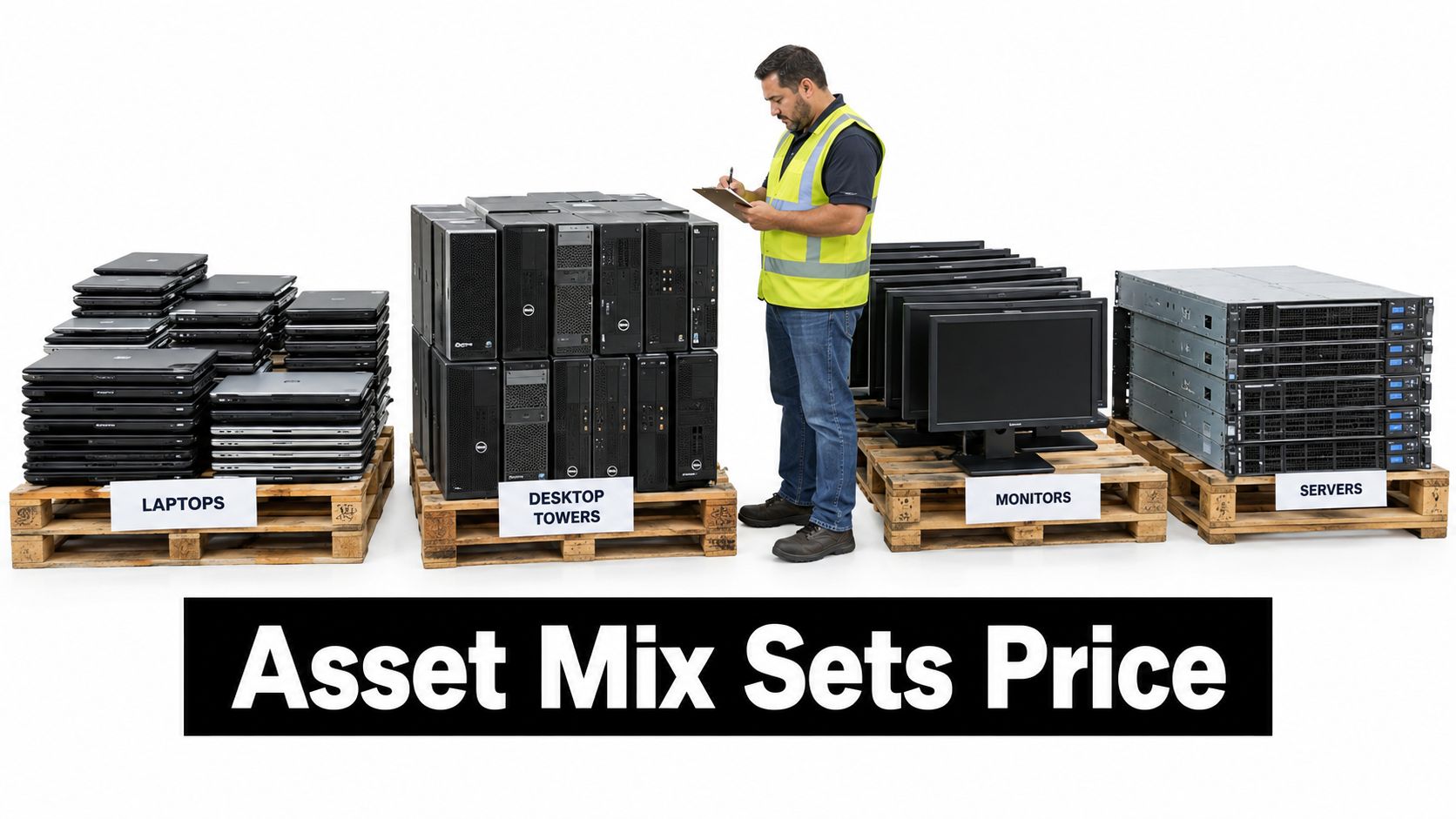
- Device count and mix. Laptops, servers, CRTs, loose drives, and battery-containing equipment require different work.
- Treatment method. Logical sanitization, drive removal, onsite destruction, and offsite shredding create different labor and equipment requirements.
- Building access. Stairs, freight-elevator restrictions, locked floors, and distant staging areas affect collection effort.
- Transportation. Route distance, load size, dedicated transport, and minimum-load terms belong in the quote.
- Specialty handling. Damaged batteries, legacy displays, and unusual equipment can require separate packaging or processing.
- Reporting depth. Serial-level reconciliation and exception resolution require more work than a bulk receipt.
- Recovery credits. Eligible equipment can offset charges, but only under the agreed testing and grading rules.
Compare the same work
Ask bidders to separate device processing, drive treatment, collection, onsite labor, specialty materials, and documentation. Show buyback credits independently so a strong resale estimate doesn't hide higher service charges.
For a hypothetical 250-laptop refresh, the following grouping makes the arithmetic clear without assuming market prices.
| Hypothetical Group | Processing Line Items | Group Total to Compare |
|---|---|---|
| 60 newer units for buyback | Testing, sanitization, grading, and reporting | 60 × agreed processing rate, less accepted buyback credit |
| 120 usable units for donation | Testing, sanitization, preparation, and donation receipts | 120 × agreed donation-preparation rate |
| 70 failed units for recycling | Storage removal, drive destruction, and residual recycling | 70 × agreed failed-unit rate, with drive charges adjusted to actual drive count |
| Shared project work | Pickup, access labor, and any separately priced closeout package | Agreed shared charges added once |
The project total is the combined group charges plus shared charges, less buyback credits. Don't count an included service again as a separate line item.
Donation can preserve value for working equipment, but it doesn't make preparation, transport, or security work disappear. A mixed facility cleanout can cost more to sort than an organized refresh, even when it contains less desirable hardware.
Use pricing transparency criteria to identify exclusions before signing. A quote without serialized reporting may look cheaper because it excludes the work your compliance team needs.
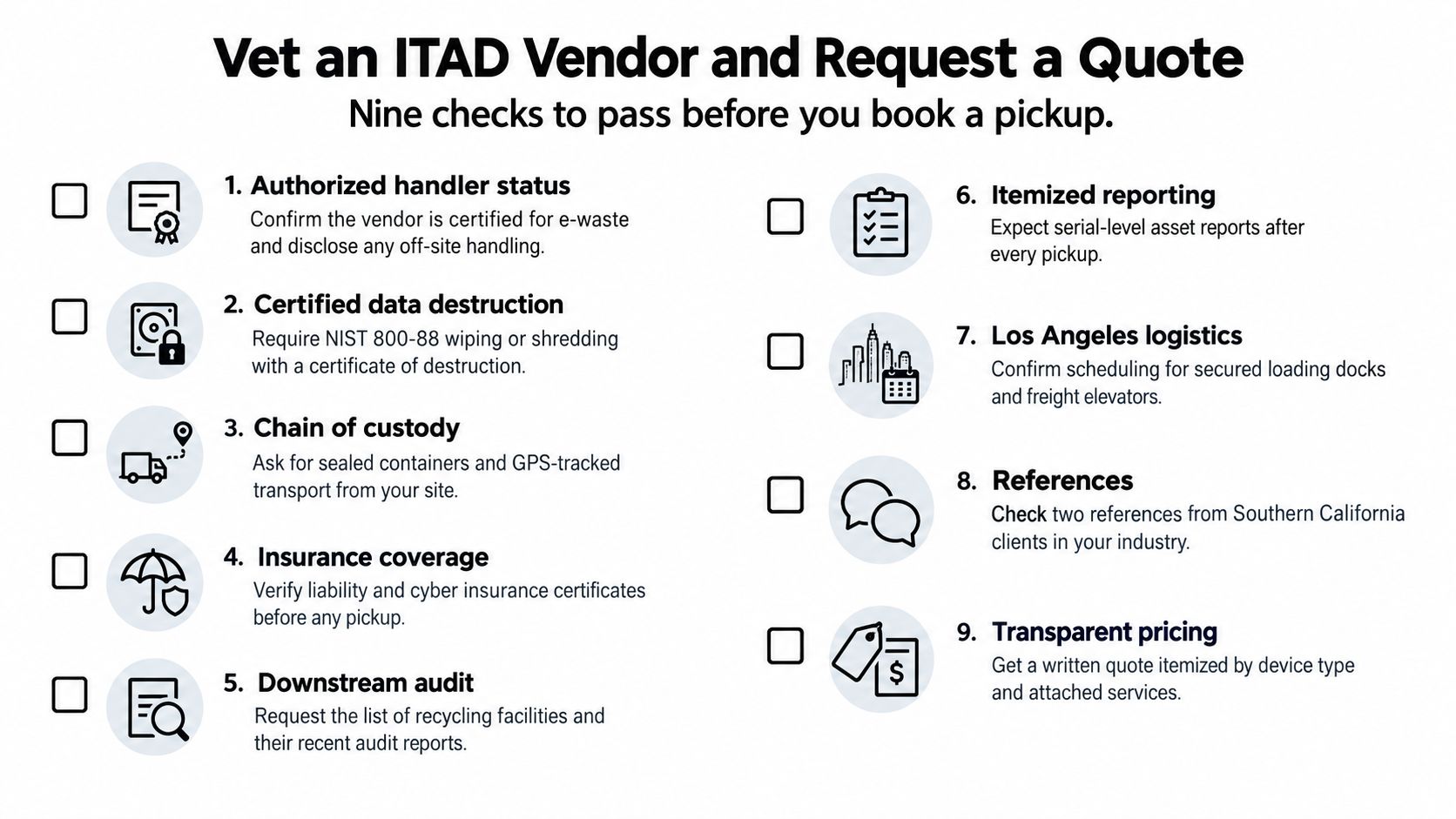
Vet an ITAD Vendor and Request a Quote
Choose the vendor that can pass the operational checks before discussing the earliest truck appointment. A fast collection doesn't help if the receiving facility can't explain its authority, storage controls, or exception process.
Checks to pass before booking
Confirm authorized handler status. Ask for the receiving facility's legal identity and applicable regulatory documentation. DTSC's requirements for handlers and recyclers specify a one-time Notice of Intent at least 30 days before applicable off-site handling and identify collectors accepting 220 pounds or more without treatment, alongside recyclers treating any amount, within the relevant requirements.
Test the sanitization answer. Ask which guidance the process follows, how tools are validated, and whether verification results are logged. A reference to a standard isn't proof that your particular storage device can be processed successfully.
Require serialized custody. Establish how identifiers connect collection, receipt, storage treatment, and downstream outcomes. Confirm whether subcontractors appear in that record.
Review insurance. Request current evidence covering the proposed transportation and facility work. Have procurement or your risk adviser assess exclusions and limits rather than treating possession of a certificate as sufficient.
Ask about audits. Establish whether customer audits are permitted, how access works, and what evidence is available for downstream facilities. If visits aren't possible, agree on an alternative review package.
Confirm Los Angeles logistics. Supply your ZIP codes, building restrictions, loading arrangements, and preferred collection windows. Include branch offices and remote-worker returns if they belong in the same project.
Obtain itemized pricing. Require separate service charges, exclusions, and buyback credits. Define who approves charges when intake reveals equipment that wasn't on the original list.
Clarify donation receipts. Ask which equipment qualifies, who receives it, and what receipt documents the transfer. Don't assume a receipt establishes a tax deduction or valuation.
Request relevant references. Seek organizations with similar equipment, access constraints, and confidentiality needs. Ask specifically how the provider resolved exceptions and completed documentation.
Send an inventory that supports a firm proposal
Prepare a spreadsheet containing device type, quantity, serial numbers, storage details, location, ownership, and target removal date. Attach photographs of racks, loading access, unusual equipment, and any damaged-battery exceptions.
Use consistent ITAD vendor selection criteria across bidders. Ask each provider to return the same deliverables and identify assumptions, rather than comparing proposals written around different service scopes.
Based in Smyrna, Georgia, Reworx offers free customer drop-off, business pickups, equipment decommissioning, secure hard drive shredding, and equipment buyback. It serves organizations nationwide, so confirm Los Angeles pickup coverage, local logistics, and the processing location before booking; free drop-off doesn't imply free collection in California.
Its donation-based recycling and social enterprise recycling mission supports technology donations, digital inclusion, and workforce development. For corporate donation programs, ask how equipment eligibility and community outcomes will be documented alongside the security records.
An organized office cleanout can support that mission without turning every retirement into a donation. Approve each asset's route, assign someone to resolve exceptions, and make final documentation part of the purchase decision.
Reworx Recycling offers business equipment pickup, secure data destruction, recycling, and donation coordination for organizations retiring IT hardware. Visit Reworx Recycling to start planning your Los Angeles project, then share your inventory to request a quote, confirm pickup availability, or arrange a donation of eligible equipment.