
August and April are the bookends that matter. In Fairbanks, the practical aurora window runs from about August 21 to April 21, which is roughly 240 nights a year, and the strongest action usually gathers between 9 p.m. and 3 a.m. near magnetic midnight (Geophysical Institute aurora forecast). That's the first rule of chasing the northern lights in Alaska, treat it like a probability problem, not a postcard problem.
The second rule is simpler. Dark skies, a high latitude, and enough nights on the ground beat wishful thinking every time. Alaska gives you the best odds in North America because the state combines long winter darkness, broad Interior access, and enough northern latitude to put you under the auroral oval instead of far below it. If you want the polished version of that trip, a good guide to high-end aurora trips can help you compare comfort levels, but the core logic never changes, stay far north, stay flexible, and give the sky time to cooperate (Explore Effortlessly's guide to high-end aurora trips).
Why Alaska Is the Most Reliable Place to Chase the Aurora
Alaska gives you the best odds because the geometry works in your favor. Fairbanks sits near 64.8°N and falls close to the auroral oval, which is commonly described as a band around 65° to 75° magnetic latitude, so you are starting near the action instead of hoping it drifts your way. That is the main reason serious aurora trips keep coming back to Alaska, especially when the goal is consistent viewing rather than a lucky one-night hit (Aurora Admin on Alaska locations).
Latitude does the heavy lifting
Go farther north and your base position improves. That is why Fairbanks and areas north of it are the standard reliability play, and why travel guidance keeps pointing to the Interior and Arctic regions as the strongest viewing zones. Darker rural roads, open horizons, and less glare all help, but latitude is the first filter (Travel Alaska northern lights page).
Practical rule: if a place has light pollution, low latitude, and a short stay, it is a weak aurora plan.
The calendar matters just as much. The practical season in Alaska runs from late August through late April, and the Fairbanks window used by the Geophysical Institute is the cleanest shorthand for that reality, about August 21 to April 21. That is the season you plan around if you want real odds instead of hopeful guesswork (Geophysical Institute aurora forecast).
Why Alaska beats the marketing version of the trip
A lot of aurora advice sounds good until you are standing outside in Alaska. The win comes from high latitude plus dry inland air plus low light pollution, not from the prettiest lodge photo. Purpose-built viewing spots such as Cleary Summit, Murphy Dome, and Chena Hot Springs matter because they combine the right sky conditions with enough distance from city glow to make the display visible.
The state's advantage is also structural. Interior and Arctic locations stay the most reliable because they offer clear, dark skies away from city lights. That is the part travelers miss when they focus only on the destination name. Alaska is not just a place with aurora, it is a place built around getting people into the right part of the sky and keeping artificial light out of the way.
If you are planning a trip, start with three levers, timing, location, and weather risk. Everything else is decoration. If you want help comparing comfort against odds, a guide to high-end aurora trips is useful, but the logic stays the same, stay far north, stay flexible, and give the sky enough nights to cooperate.
The Best Time of Year and the Best Hour of Night
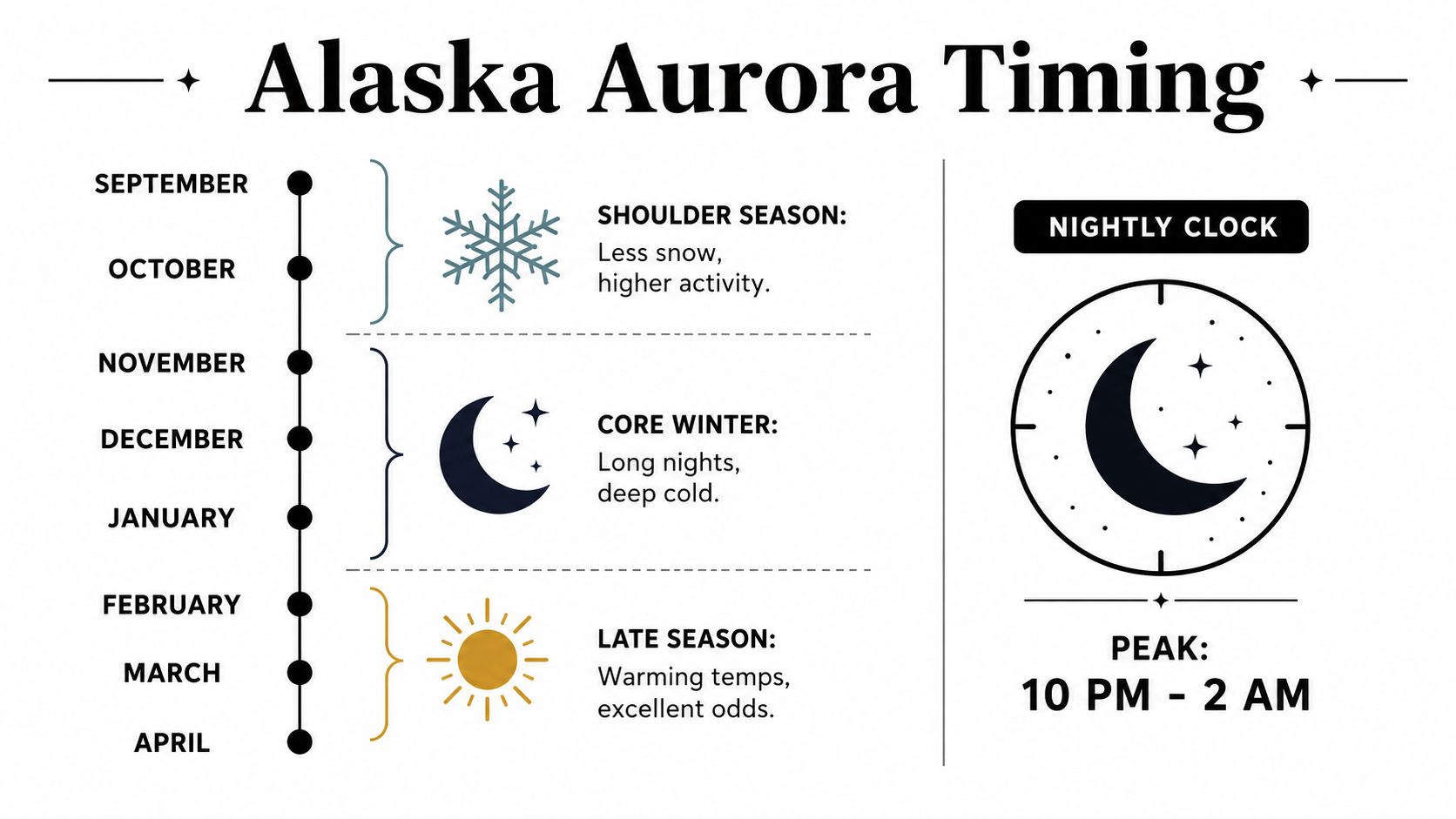
The aurora has a season, and it isn't negotiable. In Alaska, the viewing window starts when darkness returns in late summer and stretches into spring, but the sweet spots are shoulder seasons, not the deepest part of winter. Independent Alaska travel guidance and aurora specialists keep pointing to September and March as especially strong periods, and that lines up with the classic equinox pattern (Face The Outdoors on the best time to see aurora borealis).
Season first, clock second
If you only remember one thing, remember this. Equinox periods are statistically stronger than solstices, and the Geophysical Institute notes that the likelihood is about twice as high at the equinoxes as at the solstices (Geophysical Institute aurora forecast). That doesn't mean every March night is better than every December night, it means the sky is more favorable around the equinoxes than at the extremes of the year.
For practical planning, I'd rank the months this way. September is a smart shoulder-season target, February and March are excellent for deep winter trips with more usable darkness, and late autumn to early spring gives you the broadest playing field. The exact month matters less than whether you've booked enough nights to wait out clouds.
Nightly timing is where most people get sloppy
The strongest displays usually cluster around magnetic midnight, and the best viewing hours are typically 9 p.m. to 3 a.m.. Travel Alaska's aurora tips narrow that common-chase window to 10:00 p.m. to 2:00 a.m., which is the block I'd protect on any itinerary (Travel Alaska viewing tips). The overlap is the useful part, not the exact minute on the clock.
If you can only pick one week, choose the two weeks on either side of the fall or spring equinox, then add a buffer night for weather.
A clean decision rule helps. If you want milder temperatures and good odds, pick September. If you want colder air but excellent darkness, pick February. If you want the sharpest overall compromise, March is usually the strongest single-month bet. Don't confuse “best month” with “best night”, the aurora still shows up when solar conditions, darkness, and clear skies line up.
Where to Go From Fairbanks to the Arctic
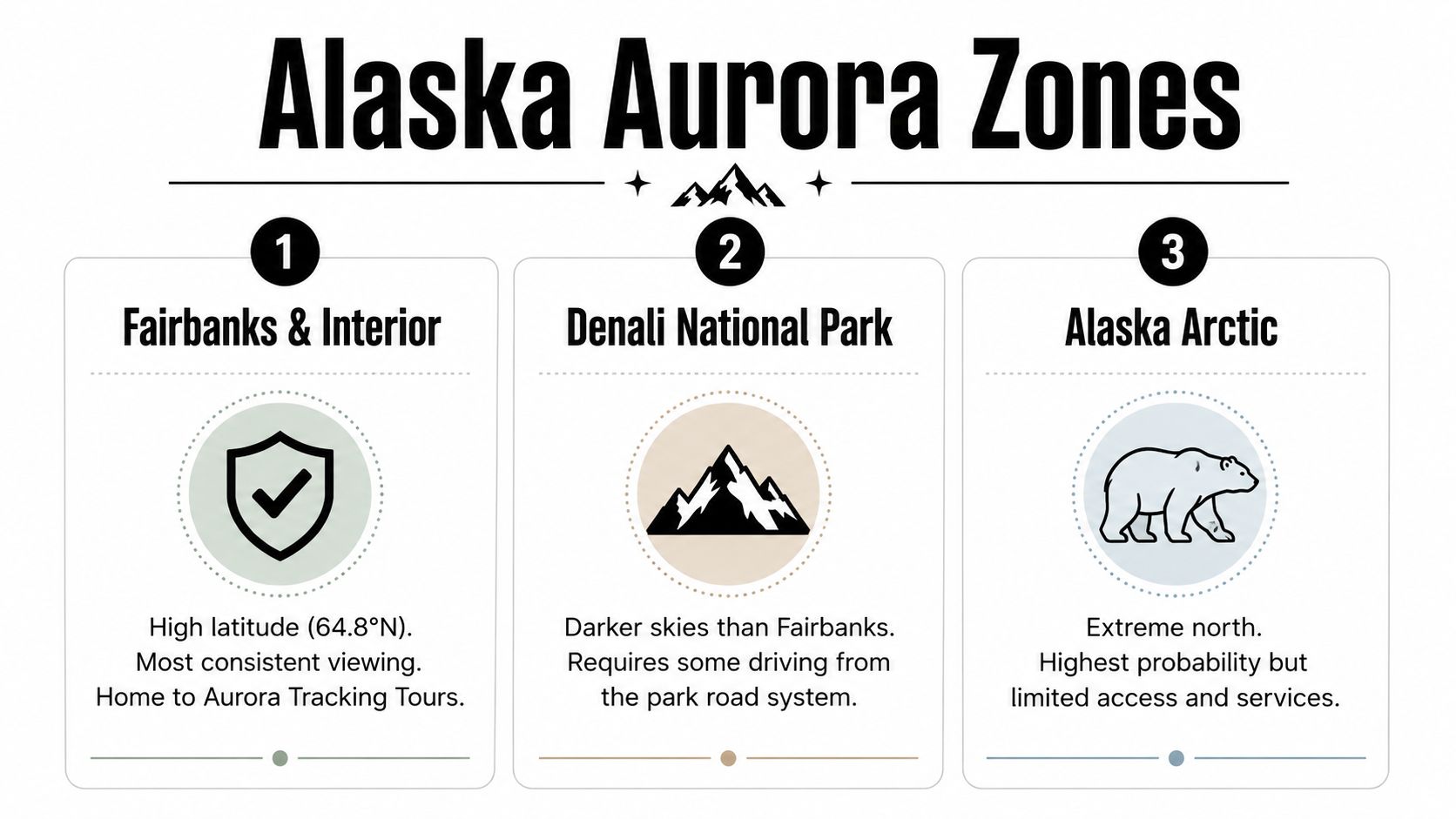
Fairbanks is the practical base for aurora chasing, and that matters more than the postcard version of Alaska. It sits under the auroral oval, has enough roads and lodging to make late-night chasing realistic, and gives you a real shot without forcing a hard expedition. The better question is not whether Fairbanks is glamorous. It is whether it gives you enough clear-sky time to justify the trip. It does.
Fairbanks is the reliability play
If this is your first aurora trip, start with Fairbanks and the Interior. The city sits in the right latitude band, and the easy runs out to Cleary Summit, Murphy Dome, and Chena Hot Springs let you escape town glow without turning the night into a survival exercise. That combination, roads, services, and a believable chance at clear sky, is why Fairbanks stays at the top of so many serious itineraries (Aurora Admin on Alaska locations).
I'd send families and first-timers here without hesitation. Fairbanks does not guarantee a show, and anyone selling that is overselling it. It does let you sleep in a bed, drive a short distance, and still be in position when the sky opens. That is the kind of trade-off that matters on a cold winter night.
The Arctic is the serious-chaser option
Go north if sky quality matters more than convenience. The Alaska Arctic gives you darker horizons, more isolation, and a stronger sense of scale, but it also asks for patience and a tolerance for thin services. The farther north you go, the better the viewing potential can get, and the less forgiving the trip becomes when weather turns.
The right way to approach this zone is to treat it as a commitment, not a quick add-on. Build in extra nights, keep your schedule flexible, and stay awake when conditions finally break. If you are planning around photography, long darkness, and a higher-stakes chase, the Arctic corridor makes sense. If your dates are tight, it can punish you fast.
Southcentral is the accessibility compromise
Anchorage, Girdwood, and Talkeetna can work, but they are the fallback, not the first choice. They are easier to reach, which is useful, but they are much less reliable unless a strong geomagnetic storm pushes the aurora south. That is the fundamental trade-off, convenience versus odds, and you should be honest about which one you are paying for.
If your trip is built around comfort, Southcentral can be fine. If your trip is built around probability, you will do better farther north. That is why I tell travelers to match the location to the goal instead of trying to make every stop do the same job. If you are bringing older gear and want to stay prepared for cold nights, a look at Alaska electronics recycling options is worth doing before you leave home.
Reading the Aurora Forecast Like a Planner
The aurora forecast stack has an order, and most travelers read it backwards. Start with the University of Alaska Fairbanks Geophysical Institute aurora forecast, because it's built for Alaska and gives you a color-coded probability map. Then check the NOAA KP index, not as a magic score, but as a rough guide to how far south a display might reach.
Read the forecast in the right order
A KP 3 can be enough for Fairbanks under the right sky, while KP 5 starts widening the possible viewing area and KP 7 is the kind of stronger storm people get excited about from farther south. But the number alone doesn't tell you if you'll see anything from your driveway. A bright aurora hidden by cloud is still invisible.
After the KP index, look at the short-term space-weather pieces, especially solar wind speed and Bz orientation. Those inputs help you judge whether the magnetosphere is getting a favorable push, but they're secondary to the Alaska-specific question, which is whether the sky is open above your head.
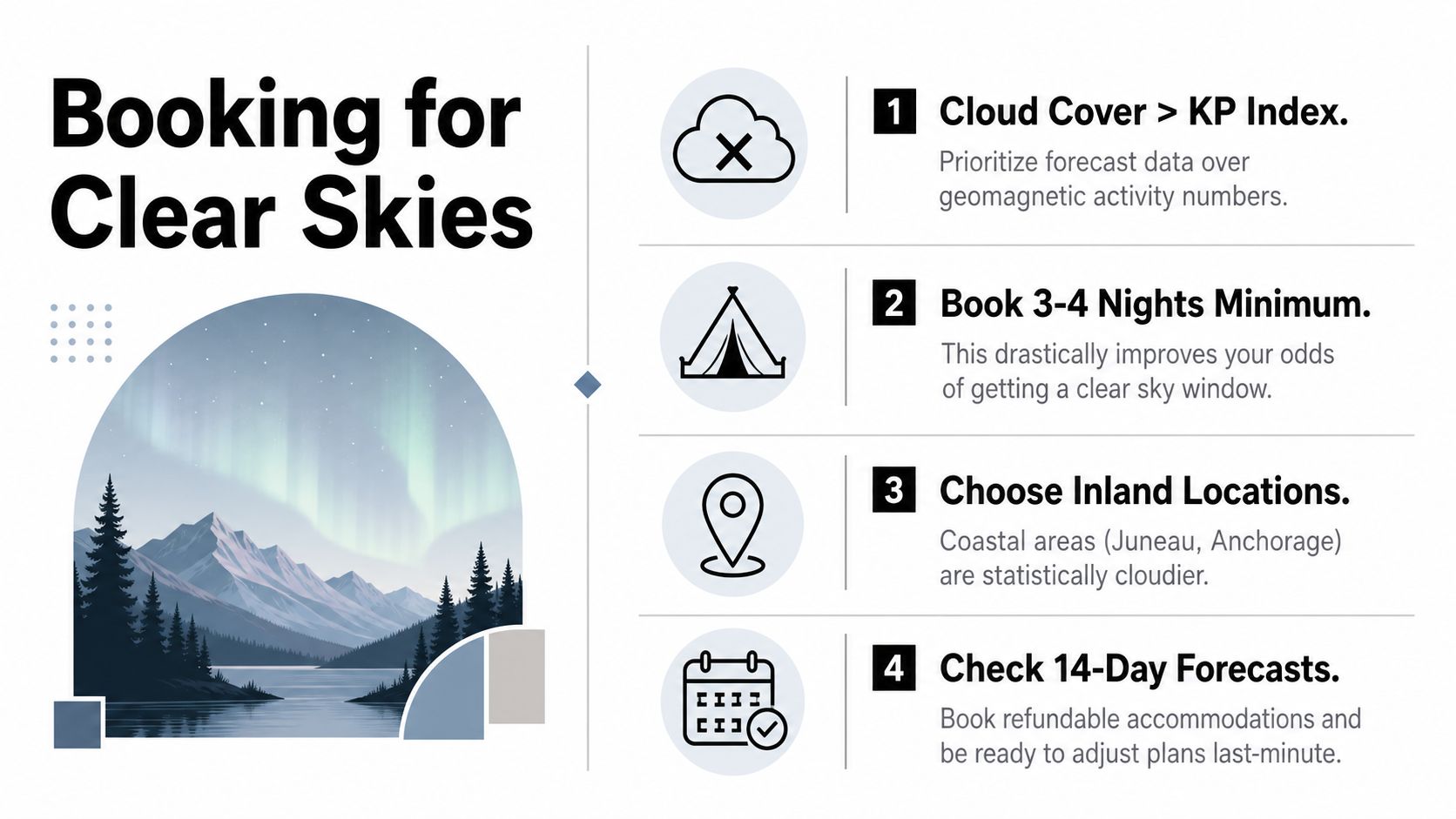
Clear skies beat a better KP number. A KP 2 with clean overhead visibility is more useful than a KP 6 under overcast.
Then go straight to cloud cover. That's where most trips succeed or fail. I'd check the NOAA GOES satellite layer, a weather app like Windy, and local weather cameras at the exact place you plan to stand before leaving the hotel. If you're in Fairbanks, a quick forecast stack can save a whole night of frustration.
The clean checklist is simple. Open the Geophysical Institute forecast, open your KP source, and open cloud cover. If those three agree, you go. If they don't, trust the clouds first. The sky doesn't care how good the aurora is if you can't see it.
Planning Around Weather Risk and Choosing How Many Nights to Book
Aurora trips are a probability problem, plain and simple. The sky can look promising all day and still shut you out by midnight, so your real job is to buy enough nights to catch one clear opening and not gamble the whole trip on a single forecast.
Nights on the ground change the odds
Plan 3 to 5 dedicated nights if you want a real shot at seeing the lights, because that gives you multiple chances to catch a clear break in the clouds (Expeditions Alaska northern lights guide). That advice holds up in the Fairbanks area, where a longer stay lets you work with the weather instead of pretending it will cooperate on cue.
A one-night aurora run is a bad bet. If the cloud deck drops in late, or if the sky clears only after you've already called it, the trip is over before it starts. More nights on the ground give you room to miss once and still recover.
Inland beats coastal when skies matter
Interior Alaska gives you a better aurora setup than the coast or southcentral because the sky is often the limiting factor, not the display itself. The Alaska-specific advice from the Geophysical Institute aurora forecast and other local guidance points in the same direction, darker inland locations with fewer cloud interruptions are the places that keep paying off. You need two things to line up, solar activity and open sky, and the second one usually decides the night.
Go where the clearer sky is. If one side of the state looks socked in, head north or east toward the better opening instead of assuming Anchorage-area convenience will save the trip. Southcentral is easier to reach, but easy access does nothing for you under a low cloud ceiling.
Keep your trip flexible enough to react. If the forecast keeps shifting, use the downtime to handle logistics, and if you are replacing old batteries, cables, or other worn electronics after the trip, use an Alaska electronics recycling option for old gear instead of stuffing dead equipment back into the closet.
If you are heading out with a headlamp, read up on how many lumens for tramping before you buy one, because you want enough light to move safely without blasting everyone's night vision.
Photography and Gear for Cold-Weather Aurora Shoots
Aurora photography rewards preparation, not luck. The setup that works in Alaska is boring on purpose, a camera with manual control, a sturdy tripod, spare batteries, and a way to keep your hands and lens from freezing into a mess. That's the kit. Everything else is optional.
The camera settings that actually matter
Start with manual mode. Use a wide aperture, then set a shutter speed between 5 and 15 seconds and an ISO between 800 and 3200. Those ranges give you room to adapt to a brighter or fainter display without wandering around in menu land when the sky is already active.
A wide-angle lens is the right call because the aurora moves across a huge piece of sky. If you only zoom tight on the glow, you lose the Alaska frame. Add a foreground like spruce trees, a cabin, a ridge, or a mountain so the photo reads as a real place instead of just green light.
Cold kills batteries and sloppy habits
Keep spare batteries in your jacket so they stay warm, and carry a microfiber cloth for condensation. The cold really does chew through power fast, and the camera's performance will drop if you treat the battery like it's summer. A sturdy tripod matters too, because even a slight shake blurs long exposures.
If you're heading out with a headlamp, read up on how many lumens for tramping before you buy one, because you want enough light to move safely without blasting everyone's night vision (Blade Master on headlamp lumens for tramping). A red mode is the key feature. Use it.
Bring the gear that keeps the night calm. Two batteries, two cards, tripod, headlamp with red light, hand warmers, and a lens cloth should live in your bag.
Reworx Recycling Alaska ITAD services
Sample Itineraries for a Five-Night Fairbanks Trip and a Seven-Night Arctic Extension
A good aurora trip has a rhythm. Dinner early, nap before dark, chase late, sleep when the sky goes quiet. If you try to stay on your home clock, you'll fight the trip the whole time.
Five nights in Fairbanks
Use the first night to arrive, settle in, and check gear. Night two is your first chase night, and Murphy Dome or Cleary Summit are the obvious targets because they keep you close to the auroral action without a brutal drive. Night three is your buffer, maybe Chena Hot Springs if the sky is poor or your legs need a break.
Night four and night five are the prime chase nights. Keep the rhythm simple, dinner at 6 p.m., nap from 7 to 9 p.m., chase from 10 p.m. to 2 a.m., breakfast at 3 a.m., sleep until noon. That sounds extreme until you've done it once. Then it feels normal.
Seven nights with an Arctic extension
If you want the deeper chase, add two nights at Coldfoot or Wiseman, with a possible Dalton Highway drive if the weather and road conditions make sense. A night in the Brooks Range gives serious chasers a different kind of silence and a better shot at feeling far from everything.
The longer plan demands better packing discipline. Layered boots, mittens instead of gloves, and a backup phone battery are not nice-to-haves up there. They're the difference between staying outside long enough to wait out the next pulse and calling it early.
Reworx Recycling Juneau AK free computer laptop recycling
If you're replacing old electronics before an Alaska trip, or you're planning an office cleanout while your team upgrades gear, schedule a pickup with Reworx Recycling and handle the hardware the responsible way.