Your refresh is finished, but the old laptops are still stacked in a locked office. Finance wants a recovery estimate, IT wants proof that the data is gone, and facilities wants the room back. Selling the equipment sounds straightforward until a buyer's attractive quote arrives with inspection conditions, transport charges, and unanswered questions about failed drives.
IT equipment buyback works best when you decide what can safely be sold before asking what it's worth. For businesses in Smyrna, Georgia, and organizations managing equipment across multiple locations, the useful comparison isn't just sale versus disposal. It's verified reuse, documented destruction, and the net settlement you'll receive.
What IT Equipment Buyback Means and Why Organizations Use It
An office refresh leaves a familiar decision: store the retired equipment, donate it, or sell it to a hardware recovery vendor. Before comparing offers, confirm which devices work, who owns them, and what information remains on their storage. The highest quote may not be the right channel if a device is not eligible for resale under your data-handling requirements.
IT equipment buyback means a vendor pays for, or provides credit against, retired laptops, desktops, servers, displays, or networking equipment. The buyer values equipment based on its resale potential, condition, and repair needs. Some items qualify for payment; others may be routed to parts recovery or recycling.
Where retired equipment goes
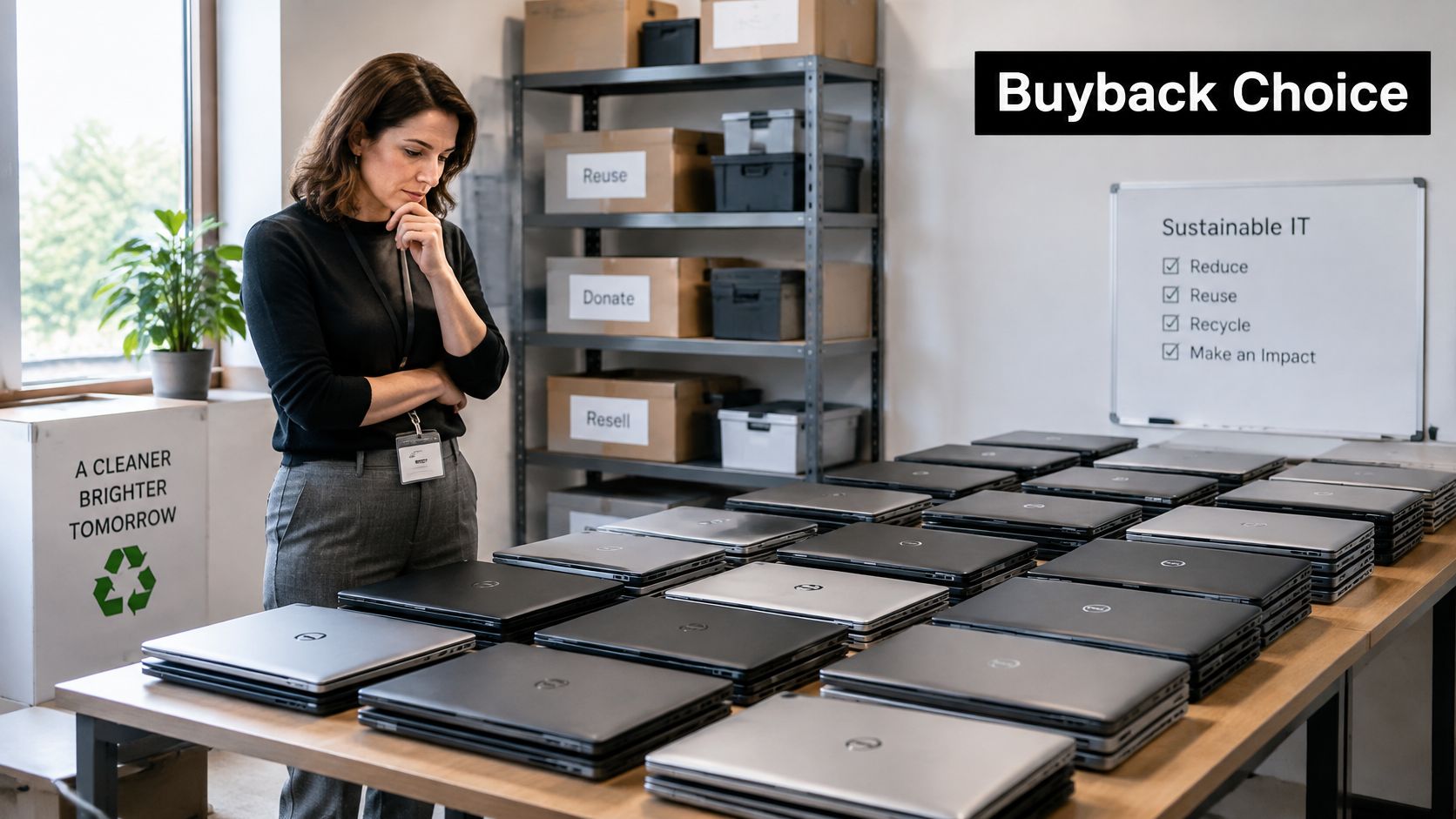
Resale and refurbishment keep complete devices in service. A working business laptop may need cleaning, replacement parts, configuration checks, and approved sanitization before another organization can use it.
Parts harvesting recovers useful components from equipment that is not economical to restore. A damaged chassis does not automatically erase the value of compatible memory, processors, or other serviceable parts.
Electronics recycling handles equipment beyond practical reuse. The agreement should distinguish recyclable material from assets with resale value so the reported outcome matches what happened to each item.
The Global E-waste Monitor 2024 reports that the world generated 62 billion kilograms of e-waste in 2022, with only 22.3% documented as formally collected and recycled in an environmentally sound manner.
Buyback is a retirement strategy, not only a payment.
Why organizations use it
A well-run program can recover residual value, offset handling costs, free storage space, and produce records for sustainability reporting. It also makes accountability clearer as equipment moves from the user's desk to the receiving processor. Compare the expected payment with deductions for condition, repairs, and handling to understand the net settlement, rather than relying on the initial quote alone.
Donation-based recycling offers another route for usable technology, particularly when community access matters more than cash recovery. SMBs, enterprise IT teams, schools, and public agencies can compare donation, resale, parts recovery, and recycling according to the equipment's condition and intended outcome. Not every retired device belongs in a resale lot.
Data Security and Sanitization Before Resale
A buyback isn't automatically the safest outcome for data-bearing equipment. A working laptop can still be unsuitable for resale if its storage can't be reliably sanitized. Conversely, destroying an entire computer may waste reusable hardware when only its storage requires destruction.
Start by assigning low, moderate, or high confidentiality under your organization's policy. Then map each classification to approved methods for the actual storage technology and intended destination. Don't let the buyer's valuation determine the security decision.
NIST sanitization controls and buyback eligibility
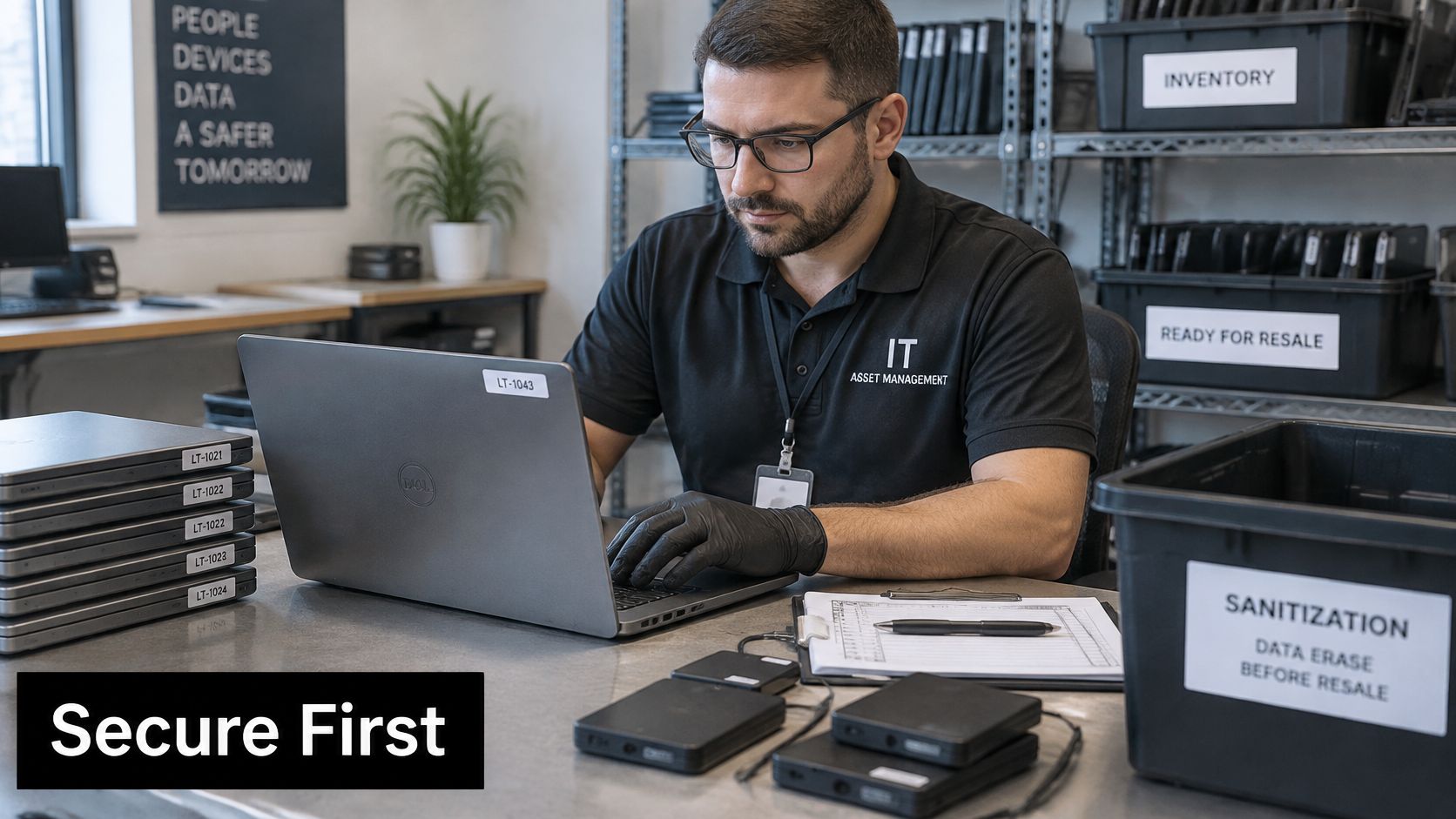
The NIST media-sanitization guidance distinguishes clear, purge, and destroy by the protection they provide and whether the medium remains usable.
| Control | What It Does | Best Fit | Buyback Eligibility |
|---|---|---|---|
| Clear | Rewrites user-addressable storage or uses a supported factory reset | Low-sensitivity devices reused internally, where policy permits | Eligible only where policy allows low-risk resale |
| Purge | Applies logical or physical methods that make recovery infeasible using laboratory techniques | Moderate- and high-confidentiality devices approved for resale under organizational policy | Eligible after a verified purge that preserves functionality |
| Destroy | Renders storage unusable through an appropriate destruction process; degaussing requires media-specific assessment | Failed or unverifiable drives, highly sensitive media, and solid-state drives requiring destruction | Destroyed media isn't eligible for resale; remaining equipment may retain value |
As a rough analogy, clearing is tidying a room, purging is a deeper treatment, and destruction is demolition. The analogy helps distinguish objectives, but the approved technical method matters more than the label.
A factory reset isn't automatically adequate sanitization. Confirm that the procedure applies to the device, reaches the relevant storage, and produces a result you can verify.
Handle exceptions before release
NIST's sanitization FAQ cautions that shredding or pulverizing can be inadequate for medium- and high-security categories because modern media stores data at high density. Destruction must suit both the technology and the security requirement. Degaussing magnetic media isn't a substitute for an appropriate solid-state destruction method.
For failed drives, uncertain encryption histories, or unsuccessful verification, I recommend a destruction-only default until the security owner approves an alternative. Apply the same conservative hold to sensitive government or health records when the required sanitization outcome can't be demonstrated. Those records don't automatically require destruction in every circumstance, but resale must never proceed on an assumption.
Use a written procedure for securing data during equipment buybacks that identifies approval authority and exception handling. Retain the device and media serial numbers, method used, verification result, and certificate of sanitization. A generic receipt saying equipment was processed doesn't establish which drive passed which procedure.
How the Buyback Process Works From Inventory to Payment
A controlled IT asset disposition (ITAD) program starts before collection day. Assign one internal owner to maintain the manifest and approve changes, rather than letting facilities, finance, and IT work from different spreadsheets.
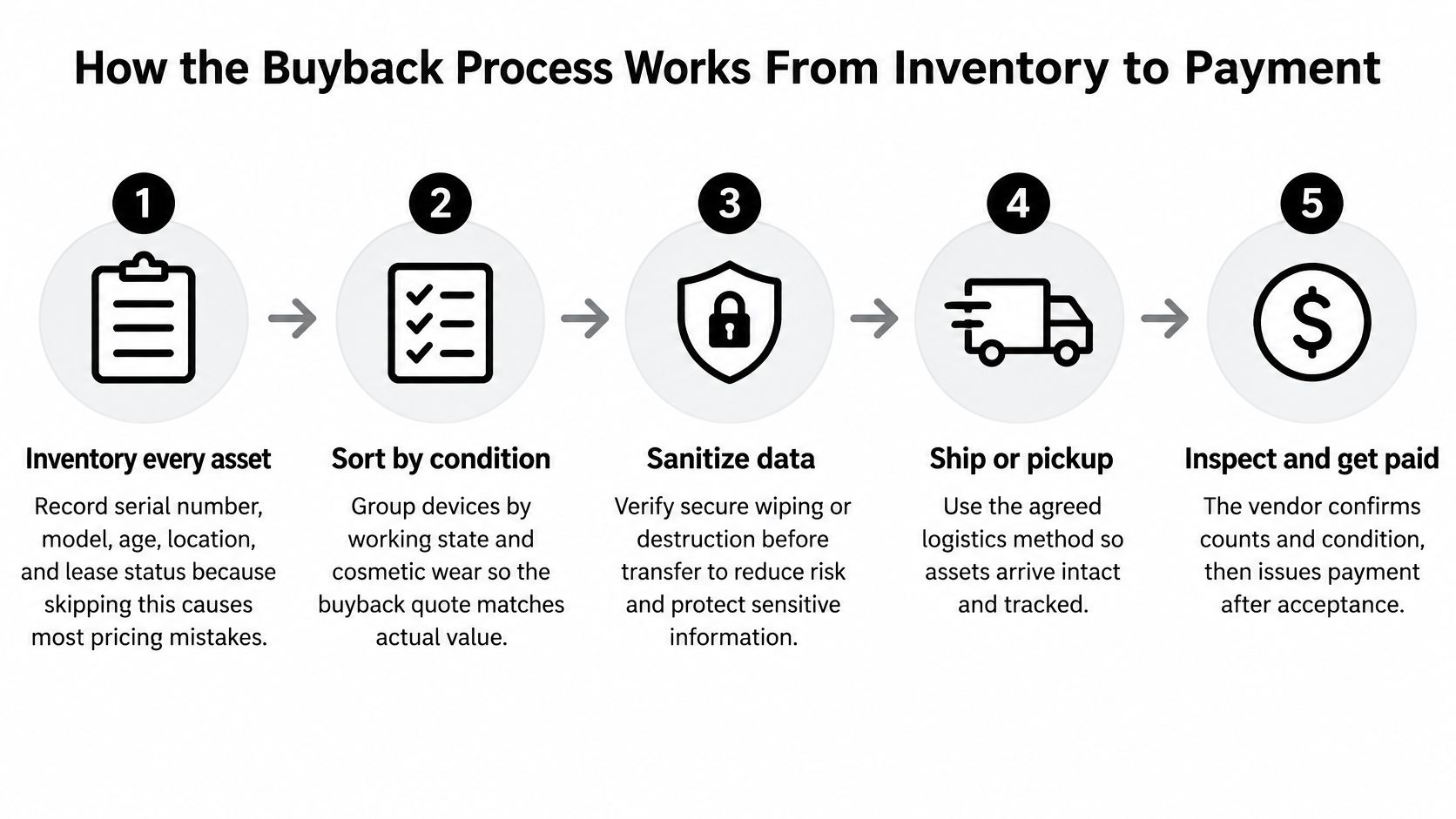
The overview below compresses the workflow. Your written procedure should preserve the separate receiving, testing, security, and settlement checkpoints.
The operating sequence
Inventory every asset. Record serial number, model, age where known, location, configuration, and lease status in your asset-management system or a controlled spreadsheet. Missing identifiers make it difficult to challenge a later rejection or reconcile an ownership dispute.
Classify condition and data risk separately. Mark equipment as reusable, parts-only, or recycle-only, then add its security classification. A common mistake is treating data-bearing and reusable as mutually exclusive categories.
Request manifest-based quotes. Give each bidder the same asset list, condition assumptions, and required services. A lump-sum estimate without an attached inventory leaves too much room for incompatible interpretations.
Arrange pickup and document custody. Agree on packaging, collection access, transport responsibility, and the handoff signature. Don't let equipment leave because a driver has arrived if the approved manifest isn't ready.
Reconcile receiving counts. Require the processor to compare arrivals with the shipping manifest and photograph pallets and visible damage. Resolve shortages before grading obscures whether the problem occurred during packing, transit, or receiving.
Test and grade the units. Specify checks for power, battery condition, storage, screen, and ports. Silent changes to grading criteria are a common source of unexpected deductions.
Execute the approved security treatment. Sanitize and verify according to the assigned class, retaining a device-linked certificate. If policy requires onsite sanitization before transport, move this checkpoint ahead of collection rather than following a rigid sequence.
Approve an itemized settlement. Reconcile accepted units, deductions, rejected equipment, and the payment date against the contract. Don't close the project while unresolved assets remain in a processor's exception queue.
Typical buyback timelines by program size
These are illustrative planning estimates, not measured industry averages or vendor guarantees. Confirm every interval in the quote, including when the payment clock starts and whether phases overlap.
| Program Size | Quote to Pickup | Testing and Sanitization | Settlement and Payment |
|---|---|---|---|
| Under 25 devices | 2–5 business days | 1–3 business days | 1–2 weeks |
| 25 to 200 devices | 1–2 weeks | 3–7 business days | 2–3 weeks |
| 200+ devices or server racks | 2–4 weeks | 2–4 weeks | 3–6 weeks |
Large server programs and lease-bound inventories can take longer because ownership checks, site access, and configuration verification must precede release. For data center decommissioning, coordinate rack removal with application shutdown approvals, not just a truck booking.
Agree on reverse logistics services before an office cleanout or facility cleanout begins. A clean handoff produces matching counts, signed forms, and a dated manifest, with a named person responsible for every exception.
How Buyback Offers Are Valued and Compared
| Device Category | Main Value Drivers | Common Reductions | Typical Outcome |
|---|---|---|---|
| Laptops, 3–4 years old | Processor generation, battery health, screen condition | Failed batteries, cracked screens, missing chargers | Resale or parts if configuration is current |
| Desktops and workstations | CPU and RAM configuration, storage type, graphics | Outdated processors, missing drives | Mostly resale in marketable bulk lots |
| Servers and storage arrays | Model, memory, drive count, warranty status | Failed drives, proprietary firmware locks | Parts or resale, often with higher handling costs |
| Monitors and displays | Size, resolution, panel condition | Dead pixels, damaged bezels | Resale in suitable volumes; recycling for unsuitable units |
| Networking gear | Model age, port count, firmware support | Unsupported firmware, missing power supplies | Resale if supported; recycling if not |
These are qualitative buying considerations, not guaranteed outcomes or age-based price bands. A laptop's age alone doesn't establish its marketability, and a supported network switch can be more attractive than a newer but locked appliance.
Configuration and current demand set the commercial starting point. Mixed lots need additional sorting, while lease restrictions can prevent sale entirely. Collection, testing, sanitization, and reporting determine how much of the starting value reaches your finance team.
The practical distinction is net recovery after reverse logistics and compliance, rather than the headline offer, a useful consideration when reviewing corporate IT equipment disposal options.
Test the quote against a rejection scenario
Consider a hypothetical 100-laptop lot. One buyer quotes a high unit value but rejects 15 units for failed batteries, charges testing against every received laptop, and deducts freight. Another buyer quotes less per accepted laptop but includes testing and collection.
The lower headline offer may produce the better settlement. That doesn't mean a battery failure should always trigger rejection: ask whether the contract permits a repair deduction instead, and who retains ownership of rejected equipment.
Commercial rule: A quote isn't comparable until its acceptance criteria and deductions are comparable.
Use this calculation without double-counting charges already included in the unit price:
Net settlement = gross unit value − rejected-unit losses − testing fees − freight − sanitization charges, plus any separately agreed parts recovery credits.
Build a quote comparison sheet
Leave the fields blank until each vendor supplies its rates and assumptions.
| Settlement Field | Quote A | Quote B |
|---|---|---|
| Gross value by asset or model | _____ | _____ |
| Rejected-unit losses and reasons | _____ | _____ |
| Testing fees and chargeable quantity | _____ | _____ |
| Freight and packaging | _____ | _____ |
| Sanitization and destruction charges | _____ | _____ |
| Recycling-only charges | _____ | _____ |
| Recovered-parts credits | _____ | _____ |
| Net settlement and payment trigger | _____ | _____ |
Require serial-level support for adjustments and a dispute window before final acceptance. A sensible cost recovery strategy also tracks reuse percentage, materials recycled, verification coverage for data-bearing assets, and time to payment. Keep reuse and recycling separate so a combined diversion total doesn't conceal destruction of otherwise usable equipment.
Documentation and Regulatory Requirements to Track
A resale invoice or donation receipt doesn't remove waste-management obligations. The legal status of the equipment and its destination matter more than the transaction's label. That distinction becomes especially important when a processor proposes overseas refurbishment or recovery.
The Basel Convention e-waste amendments FAQ explains that covered movements require notification by the exporting state to importing and transit states, followed by written consent before shipment begins. It also describes the general prohibition on movements between parties and non-parties unless an applicable agreement permits them. Don't interpret this as an identical consent requirement for ordinary domestic interstate shipments.
Keep a connected audit packet
Your paperwork should let an auditor follow an asset without reconstructing the transaction from emails.
- Asset register: Preserve serial numbers, locations, ownership status, and approved destination.
- Pickup manifest: Retain signed handoff records and receiving reconciliations.
- Security evidence: Attach the serial-number log and sanitization certificates to the corresponding asset records.
- Disposition report: Identify the receiving processor and whether equipment was reused, dismantled, or recycled.
- Settlement statement: Keep accepted values, deductions, rejected items, and payment records together.
- Downstream documentation: Obtain destination details and shipping or consent records where applicable.
Check the recycler's permits and certifications against the receiving facility and actual work performed. A certificate for one location or activity shouldn't be treated as proof that every downstream operation is covered.
Check the applicable domestic rules
Use EPA electronics recycling guidance as a starting point, then check the relevant state environmental agency's requirements. State rules differ and may impose stricter obligations. For a Smyrna business, that means checking Georgia requirements and any destination-state requirements before authorizing shipment.
A consistent chain-of-custody documentation process supports audits, insurance claims involving missing equipment, and defensible sustainability reporting. Set the retention period with your legal, security, and records-management teams rather than accepting whatever period the processor normally uses.
If an item might be waste, document and assess it as potential waste until its status is resolved. Don't relabel it as reusable merely to simplify shipping.
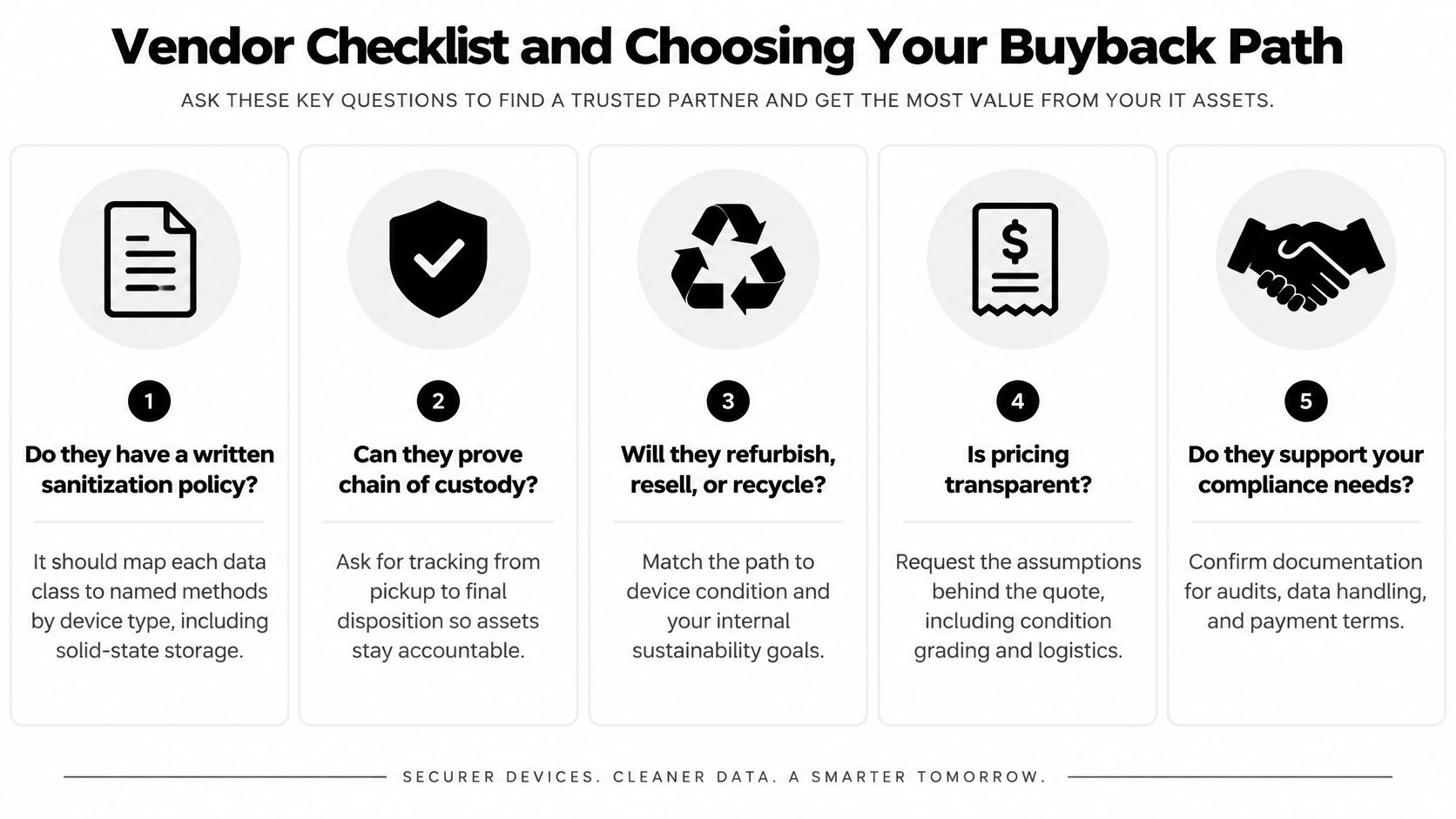
Vendor Checklist and Choosing Your Buyback Path
If a device contains data, classify its risk and decide which sanitization method it can undergo before comparing buyback offers. The highest quote may be the wrong channel for devices that cannot be safely cleared for resale. Compare the net settlement only after a vendor passes your security and legal eligibility checks, accounting for grading, rejected units, fees, and return costs.
For organizations in Smyrna and metro Atlanta, fit the collection plan to the site. An office refresh, a healthcare facility cleanout, and a warehouse retirement can require different access arrangements and acceptance checks, even when each includes standard computers.
Ask for evidence before signing
Score vendor responses as documented, incomplete, or unacceptable. An incomplete security answer needs resolution before approval; a lower price does not compensate for uncertainty.
- Is the sanitization policy written and media-specific? Ask how confidentiality classes map to named methods and device types. If the policy does not specify a method for solid-state storage, pause the review.
- Will each device have linked sanitization evidence? A consolidated report is acceptable only if it identifies the asset, storage medium, and result. Untraceable lot totals do not support reconciliation.
- Can the receiving facility show permits and certifications? Check the current scope, location, and relevant activities. A logo alone is not evidence.
- Is reporting asset-level? Request a sample with serial number, condition, processing outcome, and exception status. Without serialized records, meaningful reconciliation is not possible.
- Are deductions disclosed? Ask how grading, missing accessories, rejected units, storage fees, and return freight affect settlement. A quote without deduction rules is not a firm payment commitment.
- Who carries transport risk? Confirm insurance, subcontractor responsibility, and signed custody records. Establish who handles claims for missing or damaged equipment.
- Are environmental outcomes reported separately? Request distinct reuse and material-recycling results. Investigate vague descriptions of downstream processing.
- Can the vendor provide comparable references? Ask for schools, agencies, or enterprises with similar equipment volumes and reporting needs.
- What starts the payment clock? Record the payment trigger, deadline, and dispute procedure in the agreement.
- What happens if the agreement ends? Require controlled return or approved destruction of unsanitized assets, with evidence. The termination process must not leave data-bearing equipment untracked.
Apply vendor selection criteria consistently to buyback providers and other disposition partners. A community benefit does not replace security controls, and a strong payment offer does not make weak documentation acceptable.
Match the path to the organization
| Organization | Main Priority | Recommended Approach | Main Risk |
|---|---|---|---|
| Small and mid-sized businesses | Fast payment and simple paperwork | Bundled buyback with device-linked certificates | Accepting a lump-sum quote without an asset list |
| Enterprise IT and facilities teams | Lease compliance and audit trails | Asset-level buyback plus destruction for sensitive media | Unrecorded serial numbers and lease-return delays |
| Schools and universities | Data protection and responsible disposition | Buyback for eligible devices, destruction when stored records cannot be safely sanitized | Releasing devices that still hold student data |
| City and state agencies | Public records and procurement rules | Documented buyback under sanitization policy with appropriately certified recyclers | International movements without required consent or domestic shipments without applicable documentation |
For medical or laboratory equipment, confirm acceptance and any required decontamination before collection. A standard computer recycling contract may not cover specialized instruments. Also distinguish product destruction from routine laptop disposal when the aim is to prevent a product from re-entering commerce.
Put the decision into action
- Classify this quarter's retirements by data sensitivity and assign an approval owner.
- Separate buyback-eligible equipment from destruction-only media and unresolved exceptions.
- Request asset-level quotes from at least two vendors and score their evidence against the checklist.
- Put certificate and verification requirements in the contract, including failure handling and report deadlines.
Keep security approval separate from financial approval. Finance can negotiate recovery, but IT or the data owner must clear media for resale.
Reworx Recycling offers equipment buyback, business pickups, and secure hard drive shredding with data destruction. Share an asset list to discuss which equipment may qualify for buyback, then schedule a pickup that fits the site and the agreed disposition requirements. Visit Reworx Recycling to discuss the asset list and pickup arrangements.