A Friday recall notice lands on a hospital, a school district, or a multi-site company, and the instinct is to fold the gear into the next office cleanout. That instinct is how units go missing. The ITU backgrounder on the Global E-waste Monitor 2024 reports that the world generated approximately 62 million tonnes of e-waste in 2022, only 22.3 percent (about 13.8 million tonnes) was documented as formally collected and recycled, and the documented rate is projected to fall toward 20 percent as generation reaches 82 million tonnes by 2030. Countries with e-waste legislation reportedly reach collection rates near 25 percent. Countries without those laws sit near zero. A recycling receipt does not close that gap, and it does not prove the data is gone.
Why Recall Disposal Is Not Ordinary Recycling
Say the notice covers a laptop used on nursing carts, plus a copier in the records room and a handful of phones. Electronics recall disposal services exist to find every affected unit and prove it is gone. An office cleanout, a facility cleanout, or a routine computer recycling pickup does the opposite. It mixes recalled gear with surplus until serials, drives, and batteries can't be tied back to the notice.
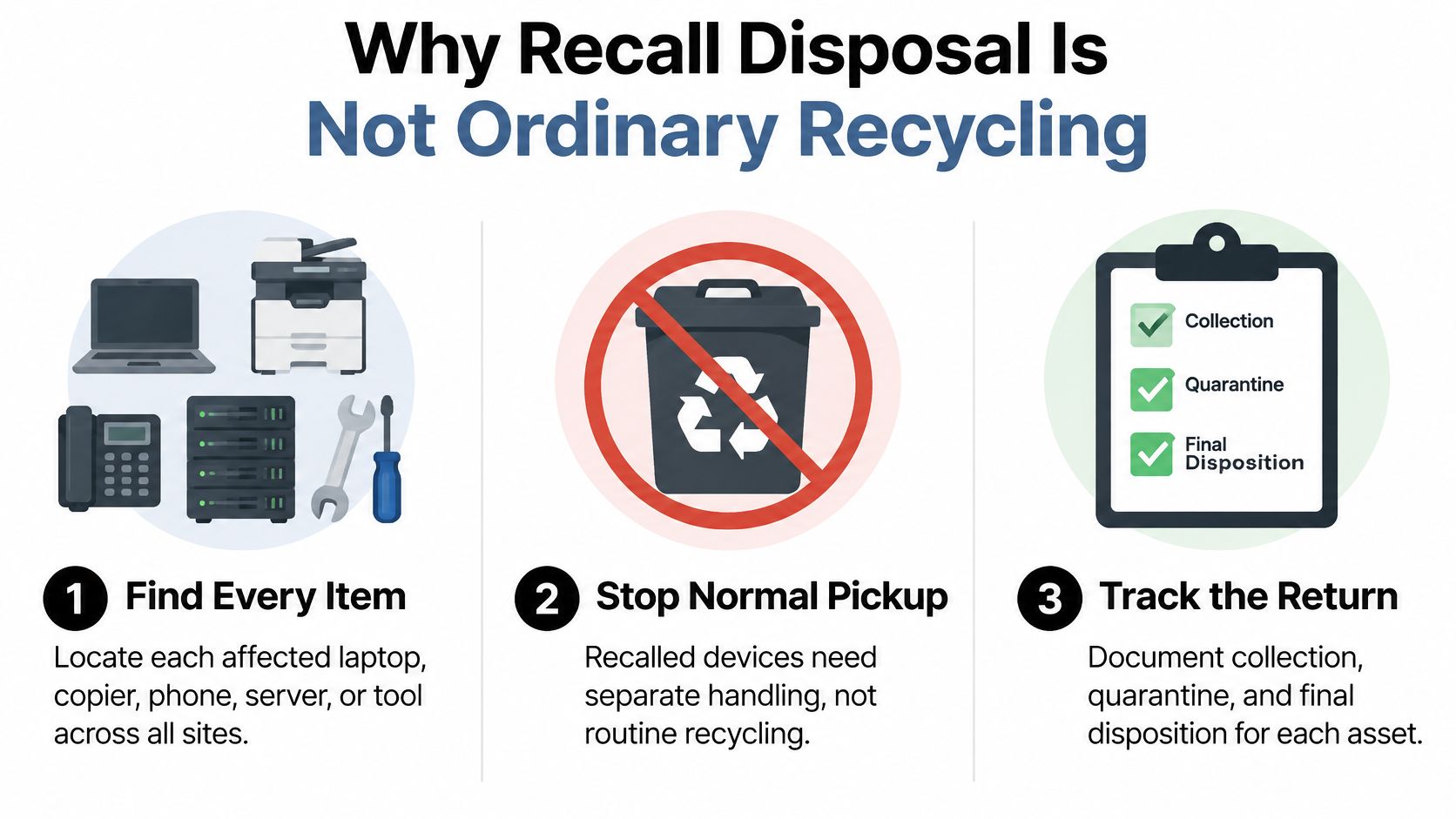
IT, facilities, sustainability, procurement, and legal share one file. IT owns the asset register. Facilities owns the cage and the truck. Sustainability owns the environmental claim. Procurement owns the vendor. Legal owns the notice match. If any of them works from a side email, the recall splits.
Two mistakes sink the job. The first is treating collected as recycled. The second is treating a recycling certificate as proof that confidential data is gone. Student records, patient files, employee data, and customer data can still sit on a drive that was "recycled" in good faith.
The sequence that holds is simple, and it has an order. Freeze and inventory. Quarantine and custody. Battery exceptions. NIST sanitization. Vendor handoff. A closeout file. Skip a step and the later record can't repair it.
A pallet that left the building is not a recall that is closed.
How to Run a Recall from Notice to Reconciliation
Print this run sheet and use it as the cover of the closeout file. The EPA ADEPT model treats reuse, recycling, and disposal as different end paths, and it tracks material from generation through collection, processing, and final disposition. A collected load is not automatically a recycled load.
| Phase | Control | Record to keep |
|---|---|---|
| 1 Detect and freeze | Match the notice to models and serials and stop redeployment or donation | Recall ID and affected model list |
| 2 Inventory | Serialize every device and loose storage medium | Serial, location, data class |
| 3 Quarantine | Seal tamper-evident containers and log each handoff | Custody log with names and times |
| 4 Separate hazards | Pull batteries, displays, networking gear, and damaged units | Exception and hazard log |
| 5 Sanitize | Apply Clear, Purge, or Destroy to the actual media | Operator, method, tool, date, outcome |
| 6 Reconcile | Match received quantity to the manifest before processing | 100 percent asset-to-record match |
| 7 Close | File data proof and recycling proof as separate controls | Closeout package |
Seven moves and the slip that breaks each one
- Freeze movement the day the notice arrives. Match model and serial ranges to the asset register. Stop redeployment, donation, and employee take-home. The slip is a well-meant "take it home until IT gets to it." That laptop is now outside the manifest.
- Build a recall manifest. Barcode or otherwise serialize every device, plus loose drives, phones, and batteries. A parent asset without its loose media looks complete and isn't.
- Classify confidentiality before anyone opens a chassis. Data class picks the sanitization method later. Opening first, then guessing, leaves you with a drive and no rule.
- Pack sealed, tamper-evident containers. Separate batteries, displays, networking gear, and data-bearing devices. Log every custody transfer with names and times. Unsigned handoffs are how a sealed tote becomes a mixed gaylord.
- Quarantine exceptions. Missing serials, swollen packs, and damaged units stay off the main pallet. Forcing them onto the standard load hides the only items that need a specialist.
- Sanitize only after identification. Use the method chosen for that medium. Shredding before the serial is tied to the drive breaks the data record even if the shred itself worked.
- Reconcile received counts to the manifest before final processing. Hold the line at 100 percent asset-to-record reconciliation, 100 percent documented custody transfers, aged exceptions, a split of reuse versus material recovery, and verified sanitization on every data-bearing unit. Where destruction blocks item-by-item testing, use representative sampling by someone who didn't run the original sanitization, and verify each time sanitization is applied when you can.
Premature dismantling is the quiet failure. Pull a drive off its parent serial and reconciliation can't be rebuilt from the scrap. Missing manifests, mixed loads, undocumented downstream processors, and unprocessed damaged devices create the same reporting hole. Reverse logistics for recalled electronics is the control layer before any recycling claim.
Practical rule: If the received count doesn't match the manifest, processing waits. Aging the exception is the record. Quietly dropping the serial is the breach.
Handle Recalled Batteries Before Anyone Ships Them
"Send it to recycling" is unsafe advice for a recalled lithium-ion pack. Moving a defective battery through a normal electronics pickup can raise thermal-runaway risk. An EPA battery roundtable notes that manufacturers are typically responsible for managing recalled batteries, while recall protocols can still produce unsafe collection and transportation. The producer may own the program. Your dock still owns the fire.
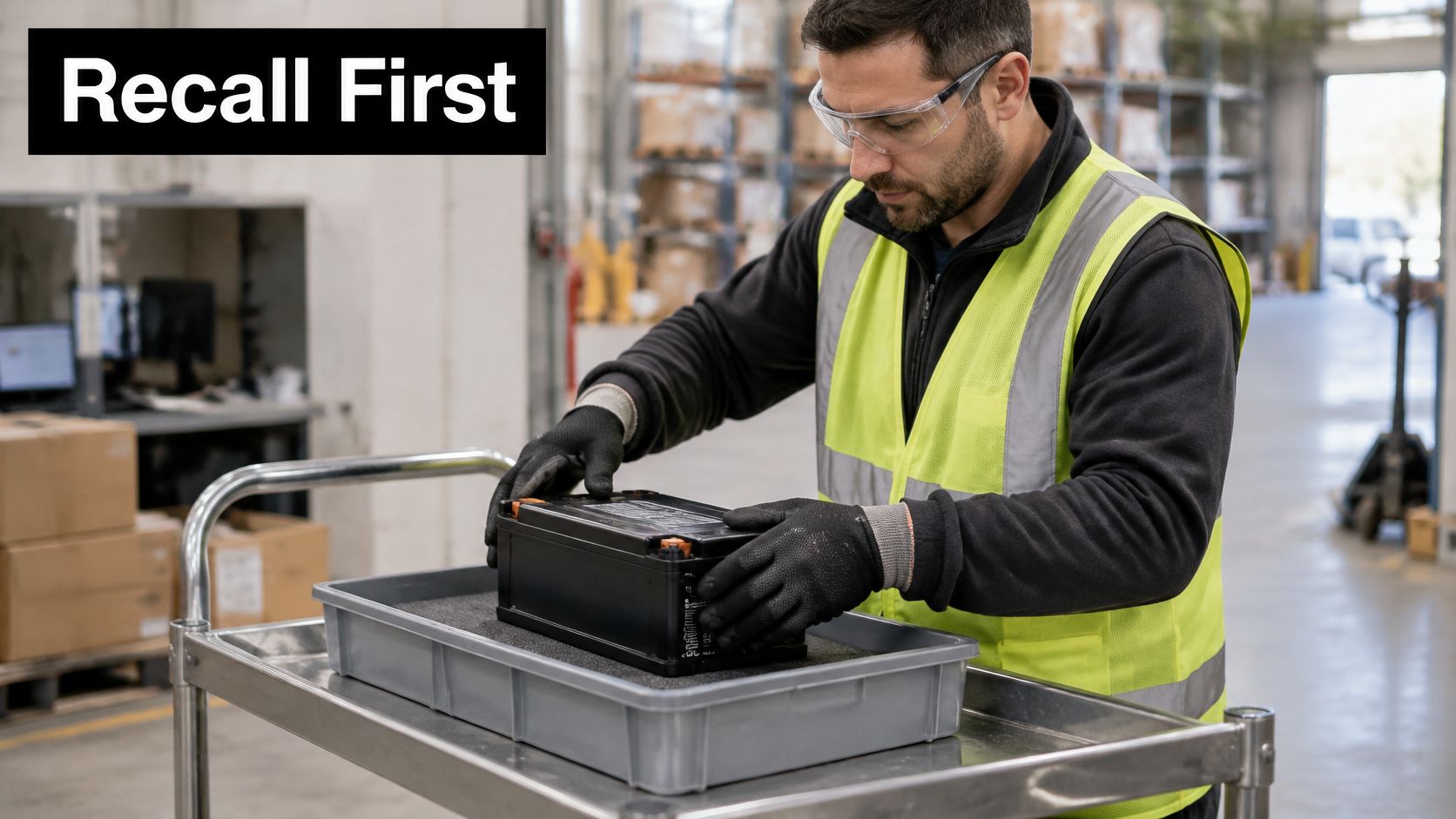
Identify the recalled component, not only the laptop, phone, e-bike, power bank, or tool around it. A pallet of intact computers can hide one swollen pack. Facilities and school staff should make that call on the floor, before the truck is booked.
| Condition | Do this | Do not |
|---|---|---|
| Swollen, hot, venting, or punctured pack | Quarantine, keep people clear, and contact the fire authority or a hazmat specialist | Place it in a standard electronics shipment |
| Recalled battery inside an otherwise intact device | Identify the component and follow the producer protocol | Treat the whole pallet as routine computer recycling |
| Manufacturer-managed battery recall | Contact the producer and document the handoff | Assume the recycler owns the safety duty |
| Routine surplus with no recall and no damage | Hold for certified pickup after data decisions | Mix it with damaged lithium packs |
What the floor does before anyone argues about ITAD
Quarantine swollen, punctured, or recalled packs away from the standard cage, in a non-combustible area. Log who found them and when. Don't tape over damage. Don't nest them with intact surplus laptops waiting on laptop disposal.
Packaging, labeling, and transport for damaged batteries follow the manufacturer instructions, a hazardous-materials specialist, or the fire authority. They don't ride a routine IT asset disposition load. An intact device that only contains a recalled battery still needs the component named and the producer protocol followed before it joins a sealed container.
If staff smell burning, see venting, or the pack is hot, clear the immediate area and call emergency services. Don't carry it to the parking lot. Keep an incident note even when nothing ignites. That note belongs in the closeout file.
Product destruction and secure data destruction still apply to the device. They happen only after the battery hazard is controlled. Lithium battery recycling is a separate path from mixed e-waste, and a vendor who blurs them is the wrong truck.
- Photograph the label. Capture model, lot, and any recall marking before the pack is wrapped.
- Record the recall number. Tie it to the serial of the parent device.
- Separate the pack if the notice says to. Leave it in the device when the notice says not to remove it.
- Refuse a mixed gaylord. Any instruction to toss a recalled or damaged pack into ordinary e-waste is a stop, not a suggestion.
Choose Clear Purge or Destroy for Each Drive
The trade-off is reuse versus certainty. Clear or Purge can put media back into service when the method matches the drive and the data class allows it. Destroy ends reuse. For most recalled units, destroy is the honest endpoint, because you don't want that serial back in a classroom, a clinic, or a donation program.
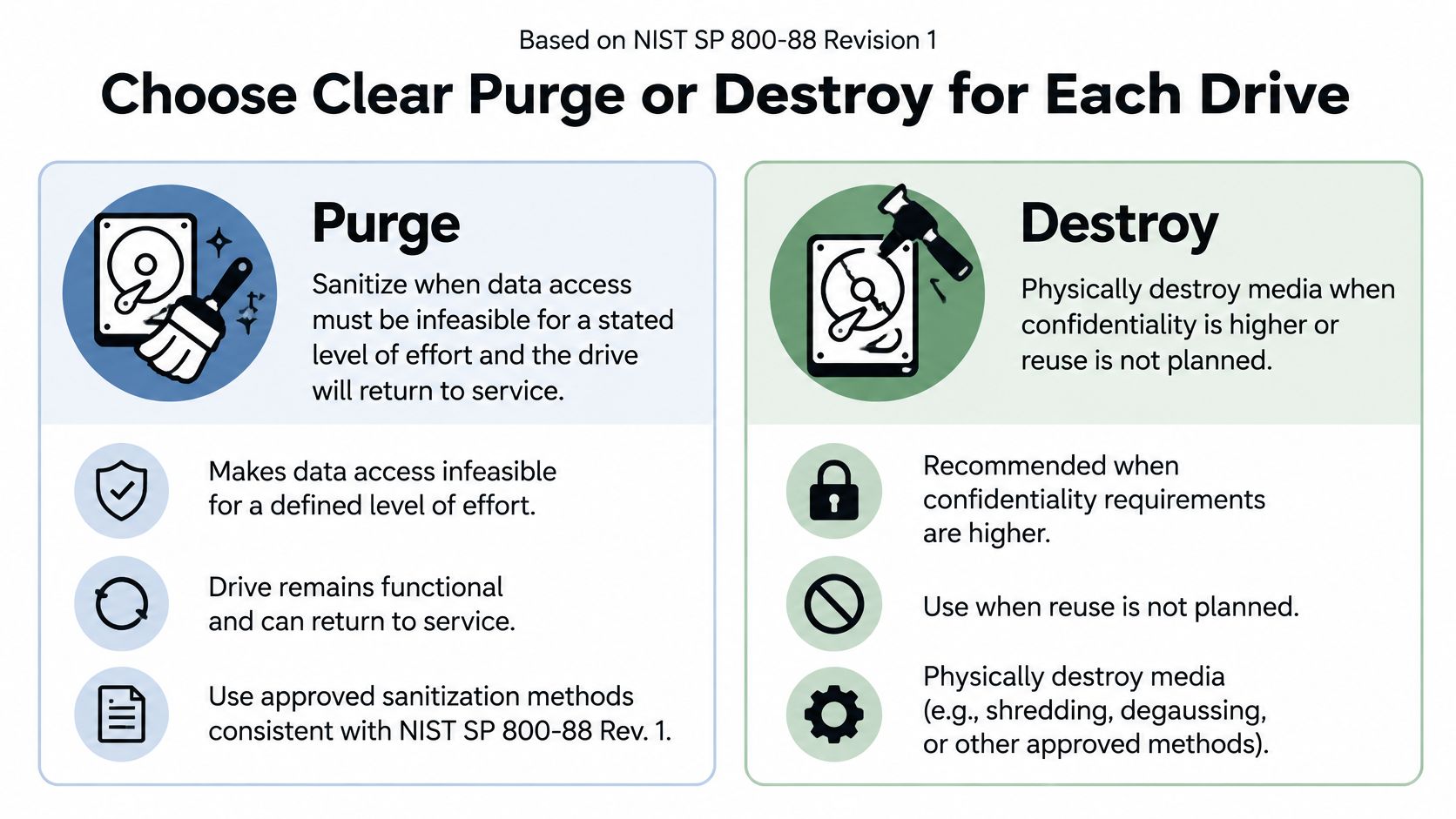
NIST SP 800-88 Revision 1 defines media sanitization as a process that renders access to data infeasible for a given level of effort. Pick Clear, Purge, or Destroy from confidentiality, the medium, and whether the device returns to service. Don't pick whatever shredder is already on the dock.
| Method | Use it when | Media returns | Proof |
|---|---|---|---|
| Clear | Low confidentiality and a real reuse plan | Yes, after a successful clear | Tool log and verification that the overwrite completed |
| Purge | Higher confidentiality on media that may still be reused, including a validated magnetic-drive purge | Only if the purge matches the medium | Tool, date, operator, and a validation decision |
| Destroy | Failed, obsolete, highly sensitive, or recall units that must not return to service | No | Destruction record naming shred, disintegrate, pulverize, melt, or incinerate |
| Do not assume shredding | SSDs, phones, flash, and embedded memory | No, unless the method hits that architecture | Media-specific method note on the certificate |
Why the chassis shredder misses flash
Clear fits low-sensitivity media with a real reuse plan, and only if the tool overwrites addressable space. A factory reset is not that tool.
Purge, including a validated purge on magnetic drives, can support reuse when recovery has to be harder than ordinary deletion. It fails if the tool isn't rated for that medium.
Destroy is the endpoint when the unit is failed, obsolete, highly sensitive, or barred from service, which is the usual recall case. NIST destruction guidance includes disintegration, incineration, pulverizing, shredding, and melting. Afterward the media can't be reused for its original purpose. That is the point.
Solid-state drives, phones, flash, and embedded memory are the exception people skip. Mechanical shredding of a chassis does not automatically reach every memory chip. The method has to match the architecture, and the certificate has to say so.
Verification is not the same as validation
Log the operator, device identifier, method, date, tool, and outcome, and keep a certificate. Verification checks that the operation finished without a technical error. Validation is the decision that the result meets the confidentiality requirement. A certificate that names the wrong method for the data class is a failed control, even with a signature on it.
For higher-risk batches, someone other than the original operator samples the media. NIST's guidance specifies that each consecutive sample location should cover at least 5 percent of its subsection without overlap, with checks spread across addressable and reserved areas. Degaussers and sanitization tools need calibration, test, and maintenance records. Mark every recalled serial as reuse or destroy before the truck is booked. Data sanitization methods only help if that mark is already on the manifest.
Records That Prove Lawful Disposal and Data Destruction
A recycler's receipt is not enough. A 2026 regulatory summary reports that 25 states plus the District of Columbia have enacted e-waste laws, while 23 states plus the District of Columbia maintain express landfill bans, and federal law does not establish one national e-waste standard. A company, university, or hospital in more than one state builds a file that survives the strictest site. "We use a certified recycler" is not that file.
| Record | What it proves | Owner |
|---|---|---|
| Asset inventory and serial numbers | Every affected unit was identified | IT asset management |
| Recall identification | The notice, model, and date match the inventory | Legal or product owner |
| Chain-of-custody log | Custody never broke between sites and the processor | Facilities |
| Sanitization method and data-destruction certificate | The chosen Clear, Purge, or Destroy step was completed | IT security |
| Certificate of recycling or final disposition | Material reached a named downstream outcome | Sustainability |
| Downstream facility details | Processing location is known and not an undocumented handoff | Procurement |
| Battery and hazard exceptions | Damaged or recalled packs were not mixed into the standard load | Facilities and EHS |
Two proofs, two owners
Walk the rows before the truck, not after the audit. IT asset management owns the inventory. Legal or the product owner matches the notice. Facilities owns custody. IT security owns the sanitization method and the certificate of destruction for hard drives. Sustainability owns the recycling or final-disposition certificate. Procurement owns the named downstream facility. Facilities and EHS own the battery exception log.
Environmental proof and data-security proof are separate controls. A device can be recycled responsibly while the organization still lacks evidence that student, patient, employee, or customer data was sanitized. Filing one PDF in place of the other is how both teams think the other one finished.
Documented downstream processing is what makes an environmental claim credible. Local collection without a named processor is only a change of address for the waste. If material might cross a national border, don't promise export on a hunch. Under the Basel Convention e-waste overview, both hazardous and non-hazardous e-waste transboundary movements are subject to the Prior Informed Consent procedure. The e-waste amendments require written notification to the importing country and any transit countries, and written consent before the shipment starts. Confirm domestic processing, or file the notifications. Don't assume only "hazardous" gear needs them.
The closeout file is complete only when every serial is reconciled or sitting on an aged exception.
Pick an ITAD Partner and Recover What You Can
Judge the partner on the controls you already defined, not on a green slogan. Before you sign, require serialized intake at pickup, tamper-evident transport, and a signed custody record at every handoff. Require separate certificates for data destruction and recycling, named downstream processors, and a written refusal to mix damaged lithium packs into ordinary loads. Ask whether the work stays domestic. If the answer is a brochure, keep looking.
Ask who loads the truck, whether containers are sealed before they leave the dock, how the manifest is reconciled on arrival, and how a missing serial gets reported the same day. Those four answers tell you more than a certification logo. Vendor selection criteria should be scored against the recall file, not against scrap price.
Reworx Recycling, based in Smyrna, Georgia, is one option for organizations that need business pickup, customer drop-off, equipment decommissioning, IT asset help, recycling consultation, and secure hard-drive shredding, from a single laptop through bulk loads for offices, schools, and public agencies. Use a partner like that when the recall needs a documented handoff rather than a dumpster.
Cost recovery is narrow. Buyback and corporate donation programs apply only to surplus outside the recall that has already been sanitized. Recalled units are a product-destruction and material-recovery job, not a resale or community-donation job. Moving a recalled device into a digital-inclusion program shifts the safety problem onto someone else. Reusable, non-recalled gear from the same cleanout, after Clear or Purge and a written reuse decision, can support donation and workforce programs. That is where a social-enterprise mission belongs. Price the recall on containment, certificates, and exception handling, not on scrap weight alone.
File the Closeout and Schedule the Handoff
This week, name a single recall owner, freeze the affected models, and start the manifest. Photograph labels on any swollen or recalled batteries and keep those units out of the mixed cage. Mark each serial reuse or destroy before you quote transport. A quote written before that mark prices the wrong job.
Build the closeout file in one shared folder from the evidence package, so IT security, sustainability, and legal work the same records instead of emailing certificates past each other. Then book the physical handoff. Schedule a pickup, ask for secure data destruction on drives that must not return, and donate only equipment outside the recall that is already cleared for reuse. Point any environmental claim at documented downstream processing, not at the fact that a truck left the dock.
Responsible recycling, digital inclusion, and workforce development apply to safe surplus. Recalled goods stay on a controlled destruction path. If any serial is still unaccounted for, or any damaged battery is still in a standard gaylord, the recall is not ready to ship.
Reworx Recycling helps businesses, schools, and public agencies retire recalled and surplus electronics with documented pickup, secure data destruction, and donation-based recycling that keeps unsafe units out of community programs. Safe surplus can support digital inclusion and workforce development once it is cleared for reuse. Visit Reworx Recycling to schedule a pickup or ask how a recall handoff should be scoped before anything leaves your dock.