Disposal accounted for just 23 cases, or 1.1% of recorded remedies in the U.S. Consumer Product Safety Commission recall data, compared with 54.6% for refunds. That gap matters because most recalls don't tell you to destroy anything. If you treat every recalled product as waste, you can break the remedy, lose a refund, and still fail to prove the unsafe item left your building.
Why a Recall Needs More Than a Recycling Bin
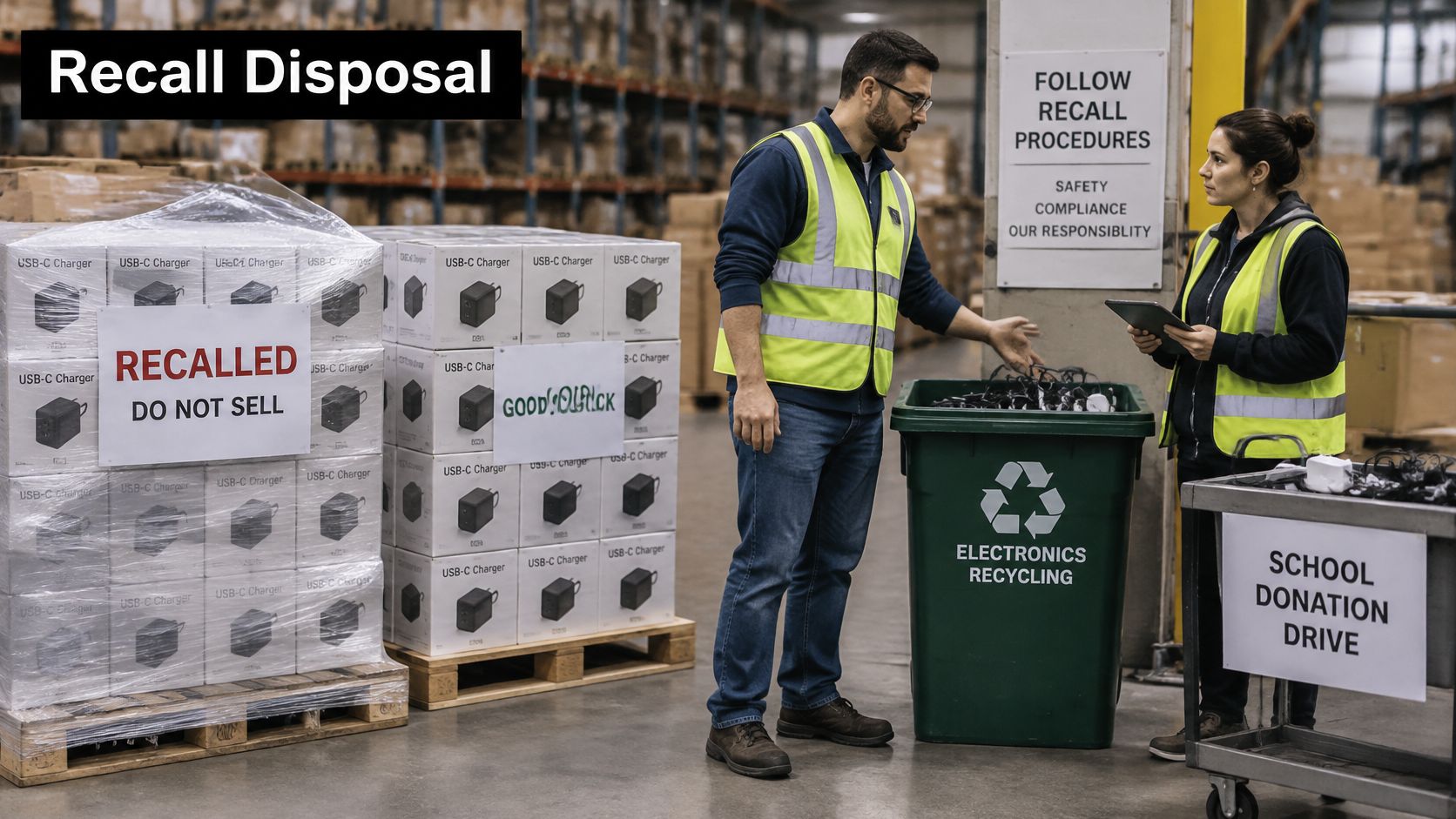
A pallet of recalled USB chargers sits next to good stock in a warehouse. Someone suggests the electronics recycling bin. Someone else mentions a school donation drive. Both ideas sound responsible, and both can put a defective product back into use.
A recycler may weigh the load and issue a receipt. That receipt usually doesn't name each charger, the recall, or the final treatment. A donation is worse for a recalled unit because it transfers the hazard to another user instead of removing it.
Recalled product disposal services identify affected units, isolate them from saleable and donatable goods, move them under custody, and finish with only the remedy the recall owner authorized.
That definition has four working parts. Product identity shows which units match the notice. Physical control keeps them from mixing with good inventory. Authorized method means the recall owner, not the hauler, chooses destruction, recycling, return, or another route. Final proof ties each unit or lot to its outcome.
This guide is for business owners, IT and facilities managers, school operations leads, and government sustainability staff. You'll get a remedy check before any destruction, a collection to certificate sequence, a hazard screen for batteries and chemicals, and criteria for hiring help.
Think of an ordinary recycling receipt as a store receipt. It proves a transaction happened. It doesn't close a case unless it identifies the recalled units and shows they can't re-enter commerce.
When Disposal Is the Remedy and When It Is Not
The recall notice decides whether a unit should be refunded, repaired, replaced, or disposed of. Match its remedy to the affected product before arranging pickup. The table summarizes the CPSC remedy categories and the corresponding action for the holder.
| Remedy | Holder action |
|---|---|
| Refund | Process the refund. Dispose of returned units only if the notice requires it. |
| Repair | Keep the unit separate and send it for the approved repair. Do not destroy it. |
| Replacement | Exchange it for the safe unit. Hold the recalled unit until the notice states what to do with it. |
| Disposal | Throw it out or recycle it using an approved route, and keep proof of the outcome. |
| No remedy available | Follow the notice. Do not create a destruction order that it does not specify. |
| New instructions | Apply the revised instructions before shipment or recycling. |
How to Read Each Row
A refund addresses the purchase, not necessarily the product's final disposition. Destroying a returned unit before the recall owner asks for disposal could remove evidence needed to process the claim. Keep it identified and separate while awaiting instructions.
For repair or replacement, the old unit must remain available for the approved process. If staff shred a laptop scheduled for a corrected battery, the organization has destroyed the item needed to complete the remedy.
Disposal is one possible remedy, not the default for every recalled item. For broader responsibilities around who pays for and controls end-of-life handling, review extended producer responsibility.
Build a repeatable intake process: record the manufacturer, model, serial or lot range, purchase dates, locations, and remedy named in the notice. If only one of two lots is affected, that distinction determines which units must be held and which may remain in service. A recycling receipt alone cannot show that the correct units received the authorized remedy or stayed out of use.
Legal Duties Behind Collection and Proof
Three duties shape a defensible service. They concern separation, collection, and evidence. Skip one, and the other two become harder to prove.
Keep Recalled Goods Apart
U.S. recall practice expects firms to define a proposed destruction method and keep recalled inventory separate from acceptable stock. Contact with the agency before destruction may also apply. The practical reason is simple: mixed storage lets a warehouse worker ship, loan, or redeploy the wrong unit.
Regulators may also verify disposal or witness destruction. A photo of a dumpster doesn't show the serial numbers inside it, who controlled the load, or where material went next. Your file should support verification, not ask an auditor to trust a vague receipt. Strong chain of custody documentation connects identity, movement, and outcome.
Arrange Safe Collection
Regulation (EU) 2023/988, adopted on 10 May 2023 and applicable from 13 December 2024, provides a useful benchmark even for U.S. organizations. When disposal is the remedy, it must account for environmental and sustainability objectives. Consumers can be asked to dispose of a product only when they can do so easily and safely, they keep rights to a refund or replacement, and they can't be required to bear shipping or return costs. For products that aren't portable, the economic operator must arrange collection.
Translate that into an office, campus, or agency setting. Don't tell staff to toss a recalled copier, laboratory device, or uninterruptible power supply into a loading dock pile. Arrange pickup, name who releases the load, and document when it leaves the site.
Cross-border movement adds another limit. Under Basel Convention e-waste controls, amendments effective January 1, 2025 made transboundary movements of electrical and electronic waste subject to prior informed consent. An overseas outlet isn't a casual shortcut. The relevant authorities must receive written notification and provide required consent before shipment proceeds.
Hazard Paths and the Service Options That Fit
A recalled laptop isn't automatically ordinary e-waste. Its risk depends on material composition, battery condition, stored data, and your status as a generator. One universal instruction can create fire, environmental, and regulatory problems.
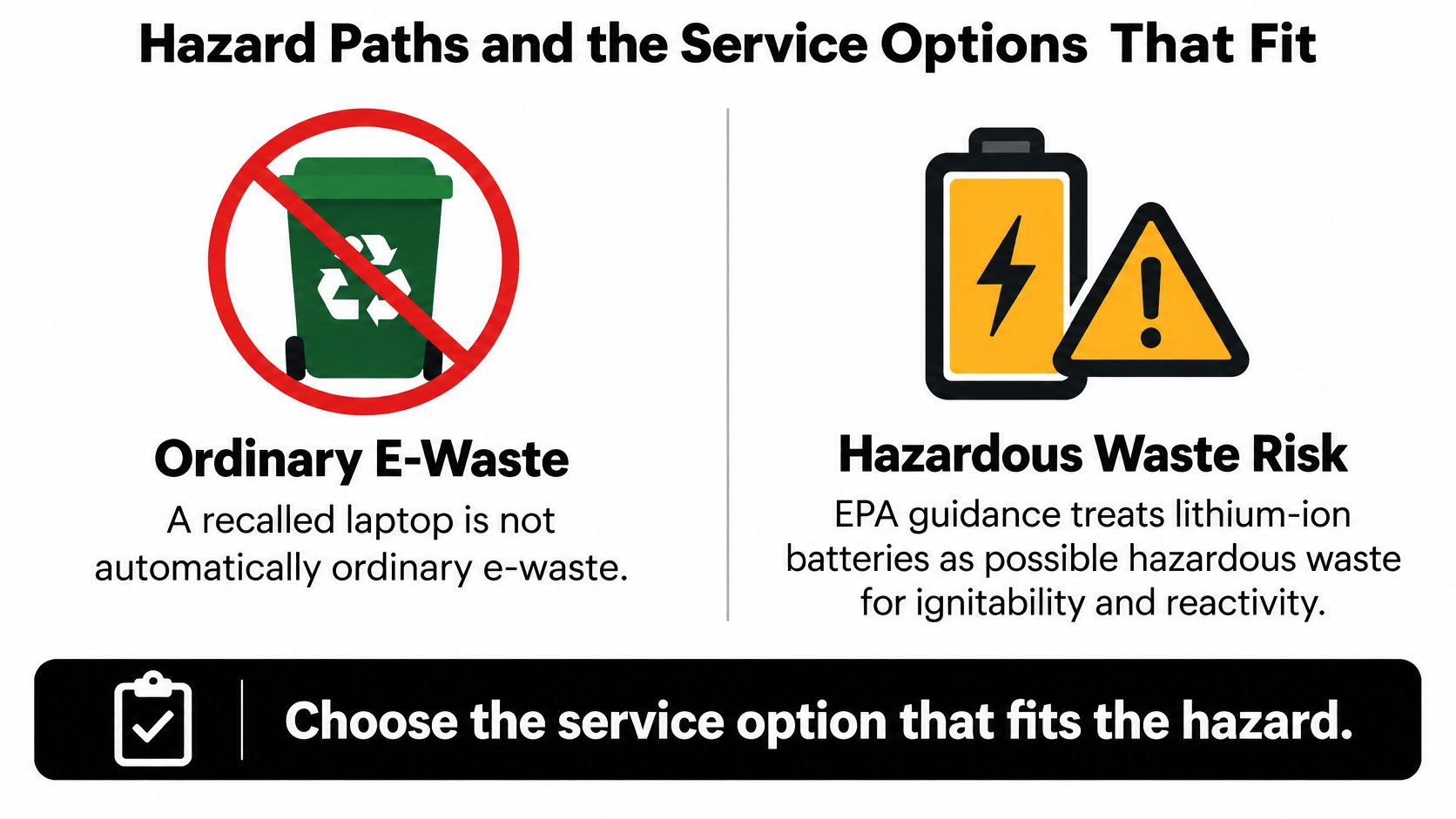
EPA guidance on lithium-ion batteries and vapes states that lithium-ion batteries may be hazardous waste because of ignitability and reactivity, and businesses, schools, and other non-household generators must determine applicable requirements. Nicotine may carry acute hazardous waste code P075, while lithium batteries may carry D001 and D003.
| Condition | Ordinary e-waste | Required path | Fitting service |
|---|---|---|---|
| Serialized laptop or desktop, intact battery, stored data | No until remedy and data status are confirmed | Quarantine, then destroy media if disposal is ordered | Offsite IT asset disposition with shredding and a certificate |
| Swollen, damaged, or leaking lithium cell or power bank | No | Hazardous waste determination, isolation, no general shred | Specialized battery handling, not a standard pickup |
| Recalled vape or other nicotine plus battery device | No | Generator rules; possible P075 plus D001 and D003 | Hazardous waste vendor, not a donation or retail take-back |
| Device with lamp, refrigerant, or mercury switch | No | Remove regulated components before recovery | Certified downstream processor |
| Non-portable recalled appliance or lab unit | No self-haul | Arranged collection and documented site exit | Reverse logistics and scheduled pickup |
| Surplus electronics with no recall match | Yes if data is sanitized | Reuse, buyback, or recycling | Donation-based recycling or buyback |
Match the Service to the Hazard
Onsite destruction fits sensitive drives or products that require witnessed treatment. Your staff can see the units processed, but you still need serial records and a certificate.
Offsite certified processing fits bulk office cleanouts and facility cleanouts after custody is sealed and documented. It's efficient for volume, provided the manifest identifies the recalled lot and the processor reports the final route.
For batteries, separate damaged cells from intact equipment and respect packaging, accumulation, and shipping requirements. Review lithium battery disposal before combining power banks, loose packs, and devices in one container. If a cell is smoking, hot, swollen, or leaking, escalate it as an emergency rather than saving it for recycling day.
Choose the Right Data Treatment
NIST SP 800-88 defines clear, purge, and destroy. Clear uses logical techniques against basic, non-invasive recovery. Purge makes recovery infeasible with state-of-the-art laboratory methods while potentially preserving the device for reuse. Destroy makes recovery infeasible and prevents reuse of the media for data storage.
That distinction matters during laptop disposal and product destruction. Clearing or purging fits only if the recall owner allows the device to return to service. If disposal is ordered, media destruction is usually the safer endpoint.
The IRS media sanitization guidelines state that simple deletion is insufficient for clearing. A factory reset by itself doesn't prove confidential information is gone.
How to Run Collection Through Final Disposition
Run the work as one chain. Each step creates the evidence the next step needs.
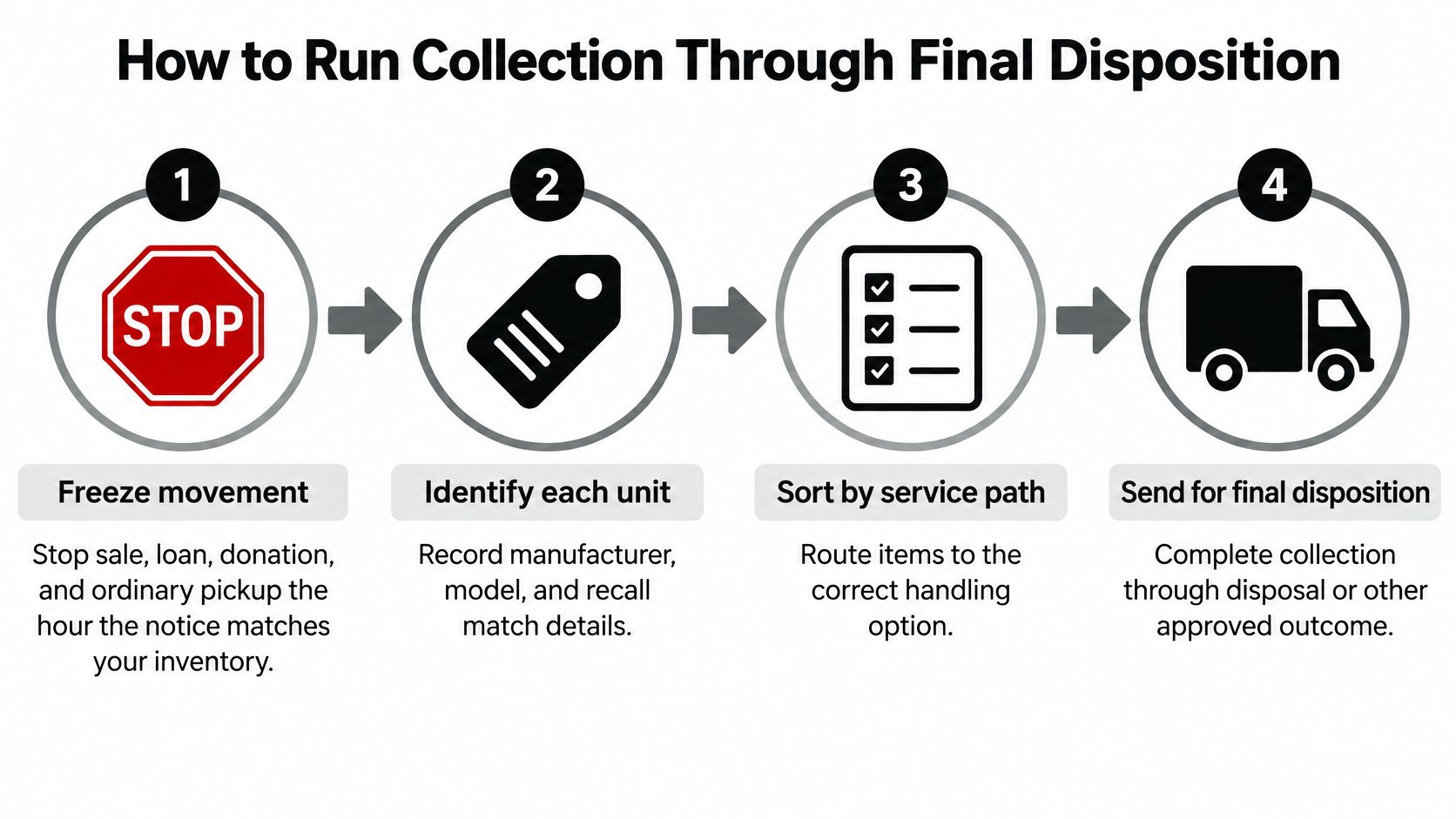
- Freeze movement: Stop sale, loan, donation, deployment, and ordinary pickup as soon as the notice matches inventory. Tell purchasing, IT, facilities, warehouse staff, and site managers which identifiers are frozen.
- Identify each unit: Record manufacturer, model, serial or lot identifier, recall notice, quantity, location, and intake date. Photograph labels when print is damaged or likely to detach.
- Quarantine the units: Use a labeled cage, locked room, or sealed pallet area apart from acceptable stock. Limit access to named staff and mark the load so nobody mistakes it for surplus.
- Reconcile the count: Compare physical units with purchasing records, asset registers, classroom lists, and warehouse inventory. Write an exception report for shortages, damaged labels, and unidentified items.
- Confirm the route: Get the recall owner's authorization for destruction, recycling, parts recovery, repair, replacement, or return. Don't let a hauler choose the remedy because a route is convenient.
- Move under custody: Use a manifest naming the releasing site, transporter, destination, quantities, and identifiers. Photograph sealed containers or record seal numbers at departure and arrival.
- Process in a safe order: Remove or neutralize batteries and regulated components first. Sanitize or destroy data-bearing media, then dismantle only when recovery was authorized.
- File and match the proof: Keep the certificate, processing date, method, downstream processor, quantities, photographs, and final disposition evidence. Match every record back to intake.
Why These Controls Matter
FDA recall guidance recommends defining a proposed destruction method, contacting the agency before destruction when applicable, preserving adequate destruction records, and maintaining recalled inventory separately from acceptable stock. That structure prevents accidental reuse or shipment.
The benchmark is 100% reconciliation between received recalled units and documented final disposition, with exceptions still open and explained.
Failure modes are predictable. Mixed storage causes reshipment because a picker sees a familiar model and assumes it's good stock. An unsealed load creates a custody gap because nobody can show whether units were removed in transit. A generic weight ticket can't answer an auditor asking for one missing serial number.
Use reverse logistics services when recalled units sit across offices, schools, clinics, or warehouses. Multi-site collection needs the same intake fields at every location. Otherwise, headquarters receives several incompatible lists and can't reconcile the total.
Disposition should follow hazard and remedy, not convenience. Equipment containing batteries, lamps, refrigerants, or mercury switches may need specialized handling. Recoverable material can be dismantled only after the recall owner authorizes recycling or destruction.
Examples for Offices Campuses and Agencies
A 40-person firm finds a recalled docking-station lot during an office cleanout. IT stops deployment and records the affected serials before sending those units for the remedy authorized by the recall owner. Unaffected spare laptops follow a separate donation route after data sanitization. Keeping the two streams apart prevents recalled products from slipping back into use.
A school district removes recalled chargers from laptop carts. Facilities staff keep those units out of the student e-waste drive, separate intact packs from damaged cells, and count returns by classroom. The resulting location-based exception list shows where collection is incomplete, instead of relying on a single claim that every charger was recovered.
A city agency decommissions a data closet containing two recalled UPS units. Procurement rejects a scrap weight ticket because it identifies neither unit. The file instead needs records tied to asset tags, including manifests, media destruction records where drives are present, downstream processor names, and certificates.
The CPSC recall handbook describes verifying disposal or destruction and allows investigators to witness disposal or arrange verification. Proof of destruction or disposal can form part of a recall remedy. A recycling receipt alone does not close the recall: records must connect the products to the authorized method and show they were not returned to use.
| Criterion | What to require | Red flag |
|---|---|---|
| Remedy confirmation | Written recall-owner authorization before any destruction | Vendor picks the route |
| Serial-level reconciliation | Count tied to each serial or lot, with an exception report | Scale ticket with no identifiers |
| Witnessed destruction | Onsite or witnessed option available | No verification offered |
| Hard-drive shredding | Certificate naming method, date, and quantity | Scrap with no media record |
| Battery separation | Hazardous waste determination and isolation before transport | Mixed bin with general e-waste |
| Reverse logistics | Scheduled multi-site pickup on signed manifests | Customer must self-haul |
| Resale ban | Written ban on resale or donation of recalled goods | Recalled units mixed into donation loads |
Cost and Service Fit
Cost usually rises with unit count, number of sites, data-bearing media, hazardous components, witnessing, and rush pickup. Buyback may offset the cost of unaffected surplus, but recalled units should not be assigned resale value.
For documented handling in regulated settings, review public sector compliance requirements before signing. Reworx Recycling provides business pickup, decommissioning, secure hard drive shredding, and electronics recycling. Its community technology donation option is for equipment that is not under recall.
Frequently Asked Questions About Recall Disposal
Can Recalled Electronics Join a Donation Drive After Data Wiping
No. Data wiping addresses information risk, not the product defect. A recalled unit under a disposal, repair, replacement, or return remedy can't be donated back into use. Donation is for equipment that doesn't match a recall and is safe to redeploy.
Is a Recycler Receipt Enough to Close a Recall
Only if it ties each serial or lot to destruction or approved recovery and shows the goods can't be resold. A receipt stating a total weight doesn't prove identity or final disposition. Keep manifests, certificates, dates, quantities, photographs, and downstream destination with the intake record.
Do We Need Agency Contact Before Destruction
Sometimes. Follow the recall notice and confirm the method with the recall owner or agency when required. Don't assume every recall requires the same contact, and don't destroy first while planning to ask later. The authorization should be written before processing begins.
Can Damaged Batteries Go in Standard Pickup
No. Isolate swollen, damaged, or leaking cells and make a hazardous waste determination. Smoking or hot batteries need emergency escalation, not storage with general electronics. Standard pickup fits only items accepted under the provider's packaging and transport rules.
Who Chooses the Disposal Route
The recall owner authorizes the route. Your provider executes and documents it. If a vendor proposes destruction before seeing the notice, pause the job.
Confirm the Remedy Before You Book Pickup
A pickup receipt does not close a recall. Before booking, confirm that the remedy authorizes disposal and that the provider can identify each unit, document custody, follow the approved method, and show the products were not returned to use.
If the notice calls for a refund, repair, or replacement, arrange quarantine and controlled transport rather than destruction. If it authorizes disposal, give the provider the serial or lot details and handling requirements. Keep recalled units separate from unaffected equipment so they cannot be mixed into a donation or reuse stream.
Choose services to match the equipment and the approved route. Reworx Recycling offers business pickups, equipment decommissioning, IT asset management, equipment buyback, electronics recycling, and secure hard drive shredding with data destruction. For recalled products, confirm in writing that the selected service can follow the authorized remedy and provide records linking the collected items to their final disposition.
If you have identified a recalled lot, Reworx Recycling can discuss documented pickup, product destruction, secure data destruction, and electronics recycling. Keep the recall owner's authorization and the provider's disposition records with your intake file.