Your facilities manager opens a storage closet and finds forty retired switches, a box of wireless access points, and a firewall nobody wants to touch. The network upgrade is finished, but nobody can confirm which devices still hold credentials, which belong to a leasing company, or which are safe to donate. Getting the equipment out is easy. Choosing and proving the right destination takes more care.
For IT teams in Smyrna, Georgia, and across the Atlanta metro area, network equipment recycling should start with a documented disposition decision, not a scrap pickup. An office move, clinic renovation, or warehouse network refresh needs a process that protects information, preserves useful equipment, and produces records that finance and sustainability teams can verify.
What Network Equipment Recycling Covers
That closet contains several different projects disguised as one cleanup. A supported switch might suit another location, an access point might need its ownership released from a cloud dashboard, and an inaccessible firewall might require destruction of its storage. Putting everything on the same pallet without classification removes those distinctions.
Network equipment recycling covers the controlled retirement of switches, routers, firewalls, wireless controllers, access points, servers, storage modules, and telecommunications hardware. The work includes testing for reuse, recovering serviceable parts, sanitizing stored information, and sending end-of-life materials to appropriate processors.
Unlike routine laptop disposal, network retirement often involves equipment that has spent years mounted in racks or ceiling spaces. The sensitive contents may be configurations, administrator credentials, certificates, or logs rather than familiar document folders.
The scale makes documented handling important: the UNITAR and ITU Global E-waste Monitor 2024 reports 4.6 million metric tonnes of small IT and telecommunications e-waste generated globally in 2022, with only 22% documented as formally collected and recycled.
Identify the asset before choosing its destination
The equipment-life examples below come from a published data-center recycling case study, which describes networking hardware remaining usable for 10 to 20 years and some data-center servers being refreshed approximately yearly. Those are not automatic replacement deadlines; support, condition, and workload still control the decision.
| Equipment | Typical useful life | Main data risk | Usual first route |
|---|---|---|---|
| Switches and routers | 10 to 20 years | Configurations and admin credentials | Redeploy or resell, then recycle |
| Data-center servers | Some refreshed about yearly | Full disk contents and potentially retained memory data | Redeploy, then parts or recycling |
| Firewalls and wireless controllers | Until security support or capacity becomes inadequate | VPN certificates and policy files | Sanitize, then resell or recycle |
| Wireless access points | Until support or wireless requirements change | Configuration and certificates | Redeploy or recycle |
| Flash and SSD storage modules | Until endurance, health, or support limits prevent reuse | Customer and operational data | Sanitize before any reuse |
| Telecom base-station equipment and antennas | Until network compatibility or physical condition prevents service | Low data in passive antennas; check active modules separately | Certified material recycling |
The last column is a starting point, not permission to release an asset. Check ownership and data status first.
Practical rule: Sort for remaining usefulness before sorting for scrap value.
Triage Each Device Before It Leaves
Functioning equipment still contains useful manufacturing work: assembled boards, tested power supplies, machined enclosures, and components that haven't failed. Shredding destroys that remaining utility. Keeping equipment running responsibly, however, requires more than seeing a power light.
Reuse isn't automatically the best outcome. An unsupported security appliance can transfer risk to its next owner, while an inefficient server may cost more to operate than its remaining service justifies. Donation shouldn't become a way to pass obsolete infrastructure to a school or nonprofit that lacks the budget to maintain it.
Start with the device's actual service position. Confirm its vendor support status, available firmware, functional condition, licensing restrictions, and whether a recipient can legally and practically activate it. For cloud-managed hardware, verify account release and subscription requirements before calling it reusable.
Make the route conditional
When replacing an older security platform, Meraki migration guidance from Splash Access can help frame the replacement conversation. Keep that migration planning separate from disposal approval: a successful cutover doesn't establish that the old appliance is safe to sell.
| Device condition | Recommended route | Evidence to record |
|---|---|---|
| Supported, current firmware, in demand | Redeploy internally or resell | Make, model, serial, and firmware version |
| Supported but aging, low demand | Donate or resell through a verified buyer | Functional test result and recipient details |
| Working parts, end of support | Parts harvesting for suitable supported applications | Component list and condition grade |
| Unsupported, power-hungry, or failed | Material recycling through a certified processor | Weight ticket and downstream recycling certificate |
| Holds data that cannot be verifiably wiped | Physical destruction of the data-bearing components | Destruction certificate matched to serial numbers |
| Subject to a records retention rule | Hold in secure storage until authorized release | Retention schedule reference and storage log |
Evaluate transport and processing costs against realistic recovery, not an advertised resale listing. Testing, missing power supplies, license transfer, freight, and sanitization can consume the apparent value of a low-demand model. Ask whether the quoted recovery is a guaranteed purchase price or an estimate contingent on grading.
Write a decision someone else can defend
Use an IT equipment audit to connect asset identity, condition, and approval in a single working register. Include data-bearing components and the proposed downstream route, not just the equipment's location.
A useful disposition entry reads: “Supported firmware available, functional test passed, recipient confirmed, approved for donation after verified sanitization.” An exception might read: “Management interface inaccessible, storage sanitization unverifiable, approved for component destruction and chassis recycling.”
Record who approved the choice and what evidence they reviewed. A defensible decision explains why the selected route was appropriate, not merely where the device went.
Why Network Hardware Needs Controlled Handling
Network hardware combines recoverable resources with components that require controlled treatment. Basel Convention technical material identifies recoverable iron, aluminum, copper, gold, silver, palladium, and rare-earth metals, alongside potential hazards including lead, cadmium, mercury, persistent organic pollutants, asbestos, and chlorofluorocarbons. These are potential constituents of electronic waste, not a claim that every router contains every substance.
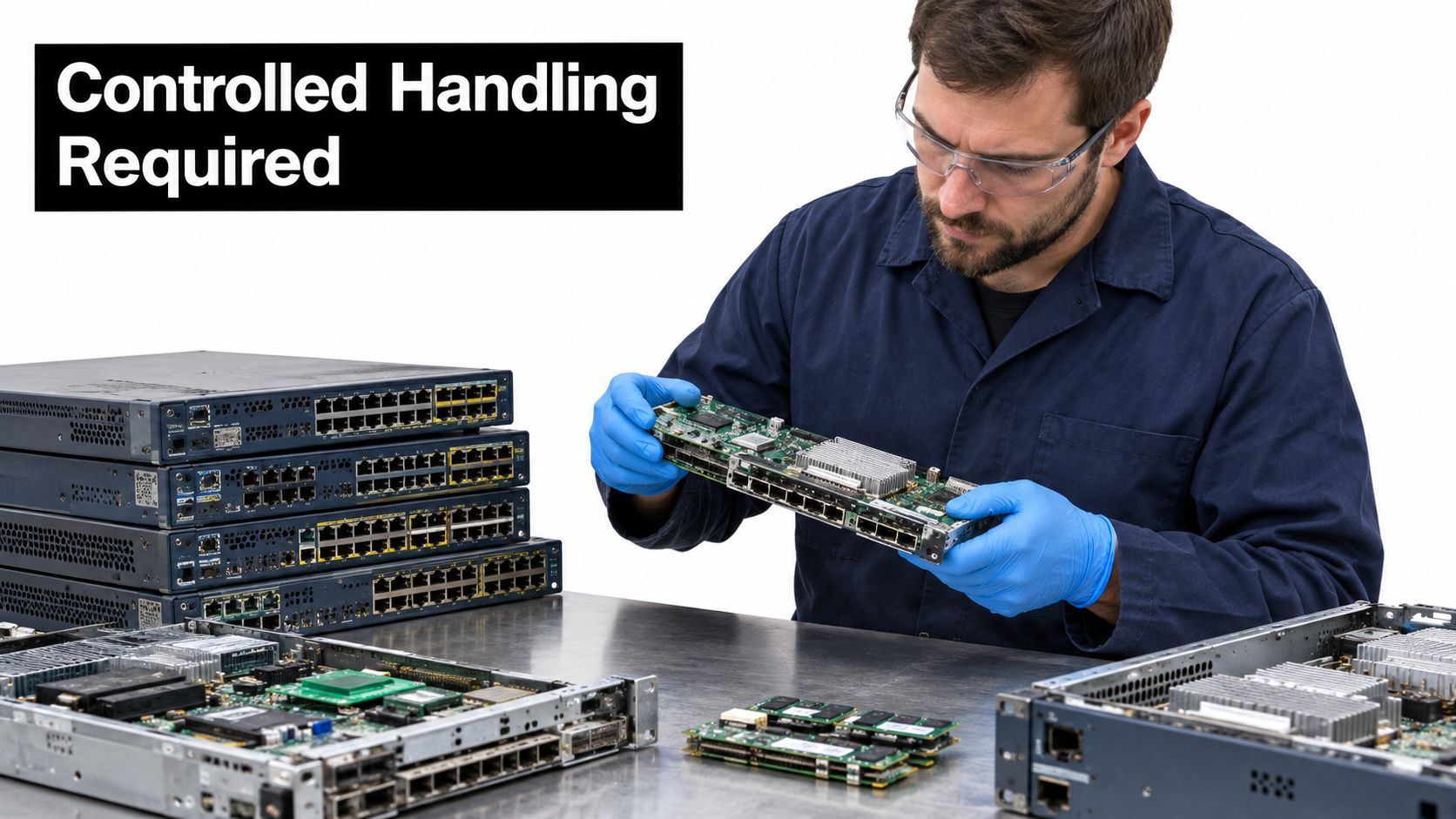
Qualified dismantlers should separate materials deliberately, rather than send intact mixed equipment into generic scrap. Printed circuit boards concentrate valuable metals but can also carry hazardous components; they need a suitable electronics refining route.
- Remove hazards first. Isolate batteries, lamps, and identified regulated components using trained personnel.
- Separate structural metals. Route steel chassis, aluminum heat sinks and enclosures, and copper cabling into their appropriate streams.
- Keep boards identifiable. Collect printed circuit boards separately, using PCB to mean printed circuit board rather than assuming every assembly contains polychlorinated biphenyls.
Follow the equipment's safe disassembly sequence rather than forcing a universal teardown order. Bag or containerize, label, and weigh each stream so the receiving processor's receipt can be reconciled against the dismantling record.
Legal Rules for Moving Used Network Gear
No single rule covers every retirement. Obligations depend on the equipment's destination, waste classification, components, ownership, and the organization's preservation policies. A domestic donation and an international shipment of failed appliances need different reviews.
For cross-border movements covered by the amendments, the Basel Convention's e-waste amendments require prior informed consent, including written notification by the exporting country and prior written consent from the importing country and, where applicable, transit countries before shipment. Have the responsible compliance specialist determine how those controls and relevant national rules apply to the proposed route.
Don't accept “used equipment” on a broker's paperwork as proof that a shipment isn't waste. Confirm classification, functionality evidence, destination, and who is responsible for the required approvals before authorizing export.
Match the scenario to its checkpoint
| Scenario | Requirement | Evidence to keep |
|---|---|---|
| Shipping used gear across a border | Determine e-waste classification; obtain prior informed consent where the Basel amendments apply | Classification record and required written notifications and consents |
| Batteries inside UPS units or devices | Arrange safe removal and separate handling, not household-bin disposal | Battery handling record and processor receipt |
| Devices covered by a records retention rule | Preserve required information and hold equipment intact when necessary until authorized release | Retention schedule and hold log |
| Donating to a school or nonprofit | Confirm recipient, asset-transfer terms, and data status | Donation receipt and transfer agreement |
| Domestic shipment to a processor | Establish documented custody and qualified downstream handling | Signed custody log and weight tickets |
The EPA's electronics donation and recycling guidance advises removing batteries before donation or recycling and says lithium-ion batteries, or devices containing them, shouldn't go into household garbage or recycling bins. For rack-mounted UPS equipment, use trained personnel and an appropriate battery handler rather than asking office staff to dismantle energized equipment.
Clear ownership and preservation before release
Legal counsel or the records owner should release preservation holds before sanitization. Sometimes preserving an approved export is sufficient; sometimes the original device must remain intact. IT shouldn't decide that distinction alone.
Donation terms should address accepted condition, software licensing, ownership transfer, recipient acceptance, and the absence of retained organizational data. Avoid promising a tax valuation through an equipment receipt.
Use a transportation compliance review to settle carrier responsibilities and required shipment records. For multi-state or international movements, have counsel review the proposed route before a broker or carrier collects the load.
Wiping, Purging and Destroying Stored Data
A leftover VPN certificate can matter more than the resale price of the firewall holding it. Routers, switches, and controllers may retain administrator credentials, routing information, logs, customer identifiers, and removable flash storage. Removing the appliance from production doesn't remove those contents.
Verification needs to be independent of the owner's assurance. Industry reporting on HPE's Erskine renewal center describes additional software checks even when customers say their SSDs have already been wiped. Treat that as an operational lesson: the receiving process should validate the claimed result.
Choose the outcome before the technique
The NIST SP 800-88 Revision 1 media-sanitization guidance distinguishes Clear, Purge, and Destroy as different sanitization outcomes. Use the definitions below to write requirements, while checking the currently applicable guidance and your organization's approved procedures before execution.
| Outcome | Protection objective | Reuse implication |
|---|---|---|
| Clear | Protect against simple, non-invasive recovery from user-addressable storage | May preserve reuse, but doesn't establish a purge-level result |
| Purge | Make recovery infeasible using state-of-the-art laboratory techniques | Can preserve the medium for reuse |
| Destroy | Make recovery infeasible and leave the medium unable to store data afterward | Ends reuse of the destroyed medium |
For reusable network assets leaving organizational control, specify a supported, verified Purge method where the hardware permits it. Don't assume an ordinary factory reset meets that requirement. Follow the manufacturer's sanitization instructions for the exact model, storage architecture, and firmware.
Cryptographic erase is suitable only when its prerequisites can be established, including effective encryption and reliable destruction of the relevant keys. Repeated overwriting isn't a universal answer for flash storage because the interface may not expose every physical storage area.
Require evidence of execution and verification
Failed, inaccessible, or unverifiably sanitizable media should enter an approved destruction route after any hold is released. Destroy removable storage rather than the entire chassis when that safely addresses the risk and preserves useful components.
An asset-level certificate or attached execution record should identify:
- The asset and media. Device serial, internal asset tag, and removable-media identifiers.
- The method. Sanitization outcome, tool or vendor procedure, and relevant version.
- The result. Execution status, verification outcome, and exceptions.
- The accountable parties. Operator, reviewer, processing date, and certificate reference.
A generic statement that a pallet was wiped isn't enough to establish which firewall passed verification. Review data sanitization methods when specifying secure data destruction, including secure hard drive shredding for media that requires physical destruction.
Preserve the evidence of sanitization as carefully as you protect the equipment awaiting it.
Step-by-Step Workflow from Inventory to Certificate
An effective retirement workflow assigns responsibility before equipment starts moving. IT owns data and technical release, facilities owns staging access and loading arrangements, and the disposition coordinator reconciles the final records.
Keep release gates in order
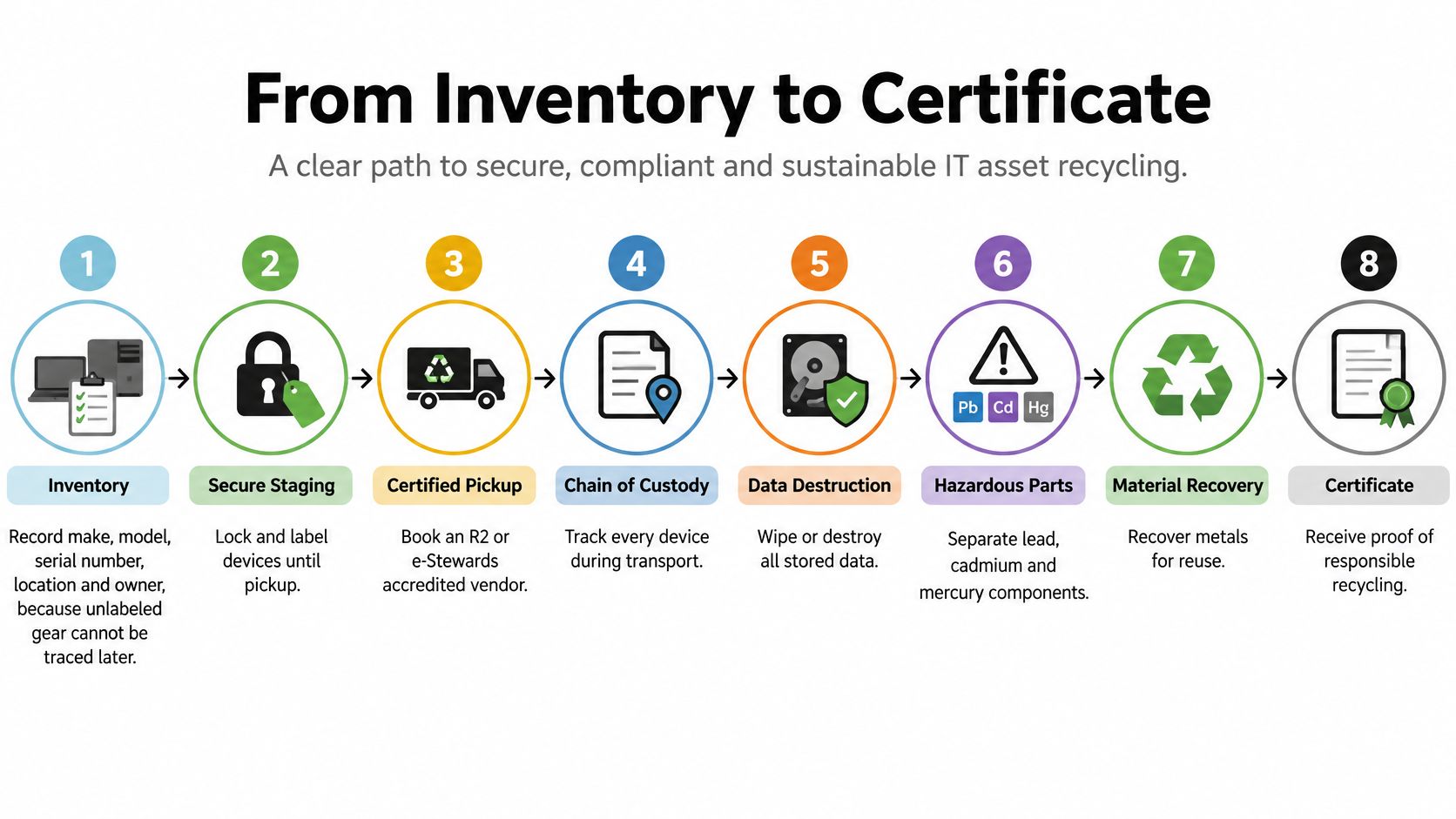
Inventory every device. Record make, model, serial number, location, owner, and any internal asset tag before changing its condition. The common slip is sanitizing or dismantling first, then discovering that labels and identifiers are missing.
Apply holds and preserve approved records. Export required configurations and logs into controlled storage, confirm recovery where necessary, and obtain release from the records owner. Don't create an unrestricted configuration archive that becomes a new credential exposure.
Approve a disposition route. Assign reuse, donation, resale, parts harvesting, recycling, or controlled hold to each asset and record the reason. Avoid letting a pickup crew make unrecorded decisions based on appearance.
Complete the approved sanitization. Use the required Clear, Purge, or Destroy outcome and retain execution and verification records before releasing an asset for reuse. If processing will occur off-site, authorize only secure transfer into controlled staging, not unrestricted resale.
Separate regulated components and material streams. Qualified personnel should isolate batteries and sort dismantled equipment into appropriate steel, aluminum, copper, and board streams. Don't dismantle a potentially reusable unit merely because the recycling container is closer.
Pack and label for reconciliation. Keep reusable equipment protected from damage, identify data-bearing loads, and log container identifiers and measured weights. The weak point is an unlabeled mixed box added after the inventory was approved.
Document transport handoffs. Require custody acknowledgment at pickup and delivery, with discrepancies recorded rather than silently corrected. Book bulk collections in advance and confirm loading access, pallet requirements, carrier identity, and the destination facility.
Close the project with downstream evidence. Collect weight tickets, reuse or resale reports, serial-matched destruction certificates, and recycling documentation. Don't mark the project complete merely because the collection invoice has been paid.
Reconcile exceptions before closing
Keep an exception register alongside the asset list. Missing equipment, unreadable labels, failed sanitization, changed resale grades, and rejected loads each need an owner and a documented resolution.
The inventory should reconcile to the collected load, the processor's receipt, and the final disposition report. If the processor reports a different count or weight, ask whether packaging, removed batteries, duplicate entries, or missing assets explain the difference.
A business pickup belongs inside this workflow, not at its beginning. Send the collection team an approved manifest, identify any equipment still awaiting secure off-site processing, and define the documents due after receipt. That preparation prevents loading-day improvisation from undoing the controls established by IT.
Measuring Diversion and ROI in a Real Refresh
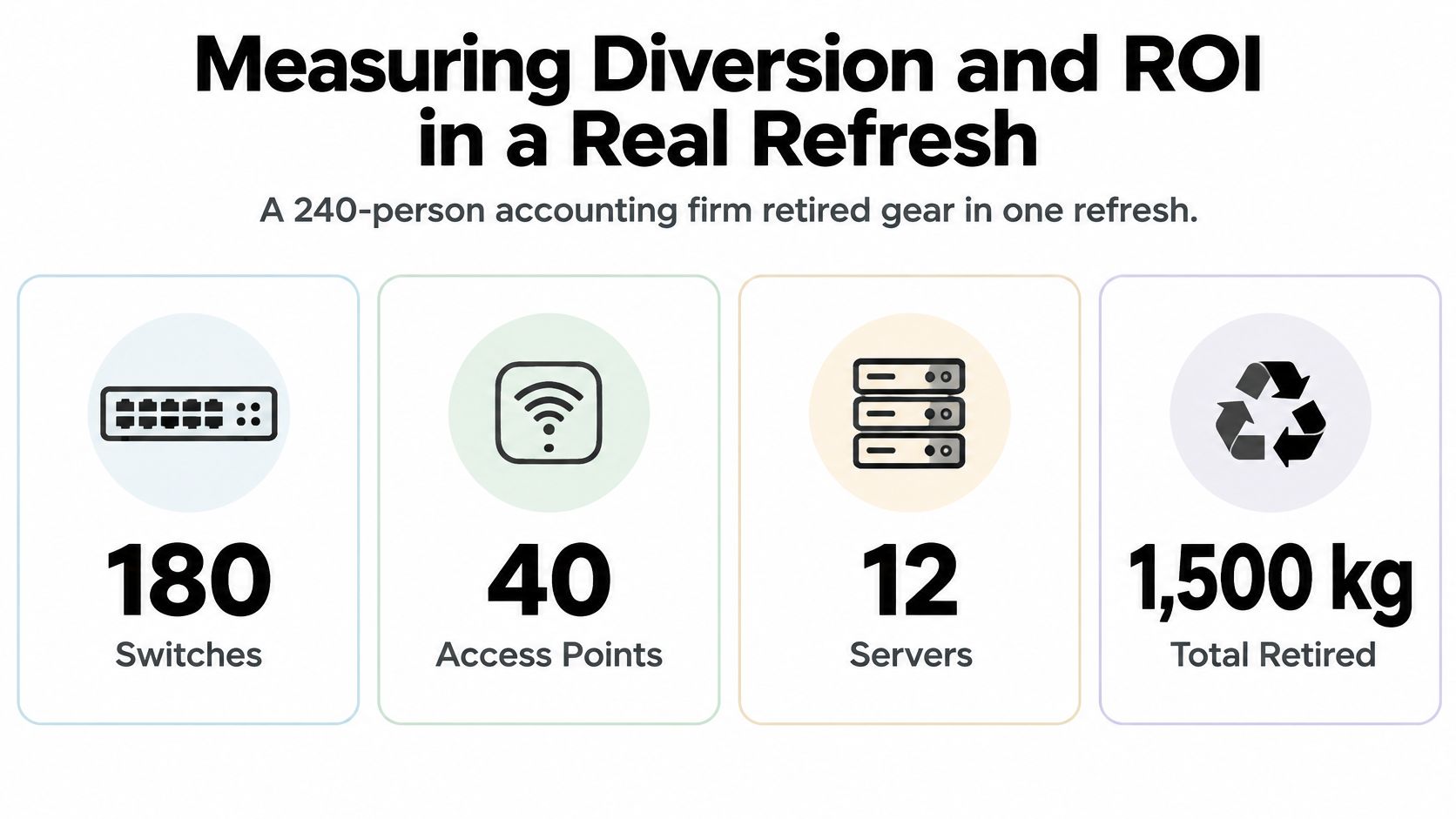
Consider an illustrative, hypothetical refresh at a 240-person accounting firm. It retires 180 switches, 40 access points, and 12 servers, totaling 232 units and 1,500 kg. These are worked-example assumptions, not reported customer results or industry benchmarks.
The firm's sustainability lead wants evidence of diversion, while finance wants to understand recovery after fees. Neither question can be answered by counting the pallets that left the office.
Separate environmental outcomes from financial results
| Metric | Formula |
|---|---|
| Diversion rate | Weight diverted divided by total weight retired |
| Reuse share | Units redeployed or resold divided by total units retired |
| Data-destruction coverage | Data-bearing units with serial-matched certificates divided by data-bearing units |
| Net recovery | Resale proceeds minus service fees |
| Chain-of-custody completeness | Handoffs with signed records divided by total handoffs |
In this hypothetical case, 1,380 kg diverted divided by 1,500 kg retired equals 92% diversion. The remaining material requires an explained destination; it shouldn't disappear into an unclassified residual category.
If 96 of the 232 units are redeployed or resold, reuse share is approximately 41%. Keep donation outcomes visible as a separate category or explicitly include them in a consistently defined broader reuse measure. Don't change the denominator between reporting periods to improve the result.
For an additional hypothetical assumption, suppose all 232 units are classified as data-bearing and each receives a serial-matched sanitization or destruction record. Coverage is then 232 divided by 232, or 100%; a generic recycling certificate wouldn't satisfy that measure.
Read the exceptions behind the percentage
A high diversion rate paired with low reuse share may indicate that useful equipment went straight to material recovery. It can also reflect an appropriately retired lot of unsupported or failed devices. The triage register explains which interpretation is justified.
Net recovery requires actual settlement statements. Subtract agreed service fees from resale proceeds, and separately identify internal labor or replacement costs if finance needs a broader project ROI. A donation can deliver community value without generating resale income.
For custody completeness, compare signed handoffs with the complete transport itinerary, including subcontracted movements. A signed collection receipt doesn't prove that every later transfer was documented.
Reporting discipline: Count only destinations supported by completed downstream records, not intended outcomes.
Use cost recovery strategies to compare buyback, resale, donation, and processing costs before approving the refresh budget. Track outcomes quarterly using consistent definitions so corporate sustainability and ESG teams can assemble year-end reporting without reconstructing each shipment.
Common Questions on Leased, Locked and Unlabeled Network Gear
Who decides what happens to leased switches?
Check the lease return and sanitization clauses first, because the lessor may retain title and specify the return procedure. Obtain written authorization before wiping, relocating, donating, or destroying equipment, and agree on the serial-matched return or destruction evidence.
What if we've lost the firewall's admin password?
Use the manufacturer's authorized recovery process rather than repeated guesses that could trigger lockout or alter evidence. If approved recovery cannot establish verifiable sanitization, document the exception and arrange destruction of the data-bearing components after any preservation hold is released.
Can we send a small batch instead of booking a pickup?
Yes, small volumes can be handled through an accepted drop-off arrangement or consolidated shipment. Confirm commercial acceptance and packaging requirements first; a single router still needs recorded identity, data status, and a receiving acknowledgment.
How should we handle equipment without a serial number?
Photograph the device and any remaining label, record its model and original location, and assign a durable internal asset tag before movement. Require that identifier on custody and processing records so the final certificate can be matched to the physical asset.
Don't invent a manufacturer serial number to fill a spreadsheet field. Mark it absent and preserve the alternative identification evidence.
Vet a Recycler and Book Your Pickup
Choose a recycler by checking the evidence it can provide for each handling route. The EPA identifies R2 and e-Stewards as accredited electronics-recycler certification standards. Review the certificate itself, including the covered facility, scope, and current status, rather than relying on a logo.
Ask for records before comparing quotes
Use written vendor selection criteria that purchasing, IT, and facilities can assess together. Ask how the vendor will document the decision to reuse, recover parts, or recycle each device.
- Certification scope. Request current R2 or e-Stewards documentation for the facility doing the work.
- Downstream controls. Ask how later handlers are qualified, monitored, and recorded.
- Data evidence. Require asset-level sanitization or destruction records, plus a procedure for failed verification.
- Disposition choices. Establish how donation, buyback, parts recovery, and recycling are selected and approved.
- Export disclosure. Identify destination countries and who reviews classification and shipment requirements.
- Insurance and liability. Review coverage, custody responsibility, loss procedures, and contractual limits.
- Itemized pricing. Separate collection, handling, testing, sanitization, destruction, and reporting charges.
- Comparable references. Ask about projects involving similar network appliances and documentation requirements.
A buyback estimate is not a final settlement until ownership, condition, and marketability are confirmed. Confirm whether collection and processing carry charges, and compare the total against the value offered.
Match the service to the load
Reworx Recycling is a full-service electronics recycling and IT asset disposition partner based in Smyrna, Georgia. Its services include free customer drop-off, business pickups, equipment decommissioning, buyback options, and secure hard drive shredding with data destruction. Confirm acceptance, pricing, and the records provided for your specific project before booking.
For an Atlanta-area office or facility cleanout, identify network hardware separately from laptops, medical equipment, or laboratory equipment. Those categories may have different acceptance requirements. If reuse is being considered, record the approval and intended route; if a device cannot meet the required data-security or condition criteria, direct it to an approved recovery or recycling route. Product destruction requires explicit authorization.
To arrange the work:
- Send the inventory. Include condition, data-bearing status, location, loading constraints, and required reporting.
- Approve each route. Select donation, buyback, or recycling by device, subject to testing and security requirements.
- Confirm the collection window. Agree on packing, custody signatures, processing deadlines, and delivery of final records.
For recurring IT asset disposition (ITAD), set up a standing release process. Each release should preserve the asset-level record and approved disposition route, so the final documentation can be checked against the inventory.
Reworx Recycling offers business pickups, equipment buyback options, and secure data destruction for retiring network hardware. Visit Reworx Recycling to discuss a pickup or recurring ITAD service.