

You've finally booked the Montana trip you've been postponing, then discover that half the Glacier National Park advice online still discusses vehicle reservations that no longer apply. That confusion is understandable. Glacier's access system has changed, the alpine road remains vulnerable to weather, and a beautiful itinerary can unravel if you treat parking, shuttles, fuel, and trail access as afterthoughts.
This Montana Glacier National Park travel guide and tips article focuses on the 2026 rules, practical route choices, weather backups, and the hikes and viewpoints worth prioritizing. Glacier rewards early planning, but it punishes rigid schedules. Build your trip around flexible access, early starts, and the assumption that mountain conditions can change your plan.
Planning a Trip to Glacier National Park in 2026
A traveler comparing old guidebooks might find one page recommending a vehicle reservation, another advising an early arrival, and a newer page mentioning Logan Pass parking permits. The newer advice is the one to follow. Glacier's park-wide timed vehicle reservation system has been discontinued for the 2026 season, so visitors don't need a pre-booked timed entry to drive into any park area this year, according to the National Park Service's 2026 access announcement.
That doesn't mean access has become effortless. The park has shifted crowd management toward a ticketed shuttle system and limited timed parking at Logan Pass. Private vehicles can use the roads, but parking at the most popular alpine destination is constrained. In 2026, Logan Pass private-vehicle parking is limited to a maximum of 3 hours, enforced around the clock during the summer access period, as explained in the official Logan Pass 2026 FAQ.
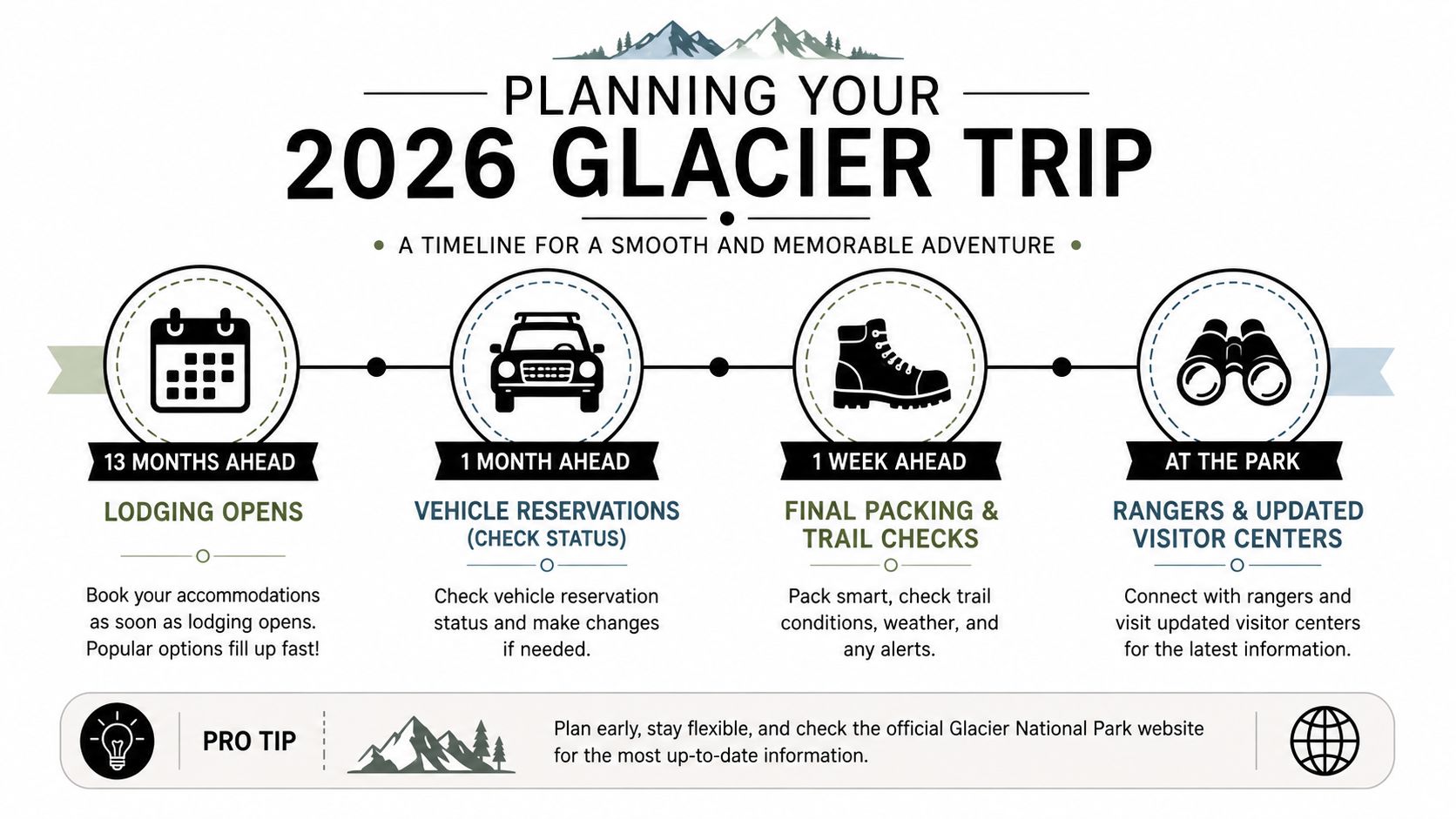
The access framework that matters
Think of your trip as four connected decisions:
- Road access: Going-to-the-Sun Road is the park's signature corridor, but its full alpine section opens seasonally rather than on a guaranteed calendar date.
- Parking access: Logan Pass requires a timed parking permit for private vehicles during the designated summer period, and the stay is capped.
- Shuttle access: The official shuttle is the smarter choice when you want to hike from Logan Pass without circling for parking.
- Weather flexibility: Rain, snow, construction, or rockfall can alter road access even after seasonal opening.
Glacier was established on May 11, 1910, and Going-to-the-Sun Road was completed in 1932, milestones recorded by the National Park Service Glacier fact sheet. Those dates matter because they frame the park as a historic transportation and conservation area, not just a scenic drive.
If you're driving an RV, confirm vehicle dimensions and road restrictions before committing to the alpine route. For broader trip preparation, a resource on collision repair for RV dealers can also help owners understand why a pre-trip mechanical check matters before mountain travel.
For another destination-planning perspective, see this Alaska Northern Lights viewing guide, especially its emphasis on aligning travel plans with changing natural conditions.
When to Visit and How Access Rules Work
Glacier rewards different travel windows. Late June can bring emerging wildflowers and dramatic snowfields, but high-country access may still be limited. July and August provide the best chance of broad Going-to-the-Sun Road access, along with the heaviest demand. September usually offers quieter trails and autumn color, though shorter operating windows and seasonal closures require closer planning.
The full length of Going-to-the-Sun Road typically opens in late June or early July and generally remains open until around the third Monday in October, according to the National Park Service road access notice. The Glacier Park Collection 2026 guide reports that the full road opened to motor vehicles on June 22 in 2026. Treat that opening as a planning reference, not a guarantee for every future visit. Snow, repairs, and alpine weather can still change access.
How to plan your arrival
Set your lodging and trail priorities first, then choose transportation around them. If Logan Pass anchors your itinerary, reserve timed parking when available or plan around the official shuttle. The Logan Pass parking permit is free, while the shuttle ticket carries a $1 Recreation.gov processing fee per ticket. The seasonal Logan Pass parking and shuttle rules are scheduled to run from July 1 through Labor Day, September 7, 2026, according to park access guidance.
For 2026, plan around the current shift in access rules. Parkwide vehicle reservations are not the basis of the plan described here. The practical constraints are timed Logan Pass parking and shuttle tickets during the designated summer period. Check the latest park notice before departure, because the schedule and reservation system can change.
Choose the shuttle if you are hiking from Logan Pass and do not need your vehicle at the trailhead. It removes the parking search and keeps your visit focused on the trail. Drivers should arrive early and keep an alternate plan for the west side, St. Mary, Many Glacier, or Two Medicine.
| Season | Road Status | Shuttle Availability | Key Booking Deadline | Crowd Level |
|---|---|---|---|---|
| Late June | Alpine access may be limited or newly open | Check current park operations | Confirm road status before departure | Building |
| July | Strongest summer access window, subject to weather | Plan around ticket availability | Secure shuttle or Logan Pass parking before the visit | High |
| August | Broad access is likely, with peak demand | Use the shuttle for Logan Pass hikes | Book transportation and lodging early | High |
| September | Access can remain excellent, but closures become more likely | Verify late-season schedule | Recheck operations shortly before arrival | Moderate to high |
| October | Seasonal and weather-related closures become more common | Services may be reduced | Treat the itinerary as weather dependent | Variable |
The 2025 pilot shows how quickly access controls can change. Reservations applied from 7 a.m. to 3 p.m. on the west side of Going-to-the-Sun Road and in the North Fork, while earlier and later entry remained open, according to the National Park Service pilot announcement. Use that pilot as background only. Do not copy its rules into a 2026 itinerary.
For broader seasonal planning, this Michigan fall colors guide reinforces a useful rule: match scenery with operating conditions instead of relying on one “best month.”
Day Trips and Multi-Day Itineraries
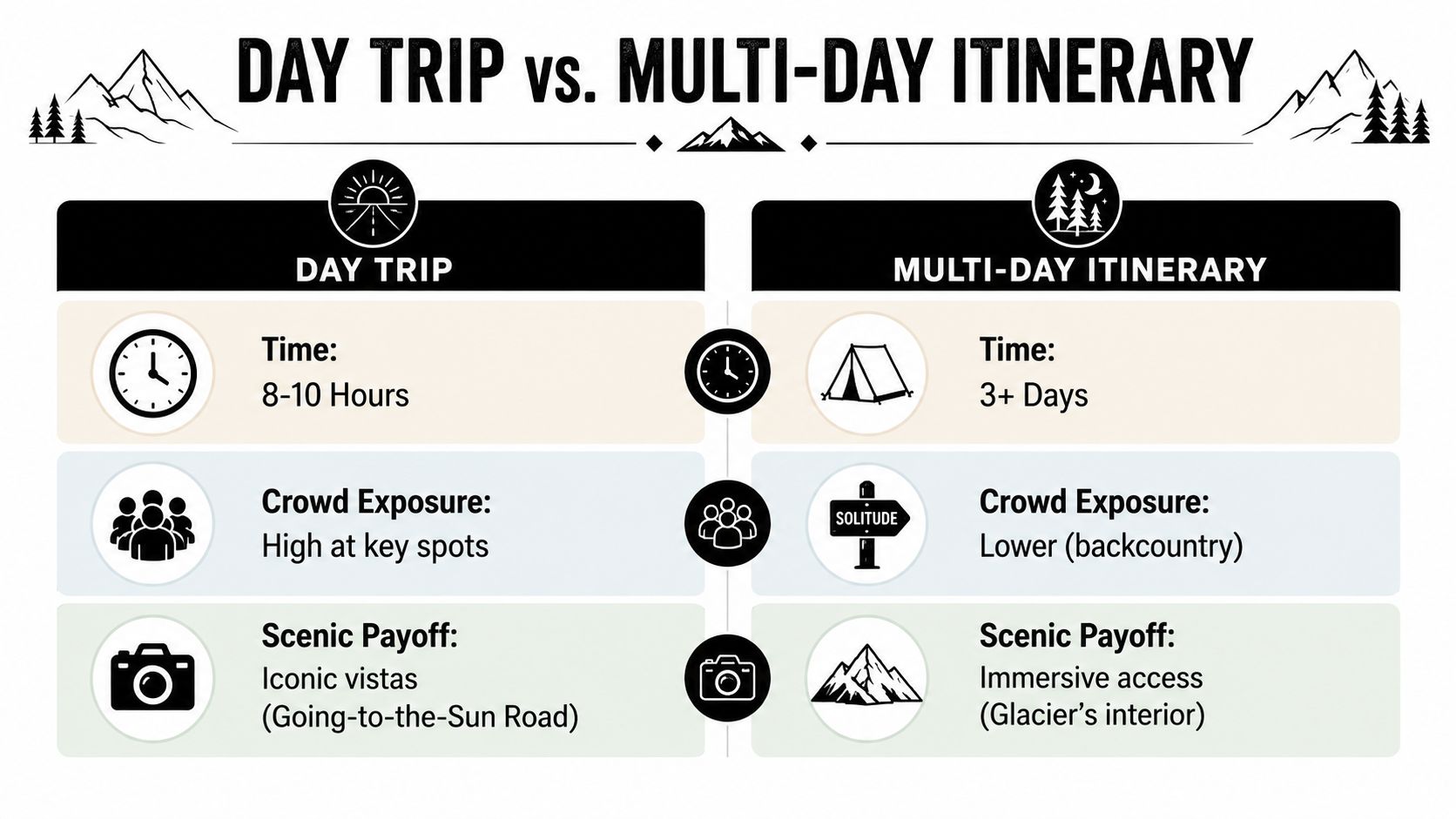
A single day at Glacier can deliver major views, but it leaves little room for delays. A longer stay is the better choice for covering Going-to-the-Sun Road, Many Glacier, Two Medicine, and quieter eastern approaches without forcing every stop into one crowded schedule.
The focused day trip
Leave before the busiest morning period with fuel, water, lunch, and offline maps ready. Start at Lake McDonald for a west-side view, then use Jackson Glacier Overlook for a major scenic payoff with little walking. Continue toward Logan Pass only after confirming your timed parking window or shuttle ticket. In 2026, vehicle reservations are no longer the main constraint, but Logan Pass parking remains timed and shuttle capacity still shapes the day.
Use this sequence:
- Early departure: Begin with supplies and directions prepared, not with a search for fuel or service.
- Jackson Glacier Overlook: Make this a low-effort scenic stop when visibility is good.
- Logan Pass: Spend your allotted parking time on a chosen viewpoint or trail rather than wandering.
- St. Mary Falls: Add the falls from the east side if the route and trail conditions fit your schedule.
- Return with margin: Leave room for slow traffic, changing weather, or a temporary closure.
A day trip works for a first overview. It does not suit visitors who want to explore thoroughly, wait out poor weather, or cover several regions at an unhurried pace.
The three-to-five-day plan
Give each major area its own purpose:
- Day one: Explore the west side, including Lake McDonald, Trail of the Cedars, and the Avalanche area.
- Day two: Drive or take the shuttle along Going-to-the-Sun Road, concentrating on Logan Pass and selected overlooks.
- Day three: Visit Many Glacier and choose a hike that matches current trail conditions.
- Day four: Set aside Two Medicine, a sunrise outing, a moderate trail, or a weather backup.
- Day five: Keep open for a longer hike, a missed viewpoint, or a quieter North Fork excursion.
Many Glacier and Two Medicine spread the trip beyond the busiest corridor. They also provide alternatives when Logan Pass access is full, shuttle tickets are unavailable, or the west side becomes too congested.
Practical rule: Keep one day flexible. A strong Glacier itinerary absorbs a closure without sacrificing the entire visit.
Fuel before entering the park. The National Park Service states that there are no fueling stations inside Glacier's boundaries, which matters when driving the road's 52 miles or traveling between distant entrances, as noted in the Going-to-the-Sun Road access notice.
Top Hikes and Must-See Viewpoints
Choose a Glacier hike by distance, elevation, exposure, weather, and access, not by the photograph that first caught your attention. In 2026, Logan Pass requires more planning because parking is timed and shuttle tickets control access. Confirm your route and arrival window before committing to a trailhead.
The Highline Trail delivers dramatic alpine exposure and wide Logan Pass views, but it requires stamina and stable conditions. Grinnell Glacier is a demanding Many Glacier objective with major weather changes along the route. Hidden Lake Overlook gives visitors a classic Logan Pass outing in less time, while Avalanche Lake and Trail of the Cedars suit travelers seeking forest, water, and a more approachable walk.
| Trail Name | Difficulty | Round-Trip Distance | Elevation Gain | Key Highlights |
|---|---|---|---|---|
| Trail of the Cedars | Easy | Short | Low | Boardwalk, old-growth forest, accessible scenery |
| Hidden Lake Overlook | Moderate | Moderate | Moderate | Logan Pass views, alpine basin, mountain wildlife |
| Avalanche Lake | Moderate | Moderate | Moderate | Forested approach, lake, steep mountain backdrop |
| Highline Trail | Strenuous | Long | Significant | Exposed ledges, alpine views, bighorn sheep habitat |
| Grinnell Glacier | Strenuous | Long | Significant | Glacier views, Many Glacier valley, changing weather |
| Siyeh Pass | Strenuous | Long | Significant | High alpine terrain and expansive mountain perspectives |
These comparisons stay qualitative because trail conditions, access, and hiking pace can change the experience. Check current park notices before leaving, especially in early summer, when snow may remain on high trails into July.
Match the hike to the access system
Logan Pass parking is a timed stop, not a flexible base for an all-day hike. If your route starts there, reserve the correct parking period or use the shuttle with a valid ticket. Start promptly after arrival. Early departures usually mean less crowding and better wildlife-viewing conditions. Late afternoon suits shorter viewpoints, but alpine thunderstorms and poor visibility can develop quickly.
Mountain goats are commonly seen around Logan Pass, and bighorn sheep may appear along the Highline corridor. Bears use forested routes and berry-rich areas, so carry bear spray where permitted, learn its operation before the hike, and keep your distance. A popular trail still demands normal wildlife awareness.
For comparison with hiking options in another mountain region, see this guide to Colorado's best hiking trails for every skill level.
Lodging Camping and Permits
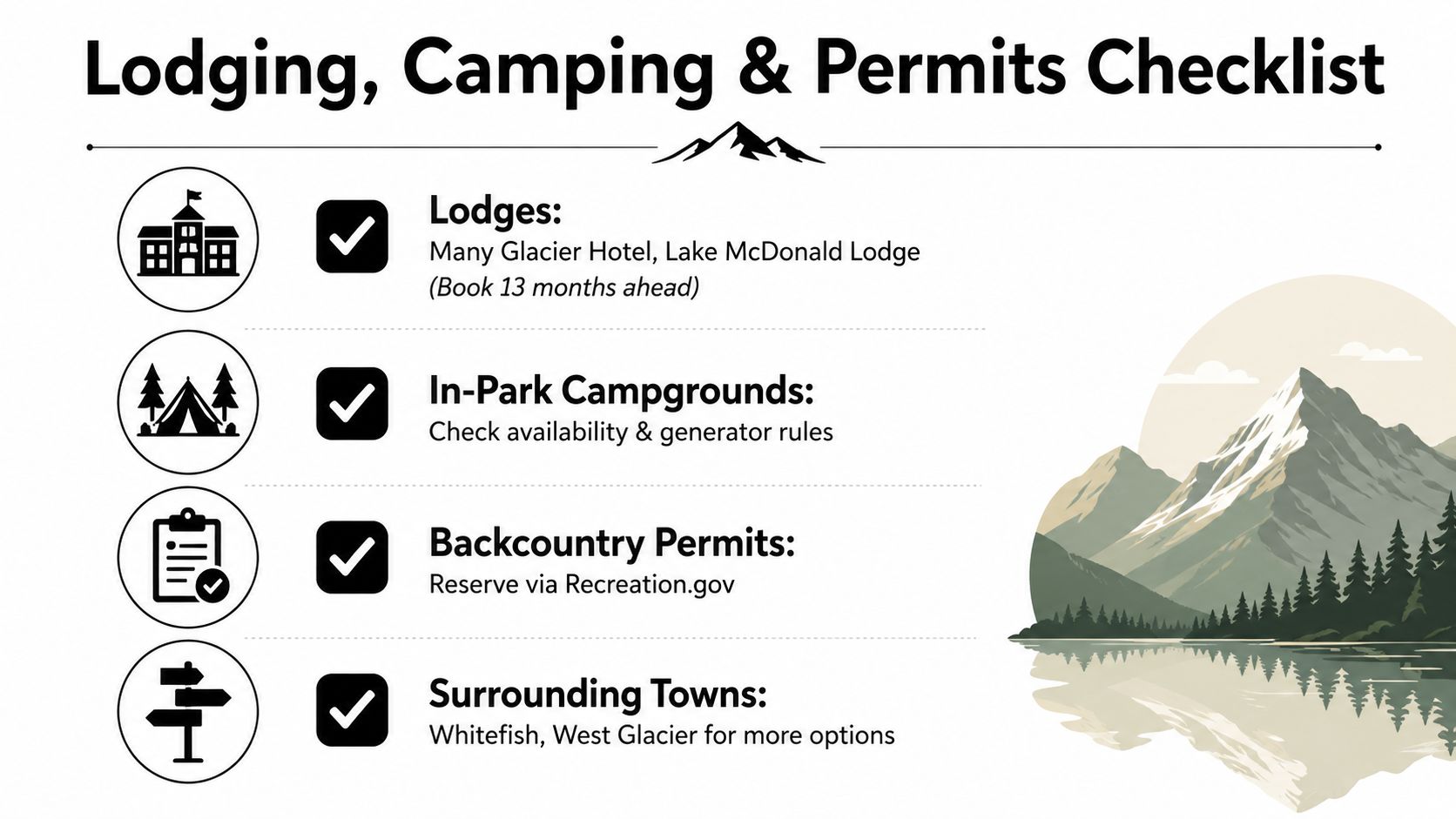
Book the bed before you finalize the trail plan. In-park lodging, including Many Glacier Hotel and Lake McDonald Lodge, can become unavailable quickly when reservations open 13 months ahead, so travelers who wait often end up commuting from gateway communities.
Where to sleep
Inside the park, compare Many Glacier Hotel, Lake McDonald Lodge, and developed campgrounds based on your preferred region. Apgar and Fish Creek suit west-side plans, while St. Mary and Many Glacier make eastern hikes easier. First-come camping requires an early arrival strategy, and reservable sites should be treated as the foundation of the itinerary rather than a secondary detail.
If you miss an in-park booking, look toward West Glacier, Columbia Falls, Whitefish, or East Glacier. Gateway lodging adds driving, but it gives you more restaurant, grocery, and accommodation choices. Choose the town that matches your primary entrance instead of assuming every base works equally well.
Backcountry permits require a separate planning track. Use the official Recreation.gov process, study designated campsite rules, and build your route around approved sites. Don't treat a backcountry permit as permission to improvise your own campsite.
Pack for exposure and limited connectivity
Bring bear spray, layered clothing, rain protection, sturdy footwear, a headlamp, food storage supplies, and a water treatment method. If you're unsure about safe field treatment, review this practical guide to purifying water while camping before departure.
Cell service can disappear well beyond the gateways. Download maps, save reservation confirmations offline, and carry printed copies of critical details. Fuel outside the park, because internal fueling options aren't available.
Packing decision: If your plan depends on a phone signal, it isn't a plan yet. Download the information before entering the park.
Safety Wildlife and Leave No Trace Practices
In Glacier, a close wildlife encounter or an exposed hike can turn serious quickly. Keep safety and conservation connected: careless food storage conditions animals to human food, shortcuts damage fragile plants, and poor weather decisions put rescuers and other visitors at risk.

Treat bear country seriously
Carry EPA-approved bear spray, not ordinary pepper spray, and practice removing its safety mechanism before hiking. Stay with your group, make noise near blind corners, and secure food and scented items. If you see a bear, assess the situation, create distance, and follow current park guidance for the species and its behavior.
Give wildlife room. Stay at least 100 yards from bears and wolves and 25 yards from other animals. Never feed an animal, approach for a photograph, or stop in the road for a better viewing angle.
Protect the environment you came to see
Remain on designated trails, especially in alpine areas where slow-growing plants and lichen can be damaged by one shortcut. Pack out everything, including food scraps and fruit cores. Use established campsites instead of clearing new areas.
Cold water, sudden weather, steep ground, and altitude demand conservative decisions. Turn around before discomfort becomes an emergency, and let storm warnings or poor visibility override a scenic objective.
RV travelers should read a practical RV travel guide before taking a large vehicle into mountain environments. Secure supplies, follow campsite rules, and avoid creating unnecessary impacts around crowded areas.
Glacier's conservation history includes designation with Waterton as an International Peace Park in 1932 and recognition as an International Biosphere Reserve in 1974, milestones documented by the National Park Service. Responsible conduct protects that legacy. Review this guide to environmental stewardship and apply its principles at every trail, campsite, and overlook.
Accessibility Family Travel and Practical Logistics
Plan accessibility around Glacier's changing access controls. In 2026, vehicle reservations are no longer required, but timed parking at Logan Pass and shuttle tickets still shape the day. Reserve the shuttle when possible, and check current parking rules before leaving your lodging. This avoids building a family itinerary around an unavailable space.
Apgar Visitor Center, the Lake McDonald Lodge area, Trail of the Cedars, and Running Eagle Falls offer more manageable surfaces than the park's rougher alpine trails. Confirm current trail and facility conditions if wheelchair access or a stroller is part of your plan.
The Going-to-the-Sun Road delivers major scenery with limited walking. Jackson Glacier Overlook and Bird Woman Falls are strong choices when mobility needs, young children, or weather rule out longer hikes. Families should use the shuttle to reduce parking searches and let children enjoy the changing views from the road.
Download offline maps before leaving gateway communities. Connectivity becomes unreliable inside the park. Fill the tank before entering, especially from Columbia Falls or East Glacier, and carry snacks, water, warm layers, and a printed itinerary. Leave time for weather and road changes. For another destination-planning example, see this Boston travel guide.
Reworx Recycling helps businesses retire computers, laptops, networking hardware, and other electronics through recycling, secure data destruction, pickups, and donation programs. Visit Reworx Recycling to arrange equipment donation or business pickup.