The popular line after a recall is "just recycle it." That line skips the step that controls risk.
A facilities lead gets a notice, sees a pile of laptops, and reaches for the same hauler who handled last year's office cleanout. That hauler may be fine for surplus gear. The hauler is the wrong first call when the notice names a defect.
Some recalled units go back to the manufacturer. Some need witnessed product destruction. Some lithium-ion packs are a fire problem, not an IT equipment disposal problem. Recycling is often the last authorized step, not the first. Chain-of-custody proof matters as much as the bin.
What follows is the order an IT asset manager uses with a facilities lead during a live recall: remedy, quarantine, serial records, media work, then a vendor who will not mix the loads.
Why Recalled Gear Is Not Ordinary E-Waste
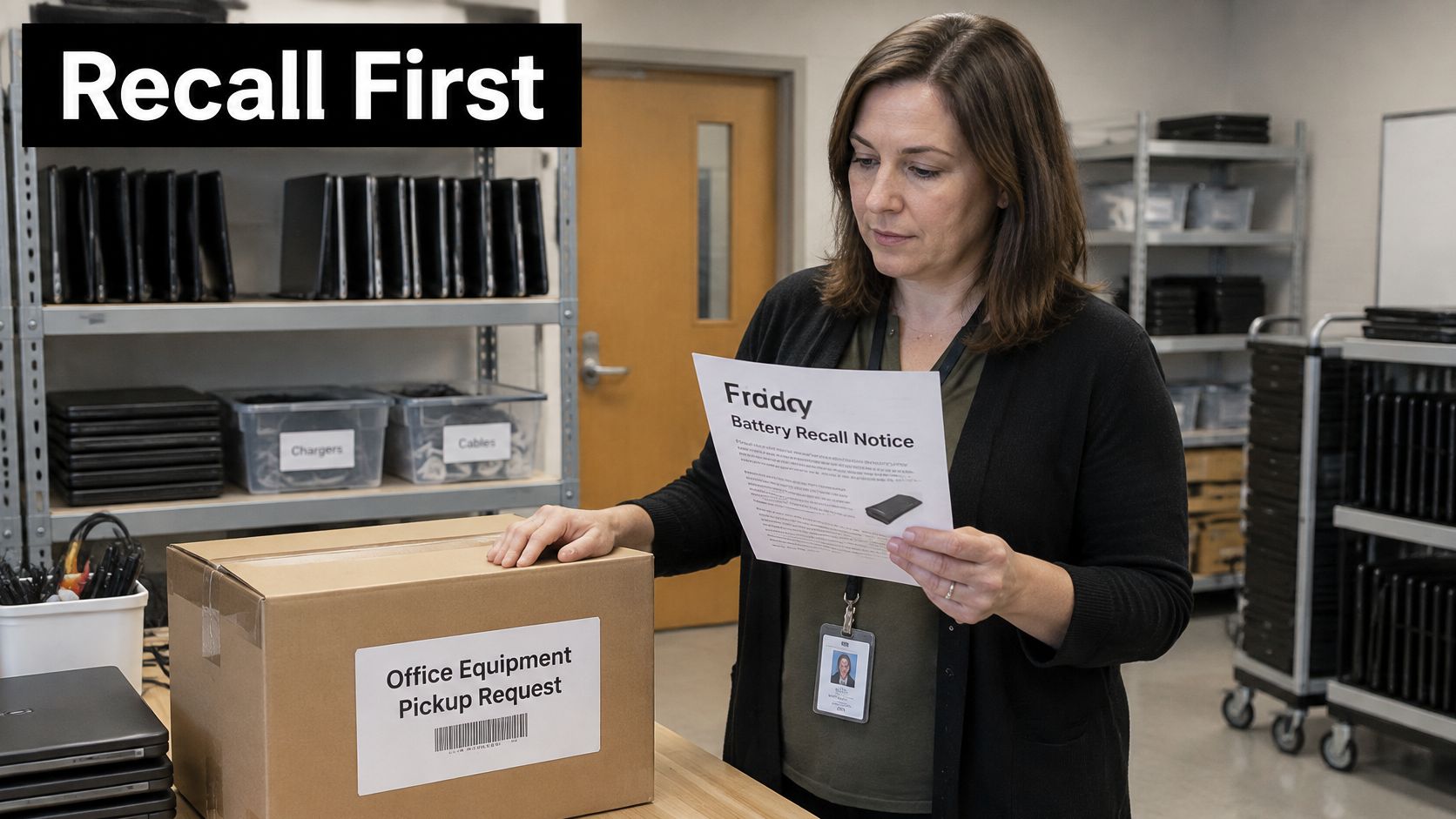
A school technology coordinator gets a Friday battery-recall notice and almost books the same pickup used for last year's office cleanout. Stop there. Recalled electronics are not ordinary e-waste, and recycling can be the wrong first move.
Some units must return to the manufacturer for repair, replacement, or credit. Others need written destruction before anyone opens a chassis. A lithium-ion device can overheat if it goes into trash, curbside recycling, or a retail battery box. "Recycle responsibly" is unsafe advice when the failure mode is thermal runaway.
In a 2025 warning, the U.S. Consumer Product Safety Commission reported 24 fires and explosions involving recalled Aeiusny power stations, including injuries and approximately $450,000 in property damage. The warning said not to use trash, curbside recycling, or ordinary retail battery boxes, and to call a household hazardous-waste center before transport because acceptance isn't universal.
Three loads on the dock
SMB owners, IT and asset managers, schools, and government facilities usually hold three different piles, and they don't share a path.
- Intact recalled laptops: They still store data, and they still carry the serials a manufacturer will ask for.
- Swollen or damaged batteries: Isolate them. They don't belong in a mixed gaylord with computer recycling.
- Surplus that is obsolete but not under recall: Test it. Donation or buyback can still be right for gear the notice doesn't name.
The order is identify the authorized remedy, quarantine, document custody, sanitize media while you keep serial evidence, then choose logistics. Match the load to a row before anyone moves a pallet.
Which Remedy Fits Each Recalled Load
Match each recalled load to a row before you call any recycler. The first action, the allowed path, and the forbidden shortcut are different for every row. Manufacturer return instructions override local recycling habits, including a client's wish to shred on site.
| Load | First action | Authorized path | Do not |
|---|---|---|---|
| Intact recalled IT with storage | Power off, log model and serial | OEM return, repair, or later certified destruction | Mixed e-waste bin or informal drop-off |
| Swollen or damaged lithium battery | Isolate and call the receiving facility | Confirmed hazardous-battery channel | Trash, curbside, or retail battery box |
| Working surplus, not on the recall | Inventory and test reuse | Donation or buyback | Shredding gear that still has life |
| Manufacturer requires return | Open a case and stop use | Reverse logistics to the OEM | On-site shred without approval |
| Authority orders destruction | Get written approval | Witnessed destruction and certificate | Unmonitored contractor disposal |
| Multi-site recall | Freeze moves and centralize the log | One quarantine lane and custody carrier | Site-by-site informal recycling |
Caveats that sit beside every row
CPSC recall guidance says recalled products should remain quarantined and segregated throughout the distribution chain. Third-party disposal contractors should be monitored so separation and proper disposal happen. Destruction may require CPSC approval and, in some cases, witnessed or otherwise verified destruction.
- Written authority comes first. A destruction order isn't a phone nod. Keep the approval with the pallet, and add a witness plus a certificate when the order calls for them. Product destruction services only fit after that writing exists.
- Battery packaging is a pre-truck check. The shipper confirms the receiving facility's packaging rules before the truck arrives. A warm or swollen cell stays out of mixed gaylords.
- A multi-site recall freezes movement until one asset log exists. Site-by-site drop-offs break the count you will need for credit and for audit.
Those rows only hold if the path is written on the pallet before the unit leaves quarantine. Intake is what creates that evidence.
How to Intake and Quarantine Recalled Units
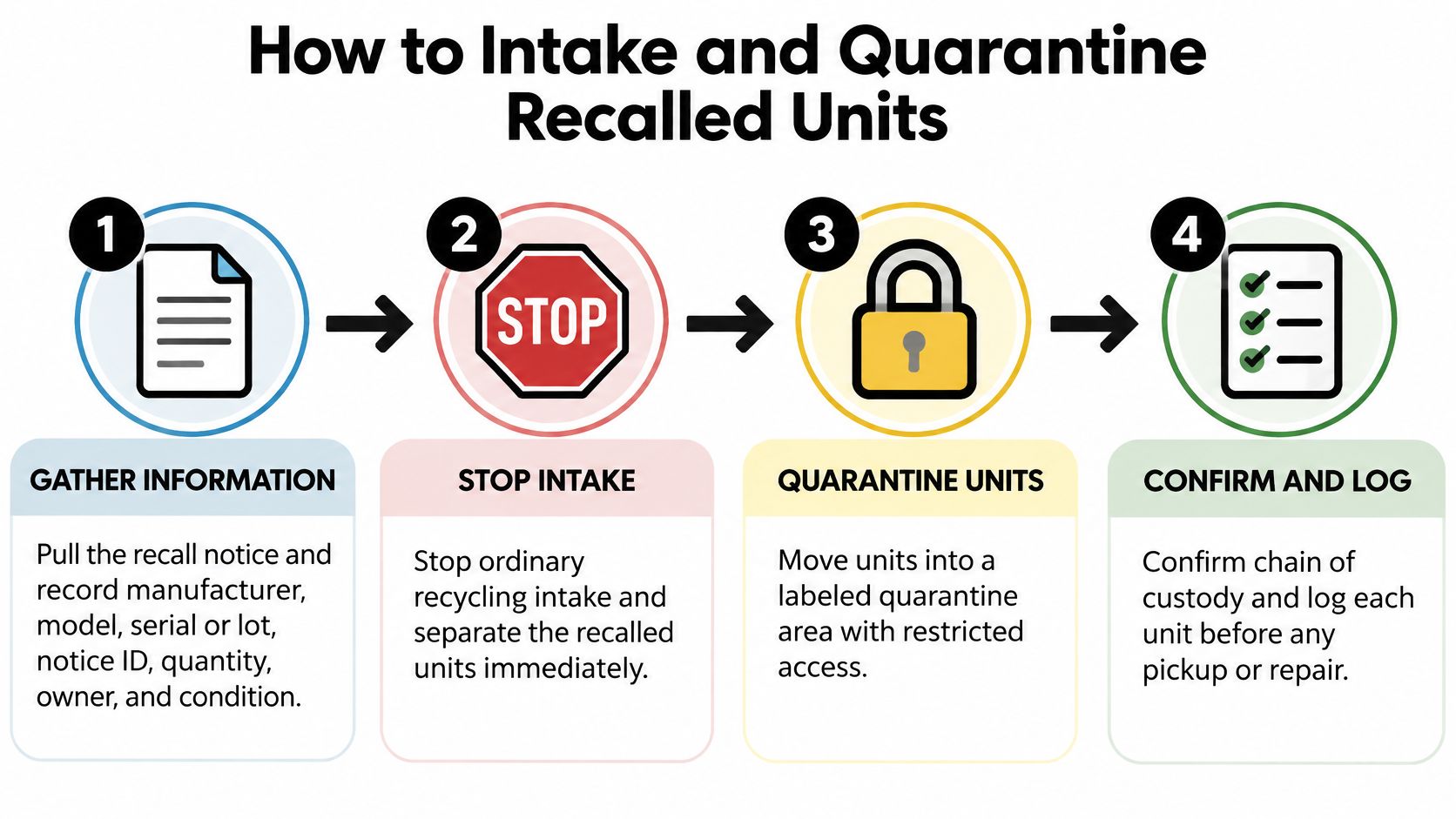
Run this the same day the notice hits. Don't wait for a hauler to "sort it on the dock."
Say a middle school has two laptop carts under the notice, and a downtown office has a separate 40-unit laptop recall from a refresh that was already staged for donation. Treat them as two counts, not one gaylord.
- Pull the notice and write the identity. Record manufacturer, model, serial or lot, notice ID, quantity, owner, and condition. A missing serial is what blocks reimbursement later.
- Stop use and collect the devices. Pull them from desks, carts, labs, and loaner pools. Note the employee or the room that had each unit. You can't reconcile a cart you never emptied.
- Segregate from ordinary streams. Keep recalled units out of returns, donation piles, and recycling gaylords. Use a labeled cage or pallet with a container ID. A mixed pallet contaminates a donation load you meant to keep.
- Photograph labels and damage. Shoot the serial plate and any swelling. Store damaged cells only under the receiving facility's instructions, not in a hallway closet "until Monday."
- Get the written path before teardown. Return, repair, destruction, or recycling has to be in writing from the manufacturer or the recall authority. Opening a chassis first destroys the evidence you needed.
- Start the custody log. Timestamps, handler names, pallet IDs, and the manufacturer case number go on every handoff. An unlogged handoff is the break an auditor finds.
- Reconcile before the carrier arrives. Match the physical count to the asset list. Hold exceptions in a separate bin so a short count doesn't ride out with a clean bill of lading.
Custody log fields for each handoff
Copy these fields. Don't invent a shorter form on the dock.
| Field | Example entry | Why it matters |
|---|---|---|
| Notice ID | 25-174 | Ties every unit to the recall authority |
| Serial or lot | Serial per laptop, lot for bulk cells | Supports reimbursement and audit |
| Pallet or container ID | Q-12 | Shows where each unit was held |
| Handler and timestamp | Name, date, time | Proves each handoff |
| Manufacturer case number | OEM-55910 | Links the unit to the remedy credit |
| Disposition certificate | DEST-4412 | Closes the custody chain |
The evidence pack is short enough to scan during the incident: the notice, the asset spreadsheet, photos, the custody log, the bill of lading, and the final certificate. Chain-of-custody documentation is the file you hand to finance and to the manufacturer, not a sticker on the gaylord.
Hold rule: Nothing leaves quarantine until the path from the decision table is written on the pallet.
How to Destroy Data Without Losing Recall Evidence
A recalled device can be ready for data destruction before it is ready for recycling. The manufacturer may require a return, witnessed destruction, or a particular battery-handling route. Keep the serial and recall evidence intact until the authorized remedy is clear.
Inventory the storage first: HDD, SSD, removable flash, embedded storage, or a cloud-linked device that still needs its account unlinked. Then match the sanitization method to the data risk and the recall instructions. NIST media sanitization guidance defines sanitization as making access to target data infeasible for the applicable level of effort. It also calls for checking the operation and deciding whether to accept the result.
| Method | Use when | Device afterward | Proof to keep |
|---|---|---|---|
| Clear | Low sensitivity and simple recovery risk | May stay usable | Tool, time, device ID, pass or fail |
| Purge | Reuse is allowed but lab recovery must fail | May stay usable | Method, verification sample, certificate |
| Destroy | Damage, failed check, or recall requires it | Unusable for storage | Serial photo, witness, destruction certificate |
Match the method to the risk
Clear suits low-risk media that will remain serviceable. A factory reset or rewrite of user-addressable space is a common approach, but it is not suitable when the result cannot be verified.
Purge suits devices approved for reuse when recovery must be infeasible. Record the method and verification result, and retain the certificate.
Destroy, including shredding, suits damaged media, failed checks, or recalls that require physical destruction. The storage device will no longer be usable.
For software sanitization, a pass screen alone is not enough. Check the result using a suitable verification method, including user-addressable space and reserved areas where applicable. If validation fails, repeat with a different or more secure technique, then record the exception and final disposition.
What the record has to name
Record the tool, method, operator, timestamp, device identifier, result, exceptions, and media-disposition certificate. Overwriting assumptions may not apply to SSDs, and a green checkmark does not show whether hidden areas were addressed.
For example, a recalled laptop may need its drive destroyed while the manufacturer still requires proof of the device identity. Photograph the serial and lot before destroying the drive. Destroying the chassis first could remove the evidence needed to support the recall credit.
Ask the processor which recognized standard it follows, such as R2 or e-Stewards, and whether it keeps erasure records. Keep the data destruction documentation tied to each device identifier, rather than relying on a general email that says the drives were wiped.
How to Contract Pickup and Reverse Logistics
The pickup contract determines whether recalled units stay traceable after they leave your site. A low haul rate can cost more in lost evidence if the carrier combines recall equipment with an ordinary office cleanout.
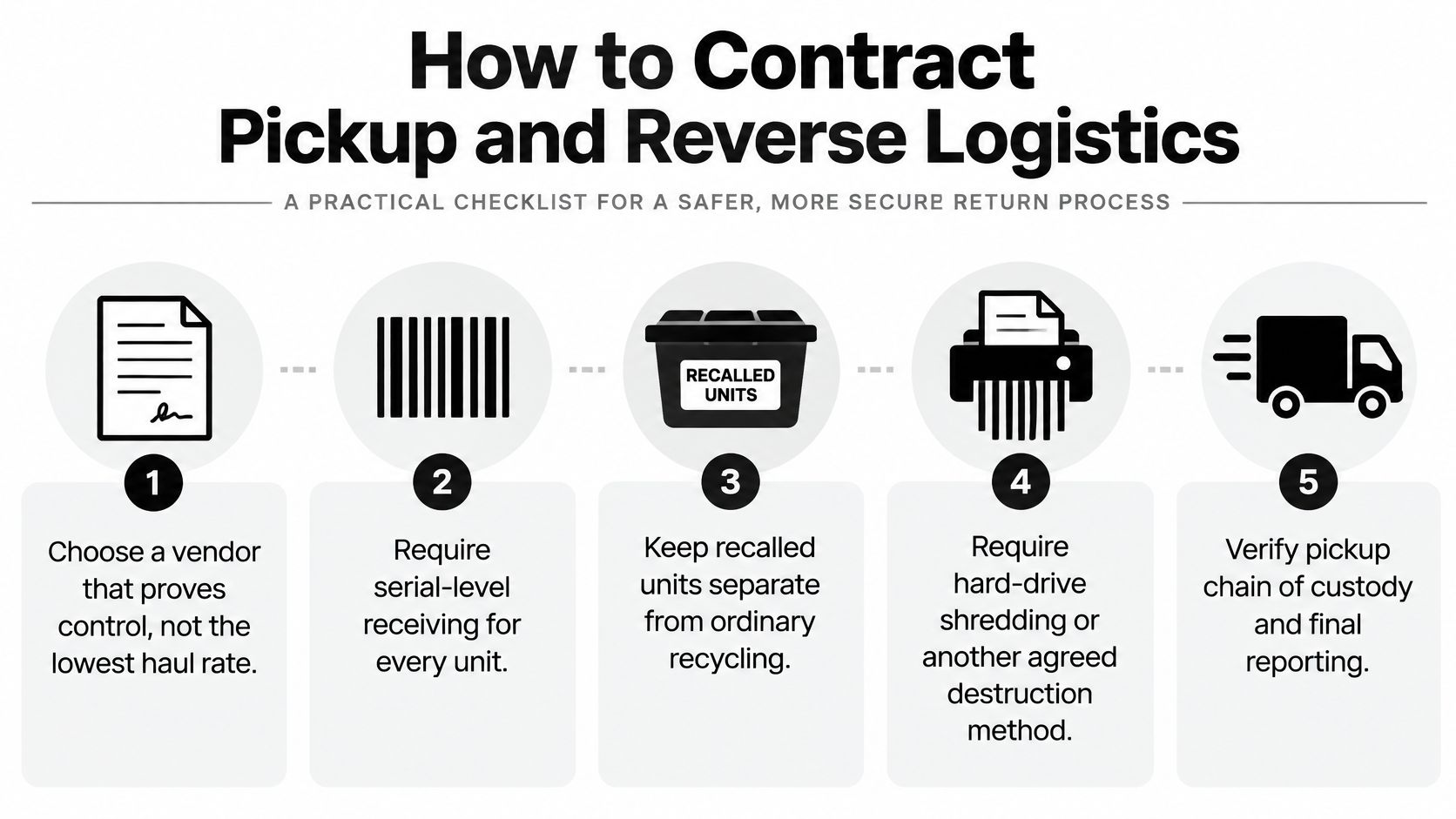
Require serial-level receiving, separate handling from ordinary electronics recycling, an agreed destruction method, and certificates that identify each device. Ask whether the provider is audited to a recognized standard such as R2 or e-Stewards, and how it controls downstream material. The U.S. Environmental Protection Agency's electronics guidance encourages recyclers to use certification from an accredited, independent third-party auditor. Such standards address reuse and recycling, worker and environmental protection, downstream handling, and data destruction.
Reuse or donation may suit working surplus when the recall remedy allows it. A return order, destruction requirement, or active hazard takes priority. Confirm the remedy before authorizing reuse.
Who pays, and who may not take the battery
If the manufacturer requires a return but security rules prevent releasing a drive before sanitization, spell out who pays for freight and how the conflict will be resolved. The OEM's shipping label does not settle the data-handling question. Put battery acceptance in the scope, and tell the carrier if the load includes lithium-ion units. A site that cannot accept damaged cells is not an appropriate destination for them.
Confirm in writing whether the service includes drop-off or pickup, IT asset reporting, recycling consultation, and a data-destruction certificate. Compare pickup and processing fees with possible manufacturer credits or buyback value for non-recalled equipment. Do not count on a credit the recall notice has not authorized.
Reworx Recycling, a full-service electronics recycling and IT asset disposition partner based in Smyrna, Georgia, is one provider to assess against the same checklist as your existing ITAD vendor. Scope reverse logistics services separately for recalled units and surplus.
| Contract feature | Recalled units | Surplus units |
|---|---|---|
| Serial-level receiving | Required, serial captured before pickup | Recommended for audit |
| Battery acceptance | Confirm the destination can accept swollen or damaged cells | Confirm the standard lithium-ion handling process |
| Destruction certificate | Names each device identifier | Required when drives hold data |
| Buyback or donation | Only after the recall remedy allows it | May be considered for working equipment |
| Freight responsibility | Defined when the manufacturer requires return | Defined in the base rate |
Before signing, make sure the contract names the scope, serial capture, separation rules, battery acceptance, certificates, indemnity, and who may witness destruction. If a required term is missing, keep the load in quarantine until the handling route is clear.
Tips for a Large Recall Incident
A single cage works for one office. A multi-site incident needs one lead and a freeze on new deployments of the affected model. Otherwise each building invents its own disposal habit by Thursday.
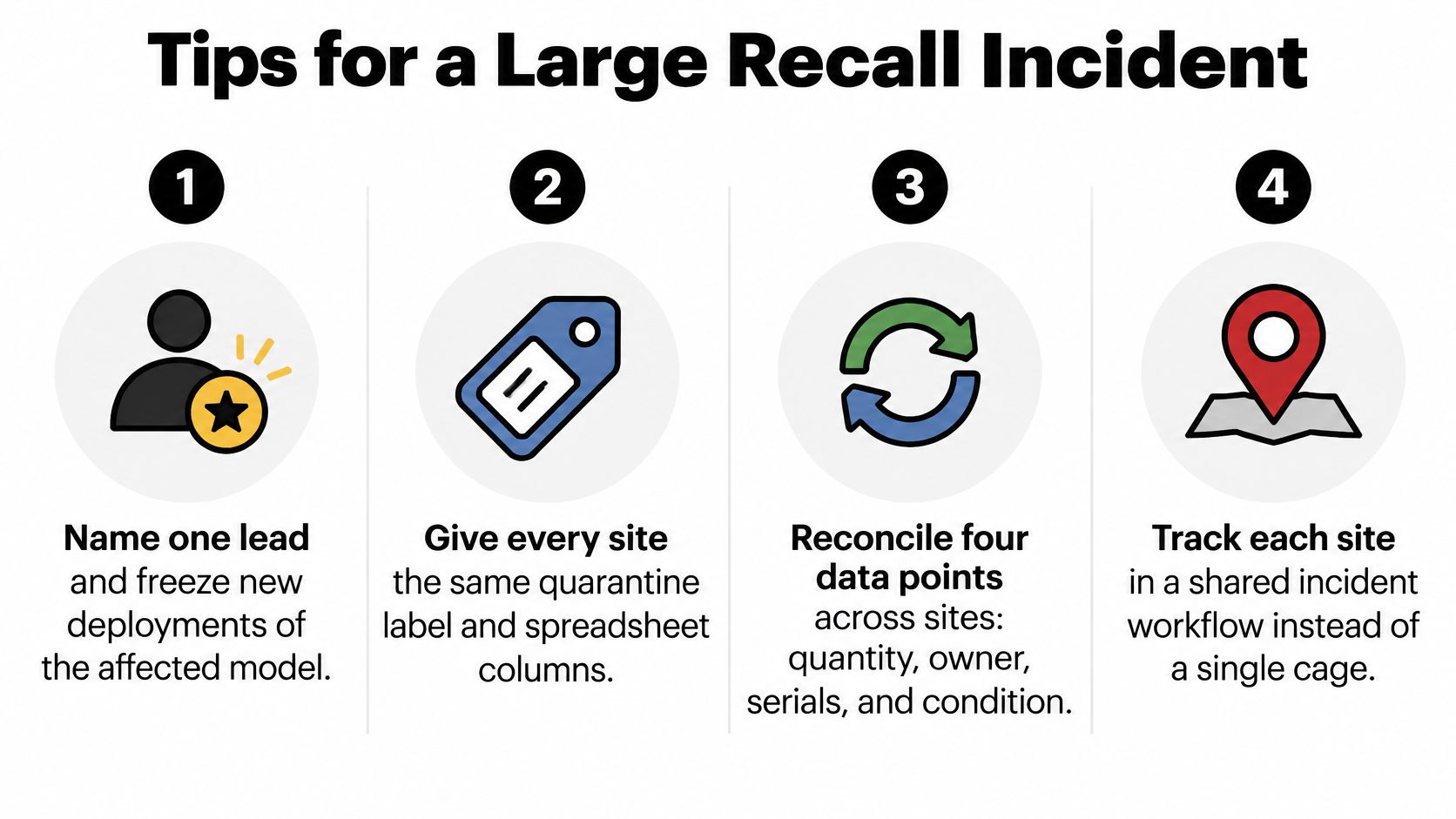
Give every site the same quarantine label and the same spreadsheet columns. Reconcile four lists daily: units found, units still with employees, units in transit, and units with a final certificate or a manufacturer receipt. Project management services for a recall are this reconciliation, not a generic status call.
Set internal site targets so people don't improvise. A practical pair is 24 hours to hand off swollen batteries to a confirmed hazardous channel, and 72 hours to move intact, powered-off laptops into custody. These are operating targets, not regulatory deadlines. The manufacturer notice or the hazardous-waste authority still governs.
Tell carriers, before pickup, that the load contains recalled lithium-ion equipment. Keep replacement credits, destruction certificates, and recycling weights in separate columns. Finance, security, and sustainability teams will misread one blended total.
Scale is why the habit matters even for a smaller event. NHTSA's 2025 annual recalls report lists more than 31 million affected units in one reported aggregate category. EU guidance published in 2025 also says consumers shouldn't be asked to dispose of dangerous products themselves when disposal could create a fire risk, and that recall instructions must give safe, clearly described actions. A 200-laptop agency event still needs the same evidence habits as a national campaign.
If a recalled model turns up in a donation pile or a corporate donation program bin, stop that drive and log the find. Don't "finish the event and fix the paperwork." Laboratory equipment disposal, medical equipment disposal, and a data center decommissioning can sit on the same dock. Only the units named in the notice enter the recall lane.
Remedy first, recycling last. Return, repair, replacement, or manufacturer-directed destruction can all outrank the bin.
Schedule a Controlled Recall Pickup
Recycling is often the last authorized step in a recall, not the first. The manufacturer may require a return, repair, replacement, witnessed destruction, or hazardous-battery handling. Keep that instruction with the asset records so the pickup follows the approved remedy.
Before requesting transport, compare the recall notice with the asset list and confirm the remedy in writing. If serial numbers, photos, or instructions are missing, complete intake first. A truck should not turn an uncertain pile into an undocumented shipment.
Keep recalled units separate from working surplus. Reworx Recycling offers business pickups, secure hard drive shredding, recycling consultations, and buyback options for surplus hardware. Working equipment may qualify for buyback; it should not be treated as a donation lot unless the applicable program authorizes that route.
For pickup planning, provide the business pickup team with the asset count and recall notice. Confirm how the recalled units will be handled and what records will accompany them. Use EPA electronics guidance for general collection context, not as a substitute for the manufacturer's remedy instructions.
Reworx Recycling serves organizations and individuals with electronics recycling and IT asset disposition services, including business pickups and secure data destruction. Contact the company through its business pickup service to discuss the load and arrange logistics.