The fastest advice you'll hear in a recall is also the advice that keeps it open. Book a general recycler, landfill the stock, or liquidate it for pennies, and the warehouse will look clean while the regulator still sees an unfinished remedy. Nationwide recalled product destruction isn't about making goods disappear. It's about proving, lot by lot and site by site, that unsafe units can't be resold and that you followed the remedy you were given.
When Destruction Is the Right Remedy
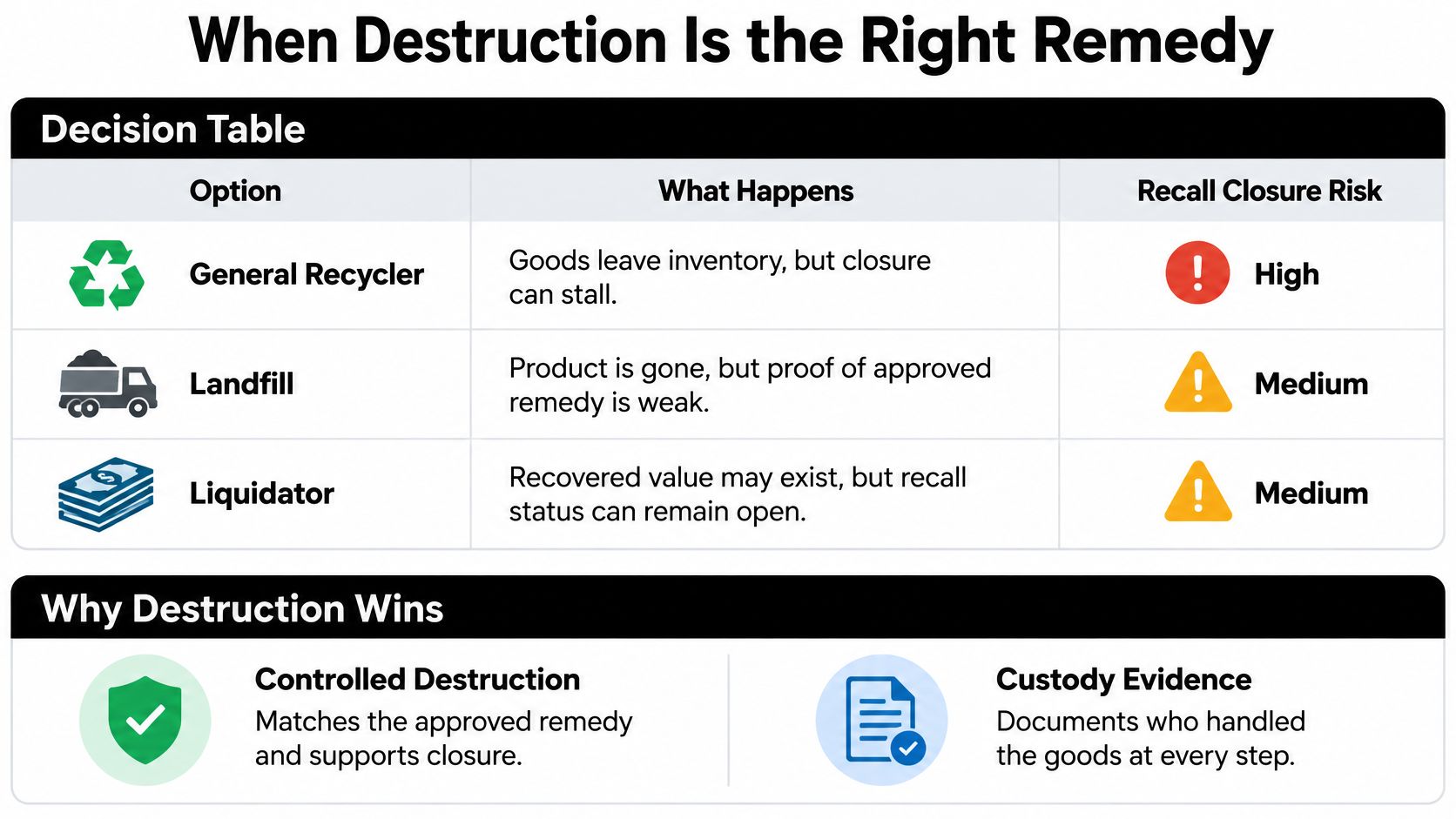
Destruction is not automatically authorized just because a product has been recalled. Refund, repair, replacement, or disposal may be the required remedy, and the written recall notice controls which actions apply. A general recycler, landfill, or liquidator can move stock without completing that remedy or showing that recalled units were handled as directed.
Read the Remedy Mix Before You Default to Destruction
Start with the written instructions, not the disposal option that is easiest to book. A refund, repair, replacement, or disposal may be specified. Destruction belongs in the plan when the notice requires it or when the instructions establish that affected units must be made unusable.
| Remedy | What it means for the affected product | Choose destruction when |
|---|---|---|
| Refund | The customer receives a refund under the recall remedy | The written instructions also require the unit to be made unusable |
| Repair | The product is corrected according to the stated remedy | The instructions require destruction instead, or the repair cannot be completed as directed |
| Replacement | The customer receives a replacement product | The written instructions require the returned unit to be destroyed |
| Disposal | The product is removed from use through the specified disposal process | The notice calls for destruction or another disposal method that prevents the unit from returning to use |
A replacement does not, by itself, resolve what happens to the returned unit. Check the notice for its handling requirements, then keep any recalled stock out of ordinary sales, recycling, or liquidation channels until its disposition is clear.
Size the Job and Name the Regulator
Before arranging transport, identify the regulator, product class, and remedy. CPSC consumer products and FDA-regulated foods, drugs, and devices follow separate tracks, with different contacts, approval steps, and evidence requirements. Confirm which instructions apply before choosing a destruction method or destination.
The scale can make those decisions harder to coordinate. The CPSC fiscal year 2024 annual report records 333 consumer-product recalls covering approximately 153 million individual units, compared with 313 recalls involving 97 million units in fiscal year 2023. A national action may involve stock across warehouses, stores, importers, and online sellers, so the remedy needs to account for each location and channel.
Cross-border movement adds another control. Under the Basel Convention text and its 2022 e-waste amendments, beginning January 1, 2025, all electrical and electronic waste moving across borders is subject to the prior informed consent procedure. That procedure requires written notification and prior written consent before shipment begins.
Practical rule: Stop sale and quarantine first. Before booking transport, record the regulator, product class, and required remedy together.
Keep non-recalled surplus separate from affected stock. After its status is clear, review asset recovery options for cleared equipment as a separate stream. Mixing it with recalled goods can send affected units into a general electronics recycling or liquidation channel before the required remedy is complete.
Run a Controlled Destruction Workflow
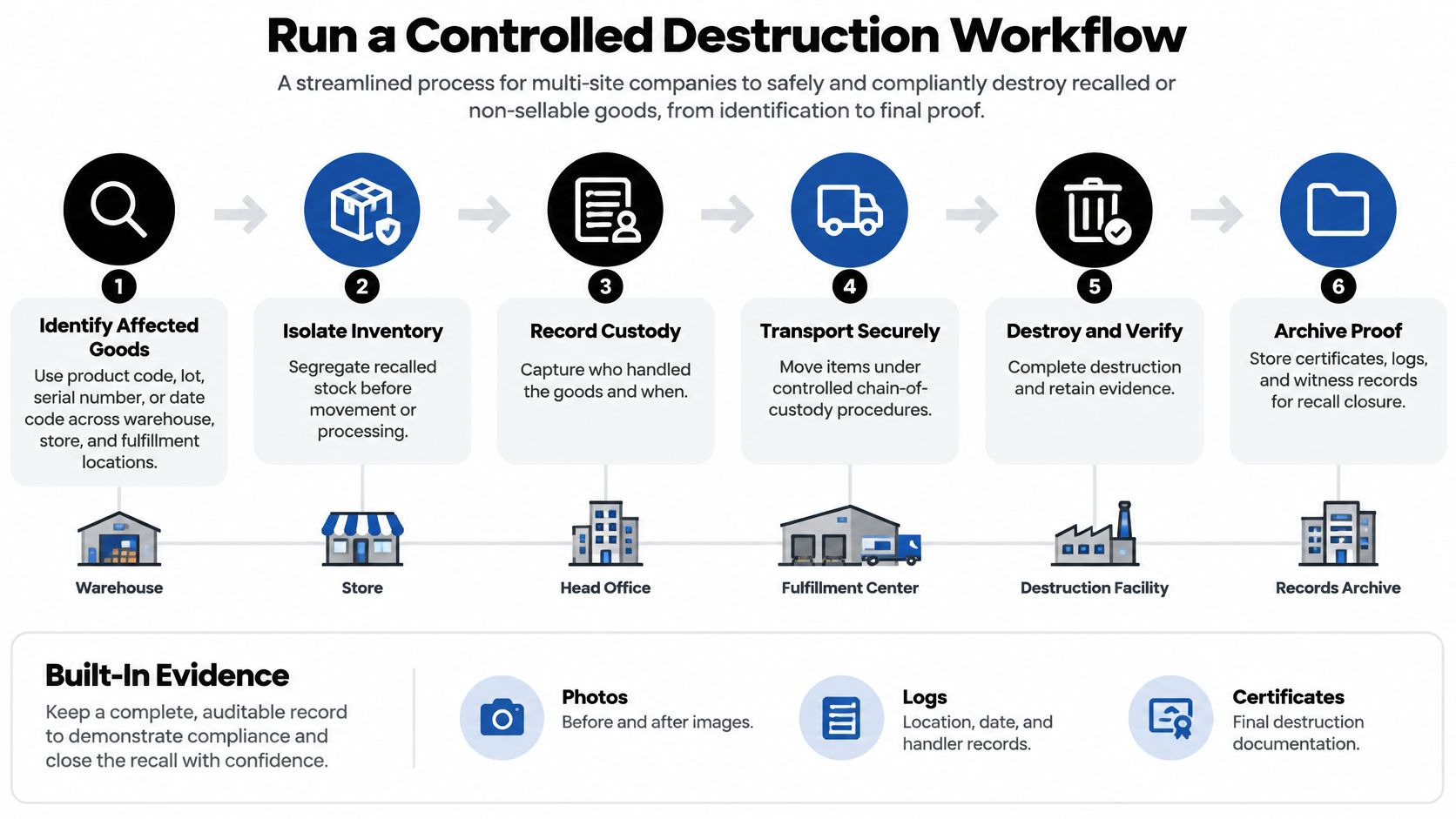
Destruction is not automatically authorized. A controlled workflow connects every recalled unit to an approved remedy and a record of its final disposition. For example, a battery SKU may be spread across 40 stores, two distribution centers, and customer returns. If each store manager improvises, counts and evidence won't match, and the total destroyed may be impossible to reconcile.
Steps 1 to 4 Identify, Notify, Quarantine, Reconcile
1. Identify affected goods. Search warehouse, store, and in-transit stock by product code, lot, serial number, or date code. A product name alone may include both recalled and unaffected production.
2. Notify and trace consignees. Log who received the notice, when they received it, and how it was sent. Keep a live list of non-responders. A missing reply leaves open the possibility that recalled stock is still in use.
3. Quarantine returns and remaining inventory. Separate recalled goods from acceptable stock in a secured, clearly labeled area. Photograph and count or identify the goods by serial number or lot before moving them.
4. Reconcile quantities. Compare opening inventory and returns with the quantities still on hand or otherwise accounted for. This running balance shows whether units remain unlocated; a destruction certificate alone cannot.
Step 5 Get Approval Before the First Cut
5. Propose the method and contact the regulator before destroying any unit. For FDA-regulated products, contact the district recall coordinator with the proposed method. For CPSC products, obtain written instructions for third-party destruction.
The battery example shows why the order matters. If 40 stores destroy stock first, the decision can't be reversed if the regulator needs to witness the work or requires a different method. Get the remedy and any witnessing requirements in writing before booking the destruction.
A certificate proves what was destroyed. It does not prove that every unit was found.
Effectiveness checks address that gap. Contact a sample of consignees to confirm they received and understood the notice, removed stock from use, and reported quantities. Track non-responders separately and follow up until they confirm removal or return.
Steps 6 and 7 Move, Destroy, and Retain Evidence
6. Move and execute under control. Use tamper-evident seals and a bill of lading that identifies the recall lot. Record each custody handoff. At the destruction site, follow the approved method and log staff, witnesses or independent verification, counts or weights, and start and finish times.
7. Issue the record and investigate variances. Prepare a destruction memo or certificate stating the date, quantity, and method. Keep transport documents, scale tickets, processing records, and photos together in the lot file. Document every variance before closing it.
Use chain-of-custody documentation to connect each shipment to its lot or item identifier, location, quantity, custody transfers, destruction date, method, operator, and final certificate. Without those links, a scale ticket records weight but not which recalled goods it represents.
Close the lot only when the quantities reconcile. Subtract destroyed, reworked, or otherwise approved dispositions from opening inventory plus returns, and account for the balance. If 12 units are missing, locate them or document their loss with supporting evidence. Until then, keep that lot open.
Mixed loads, incomplete lot identification, undocumented subcontractors, weight-only estimates, and destruction before regulator contact can all break the evidence trail. Sending recalled stock to a general recycler or liquidator may leave the goods physically gone while the recall remains unresolved. The goal is destruction that can be matched to an approved remedy and verified from the records.
On-Site Destruction or a Central Facility
Pick the location model after the method is approved, not before. A cheap freight quote means little if the plant can't run the approved method, the hazard shouldn't travel, or no witness can attend. Compare custody risk and reconcilability first, then cost.
| Model | Best when | Custody risk | Witnessing | Planning time after approval |
|---|---|---|---|---|
| On-site or mobile | Hazard should not travel, or local quarantine space is gone | Lowest transit exposure | Regulator or auditor can attend that site | Days per location |
| Single central plant | High volume of the same SKU and a certified line | Higher; sealed loads required | Witness at the plant or a written affidavit | Often 1 to 3 weeks door to certificate |
| Regional hubs | Nationwide stock with a few consolidation points | Medium if seals and counts hold | Scheduled witness windows | Often 2 to 4 weeks including freight |
When Mobile Crews Make Sense
On-site or mobile destruction fits when moving the hazard is itself a risk, stores can't hold quarantine space, or a witness must see the local lot destroyed. A mobile crew can clear a site in days, and there's no long transit leg where seals, counts, or paperwork can break down. The trade-off is repetition. Fifty sites mean fifty setups, fifty witness arrangements, and fifty chances for a local team to skip a scan.
For data-bearing equipment in a broader facility cleanout, on-site hard drive destruction follows the same logic. The media doesn't leave your control before it's destroyed. That convenience doesn't replace recall approval for the product itself.
When a Central Plant or Regional Hubs Win
Centralized destruction fits identical high-volume SKUs that can travel in sealed loads to one certified line. You'll usually get lower unit handling cost, one trained crew, and one set of equipment records. Your risk moves to transport, so seals, lot-specific bills of lading, and receiving counts have to hold.
A hybrid of three to six regional hubs fits nationwide retail or distributor networks that shouldn't run fifty separate crews or one cross-country shipment. Stores send sealed lots to the nearest hub, each hub runs scheduled witness windows, and headquarters reconciles hub certificates against store shipments. It's slower than a single plant on paper, but often cleaner in practice because freight legs are shorter and exceptions surface sooner.
Plan for edge cases before you commit.
- Damaged labels: Hold units you can't tie to a lot and log them as exceptions. Don't guess their identity to make a count balance.
- Mixed pallets: Re-sort recalled and good goods under supervision and recount. A mixed pallet sent to a central plant becomes a mixed certificate.
- Lithium batteries and hazardous materials: Confirm the carrier and plant can legally take them. This can change packaging, routing, and the destruction method itself.
Don't treat component harvesting or sustainable recycling as a location decision. Harvesting parts, reclaiming materials, or recycling cases is a different outcome from destruction and needs its own approval, even if the same building does both. Book the model that matches the approved disposition, not the building you already use for computer recycling or an office cleanout.
Pick the model that keeps counts reconcilable, not the one with the lowest freight quote.
If you can't explain, for each lot, where it was counted, who sealed it, who received it, and who watched it destroyed, the model is wrong for that recall. Change the model before you change the paperwork to fit it.
How to Choose a Destruction Vendor
A low bid can still leave the recall open. Destruction is not automatically authorized, and sending recalled stock to a general recycler or liquidator can make it harder to close the file, even after the goods are gone. Put the approved disposition and proof requirements in the bid before booking a truck.
The Bid Checklist
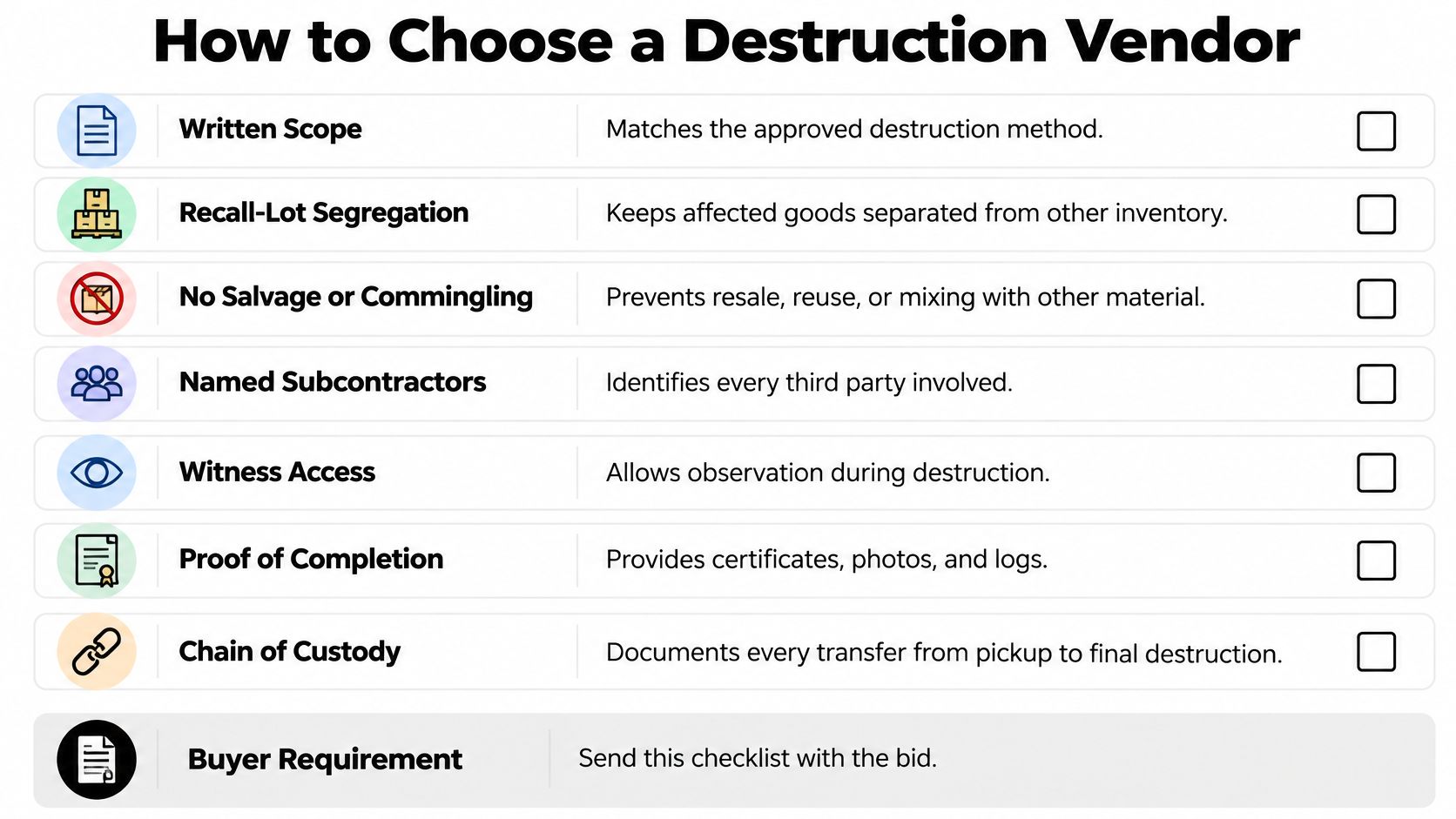
Require each bidder to confirm these controls in its written scope. A sales promise is not enough; the scope should say what the vendor will do and what records you will receive.
- Approved method match: Name the exact method authorized for the recall, not a generic recycling process.
- Recall-lot segregation: Keep recalled goods separate from other inventory from receipt through destruction.
- No salvage or commingling: Prohibit resale, parts harvesting, or mixing with other material unless separately approved in writing.
- Named subcontractors: Identify every carrier, transfer point, and downstream processor before work starts.
- Witness access: State whether your auditor or the regulator can attend, or specify the affidavit and photographic evidence the vendor will provide.
- Proof package: Provide a certificate stating the date, quantity, and method, with photos and scale evidence tied to the lot.
Compare bids against your vendor selection criteria, not against each vendor's sales format. If freight is included, compare courier speed, pricing and tracking as custody controls: transit time affects the schedule, and tracking helps account for the shipment while it is in transit.
Separate Data Destruction From Case Recycling
Recalled electronics raise a separate question: what happens to the data? The NIST media sanitization guidance describes destruction as rendering target data recovery infeasible using state-of-the-art laboratory techniques while leaving the media unable to store data afterward. It lists disintegration, incineration, pulverizing, shredding, and melting as physical methods and advises using trained and authorized personnel.
Clearing or purging data may leave a device usable, so it is not the same as physically destroying the product. A factory reset alone does not establish that the recall remedy was completed, particularly for encrypted or damaged drives. Specify who is authorized to destroy the media, which serials must be accounted for, who approves the work, and what custody records the vendor must provide. General IT equipment disposal guidance does not authorize a recall remedy, and recalled hazardous units are not donation candidates.
Price the Drivers, Not a National Rate
| Driver | What it covers | Timeline effect |
|---|---|---|
| Freight | Miles, sealed loads, and carrier type | Adds to the 2 to 4 weeks for regional hubs |
| Hazardous-material handling | Lithium batteries and similar items that affect carrier and plant requirements | Requires carrier approval and plant scheduling before shipment |
| Labor hours | Trained operators, witnesses, and count crews | Mobile-crew work is scheduled by location |
| Witness time | Regulator or auditor attendance at the site | Depends on scheduled witness windows |
| Serial reconciliation | Unit-level scans or piece counts | Adds scan time at quarantine and destruction |
| Certificate packaging | Memo, photos, scale tickets, and custody files | Adds time after destruction before the lot file is complete |
Build the schedule in sequence: regulator notice, processing at the chosen location, then certificate preparation. A quote that promises destruction in three days but delivers certificates in six weeks is not a three-day recall closure. Compare the full timeline and proof package, not just the date the equipment leaves your site.
Mistakes That Keep a Recall Open
The error that blocks closure most often is destroying before notice. The CPSC recall handbook advises companies to quarantine and segregate recalled goods, obtain written instructions for third-party destruction, prevent commingling or salvage, and request verification before disposal. It notes CPSC may witness destruction or require an affidavit and photographic evidence.
If your team has already destroyed stock, pause everything else. Contact the FDA recall coordinator or follow the CPSC written instruction process for what remains, and document what was destroyed early with whatever counts, photos, and witness records you have. Don't present already-destroyed goods as a substitute for that notice.
Fix the Failure, Don't Paper Over It
- Mixed loads: Stop the line, re-sort under supervision, and recount before any certificate is issued. A certificate for a mixed load certifies confusion.
- Incomplete lot identification: Hold units with unreadable codes as documented exceptions. Guessing a lot number to balance a spreadsheet creates a false record.
- Undocumented subcontractors: Get every downstream party onto the custody record or exclude them from the job. An unnamed transfer is a custody gap.
- Weight-only counts: Add piece counts or serial scans where the remedy requires unit-level proof. Weight can't show which serials are gone.
- Certificate without effectiveness checks: Go back to silent consignees and confirm they received the notice and removed stock. Destruction at headquarters doesn't clear a distributor's shelf.
A second pitfall is calling recycling, component harvesting, reconditioning, or donation destruction. They're different outcomes and may need separate approval and controls. The label your vendor puts on the invoice doesn't change the remedy the regulator approved.
Say a school runs an office cleanout and mixes recalled chargers with ordinary surplus laptops in one pickup. Split the streams at the dock. The chargers stay in labeled quarantine on the approved destruction path, while the laptops follow normal laptop disposal or donation review. If they travel together, you'll struggle to prove which items the destruction certificate covers.
Prevent repeats with one national playbook. Use the same quarantine label, the same reconciliation sheet, and the same exception log at every site, whether it's a warehouse, store, school, or agency office. Local improvisation is how nationwide programs produce local records nobody can add up.
Close the File and Handle What Is Left
Build the audit pack as one set per lot: notice list and non-responders, quarantine logs, reconciliation to zero, transport seals, witness notes, photos, scale or count tickets, and the certificate or destruction memo. Use a consistent destruction certificate template so every site records date, quantity, and method the same way. Don't close while a variance is open or a consignee hasn't confirmed removal.
Audit a sample of sites, not only the plant that did the shredding. Pick stores or offices at random and trace one lot from their quarantine log to the final certificate. If the trail breaks at a transfer point, fix that handoff before the next recall uses it.
Then handle what was never in the recall. Surplus laptops, office cleanout gear, and data-center equipment from a data center decommissioning project can follow donation-based recycling or IT asset disposition (ITAD) once you've confirmed they're cleared. Before donating, confirm each device is usable equipment rather than discarded e-waste, because Basel Convention guidance treats the two pathways differently and the choice determines the required paperwork.
Reworx Recycling, a social enterprise recycling organization based in Smyrna, Georgia, takes that cleared stream through documented secure data destruction, responsible recycling, and donation of suitable devices through corporate donation programs that support community technology access. Schedule a pickup or recycling consultation for non-recalled assets from medical equipment disposal, laboratory equipment disposal, or general IT equipment disposal, and keep recalled hazardous units on the destruction path already approved.
Proof that unsafe units cannot be resold is what ends the program, not the fact that a truck left the dock.
If you're separating recalled stock from cleared surplus, talk to Reworx Recycling about business pickup, secure data destruction, and donation-based recycling for the equipment that's safe to reuse or recycle. Keep recalled units on their approved destruction path, and give the rest a documented second life that supports digital inclusion in your community. Visit Reworx Recycling to schedule a pickup or plan your next IT asset disposition project.