U.S. recalls across the automotive, consumer-product, food-and-drink, medical-device, and pharmaceutical sectors involved 580.4 million defective units year-to-date through November 2024, according to Sedgwick. That volume is the starting problem, not proof that anything is finished. A shred photo and a signed certificate don't tell you whether the recalled population is gone.
Secure product recall destruction is the job of accounting for every unit, then picking a disposition that matches the hazard. IT, facilities, and sustainability managers share one file: what came back, what was repaired or replaced, what was destroyed, and what is still out. I would not book a pickup until that reconciliation is on paper and each lot has a stamped path.
Offices, schools, hospitals, and public agencies hit the same gap during laptop disposal, an office cleanout, laboratory equipment disposal, or a wider facility cleanout. The certificate is one record. It isn't the close.
Why a Certificate Does Not Close a Recall
A recall closes only when every unit in the population is accounted for as returned, repaired, replaced, or destroyed, with evidence for each disposition. Start with the reconciliation test: compare the affected population against those four outcomes and identify any unexplained remainder.
A U.S. Consumer Product Safety Commission study of 21 recalls found that, on average, 33% of products sold to consumers were returned or repaired. That figure describes a gap in consumer response, not destruction success. A completed destruction batch may account for only a small share of the recalled population.
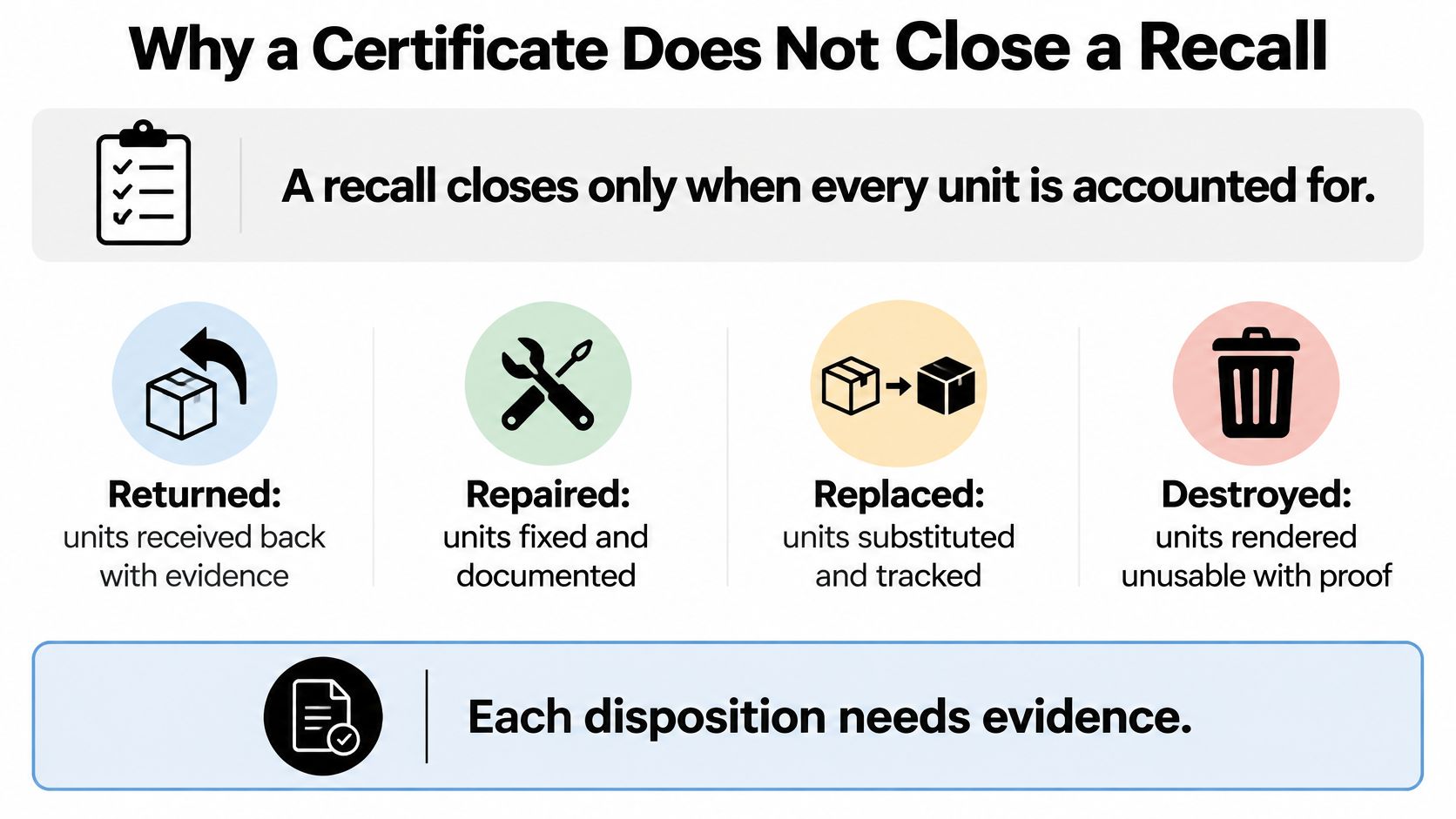
Four false closes
Counting notices as dispositions. A mailed or emailed customer notice documents communication. It does not account for a unit. Record the returned product, repair ticket, replacement, or other disposition separately.
Mixing recalled and unaffected stock. Once lots share a pallet, the count is harder to defend. Quarantine the recall population before it moves, and keep affected lots identifiable through intake and processing.
Destroying evidence before it is logged. Capture serials, labels, and photos while each unit is still available. A later certificate cannot supply a missing ID.
Closing while quantities stay unexplained. Keep outstanding units on the recall until each has a recorded outcome or an explanation. Do not use silence as a variance code.
The dashboard that replaces a certificate
Keep six measures open until the file closes: destruction yield, reconciliation variance, customer-response rate, unresolved inventory, time to final disposition, and audit-sample pass rate. Read them together. A high destruction yield does not close the gap if unresolved inventory remains large.
Practical rule: The starting population must reconcile to the four dispositions plus any explained remainder. If the quantities do not add up, the recall is still open.
A recall plan should name the destruction method, specify how the work will be recorded, and define which records must be retained. Regulators may review or witness the work. Keep the certificate with the population list and exception log, and use a documented chain of custody to connect the recorded quantities to the material handled. The reconciliation establishes what remains; the hazard-based disposition decision determines what happens to it.
Choose Destroy Recycle or Return
A recall closes when every unit in the affected population has an accounted-for disposition and supporting evidence. Assign a path to each lot before arranging transport. The right choice depends on whether the product can be made safe, whether a regulator permits rework, and whether reuse could return the hazard to commerce.
Assess each lot for injury risk, contamination, data exposure, repairability, regulatory approval, and resale risk. Controlled disassembly and material recovery may avoid blanket shredding, but record why reuse, resale, donation, or export will not reintroduce the hazard.
| Situation | Path | Use it when | Evidence to keep |
|---|---|---|---|
| Injury or contamination hazard | Destroy | Product cannot be made safe for reuse | Method, quantity match, photos or witness notes |
| Data-bearing electronics | Sanitize or destroy media, then recover materials | Storage can still be read | Asset IDs plus media disposition record |
| Regulator-approved rework | Return or repair | Written approval allows correction | Serial reconciliation and disposition instructions |
| Risk removed, materials clean | Recycle | Reuse and resale are documented as unsafe or barred | Downstream facility name and recovered weights |
| Resale or donation risk | Render unusable, then recycle or destroy | Housings or parts could re-enter commerce | Photos of rendering plus destruction record |
| Cross-border movement | Hold | Required destination consent is missing | Notification and written consent before shipment |
What each row is protecting
Injury or contamination. Destroy the product if it cannot be made safe for reuse. A bale of recyclable material is not a satisfactory disposition if a recalled product can still function.
Data-bearing electronics. Record media disposition before material recovery. Laptops, drives, and connected devices may retain readable data even when their housings are damaged. Include asset IDs and the media outcome in the record. This is the electronics use case for IT asset disposition (ITAD), including computer recycling after media risk is classified. It is not a default route for food, drugs, or other recalled goods.
Regulator-approved rework. Return or repair units only when written approval allows the correction. Reconcile serials against the approved disposition instructions.
Clean materials. Recycle only when reuse and resale are documented as unsafe or barred. Record the downstream facility and recovered weights.
Resale or donation risk. Render housings and branded parts unusable before recycling or destruction if they could re-enter commerce. Corporate donation programs and social enterprise recycling are for surplus gear that was never recalled, or recalled electronics only when donation cannot return the hazard to someone's hands.
Cross-border loads. Hold the shipment until required consent is documented. Record notification and written consent before dispatch.
Write the decision before the pickup
A 2026 California proposal would require manufacturers to provide free return or proper disposal through consumers, retailers, recycling centers, municipal facilities, and permitted waste sites. It would also prohibit exports that create significant public-health or environmental risk.
Don't book the truck on a lot that still says "TBD."
Use reverse logistics for recalled returns to keep units on their assigned path and separate from ordinary returns. Reworx Recycling handles electronics after media risk is classified, not as the default processor for every recalled product.
Match the Method to the Hazard
Match the method to data sensitivity and the physical hazard, not to whichever shredder happens to be on the dock. NIST SP 800-88 identifies four media-sanitization categories: disposal, clearing, purging, and destroying. Organizations should sanitize or destroy digital media before disposal or release for reuse outside the organization, so unauthorized people can't read what was stored on it. Destruction is the end point because destroyed media can't be reused as originally intended.
Acceptable physical methods include disintegration, incineration, pulverizing, shredding, and melting. Only trained, authorized personnel run them, and only after safety, hazardous-material, and special-disposition rules are settled. Ordinary electronics recycling isn't proof that data is gone. Document secure data destruction and physical product destruction as separate lines.
| Method | Best fit | What it proves | Limit |
|---|---|---|---|
| Clear | Low-sensitivity media approved for release | Data removed by an approved clear technique | Not enough for moderate or high confidentiality |
| Purge | Media that may leave the organization | Stronger sanitization short of physical ruin | Still needs a per-item disposition record |
| Shred, disintegrate, or pulverize | Drives and small electronics | Media can't be reused as intended | Particle size must match the classification |
| Crush | Housings and bulky goods | Product can't be reassembled | Data may survive inside |
| Incinerate or melt | Ultimate physical destruction | Nothing remains in original form | Permits and hazardous-material controls come first |
| Decontaminate at a permitted site | Contamination is the hazard | Hazard treated under the site's approval | Doesn't by itself destroy data or stop resale of intact parts |
What each method leaves behind
Clear fits low-sensitivity media that is approved for release. It doesn't cover moderate or high confidentiality. If the classification is wrong, a "cleared" drive is still a leak.
Purge is the middle path when a lower classification allows the media to leave and full destruction would be excessive. You still need a per-item disposition record. A batch note that says "purged, see attached" without asset IDs fails the reconciliation test.
Shred, disintegrate, or pulverize drives and small devices when particle size fits the confidentiality level. The limit is the cut size. A coarse shred that leaves readable fragments doesn't meet a high classification just because the machine was loud.
Crush housings and bulky goods that must not be reassembled. Crush marks don't wipe data. Pull or destroy the media first, then crush the shell so it can't be rebuilt and resold.
Incinerate or melt when nothing may remain in original form. Permits and hazardous-material controls come before the burn or the melt. This isn't an on-site favor from a general recycler.
Decontaminate only at a permitted facility when contamination is the hazard. That approval doesn't destroy data and doesn't stop intact parts from being resold.
Tie the record to the class
NIST's media-sanitization FAQ calls for a certificate of media disposition for each piece of electronic media after sanitization, and for aligning low, moderate, and high confidentiality with clear, purge, or destroy. Name the class on the asset before the method is chosen. The same logic covers data center decommissioning, medical equipment disposal, and laboratory equipment disposal when the device stores data or holds a hazardous component.
Mercury lamps, switches, and similar parts don't belong in a general shred stream. Route them through a mercury-containing equipment path with its own manifest, separate from the data-bearing media record.
Run Intake Custody and Destruction
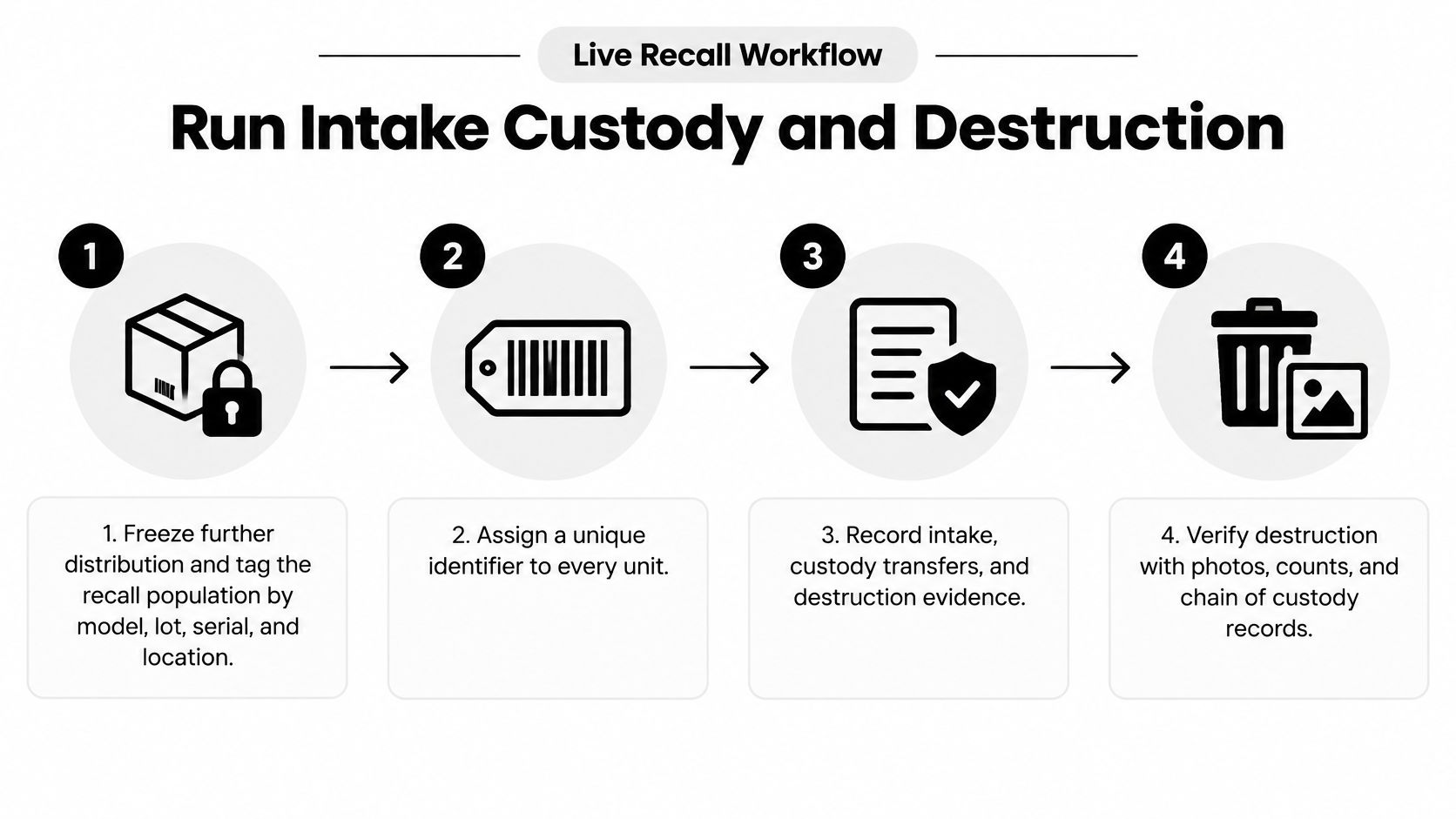
Run the live recall in this order. Each handoff produces a record. If the record is missing, the unit doesn't move.
Ten handoffs
- Freeze distribution and tag the population. Stop further shipments. Tag by model, lot, serial, and location. The record is the recall population list.
- Assign a unique identifier to every unit or lot before it moves. No ID, no travel.
- Receive against that list. Quarantine anything that doesn't match. Don't mix unaffected stock into the cage.
- Segregate by the path already chosen. Destroy, media first, rework, or hold. A mixed gaylord erases the matrix.
- Record every custody transfer with date, location, personnel, and seal or container ID. Include secure transport and locked storage.
- Reconcile before processing. Received, outstanding, repaired, replaced, and destroyed counts have to be written down before the first unit is destroyed.
- Preserve photos or video and a sample of labels where the hazard review needs them, then destroy with a method that prevents reuse.
- For storage media, document the sanitization decision, who acted, the resources used, and the interfaces with the responsible official.
- Sample when you can't check every item. Use a pre-set random or pseudorandom sample, done by someone who didn't run the original sanitization.
- Issue the destruction record naming method, equipment, operator, and verification evidence.
NIST's sanitization guidance separates verification from validation. Verification checks whether the destruction or sanitization finished without technical errors. Validation is the formal decision that the evidence supports acceptance of the residual confidentiality risk. A clean machine log is verification. Someone with authority still has to validate the residual risk.
When a sample fails
Failed samples trigger quarantine, root-cause analysis, and reprocessing. They don't get a quiet pass. Sampling should be defined before the job, tied to the risk classification, and preferably run by personnel independent of the original action. That pattern fits recalled laptops, storage devices, and connected products that need both product destruction and data protection.
A vendor certificate without serial, quantity, and exception reconciliation is the common control failure. Don't treat it as proof the population is gone.
Transport, storage, and hazmat
Put units in sealed, numbered containers. Store them locked, with an access log. A carrier manifest travels with each lot and matches the container IDs.
Treat lithium batteries and damaged units as a separate hazmat path. Segregate them, keep them in approved containers, and confirm the carrier's packaging and labeling rules before pickup. A swollen pack doesn't ride in the same gaylord as intact laptops.
Confirm federal and state hazardous-waste and e-waste requirements for each lot before it moves. Hold any load whose destination lacks the consent or documentation the matrix already required. Sustainable recycling of the clean fraction can wait. An unexplained or undocumented load can't.
Pick a Vendor and Recover Value
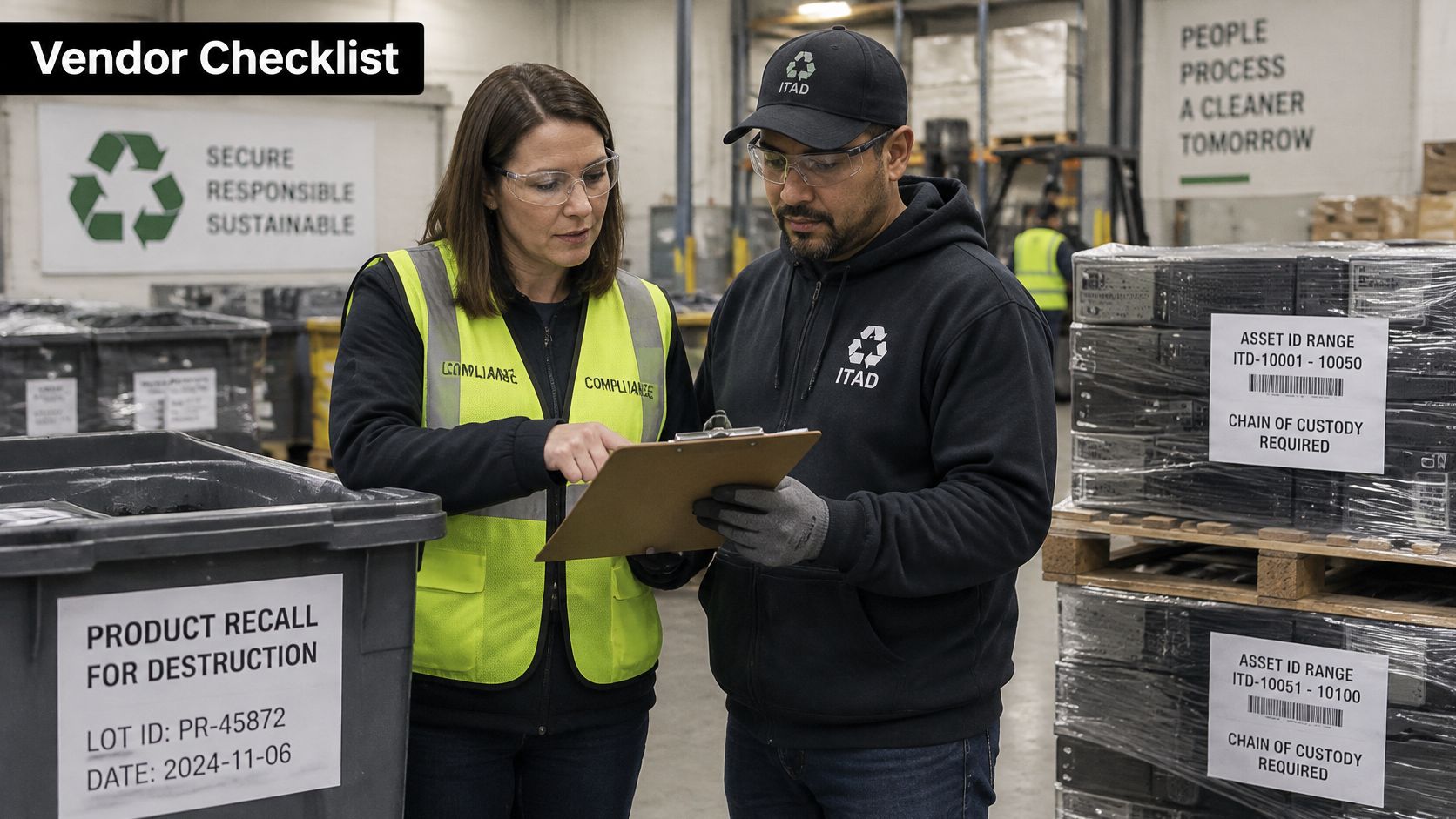
Once the method is chosen, the vendor checklist is short and essential. Ask for recall or ITAD experience, trained operators, a written chain of custody, unique asset or lot IDs, photos where the hazard allows, and dual sign-off on final disposition. Certificates should name method, equipment, operator, date, and quantity. Require named downstream recyclers. Refuse any export that lacks written consent.
The Basel Convention e-waste amendments make transboundary movements of electrical and electronic waste subject to prior informed consent. The exporting state must give written notification to the importing state and any transit states, and those states must give written consent before the movement begins.
What to demand on the certificate
Method and equipment. "Destroyed" isn't a method. Name shred, pulverize, incinerate, or the sanitization technique, plus the machine or facility.
Operator, date, and quantity. The quantity has to match the lot ID on the manifest, not a rounded estimate from the scale house.
Exceptions. Short counts, damaged seals, and failed samples stay on the certificate or an attached log. A clean certificate that hides a short count is worse than a messy one.
Downstream names. If materials move after rendering, the next facility is part of the file. "Recycled" with no destination isn't an environmental outcome you can defend.
Recovery only after the hazard gate
Value recovery is a second decision. The U.S. Environmental Protection Agency reports that recycling one million laptops saves energy equivalent to the annual electricity use of more than 3,500 U.S. homes. Recycling one million mobile phones can recover approximately 35,000 pounds of copper, 772 pounds of silver, 75 pounds of gold, and 33 pounds of palladium. Use those figures only for material that has already passed the hazard gate. They don't justify sending readable drives or intact recalled housings into a general electronics recycling stream.
For offices, schools, and public agencies, pair secure hard-drive destruction and IT equipment disposal with donation-based recycling only when the recall file shows resale and donation won't reintroduce the product. Cost recovery belongs on the clean, non-recalled, or fully rendered fraction, documented separately from the destruction yield.
File the Closeout and Book the Work
A recall closes only when the starting population reconciles to documented dispositions, with every outstanding unit assigned a reason. Keep the closeout file in a consistent order so an auditor can trace quantities to the records supporting them.
Starting population. Record model, lot, serial, and location totals at recall opening.
Quantities by disposition. List returned, repaired, replaced, destroyed, and outstanding units separately.
Variance explanations. Give every unreconciled unit a named reason, not a rounding note.
Method and facility. Record what was done, where, and by whom.
Certificate numbers. Tie each number to lot IDs, not just a PDF folder.
Sample pass rate. Include failed samples and the rework that followed.
Exceptions and rework. Log quarantine releases, reprocessing, and the person who approved each action.
Open customer follow-up. Keep nonresponsive accounts listed until the effectiveness check is complete.
Lessons for the next recall. Identify one change to make, such as capturing serial numbers at point of sale, quarantining products sooner, or improving customer records.
An unexplained quantity keeps the recall open, even when the certificate file is complete. Compare the closeout records with these certificate requirements before archiving the file.
Three next steps
Apply the disposition matrix. Route each unit according to its assigned outcome. Keep equipment out of donation or recycling channels if that could reintroduce the hazard.
Schedule work for controlled loads. Before booking a pickup for quarantined laptops, office equipment, or data-center assets, assign IDs and select the disposition method.
Assign the electronics work. Secure hard-drive destruction, IT asset disposition, and downstream recycling can cover the electronics portion of a recall. The closeout still needs to reconcile the full product population.
Reworx Recycling provides electronics recycling and IT asset disposition, including secure hard-drive destruction, IT equipment disposal, and business pickups. For eligible electronics loads, Reworx Recycling can support the electronics work while your team maintains the recall's population and disposition records.