The Miramar Recycling Center at the entrance to Miramar Landfill is the default option for most household electronics in San Diego. Businesses with large quantities should use specialized collection and recycling services and call ahead to confirm accepted items and fees.
For an office manager, the harder question isn't where to unload equipment. It's whether the handoff protects company data, accounts for every asset, and leaves a usable record of what happened afterward. Electronics recycling in San Diego, CA, works best when you choose by load size and risk, not just by whether someone advertises free collection.
Where to Take Electronics in San Diego Today
For a household, a manageable load can go to Miramar Recycling Center. For an organization, choose a collector based on the equipment volume and the records or data handling required. Use the CalRecycle collector directory to find participating options, then confirm the receiving location and acceptance terms before loading a vehicle.
Drop-off works for a small load you can transport. Business pickup may suit larger collections, while organizational handoffs can also require asset reconciliation, attention to storage media, and documentation of the transfer.
San Diego Electronics Drop-Off and Pickup Options
| Where to take it | Best for | Cost to you | Check before you go |
|---|---|---|---|
| Miramar Recycling Center | Residents with most household devices | Free or low-cost; confirm current fees | Located at the entrance to Miramar Landfill |
| CalRecycle-listed collectors and recyclers | Businesses and bulk loads | Confirm terms with the collector | Search the state directory for authorized handlers |
| Manufacturer mail-back programs | Single-brand devices | Often free; shipping may apply | Check the brand website for eligible products |
| Local-government-designated collectors | Schools and public agencies | Set by the agreement | Ask the agency which collectors it has approved |
| Reworx Recycling drop-off and business pickup | Small and mid-sized businesses, schools | Free drop-off; business pickup available | Confirm pickup terms and San Diego service area before booking |
Review Reworx's free electronics recycling drop-off service before arranging a trip. Free customer drop-off does not establish that a receiving facility is nearby, so confirm the location. Ask the company about business pickup terms and service-area eligibility before booking.
Convenience affects whether equipment gets recycled. In a 2022 survey reported by NBC 7 San Diego, 45% of respondents had an old or broken computer, 19% said they had thrown old electronics into the garbage, and 88% said they would be more likely to recycle if it were easier. Employers can respond by setting aside a collection area and scheduling pickups, rather than leaving each employee to find a drop-off point.
Practical rule: Use residential drop-off for a small, manageable load. For company assets, sensitive data, or substantial handling work, use a documented collection service.
Regional processing capacity is also reflected in a company-reported figure: EnviroGreen reports processing more than 4 million pounds of electronics in San Diego County in 2024. This gives a sense of local volume, but does not mean every provider accepts every device.
How California's E-Waste Law Shapes Every Drop-Off
Think of discarded electronics as closer to leftover paint or car batteries than kitchen scraps. The receiving channel matters because the equipment can contain materials that require controlled handling, even when the device looks harmless sitting beside a desk.
California's Electronic Waste Recycling Act of 2003, enacted through Senate Bill 20, created the Covered Electronic Waste Recycling Program and its retail recycling-fee funding mechanism, according to CalRecycle's electronics statutes overview. That structure funds collection and recycling rather than leaving covered devices to an informal disposal market.
Who Oversees the Process
The responsibilities are divided among agencies and participants:
- CalRecycle administers the covered-electronics recycling program and its collection and recycling framework.
- The Department of Toxic Substances Control oversees requirements affecting electronic-waste collection, storage, and processing.
- The California Department of Tax and Fee Administration handles the retail fee side of the program.
- Manufacturers have obligations involving product labeling, reporting, retailer notification, and consumer return information.
The CalRecycle electronics program also explains manufacturers' consumer-information responsibilities and the mechanism allowing local governments to designate approved collectors. That matters to schools and public agencies arranging collection under an institutional agreement rather than merely sending employees to a public bin.
For a business, the purchase-time recycling fee doesn't replace a retirement plan. You still need to establish who will receive the equipment, whether they accept your specific devices, and what documentation accompanies the transfer.
A California electronics recycling service overview can help frame a provider conversation, but verify the receiving facility and processing arrangements directly. The EPA's electronics donation and recycling guidance is useful general context; California's authorized handling requirements determine the local disposal route.
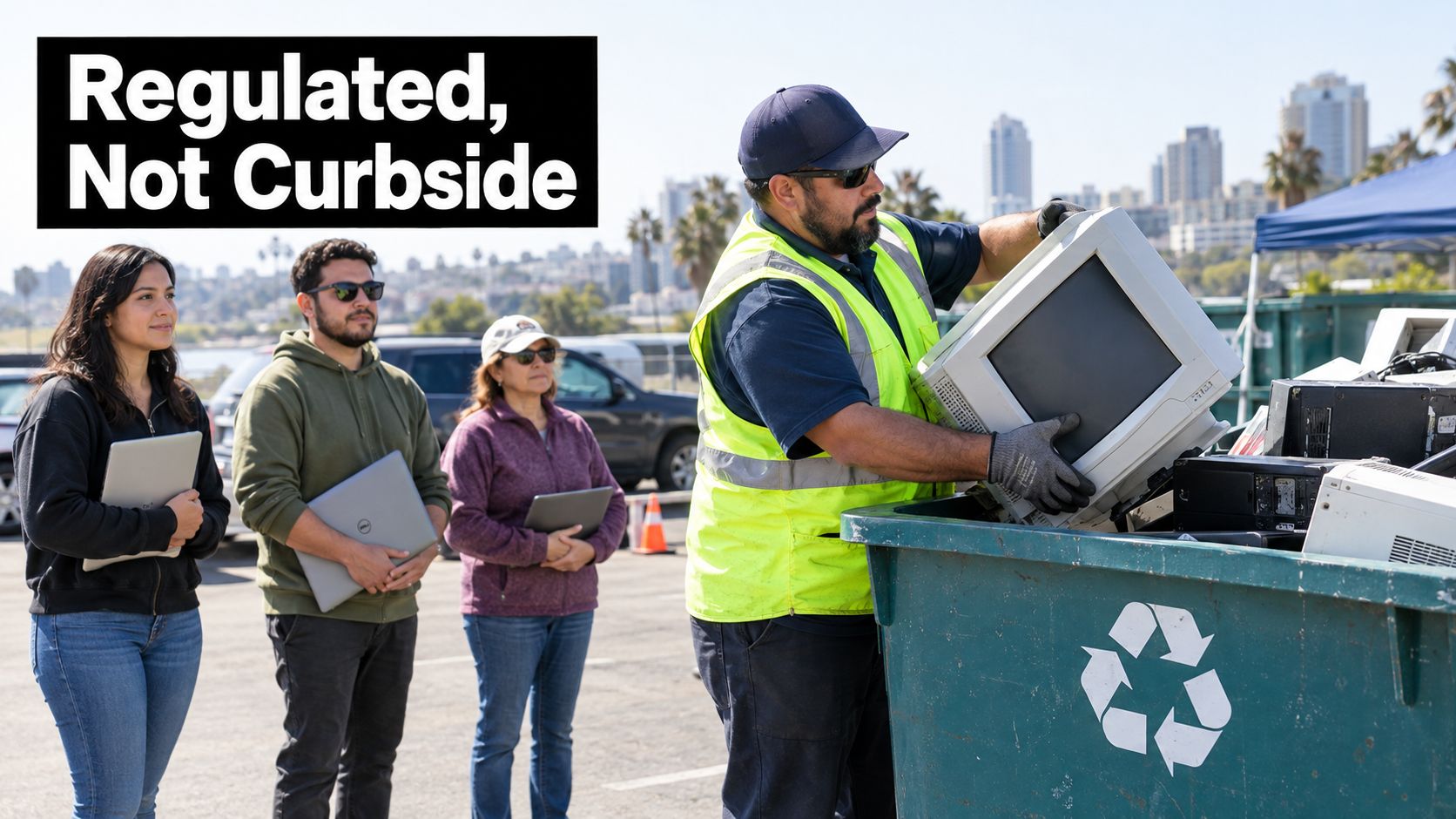
A covered device is a regulated product, not household trash. Your job is to choose an authorized channel, not simply the nearest bin.
Compliance Thresholds for San Diego Businesses
Universal waste is still regulated waste. California places discarded electronics within this hazardous-waste category, so covered equipment can't go into municipal trash or ordinary landfill disposal streams.
Lead-bearing glass, mercury-containing components, and batteries explain why careful handling matters. The operational controls address accumulation, labeling, employee training, shipment, and records, not merely what happens inside a recycling plant.
California E-Waste Compliance Thresholds
The display-size threshold, advance notice requirement, and reporting triggers below come from DTSC's e-waste requirements: covered displays include screens larger than four inches, handlers receiving off-site e-waste must submit notice at least 30 days before starting, collectors accepting at least 220 pounds from off-site sources face annual reporting, and recyclers treating any amount face annual reporting.
| Requirement | Trigger | What the organization must do |
|---|---|---|
| Universal waste handling | Any covered electronic device | Keep out of trash and route to an authorized handler |
| Covered display devices | Screens larger than four inches | Handle as covered devices and prevent breakage |
| Handler Notice of Intent | Accepting e-waste from off-site sources | Submit a one-time notice at least 30 days before starting |
| Collector annual reporting | Accepting at least 220 pounds from off-site sources | File annual reporting |
| Recycler annual reporting | Treating any amount of e-waste | File annual reporting |
| Battery-embedded products | Covered products effective January 1, 2026 | Add storage and fire-prevention steps |
The battery-embedded-product expansion changes which devices need attention during intake and staging. Treat sealed devices as a handling question, not permission to pry out a battery; ask the collector how those products should be segregated and transported.
Don't confuse a generator with a collection operation. Retiring your own office computers isn't the same activity as accepting discarded equipment from unrelated organizations. A school planning a public collection drive should determine its regulatory role before inviting outside deliveries.
Turn the Rules Into Assigned Duties
Give facilities staff responsibility for the holding area and IT responsibility for asset identification and data status. Purchasing or sustainability staff can retain the provider's acceptance terms and final disposition records.
Keep electronics separate from ordinary recyclables, protect displays from impact, and isolate damaged battery-containing equipment pending instructions. Maintain an inventory by equipment type, then retain shipping and recycling documents with the project file.
A labeled storage area is useful only if employees know its limits. Make clear that nobody should dismantle equipment, remove embedded batteries, or add unapproved materials to a collection pallet.
How to Prepare Electronics for Recycling in San Diego
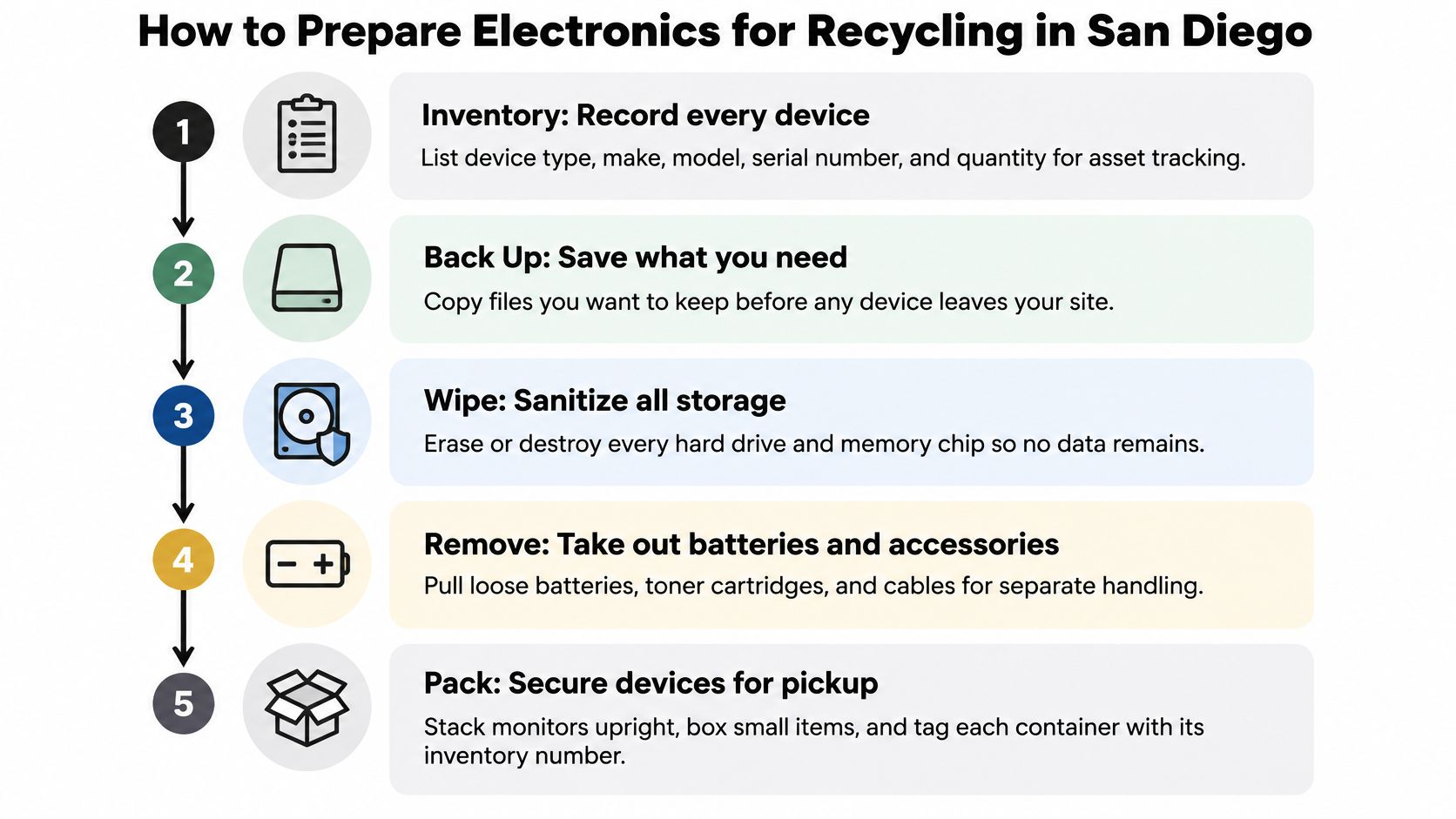
Good preparation makes the pickup easier and gives you a defensible retirement record. It also preserves reuse opportunities that disappear when working equipment gets mixed with broken screens, loose parts, and unidentified drives.
The Global E-waste Monitor executive summary reports that only 22% of small IT and telecommunications equipment was documented as formally collected and recycled in 2022. For an office cleanout, the practical response is to separate reuse candidates from material-recovery equipment before either leaves the building.
Prepare the Load in a Controlled Sequence
Build a serialized inventory. Use a spreadsheet or asset-management export listing device type, make, model, serial number, asset tag, and quantity, with an individual row for each tracked asset. Don't substitute a photograph of a storage room for a list that can be reconciled against receipts and destruction records.
Sort by handling needs. Separate covered electronics, loose batteries, general IT equipment, and accessories, then flag swollen, damaged, or leaking battery-containing devices for the collector's instructions. Don't put a suspect laptop in the middle of a shrink-wrapped pallet or attempt to extract its embedded battery.
Assign a proposed disposition. Mark each unit for internal redeployment, refurbishment or resale assessment, donation assessment, or recycling. A working Dell Latitude laptop or rack server deserves a reuse evaluation, but missing components, unsupported configurations, and repair needs can make refurbishment impractical.
Establish the data hold. Back up business records, identify every storage-bearing device, and keep unsanitized equipment in a restricted area until the approved process is complete. Don't assume that a printer, firewall, or failed laptop contains no recoverable information because it won't boot.
Protect screens and batteries. Pack monitors upright in original packaging or padded, stable containers, following the collector's instructions, and prevent loads from shifting during transport. Never break a screen to make it fit, stack heavy computers on exposed displays, or remove embedded batteries as routine preparation.
Label and photograph the containers. Give each pallet, tote, or box an identifier that connects it to the inventory, and photograph the packed load before collection. Container photos supplement the asset list; they don't establish data destruction or prove final recycling.
Confirm the collection specification. Ask about estimated weight, pickup minimums, pallet dimensions, loading-dock access, stairs, liftgate needs, and collection hours. Request a pickup receipt in advance so the driver arrives with the right paperwork rather than an unsigned generic hauling slip.
Define What Counts as a Complete Handoff
Request a signed manifest that can be reconciled line by line with the asset inventory. If the collector weighs mixed accessories separately, establish how that weight will appear alongside serialized devices.
For downstream reporting, distinguish the pickup receipt, data destruction certificate, and recycling or disposition report. They document different events and shouldn't be treated as interchangeable.
The preparation is complete when another employee can open the project folder and determine what left, who accepted it, and which final records are still outstanding.
Secure Data Destruction Before Any Device Leaves
Deleting files isn't a reliable sanitization method. It can resemble tearing the table of contents out of a book: you've removed directions to the content without necessarily removing the content itself.
Reformatting also shouldn't be accepted as proof without knowing the actual process and verification performed. Secure data destruction starts with the storage technology and information sensitivity, not a generic promise to wipe everything.
California also prohibits unauthorized parties from smashing or destroying e-waste, according to DTSC's electronic hazardous-waste guidance. Informal breakage with a hammer isn't a substitute for either controlled destruction or compliant electronics recycling.
Data Destruction Method by Device Type
| Device or media | Recommended method | Proof to request |
|---|---|---|
| Spinning hard drives | Degaussing or certified shredding | Certificate listing drive serial numbers |
| SSDs and flash storage | Cryptographic erase or shredding | Erase log or destruction certificate |
| Phones and tablets | Full factory reset plus remote wipe | Wipe confirmation for each device |
| Servers and storage arrays | Witnessed on-site or facility destruction | Chain-of-custody record |
| Printers and copiers with storage | Drive removal, then shredding | Serialized list of removed drives |
These are selection starting points, not interchangeable treatments. Degaussing addresses magnetic media, not flash storage; cryptographic erase requires suitable encryption and a validated key-destruction process.
For phones and tablets, verify that the reset or remote-wipe command completed, then remove organizational management and activation locks through the approved administrative workflow. An offline device with a pending wipe command isn't ready for donation.
Match the Evidence to the Method
Use NIST Special Publication 800-88 as the media-sanitization framework when writing requirements. Ask the provider to identify the method used, explain its suitability for the media, and supply verification rather than merely claiming compliance.
For confidential servers and storage arrays, witnessed destruction may be appropriate when your policy requires it, though qualified sanitization can preserve reuse value in other cases. Make that decision before requesting a quote, because destroying serviceable drives changes both cost and resale potential.
Release control: Sanitize before collection where feasible. If destruction must occur at a facility, release the equipment only into a documented, secure chain of custody.
Reworx Recycling offers secure hard drive shredding with data destruction. Discuss witnessing arrangements and serialized documentation through its secure data destruction service before booking; don't assume every collection includes the same destruction scope.
Vetting an IT Asset Disposition Partner
A sustainability statement does not show who receives your equipment or how processing residuals are handled. IT asset disposition (ITAD) procurement should establish those details before collection, especially when a business load includes sensitive or specialized equipment.
For eligible covered-e-waste recyclers, California Public Resources Code section 42479 requires applicable regulatory compliance, a facility inspected by DTSC within the previous 12 months with compliant findings, and access during normal business hours for unannounced inspections. This applies to specified program participants, not automatically to every company offering collection.
Questions That Produce Useful Answers
- Which facility will receive our equipment? Ask for its identity, applicable authorization, inspection status, and whether the provider acts as collector, processor, or broker.
- Will we receive serialized asset records? Request a sample report and check that it can support your asset register, not just record total weight.
- How are residuals and downstream shipments handled? Ask who receives batteries, display materials, and mixed plastics, and what records document those transfers.
- Can you supply weight-based downstream certificates? Define the reporting boundary, including whether the figures represent your shipment or a broader processing batch.
- Is data clearance completed before resale? Set a release control that keeps unsanitized equipment out of refurbishment, donation, or resale inventory.
These questions are particularly relevant to data center decommissioning, medical equipment disposal, and laboratory equipment disposal. A San Diego biotechnology laboratory should identify equipment with contamination, proprietary software, or specialized storage before classifying it as ordinary IT hardware.
Evaluate the Donation Path Separately
A corporate donation program still requires recipient suitability checks, data clearance, and documented acceptance. An unsupported or incomplete computer can transfer disposal costs and problems to the recipient, so confirm what the recipient can use before arranging a donation.
Reworx Recycling offers equipment buyback for surplus hardware and secure hard drive shredding with data destruction. Confirm the buyback terms and destruction scope in writing before booking, including which equipment and services are covered.
Use the vendor selection criteria to structure procurement conversations. Compare documented evidence, service boundaries, and reporting commitments rather than selecting a provider based only on a free-pickup offer.
What Recycling Costs and What Equipment Can Earn
Residential recycling can be free or low-cost, and manufacturer mail-back may be free apart from shipping. Don't promise employees a no-charge Miramar visit without confirming current acceptance terms and fees.
Business pricing is a logistics and service-scope question. A collector needs to know the equipment mix, volume, loading conditions, transport distance, and whether the project includes packing, inventory, sanitization, or physical destruction.
Compare the Financial Routes
| Route | Main financial consideration | What to establish in writing |
|---|---|---|
| Recycling | Handling, collection, and processing charges | Accepted equipment, exclusions, and total service scope |
| Resale or buyback | Recoverable value after testing and service costs | Grading method, deductions, sanitization, and payment terms |
| Donation | Recipient suitability and preparation costs | Acceptance criteria, receipt availability, and any collection charges |
Old, broken, or incomplete equipment may have little resale value even when it contains recoverable materials. A load dominated by damaged monitors shouldn't be budgeted like a load of recent working business laptops.
Working laptops and servers may qualify for equipment buyback based on model, age, condition, configuration, and demand. Require written data-sanitization records before any resale release; if verification fails, hold the unit for an approved alternative rather than allowing it into secondary use.
Donation is another route, not an automatic waiver of every service charge. Ask whether refurbishment, transport, or data destruction carries a cost, and whether an eligible donation receipt will be issued; tax treatment should be reviewed with your adviser.
Donate usable equipment that matches a recipient's needs, sell suitable high-value assets after verified sanitization, and recycle the rest through a documented channel.
For a larger facility cleanout, use cost recovery strategies to separate gross buyback estimates from the net project cost. Request an itemized proposal rather than letting potential resale value obscure transportation and destruction charges.
Match Your Load to the Right Recycling Channel
The City of San Diego's universal-waste guidance directs most devices to Miramar, points businesses with large quantities toward separate resources, and advises calling about accepted items and fees; the covered-electronics expansion includes covered battery-embedded products beginning January 1, 2026. For organizational planning, the missing decision is how much control the load requires.
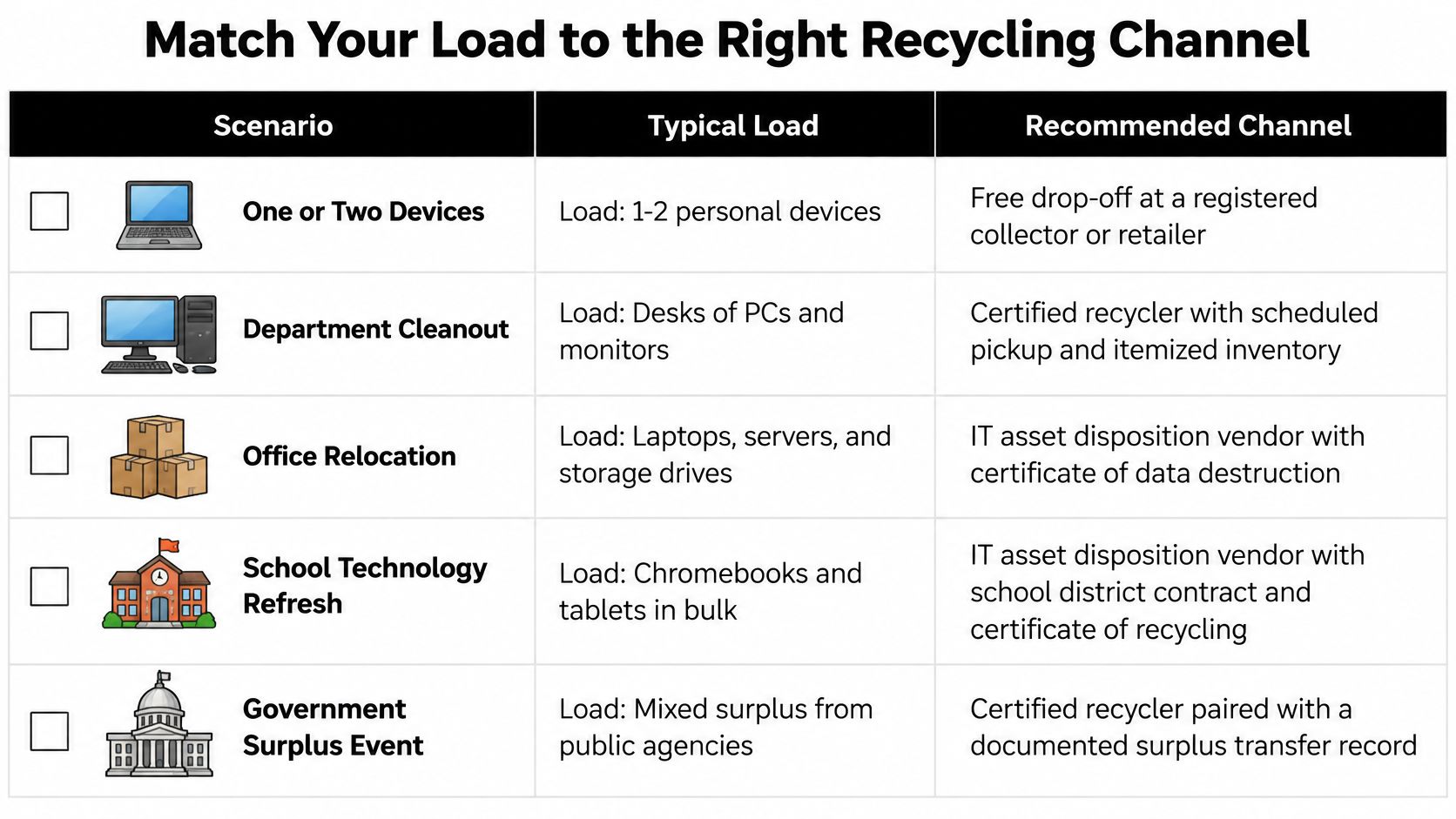
A small personal load can fit public drop-off. A department's retired equipment needs a different arrangement once asset accountability, secure storage, palletizing, and disposition reporting become part of the job.
Load Scenario and Recommended Recycling Channel
| Load | Best channel | Documentation | Watch for |
|---|---|---|---|
| One or two devices | Municipal drop-off or manufacturer mail-back | Drop-off confirmation or receipt | Confirm accepted items and fees |
| Department cleanout | Scheduled pickup from a documented recycler | Serialized inventory and weight ticket | Displays, batteries, and mixed loads |
| Office relocation | Full IT asset disposition pickup with data destruction | Destruction certificates and chain-of-custody record | Move timing and secure storage before pickup |
| School technology refresh | Donation for usable units, recycling for the rest | Donation receipt and data destruction certificates | Recipient needs and refurbishment eligibility |
| Government surplus event | Approved collector under a local arrangement | Asset tracking and disposition report | Public procurement and approval steps |
For an office relocation, reserve secure staging space before movers arrive. For a school refresh, establish recipient requirements before offering the entire fleet, and identify sealed battery-containing devices that need special storage or transport instructions.
Product destruction requires a separate scope when equipment must not return to use. Don't mix those assets into a donation pallet or assume a recycling receipt proves destruction.
Choose the Next Action
- Donate usable equipment through corporate donation programs with clear acceptance and data-clearance requirements.
- Schedule documented pickup when the project needs custody records, controlled loading, and asset reconciliation.
- Establish an ongoing ITAD partnership when recurring refreshes justify a consistent retirement workflow.
Reworx Recycling offers free customer drop-off, business pickups, equipment decommissioning, and secure data destruction. Confirm San Diego coverage, collection eligibility, and written terms before selecting the service that fits your load.
Reworx Recycling helps businesses retire electronics through donation-based recycling, equipment recovery, and secure data destruction while supporting technology access and community opportunity. Visit Reworx Recycling to plan an equipment donation, discuss a San Diego business pickup, or develop an ongoing IT asset disposition partnership with documented handling requirements.