Only 22.3% of the world's e-waste generated in 2022 was documented as formally collected and recycled in an environmentally sound manner, according to the ITU's Global E-waste Monitor 2024. For a business retiring servers, the important word is documented. Empty racks don't prove that drives were sanitized, equipment reached the intended processor, or usable hardware found another purpose.
Treat server recycling as a controlled asset retirement project, with the paper trail as the final deliverable. For Atlanta, Georgia businesses, whether you're clearing an office server room or coordinating a colocation exit, that means connecting every chassis and storage device to an approved destination, a sanitization result, and a signed handoff.
The Server Recycling Workflow at a Glance
| Phase | Core action | Record to keep | Typical owner |
|---|---|---|---|
| 1. Plan and approve | Set scope, retirement date and budget, and get sign-off | Approved disposition plan | IT manager and finance |
| 2. Inventory and tag | Log serial numbers, asset IDs and rack locations | Serialized asset inventory | IT asset team |
| 3. Triage | Decide redeploy, harvest, recycle or hold for each asset | Disposition decision per asset | IT and sustainability leads |
| 4. Sanitize | Clear, purge or destroy every storage device before dismantling | Sanitization log and certificates | Security or IT operations |
| 5. Decommission | Shut down, disconnect and remove servers from racks | Decommission ticket with timestamps | Data center or facilities staff |
| 6. Transport and hand off | Load sealed, track custody and sign each handoff | Chain-of-custody form and weight ticket | Logistics partner and site manager |
| 7. Verify and report | Reconcile counts and confirm final destinations | Final disposition report | Sustainability and finance teams |
Triage comes before sanitization because intended reuse influences the method. Destroying a serviceable drive eliminates its resale value, while choosing an inadequate wipe creates an unacceptable security risk.
Complete workload migration and approved backups before sanitization. Then sanitize storage before general dismantling or release to transport. Where physical destruction requires drive removal, make that removal a controlled security operation, with each drive tracked directly from its chassis to destruction.
Release rule: Don't approve the final invoice until serialized assets reconcile with sanitization records, receiving counts, and the pickup weight ticket. Weight supports reconciliation, but it cannot identify a missing drive.
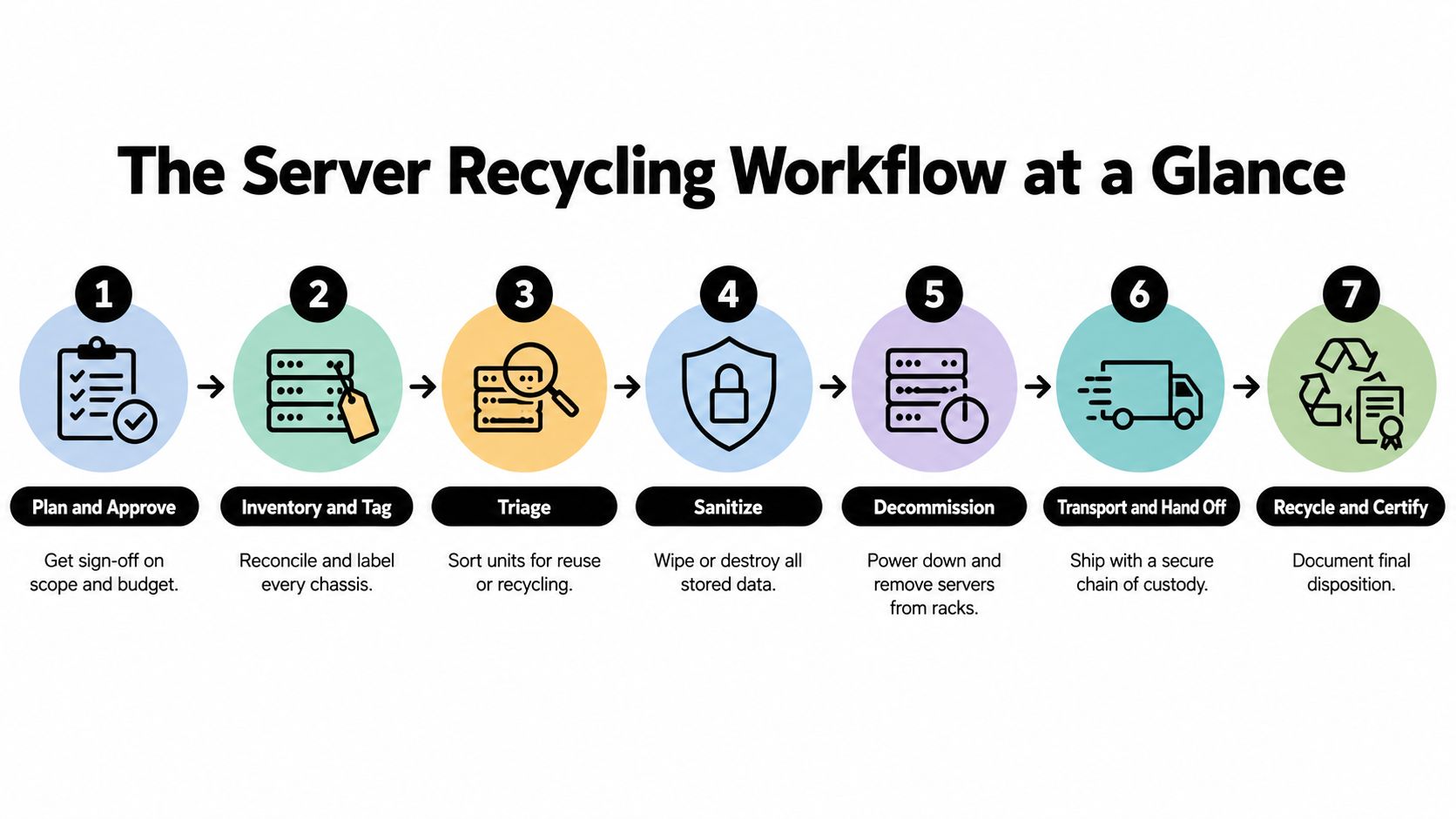
Copy this table into your project tracker, replace team names with accountable individuals, and assign dates. A phase owned by everyone is easy for everyone to skip.
Reworx Recycling supports business pickups, equipment decommissioning, secure hard drive shredding, and equipment buyback. Its donation-based electronics recycling model also connects suitable working equipment with schools and nonprofits, supporting digital inclusion and workforce development.
How to Inventory and Tag Servers Before Shutdown
Start with the asset register, not the loading dock. Your inventory must describe what physically exists, including equipment that never made it into the configuration management database, or CMDB.
Build an inventory someone else can verify
Export and reconcile the server list. Pull records from your CMDB, VMware vCenter, Microsoft Hyper-V management tools, or monitoring platform. Compare them with purchase orders and lease schedules so powered-off machines and contractual obligations aren't overlooked.
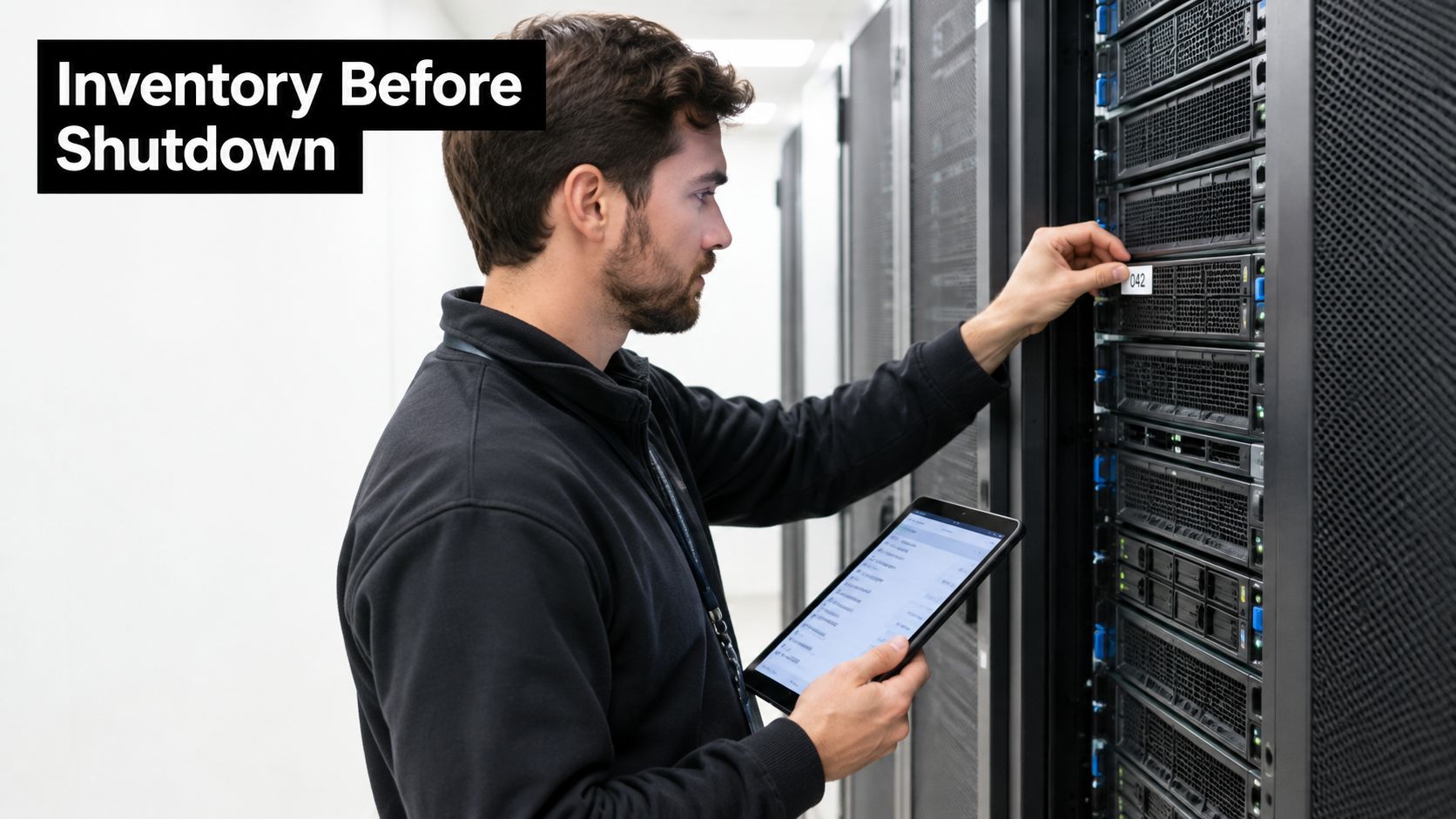
Tag each chassis physically. Apply a unique asset ID that matches the inventory spreadsheet. Position the label where a technician can read it without removing the machine or confusing it with an adjacent unit.
Capture the configuration and location. Record manufacturer, model, serial number, rack, row, rack-unit position, processor count, and installed memory. For storage, distinguish empty bays from installed drives and record drive capacities rather than assuming every bay matches.
Create separate drive records. Log each drive's serial number, media type, capacity, bay position, and parent chassis ID. Drives can change custody independently of servers, so a chassis-only list leaves a gap precisely where security teams need detail.
Photograph identifying features. Capture the front, rear, and asset label, keeping management credentials and sensitive screen content out of the photographs. Store images against the asset record so damaged labels and configuration disputes can be resolved later.
Flag sensitive workloads. Identify equipment that held payment, patient, student, government, or confidential business records. Security should assign the handling classification and approved sanitization method rather than leaving that decision to the removal crew.
Confirm ownership and return obligations. Mark leased assets, lessor instructions, warranty ownership, and any restrictions on resale or donation. Don't send leased equipment into an ordinary recycling stream without contractual approval.
Resolve exceptions before the shutdown window
Use a temporary controlled identifier for legacy equipment with missing labels, then document how its identity was established. At colocation sites, connect the inventory to cage permissions, tenant ownership, and access logs. Investigate machines that moved between locations without an asset-register update.
A consistent inventory labeling system helps technicians connect physical equipment to retirement records without relying on memory.
Finish with a physical-to-export reconciliation. Every tagged server should match an approved record, and every exported record should resolve to equipment, a documented transfer, or an explained exception. Don't start decommissioning with unexplained differences.
Deciding Between Reuse, Harvesting and Recycling
Reuse first isn't a universal environmental rule. A server that still boots may consume too much electricity for the useful work it delivers, lack supported firmware, or need unreliable replacement parts.
A 2025 server life-cycle case study found that refurbishment reduced average environmental impact by 23% compared with replacing a standard server after four years and recycling it; the study also found that an advanced recycling process reduced impact by an additional 24% compared with a business-as-usual recycling route. Those are case-specific comparisons, not guaranteed savings for every retirement project.
Match the machine to a useful destination
| Server condition | Best path | Why it fits |
|---|---|---|
| Supported and efficient for current workloads | Redeploy internally or sell intact | Keeps the whole machine in service and delays new manufacturing |
| Supported but power-hungry for its workload | Refurbish, resell or retire after an energy comparison | An older chassis can cost more to run than newer hardware |
| Obsolete chassis with usable CPUs, memory or drives | Harvest components for reuse or resale | Parts keep value even when the server cannot run a modern workload |
| Failed, unsupported or physically damaged | Recycle through documented material recovery | Recovers metals and circuit boards after sanitization |
| Lease return or unknown ownership | Hold and confirm before any disposition | A wrong disposition can breach lease terms or leave assets unaccounted for |
Measure power under a representative workload using metered power-distribution units or server management telemetry. Compare equivalent useful output, not an idle legacy machine against a fully loaded replacement. Include upgradeability, remaining reliability, transport distance, electricity carbon intensity, and downstream recovery quality.
Component harvesting works when the chassis has become obsolete but compatible memory, processors, power supplies, or sanitized drives still have a credible destination. It doesn't work well when staff spend days testing parts that nobody needs.
Keeping hardware out of a recycling stream isn't automatically a benefit if the next owner runs an inefficient machine without a useful workload.
For a quick financial screen, multiply measured input power by expected operating hours and your electricity tariff. Compare the annual energy cost of keeping the unit with a replacement performing the same work, then weigh that result alongside acquisition cost, embodied impacts, and support risk before approving reuse.
Matching Sanitization Methods to Each Drive Type
Deleting files isn't media sanitization. The IRS media sanitization guidelines explain that information can remain recoverable through data, disk, or file-recovery utilities after deletion.
Choose among clear, purge, and destroy based on media characteristics, sensitivity, and destination. Clearing commonly uses overwriting; purging uses stronger media-appropriate techniques, such as supported secure erase or cryptographic erase; destruction makes the media unusable for its original purpose.
Choose the method before running the tool
| Media and condition | Reuse intent | Recommended method | Verification and record |
|---|---|---|---|
| Hard drive with sensitive data | Reuse inside a trusted organization | Supported ATA Secure Erase appropriate to the drive; degaussing only if reuse is abandoned | Verification result and log entry per drive |
| Hard drive with low-sensitivity data | Reuse internally | Clear by overwriting all user-addressable sectors | Read-back verification and assessment of inaccessible or reserved areas |
| SSD or NVMe drive | Reuse or resale | Validated vendor sanitize command or cryptographic erase; overwriting can miss over-provisioned cells | Tool report, device-specific method validation, and verification result |
| Failed, unreadable or damaged drive | Recycle only | Physical destruction by shredding or pulverizing | Inspection of remnants and destruction record |
| Any drive with regulated or highly sensitive data | Recycle only | Destruction to a documented particle-size requirement appropriate to the media and policy | Certificate listing every serial number |
| Tape or removable media | Recycle only | Degaussing for compatible magnetic media, followed by destruction; direct destruction for nonmagnetic media | Certificate listing every serial number |
Degaussing isn't a reuse method for modern hard drives, and it doesn't sanitize flash storage. Likewise, an ATA command isn't a blanket guarantee: confirm that the device supports the command, that the implementation meets your policy, and that the operation completed.
For SSDs, ordinary host-level overwriting can miss over-provisioned cells and remapped locations. Cryptographic erase requires confidence that encryption protected the relevant data throughout its life and that all necessary keys, including recoverable copies, are rendered unavailable.
Verify the result independently
The cited NIST SP 800-88 Revision 1 guidance recommends verification of each operation when practical and representative sampling when individual verification is impractical; its sampling guidance specifies pseudorandom locations across user-addressable and reserved areas, with two non-overlapping samples per subsection, each covering at least 5%. Treat that document as revision-specific guidance and have security confirm the applicable standard and method before execution.
A software completion screen alone doesn't establish that inaccessible areas were addressed. If the tool can't inspect a relevant area, record the limitation and escalate the disposition decision rather than marking the drive successfully cleared.
- Record the operation. Capture drive serial, parent asset, method, operator, timestamp, tool and version, outcome, and intended destination.
- Separate exceptions. Failed commands, unreadable drives, unrevoked keys, and unsupported media go into a controlled exception queue.
- Inspect destruction output. Confirm remnants satisfy the approved process and connect the destruction event to the serialized intake list.
Use the data sanitization methods guidance to prepare questions for your service provider. If a wider office refresh includes mobile devices, Used Mobiles 4 U's explanation of secure data erasure before selling phones provides useful device-retirement context, but enterprise server media still needs its own approved procedure.
For failed or highly sensitive media designated for recycling, physical destruction is the conservative choice. Record the result by serial number, not as a vague box of destroyed drives.
Decommissioning and Rack Removal
Decommissioning converts approved, retired equipment into a controlled shipment. Don't release a rack for removal until the inventory reconciles and the workload owner has accepted the migration or retirement.
Execute the removal ticket
Confirm scope. Check every asset ID, rack position, removal date, and disposition approval against the ticket. Mark shared infrastructure that must stay operational.
Close workload dependencies. Confirm backups or migrations, test required restores, and obtain application-owner sign-off. Check scheduled jobs, backup agents, and monitoring dependencies before declaring the host unused.
Complete the approved data operation. Sanitization follows workload release, not the other way around. If a drive must be removed for destruction, keep it under security control and link the removal to its chassis record.
Shut down and isolate. Follow a controlled shutdown sequence, disconnect power, network, and management connections, and timestamp the actions. Label cables that remain in service instead of cutting unidentified bundles.
Remove residual access. Clear management-controller credentials and configurations, disable remote access, and revoke remaining service credentials or encryption keys through the approved process. Operating-system shutdown alone doesn't clear a baseboard management controller.
Extract equipment safely. Use the manufacturer's weight information to select a lift or coordinated handling team. Stabilize the rack, follow rail-release instructions, and stage pallets without blocking aisles or emergency routes.
Document what remains. Reconcile shared storage, switches, rails, and other retained equipment against the approved scope.
Stop-work condition: An unidentified cable, unlisted server, or unexpected live dependency requires resolution before removal continues.
Book colocation access and escort windows in advance. The facilities lead and IT owner should sign the completed ticket before equipment passes to transport.
Transport, Handoffs and Cross-Border Shipments
Custody becomes uncertain when someone signs for a pallet without checking what it contains. A clean loading area won't compensate for an unsigned transfer or an unexplained change in the manifest.
Keep sanitized drives and tracked equipment in sealed, lockable containers or properly secured pallets. Shrink-wrap stabilizes a load, but it isn't a substitute for access control or tamper evidence. Never transport loose drives in an open vehicle compartment.
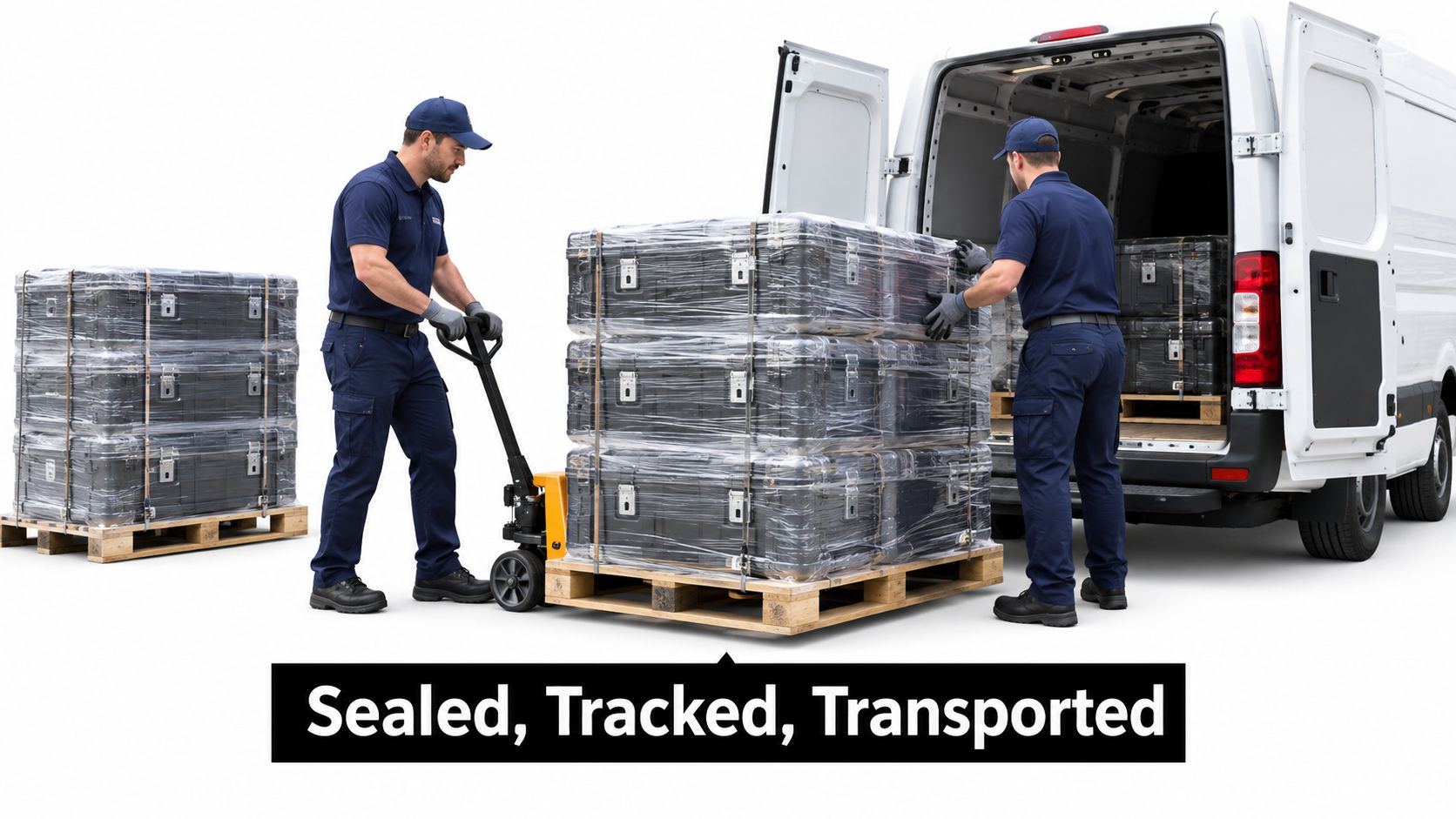
Make each transfer an acceptance event
- At release: The site representative checks asset and container counts, records seal identifiers, and photographs the secured load before departure.
- With the carrier: The driver signs for the identified load, including exceptions, destination, and collection time.
- At receipt: The processor records arrival condition, checks seals and counts, and reports discrepancies before processing.
Plan loading around actual equipment weights, pallet ratings, dock access, and liftgate capacity. Keep drive-bearing equipment grouped by manifest and separate batteries or other items requiring special handling.
The transportation compliance guidance can help frame the logistics review, but the signed project documents must identify who accepts responsibility at each transfer.
Check the destination before collection
The Basel Convention e-waste amendments, effective January 1, 2025, brought both hazardous and non-hazardous transboundary e-waste movements under the Convention's Prior Informed Consent procedure. Don't assume an export becomes unrestricted because someone describes the contents as recyclable.
The Basel Convention's amendments FAQs explain the exporting-state notification and prior written-consent process, including importing and applicable transit states, as well as restrictions affecting movements between parties and non-parties.
Before pickup, request the proposed destination, equipment classification, destination-country authorization, and applicable shipment documents. Have qualified compliance staff assess the specific route and national rules.
For a mid-sized Atlanta retirement project, I would start with documented domestic processing. It removes an international logistics complication, although you still need to verify the processor's downstream destinations.
Records That Prove Responsible Disposition
A single diversion percentage proves little without definitions and supporting records. A vendor can combine intact reuse, component harvesting, material recovery, and disposal into an attractive headline that doesn't explain what happened to your equipment.
The 2025 ICEF sustainable-data-center roadmap reported that more than two-thirds of surveyed operators lacked fleetwide quantitative data on reuse, recycling, and landfill diversion; it also cited Microsoft's 90.9% reuse-and-recycling rate for servers and components in 2024 and Google's approximately 8.8 million components harvested for reuse or resale that year. Those measures describe different boundaries and cannot be treated as equivalent performance scores.
Require a report that separates outcomes
| Outcome | What the final report should establish |
|---|---|
| Intact reuse | Units and weight redeployed, donated, or resold, with destination evidence |
| Component harvesting | Parts recovered, their destination, and remaining chassis treatment |
| Material recovery | Weight delivered to identified recovery processors |
| Disposal | Residual landfill and incineration quantities, reported separately |
Define these categories in the contract before pickup. Prevent double counting when components leave a chassis, and explain where unit counts stop being meaningful after dismantling. A shipment to a broker isn't, by itself, proof of completed reuse or final material recovery.
Build the evidence package around the serialized inventory. Include pickup and weight records, custody signatures, sanitization logs, destruction certificates, downstream processor identities, exception resolutions, and the final disposition report. Use chain-of-custody documentation that lets an auditor follow an asset without reconstructing the project from email.
Verify facilities, not just company names
Ask each downstream processor for current third-party certifications, such as R2 or e-Stewards for electronics recycling and NAID AAA for data destruction. Confirm the certificate number, scope, and expiry date on the vendor's website and in writing, then independently check the relevant certification directory.
- Facility coverage: Confirm that the named handling location falls within the certificate's scope.
- Subcontractor visibility: Include subcontracted processors in custody and downstream records.
- Jurisdictional compliance: File the state e-waste and data-privacy requirements applicable to each originating location.
- Retention ownership: Keep certificates with the asset register for the period your auditors, contracts, and regulators require.
Request the same documentation from Reworx Recycling before booking pickup. Keep your own copies rather than depending on continued access to a vendor portal.
Capture Buyback Value and Book Your Pickup
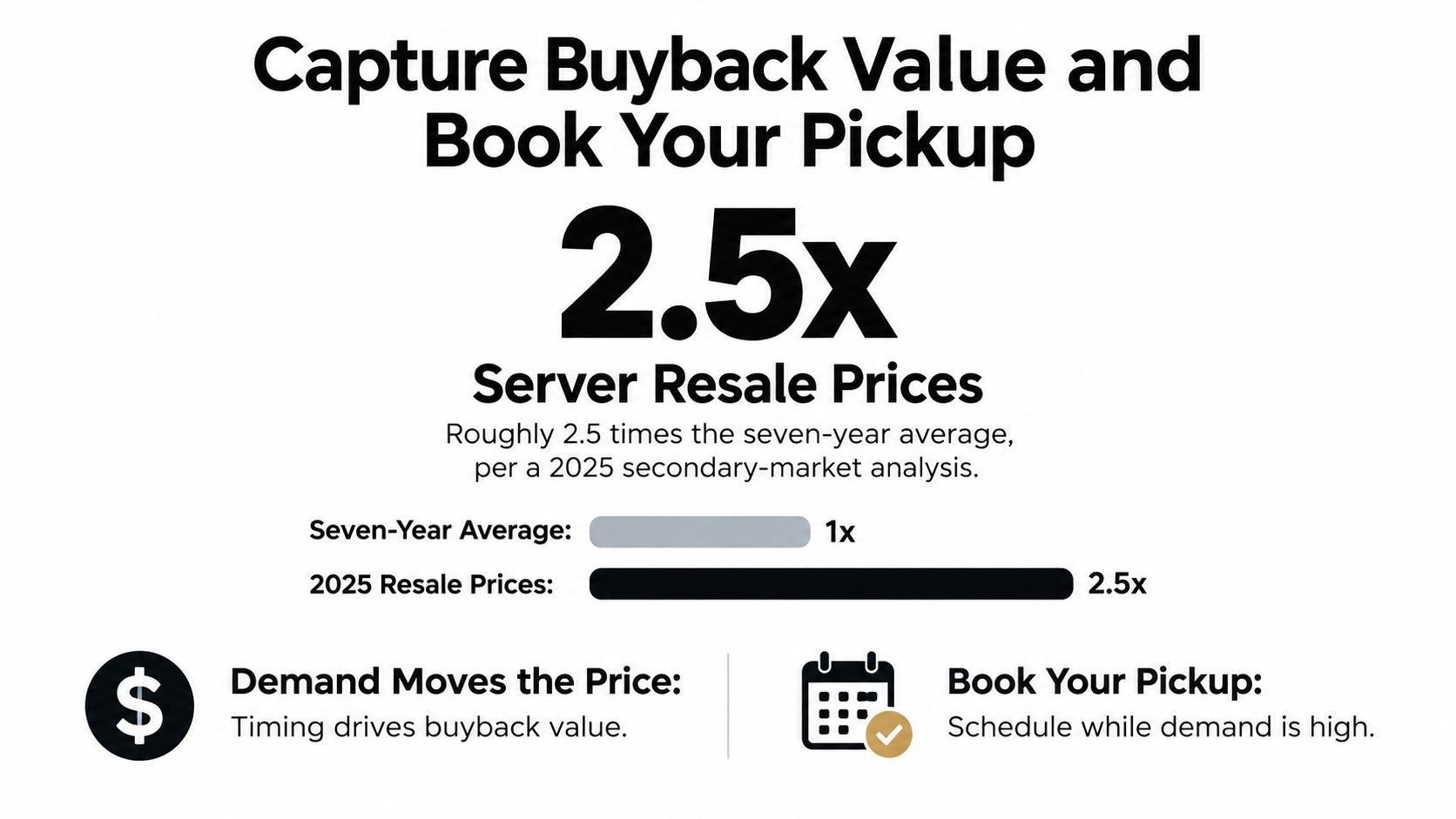
Server resale prices reached roughly 2.5 times their seven-year average during 2025, according to the secondary-market analysis reported by E-Scrap News. Strong secondary-market pricing is reason to request a current quote for your specific models, since resale conditions move with demand and no retired server is automatically worth a premium.
Sell a verifiable configuration
Buyers need a usable specification, not a photograph of shrink-wrapped equipment. Group matching models into configured lots and document processor models, memory configuration, network adapters, drive status, rails, power supplies, and test results for each lot.
Check warranty transferability, firmware status, and any licensing restrictions before requesting binding offers. If the drives will be destroyed, quote the server as diskless so the offer reflects what the buyer actually receives.
Whole-lot buyback reduces handling and clears the site faster, but buyers price testing, sorting, and remarketing work into their offer. Component-level sales can produce better gross proceeds when individual parts have demand, yet your team carries the testing labor, packaging, transaction costs, unsold inventory, and the extra asset records each part generates. A lot sold in one transaction produces one line in the disposition report; a parted-out server produces many.
Compare offers on net recovery after service costs rather than the headline purchase figure. Ask whether transport, sanitization, rejected equipment, and final reporting are included. Practical cost recovery strategies account for the retirement project's full cost, not just the best line item.
Route donations and non-server equipment correctly
Donation complements buyback when supported equipment has a suitable recipient but limited commercial resale value. Confirm the recipient can operate, maintain, and eventually retire it responsibly. Donating an expensive-to-run server without a workload or support plan only transfers the disposal problem to a less equipped owner.
During an Atlanta office cleanout or facility cleanout, keep reusable computers and laptop disposal inventory distinct from server lots. If the project also covers medical equipment disposal, laboratory equipment disposal, or product destruction, request separate acceptance and handling instructions instead of assuming every item belongs in the same computer recycling stream.
Book against a complete scope
Reworx Recycling is a full-service electronics recycling and IT asset disposition partner based in Smyrna, Georgia. Its scope runs from business pickups, equipment decommissioning, and secure hard drive shredding through IT asset management and equipment buyback, so a single provider can carry a project from rack removal to the final disposition report.
- Confirm the inventory: Resolve ownership, configurations, drive status, and disposition decisions before scheduling.
- Choose the pickup window: Confirm dock access, building permissions, staging space, and site contacts.
- Request the documentation package: Agree on custody forms, serialized sanitization evidence, downstream reporting, and closeout timing.
- Authorize the services: Specify pickup, data destruction, decommissioning, and buyback requirements before collection.
A buyer who retains original drives without approved sanitization evidence, or accepts unidentified parts outside the manifest, breaks the chain your records are meant to prove. Secure IT asset disposition (ITAD) closes when the records reconcile, not when the truck leaves.
Reworx Recycling provides business pickups, equipment decommissioning, secure data destruction, and buyback options to help organizations retire servers and recover value where the market supports it. Visit Reworx Recycling to plan your server retirement or arrange a pickup with the documentation your team needs.