The replacement servers are live, the old racks need to come out, and facilities wants a firm date for clearing the room. Meanwhile, IT has a spreadsheet of equipment, security wants proof that the drives are unreadable, and procurement wants to know whether the retired hardware has any value.
That's where data center recycling becomes an IT asset disposition (ITAD) project rather than a hauling job. For a Smyrna, Georgia business retiring a server room or coordinating a larger facility cleanout, the useful outcome isn't an empty floor alone. It's an empty floor backed by verified data outcomes, documented equipment destinations, and an honest account of what couldn't be recovered.
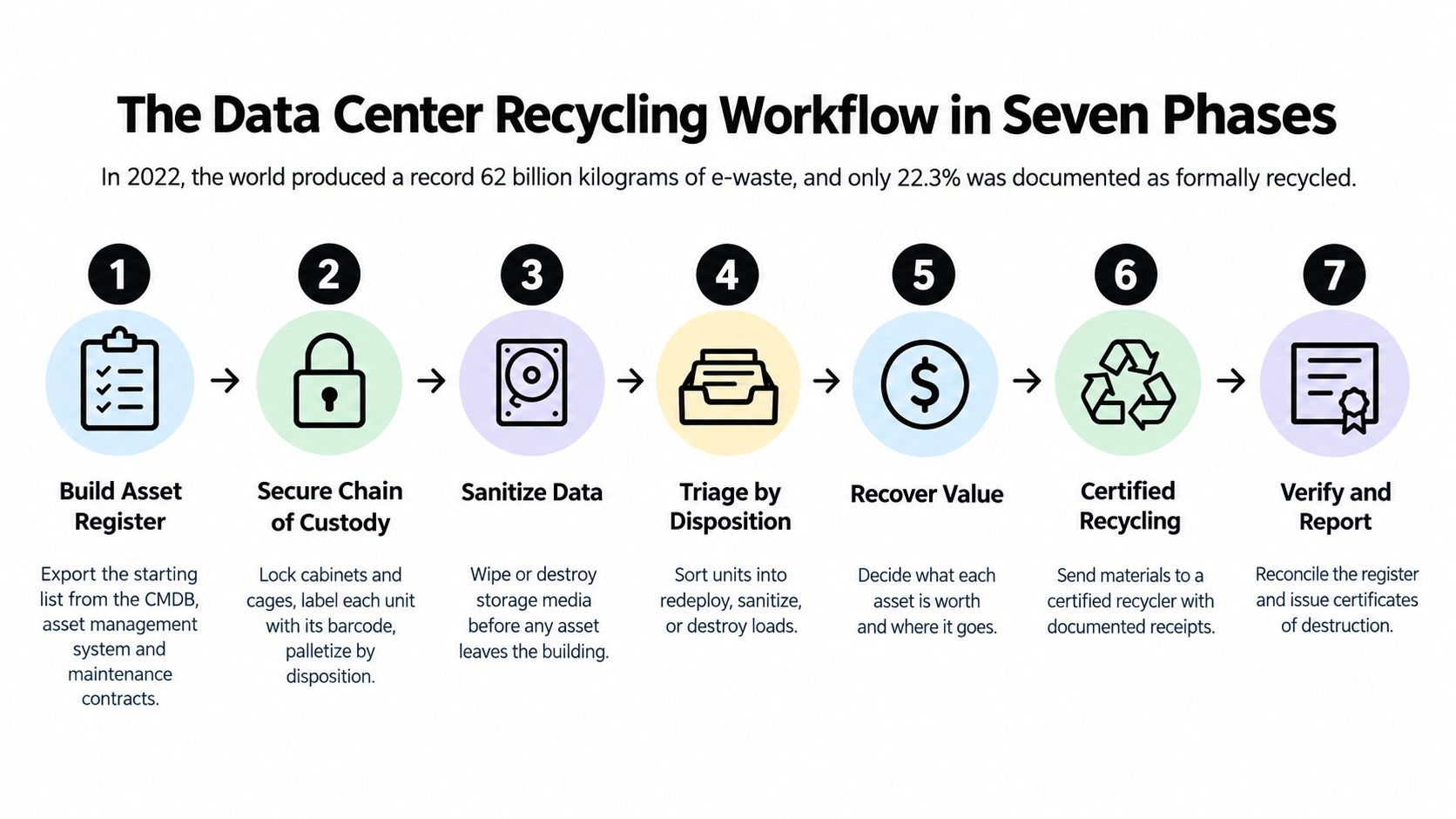
The Data Center Recycling Workflow in Seven Phases
The world generated 62 billion kilograms of e-waste in 2022, and only 22.3% was documented as formally collected and recycled through environmentally sound methods, making a data center exit a governance project as much as a hauling job, according to the Global E-waste Monitor.
Scope and inventory. The IT operations lead defines the equipment boundary and produces the asset register. Include storage, networking, spare media, batteries, and infrastructure electronics, not just servers listed in the migration plan. Decide explicitly whether racks, cables, and cooling-related controls belong in the project.
Classify data and choose sanitization. The security officer produces a sanitization plan linking information sensitivity, media type, and intended disposition. Start this work while inventory is underway. A leased storage array and an owned server with failed drives need different instructions before either reaches the dock.
Pack, weigh, and move under custody. The facilities manager produces a signed custody log with seal numbers. Define secure staging areas, loading access, container identification, and receiving contacts before crews begin dismantling equipment.
Sanitize, destroy, and verify. Internal security staff or an approved vendor produces verification records. Schedule this phase on-site before departure when policy requires it. Otherwise, authorize a documented transfer to a secure processing location rather than letting equipment leave under an informal promise.
Redeploy, sell, donate, or recycle. The ITAD manager produces the disposition report. Begin evaluating routes during inventory so testing, ownership restrictions, and donation eligibility don't become last-minute obstacles. No asset should enter a resale or donation stream before security releases it.
Reconcile downstream processing. The sustainability lead produces the mass-balance report. Require evidence of actual treatment routes, including residual disposal, rather than accepting the collection receipt as the environmental result.
Close out and review. The project sponsor produces a lessons-learned summary and authorizes closure. Unexplained missing devices, failed sanitization, and unconfirmed destinations remain open issues even when the room is empty.
Schedule backward from the empty-room date
Treat the date the data hall must be empty as a physical deadline, not the project completion date. Work backward through loading access, shutdown approvals, sanitization capacity, testing, and inventory reconciliation. Leave document review and exception closure on the schedule after removal.
The graphic provides a simplified operational sequence. Your approved plan must specify whether sanitization occurs before movement or after controlled transport, because the right sequence depends on security policy and the agreed processing location.
First action: Name an accountable owner for each phase and book a site walk before anything is powered down.
How to Build an Asset Register Before Pickup
Build the register around the question an auditor will ask later: What happened to this specific device? A rack count can support space planning, but it can't establish the fate of the drives inside each chassis.
Use the inventory controls in NIST's media-sanitization guidance as the security foundation. Treat storage devices as controlled information assets until their approved disposition is complete.
Build from records, then verify on the floor
Export the starting lists. Pull records from the configuration management database (CMDB), asset management system, and hardware maintenance contracts. Keep the original exports so reviewers can distinguish source records from later corrections. Don't assume a maintenance contract proves that the covered equipment is still present.
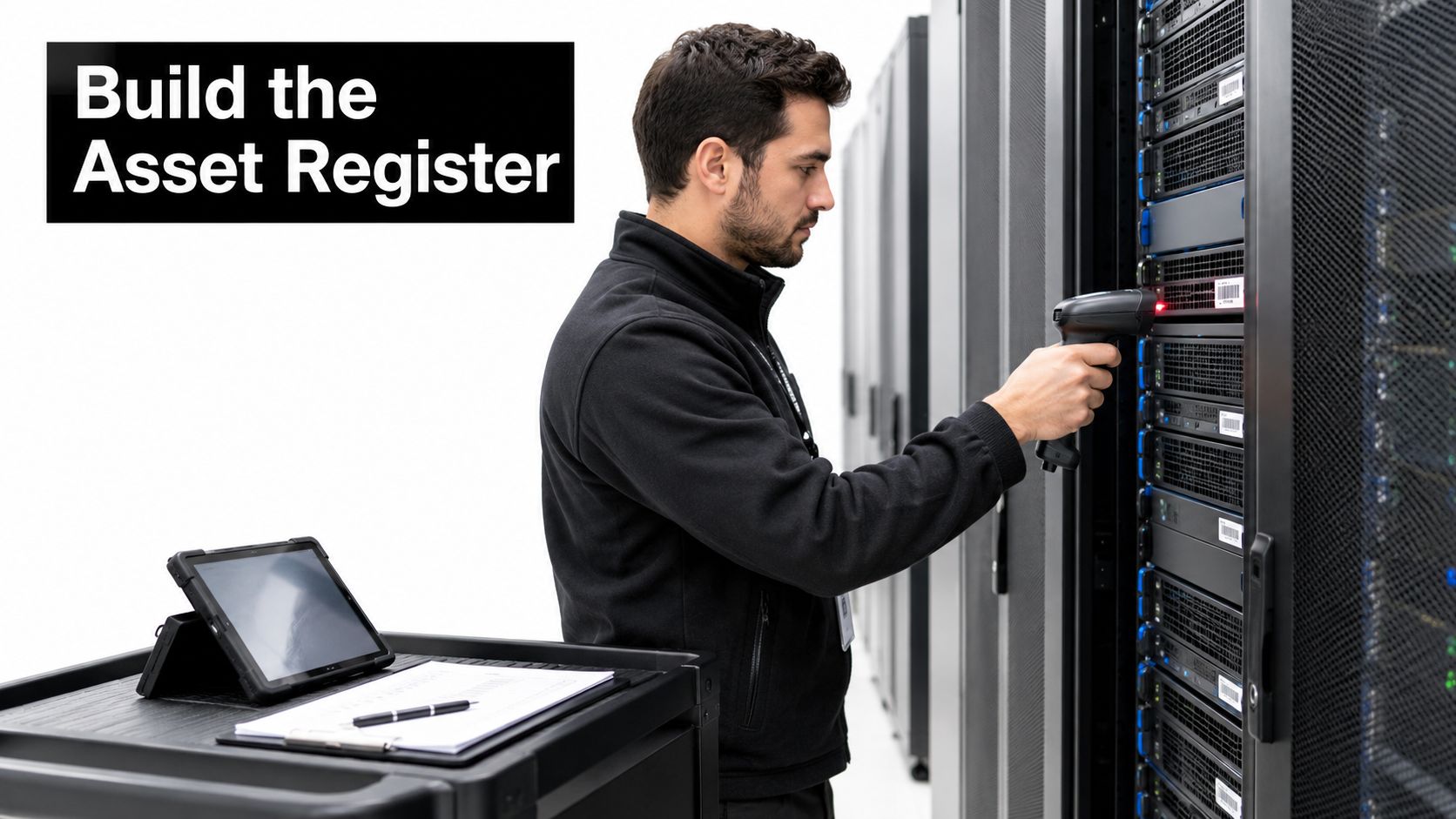
Walk the room and label components. Barcode each chassis, hard drive, SSD, tape cartridge, and removable medium. Include spare drives in cabinets, service stock, and equipment awaiting repair. Preserve parent-child relationships so a drive removed from a server remains traceable to its original chassis.
Record identifying and security details. Capture serial number, make, model, rack and unit position, business owner, and data classification. For encrypted media, record encryption status and the responsible key-management system or custodian, not the secret key itself. Add location and status fields that operators can update during movement.
Assign an intended disposition. Use clear categories such as redeploy, harvest, sanitize and resell, destroy, or hold for review. Keep intended disposition separate from final disposition. A server provisionally marked for resale may fail testing and require a different route.
Create a controlled hold queue. Flag failed drives, unlabeled media, leased units with return conditions, and hardware from closed projects. Give each exception a named decision-maker. Don't let unidentified equipment become an anonymous recycling load simply because nobody recognizes it.
Reconcile at the dock and freeze the release version. Compare physical items against the approved register before loading. Apply a version date and preserve subsequent changes as logged amendments rather than overwriting the shipment baseline.
Resolve ownership before equipment moves
Orphaned devices need an owner who can authorize release. A project manager's assumption that an old appliance is abandoned isn't equivalent to confirmation that the organization owns it and can dispose of it.
Leased equipment needs particular attention. Attach the return conditions, identify permitted sanitization methods, and clarify whether removing or destroying storage would breach the return agreement. Resolve that conflict before a destruction operator receives the device.
Use asset inventory management guidance to structure the working register, then make the fields match your own audit and security requirements. The inventory must support later certificates, not merely satisfy a collection booking.
A simple reconciliation sheet with expected, found, and unaccounted columns is a useful first pass. Run it during the site walk, then assign every discrepancy before authorizing pickup. The point isn't to produce a polished spreadsheet; it's to prevent an unknown item from becoming an undocumented departure.
Matching Sanitization Methods to Each Media Type
NIST distinguishes Clear, which protects against straightforward recovery through normal interfaces, Purge, which provides stronger protection against advanced recovery, and Destroy, which makes recovery infeasible while eliminating the medium's future storage use. Its current media-sanitization guidance supports selecting methods according to media characteristics, information sensitivity, and intended disposition.
Sanitization method by media type
| Media | Method | Verification | Common mistake |
|---|---|---|---|
| Reusable hard disk drive for redeployment | Clear, or Purge for confidential data under the approved policy | Sampled reads, including reserved areas where applicable | Treating a quick format as sanitization |
| Failed or unverified hard disk drive | Destroy by shredding or pulverizing | Witness or process evidence plus a certificate listing the device serial | Sending it to bulk recycling untested |
| SSD or NVMe drive | Supported Purge technique, such as validated cryptographic erase or vendor sanitize command, or Destroy | Command completion log and method-appropriate checks, including sampled reads where applicable | Degaussing, which doesn't erase flash memory |
| Magnetic tape | Degauss using equipment rated for the tape format, or Destroy | Match degausser rating to cartridge requirements and retain process records | Using a degausser not rated for the tape type |
| Network switches, firewalls, and routers | Validated factory reset plus removal of stored credentials and certificates; escalate if insufficient | Sanitized configuration evidence showing no retained keys or credentials | Wiping the operating system while leaving passwords and keys on flash |
| Encrypted drive with key destroyed | Validated cryptographic erase, then Destroy if required by the policy for media leaving organizational control | Key-destruction record and confirmation that cryptographic-erase prerequisites were met | Assuming encryption alone equals sanitization |
The table is a decision aid, not permission to apply the same command to every device. A vendor sanitize command must be supported by the specific hardware, and cryptographic erase requires confidence in the encryption implementation and key lifecycle.
For encrypted drives, physical destruction after key destruction can be a conservative organizational rule. It isn't a universal requirement to destroy every encrypted drive that leaves your control.
Avoid the shortcuts that leave uncertainty
Ordinary deletion isn't secure erasure. The FTC's business guidance on protecting personal information warns that files deleted through normal keyboard or mouse commands may remain recoverable. A factory reset also needs validation against the device's storage behavior rather than acceptance based on the button's label.
Degaussing belongs to magnetic media workflows, not SSD processing. Failed drives require their own queue because a tool that can't communicate with a device can't establish that its data was sanitized.
Destruction may be the simplest and most cost-effective choice when damaged media won't be reused, as the NIST guidance explains. The trade-off is explicit: you gain an irreversible disposition but give up the storage device's reuse value.
Verification checks what the process actually did. Validation decides whether that result satisfies your confidentiality requirements.
For methods involving sampled reads, use pseudorandom locations across the addressable space, including relevant reserved areas. A check limited to familiar user-visible locations can miss residual information. Failed or inconclusive results require repetition, escalation, or destruction, not an optimistic certificate.
Make the decision repeatable
NIST treats sanitization as an enterprise-wide program, rather than a series of operator guesses. Write decision rules for reusable media, failed devices, encrypted storage, and equipment leaving organizational control.
Review data sanitization methods against those rules before approving the work order. File the device serial, selected method, verification result, and operator for every processed device, with supporting tool logs or destruction evidence attached.
Keeping Chain of Custody From Rack to Recycler
At the loading dock, the question changes from “What do we own?” to “Who has control of it now?” Control has to remain visible through staging, transport, receipt, and processing.
The ITU and World Bank guidance on green data centers provides context for documented disposal and responsible recycling. Operationally, the buyer needs a connected record of inventory, data treatment, reuse, component recovery, and residual waste.
Run the dock as a controlled handoff
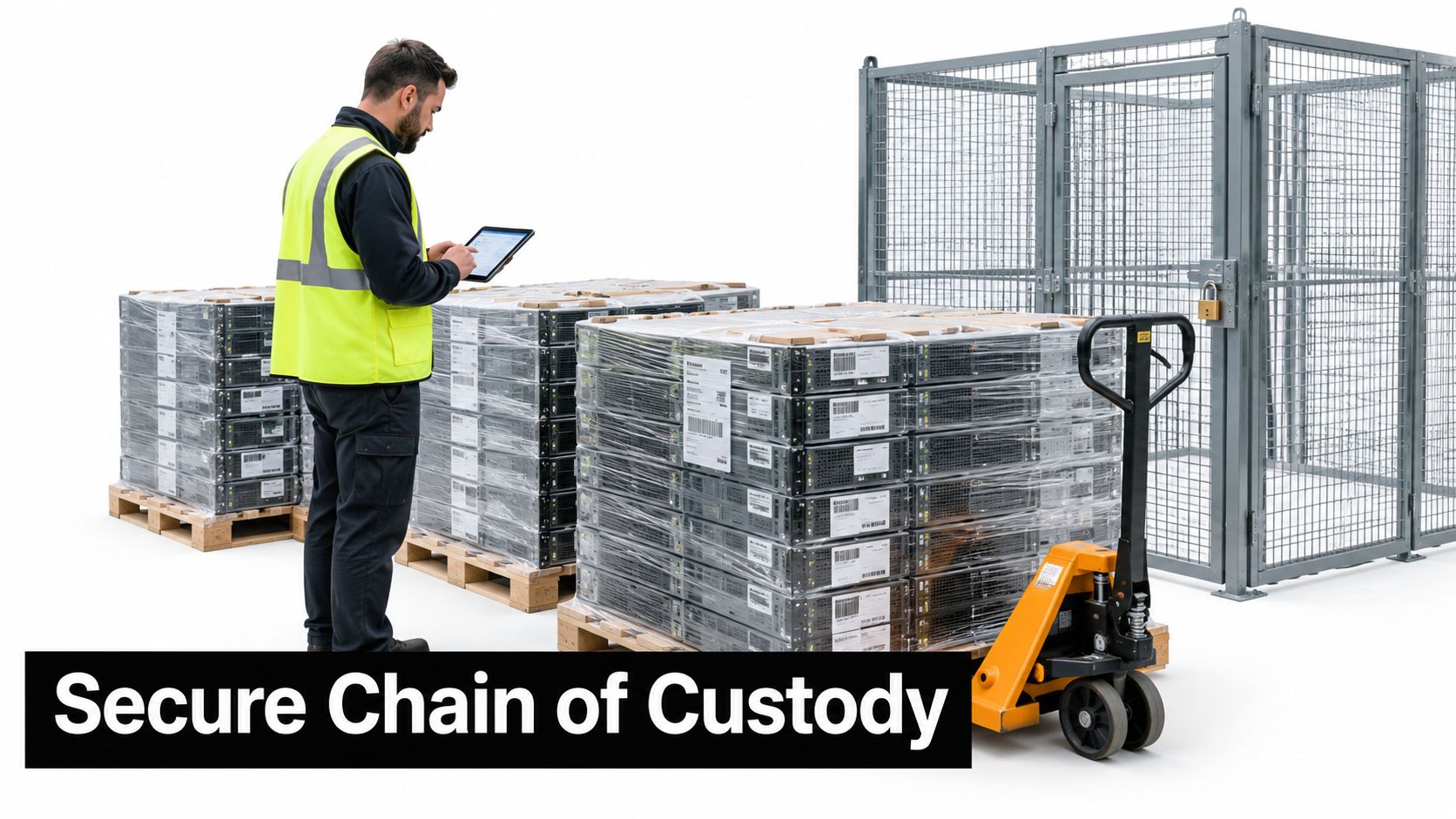
- Stage by disposition. Lock cabinets and cages, keep barcodes visible, and separate reusable equipment from media awaiting sanitization or destruction. Labels should tell handlers which route is authorized without exposing sensitive business information.
- Record the weight. Weigh pallets on a calibrated scale and enter gross weight on the custody log. Record tare information separately when needed for the later mass calculation.
- Seal data-bearing containers. Enter seal numbers on the outbound log and pickup manifest. Photographing a sealed container can supplement the record, but it doesn't replace signatures.
- Name the releasing staff. Assign a facilities representative and an IT or security representative to confirm release. Record their names and obtain carrier acknowledgment on the bill of lading.
- Confirm processor receipt. Require arrival time, receiving location, seal condition, and the receiving person's signature. A pickup signature alone doesn't prove delivery to the approved facility.
Handle exceptions before the truck arrives
Put UPS batteries and lithium packs on separate handling instructions and shipment documentation appropriate to the materials. Confirm packaging and transport requirements with the carrier instead of assuming the electronics pickup arrangements cover them.
For colocation returns, obtain the provider's written release and preserve the access log. For remote sites, consider consolidation where secure storage and transport arrangements allow it. Fewer handoffs can simplify oversight, but consolidation isn't worthwhile if equipment sits unsecured while awaiting collection.
When designing the handoff forms, the device custody documentation tips from myhalo offer a practical companion resource. Compare the proposed fields with your required chain-of-custody documentation before agreeing to the vendor's standard manifest.
Reverse logistics includes the return destination. Redeployed units should enter a named stock location, and donated units should reach a named receiving partner. Reworx Recycling offers business pickups and secure drive handling, giving organizations an option to coordinate an agreed pickup window rather than arranging the carrier independently.
Custody isn't a folder of unrelated signatures. It's the ability to follow the same identified equipment through every authorized handoff.
Certificates and Metrics That Prove the Job Was Done
Ask for the closeout document set before awarding the work. A vendor should know what evidence you expect, how it must be formatted, and which missing records will prevent acceptance.
Proof documents to request and what each one shows
| Document | What It Proves | What to Request |
|---|---|---|
| Reconciled asset register | Every barcoded unit has a final disposition | Line-by-line match to the original inventory |
| Certificate of sanitization | Recorded method and verification result for each device | Device serials, method name, operator, and supporting results |
| Certificate of destruction | Recorded physical destruction of drives or media | Serial list, destruction facility details, and process evidence |
| Bill of lading and weigh tickets | Recorded shipment weights and custody handoffs | Calibrated scale records, gross and tare basis, and signatures |
| Downstream processor disclosure | Declared material destinations and operating credentials | Facility identity, permits, R2 or e-Stewards status, and final treatment route |
| Mass-balance report | Reuse, material recovery, and disposal outcomes | Separate rates with a stated denominator for each |
| Exceptions log | Failed verification, missing units, or unresolved items | Closure evidence or escalation notes for each exception |
A certificate documents an asserted event. Its usefulness depends on whether you can connect that event to the equipment released from your site and the underlying processing evidence.
Review certificate requirements with procurement and security before processing begins. Don't wait until closeout to discover that the vendor issues a batch certificate without device serials.
Measure outputs rather than collection activity
The EPA's electronics generation and recycling methodology distinguishes collection for reuse or materials recycling from energy recovery and landfilling. That distinction matters because inbound weight isn't proof of material recovery.
A dense server shipment can include complete reusable systems, batteries, metal-bearing boards, and fractions that ultimately require disposal. Report those outcomes separately instead of applying a recycling label to the entire truckload.
Use these measures with explicit boundaries:
- Reuse rate by unit count. Units prepared for reuse divided by in-scope units received, with the counting convention stated.
- Reuse rate by mass. Mass prepared for reuse divided by total in-scope equipment mass received.
- Material-recovery rate by mass. Mass recovered as materials divided by the same in-scope equipment mass.
- Disposal rate by mass. Mass sent to disposal divided by that equipment-mass denominator.
Leave packaging out unless the project explicitly includes it. Report energy recovery separately, and explain how removed batteries, harvested parts, and processing residues fit the accounting boundary.
Check credentials without outsourcing judgment
Ask downstream processors for facility identity, accepted materials, permit or certification status, and final treatment routes. Buyers commonly request R2 or e-Stewards credentials, but the relevant question is whether the certificate is current and covers the actual facility and activities involved.
Certification provides evidence of an audited management system within its scope. It doesn't prove flawless handling of your particular shipment, which is why load-specific evidence and the exceptions log still matter.
Signoff rule: If the mass balance doesn't close, the exceptions log must explain the gap before you accept the project.
Document rounding, measurement differences, retained stock, and unresolved processor reporting separately. Don't hide an unexplained difference inside a broad diversion figure just to finish the report.
Recovering Value and Netting Out the Real Cost
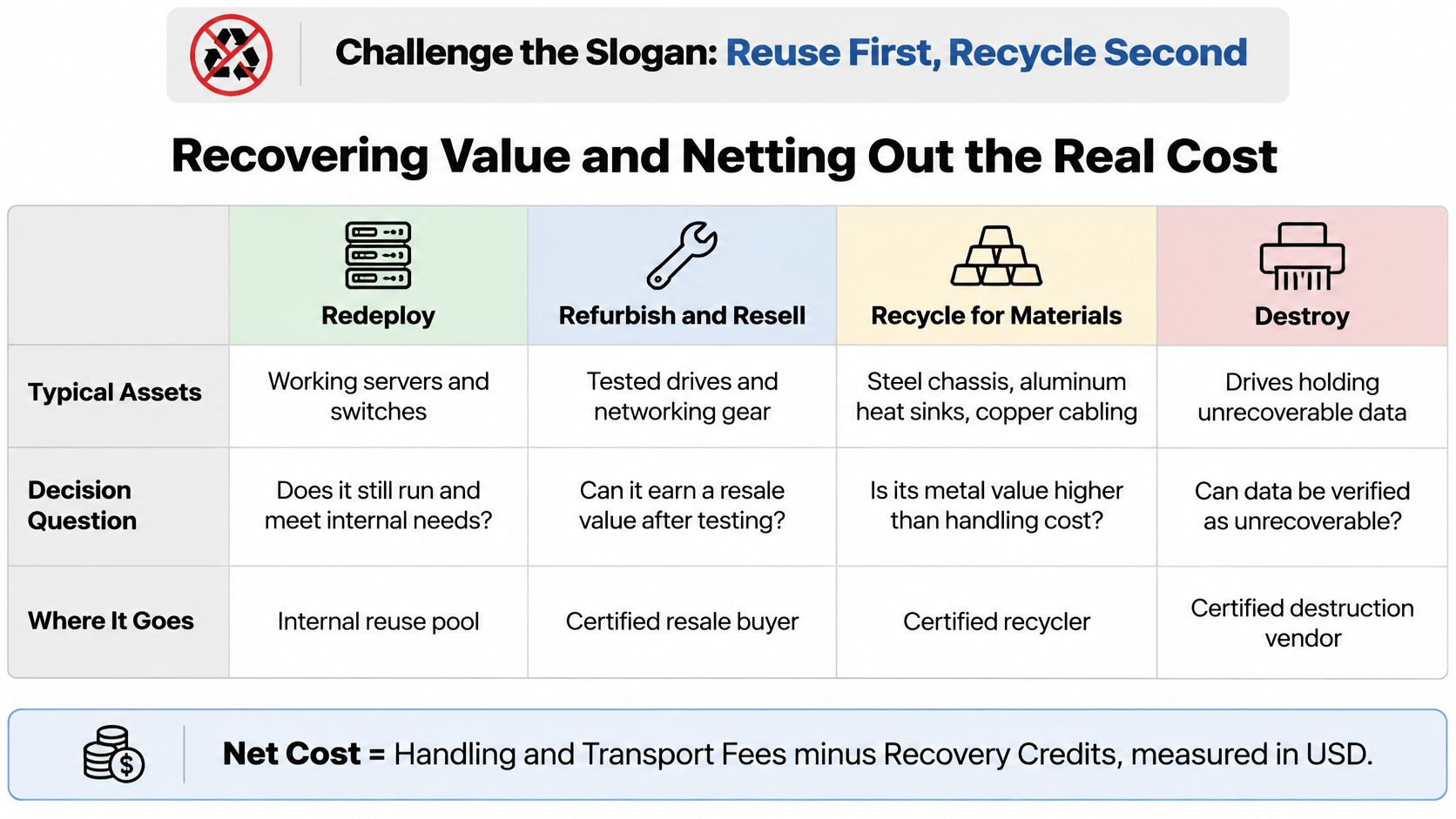
Reuse first, recycle second is a useful preference, but it isn't a complete disposition plan. Steel chassis, aluminum heat sinks, and copper cables are comparatively straightforward to recover; some fire-retardant plastics may instead require incineration or landfill.
An academic case study of specialized electronics recycling found that the specialized process reduced assessed impacts by 24% compared with business-as-usual processing. That result is specific to the case studied, not a promised improvement for every load, but it demonstrates why the processing route matters.
Recovery route by asset condition
| Route | Fits When | Value or Cost Outcome |
|---|---|---|
| Redeploy internally | Unit passes functional testing, sanitizes cleanly, and meets a real internal need | May avoid a new purchase; no sale proceeds |
| Buyback or resale | Enterprise-grade gear has current market demand | Per-unit payment based on condition grade; request a price sheet |
| Donation to a partner | Working equipment has weak resale demand and a named receiving partner | Documented community benefit; receipt and tax treatment require appropriate review |
| Component harvest | Failed hardware contains reusable memory, fans, or power supplies | Parts value may offset testing and removal labor |
| Specialized metal recovery | Boards, heat sinks, and copper cabling have an appropriate processing route | Possible recovery credit against handling and transport |
| Residual waste | Fire-retardant plastics or mixed fractions have no available recycling route | Disposal charges included in the reported disposal outcome |
Choose usefulness before theoretical value
Redeployment makes sense when a unit meets an actual operational need. Moving obsolete servers into a storage cage without an assigned use postpones the decision and preserves handling obligations.
For resale, request condition grades, acceptance criteria, and a per-unit price sheet. Clarify how missing rails, absent drives, failed power supplies, or cosmetic damage affect settlement, and whether the buyer can revise the offer after inspection.
Donation-based recycling offers another route for useful equipment. Corporate donation programs should match working technology to a recipient's needs rather than transfer unsuitable hardware and its disposal burden.
The publisher's social enterprise recycling model connects technology donations with digital inclusion and workforce development. Record the recipient, equipment condition, security release, and transfer acknowledgment so community impact remains connected to an accountable disposition.
For a Smyrna organization combining a server retirement with computer recycling, laptop disposal, or an office cleanout, keep asset classes separate during valuation. A working laptop suitable for a community program shouldn't disappear into the same settlement category as damaged rack hardware.
Compare the settlement, not the opening offer
Use net cost = handling and transport charges minus recovery credits as the commercial starting point. Include sanitization labor, failed-drive destruction, carrier minimums, storage, and any cage or rack removal charges.
Ask whether component harvesting adds value after labor, testing, and residual disposal. Metal content alone doesn't establish a profitable recovery route.
Review cost recovery strategies alongside the proposed statement of work, not separately from it. If the broader facility project includes medical equipment disposal, laboratory equipment disposal, or product destruction, require separate acceptance criteria and quotations rather than assuming standard IT equipment disposal covers those items.
A buyback offer is only as defensible as its condition grading and settlement rules. A donation without a documented receiving destination is similarly difficult to support during an audit.
Confirm Your Vendor and Lock the Project Timeline
Ask the vendor which facilities hold R2 or e-Stewards certification, what insurance applies, and whether destruction occurs on-site or at an authorized processing facility. Identify every subcontractor that will touch the equipment, confirm any required licenses, and ask whether your security representative can witness destruction.
Evaluate the answers against your project rather than a generic sustainability claim. A vendor may offer suitable electronics recycling while lacking the on-site destruction capacity, reporting format, or restricted-access logistics your particular exit requires.
Put acceptance terms into the agreement
The service-level agreement should specify the pickup window, sanitization turnaround, certificate delivery deadline, and exception-handling time. Also state the price for failed-drive destruction, reporting format, subcontractor disclosure obligations, and approval process for disposition changes.
Require notice before a vendor substitutes a downstream processor or changes an approved treatment route. A low quote becomes harder to compare if the provider can alter the work without your approval.
Use the following as a planning template, not a claim about standard processing times. Adjust the intervals to your equipment volume, access restrictions, security requirements, and vendor capacity.
Project timeline around the exit date
| Timing | Milestone | Owner |
|---|---|---|
| 8 to 6 weeks before exit | Scope signed off, register started, vendors shortlisted | Project sponsor |
| 6 to 4 weeks before exit | Vendor SLA signed, sanitization plan approved | Security officer |
| 4 to 2 weeks before exit | Register frozen, custody and pickup dates booked | Facilities manager |
| Exit week | Loads moved, weights and seal numbers logged | Facilities and ITAD lead |
| 1 to 3 weeks after exit | Certificates received, exceptions closed | Vendor manager |
| 4 to 6 weeks after exit | Mass-balance report and net-cost summary filed | Sustainability lead |
If the building deadline is fixed, reserve capacity before dismantling starts. Confirm dock appointments, freight-elevator availability, secure staging, power-down authorization, and any landlord or colocation-provider requirements.
Don't make the facilities manager responsible for deciding whether sanitization passed. Facilities controls access and movement; security approves data outcomes; procurement manages commercial acceptance. Clear ownership prevents a loading deadline from becoming an accidental security waiver.
Close through a single approval gate
The project sponsor signs off when the register reconciles to the certificates, the mass-balance report and net-cost summary are filed, and donation or buyback receipts are confirmed. Open exceptions need documented resolution or formally accepted escalation, not an assumption that the vendor will eventually send something.
Archive custody logs and supporting evidence for the period required by your retention policy. Preserve readable exports and attachments alongside any portal records so future reviewers don't depend on an expired vendor login.
For a Smyrna, Georgia business planning recurring refresh cycles, agree on a repeatable pickup, reporting, and donation process rather than renegotiating disposal after every upgrade. Sustainable recycling works better as a controlled operating procedure than as an urgent purchase made after the racks have already been disconnected.
Reworx Recycling is a Smyrna, Georgia electronics recycling and IT asset disposition partner offering business pickups, equipment decommissioning, secure hard drive shredding, and donation-based options that support community technology access and workforce development. Visit Reworx Recycling to request a consultation or pickup window, donate working equipment, or establish a recurring partnership for governed data center recycling.