A typical ITAD vendor review starts under pressure. Finance wants quotes. IT wants documented data destruction. Sustainability wants proof of downstream handling. Operations wants assets removed without disrupting users, projects, or site schedules. At first glance, several vendors can meet the brief. The gap shows up later, in what they can verify and what your team can defend.
IT asset disposition is a risk decision as much as a purchasing decision. The vendor you choose may handle devices containing company data, regulated information, reusable equipment, batteries, and other controlled materials. If the process is loose, your organization absorbs the exposure. If the process is structured, you can show security, procurement, legal, and leadership exactly how the decision was made and why the selected provider met the standard.
The practical way to do that is a weighted scoring model tied to evidence, not sales language. Price belongs in the model, but ITAD decisions, therefore, should not hinge on price alone. A low pickup quote can hide weak chain-of-custody controls, unclear downstream partners, poor reporting, or limited resale capability that reduces total value recovery.
I recommend treating vendor selection as a documented risk management exercise. Score each provider against the same criteria. Require specific documents. Ask questions that can be verified. If a recycler claims strong controls, request the audit trail, certificate scope, sample reporting, and proof of how exceptions are handled. Organizations should think beyond disposal alone. Good vendor selection in ITAD means building a process that stands up to audit, protects data, supports environmental goals, and holds up when a stakeholder asks, "Why did we choose this company?"
That approach also helps separate baseline qualifications from real operating maturity. For example, a vendor that publishes clear guidance on electronics recycling certification requirements gives you a starting point for what to request and verify, rather than leaving your team to rely on logos and broad claims.
For ITAD, I'd go one step further. Treat your recycler like a risk-bearing operating partner, similar to any strategic partner for facility operations. The framework below uses eight criteria, with practical questions, document requests, and scoring guidance, so your final choice is defensible on paper and workable in the field.
1. Certifications and Compliance Standards
Certifications are the first screen, not the final decision. If a vendor can't produce current credentials relevant to electronics recycling, environmental management, and data handling, they shouldn't make your shortlist.
In ITAD, certifications do two jobs. They show whether the vendor has passed external review, and they give your team a clean way to verify process maturity without relying on sales claims. For organizations managing regulated devices, internal audit requests, or public sustainability commitments, that's a strong starting point.

What to Request Up Front
Ask for the current certificate, scope, and most recent audit evidence. Don't stop at a logo on the vendor's homepage. A credible provider should be comfortable sharing documentation and explaining what sites, services, and business units are covered.
A practical example is checking a recycler's published guidance on electronics recycling certification requirements. That kind of resource is useful because it reflects how the vendor thinks about formal verification, not just marketing language.
- Verify Scope Carefully: Confirm the certification applies to the location handling your assets, not just a parent entity or different facility.
- Match Standards to Risk: A healthcare group may prioritize privacy and chain-of-custody controls, while a manufacturer may care more about environmental handling and downstream traceability.
- Make Renewal a Contract Term: If a certification lapses, your agreement should define what happens next.
Practical rule: If a vendor says certification is "in process," treat them as uncertified until the final documents are in hand.
One more point matters here. Modern vendor evaluation increasingly includes risk-based review, especially around financial stability, cybersecurity posture, regulatory compliance, and operational reliability. Certifications don't answer all four on their own, but they help you identify which vendors take governance seriously and which ones are improvising.
2. Data Security and Information Destruction Capabilities
Most ITAD failures that keep leaders awake at night start with data, not scrap value. A retired laptop, server, firewall, copier drive, or medical device can still hold sensitive information long after it's left active service.
A vendor's destruction process has to be specific. "We wipe drives" isn't enough. You need to know how assets are identified, how they're tracked, when media is sanitized versus physically destroyed, who witnesses the process, and what documentation comes back to your team after completion.
The Questions That Expose Weakness
Ask the vendor to walk you through chain of custody from pickup to final destruction. Ask what happens if serial numbers are unreadable, if a device arrives damaged, or if encrypted media can't be logically sanitized. Good vendors answer directly. Weak ones pivot to generic assurances.
For highly sensitive environments, review the provider's secure data destruction services and compare them against your retention, audit, and legal requirements. If your business has ever needed professional data recovery services near me, you already know how much recoverable information can remain on supposedly retired hardware.
- Require Device-Level Records: Certificates should connect back to identifiable assets wherever possible.
- Check for Exception Handling: Ask how the vendor documents failed wipes, damaged drives, and assets that must be shredded instead of reused.
- Confirm Physical Security: Locked transport, sealed containers, access-controlled processing areas, and documented handoffs matter.
A chain of custody that breaks for even one pallet can become the only fact legal cares about later.
Independent best-practice guidance recommends evaluating vendors against service benchmarks such as historical uptime, response and resolution times, on-time delivery rates, and post-implementation defect or patch rates, while also validating security and compliance through evidence like SOC 2 Type II reports, ISO certifications, breach history, and third-party risk checks when assessing service performance and security controls. For ITAD, that translates into a simple standard. If the vendor can't produce verifiable security artifacts and audit-ready destruction records, don't rely on reputation alone.
3. Environmental Impact and Recycling Practices
A vendor can be secure and still be a poor environmental choice. That's the mistake many teams make when they reduce ITAD to "data destruction plus pickup."
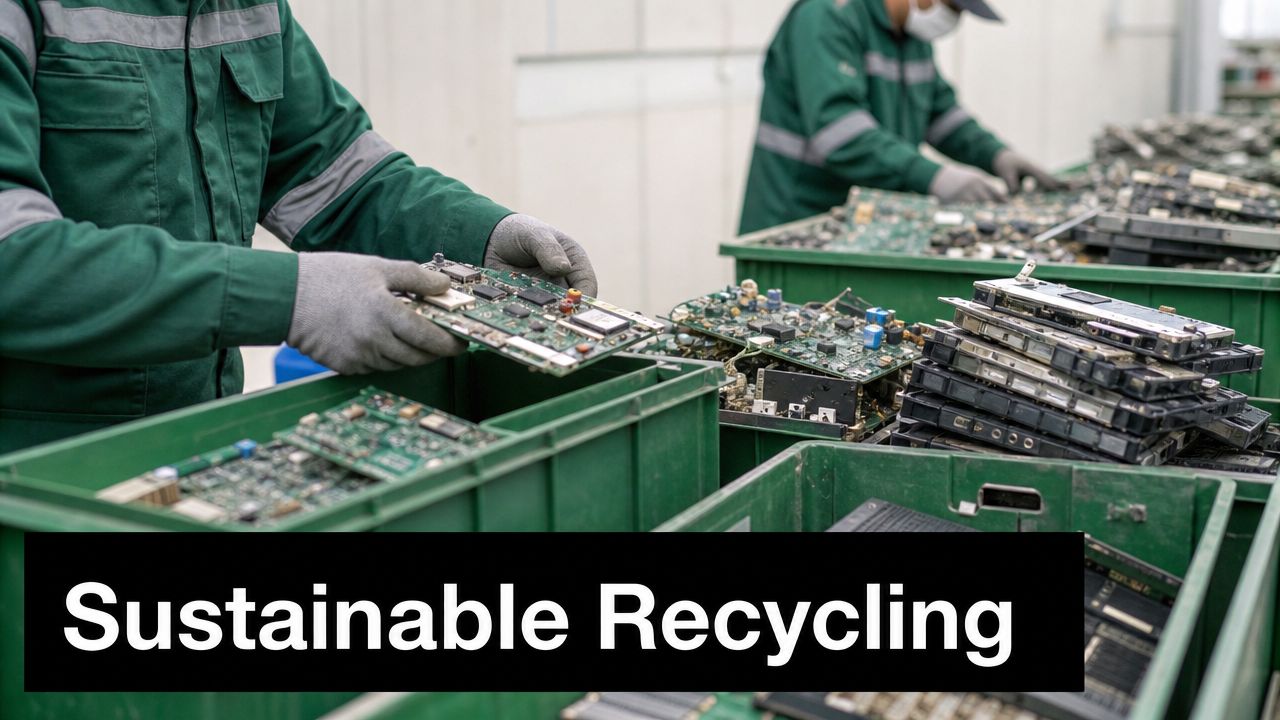
You need to know what happens after collection. Which assets are reused, which are dismantled, where hazardous components go, how downstream vendors are managed, and whether materials stay in channels your organization can stand behind if someone asks hard questions later. At this juncture, sustainability teams, ESG leads, and procurement often discover they were evaluating different problems.
Trace the Downstream Path
Ask the vendor where material goes after triage. Ask whether they refurbish, harvest parts, or send mixed streams to other processors. If they use downstream partners, request the control process they use to approve and monitor them.
A useful baseline is understanding the environmental impact of electronic waste and then pushing the vendor to explain their own handling model in those terms. If your company publishes sustainability updates, this isn't optional. You need enough detail to support your own claims.
- Ask About Reuse First: Extending equipment life is often more aligned with sustainability goals than immediate shredding of all devices.
- Request Hazardous Material Handling Details: Batteries, screens, lamps, and specialized equipment need more than generic recycling language.
- Check Reporting Fitness: Make sure their environmental reporting can feed your internal ESG or facilities reporting process.
The most useful comparison isn't "green" versus "not green." It's transparent versus opaque. Some vendors can explain their process clearly, including reuse criteria and downstream oversight. Others retreat into broad promises about zero landfill or responsible recycling without showing how they control outcomes. That's usually where trouble starts.
For general compliance context, the EPA's e-waste guidance is a sensible external reference point when you're reviewing a vendor's environmental claims.
4. Service Flexibility and Logistics Capabilities
A capable recycler can still fail your program if they can't operate the way your sites work. Logistics is where many vendor selection criteria become real.
Think about the difference between a single office cleanout and a phased retirement across clinics, branches, warehouses, or campuses. Add security escorts, loading dock restrictions, after-hours pickups, serialized asset lists, and seasonal refresh cycles. Suddenly the low bidder doesn't look so cheap.
Test the Operating Model, Not Just the Promise
Ask how the vendor handles bulk pickups, boxed laptop returns, pallets from multiple sites, and assets that must remain segregated by department or legal entity. If you have complex transportation needs, borrow discipline from a carrier vetting checklist and apply the same thinking to ITAD pickups. Who arrives, how handoff is documented, how delays are escalated, and what backup plans exist if access windows change?
Reworx Recycling's overview of IT asset disposition companies is relevant here because it reflects the broader service model buyers should expect, including collection, handling, and downstream processing considerations.
A weighted scorecard helps. One industry framework recommends 30% technical capability, 20% implementation track record, and 20% total cost of ownership, with the remaining share commonly assigned to support quality and financial stability. For ITAD, logistics capability sits inside technical capability and implementation track record more than teams expect.
If a vendor needs your team to redesign site operations around their pickup process, they aren't flexible enough.
A realistic scenario is a multi-floor office exit where facilities wants everything out in one window, security wants serialized chain of custody, and HR wants reusable laptops routed into a donation-based recycling program rather than immediate destruction. The right vendor can support those competing goals without turning the project into six separate workstreams.
5. Pricing Transparency and Value Recovery Options
Price matters. It just shouldn't drive the whole decision.
The most common ITAD pricing mistake is comparing pickup or processing fees without comparing what is included. One quote may assume mixed pallets, no serialized reporting, no on-site labor, and standard turnaround. Another may include detailed inventory, secure packing support, destruction certificates, and resale sharing. Those aren't equivalent offers.
Read the Commercial Model Line by Line
Ask for a pricing schedule that separates transportation, on-site labor, data destruction, deinstallation, recycling, refurbishment evaluation, and resale or buyback treatment. If they offer revenue share, ask how they grade device condition and how disputes are resolved. If they say there are no fees, ask where the economics come from.
A practical reference point is reviewing options for recovering money for old electronics and then comparing that to your own asset mix. Late-model laptops and network gear may have reuse value. Broken peripherals and obsolete equipment usually won't. A vendor that pretends everything is revenue-positive is usually smoothing over the full picture.
The broader procurement lesson is clear. Teams increasingly need to weigh vendor selection criteria beyond price, especially where resilience, compliance, hidden support costs, and long-term continuity matter in decisions that go beyond the bid amount.
- Separate Fees From Recovery: Don't let resale projections hide transportation or destruction costs.
- Define Ownership of Proceeds: The contract should state who keeps what and when reconciliation happens.
- Use Real Device Samples: Ask for a valuation process based on representative equipment, not a hopeful spreadsheet.
What works is a total-cost view. What doesn't work is choosing the vendor with the lowest headline fee, then discovering later that reporting, special handling, packed pickups, and exception assets all trigger add-ons.
6. Vendor Reputation and Track Record
Reputation is useful, but only when you test it. A polished website, recognizable clients, and strong sales coverage don't tell you how the vendor behaves when a shipment is late, a serial number is missing, or a site lead changes the loading plan on the day of pickup.
The right way to evaluate track record is to ask for proof from organizations that resemble yours. Similar industry, similar volume, similar risk profile. A vendor that handles occasional office pickups may not be ready for medical equipment disposal, data center decommissioning, or a statewide refresh project.
Ask References About Friction, Not Satisfaction
Most references will say the vendor was responsive and easy to work with. That doesn't help much. Ask what went wrong during the engagement and how the vendor handled it. Ask whether final reports matched what was picked up. Ask whether invoices changed after the project started.
Useful prompts include:
- Ask About Escalations: Who stepped in when something went off plan?
- Ask About Accuracy: Were serialized records, destruction certificates, and pickup manifests complete?
- Ask About Consistency: Did the service quality hold up after the first project?
A practical field example is comparing two vendors after an office cleanout. Both may collect equipment successfully. Only one may return clean documentation, reconcile exceptions quickly, and support internal audit requests without chasing. That's the vendor with a track record worth paying for.
If you're evaluating a regional provider such as Reworx Recycling for Georgia operations, reputation should include local execution. Can they support pickups, secure data destruction, sustainable recycling, and donation-based recycling workflows in the markets where you operate? That's more useful than generic name recognition.
7. Reporting and Documentation Capabilities
Reporting is where your selection process either becomes defensible or falls apart. If you can't prove what left the building, what was destroyed, what was reused, and what was recycled, you don't have a mature ITAD program. You have a pickup history.
This criterion matters more than many teams expect because reporting has to satisfy multiple audiences at once. IT wants asset-level closure. Security wants destruction evidence. Sustainability wants environmental reporting. Finance wants disposition support. Audit wants consistency.
Review Sample Outputs Before You Sign
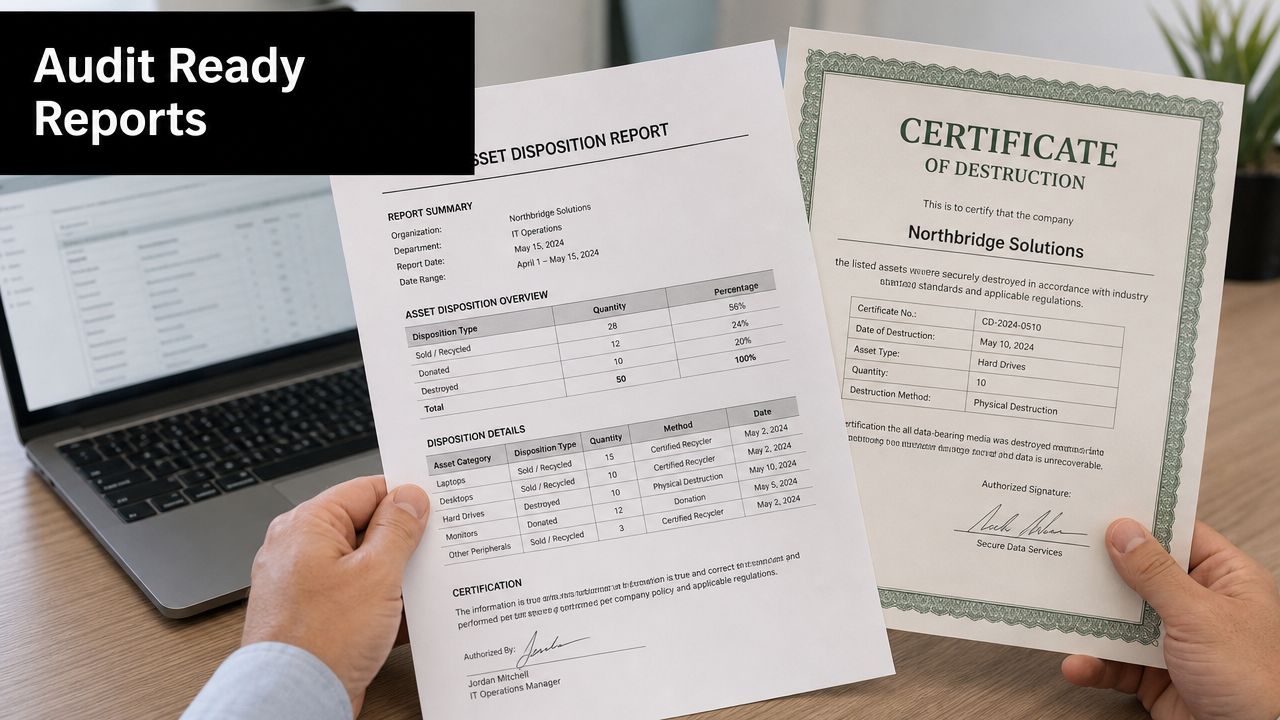
Ask for sample manifests, destruction certificates, serialized inventory reports, and environmental summaries. Don't accept screenshots alone. You want to see whether the reporting is detailed enough to survive an internal review six months later when the original project team has moved on.
Good reporting usually includes asset identifiers, disposition method, processing dates, and exception notes. Better reporting also lets you reconcile what was scheduled, what was collected, and what was ultimately processed.
Good documentation reduces two kinds of risk at once. Operational confusion now, and audit pain later.
A common real-world issue is mixed lots from a facility cleanout. Without strong documentation, a batch of monitors, laptops, docking stations, and loose drives turns into a vague line item. With strong documentation, your team can answer specific questions later about destruction status, reuse pathways, and final disposition. That's the difference between manageable governance and avoidable exposure.
8. Specialized Services and Technical Expertise
Basic electronics recycling is one thing. Complex retirement projects are another.
If you're decommissioning a server room, retiring lab hardware, clearing out a healthcare site, or managing product destruction for failed inventory, you need a vendor with technical depth. That includes packing, de-racking, device identification, media handling, redeployment decisions, and reverse logistics coordination across locations.
Match Expertise to the Actual Asset Mix
Start with the assets your team retires most often. Laptops and monitors are straightforward. Network gear, storage arrays, medical devices, laboratory equipment disposal, and data center hardware usually aren't. The vendor should be able to explain how they handle each category without resorting to vague "white glove" language.
This is also where specialized services can create value. A vendor that supports testing, refurbishment triage, and corporate donation programs may help you divert more usable equipment into reuse rather than default destruction. For organizations with social impact goals, that's a meaningful differentiator. It's one reason some businesses work with social enterprise recycling partners such as Reworx Recycling when they want IT asset disposition tied to community benefit as well as compliance.
What works in practice is requesting a proof of concept with real data, asking for independent security artifacts such as SOC 2 Type II reports, and verifying references from organizations with similar scale and use cases before final scoring, as recommended in that earlier vendor-selection framework. That approach is especially useful when the vendor will support secure data destruction, office cleanout activity, laptop disposal, data center decommissioning, and donation-based recycling under the same relationship.
The red flag is a vendor that says yes to every specialty request but can't describe the process owner, documentation path, or downstream handling method for each service line.
Vendor Selection: 8-Criteria Comparison
| Item | 🔄 Implementation Complexity | ⚡ Resource Requirements | ⭐ Expected Outcomes | 📊 Key Advantages / Impact | 💡 Ideal Use Cases / Tips |
|---|---|---|---|---|---|
| Certifications and Compliance Standards | High, third‑party audits & ongoing recertification | Moderate, vendor certification costs and documentation | High ⭐, verified compliance & reduced legal risk | Demonstrable accountability, ESG support, simplified audits | Regulated industries (healthcare, government); request current certificates |
| Data Security and Information Destruction Capabilities | High, technical processes, chain‑of‑custody and verification | High, shredders, secure transport, certified procedures | Critical ⭐, irreversible data removal and audit evidence | Prevents breaches, enables regulatory compliance (NIST/DoD), provides certificates | Organizations with PII/PHI; consider on‑site or witnessed destruction |
| Environmental Impact and Recycling Practices | Medium, tracking waste streams and environmental controls | High, domestic processing, hazardous handling, material recovery | High ⭐, landfill diversion and measurable recovery metrics | Improves ESG, reduces contamination, recovers valuable materials | Sustainability programs, campuses, firms needing carbon/ESG reporting |
| Service Flexibility and Logistics Capabilities | Medium, route planning, scheduling, multi‑site coordination | Variable, pickup fleet, storage, regional coverage | Good ⭐, operational efficiency and minimal business disruption | Convenience, scalability, reduces internal IT burden | Distributed organizations, large refresh projects; map locations and volumes |
| Pricing Transparency and Value Recovery Options | Low–Medium, pricing models, valuation processes | Low–Medium, appraisal capability and market tracking | Moderate ⭐, budget predictability and potential revenue offset | Enables ROI analysis, bulk discounts, buyback opportunities | Budget‑conscious orgs and high‑volume disposals; get upfront valuations |
| Vendor Reputation and Track Record | Low, due diligence and reference checks | Low, time for research and reference calls | High ⭐, reliability and reduced vendor failure risk | Proven processes, accountability, customer confidence | Mission‑critical programs; request sector‑specific references |
| Reporting and Documentation Capabilities | Medium, integration of tracking systems and custom reports | Medium–High, dashboards, data retention, reporting tools | High ⭐, audit readiness and traceable disposition records | Supports compliance, ESG disclosure, real‑time verification | Regulated entities and auditors; require sample reports and SLAs |
| Specialized Services and Technical Expertise | High, specialized workflows (decom, refurbishment, testing) | High, technical staff, testing/refurb facilities, reverse logistics | High ⭐, strategic value, extended asset life, resale revenue | Consultation, data center decommissioning, revenue from refurbishment | Complex ITAD projects, data center retirements, organizations seeking resale options |
Making Your Final Decision with Confidence
A final ITAD decision often gets tested after the contract is signed. Legal asks how downstream vendors were checked. Security wants proof that destruction controls were verified before pickup. Sustainability needs defensible reporting for reuse and recycling claims. If the selection file cannot answer those questions, the process was too loose.
Use the scorecard as a decision record, not just a ranking tool. A weighted model helps, but only if the scoring is tied to evidence and minimum thresholds. In ITAD, that structure is essential for preventing a cheap quote from overwhelming higher-risk weaknesses in data security, reporting, logistics, or downstream recycling controls.
The strongest approach is simple. Score each finalist against the eight criteria in this guide. Then require document validation before final approval. That usually includes current certifications, sample certificates of destruction, audit-ready chain-of-custody records, insurance coverage, sample environmental and asset reports, logistics SOPs, and pricing terms that explain fees, rebates, and shared value recovery.
If a vendor cannot produce the document, treat the capability as unproven.
At this stage, organizations should think beyond disposal alone. The better decision usually comes from balancing risk reduction, operational fit, and asset value recovery across the full program. That can include resale, redeployment, donation support, secure media destruction, and service coverage for offices, labs, clinics, warehouses, and data centers. The lowest pickup price rarely reflects the full cost of exceptions, weak reporting, or poor downstream controls.
I have found that final approvals move faster when teams set a few hard gates before reviewing total score. For example, any vendor that fails core data destruction requirements, cannot document downstream accountability, or provides incomplete reporting samples should be removed from consideration even if pricing looks attractive. That avoids the common procurement mistake of negotiating with a finalist who was never acceptable from a governance standpoint.
Reworx Recycling is one option for organizations that want electronics recycling and IT equipment disposal support combined with secure hard drive shredding, pickup services, and a donation-based model tied to community benefit. For businesses evaluating partners in Georgia and beyond, that kind of integrated service model can be easier to govern than splitting pickup, destruction, reuse, and recycling across multiple vendors.
Choose the vendor you can defend to audit, security, legal, and sustainability without adding explanations after the fact. If the scorecard, supporting documents, reference checks, and approval thresholds all point in the same direction, you have a selection process that is easier to justify and safer to scale.
If you're reviewing ITAD vendors and want a partner that supports electronics recycling, secure data destruction, donation-based recycling, and responsible equipment retirement, visit Reworx Recycling to explore pickup options, service guidance, and ways to donate old equipment or start a long-term recycling partnership.