A pallet of retired laptops, cordless tools, and uninterruptible power supply units arrives at your loading dock. The recycler is scheduled to collect it, but nobody knows which batteries are safe to stage, which devices need isolation, or whether the shipment can legally leave by the planned carrier. That uncertainty is where battery programs fail.
Lithium battery recycling isn't only a chemistry problem. For facilities teams, IT managers, and sustainability leaders, it starts with intake, storage, labeling, chain of custody, and transport. The recycler can't correct an unsafe receiving process after a damaged battery has already been placed beside cardboard or loaded into an ordinary gaylord.
This guide gives you a practical operating model for safe collection, compliant movement, vendor evaluation, and repeatable auditing. It also places battery handling inside the broader electronics recycling and IT asset disposition, or ITAD, program, where secure data destruction, reuse, donation-based recycling, and sustainable recycling should work together.
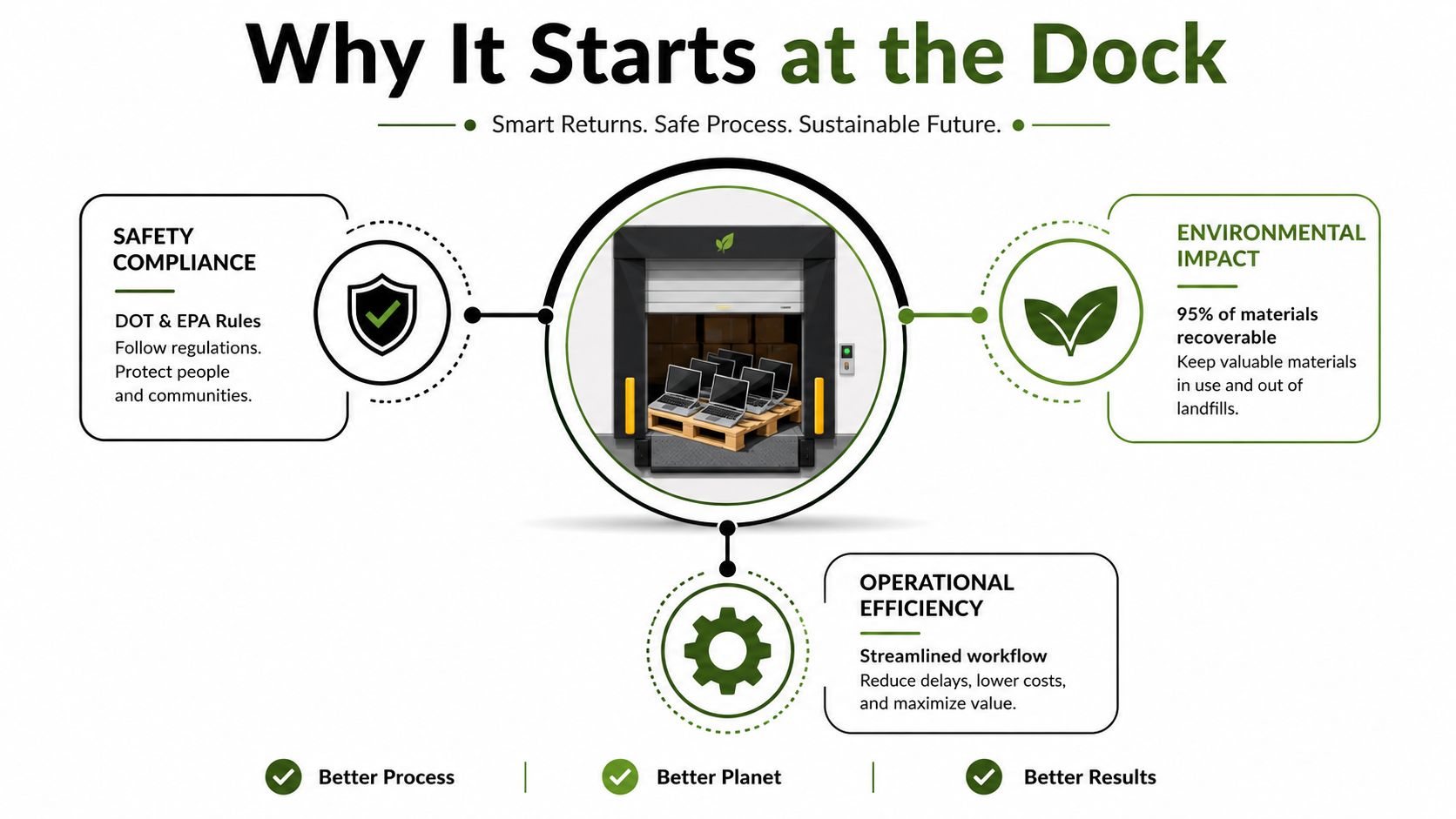
Why Lithium Battery Recycling Starts at Your Loading Dock
The first twenty feet belong to your organization. A recycler can provide collection, transportation, sorting, disassembly, and material recovery, but your staff still controls what enters the building, how it's identified, and where it waits for pickup.
That matters because lithium-ion batteries can ignite during storage or processing. The National Fire Protection Association's discussion of lithium-ion battery facility fires treats battery recycling as a fire-sensitive waste-management activity, not ordinary scrap handling. A sustainability program that ignores the loading dock creates avoidable exposure for employees, contractors, property, and the surrounding community.
The waste problem is also expanding faster than recovery infrastructure. Widely cited global estimates place lithium-ion battery recycling at only about 5%, while one research summary projects roughly 8 million tons of lithium-ion battery waste worldwide. An industry overview cited by the CAS summary of lithium-ion battery recycling projects battery materials available for recycling from 200,000 tons in 2020 to 1.4 million tons by 2030 and more than 7 million tons by 2040. The U.S. government has also noted that no widely accepted U.S. recycling rate exists, which reinforces the practical point: end-of-life recovery remains limited compared with the installed battery base.
Make receiving a controlled decision
Start with a receiving station, not an open storage corner. Assign a trained person to inspect incoming laptops, tablets, tools, battery backups, e-bikes, and loose cells before they join the general electronics stream.
For intact consumer batteries, the EPA guidance for used lithium-ion batteries recommends bagging each battery individually and taping its terminals before delivery to an electronics recycling or hazardous-waste facility. The purpose is straightforward. Separate bags and covered terminals reduce contact between conductive surfaces and lower short-circuit risk.
A quick visual check should follow. Look for swelling, punctures, crushed housings, leaking electrolyte, heat damage, exposed conductors, corrosion, odor, or signs that a device has been involved in an incident. A voltage check can help trained personnel identify an abnormal condition, but it isn't a substitute for physical inspection or a vendor's acceptance protocol.
Don't place a swollen, leaking, crushed, hot, or otherwise compromised battery into the ordinary intact-battery container. Isolate it in a suitable fire-resistant container, restrict access, record the condition, and escalate to a qualified battery recycler or hazardous-materials professional. Under transport rules, a damaged or defective battery is one that has a potential for dangerous failure, such as fire, rupture, or short circuit, based on damage or an identified safety defect. That classification changes packaging, carrier options, and whether the shipment can move at all.
Give the receiving team a short escalation checklist
- Accept and stage: The battery or device is intact, cool, identified, and free of visible damage.
- Protect terminals: Each loose battery is individually bagged and has its terminals taped, following EPA consumer-handling guidance.
- Isolate immediately: Swelling, leakage, crushing, heat, exposed conductors, or an unknown condition requires a separate fire-resistant container.
- Document the exception: Record the asset, location, observed condition, handler, and time of isolation.
- Escalate before shipment: Ask the recycler or qualified transport specialist how the item must be packaged and moved.
- Stop the load: If staff can't determine the battery type, condition, or transport status, don't place it on a routine outbound pallet.
Practical rule: A battery isn't “ready to recycle” merely because someone has removed it from a device. It's ready when your team can identify its condition, protect it from short circuits, and match it to an approved downstream process.
For business leaders building a wider reverse-logistics program, Reworx's guidance on efficient and sustainable reverse logistics fits the same operating principle. Electronics recycling should begin with controlled movement inside the facility, then continue through documented pickup, processing, and final disposition.
Storage and Labeling That Survives an Inspection
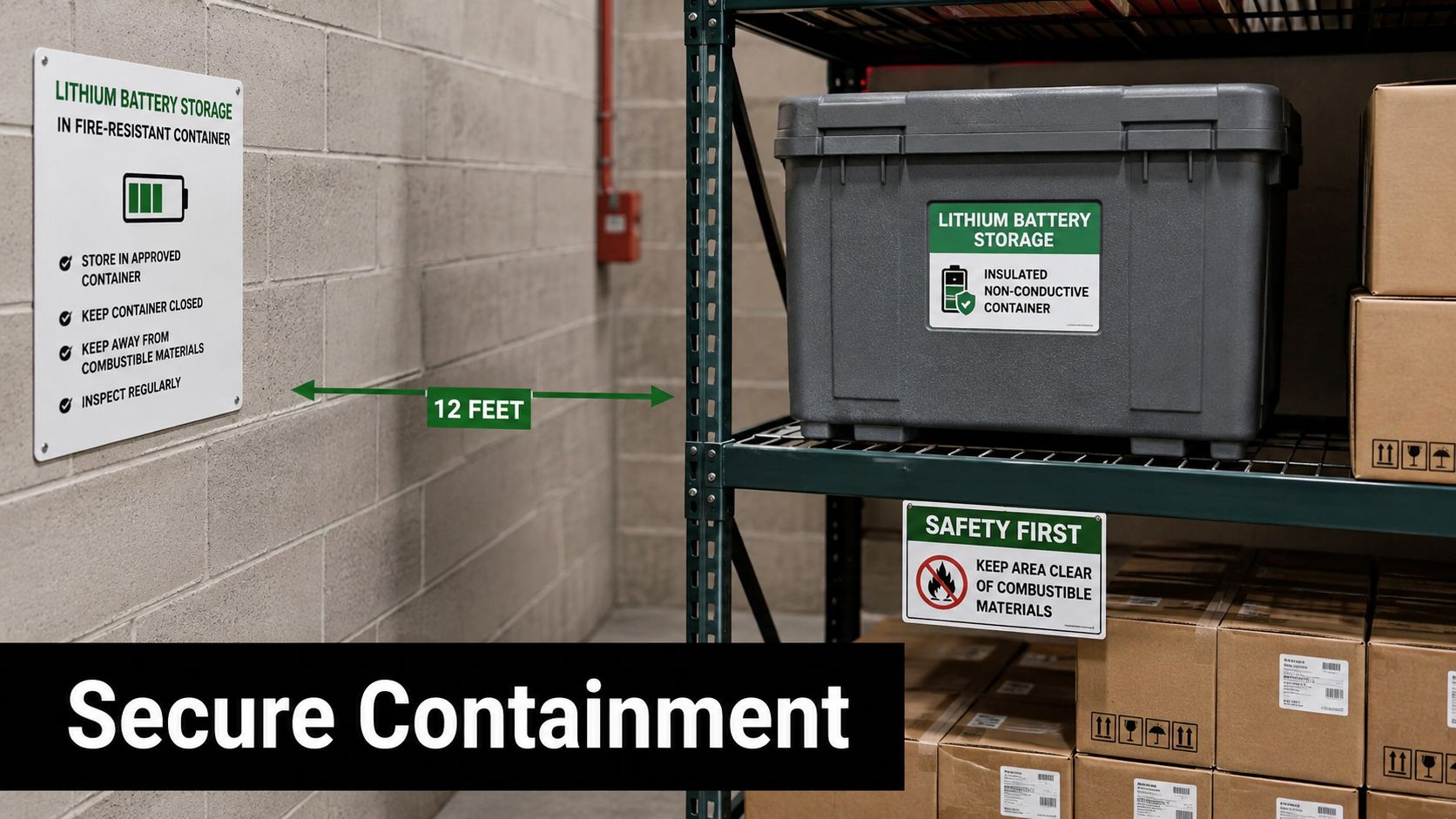
A battery storage area should look intentional. Use a lidded, insulated, non-conductive container suited to the battery stream, keep it away from combustible materials and ignition sources, and prevent placement near exits, electrical panels, heaters, or forklift traffic. Don't let the container become a catch-all for toner, cardboard, aerosol cans, or ordinary office cleanout debris.
The room itself needs an owner. Mark the designated area on a floor plan, post the handling rules, restrict access, and maintain an inventory or accumulation log. Local fire codes can impose quantity and separation thresholds, so your facilities or environmental health and safety team should confirm requirements with the authority having jurisdiction rather than relying on a generic online limit.
Label the contents, not just the container
A durable label should identify the waste stream, battery chemistry when known, condition category, hazard communication information, and accumulation date. If a box contains mixed chemistries, say so. Better still, separate the streams before they reach the recycler, because chemistry mixing makes downstream processing and vendor acceptance more difficult.
Use a distinct label for damaged or defective cells. Staff should understand that “damaged” isn't a cosmetic category. A crushed casing, swelling, leakage, burn mark, or evidence of overheating can change the handling path and require specialized packaging.
For portable power products, temperature control also deserves attention. Facilities teams managing micromobility assets can use this practical reference on e-bike battery storage temperatures, then confirm the recycler's requirements for the specific battery design. Indoor storage is usually easier to supervise, but a damaged cell may require a specialized outdoor or otherwise segregated arrangement determined by fire-safety professionals and the receiving vendor.
Document the area with photographs, inspection records, container specifications, training sign-ins, and pickup manifests. Reworx's universal waste resource can help frame the broader waste-management conversation, but your local requirements and the battery recycler's acceptance rules control the actual setup.
Transporting Lithium Batteries Under DOT and UN Rules
Transport decisions should happen before the carrier arrives. UN 38.3 is the core transport standard for lithium batteries, and it requires eight tests, designated T.1 through T.8, before transport. Batteries that haven't passed the required testing can't be placed on a pallet because a vendor has agreed to recycle them. The UN 38.3 transport overview explains that lithium batteries aren't eligible for transport by air, sea, road, or rail unless they have passed the applicable testing.
That baseline doesn't make every battery shipment identical. Intact batteries, batteries contained in equipment, damaged or defective batteries, recalled products, and prototypes can have different packaging, marking, documentation, and carrier requirements. A damaged battery may need a specialized container and a ground-only solution. It shouldn't be treated like a normal laptop shipment.
Use a release decision, not a shipping guess
Before releasing a container, confirm the following:
- Identify the battery: Record whether the battery is lithium-ion, lithium-metal, contained in equipment, or loose. Confirm chemistry and model information when available.
- Classify condition: Separate intact and undamaged items from damaged, defective, recalled, or unknown-condition items.
- Confirm test status: Obtain UN 38.3 test evidence or a supplier declaration through the recycler or manufacturer.
- Protect terminals: Use inner packaging that prevents movement and contact between terminals. Use outer packaging appropriate for the battery type and condition.
- Apply markings: Use the correct lithium battery marks, labels, and dangerous-goods documentation required for the shipment.
- Choose the carrier: Verify that the carrier accepts the classification and service level. Don't assume a routine parcel account is authorized for every battery category.
- Train the shipper: The employee preparing the package needs the hazmat training required for the work, with records maintained by the organization.
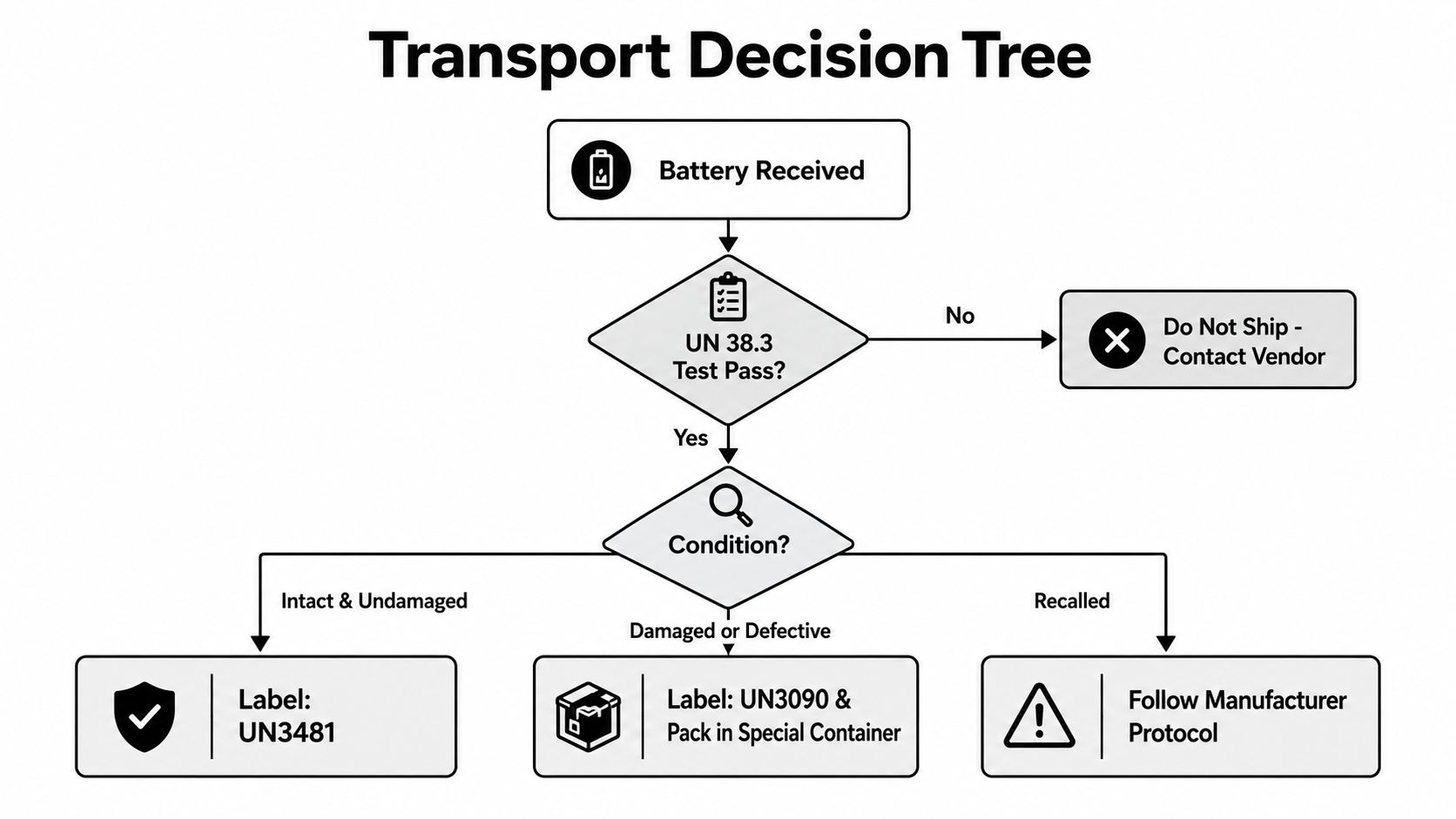
Air transport is especially restrictive for damaged or defective batteries. Don't put a suspect cell on an air shipment to save time. Ask the recycler for a compliant ground plan or specialized service, and hold the material safely until the instructions are confirmed.
Online merchants face similar decisions when products move through parcel networks. A practical discussion of hazmat rules for WooCommerce stores is useful for teams that manage e-commerce returns, but corporate facilities should still follow their carrier, DOT, and dangerous-goods compliance procedures.
Use Reworx's UN 3481 labeling resource as a reference when devices contain lithium-ion batteries, then validate the final label and package configuration with the party accepting the shipment. The package shouldn't leave until the paperwork, packaging, condition classification, and carrier acceptance align.
How Recycling Processes Differ and What That Means for Vendors
The process a recycler runs determines what it can recover, how it handles mixed chemistry, and what records it can provide afterward. Do not choose a vendor because its technology label sounds advanced. Ask how it handles your actual feedstock, including laptops, power tools, backup batteries, and loose cells.
Pyrometallurgy uses high-temperature treatment. It accepts some mixed or complex feedstocks, but it consumes substantial energy and recovers fewer of certain battery materials. Hydrometallurgy leaches cathode material, purifies the solution, and recovers metal salts. Direct recycling preserves and regenerates active cathode or anode materials instead of reducing everything to elemental products. Its practical limits include scale, impurity control, and chemistry-specific processing.
A 2023 review described an industrial hydrometallurgical sequence involving discharge, thermal pretreatment, mechanical treatment, acid leaching, solvent extraction, and crystallization. The reported overall efficiency was 91%, while the mechanical stage recovered 72%. Electrolyte and graphite recovery contributed to the broader result. The Royal Society of Chemistry review also identifies weak upstream sorting and mixed chemistries as practical problems.
| Route | Typical Recovery | Strengths | Watch For |
|---|---|---|---|
| Pyrometallurgical | About 50% to 61% in the cited critical review, which compares recycling routes | Handles complex feedstocks and produces recoverable metal outputs | Energy intensity and weaker recovery for some battery materials |
| Hydrometallurgical | Around 91% in the described industrial example | Strong metal recovery and production of metal salts | Acid, temperature, reductant, time, and solid-to-liquid controls affect results |
| Direct recycling | Advancing through pilot and project work, with results dependent on chemistry and process design | Preserves active materials and may support regeneration | Limited scale, impurity control, chemistry matching, and uncertain economics |
Percentages are useful only when the denominator is clear. A vendor may report cathode recovery, total material recovery, or recovery into an intermediate product. Request the material form, test method, chemistry scope, and downstream destination. Also ask whether the result applies to your stream or to a controlled laboratory or commercial benchmark.
Reworx's hydrometallurgical recycling service information provides context for evaluating that route. The practical question is which process reliably accepts your battery stream and documents the resulting material, rather than which label sounds most advanced.
Choosing a Recycling Vendor and Designing Chain of Custody
Price is only one line in the vendor comparison. A defensible program needs a recycler that can demonstrate environmental controls, downstream accountability, insurance, worker-safety practices, and a documented approach to batteries that arrive damaged or mixed.
Ask whether the vendor holds certifications relevant to the service scope, such as R2, e-Stewards, or ISO 14001. Certification alone doesn't prove that every subcontractor or battery processor meets your requirements, so request the certificate scope and identify each downstream facility. Your contract should address rejected loads, incident notification, insurance, regulatory responsibilities, and ownership of recovered materials.
Require evidence at every handoff
A chain of custody should let you answer four questions: what was collected, who handled it, where it went, and what happened after processing. At minimum, request:
- Serialized manifest: Tie devices, battery containers, or asset groups to the pickup record.
- Weight documentation: Retain weigh tickets or equivalent shipment records for the material transferred.
- Condition exceptions: Record swollen, leaking, recalled, or unknown-condition batteries separately.
- Data destruction evidence: For laptops, servers, phones, and storage devices, require certificates or reports for secure data destruction.
- Final disposition: Identify reuse, resale, component recovery, recycling, and disposal outcomes.
- Downstream records: Request documentation from subcontracted processors rather than accepting an undefined “responsibly recycled” statement.
Devices containing batteries also belong in a broader ITAD workflow. A laptop shouldn't be stripped for recycling before the organization decides whether it can be securely erased, reused, donated, or sold. Reworx Recycling offers battery recycling alongside electronics recycling, equipment pickup, data destruction, and IT asset disposition services, which can help organizations coordinate those streams through one operating plan. Its battery recycling service is one option to evaluate alongside qualified local and national vendors.
Treat reuse as a separate decision
Buyback and reuse can recover value from functional hardware, but battery health, data sensitivity, warranty expectations, and device condition determine whether resale is realistic. Don't send a device to resale merely because it powers on. Require secure data destruction first, document battery condition, and separate equipment with uncertain safety characteristics.
Red flags include vague downstream claims, missing certificates of destruction, no clear damaged-battery protocol, refusal to share audit information, and a contract that doesn't identify who carries risk after pickup. If the vendor can't explain the path from your container to its final destination, keep looking.
Rolling Out the Program and Auditing It Year After Year
Start with one building or one asset class. A pilot involving retired laptops and power tools will expose gaps in intake, storage, labeling, training, and pickup scheduling before the process reaches every office, school, warehouse, or public-sector facility.
Give the pilot a small operating kit. Keep the documents short enough that staff will use them at the dock.
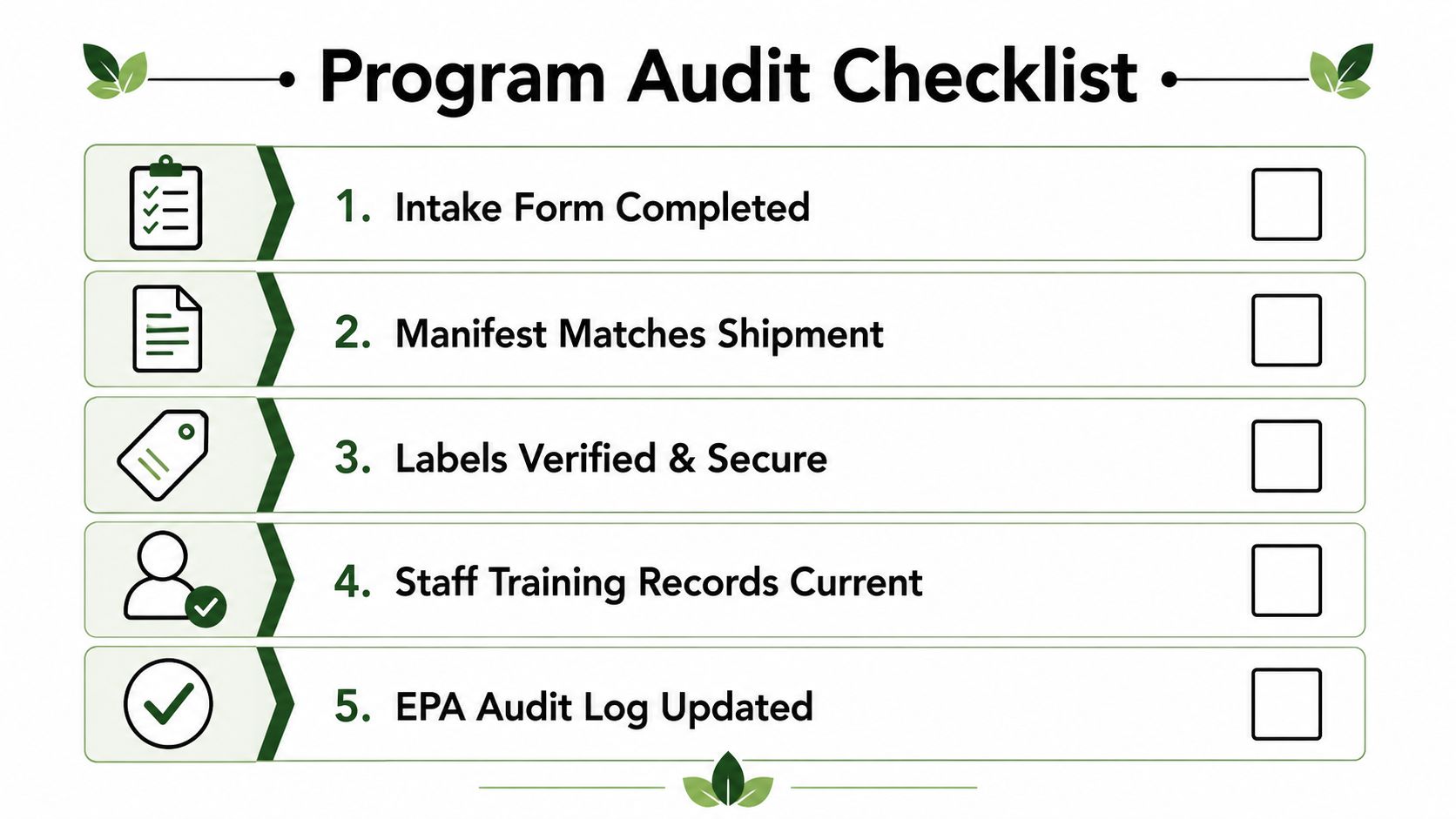
Build five working documents
- Intake form: Capture date, department, device or battery type, quantity, chemistry when known, visible condition, handler, and storage location.
- Manifest template: Match container IDs, asset identifiers, weights, pickup date, carrier, recycler, and exceptions.
- Labeling tag: Show stream, condition, chemistry, accumulation date, handling warning, and responsible department.
- Training script: Tell staff not to place lithium batteries in household garbage or recycling bins, not to tape over visible damage, and not to move a hot, leaking, swollen, or crushed cell without escalation.
- Audit checklist: Verify intake records, container condition, labels, training records, shipment documentation, downstream reports, and corrective actions.
The EPA's guidance on used lithium-ion batteries is clear that these batteries and devices containing them shouldn't enter household garbage or recycling bins. Businesses should route them through separate recycling, household hazardous-waste, certified electronics-recycling, or takeback channels appropriate to the material.
Train facilities, IT, security, shipping, and custodial teams together. A shipping clerk may notice a damaged battery before an IT technician does, while a janitorial employee may be the person who finds a discarded power bank. Everyone needs the same stop-work instruction and escalation contact.
Review the program annually and after every incident, rejected load, regulatory change, or major equipment refresh. Compare the recycler's downstream report with your manifest, investigate discrepancies, update purchasing specifications, and use ITAD results to improve future device selection. A consistent quarterly spot check is more useful than a thick policy binder nobody opens.
Compliance, Value Recovery, and Community Impact Together
A battery program earns its value at the loading dock, storage closet, and shipping desk. It keeps damaged cells from sitting unnoticed, entering an unsuitable carrier, or reaching general waste. It also gives sustainability managers records they can defend: what the organization collected, how it moved, which process received it, and whether devices were reused or recycled.
Regulatory expectations are tightening. Under the European Union's Batteries Regulation, adopted in July 2023, the earlier portable-battery collection target was 45% by 31 December 2023. The next target is 63% by 31 December 2027, as stated by the Council of the European Union. Lithium recovery from waste batteries is required to reach 50% by the end of 2027 and 80% by the end of 2031. These requirements apply directly within the EU, while also shaping supplier expectations, manufacturer decisions, and global sustainability programs.
Vendor capacity varies by chemistry and region. The cited industry overview says China accounted for roughly 80% of worldwide recycling capacity in 2023, when global capacity was about 340 GWh, according to the CAS summary linked earlier. Fraunhofer research warns of a possible LFP recycling-capacity shortfall by 2035. A California Energy Commission project reported more than 95% purity in cathode and anode separation, more than 90% yield of active-material retrieval, and a path to 100 kg per day of regeneration. Those results do not prove that every chemistry has an economical industrial route. Require vendors to identify the chemistry they accept, the process used, and the downstream facility handling it.
Battery recycling belongs inside electronics stewardship. Reusable laptops and tablets can support donation, digital inclusion, and workforce development. Equipment that cannot be reused still requires secure data destruction, material recovery, and documented disposition. Donation-based recycling and social enterprise recycling can connect environmental work with community benefit, provided safety and data controls remain in place.
Before pickup, assign an intake owner, confirm the storage location, and obtain a written transport and downstream plan. Treat each collection as an operating capability, not an office cleanout.
Reworx Recycling helps organizations coordinate lithium battery recycling, electronics recycling, IT equipment disposal, equipment pickups, secure data destruction, reuse, and donation-based recycling through a documented ITAD approach. Visit Reworx Recycling for practical guidance, then contact the team to plan a battery collection, schedule a pickup, or build a technology donation program.