
A certificate of destruction for hard drives is your official, legally binding proof that your company’s data-carrying devices were securely and permanently destroyed. Think of it as the death certificate for your sensitive digital information—it confirms the data is 100% gone and completely irrecoverable. This single document is one of your strongest defenses against data breaches and crippling compliance penalties, especially for businesses in regulated industries.
What Is a Certificate of Destruction
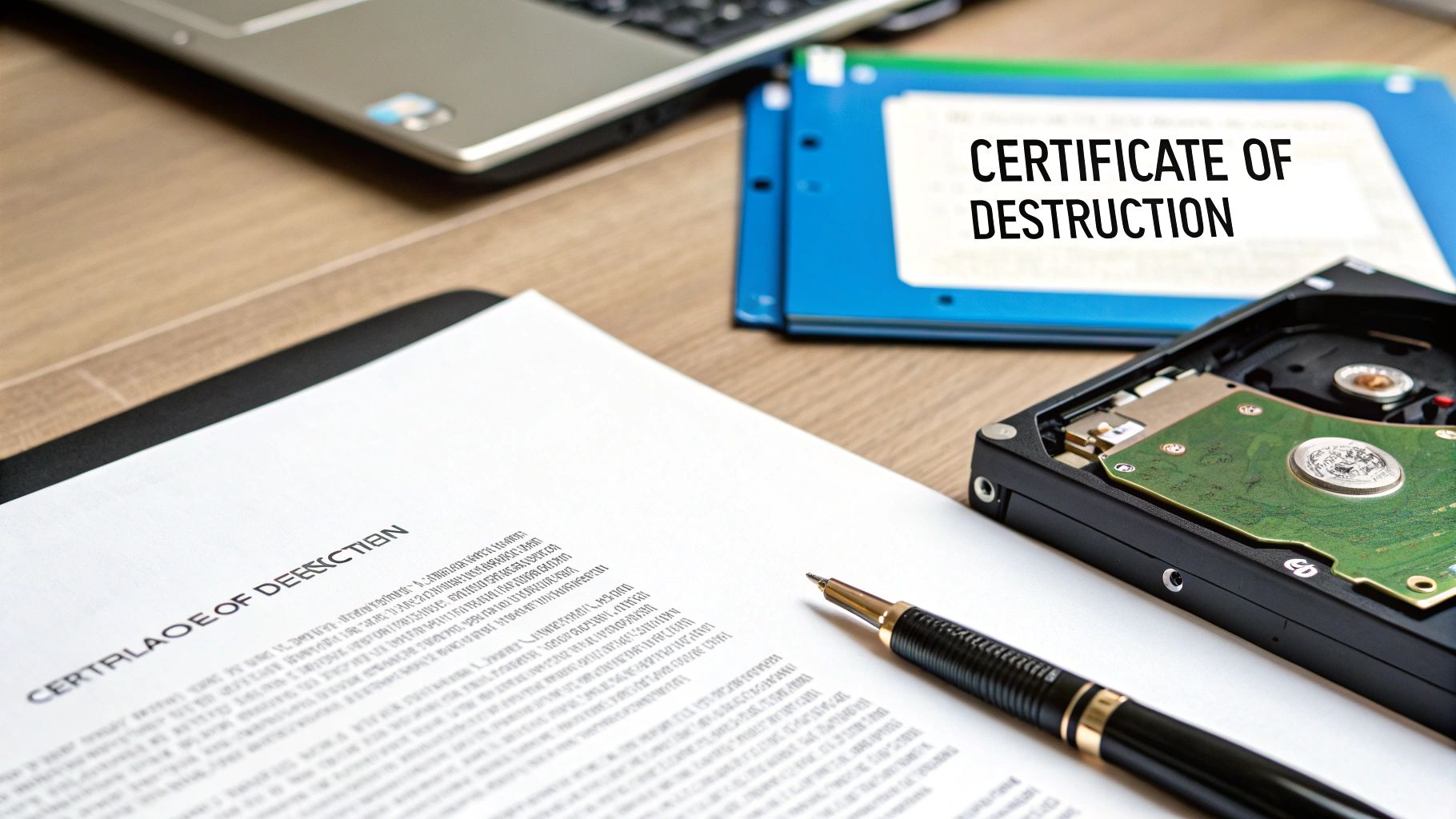
When your business retires old computers, servers, or any device containing a hard drive, just deleting files or reformatting the disk is a huge gamble. Hidden data can often be recovered with the right tools, leaving your organization wide open to attack. A Certificate of Destruction (CoD) is the formal document a professional IT asset disposition (ITAD) vendor, like Reworx Recycling, issues once they have physically destroyed the storage media.
This certificate is so much more than a simple receipt. It’s a cornerstone of your risk management and compliance strategy, giving you a verifiable, auditable record that you’ve met your due diligence obligations for protecting confidential data.
The Purpose of Certified Documentation
At its core, the primary function of a CoD is to transfer liability. Once that certificate is in your hands, it proves that your responsibility for the data ended with a secure, compliant destruction process. This is absolutely essential for any organization handling sensitive information, such as:
- Customer Data: Names, addresses, credit card numbers, and other personally identifiable information (PII).
- Employee Records: Social Security numbers, payroll details, and private health information.
- Intellectual Property: Trade secrets, proprietary research, and confidential business plans.
Without this official proof, your organization stays on the hook for some serious risks. We're talking about steep regulatory fines, lawsuits, and the kind of damage to your brand's reputation that can be impossible to repair if a data breach is traced back to an improper office cleanout or equipment disposal.
Key Elements of a CoD
A solid, legally defensible CoD tells a clear and detailed story of the destruction process. It should always include a unique serial number for tracking, the exact date of destruction, the specific method used (like shredding or degaussing), and an authorized signature from your vendor.
For businesses that need the highest level of assurance, partnering with a certified vendor isn't optional—it's critical. You can get a better sense of why ITAD certifications matter for your data security by reviewing these common e-waste certification standards.
Ultimately, a Certificate of Destruction provides peace of mind. It’s the final, non-negotiable step in the IT equipment lifecycle, confirming your data is gone for good and your business is protected.
Why Your Business Needs Certified Destruction
In a world overflowing with data, ignoring how you dispose of old hard drives is more than just an oversight—it's a massive liability waiting to spring. For any business, a certificate of destruction for hard drives isn't just a piece of administrative paper. It’s a core part of risk management, a legal necessity, and a shield for your brand.
Simply shoving old equipment in a storage closet or running basic wiping software creates a ticking time bomb. As long as that physical hardware exists, the data on it is a potential target. The only way to permanently defuse that threat and prove you acted responsibly is through a certified destruction process, backed by a formal CoD.
Meeting Strict Regulatory Demands
The biggest push for certified destruction comes from the web of data privacy laws governing how businesses handle sensitive information. Regulations at the state, federal, and even international levels have strict rules for IT equipment disposal, and the penalties for getting it wrong are steep. A Certificate of Destruction is your official, auditable proof that you met those legal duties.
A CoD is more than just paperwork; it’s a legal shield demanded by major data protection laws. HIPAA, for example, can slap fines of up to $1.5 million per year for improperly disposing of health information. Meanwhile, GDPR in Europe enforces the "right to be forgotten," requiring organizations to prove data has been securely and permanently destroyed. It's no surprise that over 80% of large enterprises in sensitive sectors like finance and healthcare in North America rely on certified product destruction services.
These laws include:
- HIPAA (Health Insurance Portability and Accountability Act): Mandates that protected health information (PHI) must be rendered unreadable, unusable, and indecipherable before it's thrown away.
- FACTA (Fair and Accurate Credit Transactions Act): Requires businesses to destroy consumer information to prevent identity theft and fraud.
- GDPR (General Data Protection Regulation): Gives EU citizens the "right to erasure," demanding their personal data be permanently deleted on request.
Frameworks like the General Data Protection Regulation (GDPR) are a major reason certified data destruction is so critical. To make sure your processes are up to snuff, you can cross-reference them with this comprehensive GDPR compliance checklist. A CoD is the tangible proof that you’ve done your part.
Protecting Your Business from Financial and Reputational Harm
Beyond the legal fines, the fallout from a data breach can be catastrophic. The direct financial costs—investigations, customer notifications, credit monitoring, and legal fees—can easily spiral into the millions. But the damage to your company's reputation? That can be even worse.
A single data breach can shatter years of customer trust. When sensitive information gets out because of improperly disposed hardware, the public sees it as pure negligence. That leads to lost customers and a tarnished brand that can take years, if ever, to rebuild.
A certified destruction process stops this risk at its source. By physically shredding hard drives and issuing a CoD, a trusted social enterprise like Reworx Recycling makes data recovery impossible. This is a vital step for protecting your intellectual property, your clients' confidential information, and the trust you've worked so hard to earn. You can learn more about how this works in our guide on how data destruction protects businesses.
Ultimately, investing in certified destruction is an investment in your company’s future. It turns a potential liability into a verified security measure, ensuring your end-of-life IT assets don't become the source of your next crisis.
Anatomy of a Legally Defensible Certificate
Let's be clear: not all Certificates of Destruction are created equal. A generic, flimsy document might give you a false sense of security, but it won't hold up if you're ever faced with a compliance audit or legal challenge. A truly defensible certificate of destruction for hard drives is a detailed, verifiable document that creates an airtight record of how your data was handled.
Think of it like the title to a car. A simple handwritten bill of sale is weak, but a state-issued title with a VIN, date, and official seals is legally binding. The same logic applies here. A robust CoD is your legally binding proof that you did your due diligence, effectively transferring liability from your business to the certified destruction process itself.
Essential Components of a Valid CoD
To stand up to any real scrutiny, every certificate needs to include several non-negotiable pieces of information. These elements create a clear, unbroken audit trail that traces the journey of your assets from your facility to the final point of destruction. Without them, the document's validity is shaky at best.
Key details you should always look for include:
- Unique Certificate Number: A specific tracking number for that exact destruction job, which prevents any chance of duplication or fraud.
- Client Information: Your company’s full legal name and physical address.
- Vendor Information: The name, address, and contact details of the certified ITAD partner performing the work, such as Reworx Recycling.
- Chain of Custody Record: Documentation showing who handled the assets and when, from the moment they were picked up until they were destroyed.
- Destruction Method: A clear, unambiguous statement of how the drives were destroyed (e.g., industrial shredding to a specific particle size).
This level of detail is what separates a real certificate from a worthless piece of paper. A vague document that just says "hard drives destroyed" is a massive red flag. For a deeper dive into what makes a process truly secure, feel free to review our guide on practices for secure data destruction.
Distinguishing Essential From Recommended Fields
While some components are absolutely mandatory for a legal defense, others add valuable layers of proof and transparency. Knowing the difference helps IT and compliance managers evaluate how thorough a vendor really is. It also doesn't hurt to have a baseline for understanding how documents are legally notarized, as some high-security destruction processes may even include this step.
The table below breaks down what you should demand versus what is simply good to have.
Key Components of a Valid Certificate of Destruction
This table outlines the essential and recommended fields that should appear on any legally sound Certificate of Destruction for your hard drives.
| Component | Description | Importance Level |
|---|---|---|
| Serialized Asset List | A complete list of each hard drive's unique serial number. | Essential |
| Authorized Signatures | Signatures from both your company and the vendor's authorized personnel. | Essential |
| Date and Location of Destruction | The exact date and physical address where the destruction occurred. | Essential |
| Statement of Liability Transfer | A clause confirming the vendor accepts liability upon receipt of the assets. | Recommended |
| Reference to Regulations | A statement that the destruction process meets specific standards (e.g., NIST 800-88). | Recommended |
| Witness Acknowledgment | An optional field for a designated witness who observed the destruction. | Recommended |
Having all of these elements in place transforms your CoD from a simple receipt into a powerful legal tool.
The most crucial element on this list is the serialized asset list. A non-serialized certificate is almost worthless, as it fails to prove that your specific hard drives were the ones destroyed.
When you partner with a meticulous social enterprise recycler like Reworx Recycling, you receive a certificate that includes all essential components as a standard practice. This isn't just about paperwork; it's about providing undeniable proof that your organization took every necessary step to protect its sensitive data, ensuring your compliance and peace of mind.
The Secure Destruction Process Step-by-Step
Have you ever wondered what really happens to your company's old hard drives once they leave your sight? A professional IT asset disposition (ITAD) process isn't just about hauling away junk; it's a meticulously tracked journey built from the ground up to stamp out risk. For any IT manager or corporate sustainability leader, knowing the ins and outs of this journey is the only way to be sure a vendor’s security promises hold up.
A social enterprise partner like Reworx Recycling takes the guesswork out of the entire lifecycle. From the moment our team arrives for a donation pickup to the second the final certificate of destruction for hard drives is in your hands, every action is designed for total data protection and transparency. Your sensitive information is too important to be handled any other way.
Stage 1: Secure Logistics and Chain of Custody
The process kicks off the second you schedule a donation pickup. This isn't like calling a standard moving company—it’s the first critical security handoff.
True ITAD pros use secure, GPS-tracked vehicles and employ trained staff who understand the weight of what they're handling. Before a single piece of equipment is moved, we create a detailed inventory right there at your facility, often capturing every serial number. This is where the chain of custody begins: a formal, unbreakable log that tracks every asset, every person who touches it, and every location it visits.
Stage 2: The Physical Destruction Method
Once the drives arrive at our secure facility, they’re prepped for their final moments. While a few methods exist, the undisputed gold standard for making data disappear forever is physical destruction. Unlike software wiping, which can sometimes leave faint digital ghosts behind, physically obliterating a drive guarantees it will never tell its secrets.
The most common and brutally effective method is industrial shredding. We feed the hard drives into powerful machinery that grinds them into tiny, mangled pieces of metal and plastic. This process pulverizes the magnetic platters that hold your data, making recovery a physical impossibility. Want to see this in action? Take a closer look in our in-depth guide to hard drive shredding.
The infographic below shows how the key details from this secure process flow directly into the final certificate you receive.
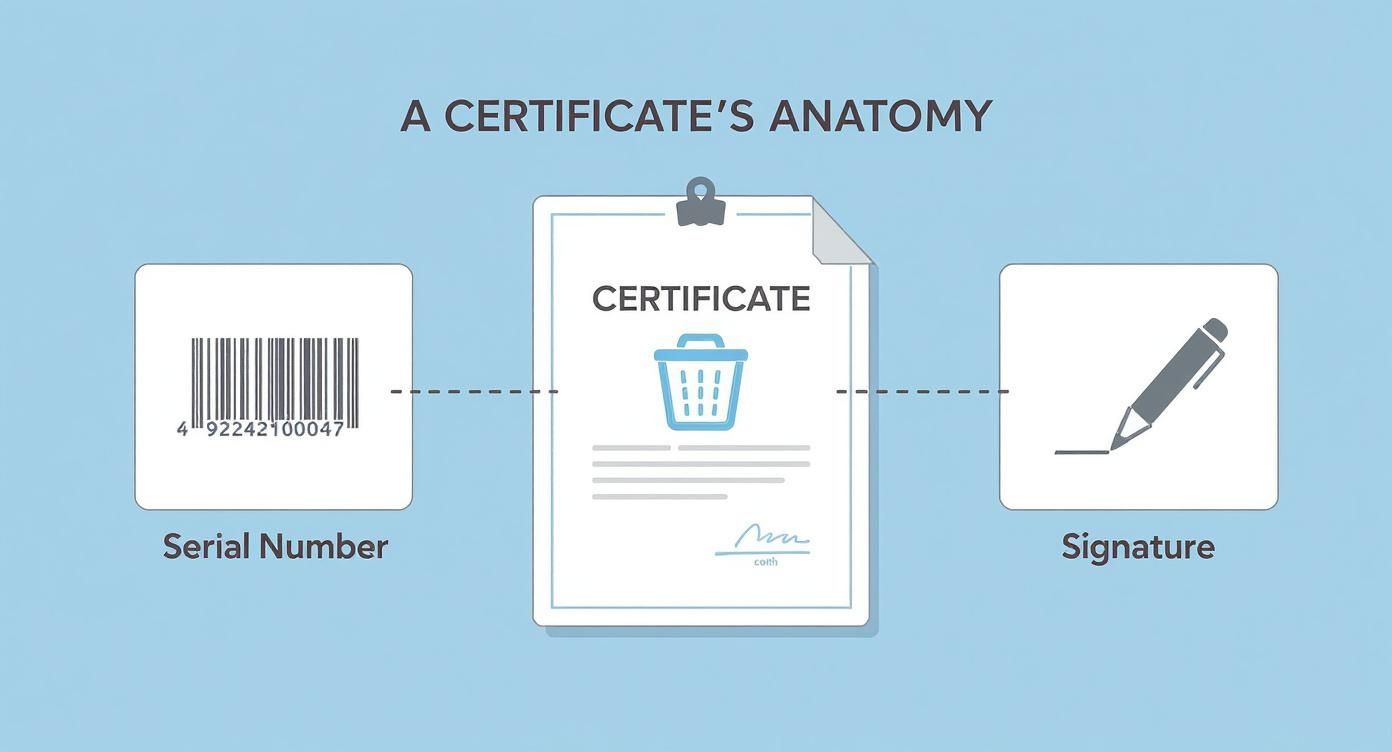
This visual really drives home how verifiable data points, like serial numbers and the specific destruction method, are the building blocks of a certificate you can actually trust.
Stage 3: Verification and Certificate Generation
After the last drive has been turned into confetti, the final—and most important—step is to verify the job is done and issue your Certificate of Destruction. This isn't just an automated email; it's the formal, documented proof of the entire secure process.
Our team reconciles the initial inventory of serial numbers with the pile of shredded assets. This careful cross-check confirms that every single device you entrusted to us has been accounted for and permanently destroyed. Only then do we generate the formal CoD, complete with all the essential details:
- A unique certificate ID
- A full list of destroyed asset serial numbers
- The date and location of the destruction
- The specific destruction method used (e.g., "Shredded to 2mm particles")
- An authorized signature from our team
This final document is your definitive proof of compliance. It closes the loop on the chain of custody and serves as your legal record that you fulfilled your data protection duties responsibly and completely.
When you partner with a social enterprise like Reworx Recycling, you get more than just this airtight security. All those shredded materials are responsibly recycled, feeding back into a circular economy. This means your IT equipment disposal not only protects your business but also supports the environment and our community—turning a necessary security task into a genuinely positive impact.
Choosing a Trusted Data Destruction Partner

Your data security is only as strong as the partner you trust to destroy it. Now that you understand why a certificate of destruction for hard drives is so important, the next move is finding a vendor who can actually deliver on their promises. A bad choice can expose your business to the exact risks you’re trying to prevent, making all your hard work meaningless.
Picking the right IT Asset Disposition (ITAD) partner isn't about finding the lowest price. You need a vendor whose entire process—from their certifications to their paperwork—can hold up under a microscope.
Key Vetting Criteria for ITAD Vendors
When you're evaluating potential partners, you need to see tangible proof of their security and compliance. A truly professional service will be an open book about their qualifications and procedures, making it easy for you to confirm they know what they’re doing.
Your vetting checklist should include these non-negotiables:
- Industry Certifications: Look for credentials like NAID AAA Certification, which is the gold standard for secure data destruction. You should also see R2 (Responsible Recycling) Certification, which guarantees they handle materials in an environmentally sound way.
- Serialized Certificates of Destruction: Make sure the vendor provides a detailed, serialized CoD for every single data-bearing device. A generic, non-serialized certificate is a major red flag.
- Robust Security Protocols: Ask them about their chain of custody, how secure their facility is, whether they background check employees, and if they use secure, GPS-tracked trucks for logistics.
The need for these services is exploding. The global market for hard drive destruction services was valued at around $1.5 billion in 2023 and is expected to climb to $3.6 billion by 2032. This growth shows just how essential certified, auditable data destruction has become for businesses trying to sidestep data breach costs, which now average nearly $5 million per incident. As you can see from these hard drive destruction market insights, the certificate of destruction has become a must-have compliance tool.
The Hidden Risks of Uncertified Recyclers
The promises of a certified, professional service are a world away from the risks you take with uncertified recyclers or scrap collectors. They might quote you a lower price, but the potential hidden costs are massive. These operators often don't have the secure facilities or documented procedures to guarantee your data is truly gone.
An uncertified recycler may promise destruction, but without a legally defensible Certificate of Destruction and a transparent chain of custody, that promise is worthless. You are left with all the liability and no verifiable proof of proper disposal.
If you're looking for more guidance on making this critical decision, we've outlined other key factors in our article on selecting a reliable e-waste recycling partner.
The Reworx Recycling Advantage: Social Enterprise Security
This is where Reworx Recycling brings something unique to the table. As a donation-based social enterprise, we merge top-tier, certified data destruction with a deep community mission. We don’t think you should have to choose between bulletproof data security and making a positive social impact.
When you partner with us, you get it all:
- Certified Security: We provide fully compliant, serialized Certificates of Destruction for every device we handle, making sure your legal and regulatory ducks are in a row.
- Environmental Responsibility: Our R2 certification means all non-reusable materials are recycled ethically, keeping hazardous e-waste out of landfills where it doesn’t belong.
- Community Impact: Your donated IT equipment fuels our workforce development programs and helps us get technology into the hands of underserved communities, closing the digital divide.
With Reworx Recycling, choosing a trusted partner isn’t just about protecting your data; it’s about actively building a more sustainable and equitable future.
Answering Your Questions
Even after you've got the basics down, it's natural to have a few more specific questions about getting a certificate of destruction for hard drives. Let's tackle some of the most common ones we hear from business owners and IT managers, so you can finalize your data disposal plan with total confidence.
Is Just Wiping or Formatting My Hard Drives Good Enough?
In a word: no. At least, not if you're dealing with sensitive data. Software methods like wiping, reformatting, or even degaussing (which uses a massive magnet) aren't completely foolproof. The scary truth is that with the right forensic tools, a determined individual can often recover data from drives that were supposedly "erased."
This is where compliance really comes into play. Physical destruction is the only way to guarantee data is 100% irrecoverable. The Certificate of Destruction you get afterward is your auditable, legally sound proof that the data is gone for good—the standard required by regulations like HIPAA, FACTA, and GDPR.
What's the Difference Between a Certificate of Destruction and a Certificate of Sanitization?
These two documents sound similar, but they certify completely different outcomes for your old tech. Knowing the difference is critical for getting the right paperwork for the job.
-
Certificate of Destruction (CoD): This is the final word. It confirms the physical hard drive has been utterly destroyed, usually by feeding it through an industrial shredder. The drive becomes a pile of tiny metal and plastic fragments, and the data is gone forever. This is the gold standard for any asset leaving your possession, as it wipes out all future liability.
-
Certificate of Sanitization: This document simply verifies that data was erased using a specific software program. The hard drive itself is still physically intact and can be used again. This is fine for devices you plan to reuse or move to another department within your own company, but it's not the right choice for equipment you're getting rid of permanently.
For true peace of mind and bulletproof compliance, the CoD is always the way to go for equipment that's leaving your control for good.
How Long Should We Hold Onto Our Certificates of Destruction?
While your internal policies might differ, the industry best practice is to keep your Certificates of Destruction for a minimum of three to seven years. If your business is in a tightly regulated field like healthcare, finance, or government contracting, you'll want to check with your legal or compliance team—they may require you to keep them even longer.
Think of your CoD as a permanent legal document. It’s your official proof that you did your due diligence if you ever face a data breach investigation or a compliance audit. These certificates should be stored securely right alongside your other essential business records.
Your Certificate of Destruction is the final chapter in your data's lifecycle story. Storing it properly ensures you can prove you gave that story a secure and compliant ending, years after the fact.
This simple bit of record-keeping can absolutely save your organization from a world of legal and financial pain down the road.
Does Reworx Recycling Provide CoDs for Donated Equipment?
Yes, we absolutely do. Reworx Recycling issues a serialized Certificate of Destruction for every single data-bearing device we process, and that includes all the equipment we receive through our corporate donation programs. Our commitment to data security is the same for every device that comes through our doors, no matter how we got it.
Our process guarantees that the original hard drives from donated computers, servers, and laptops are securely and physically destroyed before any refurbishment happens. This unique model allows your business to support our community mission with your old tech, without ever compromising on data security.
By partnering with us, you get to check off several boxes at once:
- Airtight Security: You receive a legally defensible CoD, eliminating data breach risks.
- Environmental Stewardship: Your e-waste is recycled responsibly according to R2 standards.
- Community Impact: Your donation helps bridge the digital divide and supports workforce development.
- Financial Benefit: You may be eligible for a tax benefit for your donation.
It’s an approach that gives your business both legal peace of mind and a powerful way to make a real difference.
Ready to simplify your IT equipment disposal while ensuring certified, auditable proof of data destruction? Partner with Reworx Recycling, the social enterprise that protects your business and supports your community. Schedule a pickup, learn more about our corporate donation programs, or explore our services today. Visit us at https://www.reworxrecycling.org/category/recycling-blog.