You're staring at the same problem a lot of operations leaders face right now, a storage room full of retired laptops, a dock backed up with customer returns, and a deadline that won't move because finance wants the books clean and IT wants the devices gone. That's the point where reverse logistics services stop being a nice-to-have and become the only sane way to keep value from leaking out of the business. If you let the pile sit, you lose resale opportunity, create compliance exposure, and turn a simple asset refresh into a mess nobody wants to own.
The fix is not improvisation. It's a disciplined reverse flow with clear handoffs, clean documentation, and a partner that knows when to resell, refurbish, recycle, donate, or destroy.
When Returns Pile Up and Old Hardware Won't Quit
A facilities manager at a 200-person company knows the feeling. Two pallets of retired laptops are parked in a storage closet, customer returns are stacking up at receiving, and HR just moved the refresh date for office equipment. That's not a storage problem. It's a reverse logistics problem, and if nobody owns it, the business starts paying for it in lost space, lost time, and lost recovery value.
The cost shows up fast. Devices that sit too long get harder to resell, harder to account for, and easier to misplace. Returned goods that aren't triaged quickly clog the dock, confuse inventory, and frustrate customer service teams. If the assets contain data, every day of delay also extends the period where chain-of-custody and sanitization risk can go unmanaged.
A better model is simple. Create a controlled intake path, decide what gets repaired, resold, recycled, donated, or destroyed, and document every handoff. That's the core reason companies bring in reverse logistics services instead of letting returns and retired hardware drift through ad hoc storage rooms.
For a useful fleet-oriented comparison of how returns workflows can be formalized, the structure in Fleetalyse returns for commercial fleets is worth a look because it reinforces the same principle, returns need a defined route, not a hopeful one.
The moment you treat asset disposition like a process instead of a cleanup task, the whole operation gets easier to run. Reworx Recycling's guidance on office e-waste overload fits that mindset, since office cleanouts are usually where the mess becomes impossible to ignore.
Practical rule: if a returned or retired asset doesn't have an owner, a timestamp, and a destination, it doesn't have a process.
What Reverse Logistics Services Actually Cover
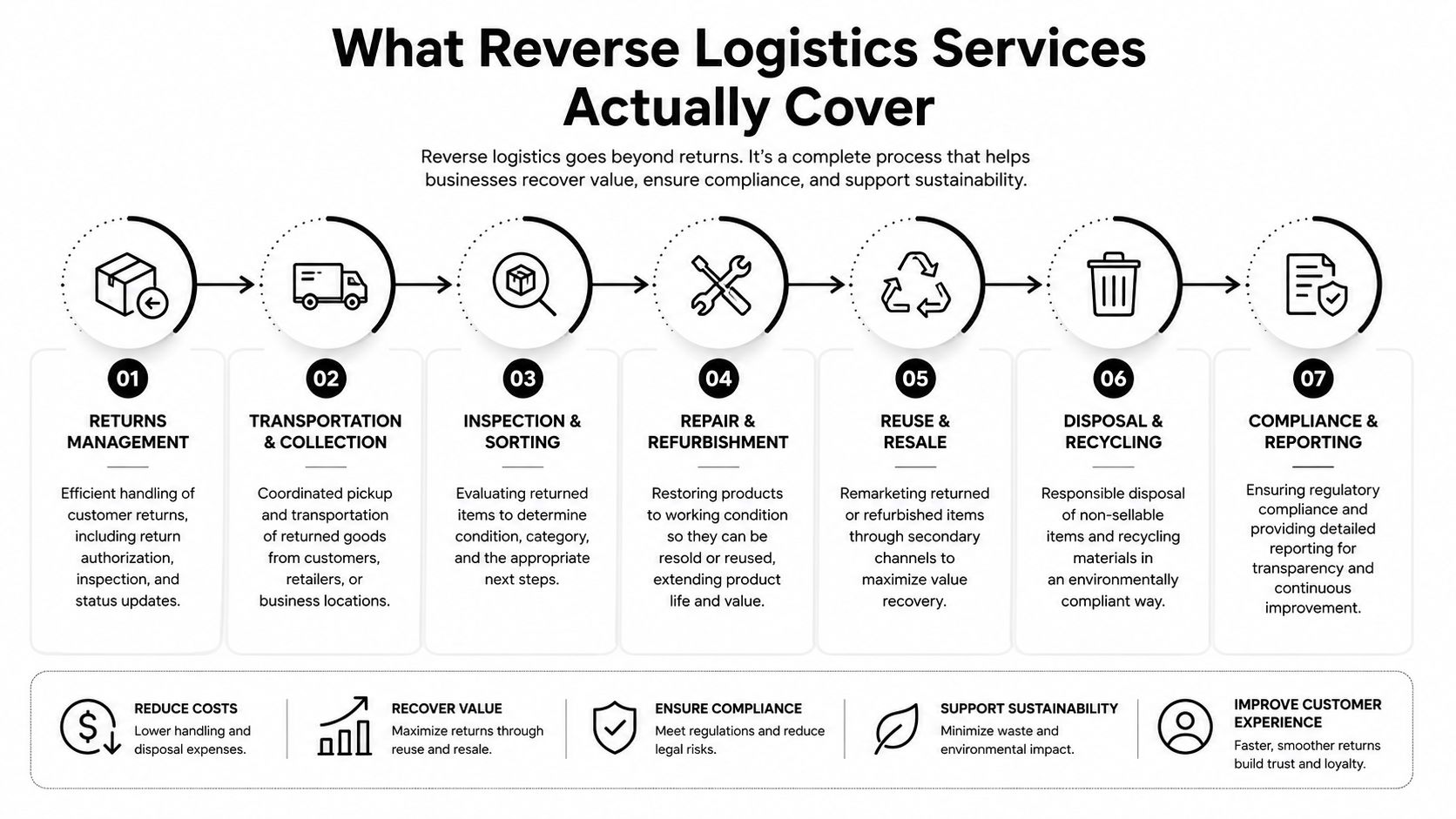
Reverse logistics is the reverse journey of goods after they've left the customer, the warehouse, or the office. It's not just “handling returns.” It's the full system that decides whether an item goes back into inventory, gets repaired, gets sold again, gets donated, or gets dismantled responsibly. The business value comes from moving each asset to the right next stop without creating security, inventory, or reporting problems.
Think of it like a restaurant kitchen
The cleanest way to understand the flow is a restaurant. First, items arrive at intake, which is the receiving dock. Then they go through triage, where staff sort what's usable, what needs work, and what needs to be discarded. Repair is the kitchen rework stage, resale or reuse is serving the item again or sending it to a community kitchen, and responsible disposal is the compost and recycling stream.
Each stage solves a different business problem. Intake supports visibility. Triage supports speed and accurate grading. Repair and refurbishment protect margin. Resale and reuse recover value. Disposal and recycling support ESG reporting and reduce landfill pressure.
Reverse logistics services become especially valuable when the assets are electronic. A laptop that can be redeployed should not be shredded just because the intake team moved too slowly. A monitor with cosmetic wear might still have reuse value. A device with sensitive data needs a verified disposition path, not a shrug and a trash cart.
That's the difference between a closed-loop system and a closet full of unresolved decisions. One recovers value and keeps records straight. The other hides liability until somebody asks for a report.
The Five Core Service Categories Explained
The five service categories are easy to name and easy to confuse. The mistake most companies make is buying “returns help” without defining which problem they're trying to solve. That leads to bad routing, weak reporting, and too many assets taking the most expensive path by default.
| Service Category | Business Problem Solved | Primary Outcome |
|---|---|---|
| Returns management | Customer returns, excess inventory, and intake chaos | Faster triage, cleaner decisions, better customer experience |
| Refurbishment | Recoverable devices that need testing or repair | Extended asset life and higher reuse value |
| Remarketing | Assets with resale potential that need a secondary channel | Cash recovery through resale or employee purchase programs |
| Recycling | End-of-life hardware that should not be reused | Material recovery and cleaner disposal reporting |
| ITAD pickups | Devices with data risk or serialized tracking needs | Chain-of-custody control and secure disposition |
Returns management is the front door. It covers intake, grading, routing, and refund or replacement decisions. If the process is weak here, everything downstream gets slower and more expensive. Good returns handling is about speed and accuracy, not just politeness.
Refurbishment is the recovery lane. Devices get diagnosed, repaired, cleaned up, and checked for working condition. Companies preserve value they would otherwise throw away during this process. Remarketing follows when units are ready for a secondary channel, whether that means wholesale dealers, asset recovery portals, or employee purchase programs. The business problem here is simple: maximize recovery without creating a compliance headache.
Reworx Recycling's IT asset disposition page is a useful reference point for organizations that need a structured path for end-of-life electronics rather than an informal pickup.
Recycling is for assets that are done. Materials are separated, recovered, and routed downstream so metals, plastics, and other components don't end up as unmanaged waste. ITAD pickups solve the security and custody problem. They cover transport, serialized tracking, and controlled data handling so a device's story stays intact from collection to final disposition.
A defensible program doesn't try to force every device into resale. It sends each device to the highest-value path that still meets security and compliance requirements.
How These Services Connect to Your Supply Chain
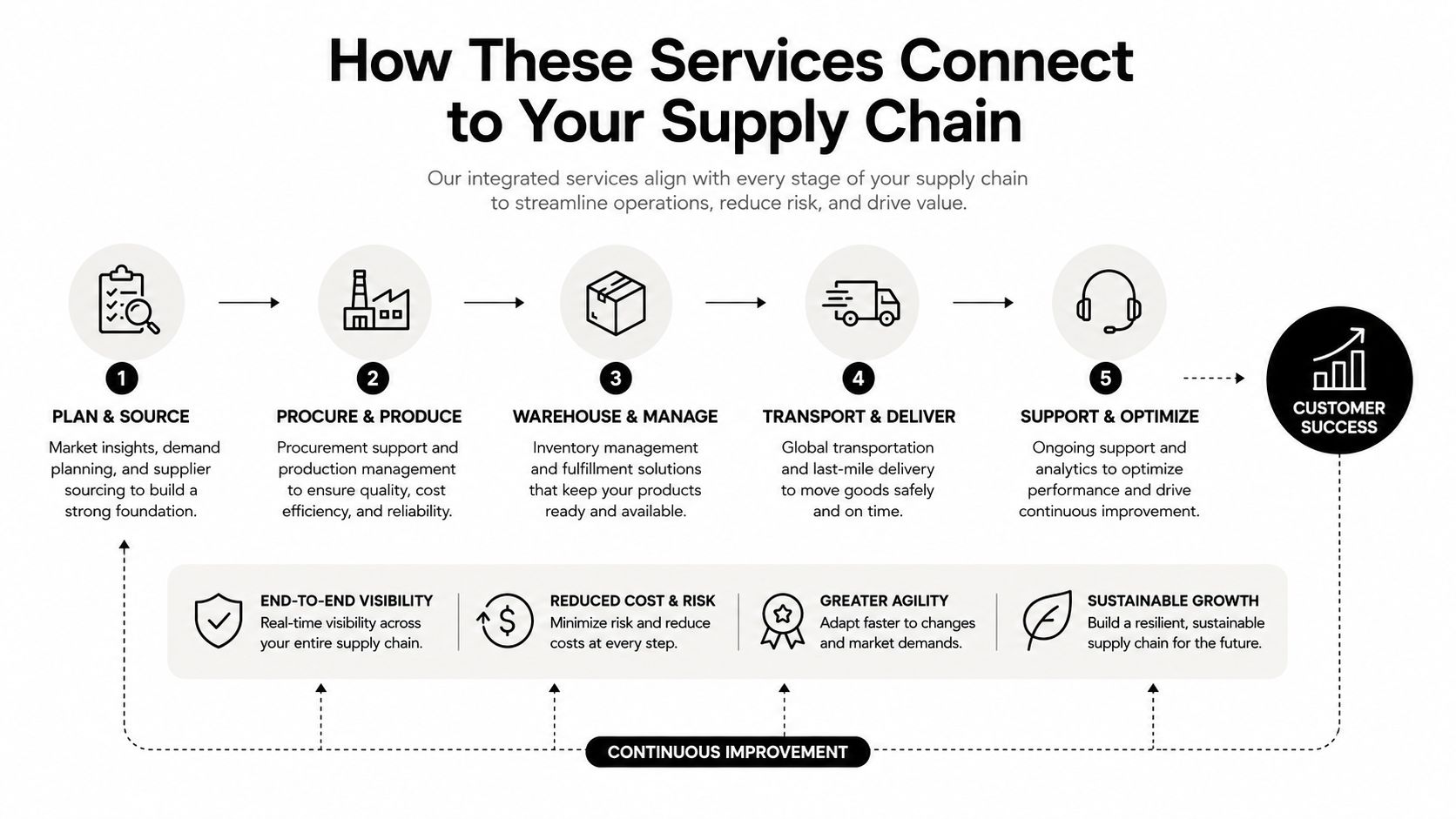
Reverse flow should plug into the forward supply chain, not sit outside it like an afterthought. Procurement needs to know which models fail early. Warehousing needs a separate lane for returns and retired assets. IT needs wiped devices delivered in a predictable state. Finance wants credits, disposal records, or donation paperwork that it can use.
The handoffs that matter
The first handoff is receipt. If the receiving dock doesn't capture serial numbers, condition notes, and return reason, the rest of the chain starts blind. The second is triage. If nobody tags assets accurately, refurbishment and remarketing become guesswork. The third is sanitization. If data wiping gets deferred until “later,” you've already weakened the process.
Where programs usually break
The worst failures are usually boring. A dock team accepts equipment without a manifest. A manager assumes the vendor owns chain-of-custody once the truck leaves. ESG metrics get recorded in a spreadsheet nobody folds into the sustainability report. Those gaps don't just slow things down, they make audits and reconciliations harder than they need to be.
The supply chain connection is broader than many realize. Procurement can use return and failure patterns to tighten future purchasing decisions. Finance can track recovered value and disposal outcomes. Operations can use the data to reduce bottlenecks. Sustainability teams can use the same records to show where assets went and why.
Reworx Recycling's overview of reverse logistics in the supply chain lines up with that reality, because the reverse side only works when each handoff is owned and visible.
If the forward chain is disciplined and the reverse chain is casual, the business is only half-managed.
A Real-World Example of a Donation-Based ITAD Flow
A mid-sized company schedules a pickup for several hundred retired laptops and monitors. The provider arrives with serialized asset tags and tamper-evident containers, then logs the shipment before it leaves the site. That first record matters, because once the equipment moves, chain-of-custody has to stay traceable without dispute.
At intake, the devices are logged again and separated by condition. Units that can be reused move into data sanitization and functional grading. NIST SP 800-88 defines Clear, Purge, and Destroy as the three sanitization levels, and guidance based on that framework says the method should match the media type and reuse or disposal need, with physical destruction used when data can't be effectively sanitized. For businesses handling sensitive equipment, that standard is the backbone of a credible ITAD program. The UK DWP sanitisation standard summarizes that same logic clearly in its secure sanitisation and destruction standard guidance.
What the client gets back
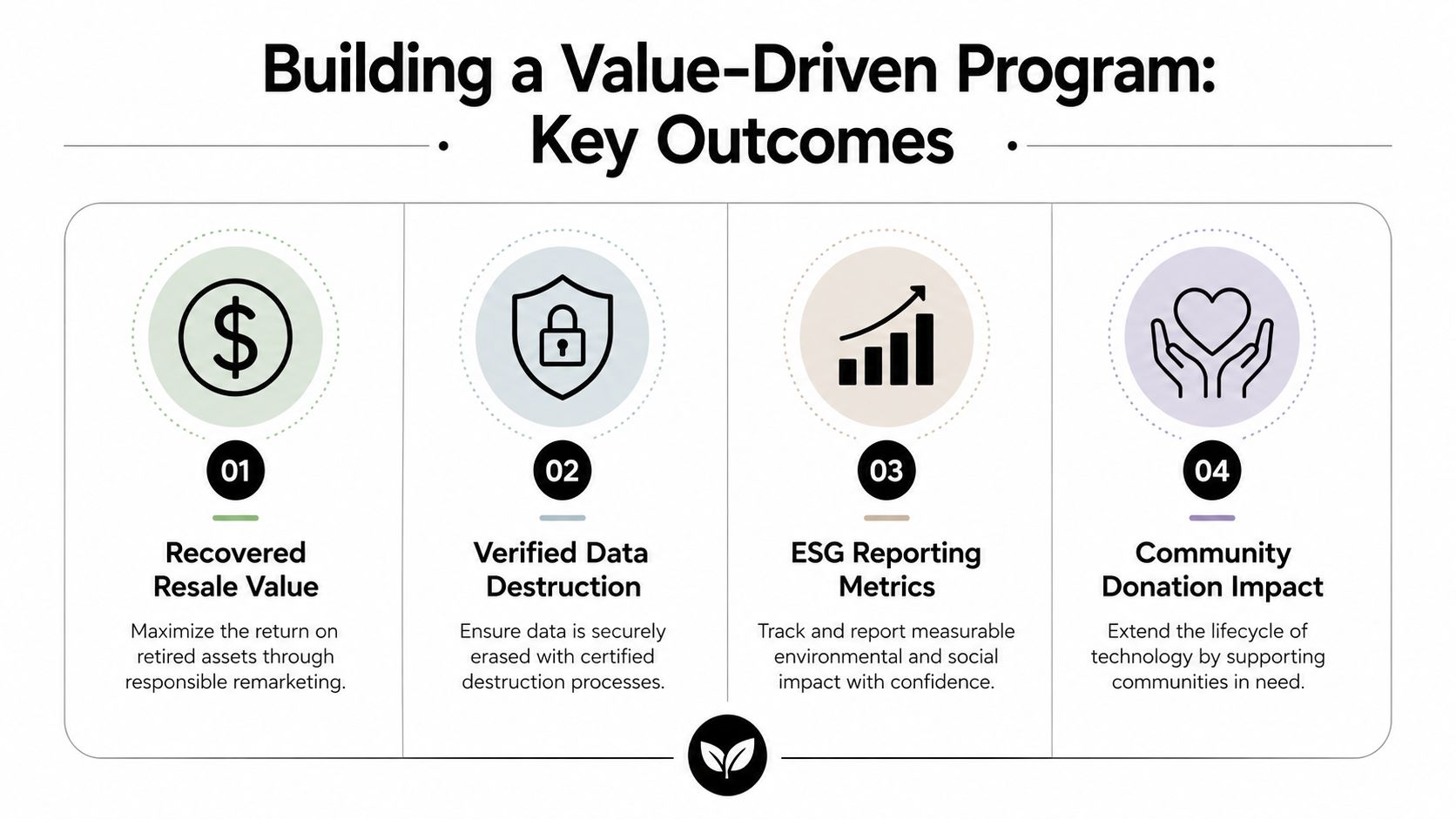
The client should not have to guess what happened. They should receive chain-of-custody records, certificates of data destruction where needed, an ESG-ready diversion report, and a community-impact summary that shows where donation-eligible equipment was placed. That package turns a pickup into an auditable program.
Donation-based ITAD also gives the company a better route for usable assets. It lets security teams keep control of sensitive equipment while extending working devices into nonprofit, school, or community use. In this example, Reworx Recycling can fit that model when the organization wants donation-based processing alongside secure handling and recycling, and its donate a laptop option shows how that handoff can be structured.
The point is discipline, not sentiment. If the devices can be reused safely, donation creates value. If they cannot, responsible recycling protects the business and the downstream environment.
Choosing the Right Reverse Logistics Partner
The right partner depends on your risk profile, not just your return volume. A business handling consumer returns may care most about speed and resale recovery. A business managing serialized IT assets should care more about custody, sanitization, and reporting. Those are different jobs, so the vendor has to match the job.
| Criterion | Commercial Refurbisher | Donation-Based ITAD Provider | General Electronics Recycler |
|---|---|---|---|
| Certifications and audit history | Often strong on resale operations, varies on compliance depth | Usually aligned to custody, reporting, and documented process control | Can vary widely, often focused on downstream recycling |
| Data sanitization standards | May offer wiping, but often not the main emphasis | Usually central to the service model | May provide destruction, but depth can vary |
| Chain-of-custody tooling | Useful if assets are serialized and resold | Strong fit for serialized reporting and transport logs | May be lighter unless specifically built for ITAD |
| Downstream transparency | Good for resale channels, less focused on donation | Stronger fit for donation, reuse, and compliant recycling | Usually centered on material recovery |
| ESG and community reporting | Often limited | Typically deeper because donation and diversion are part of the model | Usually basic disposal documentation |
| Geographic coverage and responsiveness | Depends on resale network | Depends on pickup footprint and scheduling discipline | Often built around collection routes |
| Insurance and liability coverage | Must be checked carefully | Must be checked carefully | Must be checked carefully |
| Pricing clarity | Can be commission-based or net recovery based | Should be transparent about processing and disposition | Should be clear about recycling and transport fees |
What to ask before you sign
Start with certifications and audit history. Then ask how they sanitize data, who owns chain-of-custody, and what documents you get at the end. If the vendor cannot show credible serialized tracking and downstream transparency, they are not ready for enterprise assets. For a tighter vendor review, use this vendor selection criteria checklist before you commit.
The split between a commercial refurbisher and a donation-based ITAD provider matters. A refurbisher is usually built for maximum resale recovery. A donation-based partner is built for compliant processing plus charitable placement when the asset qualifies. A general electronics recycler is strongest when material recovery is the priority. None of those models is wrong on its own. The wrong choice is picking one without matching it to your business goal.
For mid-sized companies, the safest choice usually sits closer to documentation and control than to flashy recovery promises. If the program touches laptops, monitors, phones, or other serialized devices, insist on clear reporting that supports security, ESG, and community-impact goals. If the partner cannot explain how donation, remarketing, and recycling are separated, you will end up with a muddy process and weak records. A defensible program makes those paths explicit from the start.
Donation-based ITAD also deserves a place beside commercial refurbishers and remarketers. It is the right fit when the company wants reuse, donation, and verified downstream handling, not just cash back. Commercial resale can still make sense for high-demand assets. Donation closes the loop for usable equipment that should serve schools, nonprofits, or community groups instead of sitting in storage.
Common Misconceptions That Derail Programs
The first bad assumption is that reverse logistics is just a cost center. It isn't. If managed properly, it becomes a value-recovery engine tied to inventory accuracy, risk reduction, and reporting. That's why the operating model matters so much. You're not just paying for removal, you're buying control over what happens next.
The second mistake is thinking any recycler with a shredder can handle ITAD safely. That's reckless. A defensible program needs downstream-vendor due diligence, documented sanitization standards such as NIST 800-88, and chain-of-custody records that hold up in an audit.
The third misconception is that donation and refurbishment are unreliable compared with commercial resale. They're not unreliable, they're just different. Donation-based routing is the right answer when the organization wants community impact, documented diversion, and a legitimate reuse path for equipment that still has life left in it.
The fourth mistake is treating data wiping like a checkbox. Data sanitization has to be a tracked process, not a one-time event. If the vendor can't tie sanitization to serial numbers, disposition decisions, and final reports, the program isn't auditable.
A strong program watches the numbers that matter, returns volume, recovery rate, and diversion from landfill. It also asks the harder question: can we prove where every asset went?
Building a Program That Recovers Value and Builds Community
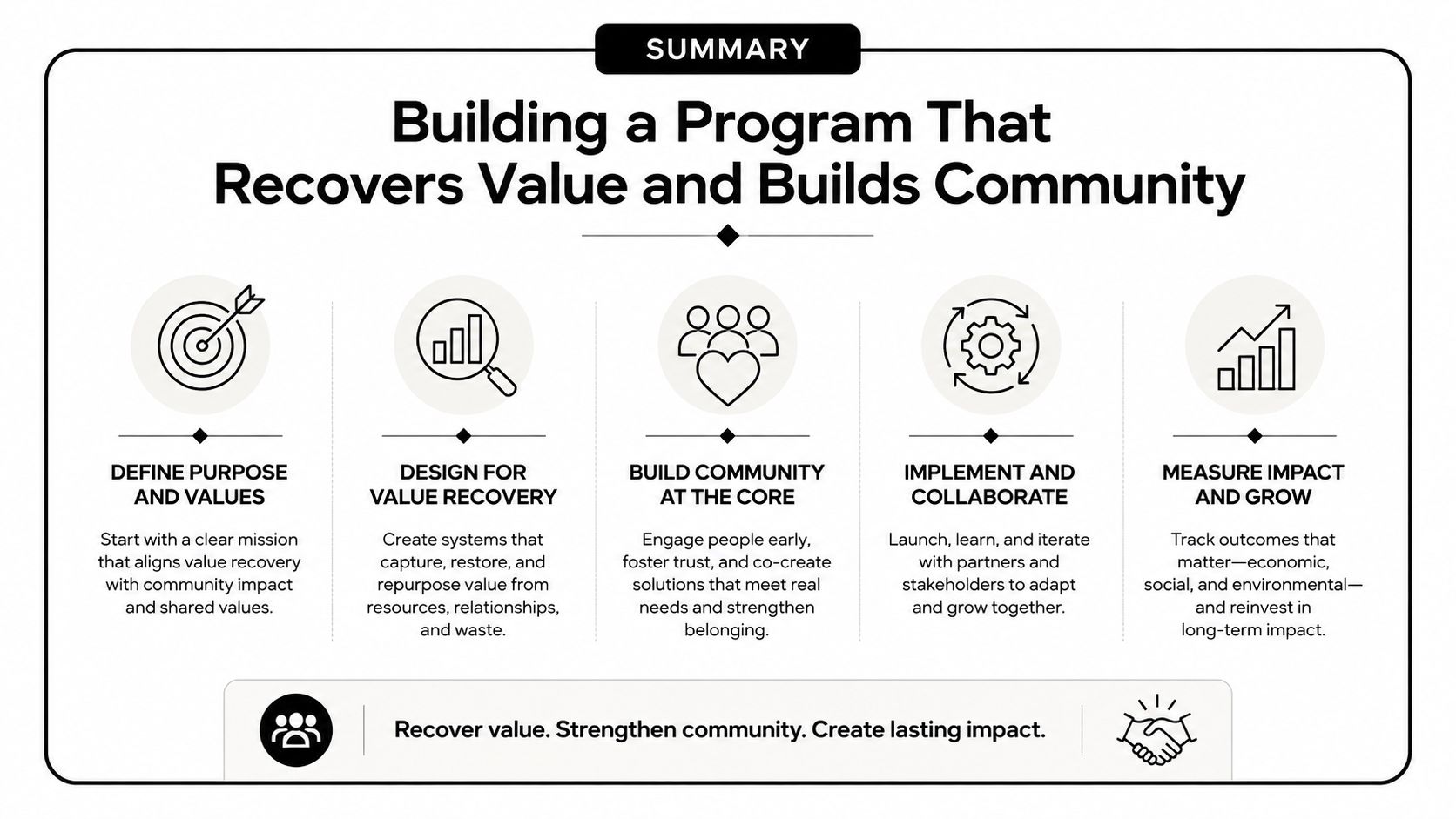
Start this week with four moves. Inventory the retired assets you already have. Separate recovery priorities by category, resale, donation, recycling, or destruction. Ask your current vendor for chain-of-custody records, sanitization proof, and downstream reporting. Then schedule a pickup or partnership discussion before the backlog grows.
That's the standard a mid-sized business should demand. Reverse logistics services should protect data, recover value, support ESG reporting, and create a measurable community outcome where possible. If the program does only one of those things, it's incomplete.
Reworx Recycling helps businesses handle electronics recycling, IT asset disposition, secure data destruction, and donation-based equipment recovery with documentation that supports operational and reporting needs. If you're ready to clear out retired hardware, protect sensitive data, and route usable equipment into a responsible next life, visit Reworx Recycling and start a pickup or partnership conversation today.