Your warehouse team has blocked the recalled SKU, customer service is processing returns, and a destruction vendor has offered a pickup date. Then compliance asks which serial numbers are on the pallets, whether the regulator has accepted the destruction method, and who will verify what happens after collection. The pickup is easy to arrange. The answers take more preparation.
Certified destruction for recalled products is an evidence-controlled process, not just a disposal service. For an Atlanta, Georgia, business coordinating warehouse returns, corporate IT equipment disposal, or medical equipment disposal, the practical challenge is connecting each affected unit to an authorized outcome. That means controlling the product, protecting any stored data, and documenting the downstream route without confusing recalled inventory with equipment eligible for donation.
Which Agencies Must Approve Destruction First
Confirm the regulatory route before scheduling irreversible processing. Not every authority issues the same approval, and not every recall requires destruction. Your recall lead should establish whether the proposed method needs agency review, a written disposal request, witnessing, or another form of verification before anyone crushes or ships the inventory.
The FDA recall guidance recommends submitting the proposed destruction method, contacting the district recall coordinator before destruction, and keeping adequate documentation even when an investigator doesn't attend. The agency may review the method or observe the work directly. That makes destruction a formal recall close-out activity, not an ordinary warehouse waste transaction.
Agency approval triggers by product type
Use this table to assign the regulatory conversation. It distinguishes destruction authorization from separate data-disposal and environmental obligations.
| Agency | Product or case | Approval step | Witness or verification |
|---|---|---|---|
| FDA | Food, drugs, medical products and other FDA-regulated goods | Submit proposed destruction method and contact district recall coordinator before destruction | Agency may observe the event or review written records |
| CPSC | Consumer products under CPSC jurisdiction | Submit written disposal request before destruction | Agency may witness, or accept affidavit and photographs |
| FTC Disposal Rule | Devices or files holding consumer report information | Reasonable disposal practices and due diligence on the destruction provider | Independent audit, references or recognized certification reviewed |
| EPA and state agencies | Hazardous waste, batteries and exported e-waste | Determine hazardous-waste classification and applicable prior-consent requirements for exports | Shipment tracking and confirmation of receipt |
| State environmental agency | Products under state disposal rules | Confirm state-specific requirements before destruction | Obtain the records and any witness verification specified by the state agency |
The FTC entry isn't a general requirement to obtain government permission before destroying a device. Similarly, environmental review doesn't replace the product-safety regulator's disposition instructions. Assign an owner to each applicable obligation rather than assuming the recall administrator handles everything.

Establish the acceptable outcome
The FDA recall procedures state that a recall isn't terminated until the firm has brought the product into compliance or disposed of it acceptably. They also warn that ordinary disposal may be inadequate for carcinogenic, contaminated, hazardous, or otherwise dangerous goods.
A disposal description such as landfill therefore doesn't establish that the proposed route addresses the hazard. Ask whether the material needs treatment before disposal, which facility can perform that treatment, and what processing or validation records the agency expects.
For FDA-regulated inventory, prepare the proposed method alongside the product description, quantity, hazard information, and intended processing facility. Identify who will supply destruction receipts, processing records, and the authorized company statement. Keep agency correspondence with the disposition file so an investigator can connect the decision to the actual event.
Practical rule: A destruction appointment isn't regulatory authorization. Get the applicable agency's expectations in writing before committing the material to an irreversible process.
An environmental compliance audit checklist can help separate product-safety approval from waste-handling obligations. If the item is food, a drug, a medical device, a consumer product, or a battery, contact the relevant regulator or recall administrator first. A destruction date booked before that conversation can become a difficult record to defend.
Choosing a Certified Destruction Vendor
Choose the provider by the evidence it can produce, then compare price. A low processing quote doesn't help if your team must reconstruct missing handoffs or discover after collection that a subcontractor changed the route.
The FTC Disposal Rule guidance requires reasonable disposal practices for consumer report information and expects due diligence when organizations hire outside disposal providers. Its examples include reviewing independent audits, checking references, evaluating security procedures, or requiring recognized industry certification. That scope matters: it isn't a blanket rule for every file on every recalled device.
Request evidence before awarding the work
Use a vendor selection checklist to compare written answers rather than sales presentations.
Independent audit reports. Request evidence covering facility security and custody controls. Check the facility name, scope, findings, and corrective actions, not just the report cover.
Relevant references. Ask for contacts familiar with similar recall inventory or consumer-data destruction. Confirm whether the provider delivered usable records and resolved discrepancies promptly.
Written security procedures. Look for access restrictions, camera coverage, storage controls, and destruction-log management. Ask who can amend a log and how changes remain traceable.
Verified credentials. If a bidder cites NAID AAA or R2, verify its current status and scope with the certifying body. Don't treat a website logo as proof that every proposed service or downstream facility is covered.
Continuous custody. Specify sealed, tracked transport and a seal-number record at each handoff. Require an exception procedure for a broken seal, missing container, or unexpected vehicle change.
Witnessing options. Compare in-person observation, video, and signed event logs against the verification your recall requires. Video is useful only when it can be tied to the identified material.
Contractual transfer restrictions. Obtain signed no-resale and no-commingling terms, plus the downstream facility list. Require written approval before a broker reroute or subcontractor substitution.
A sample certificate. Review the actual form before the first load. Ask the provider to demonstrate how it attaches serial inventories, partial-load exceptions, and completion records.
Compare the trade-offs honestly
On-site destruction reduces transport handoffs but may limit available processing equipment. Off-site processing can provide specialized machinery, but your team must account for transport, staging, and any storage before processing. Neither arrangement is automatically more defensible.
Buy the documented outcome, not the promise that everything will be taken care of.
Ask bidders to price reconciliation, witnessing, photographs, and exception reporting explicitly. If those services are excluded, the cheaper quote may transfer the documentation work to your staff. Record who authorizes subcontractors and who must notify your compliance lead when the agreed process cannot be followed.
The Seven-Step Certified Destruction Workflow
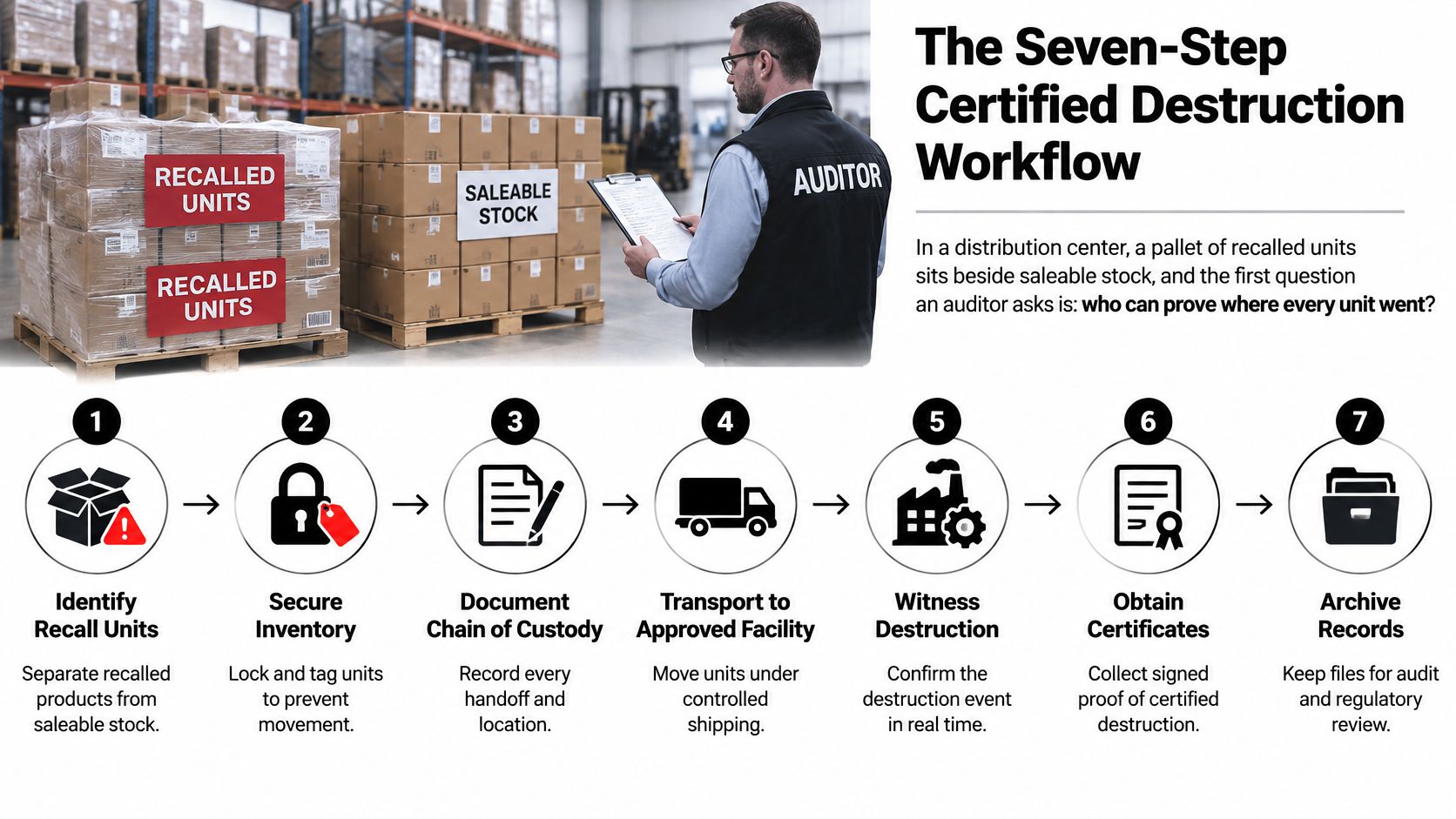
A pallet of recalled units sits beside saleable stock in a distribution center. An auditor asks who can prove where every affected unit went, including returns received after the first pickup. A pallet count won't answer that question unless someone has tied it to the recall inventory.
The CPSC Regulated Products Handbook calls for a written disposal request before destruction of covered consumer products and allows agency witnessing or alternative verification such as an affidavit and photographs. It also supports inventory updates and certification for off-site destruction. Build the operating plan around that authorization, not around the truck's availability.
Execute the controlled sequence
Identify the affected inventory. Record the recall number, SKU, lot or serial range, and quantity. Check model variants so unaffected merchandise doesn't enter the destruction stream.
Quarantine every distribution point. Block fulfillment and segregate units in warehouses, stores, return centers, and other holding locations. Give late returns the same controlled intake process.
Label containers and pallets. Mark them as recalled stock and assign container identifiers. Staff should be able to distinguish them from saleable, ordinary returned, or salvage inventory without opening the packaging.
Issue written vendor instructions. Prohibit resale and commingling, identify the approved destination, and state the authorized method. The vendor should acknowledge those instructions before accepting custody.
Perform the approved destruction. Match the actual processing event to the authorized instructions and verification arrangements. Stop processing if the material, hazard, or method differs from the approved plan.
Reconcile the physical counts. Compare received and processed units with the recall inventory. Investigate shortages, overages, damaged labels, and units held back from processing.
Obtain signed completion evidence. Collect the certificate or affidavit identifying the date, quantity, method, responsible employee, and witness where applicable. Don't sign an unqualified completion statement while exceptions remain unresolved.
Certified destruction workflow by step
These are practical ownership assignments. Document any different allocation before work begins.
| Step | Action | Usual owner | Evidence to keep |
|---|---|---|---|
| 1 | Identify recall number, SKU, lot or serial range and quantity | Quality or recall lead | Recall notice and unit count |
| 2 | Quarantine and segregate units at every distribution point | Warehouse manager | Location log and photographs |
| 3 | Label containers and pallets as recalled stock | Warehouse manager | Label record and pallet map |
| 4 | Issue written no-resale and no-commingling instructions to the vendor | Compliance lead | Signed instruction letter |
| 5 | Perform the approved destruction method | Destruction vendor with witness | Destruction log and method record |
| 6 | Reconcile physical counts to recall inventory | Inventory controller | Reconciled count sheet |
| 7 | Obtain signed certificate or affidavit | Authorized officer | Certificate of destruction |
The vendor's responsible operator signs the processing record; the witness signs for what they observed. The inventory controller signs the reconciliation, and the recalling organization's authorized officer accepts the completed disposition record. Don't ask one person to certify activities they cannot verify.
A vendor invoice is not proof of destruction. It establishes a billed transaction, not necessarily the identity, count, method, or completed disposition of the goods. Use chain-of-custody documentation to connect the handoffs with processing logs and signed results.
For marketplace inventory, separate retrieval planning from destruction authorization. Procurement teams can check standard-size FBA removal charges through Agent Central when budgeting retrieval, but a removal order doesn't establish the final disposition.
Before a truck leaves, finish the release controls: authorization, inventory identification, vendor instructions, transport arrangements, and evidence requirements. Off-site destruction and final reconciliation necessarily occur later. Data-bearing electronics also need a defined sanitization decision before processing begins.
Sanitizing Data-Bearing Recalled Devices
NIST sanitization methods for recalled media
Treat these as selection starting points, not automatic permissions to reuse recalled equipment. Product-safety restrictions and media-specific technical requirements still govern the final decision.
| Method | What it does | Best for | Reusable afterward |
|---|---|---|---|
| Clear | Logical overwrite of addressable storage where supported | Devices staying inside the organization under an approved risk decision | Yes, within the same controlled environment |
| Purge | A supported sanitization technique, such as cryptographic erase, that resists laboratory recovery | Devices leaving custody for authorized resale, donation or recycling | Yes, once purge is verified and the technique preserves usability |
| Destroy | Disintegration, pulverizing, shredding, incineration or melting | Recalled media that must never be reused | No, the media is unusable |
A recalled laptop can fail to power on while its drive remains readable. A router or medical device can retain information in flash memory even when its main function no longer works. A defective product isn't necessarily sanitized media.
NIST SP 800-88 Revision 1 defines sanitization around making access to target data infeasible for a specified level of effort. It distinguishes Clear, Purge, and Destroy, and identifies disintegration, incineration, melting, pulverizing, and shredding as physical destruction techniques. It also calls for trained, authorized personnel and advance identification of safety, hazardous-material, and special-disposition needs.
Make the media decision before processing
Inventory the data-bearing components. List drives, removable cards, embedded flash, and other storage associated with each product type. For laboratory equipment disposal, include attached controllers and computers rather than checking only the main instrument.
Match the method to the medium and confidentiality. Don't assume a generic overwrite reaches every relevant area of flash storage. Select a supported technique and define what successful completion must look like before the operator starts.
Run the process under controlled verification. Use authorized personnel and the witness arrangements established for the project. If equipment cannot complete the selected sanitization method, quarantine it for a documented alternative rather than marking it complete.
Record the outcome. Connect the media identifier, method, operator, verification result, and any exception to the disposition documentation. Keep the device and its removed storage traceable even if they follow different processing routes.
A data sanitization methods comparison helps IT and compliance staff agree on terminology before requesting quotes. For secure data destruction, a method name alone isn't enough. Your specification should identify the media, selected process, acceptance criteria, and required completion evidence.
Destroying the enclosure doesn't prove that the storage medium was destroyed.
For data center decommissioning or laptop disposal, selective media removal may simplify verification while allowing authorized recovery of other materials. Whole-device destruction may be preferable when the recall prohibits reuse or when safe disassembly isn't practical.
Neither choice eliminates battery and hazardous-component planning. Don't send a damaged battery through a general shredder merely because the storage medium requires destruction. Have the qualified processor establish a safe sequence that meets both the product-disposition and data-security objectives.
Building a Certificate of Destruction Evidence Packet
Required fields in a certificate of destruction
Use this as a working specification, then align it with the particular recall and regulator. The fields aren't a claim that every authority mandates an identical certificate.
| Field | What it records | Expected entry |
|---|---|---|
| Recall reference | Recall number, SKU and affected lot or serial range | Taken directly from the recall notice |
| Quantity | Units destroyed, reconciled to the recall count | Count sheet attached, with variances explained |
| Date and location | Destruction date, facility and transport dates | Named facility and dated receiving record |
| Method | Destruction method and any sanitization method applied | Stated method, such as shredding to a documented particle size or NIST Destroy |
| Custody | Seal numbers, transport details and receipt signatures | Driver name, seal number and receiver signature |
| Authorization | Responsible employee, witness and regulator correspondence | Named officer, witness name and agency reference |
| Photographs | Dated images of containers, loading and destruction | Before and after images tied to the count |
The certificate is the signed summary of an evidence packet, not a substitute for its attachments. A reviewer should be able to start with a recalled serial number or lot and follow it through release, receipt, processing, and final disposition.
NIST SP 800-88 Revision 2 treats media sanitization as an organizational program using controls appropriate to information sensitivity. Its test concerns whether access to target data has been made infeasible, not whether equipment was processed or recycled. For recalled electronics, retain method-selection and completion evidence that supports the outcome claimed on the certificate.
Build a template your team can actually review
Start with a header containing the recalling organization, recall reference, project identifier, and processing facility. Follow it with a reconciled count table separating units received, units destroyed, units held, and unresolved exceptions. Attach the asset-level list when the certificate itself cannot reasonably hold it.
The method statement should describe what the processor did, not merely say compliant disposal. Add a custody log, signature block with names and titles, and an attachment index covering photographs, processing results, agency correspondence, and downstream records. Use a certificate requirements checklist before accepting the vendor's final form.
Keep the documents distinct:
- Certificate of destruction. Records completion of the specified destruction event.
- Recycling certificate. Records a recycling outcome without necessarily proving product destruction.
- Custody record. Shows possession and transfer, not completion of processing.
- Sanitization record. Supports the claimed treatment of stored data.
- Recall status report. Communicates the organization's recall progress and disposition to the regulator.
Show exceptions instead of hiding them
If part of a load remains quarantined, identify it on the certificate or a controlled attachment. State what was completed and what remains open. A count mismatch needs an explanation before an officer signs an unqualified statement.
Photographs support the record, but an image of shredded material doesn't identify the source units by itself. Tie image filenames or identifiers to the container log and event record. Preserve originals and keep corrections traceable.
Retain the packet for the period established by the applicable regulator, legal counsel, contracts, and your retention policy. Link it to the inventory system so computer recycling, IT asset disposition (ITAD), and recall closure records use matching identifiers rather than separate spreadsheets with unexplained totals.
Confirm Downstream Compliance Before You Sign
A local pickup does not establish where recalled products end up. The collecting company may consolidate material, transfer residues to another processor, or use an international recovery route. Ask for the destination of each material stream, not only the first unloading location.
The EPA's guidance on international e-waste requirements explains that Basel Convention amendments effective January 1, 2025, generally require prior written consent from importing and transit countries for covered e-waste and electronic scrap shipped for recovery or disposal. U.S. export arrangements need particular attention: labeling a shipment recyclable does not establish that the route meets applicable requirements.
A recall decision does not authorize a noncompliant export. Hazardous-waste rules may separately require consent, shipment tracking, and confirmation of receipt and recovery. Make the contract require records relevant to the actual route.

Ask destination-specific questions
- Receiving facilities. Which named facility receives each load or separated material stream? Is the route domestic or international?
- Material classification. How are batteries, damaged devices, and hazardous components classified, and who documents the decision?
- Receipt and recovery. What shipment-level records confirm acceptance and completed recovery or disposal?
- Rerouting responsibility. Who approves a broker's route change? What notification and liability terms are in the contract?
- Approved downstream vendors. Which processors are authorized, and who can provide applicable export-consent documents before shipment?
Transferring ownership does not necessarily resolve every legal responsibility. Have counsel establish each party's obligations for the waste, jurisdictions, and shipment arrangement. Require the vendor to produce records on request, and retain them in the recall file.
Keep donation and destruction streams separate
At an Atlanta office or facility cleanout, separate recalled stock from working surplus at intake. Transfer working equipment only when it is eligible for reuse and has the required sanitization and authorization. Keep recalled inventory out of donation channels unless the recall requirements explicitly permit that disposition.
For a clinic retiring treatment equipment, review administrative compliance separately from waste routing. Omega Lasers provides a checklist to check your laser clinic's compliance. It can support that parallel review, but does not replace recall or environmental instructions.
Choose an authorized material-recovery route only after establishing the required safety and security outcomes. Close the file when signed records account for the disposition, including any unresolved exceptions.
Reworx Recycling offers free customer drop-off, business pickups, equipment decommissioning, IT asset management, recycling consultations, and secure hard drive shredding with data destruction. It also provides buyback options for surplus hardware. Visit Reworx Recycling to schedule a business pickup or request a recycling consultation for your equipment.