You're staring at a vendor notice, a pickup log, and a folder full of manifests, and the uncomfortable question is whether that paperwork would hold up if an auditor asked for the full story. For electronics recyclers and the IT managers who depend on them, an environmental compliance audit is rarely about one permit or one shelf of files. It's about whether the entire path, from collection to final disposition, is documented tightly enough to survive scrutiny when equipment leaves your building.
Why Environmental Compliance Audits Matter for Electronics Recyclers
A pickup can look clean on paper and still fail under review. The gap usually shows up later, after assets leave the site and someone asks for proof that the chain of custody stayed intact, that downstream handlers were qualified, and that the records support both environmental compliance and the ESG story the business plans to tell.

An environmental compliance audit is a structured review of operations, permits, plans, practices, and environmental liability. EPA audit protocol treats it that way because compliance has to be measured against actual operations, records, and legal exposure, not only against what a policy says should happen EPA compliance protocol. For electronics recyclers, that matters because the audit often reaches beyond the dock door into downstream processing, waste handling, and the quality of the file set that proves it.
Practical rule: if a customer asks what happened to retired equipment after pickup, the answer should be a record set, not a verbal assurance.
Oversight of this work is not unusual. In INTOSAI's survey results, Supreme Audit Institutions reported a large number of environmental audits since 1989, many respondents said they had performed at least one environmental audit, and later survey findings showed that compliance auditing on environmental issues had become a normal part of public oversight INTOSAI survey results. That is the direction this market moved in, and recyclers feel it when customers or regulators ask for cleaner evidence than a stack of outbound forms.
The pressure now extends into Scope 3 accounting and ESG reporting. Once devices leave the facility, teams want proof that handling was documented, vendors were managed, and claims about diversion or recycling can be defended end to end. A recycling audit that only checks the onsite pile misses the risk that appears later, when someone asks for the chain of custody, the final disposition package, and the reporting trail behind it. If your organization is trying to connect that material flow to corporate reporting, environmental impact reporting for recycled electronics becomes part of the evidence system, not a side project.
For a company like Reworx Recycling, the compliance value sits in the recordset as much as in the material handling. Businesses do not need a speech about responsible recycling, they need evidence that holds together when procurement, legal, and sustainability all ask different versions of the same question. Matil's compliance extraction API can help teams pull that evidence into one place without relying on memory, scattered inboxes, or a last-minute scramble through file shares. That is where audit readiness starts.
Pre-Audit Preparation and Building Your Regulatory Register
The part that breaks most programs is the part everyone wants to rush. Teams jump straight to permits, but the audit usually fails earlier, at the point where no one has mapped the operation against the actual requirements. A strong pre-audit phase turns that chaos into a regulatory register, which is just a disciplined list of what applies, where it applies, and who owns the proof.
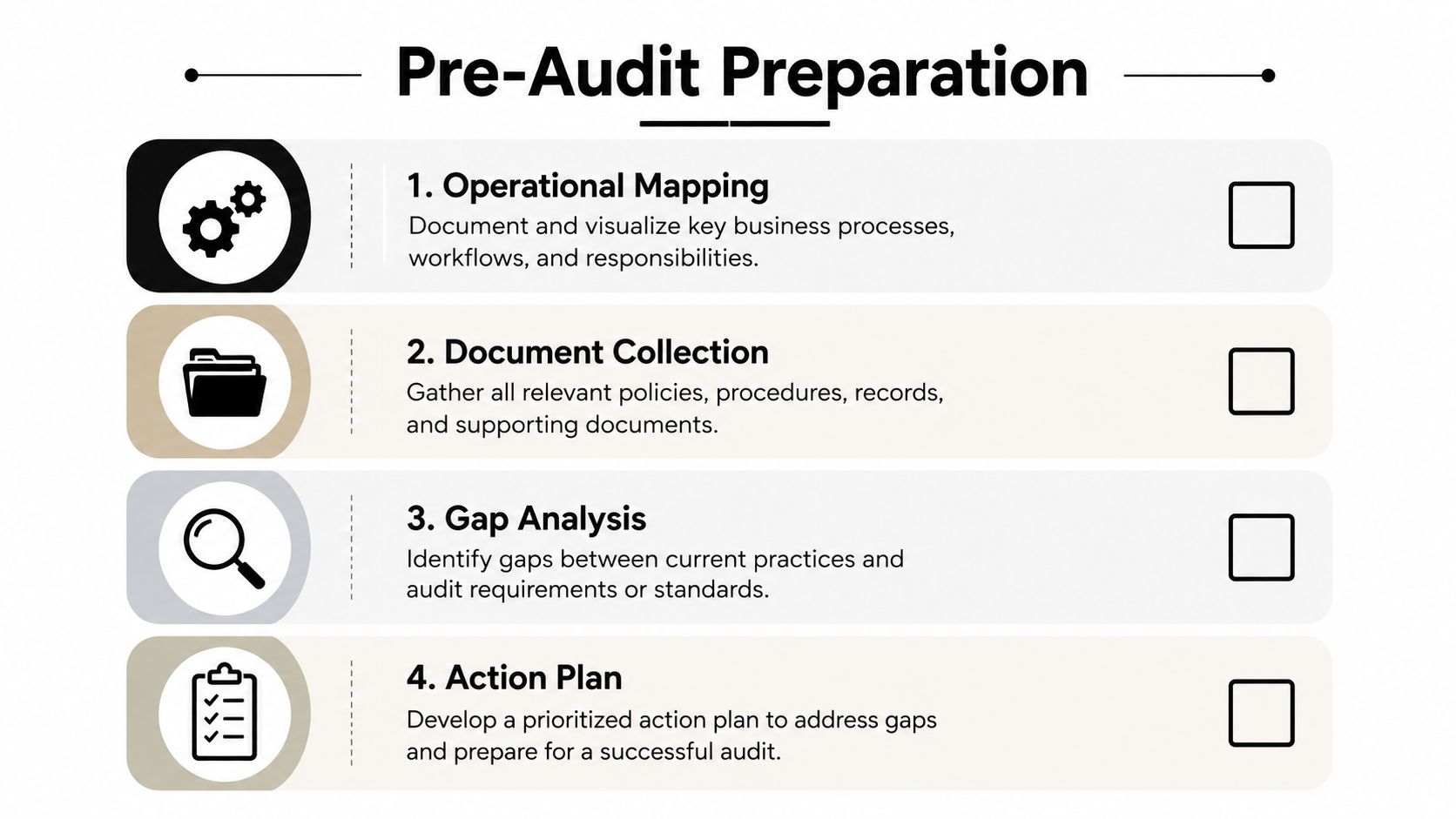
The cleanest way to build that register is to start with operations, not law books. List every activity that touches regulated material, including receiving, sorting, dismantling, storage, packaging, outbound shipping, and any process that touches air, water, land, or hazardous substances. Then tie each activity to the permit, license, reporting duty, inspection rule, training obligation, or local requirement that governs it.
What belongs in the register
For an electronics recycler, that register should include current permits and licenses, expiration dates, monitoring schedules, inspection frequency, reporting deadlines, and the retention rule for each record type. It should also map special handling requirements for lamps, batteries, printer cartridges, pallets with contamination, and any material that crosses from ordinary waste into regulated waste. If your business handles data center equipment, the register should also capture upstream and downstream documentation for transfers, decommissioning, and final disposition.
A practical audit flow starts with the three-phase structure outlined in EPA-aligned guidance, pre-audit planning, on-site execution, and post-audit follow-up audit process overview. In real facilities, the pre-audit stage is where you confirm the scope, line up the team, and assemble the documents before anyone walks the floor. That means site maps, permit files, waste profiles, training logs, incident records, vendor approvals, and any contract language that defines who owns environmental obligations.
The best-prepared sites don't hand auditors a binder and hope for the best. They hand over a register that makes the binder easy to verify.
The easiest way to slow down the whole process is to keep records in different systems with no owner and no naming standard. A better approach is to create one index for permits, one for monitoring, one for incidents, one for training, and one for vendor files. If you want a practical way to keep those records aligned before the audit starts, Matil's compliance extraction API is a useful example of how teams centralize source documents without relying on memory or scattered folders.
Organizing the evidence
Pre-audit prep also means deciding what counts as proof. A scanned permit with no sign-off history is weaker than a permit folder that shows the current version, the renewal date, and the internal review note. A training spreadsheet is better when it's paired with rosters, course content, and completion dates. A shipping log means more when it sits beside transfer documentation and signed receipts.
The point isn't to over-document everything. It's to make the auditor's job simple enough that the facility's story is obvious on paper before anyone asks a follow-up question.
Legal and Regulatory Checkpoints for Electronics Recycling
An audit at an electronics recycling site usually gets complicated because the operation sits at the intersection of hazardous waste, universal waste, shipping, storage, and recordkeeping. EPA guidance for environmental compliance audit preparation does not treat permits as the whole story. It asks auditors to review business operations, waste streams to air, land, and water, reporting, record-keeping, and how chemicals or hazardous materials are handled. That wider scope is why e-waste operations get caught off guard.
What auditors verify
At the floor level, the auditor wants to see whether the written process matches what people do every day. Current permits should be posted and understood. Emissions or discharge limits need to be monitored on schedule. Hazardous waste manifests must be complete and traceable. Training records should be current. Emergency response procedures need to be real enough that employees can describe them without coaching.
State rules matter too, because electronics and components often move through several compliance layers before they leave the site. A facility may be clean on the EPA side and still stumble on local storage restrictions, reporting deadlines, or chain-of-custody expectations tied to customer contracts. A permit-only review gives a false sense of security.
The EPA audit protocol treats the facility as a system, not a pile of forms. That system includes what comes in, what gets stored, what gets broken down, what gets sent out, and what gets documented along the way. For electronics recyclers, the weak points are usually familiar, missing signatures, stale training files, or an outdated storage map that no longer matches the yard.
Certification expectations
Certification frameworks such as R2 and e-Stewards raise the bar on operational discipline, even when they are not the direct legal standard. They push companies toward better controls around downstream vendors, data handling, and evidence quality. Reworx Recycling's e-waste certification standards page is useful if you are aligning internal controls with third-party expectations around responsible electronics management.
Good audits test the system, not just the paperwork. If the system breaks when one employee is absent, the audit will expose it.
The gaps that surface most often are painfully ordinary. People cannot produce current versions of permits. Waste labels do not match the manifest. A vendor has changed, but the approval file was never updated. Training happened, but nobody saved the attendance sheet. On their own, each issue looks small. Together, they tell the auditor that the compliance program depends too much on memory and too little on controls.
That is why the evidence has to survive movement offsite. Once assets leave the building, you need a clean chain from intake through storage, sorting, shipment, and downstream disposition. The files that hold up are the ones that show who touched the material, what changed hands, and what review happened before release. That same evidence also feeds Scope 3 reporting and ESG claims, so the record set has to work for compliance staff and sustainability teams at the same time.
For teams that want that evidence to support enterprise compliance ROI metrics, the practical test is simple. If an auditor asks for the story behind a shipment, can you show the permit context, the vendor approval, the transfer record, and the internal sign-off without rebuilding the file from memory. If the answer is yes, the controls are probably holding. If the answer is no, the site is still depending on people to explain what the records should have shown.
Audit Checklist and Evidence Templates That Work
A useful checklist is not a list of chores. It's a structure for proving that the facility's controls are active, repeated, and owned by specific people. If the evidence is scattered, auditors spend time reconstructing the story, which is exactly where defensibility gets weak. If the evidence is organized, they can verify the story faster and with fewer assumptions.
For teams looking for a reusable format, Reworx Recycling's compliance checklist template is relevant as a starting point for organizing that evidence pack around actual audit categories.
Evidence categories that hold up
| Category | Evidence Items | Common Gaps |
|---|---|---|
| Permits and licenses | Current permits, renewal dates, approvals, site-specific conditions | Expired copies, missing local approvals, no owner for renewals |
| Monitoring and testing | Sampling schedules, lab results, inspection logs, trend reviews | Missing periods, late reviews, no follow-up on anomalies |
| Waste handling | Manifests, transfer logs, container labels, storage photos | Unsigned manifests, unlabeled containers, weak chain of custody |
| Training and competency | Rosters, course outlines, completion records, refresher schedules | No attendance proof, outdated material, no retraining trigger |
| Equipment and maintenance | Preventive maintenance logs, calibration records, service tickets | Unreconciled repairs, missing service dates, no escalation path |
| Vendor management | Approval packets, contracts, downstream due diligence, audit responses | Unreviewed vendors, no documentation of exceptions, stale approvals |
The strongest finding reports use a format that forces clarity: requirement, observed condition, compliance gap, risk, corrective action, and priority rating. That structure keeps the report operationally useful instead of vague. A bad report says “documentation incomplete.” A good report says the requirement, what was observed, why the gap matters, what needs to happen, and how urgent it is.
What to bring to the audit table
The best evidence sets are built for three kinds of scrutiny. Site inspections need visible, current conditions. Document reviews need indexed records with version control. Employee interviews need people who can explain their own role without reading a script.
A practical prep stack should include:
- Permits and licenses, current copies with expiration dates and internal owners.
- Manifest and shipment records, signed, dated, and traceable to each outbound load.
- Training files, with rosters, topic coverage, and refresher history.
- Maintenance logs, especially for equipment that controls storage, handling, or environmental release risk.
- Vendor files, including approval, review notes, and downstream responsibility checks.
For leaders who want the business case behind the administrative work, enterprise compliance platforms often frame the payoff in terms of visibility and control. The broader point is simple, and enterprise compliance ROI metrics are usually most persuasive when they show how centralizing evidence reduces scramble during audit season.
The common mistake is treating the checklist like a one-time event. It works better as a standing evidence system. When a permit changes, update the register. When a shipment leaves, archive the receipt. When training is completed, file the proof the same day. That cadence is what makes the next audit feel ordinary.
Common Nonconformances and Corrective Actions
Most audit findings in electronics recycling are not exotic. They're predictable, which is why they're so frustrating. The site usually knows what went wrong, but the fix stops at the symptom instead of reaching the root cause. EPA protocol explicitly pushes auditors to analyze exceptions for cause and effect, group findings by common causes, and examine each group for underlying causes before corrective measures are assigned EPA audit protocol.
Surface fix versus real correction
A missing manifest can be solved two ways. The surface fix is to chase the signature and file it. The better fix is to ask why the chain broke, whether the receiving step is unclear, and whether the shipment process needs a control point that prevents the omission next time.
That difference matters across the usual problem set. Incomplete hazardous waste manifests often point to handoffs with no owner. Inadequate training records usually mean the training happened, but the recordkeeping step wasn't built into the workflow. Missing monitoring data usually signals an interrupted schedule, unclear responsibility, or a file system that makes gaps too easy to hide.
Improper storage of universal waste is another common nonconformance. The corrective action is not just relabeling the containers. It's confirming segregation rules, improving layout, training the receiving team, and adding inspection checkpoints. Vendor chain-of-custody gaps follow the same pattern. If the downstream file is thin, the issue is often approval discipline, not just missing paperwork.
How to think about corrective action
Corrective action works when it changes the process that created the finding.
The fastest way to get audit findings closed is to assign an owner and a deadline. The fastest way to get repeat findings is to close the ticket and leave the workflow untouched. A real corrective action may involve retraining, revising a form, adding a sign-off step, or changing where records are stored so the right file can be retrieved without a scavenger hunt.
For facilities that treat environmental controls as part of a broader management system, Reworx Recycling's quality management systems page is a useful reminder that consistency is built, not improvised. The same logic applies whether the issue is a mislabeled pallet or a missing vendor review.
The best teams don't wait for a repeat finding to prove the point. They look for patterns across findings and fix the shared cause once. That is where audit prep becomes operational improvement instead of compliance theater.
How Reworx Recycling Simplifies Environmental Compliance
A lot of organizations focus on the audit event and ignore the evidence system that has to survive after the trucks leave. That's where the risk piles up, because sustainability teams, investors, and public-sector buyers want proof that retired equipment was handled responsibly across the reverse-logistics chain. Reworx Recycling's compliance reporting supports that need with retirement approval records, pickup or transfer logs, processing confirmations, and archived final disposition packages that can be accessed when audit questions come in.
That matters most when assets move offsite. Once the equipment is no longer sitting in your building, the questions shift from “did we send it out” to “can we prove where it went, who handled it, and what documentation survived each handoff.” Reworx's documented chain of custody and certificates of destruction help keep that story intact, especially when ITAD, secure data destruction, and environmental reporting all intersect.
A business that works with a provider like Reworx also reduces the amount of detective work its own team has to do later. Instead of reconstructing shipments, approvals, and disposition records from email threads and spreadsheets, the company can lean on a cleaner documentation trail. That's a practical advantage in audits, vendor reviews, and ESG reporting cycles.
Reworx Recycling also fits the donation-based recycling model, which is useful when organizations want responsible disposal that still supports community impact. The compliance side and the social-enterprise side can work together when the process is documented well and the downstream records are complete. That combination gives businesses a cleaner path for electronics recycling, IT equipment disposal, and broader IT asset disposition decisions.
If your team is preparing for an environmental compliance audit, Reworx Recycling can help you retire equipment with the documentation trail auditors expect and the handling controls your sustainability team needs. Visit Reworx Recycling to review recycling guidance, request support for secure equipment disposition, or plan a pickup that keeps your compliance records organized from start to finish.