An office cleanout rarely fails in the obvious places. The pallets get wrapped. The truck arrives. The old laptops leave the building. Everyone assumes the process is under control.
The fundamental problem starts with a quieter question. Can you prove what happened to each device after it left your floor? If the answer depends on memory, a generic pickup ticket, or a vendor promise, the process isn't under control. It's just moving.
The Unseen Risk in Every Office Cleanout
An IT manager usually notices the risk before anyone else does. A lease is ending, a department is relocating, or a hardware refresh is finally moving after months of planning. Desktops come off desks, network gear gets unracked, and old backup drives appear from drawers no one has opened in years.
At that point, the inventory problem turns into a trust problem.
A facilities team may be coordinating movers. Procurement may be focused on replacement equipment. Sustainability may care about diversion and donation outcomes. Legal may only step in if there's a compliance concern. But the person closest to the assets knows what matters most: if even one server, hard drive, or executive laptop drops out of the record, the whole project gets harder to defend.
Where office cleanouts usually break down
The weak spots are predictable:
- Mixed responsibility: Facilities, IT, and outside contractors all touch the project, but no one owns the full handoff trail.
- Loose manifests: A pickup sheet that says "miscellaneous electronics" doesn't help when someone later asks about a specific laptop or failed RAID array.
- Last-minute additions: Devices pulled from closets and storage rooms often bypass the original inventory.
- Vendor assumptions: Teams assume the recycler or ITAD provider will document everything, then discover too late that the records aren't asset-specific.
That contractor exposure isn't unique to IT. Facility leaders are already dealing with the same operational blind spots in broader vendor oversight, which is why these insights on facility contractor risk are worth reading before any large decommissioning or cleanout starts.
Practical rule: If an item is sensitive enough to erase, it's sensitive enough to track individually.
The cleanest projects start before pickup day. That means reconciling what you think you have against what is physically present, then building a chain that follows those assets through transport, processing, and final disposition. A pre-removal review like this guidance on IT inventory audits before recycling usually surfaces the assets that create the biggest downstream problems.
Why this matters beyond data security
The initial focus is often on breach risk, and rightly so. But poor documentation also creates trouble in sustainability reporting, internal audits, insurance questions, and finance reconciliation. If you can't show what left, who received it, and what happened next, you can't confidently claim secure data destruction, responsible recycling, or valid donation outcomes.
That is what chain of custody documentation solves. Not in theory. In the daily reality of office cleanouts, facility closures, and IT refresh cycles.
What Is Chain of Custody in E-Waste and ITAD
In IT asset disposition, chain of custody documentation is the birth-to-burial certificate for each device. It isn't a one-time form. It's a chronological record that follows an asset from collection through transfer, processing, data destruction, and final disposition.
That distinction matters because a pickup receipt only proves that someone took possession of a load. It doesn't prove what was in the load, who handled individual assets, whether the items stayed secure in transit, or whether specific drives were destroyed.
More than a receipt
In forensic and legal practice, chain of custody exists to create an unbroken, chronological record of evidence handling, tracking custody, control, transfer, analysis, and disposition from collection to court admission. Standard documentation includes the date and time of collection, location, identity of each handler, identifiers such as serial numbers, hash values for digital evidence, and signatures confirming each handoff. Courts rely on that paper trail to decide whether evidence may have been altered, contaminated, or accessed without authorization, as outlined in StatPearls on chain of custody.
That legal origin is exactly why the concept belongs in ITAD. End-of-life electronics aren't courtroom exhibits, but they often contain regulated data, intellectual property, employee records, customer information, and internal communications. If your process can't withstand scrutiny, it isn't much of a control.
What chain of custody covers in practice
A usable record usually answers five questions:
| Question | What the document should show |
|---|---|
| What was it | Asset tag, make, model, serial number, drive details, or other unique identifiers |
| Where did it start | Site address, room, rack, office, cage, or department |
| Who handled it | Named individuals or documented custodians at each transfer |
| When did custody change | Timestamps for pickup, loading, receipt, processing, and disposition |
| What happened next | Sanitization, shredding, resale prep, donation evaluation, or recycling |
A strong process also links the custody record to downstream proof, especially for storage media. That's where documents like a hard drive certificate of destruction become important. The certificate confirms the destruction event, but it only has real value if it's tied back to the original asset and transfer record.
A certificate without a custody trail is just a statement. A certificate attached to a serialized chain is evidence.
Why businesses can't treat this as optional
In e-waste and ITAD, chain of custody does three jobs at once.
First, it protects against data exposure. If a drive, laptop, or firewall appliance contains recoverable data, you need a documented record of who had access to it at every stage.
Second, it supports compliance and defensibility. Whether you're dealing with internal audit, privacy obligations, or contractual requirements, documented handling shows that controls were applied rather than assumed.
Third, it supports asset accounting. Companies regularly need to reconcile retired equipment against fixed asset records, internal inventories, insurance schedules, and sustainability reports. Without a clear chain, those records drift apart.
A mature ITAD program doesn't bolt this on at the end. It builds the custody record into every handoff from the start.
Essential Elements of an Ironclad CoC Document
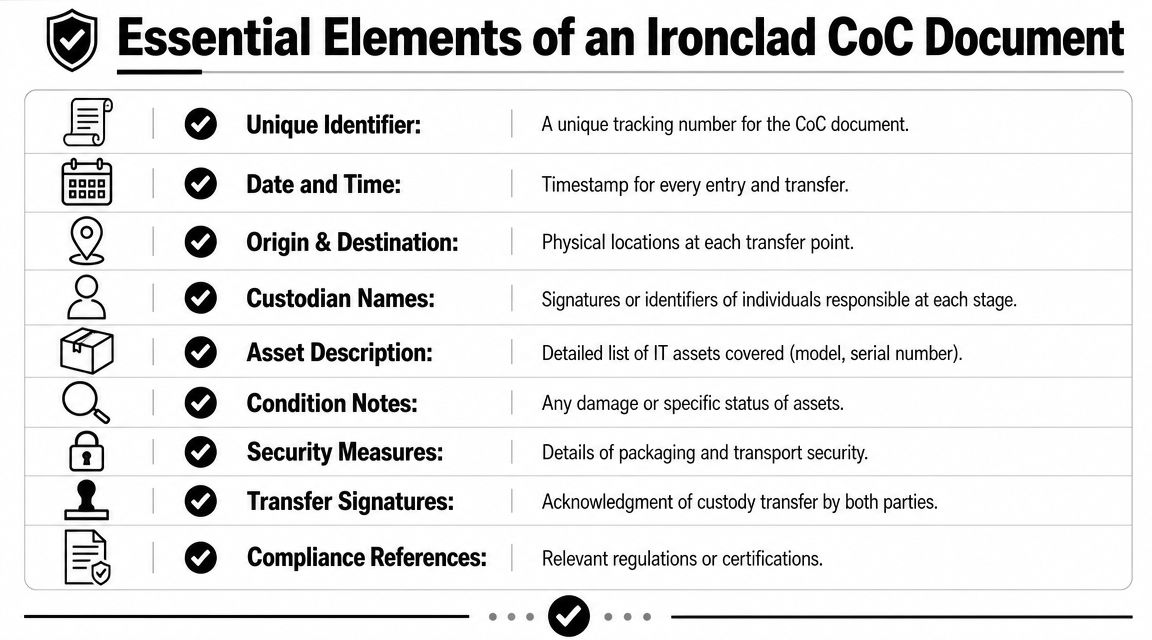
An ironclad chain of custody record is detailed enough that a third party can reconstruct the entire lifecycle of an asset without calling people to ask what happened. If the form depends on interpretation, it will fail when the pressure is on.
The fields that can't be missing
A practical CoC document should include these elements, with enough precision to stand on its own:
- Unique tracking number that ties the form to a specific project, pickup, or manifest.
- Exact timestamps for collection, transfer, receipt, and processing events.
- Origin and destination details for each handoff, not just a company name.
- Named custodians with signatures or equivalent identifiers at every transfer point.
- Asset-level description such as make, model, serial number, asset tag, and media type.
- Condition notes if an item is damaged, unsecured, powered on, missing parts, or otherwise unusual.
- Security method used during packaging and transport, such as sealed gaylords, locked carts, serialized containers, or wrapped pallets.
- Transfer acknowledgment from both sides of the handoff.
- Related compliance or destruction references that connect the record to sanitization, shredding, recycling, or donation disposition.
What doesn't work is broad counting. "10 laptops" is not documentation. "10 Dell Latitude units with recorded serial numbers and matching asset tags" is documentation.
Specificity beats volume
I've seen vendors hand over long reports that still leave the client exposed because the records were busy, not precise. A stack of forms doesn't help if none of them identify the actual devices in question.
The easiest test is simple. Pick one retired laptop from the project and try to follow it forward. If you can't identify:
- where it was collected,
- who signed for it,
- when it arrived at processing,
- what happened to its drive,
- and how it was finally dispositioned,
then the chain isn't complete.
The strongest custody record is boring to read. Every line is specific, repeatable, and easy to verify.
What strong evidence capture looks like
Good documentation also includes supporting evidence outside the form itself. That may include intake photos, sealed pallet images, receiving logs, destruction logs, and process reports tied back to asset identifiers.
A useful parallel exists in physical evidence handling. This guide for law enforcement evidence shows how storage discipline, controlled access, and traceable handling make records defensible over time. ITAD projects need the same mindset, even if the assets are headed for shredding, refurbishment, or material recovery instead of a courtroom.
For organizations building or reviewing templates, a destruction certificate template can help frame the output documents, but the certificate itself should sit on top of a stronger custody log.
A quick pass-fail review
Use this short checklist when evaluating your current form:
| If your document says | You still need |
|---|---|
| Box of electronics | Device list or linked serialized manifest |
| Picked up by driver | Named custodian and signed transfer |
| Processed at facility | Timestamp, location, and disposition event |
| Drives destroyed | Link to asset identifiers or destruction batch record |
Most documentation failures happen because teams stop at the load level. Secure ITAD requires records at the asset level whenever the data risk, audit risk, or financial value justifies it. In practice, that includes far more equipment than many organizations expect.
Integrating CoC into Your IT Decommissioning Workflow
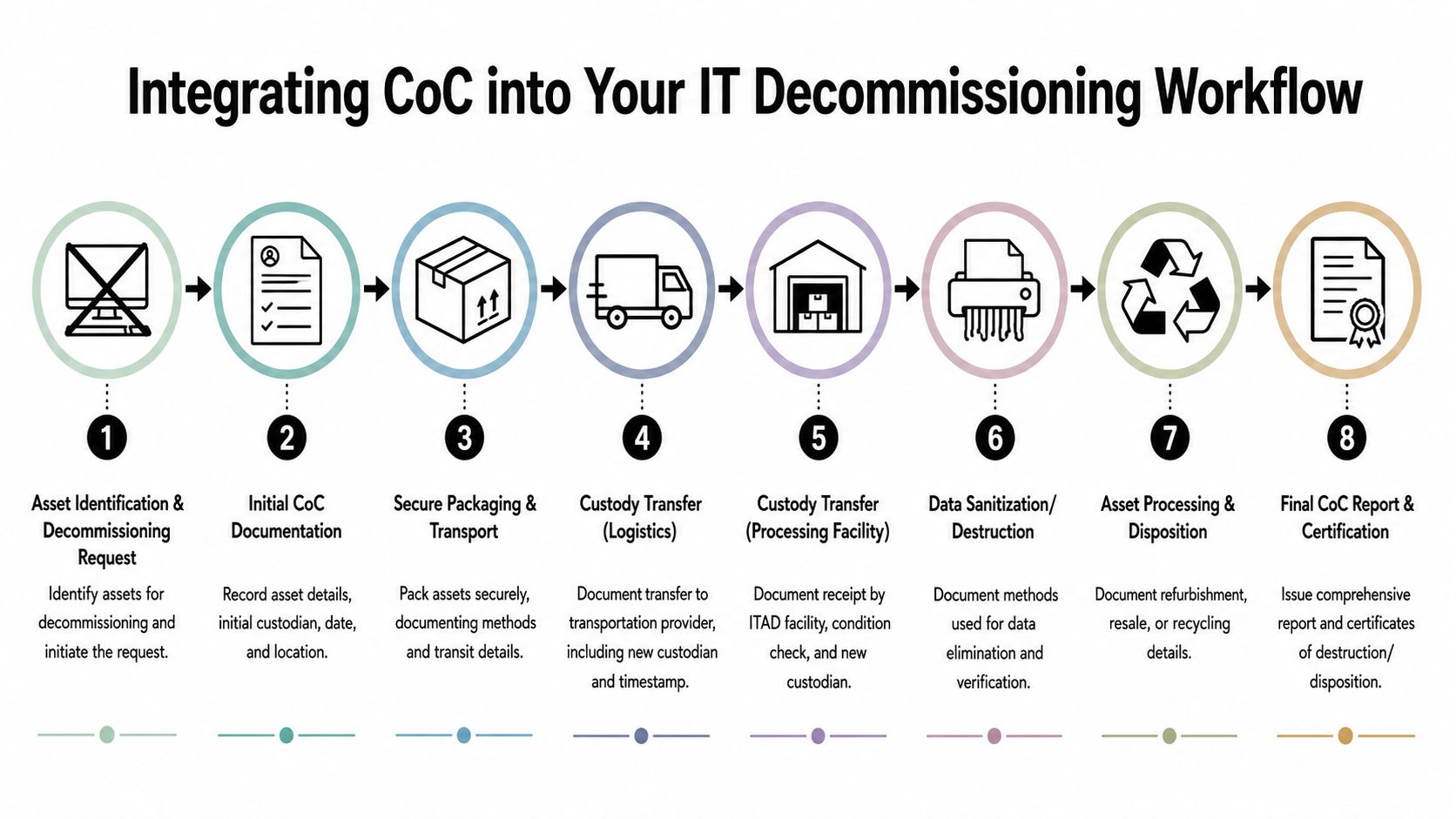
Chain of custody breaks down when it's treated as paperwork after the work is done. It holds up when the documentation is built into the workflow itself.
That starts before anything is loaded onto a truck.
Start with the internal handoff
The first transfer often happens inside your own organization. A business unit releases equipment to IT. IT stages devices for removal. A facilities team grants dock access. If those steps are informal, the outside vendor inherits a messy chain on day one.
A cleaner decommissioning flow usually follows this sequence:
- Identify the assets for retirement. Pull from CMDB records, asset management tools, lease schedules, and physical walk-throughs.
- Reconcile exceptions early. Mark devices that are missing, reassigned, damaged, or outside the expected list.
- Stage by category. Separate laptops, networking gear, servers, mobile devices, and media for easier verification.
- Assign an internal custodian. One person or team should own the pre-pickup manifest.
This is especially important in larger projects such as office closures, data center decommissioning, laboratory equipment disposal, or medical equipment disposal. Complex jobs create more handoffs, and more handoffs create more chances for ambiguity.
Verify at pickup, not after
Pickup day should be a matching exercise, not a guessing exercise. The vendor and the client should be validating the staged assets against the manifest, then recording custody transfer at the point of removal.
That means documenting:
- The physical site where the assets were released
- The date and time the transfer occurred
- The people involved in the handoff
- The transport method and container condition
- Any variances between the expected and actual load
If a device appears that wasn't on the manifest, it shouldn't be tossed onto the pallet and then only remembered later. It should be added properly, or held back until it can be documented.
If the pickup team is fixing the paperwork after the truck leaves, the chain already has a weak point.
Follow the asset through transport and processing
After pickup, the custody trail must continue through every operational stage. That includes secure transport, receiving at the processing facility, intake verification, data sanitization or destruction, and final downstream disposition.
A practical workflow often looks like this:
| Stage | What must be documented |
|---|---|
| Transport | Driver or carrier handoff, sealed load status, departure and arrival timestamps |
| Facility intake | Receiving team, condition check, manifest confirmation, exceptions |
| Data handling | Sanitization method or physical destruction event tied to asset records |
| Disposition | Reuse, donation evaluation, parts harvest, commodity recycling, or product destruction |
For teams managing recurring projects, a formal guide such as this server decommissioning checklist helps standardize the upstream steps that make downstream custody records cleaner.
One operational option in this space is Reworx Recycling, which provides serialized custody documentation as part of its IT asset disposition workflow. That matters because clients usually don't need more forms. They need one coherent record that tracks pickup through final disposition without forcing their internal teams to patch the process together.
Different projects need different depth
Not every project needs the same level of granularity, but most businesses underestimate how quickly risk increases.
A routine laptop refresh may focus on asset IDs, signed transfer, and destruction reporting for drives. A data center decommission may require rack-level mapping, staged removals, and tighter receiving controls. A healthcare environment may need sharper attention to mixed devices, embedded storage, and restricted handling.
The common mistake is trying to use one generic pickup process for all three. A mature chain of custody workflow scales with the project instead of flattening everything into "electronics removed."
Best Practices for Documentation Retention and Audits
The value of chain of custody documentation doesn't end when the equipment is gone. In many organizations, that's when the record becomes most important.
An auditor may ask for proof months later. Legal may need to confirm disposition long after the office closeout is forgotten. A privacy review may hinge on whether the business can show who accessed a device and how its data was eliminated. If the records aren't retained properly, the process may as well not have happened.
Keep records longer than the project feels alive
One documented retention benchmark states that custody records are commonly kept for 3 to 7 years for routine operational evidence, while legal matters may require indefinite retention until all appeals are exhausted, according to LHH's overview of documenting chain of custody. The same resource notes that digital evidence checklists can include hash values for both source and resulting image files, along with the capture method and device condition, which shows how digital integrity depends on technical validation as well as administrative logs.
That doesn't mean every business should blindly adopt one retention window. It means your retention policy should match your regulatory environment, contractual obligations, litigation profile, and internal audit requirements.
Build records so an auditor can navigate them quickly
Retention is only half the job. Retrieval matters just as much.
The strongest setups usually share a few habits:
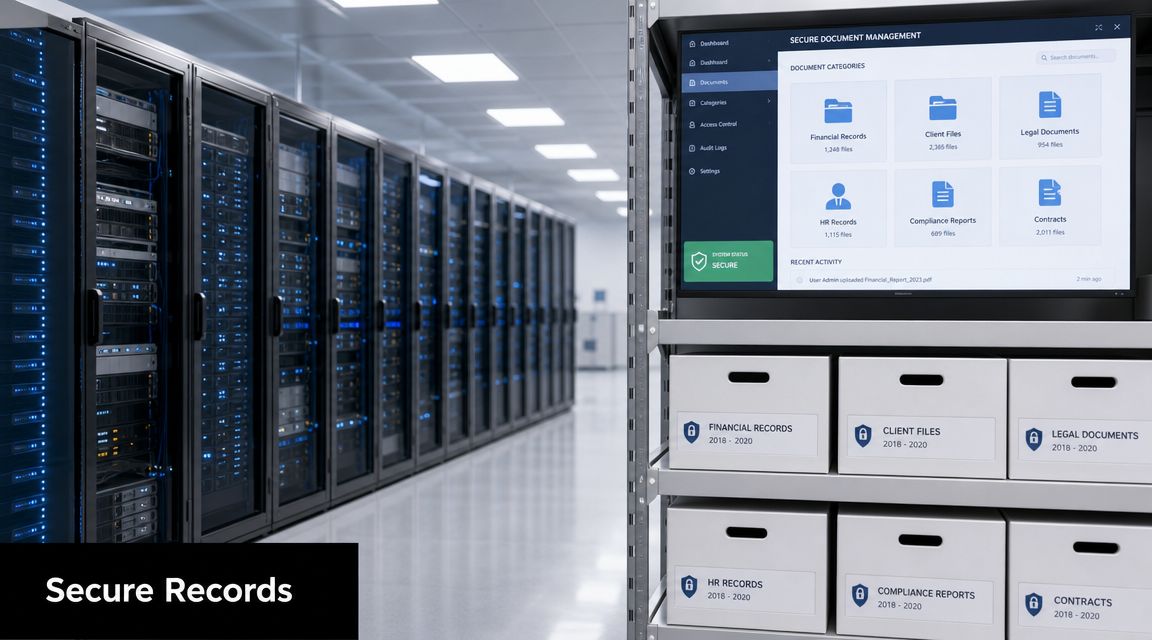
- Centralized repository: Keep manifests, certificates, intake records, and disposition reports in one controlled system rather than scattered across inboxes and shared drives.
- Consistent naming: Use project IDs, pickup dates, client site names, and manifest numbers in a predictable format.
- Linked records: Make sure destruction certificates, serialized asset lists, and recycling reports point back to the original custody record.
- Access logging: Limit who can edit or replace records, especially for digital chain of custody documentation.
- Version discipline: If a manifest changes, preserve the original and log the revision reason.
Cloud systems make this easier and harder at the same time. Easier because records are accessible to distributed teams. Harder because access events, edits, and exports multiply quickly. In digital environments, the challenge isn't who physically carried the devices. It's whether your organization can audit who viewed, changed, or transmitted the documentation itself.
Audit readiness comes from retrieval speed. If it takes days to reconstruct a disposal event, the control wasn't operational.
Questions to ask any ITAD vendor
Vendor due diligence should get specific fast. Ask questions that force process details, not marketing language.
- How do you document custody transfers? Ask whether records are load-level, pallet-level, or asset-level.
- How are exceptions handled? Missing serial numbers, unlisted devices, damaged equipment, and mixed loads should have a documented process.
- Who can access the records? You want named responsibility, not "our team handles that."
- How are digital records protected? Access controls, audit logs, and retention workflows matter.
- Can they support audit requests later? If a vendor can't explain retrieval and retention, the relationship carries hidden risk.
For businesses that prioritize secure data destruction controls, NAID AAA certification considerations are also relevant during vendor review because documentation quality and process discipline tend to rise together.
A vendor should be able to walk you through the chain without improvising. If they can't explain it clearly, they probably can't prove it under scrutiny.
Your Path to Secure and Responsible ITAD with Reworx
Chain of custody documentation is the backbone of a defensible ITAD program. It turns disposal from a hopeful transaction into a provable process. Without it, businesses can't confidently show secure handling, reliable data destruction, accountable transfer, or responsible downstream disposition.
That matters for more than security.
A documented chain supports environmental reporting because it connects removed assets to actual recycling or reuse outcomes. It supports internal governance because finance, legal, IT, and sustainability can all reference the same record. It supports donation pathways because equipment intended for community benefit still requires controlled intake, tracking, and disposition before anyone should trust the outcome.
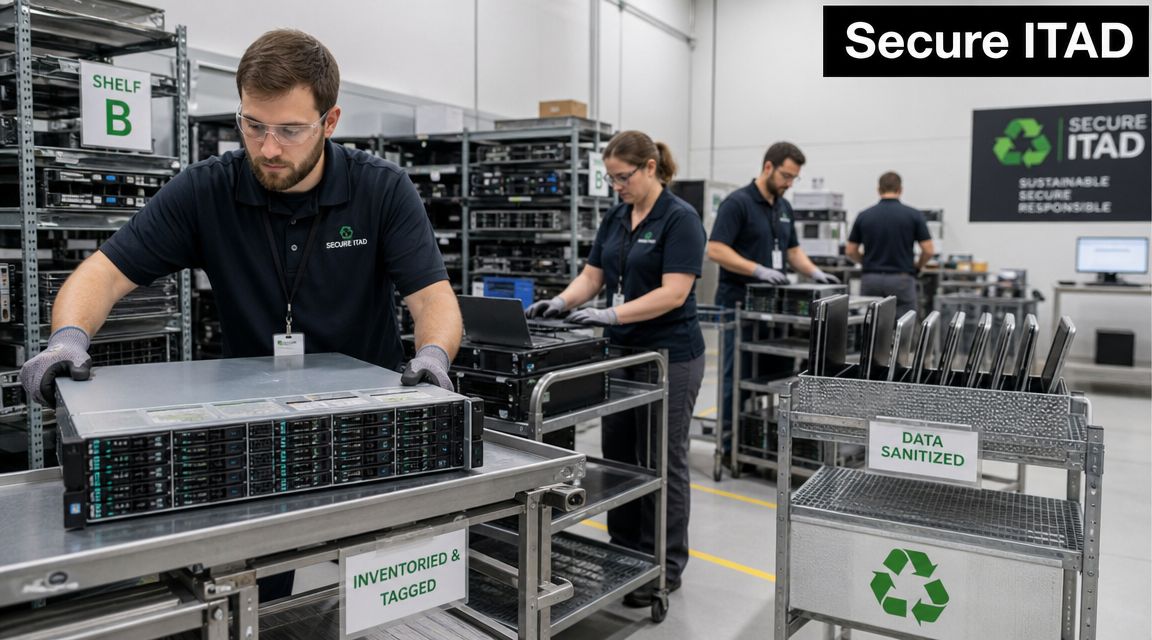
What responsible ITAD looks like in practice
The strongest programs don't separate data security from sustainability. They connect them.
A laptop that moves into donation-based recycling still needs documented intake, review, and status control. A server headed for shredding still needs a clear transfer trail before the destruction event. A mixed office cleanout still needs enough granularity to distinguish reusable devices, storage media, peripherals, and true scrap.
That is where chain of custody becomes more than legal-style paperwork. It becomes the operating system for responsible end-of-life management.
Why the social mission still depends on documentation
Organizations often like the idea of corporate donation programs and social enterprise recycling, but they hesitate for a sensible reason. They don't want equipment, data, and downstream outcomes to disappear into a black box.
Transparent custody records solve that trust gap. They show what arrived, how it was processed, what was destroyed, what was recycled, and what was suitable for reuse or donation. That transparency is what makes community impact claims believable instead of aspirational.
The same principle applies whether you're managing laptop disposal, secure data destruction, product destruction, or a multi-site facility cleanout. If you can't trace it, you can't stand behind it.
The practical standard to hold your program against
Ask three questions of your current process:
| Question | If the answer is no |
|---|---|
| Can we trace each sensitive asset from pickup to disposition? | Your documentation is too loose |
| Can we retrieve the supporting records quickly? | Your retention process is weak |
| Can we explain the chain clearly to an auditor or client? | Your workflow isn't mature enough |
Businesses don't need more vague assurances from recyclers or ITAD vendors. They need a documented system that can survive operational pressure, compliance review, and internal scrutiny.
If your current process depends on trust alone, it's time to rebuild it around evidence.
If you're reviewing your ITAD process, planning an office cleanout, or building a corporate donation program, Reworx Recycling is a practical place to start. You can use their resources to evaluate your current documentation standards, plan a pickup workflow, and structure an end-of-life program that supports secure data handling, sustainable recycling, and accountable community impact.