You've just learned a batch of laptops, servers, or medical devices in offices, schools, or customer sites must come back. Some units sit in storerooms, some are still in use, and nobody's list matches. The trucks are the easy part. Product recall reverse logistics services succeed or fail on records. You're done only when every serial number has a verified, documented disposition and your file proves no affected unit returned to commerce.
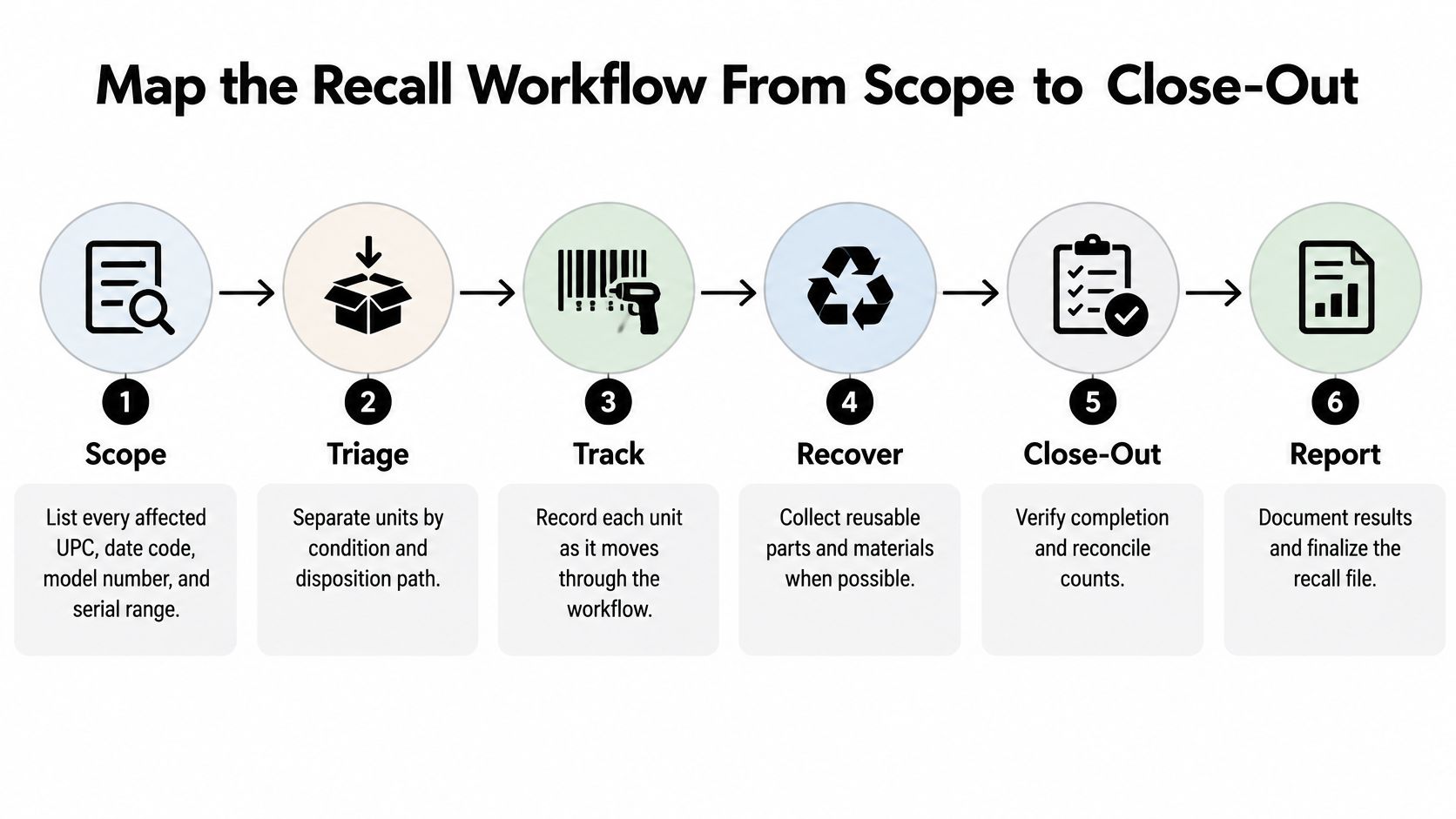
Map the Recall Workflow From Scope to Close-Out
A warehouse ships one affected model while another site has already stopped using it. That gap usually starts with conflicting scope records, not a transport delay. Freeze the affected identifiers first, then make every notice, hold and collection decision follow the same version.
Freeze Scope Before You Announce Anything
Record every affected UPC, date code, model number, and serial range in a signed scope memo. Warehouses, distributors, service partners and customer notices should all use that source. If the scope changes, issue a numbered revision and retain both versions so the file shows which units were included at each stage.
Then isolate stock at every location and tell each site to stop sale the same day. A back-room move is not quarantine. Use a segregated area, status labels, and a log that records location and timestamp.
Work to a Deadline You Can Prove
Under the CPSC Fast Track Recall Program, a company's Full Report and Corrective Action Plan must be ready for implementation within 20 working days. The plan includes a CPSC-approved remedy, a joint news release, a point-of-purchase poster, and a CPSC-approved reverse-logistics plan. Build routing, communications and inventory controls before the announcement; the deadline leaves little room to invent them afterward.
The CPSC FY2024 annual performance report reports that the agency negotiated and implemented 333 voluntary recalls during fiscal year 2024, covering 41 million consumer-product units. A controlled workflow makes each phase traceable, from the first scope decision to the documented disposition of every unit.
| Phase | Core action | Benchmark or reference | Evidence to keep |
|---|---|---|---|
| Scope | Identify affected UPCs, date codes, model numbers and serial ranges | Freeze before any notice goes out | Signed scope memo with identifiers |
| Quarantine | Isolate recalled stock and stop sale at every location | Same day as the notice | Quarantine log with locations and timestamps |
| Notification | Reach every consignee and end user by letter, phone or visit | Prompt effectiveness checks after the recall letter, as FDA guidance for medical device recalls recommends within about 5-7 days | Notice log by contact method and date |
| Collection | Schedule business pickups or run customer drop-off | Set by the remedy plan and the 20-working-day Fast Track deadline | Signed pickup manifests with unit counts |
| Remedy | Refund, repair, replace or dispose of each unit | Match the CPSC-approved remedy | Remedy record per serial number |
| Effectiveness check | Confirm receipt and corrective action at each consignee | Repeat until every consignee in scope is covered | Check results by consignee |
| Close-out | Reconcile every unit to a final disposition | Zero unresolved units or an approved residual-risk decision | Final reconciliation report by asset |
For electronics and IT equipment, use the same phases whether units go to inspection, repair, replacement, electronics recycling or secure product destruction. Pallet totals can help plan a pickup, but they cannot show which asset was received or what happened to it. Reconcile each serial number or asset tag to its final disposition.
At each phase, be able to name who acted, when they acted, and where the proof sits. If the record depends on someone's memory, the phase is not controlled.
Choosing a Recall Reverse Logistics Partner
A recall can meet its transport deadlines and still fail at close-out if the partner cannot show what happened to each unit. Choose a provider for its records as well as its pickup capacity. A file tied to serial numbers or asset tags makes it possible to answer later questions about an individual unit.
Ask for Proof in Writing
Score candidates against structured vendor selection criteria for recycling and ITAD partners and keep the results with the recall records. Use criteria that test whether the provider can document each handoff and final disposition.
| Criterion | What to verify | Red flag |
|---|---|---|
| Data destruction standard | Written method per NIST SP 800-88 (clear, purge or destroy) and a certificate for each serial number | A generic 'wiped' claim with no certificate |
| Chain-of-custody records | Timestamped handoffs, signed manifests and seal numbers | Verbal confirmation only |
| Serial-level reconciliation | Unit counts matched to serial or asset tags at pickup and at receipt | Lot-level counts with no serial list |
| Downstream transparency | Named recyclers, export status and destination for each lot | 'Recycled' with no destination named |
| Pickup coverage and surge capacity | Scheduled pickups inside your recall window and capacity for bulk loads | No written turnaround commitment |
| Audit-ready reporting | A redacted sample recall file with disposition by asset | Refusal to share a sample file |
Get written answers to the operational questions: Who signs at pickup? How are shortages reported, and how quickly? Which downstream recycler receives batteries, circuit boards, and shredded drives, and what certificate is returned by lot?
A provider who cannot show a redacted sample file before the recall may struggle to produce a complete one under deadline pressure.
Where a Full-Service Recycling Partner Fits
Reworx Recycling, based in Smyrna, Georgia, offers electronics recycling and IT asset disposition services, including business pickups, equipment decommissioning, asset management, secure hard drive shredding with data destruction, equipment buyback, and reverse-logistics guidance. These services can support electronics handling and end-of-life management connected to a recall.
Keep recalled units separate from unaffected stock. Recalled units follow the remedy plan; unaffected stock from the same fleet, once cleared and sanitized, can go through a donation channel. Maintain separate records so the disposition of unaffected equipment does not obscure the recall reconciliation.
Close the evaluation by asking each candidate for a redacted recall file from a past job showing disposition by asset. Compare the records, not the sales claims.
How to Pick Up and Transport Recalled Equipment
Pickup day is where clean scope turns messy. A site adds extra units to be helpful, packs affected and unaffected stock together, or hands over an unsigned count. Each shortcut becomes a reconciliation problem you'll own later.
The CPSC recall checklist for businesses requires businesses to identify affected UPCs, date codes, and model numbers, isolate recalled inventory, notify the distribution chain to stop sale and segregate products, and draft a reverse-logistics plan. Treat those controls as pickup prerequisites, not paperwork to finish afterward.
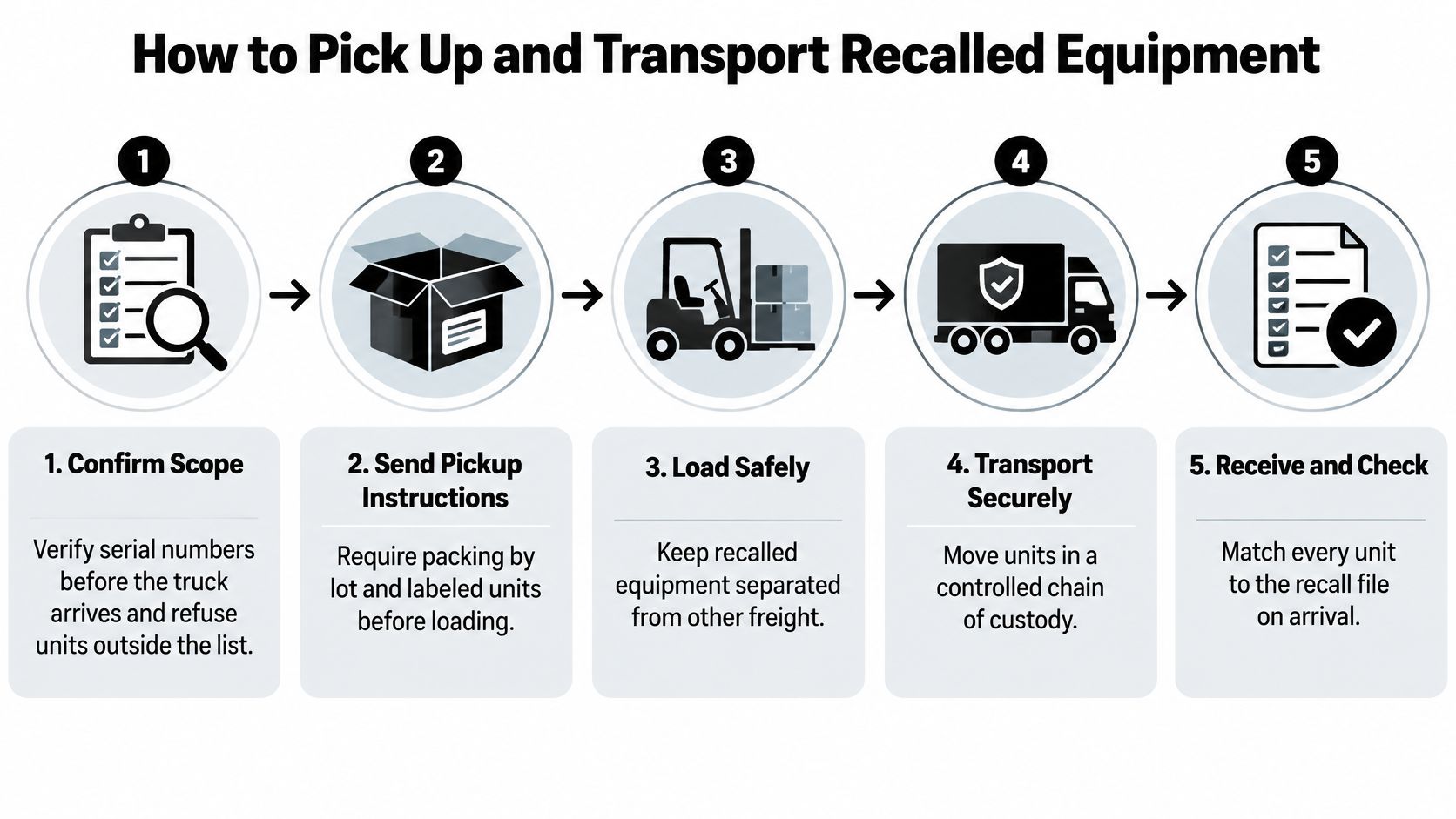
Run the Pickup in Eight Steps
- Confirm scope before the truck arrives. Check serial numbers against the frozen list and refuse units outside it, so unrelated IT equipment disposal doesn't contaminate the recall file.
- Send written pickup instructions. Require packing by lot and forbid mixing affected and unaffected stock, because mixed loads break reconciliation at receipt.
- Pack in tamper-evident containers. Label each container with lot, count, and date, and photograph seals where units carry data or high residual value.
- Count and scan at pickup. Both sides sign the manifest. An unsigned count is an argument you'll lose when a shortage appears.
- Transport in sealed, trackable vehicles. Log departure time, driver, vehicle, and seal numbers, and keep recalled freight separate from saleable stock, consistent with documented transportation compliance practices.
- Reconcile at the receiving site within 24 hours. Match every unit to the manifest, flag shortages the same day, and open an exception record while memories and camera footage are fresh.
- Store quarantined units in a locked, segregated area. Keep them apart from inventory awaiting resale, donation, or normal computer recycling.
- Escalate exceptions immediately. Nonresponsive accounts, missing units, swollen batteries, and damaged devices need named owners and, where required, hazardous-material handling.
Handle End-User Returns Separately
For employees, students, or customers returning units directly, give one clear message. State the drop-off location, hours, what to bring, a prepaid label where the remedy allows, and a one-line reason for the return. Point people who have unrelated electronics to donate toward donation-based recycling rather than the recall stream.
Don't confuse shipping proof with recall proof. Carrier delivery confirmation shows a box arrived somewhere. It doesn't show receipt by the right person, quarantine, inspection, or corrective action.
Practical rule: If the manifest, seal log, and receiving scan don't agree, stop and resolve it that day. Don't let processing outrun reconciliation.
That discipline protects laboratory equipment disposal, medical equipment disposal, and ordinary laptop disposal alike. The equipment differs, but chain of custody either connects pickup to final disposition or it doesn't.
Sorting, Inspection and Data Destruction Methods
Sorting decides what can be repaired, reused, recycled, or destroyed, so do it before anyone promises a disposition. Separate functional units, defective or safety-critical units, data-bearing devices such as laptops, servers, and phones, non-data-bearing components, and batteries. Record condition by serial number while the unit is in front of you.
Choose Sanitization by Sensitivity and Destination
Removing a device from service proves nothing about its data. The NIST Special Publication 800-88 Revision 2 FAQ defines media sanitization as rendering access to target data infeasible for a given level of effort and organizes sanitization around three methods, clear, purge, and destroy.
- Clear for low-sensitivity media staying inside your organization. It supports internal redeployment where the device doesn't cross a trust boundary and verification confirms the result.
- Purge for media leaving your control. Use it before resale, donation, or reuse outside the organization, where a stronger method and documented verification matter.
- Destroy for failed or unsanitizable media. Route unreadable drives, failed verification, and media that can't be reliably purged to physical secure data destruction.
Match the method to your approved data sanitization methods for retired media rather than habit or available equipment. A drive from an executive laptop, a student device, and a decommissioned server may need different treatment even in the same pickup.
Make the Certificate Worth Keeping
A certificate per serial number should show the method, tool, operator, date, and result. NIST guidance also ties credible programs to assigned responsibilities, personnel training, and controlled tool configuration, testing, calibration, and maintenance. Without those controls, a certificate is formatted trust.
Say a batch of recalled laptops arrives for inspection. Most drives purge and verify, so those units can move to certified repair or reuse if the recall remedy allows it. A few drives fail verification. Don't retest them until they pass or put them back in the batch. Segregate them, record the failure, and destroy them by serial number.
That split outcome is normal in IT asset disposition (ITAD), data center decommissioning, and laptop disposal. Your workflow should expect mixed results and preserve chain-of-custody evidence before any unit moves to reuse or electronics recycling. I would rather explain a small destruction list with clear failure records than defend a perfect pass rate nobody can reproduce.
Deciding Between Refurbishment, Recycling and Destruction
Recall disposition doesn't automatically mean destruction. Recalled electronics may return to use after correction, yield working parts, enter material recycling, or require permanent destruction. The defect, the data, and the proof you must keep should drive that choice.
Triage in Three Decisions
First decide whether the defect is repairable or must be permanently disabled. A safety-critical defect, counterfeit component, or altered unit rules out reuse regardless of resale value. Keep safety quarantine separate from final disposition so commercial pressure doesn't blur that call.
Second, classify data-bearing assets and complete the approved sanitization method before a unit leaves the controlled area. Third, compare certified reuse, parts recovery, material recycling, destruction, and export against safety, data protection, carbon and landfill impact, resale restrictions, chain-of-custody risk, and audit proof. These circular economy business models for recovered equipment help sustainability leaders explain different outcomes for similar looking devices.

Recent research on recovery choices for discarded electronics frames recovery as a choice between reuse and recycling and identifies processing cost as a central design variable in optimized electronic-waste reverse-logistics networks. Cheapest transport or disposal therefore may not produce the lowest total cost once sorting, rework, risk, and material recovery are counted.
| Disposition route | Choose it when | Main risk | Proof to keep |
|---|---|---|---|
| Certified reuse | The defect is fixed, the unit is retested and it passes safety checks | Altered or counterfeit components | Repair record and retest results |
| Parts recovery | The unit cannot be reused whole but has working components | Undocumented resale of components | Parts log by serial number |
| Material recycling | The unit has no safe reuse value and its data is sanitized or destroyed first | Hazardous fraction handled poorly | Downstream recycler certificate by lot |
| Destruction | The defect is safety-critical or the media cannot be sanitized | Loss of recoverable material value | Destruction certificate by serial number |
| Export for recovery | The destination country requires international movement | Shipment without prior written consent | Prior consent records and transit approvals |
Cross-border movement adds a hard gate. The Basel Convention e-waste amendments FAQ states that covered transboundary movements require written notification before shipment and prior written consent from the importing state and, when required, transit states. Confirm destinations before accepting or loading bulk recalled equipment.
Indiscriminate destruction isn't a safe default because it increases e-waste and eliminates recoverable materials. When executives ask why some units were reused and others destroyed, answer from the triage record for each serial number, not from a general sustainable recycling policy.
Proving Recall Completion With Records, Cost and Lessons
A single blended success rate can hide the failure that matters. Returns may look strong while one distributor never notified downstream accounts or a region still holds unverified product. Measure contact, action, units, and unresolved risk separately.
Use Metrics That Expose Gaps
The FDA introductory guidance on medical device recalls.pdf) recommends conducting effectiveness checks within approximately 5-7 days of issuing a recall letter and recommends multiple contact methods including letters, telephone calls, and personal visits. It also calls for response logging, a common product identifier, a consignee list, and a standardized questionnaire.
| Metric | Formula | Cut by |
|---|---|---|
| Notification coverage | Consignees reached divided by consignees in scope | Channel, region and customer tier |
| Action compliance | Consignees that quarantined, returned or corrected divided by consignees reached | Product identifier and distributor |
| Unit reconciliation | Units accounted for divided by units distributed | Lot, serial range and location |
| Unresolved-risk rate | Units or locations without verified disposition divided by units distributed | Geography and disposition route |
| Effectiveness check timing | Days from recall letter to first effectiveness check, against a 5-7 day target | Recall event and contact method |
Calculate each metric by channel, geography, customer tier, and product identifier. Aggregate percentages conceal distributor and regional failures, so review the worst cuts first.
Keep the Record an Auditor Can Follow
For each consignee, record identity, notification date and method, quantity shipped, quantity quarantined, quantity returned or corrected, downstream notifications, disposition, and unresolved exceptions. Link those entries through consistent chain-of-custody documentation so a reviewer can move from shipped quantity to final outcome without reconstructing emails.
Write escalation rules before you need them. Alternate contact methods for nonresponders, distributor-level tracing when onward shipment is detected, and documented disposition approval for damaged, incomplete, or counterfeit returns should trigger automatically.
Track cost with the same discipline. Record cost per unit collected, cost per serial number reconciled, and days from notice to containment, then compare each measure by channel, region, and disposition route. Cost per collected unit alone rewards fast pickup even when records remain incomplete.
Close with a post-recall review while the team remembers where tracking broke. Root-cause missed consignees, late reconciliations, and mixed loads, then update the scope template, pickup instructions, and partner criteria. Log the lessons where the next recall owner will find them, not in a meeting deck nobody owns.
Schedule a Recall Readiness Review With Reworx Recycling
You don't need a live recall to find weak records. Run three readiness checks this week and you'll know whether your next office cleanout, facility cleanout, or product destruction project could withstand recall-level scrutiny.
Test Your File Before Regulators or Customers Do
- Check the scope template. Confirm it can hold UPCs, date codes, model numbers, and serial ranges in one frozen list before any notice goes out.
- Rebuild your last disposal file. Pull a recent IT equipment disposal, laboratory equipment disposal, or medical equipment disposal record and try to compute notification coverage and unit reconciliation from your own documents. If you can't, the file isn't audit-ready.
- Score partners now. Apply the six partner criteria while you have time to request sample files, named downstream destinations, and written turnaround commitments.
Readiness isn't a binder on a shelf. It's whether a new team member can trace one serial number from notice to final disposition without asking who handled it.
A readiness review with Reworx Recycling, a Smyrna, Georgia electronics recycling and ITAD partner, maps your current procedures against the recall phases, sanitization methods, and completion metrics in practical terms. The review can cover free customer drop-off, business pickups, secure hard drive shredding, decommissioning, and asset-level documentation.
Choose the next step that fits your situation. Book a readiness review or pickup for affected equipment, donate unaffected and properly cleared equipment from the same fleet through a social enterprise recycling program, or partner for recurring e-waste and end-of-life support. Responsible electronics recycling keeps data safe, keeps usable hardware in community hands where it qualifies, and keeps hazardous material out of landfills.
If recalled laptops, servers, or other electronics need controlled pickup, secure data destruction, and asset-level disposition records, Reworx Recycling can help you plan the recall file before collection begins. You can also arrange donation-based recycling for unaffected equipment that has been cleared for community reuse. Visit Reworx Recycling to schedule a readiness review or business pickup.