Your maintenance team has pulled recalled drills from service, the warehouse needs its floor space back, and an electronics pickup is already on the calendar. It's tempting to add the tools to that load and close the work order. Don't book their disposal route yet. First, check the manufacturer's recall instructions and determine whether each battery is stable, damaged, or still subject to a return program.
For facilities and IT managers in Smyrna, Georgia, that decision belongs alongside the asset inventory, not at the loading dock. Recalled power tool disposal services need to distinguish manufacturer returns, battery recycling, electronics processing, and equipment that's eligible for donation.
Why Recalled Power Tools Need Their Own Disposal Route
Say a school district maintenance shed has forty recalled cordless drills and impact drivers sitting in a mixed bin, waiting for a general e-waste pickup. Someone has already counted them as retired assets. But nobody has checked whether the recall covers the tool, the battery, or the charger.
Recycling isn't automatically the safest first action. A recall changes the handling decision, and a lithium-ion pack can make an otherwise routine equipment cleanout a battery-safety project.
The EPA's used lithium-ion battery guidance says these batteries and products containing them shouldn't enter household garbage or municipal recycling bins because they can cause fires during transportation, at landfills, and at recycling facilities. It specifically identifies power tools as products whose removable batteries can go to dedicated battery-recycling or household-hazardous-waste collection points, while explaining that municipal recovery facilities process paper, plastic, metal, and glass, not lithium-ion packs.
Practical rule: Remove the tool from service before deciding whether it belongs in a return shipment, a battery collection, or an electronics load.
A controlled route accounts for battery chemistry, condition, packaging, transportation, and the receiving facility's acceptance criteria. A generic scrap-metal bin doesn't provide those controls. Neither does an electronics pallet assembled without battery screening.
The environmental and legal impacts of improper commercial e-waste disposal extend beyond the organization that discards the equipment. Collection workers, transport crews, downstream processors, and neighboring communities also face the consequences of a poor handoff.
Keep the practical deliverables clear: a unit-level routing decision, a handling procedure, a complete record, and a qualified provider. Equipment confirmed unaffected by the recall may still support corporate donation programs, but a donation goal never overrides recall restrictions.
Choosing the Disposal Route for Each Recalled Unit
Check the recall before matching equipment to a disposal channel. Read the notice against the manufacturer, model, serial range, battery identification, and kit configuration. An intact-looking battery can still be recalled, so appearance alone doesn't clear it for ordinary collection.
The EPA's lithium-ion battery recycling frequently asked questions advise separate storage and protective handling for damaged, defective, or recalled batteries. That makes manufacturer instructions and battery condition the starting points, not the pickup date.
Disposal channel by recalled tool condition
Match each unit to a row before handling it. Where a manufacturer return program applies, its instructions take priority over a routine recycling booking.
| Tool or battery condition | Battery state | Disposal channel | Packaging and handling |
|---|---|---|---|
| Cordless tool with removable battery | Intact and stable | Specialized battery recycling or household-hazardous-waste collection that accepts business material | Each pack in its own plastic bag or terminals covered with electrical tape |
| Cordless tool with embedded battery | Intact and stable | Certified electronics recycler that accepts embedded batteries | Keep battery in the tool and protect the switch from contact |
| Battery pack | Swollen, hot, leaking or crushed | Emergency isolation, then recycler or manufacturer instructions | Trained personnel use a suitable fire-resistant container with noncombustible material when safe |
| Corded tool with no battery | Not applicable | Electronics recycling or reuse channel after recall clearance | Keep separate from any battery-containing equipment |
| Tool sold with charger and battery | Intact and stable | Battery to battery channel, tool and charger to electronics channel | Split the kit only when permitted and safe, then label each container |
| Any recalled unit under an open manufacturer return program | Assess under recall instructions | Manufacturer-directed quarantine before any recycler accepts it | Hold in a segregated, labeled area and record model and serial number |
A household collection site isn't automatically available to a business or school district. Confirm commercial eligibility, accepted chemistry, and recalled-battery acceptance before sending material there. Likewise, a specialized battery processor may accept loose packs but not complete drills, saws, or chargers.
Choose the remedy before the truck
A manufacturer may require a return, replacement, authorized repair, or a specific disposal procedure. Keep that remedy intact until the manufacturer confirms what may leave your site and how. An expired or inapplicable return program isn't permission to improvise a shipment.
For a repairable corded tool, it can be useful to find a reputable tool repair shop through Value Tools Co.’s repair guidance. Check the recall remedy first, however, because an independent repair doesn't replace manufacturer authorization or establish recall clearance.
For a stable removable pack, discuss lithium battery recycling with the receiving provider using the actual model and condition information. Don't describe the load merely as miscellaneous electronics. For an embedded battery, get acceptance for the complete tool rather than asking staff to open its housing.
A recycling appointment is not authorization to move a recalled battery.
Match the proof to the destination
A manufacturer return should produce a return authorization and delivery record. A battery transfer needs a receipt identifying the receiving channel. Electronics processing should produce final disposition documentation, while data-bearing equipment needs separate evidence of the agreed data-destruction method.
Record the selected route beside each serial number. If the tool and battery follow different paths, retain their relationship in the inventory so the file explains what happened to the original kit.
Donation is a clearance decision, not a disposal shortcut. Donation-based recycling and social enterprise recycling can support usable equipment, but recalled tools must not enter reuse inventory by default. Require documented confirmation that a unit is unaffected or has completed an authorized remedy before considering reuse.
Leave estimated disposal cost marked unknown pending written quotation until the provider has assessed the load, location, and battery condition. A low routine-pickup quote is meaningless if recalled packs are excluded from the service.
How to Process a Recalled Tool Batch Step by Step
Assign a facilities coordinator to control the physical batch and an asset owner to reconcile the inventory. At a Smyrna office-and-warehouse operation, that might mean facilities manages tools while IT manages computers in the same facility cleanout. They can share project planning without sharing unreviewed containers.
The OSHA bulletin on lithium battery safety recommends removing damaged, defective, or swollen batteries from service, isolating them in a fire-resistant container with suitable noncombustible material, and following applicable disposal rules. An actively heating, smoking, or venting battery is an emergency, not a packing task: keep people away and activate the site emergency response procedure.
Control the batch before preparing containers
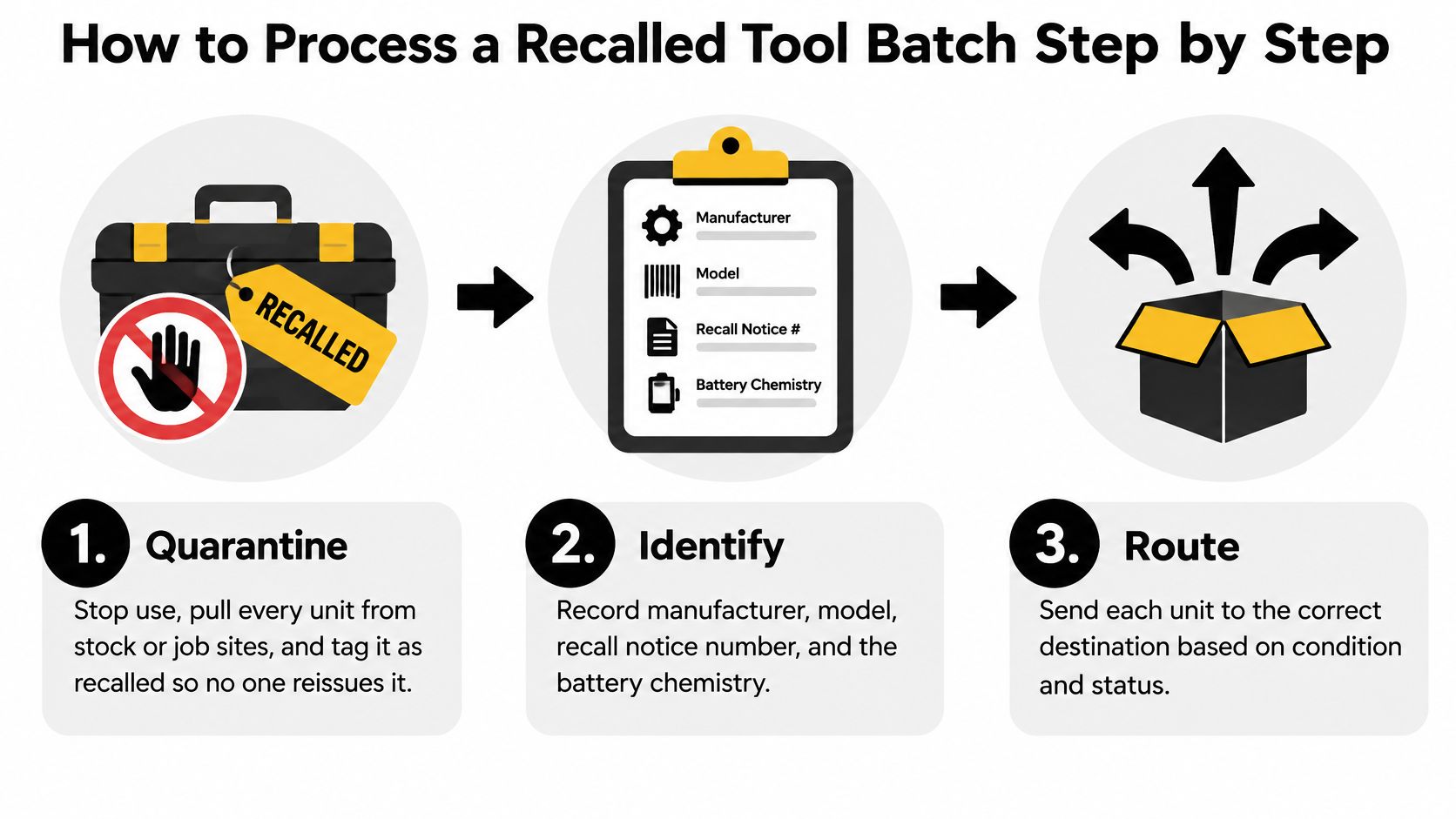
Quarantine and check the return program. Stop use, withdraw affected tools from stock and job sites, and tag them against reissue while checking whether the manufacturer's return program remains open. Apply the approved route before anything leaves quarantine, rather than letting someone retrieve a seemingly working drill for a quick repair job.
Identify the exact equipment. Record manufacturer, model, recall notice number, and the battery chemistry printed on the label, using readable label photographs where useful. Don't assume every pack carrying the same brand has the same chemistry or recall status, because that shortcut can send an affected unit down the wrong route.
Build the inventory before disturbing the batch. Log quantities, serial numbers, and observed condition, and photograph damaged equipment from a safe position before movement. Don't handle a suspect pack just to improve a photograph; an incomplete image is preferable to unnecessary exposure.
Separate only what's safe and authorized. Remove a removable battery only when the tool's condition and recall directions permit it, keeping tool and pack identifiers connected in the log. Don't open housings, puncture cells, deliberately discharge packs, or attempt field disassembly without an authorized controlled procedure and appropriately qualified personnel.
Prepare the accepted material for handoff
Triage without testing the defect. Check for swelling, punctures, crushing, leakage, unusual heat, or smoke, and escalate suspect units under the site safety plan. Don't charge a pack or run the tool to see whether it still works, since a functional check isn't a safety clearance.
Protect intact battery terminals. Cover exposed terminals with nonconductive electrical tape or place each intact pack in its own plastic bag, taking care not to obscure identification needed for acceptance. Don't put loose packs together in a bag or bucket, where exposed contacts can reach other batteries or metal.
Use approved containment and labeling. Put prepared packs in the containers specified by the receiving facility and carrier, with appropriate battery hazard information and separation from scrap metal and general electronics. Don't improvise an airtight container for a suspect battery, load packs into the nearest mixed gaylord, or store the batch at a sun-heated loading dock.
Confirm acceptance and transportation in writing. Obtain the receiving facility's acceptance and the carrier's packaging and transport requirements before the truck arrives, including applicable state requirements and any special arrangements for recalled batteries. Don't accept a verbal promise that the driver will sort it out; reconcile the shipment at handoff and retain the transfer receipt.
For intact packs, the EPA's battery-handling precautions explain why individual bagging or terminal protection matters: it prevents contact with other batteries or metal objects that could create a short circuit. Those precautions don't turn damaged packs into ordinary shipment material.
A clean handoff has no unidentified loose batteries, no unexplained inventory differences, and no unlabeled containers. The coordinator should know which facility receives each container, which carrier moves it, and which document closes the transaction.
Documents That Prove Recall Compliance
Chain of custody connects the removed asset to its final outcome. A recycling certificate alone can't establish that the original batch was handled correctly if it doesn't reconcile with the tools pulled from service.
For businesses, schools, and public agencies, the EPA's lithium-ion battery recycling guidance also makes waste classification important: most discarded lithium-ion batteries are likely to exhibit ignitability and reactivity characteristics associated with D001 and D003 hazardous-waste codes. Have the organization's environmental lead confirm applicable generator, storage, transportation, and manifest requirements before shipment rather than treating a vendor receipt as a substitute.
Records to keep for each recalled-tool batch
| Document | Key fields to record | Why it matters |
|---|---|---|
| Recalled-asset inventory log | Manufacturer, model, serial number, quantity, condition, recall status | Shows every unit was accounted for |
| Damage and condition photos | Date, unit ID, visible swelling or damage | Supports triage and escalation decisions |
| Battery transfer manifest or receipt | Battery count, receiving facility, date, transporter | Proves handoff to a qualified channel |
| Certificate of recycling | Units processed, method, facility, date | Final proof of disposition |
| Certificate of destruction | Device serials, destruction method, verification of data removal | Required by the agreed process when data-bearing devices are in the batch |
| Manufacturer recall correspondence | Notice number, return or quarantine instructions | Shows manufacturer directions were followed |
Keep the inventory as the master record. Attach photographs to asset identifiers, not to an unstructured folder named damaged equipment. A clear image showing the unit label and observed defect helps explain why staff escalated that item rather than placing it with stable packs.
The transfer receipt establishes the change in possession, but it doesn't necessarily prove final processing. Require the final recycling record to reconcile with the accepted quantity and explain rejected, returned, or separately processed material.
Separate asset disposition from data security
Most conventional drills don't require secure data destruction. However, a combined IT equipment disposal project may include laptops, connected devices, or storage media that do. Keep the data-bearing inventory explicit and require device-level evidence of the agreed sanitization or destruction process.
A certificate's title isn't enough. Product destruction, materials recycling, and data destruction describe different outcomes, so the documentation should say what the processor performed.
Use a consistent chain-of-custody documentation process across the project, while keeping battery acceptance records distinct from computer recycling and laptop disposal records. Retain manufacturer emails and return instructions alongside the notice number so the file explains why each route was selected.
Set a retention schedule using organizational policy and applicable local requirements. Name an owner who can retrieve the complete file after the pickup coordinator changes roles.
Copy this checklist into the work order and complete an owner and date for each line:
- Inventory reconciled: Owner ___; date ___.
- Condition photographs attached: Owner ___; date ___.
- Manufacturer directions retained: Owner ___; date ___.
- Acceptance and transport records filed: Owner ___; date ___.
- Transfer receipt reconciled: Owner ___; date ___.
- Final recycling and applicable destruction certificates received: Owner ___; date ___.
Questions to Ask a Disposal Provider Before Signing
A provider's willingness to collect electronics doesn't establish its ability to handle recalled batteries. Evaluate the actual receiving facility, transportation arrangement, and exception procedure, not just the sales proposal.
For Georgia businesses coordinating an office cleanout or equipment retirement, the right contract separates ordinary electronics from material requiring special approval. Use written vendor selection criteria so procurement, facilities, IT, and environmental staff evaluate the same scope.
Battery handling and receiving facilities
- Accepted conditions: Do you accept battery-containing equipment, loose intact packs, recalled packs, damaged packs, or only selected categories? Ask the provider to identify exclusions against your inventory.
- Receiving destination: Which facility will receive the material, and what approvals or licenses apply to its role? Request evidence relevant to that facility rather than relying on a company-wide statement.
- Transportation: Who packages and transports the batteries, and what requirements must your employees meet before collection? Confirm who handles a unit that changes condition before loading.
- Incident responsibility: What happens if a battery heats, leaks, or is rejected during pickup? Require a stop-work and escalation procedure, not an assumption that the driver will take everything.
A certified electronics recycler can be appropriate for accepted embedded-battery equipment, but certification doesn't eliminate the need for batch-specific approval. A routine pickup team may have a narrower scope than the provider's specialist subcontractor.
Documentation and recall screening
- Traceability: Will receipts identify the batch, quantities, destination, and transporter, and will final records reconcile rejected material?
- Final evidence: Do you provide a certificate of recycling and separate destruction documentation for data-bearing devices when included in scope?
- Recall checks: Who compares model and serial information with the recall notice, and who stops processing if a match is discovered?
- Subcontractors: Will material move to another processor, and how will your organization receive evidence of that downstream handoff?
Ask who can refuse the load, and what happens next. That answer often reveals more than a broad promise to recycle everything.
Pricing and contract protections
- Quote basis: Is pricing per unit, by weight, or per service visit? Identify minimum loads, packaging charges, special handling, failed collection fees, and any return freight before approval.
- Change controls: What written authorization is required for additional charges, and how are price increases capped?
- Insurance and liability: Who bears responsibility for a battery fire in transit or at the receiving facility, and what insurance supports that obligation?
- Termination: Can you suspend collection or end the agreement if required licenses, insurance, or downstream arrangements lapse?
The Smyrna-based social enterprise's broader services include free customer drop-off, business pickups, equipment decommissioning, secure hard drive shredding, and equipment buyback options. Those services provide a useful comparison scope, but free drop-off is not blanket acceptance of recalled batteries.
Community commitments matter after safety and acceptance are settled. Ask how donation-based recycling supports technology access and workforce development, and how the provider prevents recalled equipment from entering donation inventory. A social mission should strengthen operational controls, not replace them.
Schedule a Compliant Recalled Tool Pickup
Before requesting a collection date, confirm the recall and quarantine status, assign each unit to an approved destination, and prepare the shipment records. Final processing certificates come after treatment, but the inventory, acceptance confirmation, and transport arrangements belong in the file before collection.
Your practical action this week is straightforward: designate a labeled holding area, account for the affected tools, photograph their condition where safe, and check whether the manufacturer's return program remains open. If a unit shows signs of active failure, stop the cleanout activity around it and use the emergency response procedure instead.

Give the coordinator an actionable request
Send the provider a concise batch description rather than requesting a generic junk pickup. Include the recall notice, inventory, battery condition, removable or embedded configuration, site access details, and the manufacturer's directions.
- Cleared equipment for donation: Identify unaffected, usable hardware separately so corporate donation programs can assess it without mixing it with recalled assets.
- Material ready for collection: Use the electronics recycling pickup request to begin coordination, with battery acceptance confirmed before scheduling.
- Devices containing data: Request data destruction scope and documentation alongside the asset list rather than assuming materials recycling covers information security.
- Recurring projects: Discuss a standing process for office cleanouts, year-end IT asset disposition (ITAD), and larger equipment retirement projects.
The same planning discipline helps organizations coordinating data center decommissioning, medical equipment disposal, or laboratory equipment disposal. Each stream needs its own acceptance assessment, even when a common project manager coordinates the work.
Responsible sustainable recycling protects workers and keeps unsafe equipment out of reuse channels. Separately cleared technology can support digital inclusion and local workforce development, giving organizations a community outcome without compromising recall controls.
Reworx Recycling offers donation-based electronics recycling, business pickups, and secure data destruction, with recalled-tool battery handling subject to specific acceptance review. Visit Reworx Recycling to plan your next step: donate cleared equipment, request a pickup assessment, or discuss a recurring recycling partnership that supports responsible disposal and community technology access.