Launching an effective e-waste awareness or recycling program usually starts with a messy reality. Your IT team has surplus laptops stacked in storage, facilities wants a cleanout plan, procurement needs vendor language that won't create risk, and sustainability leaders still need a simple way to explain why the effort matters. The strongest educational resources do more than define terms, they help you make decisions that hold up under audit, protect data, and support reuse where it makes sense.
For teams building an ITAD policy, a school recycling campaign, or a corporate collection event, the fastest path forward is to use sources that are practical, current, and specific. That means pairing federal guidance with certification standards, state law summaries, and technical media-sanitization rules, then filling the operational gaps with training and partner support. If you also need a quick background screening partner for volunteers or program staff, a nonprofit background check company can help you tighten the people side of the process too.
1. Services – It Asset Disposition
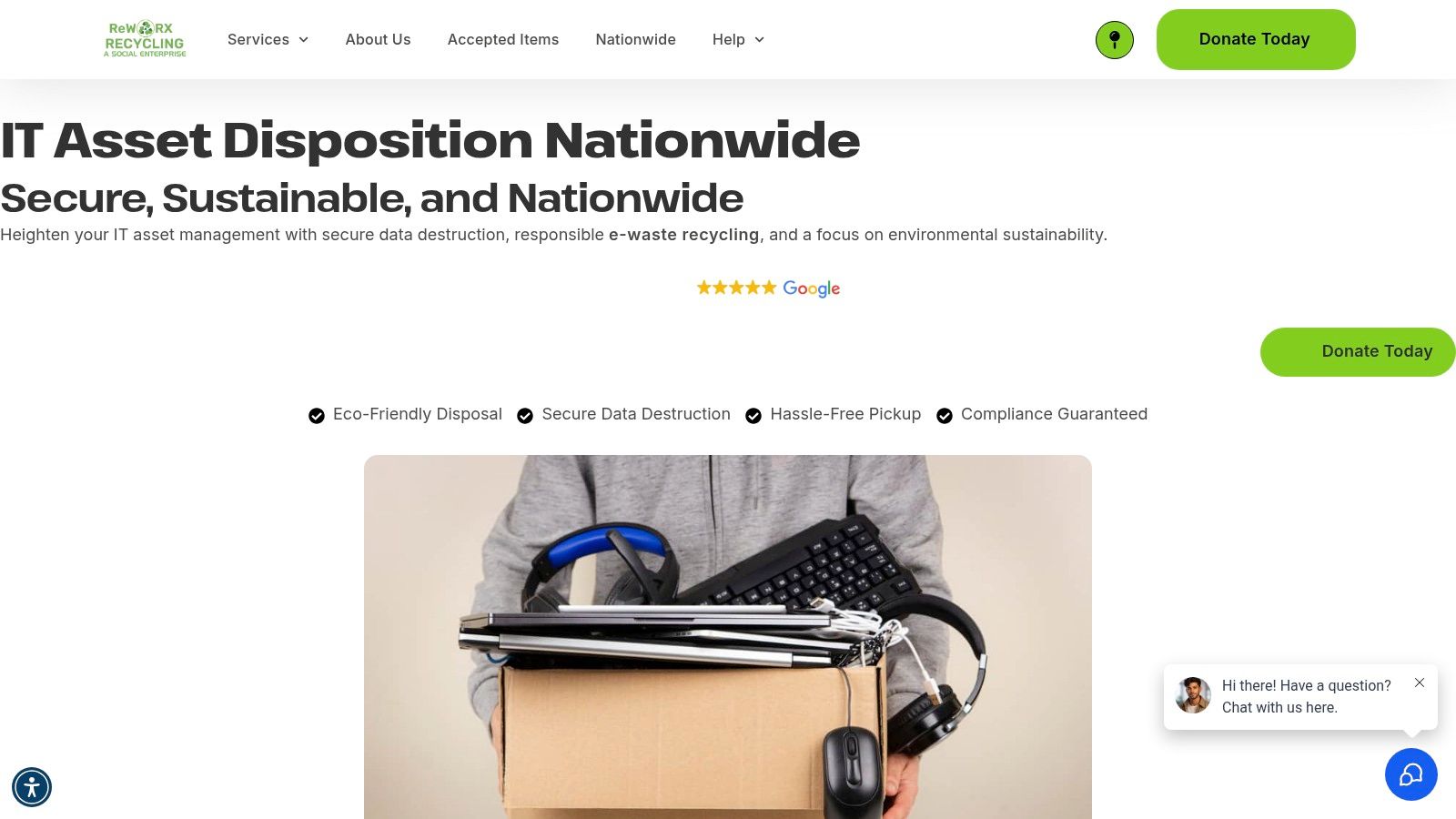
Reworx Recycling's IT Asset Disposition service is the most useful starting point if your program needs one partner to handle the full retire-and-recover workflow. Based in Smyrna, Georgia, Reworx combines secure data destruction, hard-drive shredding, equipment decommissioning, IT asset management, reverse logistics, recycling consultations, and buyback options in one service path. For businesses, that matters because the program stops being a string of handoffs and becomes a managed process with fewer chances for mistakes.
Why this resource works in practice
Reworx is especially relevant when you need to move from policy to execution. The service model supports free customer drop-off and business pickups, which helps smaller offices and larger organizations use the same vendor without redesigning their disposal workflow. That flexibility is valuable for office cleanout, facility cleanout, laptop disposal, and year-end IT refreshes.
Practical rule: If your program touches sensitive data, choose a disposition partner before you choose a pickup date. Data handling drives the process, not the other way around.
The trade-off is that the public page doesn't spell out every operational detail. You'll still need to confirm pricing, turnaround expectations, and any formal certifications directly with the team. Buyback also depends on device condition and market demand, so it's smart to treat recovery value as a bonus rather than the foundation of your business case.
For sustainability leaders, the appeal is straightforward. Reworx is a social enterprise recycling partner, so the program is built around diversion from landfills and community impact, not just asset removal. That gives corporate donation programs a cleaner story for internal stakeholders who want both compliance and visible reuse outcomes.
2. U.S. EPA Electronics Donation and Recycling
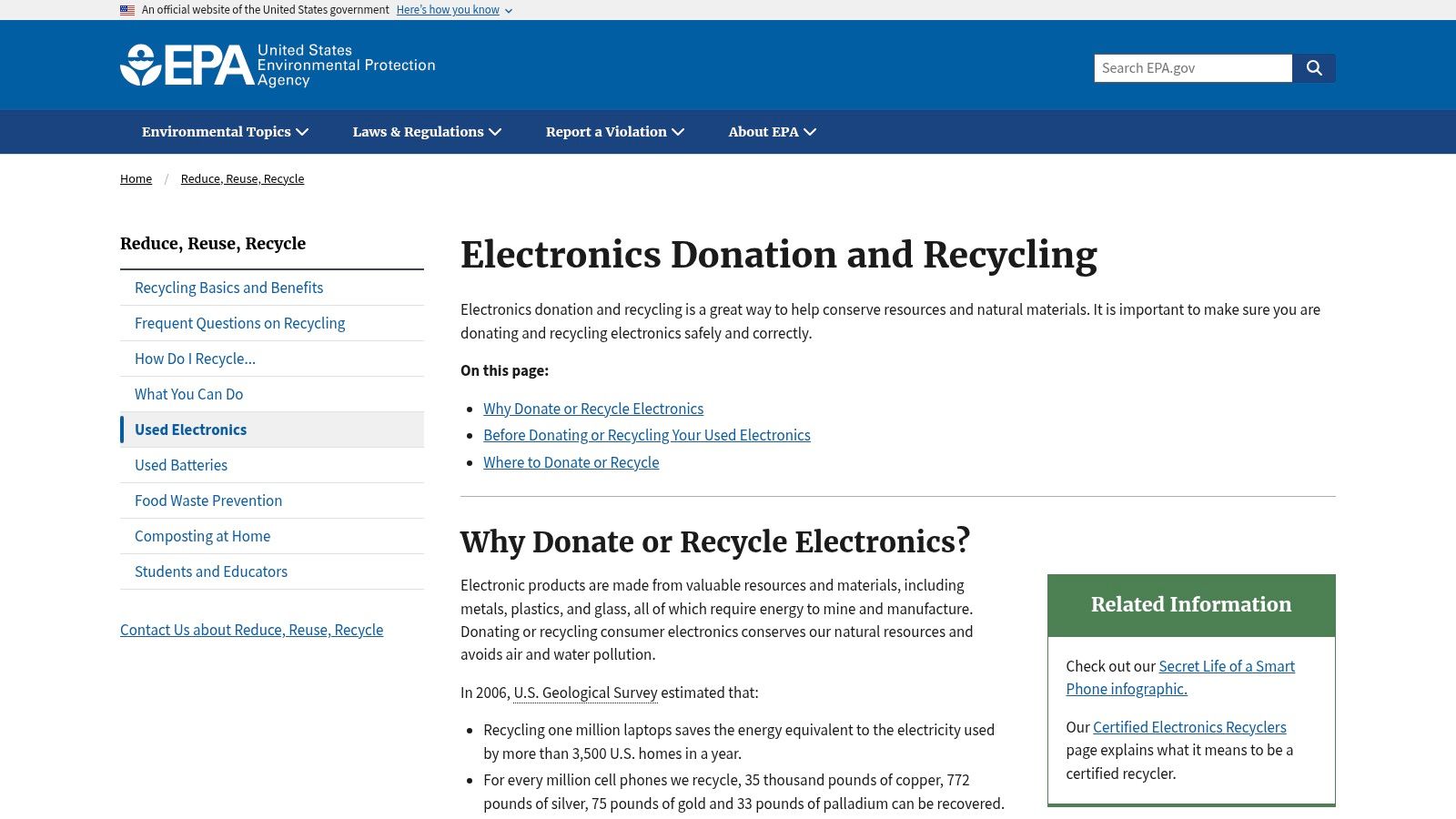
The EPA's Electronics Donation and Recycling guidance is one of the cleanest public-facing introductions for staff who are new to the process. It reads in plain English, which makes it useful for onboarding office managers, school administrators, and anyone who needs to understand what to do before donating or recycling devices. The page also points users toward state programs and retailer or manufacturer take-back options, so it works well as a policy handout or intranet link.
Best use case for internal education
This is the resource to assign when your team needs a basic before you donate or recycle checklist without a lot of technical jargon. It covers the kind of common-sense preparation that often gets missed, including battery separation and the basics of protecting data before devices leave the building. For organizations that are trying to build a repeatable process, that kind of simple framing reduces confusion fast.
The strength of the EPA page is neutrality. It doesn't push a vendor, so it's easier to use in procurement training, board materials, and staff reminders. The limitation is that it stays broad, so it won't give you a deep operating standard for media sanitization, downstream due diligence, or contract language.
For practical program rollout, I'd pair this page with Reworx's laptop donation guidance. That combination helps a team explain the public-facing “why” while also showing exactly how a device should move from office use to a donation or recycling stream.
3. U.S. EPA Certified Electronics Recyclers
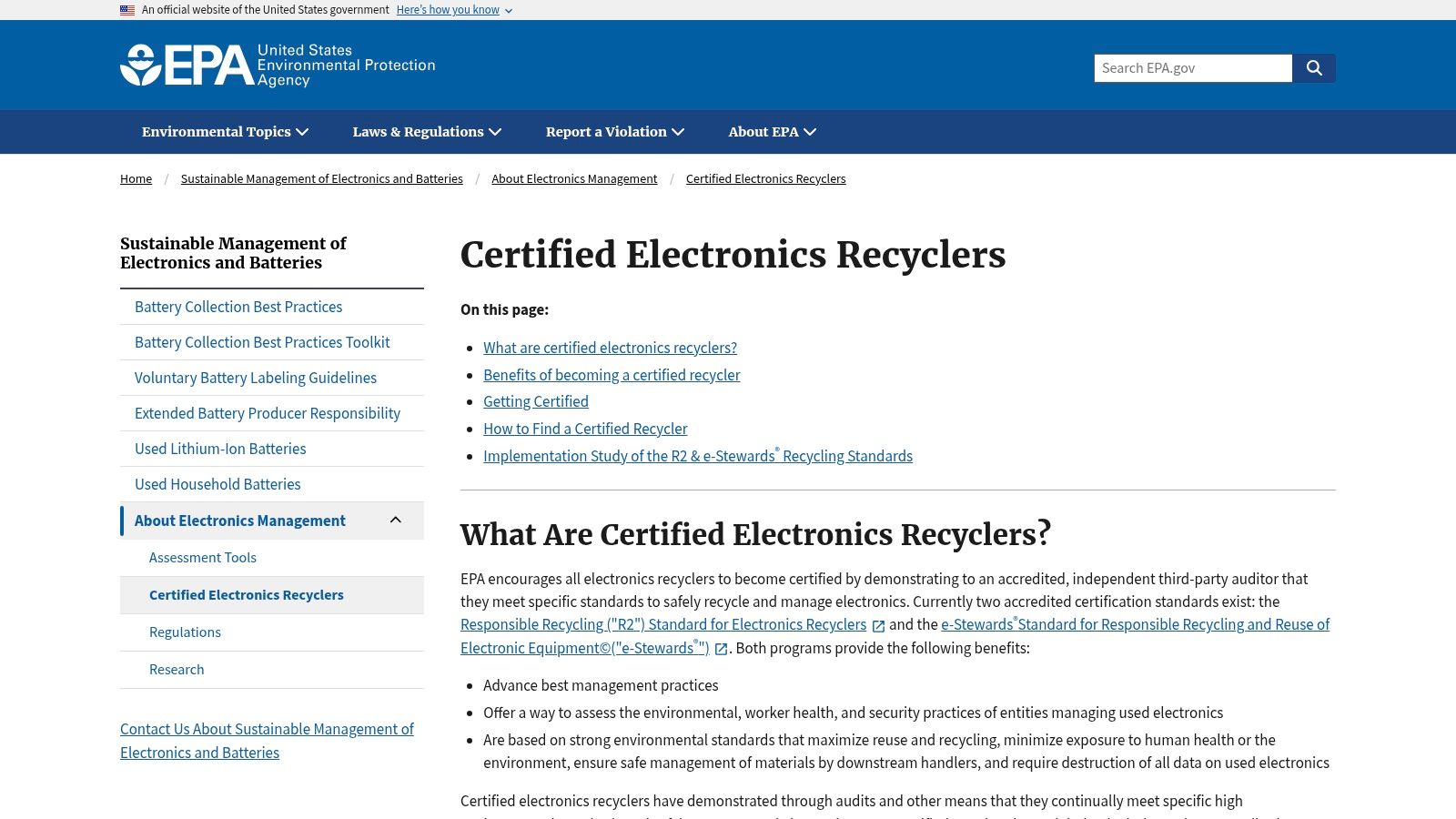
The EPA's Certified Electronics Recyclers overview is the clearest federal resource for vendor selection language. It explains the value of certification, points users toward R2 and e-Stewards, and helps procurement teams justify why a contract should require a certified downstream partner. If you're writing policy, this is one of the easiest resources to cite internally because it frames certification as a guardrail for both worker safety and data security.
Where it helps and where it stops
The page is useful for building IT asset disposition criteria, especially if your organization wants to make certification mandatory in an RFP. It also includes pointers on how to find certified recyclers, which is helpful when a facilities team needs a fast shortlist for an upcoming cleanout. That's the practical win, a common framework that keeps the conversation focused on risk rather than price alone.
The limitation is structural. The EPA does not maintain a single central searchable list, so you still have to go to the certification programs themselves for the deepest verification. That's not a flaw, it's just a reminder that vendor diligence still belongs to your team.
For organizations that need a public-facing explanation of why certified vendors matter, Reworx's certification overview can help frame the conversation in business terms. Use the EPA page to set the standard, then use your partner conversation to confirm how the standard shows up in actual pickup, storage, and downstream handling.
4. SERI R2v3 Knowledge Base
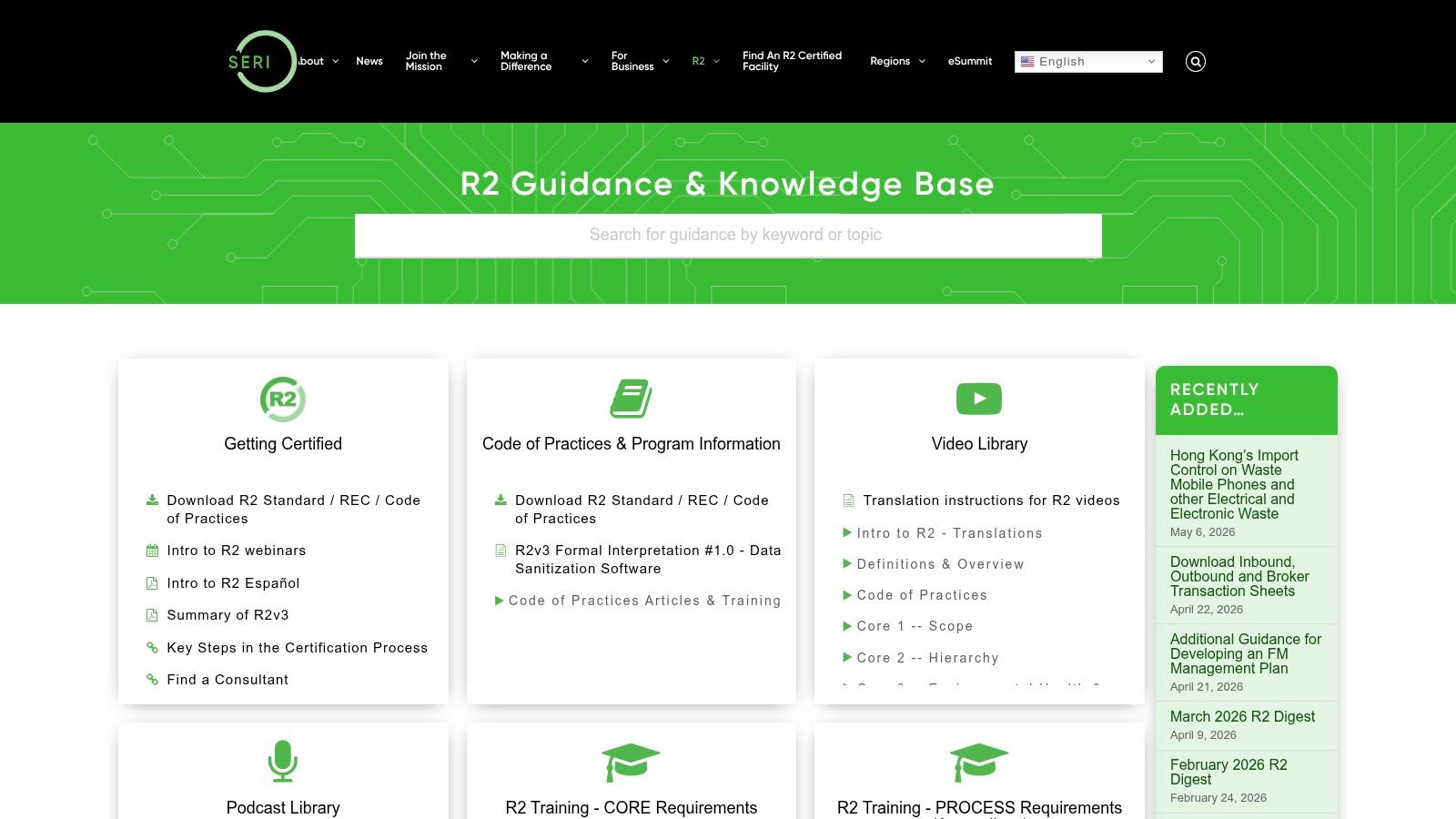
Sustainable Electronics Recycling International's R2v3 Knowledge Base is the primary source for teams that need to understand how the R2 standard works in practice. It includes formal interpretations, data sanitization guidance, and implementation detail on equipment categorization and code of practices. If your program touches enterprise ITAD, this is the resource that moves you from “we know the standard exists” to “we know how to apply it.”
Use it for policy detail, not just certification buzzwords
The value here is specificity. R2v3 guidance gets into data sanitization requirements and acceptable methods, which is exactly where many internal programs get fuzzy. If your IT team is drafting SOPs, this source helps avoid a vague checklist and replaces it with a standard that can be audited.
This is also the right place to verify downstream due diligence expectations. That matters because a vendor can sound sustainable on paper while still leaving the organization exposed if reuse, recycling, or export controls aren't managed correctly.
Organizations often start with broad sustainability goals, then discover the real work sits in the sanitization record, the chain of custody, and the downstream review.
The trade-off is complexity. SERI's materials are technical, and some content requires accepting license terms. That makes it better for compliance owners, ITAD managers, and procurement leads than for a general employee audience. For the frontline training layer, pair it with simpler materials and one trusted implementation partner.
5. e-Stewards Standard and Resource Library
The e-Stewards Standard and resource library is the strongest fit for organizations that want especially strict controls on export and downstream handling. It emphasizes worker health and safety, data security, and restrictions aligned with the Basel Convention, including a clear stance against hazardous e-waste exports to developing countries. That makes it valuable for ESG teams that want their claims to rest on a rigorous, visible framework.
Best for teams that want a tighter boundary
e-Stewards tends to work best when an organization wants to go beyond minimum compliance and reduce reputational risk. Its guidance also supports integration with ISO 14001, RIOS, and NAID AAA, which makes it easier to align environmental management with secure disposition practices. That combination is especially useful for enterprises that report on sustainability and information governance in the same program review.
The trade-off is availability. Some U.S. regions have fewer certified sites than R2, so you may not get the same vendor density. The standard language is also formal and technical, so it's not the easiest read for operational staff who just want a quick how-to guide.
That doesn't make it less useful. It just means the resource is best used by compliance leaders, procurement teams, and sustainability directors who need a principled standard to anchor policy language. For a broader operations rollout, you'll usually want to supplement it with a partner that can explain how those rules show up in collections, transport, and downstream controls.
6. i-SIGMA NAID AAA and Data Destruction Best Practices
The NAID AAA certification page from i-SIGMA is essential if your program includes physical records, electronic media, or highly sensitive devices. It focuses on secure destruction, audit protocols, and vendor accountability, which is exactly where many IT and compliance teams need more structure. The certification's scheduled and unannounced audit model is especially relevant when leaders want proof that a provider's process is real, not just documented.
Where it fits in a secure workflow
This resource is strongest when the issue is not general recycling but secure data destruction. It offers a practical foundation for procurement clauses, especially when legal, records management, and IT all need the same vendor language. The site also points users to research, white papers, and a professional textbook on information disposition, which gives serious teams more than a single certification summary.
Practical rule: If a vendor can't describe its destruction process in terms your legal team and your IT manager both understand, keep looking.
The downside is that some materials are member-based and the certification content can feel dense. That's normal for a security-centered resource. For organizations that need to explain the program to non-technical stakeholders, this source works best when paired with a trusted service provider that can translate the requirements into everyday operating steps.
Reworx Recycling's NAID AAA page is a useful companion if you want to see how a service partner presents those expectations in a business-friendly format. Together, the two resources help you move from certification language to actual controls.
7. NIST Special Publication 800-88 Rev. 1
The NIST SP 800-88 Rev. 1 guidelines for media sanitization are the technical backbone for any serious data-destruction policy. NIST lays out Clear, Purge, and Destroy methods by media type, and it adds verification and documentation expectations that make the guidance useful in real audits. If your team needs one U.S. government source to anchor SOPs, this is usually the one.
The standard that keeps policies from drifting
NIST matters because it turns data destruction into a decision process. You don't just say “wipe the drive,” you choose a sanitization path based on the media, the risk, and the downstream use case. That's especially important for mixed inventories, where a program might include SSDs, HDDs, and devices with different handling requirements.
The document is technical, so it's not the best onboarding handout for frontline staff. It's the right reference for ITAD managers, security teams, and anyone writing disposal SOPs or contract specifications. It also gives your organization a defensible basis for asking a vendor how verification is recorded and how exceptions are handled.
For a more operational explanation, Reworx's data sanitization methods page can help bridge the gap between government guidance and day-to-day implementation. That pairing is useful when you need the rigor of a federal standard and the simplicity of a provider who can execute it.
8. National Conference of State Legislatures E-Waste Laws Overview
The NCSL e-waste laws overview is the quickest way to get your bearings across state-level electronics recycling laws. It summarizes program types, statute references, landfill-bans context, and links to state program pages. For multi-state operators, that makes it an efficient front door before you dig into each state's actual requirements.
A good map, not the final word
This resource is especially helpful for legal and compliance teams that need to compare jurisdictions quickly. It gives a broad view of where e-waste programs exist and how states structure them, which is useful when planning collections, pickup routes, or corporate donation programs across multiple locations. It also helps identify where a state's program model may create extra registration or reporting work.
The limitation is timeliness. Like many legislative summaries, it should be treated as a starting point, not the final authority. Your team still has to confirm current rules on the state's own site before launching anything that touches covered devices or consumer-facing collection events.
That's why NCSL works best as a planning tool. It helps your sustainability or facilities lead avoid blind spots before the legal team gets pulled in late. For companies operating in or near Georgia, the next resource makes that state-level step much more concrete.
9. Electronics Recycling Coordination Clearinghouse Public Resources
The Electronics Recycling Coordination Clearinghouse public resources are practical for teams that need operational guidance, not just legal summaries. The site includes maps of state legislation, collector best-practice documents, consumer awareness research, and a public e-Cycle Compliance Calendar. Those tools are especially useful when a recycling program spans reporting deadlines, collection logistics, and public messaging.
Useful for keeping programs on schedule
This is the resource I'd use when a team says, “We know we need to do this, we just don't want to miss a filing.” The compliance calendar is valuable because program implementation fails most often on basic timing, not strategy. Collector best-practice materials also help teams think through storage, handling, and public communication before the first bin gets rolled into a lobby.
The public side of the site is strong enough to support planning, but the deeper databases and some advanced tools sit behind membership. That means the clearinghouse is excellent for field-tested guidance, yet not enough by itself for a regulated operation that needs exhaustive state-by-state detail.
For organizations building a repeatable process around electronics recycling, the payoff is simple. ERCC helps keep the operational calendar visible, which is often the difference between a smooth launch and a scramble during reporting season.
10. Georgia Environmental Protection Division Hazardous Waste and E-Waste Guidance
The Georgia Environmental Protection Division hazardous waste generator guidance is the most relevant state resource for organizations operating in Georgia. It covers generator compliance summaries, universal waste guidance for electronics, links to federal systems like e-Manifest and RCRA, and contact points for technical assistance. For businesses in the Atlanta metro, this is the resource that helps connect your internal policy to the state enforcement picture.
Why state guidance matters for local operations
State-specific guidance matters because federal principles don't always answer the operational question your team is facing on the ground. A facilities manager trying to schedule a cleanout or a compliance lead preparing for an inspection needs to know what Georgia expects, not just what the broad federal framework says. This page helps close that gap.
The practical value is direct. It's one of the few public resources that can support internal questions about generator responsibilities, forms, and whether a material stream should be handled as universal waste. That makes it useful for corporate campuses, hospitals, universities, and public-sector offices that run recurring equipment refreshes.
The caution is equally direct. Some documents on state sites may be older, so your team should confirm current applicability before relying on them. Still, for a Georgia-based organization building a compliant electronics recycling workflow, this is the right place to start before a pickup is scheduled or a disposal policy is finalized.
Top 10 E‑Waste Educational Resource Comparison
| Item | Core scope | Data security / compliance (★) | Value / Cost (💰) | Target (👥) | Unique selling points (✨🏆) |
|---|---|---|---|---|---|
| Services – IT Asset Disposition (Reworx Recycling) | End-to-end ITAD: decommissioning, pickups, buyback, shredding | ★★★★☆, strong processes; contact for certs | 💰 Variable, service fees; buyback offsets; free drop‑off | 👥 Businesses, schools, individuals | ✨ End-to-end ITAD; 🏆 on-site hard‑drive shredding; flexible logistics |
| U.S. EPA, Electronics Donation & Recycling | Plain-English guidance for prepping devices for reuse/recycling | ★★☆☆☆, basic security guidance | 💰 Free guidance | 👥 Households, schools, small businesses | ✨ Step-by-step checklist; 🏆 vendor‑agnostic federal resource |
| U.S. EPA, Certified Electronics Recyclers (R2 & e‑Stewards) | Overview of certifications and how to find certified vendors | ★★★★☆, cert-focused framing for procurement | 💰 Free guidance (links to cert bodies) | 👥 Procurement, compliance teams | ✨ Certification pointers; 🏆 authoritative policy support |
| SERI, R2v3 Knowledge Base | Official R2v3 interpretations, DS methods, implementation guidance | ★★★★★, primary source for R2 compliance | 💰 Mostly free; some licensed docs | 👥 ITAD managers, auditors, compliance | ✨ R2v3 interpretations & data sanitization; 🏆 definitive R2 resource |
| e‑Stewards, Standard & Resource Library | e‑Stewards standard, export controls, social responsibility guidance | ★★★★★, strict controls & downstream due diligence | 💰 Standard free; certification fees apply | 👥 ESG officers, procurement, NGOs | ✨ Strong export prohibitions; 🏆 high social & environmental standard |
| i‑SIGMA (NAID), Data Destruction & NAID AAA | NAID AAA criteria, audit protocols, data destruction best practices | ★★★★★, deep focus on secure destruction & audits | 💰 Some member-only content; certification fees | 👥 Security teams, ITAD vendors, auditors | ✨ Audit protocols & templates; 🏆 privacy/regulatory alignment |
| NIST SP 800‑88 Rev.1, Media Sanitization | Definitive gov't guidance: Clear, Purge, Destroy + verification | ★★★★★, auditor-recognized, prescriptive controls | 💰 Free | 👥 IT/security auditors, ops teams | ✨ Method selection & verification tables; 🏆 authoritative standard |
| NCSL, U.S. E‑Waste Laws Overview | State-by-state summaries and statute references for e‑waste laws | ★★★★☆, legal/compliance mapping | 💰 Free | 👥 Legal & compliance teams, multi-state operators | ✨ State maps & statute links; 🏆 single jump-off for state rules |
| ERCC, Public Resources | Maps, best-practice docs, compliance calendar for e‑waste programs | ★★★★☆, practical operational compliance guidance | 💰 Public resources free; advanced tools paid | 👥 Collectors, program managers, regulators | ✨ Compliance calendar & field guides; 🏆 operationally focused resources |
| Georgia EPD, Hazardous Waste & E‑Waste Guidance | Georgia-specific generator guidance, forms, contacts, reporting links | ★★★☆☆, state enforcement insight | 💰 Free | 👥 GA businesses, waste generators, consultants | ✨ State forms & contacts; 🏆 direct regulator guidance for GA operations |
Partnering for Impact Putting Resources into Action
These resources give you the framework for a strong electronics recycling program, but the test is execution. A policy only becomes useful when your IT team knows how to sanitize media, your facilities team knows how to stage equipment, and your sustainability leader can show that the process supports both compliance and community impact. That's where the right partner changes the outcome.
Reworx Recycling fits into this workflow as a social enterprise that understands the full chain, from IT asset disposition and secure data destruction to donation-based recycling and responsible logistics. The resource stack above helps you define what good looks like, but a qualified partner helps you carry it out without creating extra risk. That's especially important for schools, government agencies, and businesses that need to balance security, convenience, and reuse.
The strongest programs don't treat education as a one-time handout. They use it to train employees, shape procurement language, and make collection events easier to run the next time around. Reworx supports that approach by helping organizations plan office recycling programs, year-end ITAD initiatives, and equipment donation flows that keep valuable assets in circulation longer when reuse is appropriate.
When you build from trusted educational resources and pair them with an experienced operator, the result is cleaner compliance and less waste. You also give your team a simpler story to tell, one that connects responsible electronics recycling with community benefit and lower risk across the organization.
Reworx Recycling helps businesses retire old technology through secure data destruction, equipment pickup, and responsible IT asset disposition that supports both compliance and community impact. If you're ready to strengthen your electronics recycling program with a partner that understands the details, visit Reworx Recycling and start planning your next pickup or donation.