Your storage room is finally clear. The laptops are off desks, the retired servers are out of the rack, and the old monitors from the office cleanout are stacked on pallets waiting for pickup. Then the uncomfortable question hits: where does all of it go next, and how do you prove it was handled correctly?
That question sits right at the intersection of risk, compliance, and reputation. For an IT manager, IT asset disposition isn't just about moving obsolete hardware off-site. It's about protecting data, avoiding sloppy downstream handling, and making sure your company doesn't discover too late that “recycling” meant something very different to the vendor than it did to you.
Environmental certifications matter. Acronyms like R2 and e-Stewards can look like procurement shorthand, but they represent something more practical. They tell you whether a recycler has been audited against a defined operating standard. In other words, they help turn a vague vendor promise into a process you can verify.
The High Stakes of IT Equipment Disposal
A familiar scene plays out in businesses every week. A server refresh is done. The data center decommissioning project is wrapped. Facilities has cleared one floor during an office cleanout, and now there's a mixed pile of aging desktops, networking gear, hard drives, printers, and maybe even specialty devices from a lab or clinic. Everyone feels relieved until someone asks who signed off on disposal.
That moment matters because retired hardware carries multiple risks at once. A drive that wasn't destroyed properly can expose sensitive information. Equipment shipped to the wrong downstream vendor can create environmental liability. A public sustainability claim can start to look thin if your electronics recycling process can't stand up to scrutiny.
The scale of the problem is already large and still growing. Globally, a record 62 million tonnes of e-waste was produced in 2022, with projections showing it will reach 82 million tonnes by 2030. Less than 23% of this is formally collected and recycled, according to the Global E-waste Monitor coverage from ITU.
Where business risk actually shows up
The confusion usually starts because disposal sounds operational. In practice, it's strategic.
- Data risk: A retired laptop isn't harmless just because it's powered off. If secure data destruction wasn't documented, your problem can outlive the device.
- Environmental risk: Electronics contain materials that need controlled handling. “We sent it to a recycler” isn't enough if the chain of custody breaks.
- Brand risk: Customers, employees, and public agencies increasingly expect proof, not marketing language.
- Procurement risk: If a vendor can't explain its process clearly, your team may be inheriting its gaps.
Practical rule: If you can't explain where assets went, how data was destroyed, and what standard governed the process, you don't have a disposal program. You have a hope-based workflow.
A certified recycler gives you a firmer footing. Environmental certifications create an audited structure around electronics recycling, computer recycling, laptop disposal, medical equipment disposal, and broader IT equipment disposal work. If you want a grounded overview of the risks behind improper handling, this guide to the environmental and legal impacts of improper commercial e-waste disposal is a useful starting point.
What Are Environmental Certifications for ITAD
Think of environmental certifications as building codes for the ITAD world. A building code doesn't guarantee a beautiful office, but it does set strict rules for safety, integrity, and accountability. Certifications play the same role for recyclers and refurbishers handling end-of-life electronics.
Without that structure, buyers have to rely on broad claims like “green,” “secure,” or “responsible.” Those words sound reassuring, but they don't tell you how drives are handled, how downstream vendors are vetted, or what happens to non-working equipment. Certification replaces that ambiguity with documented requirements and independent verification.
What these standards are built to do
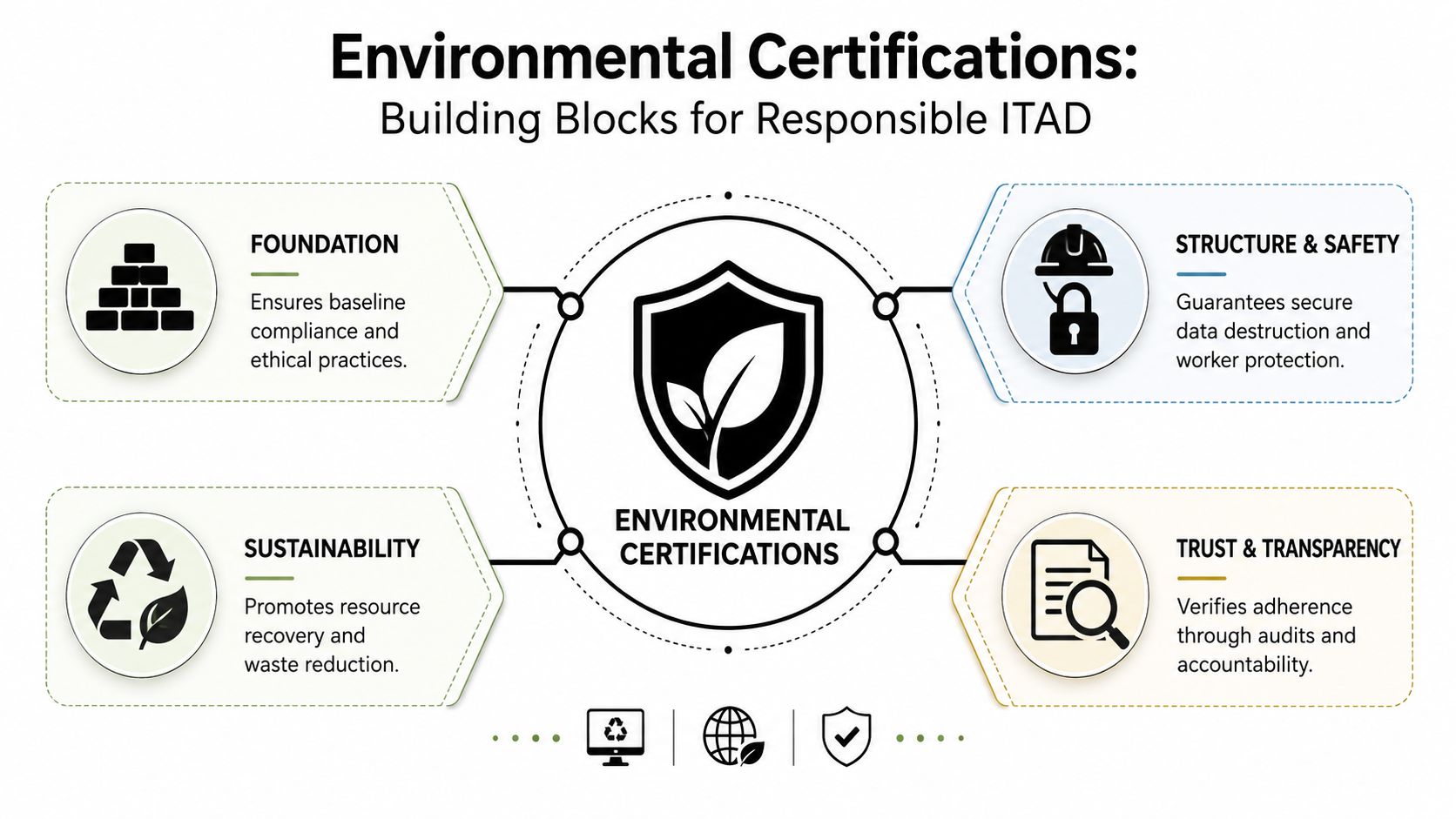
A serious certification framework usually touches several operational layers at once:
- Environmental controls: The recycler needs defined procedures for handling, sorting, storing, and moving equipment and components.
- Data handling: The process must account for storage media and what happens before a server, laptop, or hard drive changes hands.
- Worker safety: Safe operations matter because electronics processing isn't just clerical work. It involves physical handling, dismantling, and exposure controls.
- Traceability: Assets shouldn't disappear into a black box after pickup.
That last point is where many non-experts get tripped up. They assume certification only means “the company recycles.” In reality, certifications are also about management discipline. They require companies to document procedures, train staff, maintain records, and submit to audits.
Why vague green claims aren't enough
If a vendor says it offers sustainable recycling, ask what that means in practice. Does it prioritize reuse where appropriate? Does it document secure data destruction? Does it control downstream movement? Does it keep records that your compliance or legal team can review?
Those aren't abstract concerns. They shape contract terms, audit readiness, and executive confidence.
A certification doesn't eliminate your due diligence. It gives your due diligence something real to inspect.
For IT managers, that changes the conversation. You're no longer comparing slogans. You're comparing operating systems, controls, and proof. That's why certifications matter in IT asset disposition, secure data destruction, product destruction, facility cleanout work, and corporate donation programs. They help translate a vendor's promises into auditable business safeguards.
Decoding the Key E-Waste Certifications
When buyers talk about certified electronics recycling, two names usually dominate the conversation: R2 and e-Stewards. Both are recognized in the e-waste space. Both aim to improve accountability. But they don't mean exactly the same thing, and understanding the difference helps you make a smarter vendor decision.
R2 in practical terms
R2, short for Responsible Recycling, is widely used across the electronics refurbishment and recycling industry. The main business value of R2 is that it gives organizations a structured framework for responsible reuse, recycling, data handling, and downstream management.
Its reach matters because it signals market familiarity. The R2 Standard page from SERI states that the R2 Standard is the most widely adopted certification, with over 1,000 certified facilities operating in more than 40 countries, demonstrating its global reach in the electronics refurbishment and recycling industry.
For an IT manager, the “why” behind R2 is straightforward:
- It supports a controlled process for handling used electronics.
- It puts documentation and auditability at the center.
- It aligns well with organizations that want to recover value through reuse where appropriate, rather than treating every device as scrap.
That last point matters in real projects. During a laptop disposal initiative or office hardware refresh, some assets may still have reuse potential. A standard that treats reuse as part of responsible disposition can support both sustainability goals and asset recovery logic.
e-Stewards in practical terms
e-Stewards is often understood as the stricter signal when a buyer wants a hard-edged position on responsible processing and downstream control. In procurement discussions, companies often view it as a trust marker for organizations that want strong reassurance around how electronics are handled after collection.
The business benefit isn't just environmental posture. It's decision clarity. If your legal, compliance, or ESG team wants a recycler with a clearly defined stance on responsible handling and downstream accountability, e-Stewards often comes up quickly.
What the acronyms mean for your business
Many teams get stuck trying to determine which logo is “better.” That's usually the wrong question. The better question is which certification philosophy fits your risk profile.
- If your priority is operational consistency with strong reuse and process controls, R2 may align well.
- If your priority is a highly restrictive posture around downstream responsibility, e-Stewards may be more appealing.
- If your priority is contract confidence, either can be meaningful if the certification is current, the scope matches the services offered, and the recycler can document chain of custody.
One factual way to assess a provider is to review how it presents those standards and whether it can explain them beyond logo placement. This overview of e-waste certification standards is a useful reference point when evaluating what each label is intended to signal.
Comparison of Major E-Waste Certifications
| Certification | Primary Focus | Data Security Mandate | Export Stance | Governing Body |
|---|---|---|---|---|
| R2 | Responsible recycling, reuse, operational controls, downstream management | Includes documented controls for handling data-bearing devices | Managed through standard requirements and downstream oversight | SERI |
| e-Stewards | Responsible e-waste handling with a strong emphasis on rigorous downstream accountability | Includes requirements tied to secure handling of data-bearing assets | Known for a stricter stance in buyer evaluations | Basel Action Network |
If a vendor only says “we're certified,” ask the next question immediately: certified to what, for which services, and at which facility?
How this affects procurement decisions
A recycler's certification isn't just a badge for a website footer. It affects how you should write your RFP, what your legal team asks for, and how you document vendor approval. In ITAD, the downstream process matters almost as much as the pickup itself.
That has direct implications for services such as:
- Secure data destruction for hard drives and other media
- Data center decommissioning where mixed asset streams need tracking
- Medical equipment disposal when devices may involve both environmental and information security concerns
- Laboratory equipment disposal where chain-of-custody discipline matters
- Donation-based recycling and corporate donation programs where reuse has a social value component but still requires control
A partner that operates under a major certification framework should be able to explain where assets go, how they are processed, and what documentation supports that journey. If they can't, the acronym isn't doing much work for you.
Complementary Standards That Signal Trust
R2 and e-Stewards get most of the attention, but they don't tell the whole story. Discerning buyers often look for a stack of certifications and controls, not a single logo. That's because electronics recycling isn't one activity. It's environmental management, secure handling, quality control, worker safety, and documented destruction, all happening in the same operating environment.
What each additional standard adds
ISO 14001 is best understood as an environmental management backbone. It tells you the company has a formal system for identifying environmental aspects, managing responsibilities, and maintaining internal discipline around its environmental obligations.
NAID AAA speaks directly to data security concerns. If your biggest anxiety is whether drives, devices, and media are destroyed through a controlled and documented process, this is one of the standards buyers often look for.
RIOS is useful because it brings quality, environmental, and health and safety thinking into one management framework. For facilities managers and procurement teams, that integrated approach can be easier to trust than a patchwork of unrelated claims.
Why the stack matters more than the badge
A recycler handling IT asset disposition, product destruction, office cleanout work, and facility cleanout services is dealing with more than one risk category. That's why complementary standards can create a fuller picture.
- Environmental confidence: ISO 14001 supports management-system discipline.
- Information security confidence: NAID AAA adds depth around secure destruction workflows.
- Operational confidence: RIOS signals structured control across multiple business functions.
For buyers evaluating a recycler, these standards aren't competitors to R2 or e-Stewards. They are supporting evidence. If you want to understand how one of those layers works from a data-destruction perspective, this page on AAA NAID certification gives useful context.
Multiple certifications don't automatically make a vendor right for your program. They do make it easier to ask sharper questions and get more verifiable answers.
How to Verify a Recycler's Certifications
A surprising number of procurement problems start with a simple mistake: someone sees a certification logo on a website and assumes the matter is settled. It isn't. Verification is part of due diligence, and it should be handled with the same care you apply to insurance documents, security questionnaires, and contract review.
Start with the certificate itself
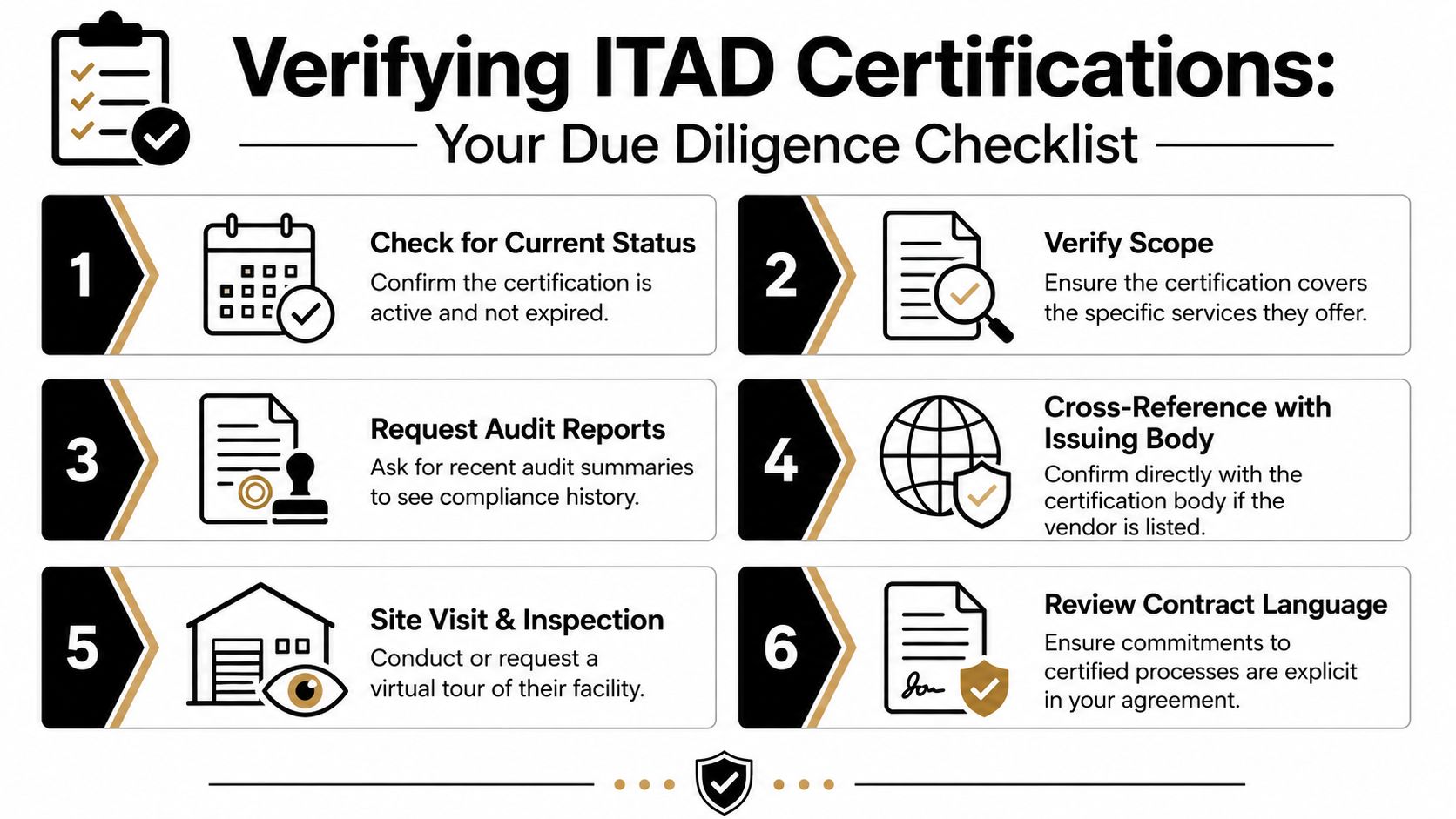
Ask for a current copy of the certification, not just a web badge. Then read it carefully.
Check for these basics:
- Company name. It should match the legal entity you're contracting with.
- Facility address. Certifications are often site-specific.
- Scope. The document should reflect the services you're buying.
- Current status. An expired certificate doesn't help you.
- Issuing body details. You should be able to identify who issued it and how to validate it.
A mismatch doesn't always mean fraud, but it always means you should pause.
Cross-check what the vendor tells you
Then go one level deeper. Compare the certificate with the vendor's actual proposal and service claims.
- If they offer secure data destruction, make sure the certified scope supports that claim.
- If they offer pickup and processing from multiple sites, ask which facilities are certified.
- If they use downstream partners, ask how those partners are vetted and documented.
- If they promote donation-based recycling, ask how devices are triaged for reuse versus recycling.
Chain-of-custody documentation becomes essential. A recycler should be able to explain the movement of assets from pickup through final disposition. This overview of chain of custody documentation is useful if you're building a vendor review checklist.
Don't just ask, “Are you certified?” Ask, “Which facility is certified for which services, and how will that appear in my contract and documentation?”
Red flags worth taking seriously
Some warning signs are subtle but important:
- Reluctance to share documentation: A serious operator should expect verification questions.
- Scope that feels too narrow: The company may be certified for one activity but selling you another.
- Brand-heavy marketing and proof-light responses: Logos should never substitute for records.
- No clarity on subcontractors: If another party touches your assets, that matters.
A short site visit, or at least a guided virtual tour, can also tell you a lot. You don't need to audit the vendor yourself, but you do need confidence that the documented process resembles the actual one.
Your Vendor Selection Checklist for Certified Recycling
When you're comparing vendors, the most useful move isn't asking for more marketing material. It's asking better questions. Good questions expose weak controls quickly, and they help you separate a recycler with a disciplined process from one with a polished sales sheet.
Questions that reduce business risk
Use these in procurement calls, RFPs, or renewal reviews.
- Which certifications do you currently hold? Ask for copies, issuing details, facility coverage, and scope.
- How do you handle data-bearing assets? Listen for specifics around secure data destruction, segregation, transport, and documentation.
- Will you provide a Certificate of Destruction or equivalent records? If the answer is vague, your audit trail may be weak.
- How do you manage downstream vendors? This tells you whether the recycler controls what happens after the initial pickup.
- What happens to equipment that can be reused? The answer reveals whether the vendor has a disciplined approach to refurbishment, donation, or material recovery.
- How do you document chain of custody? This is one of the clearest signals of operational maturity.
Questions that connect disposal to mission
Not every buyer is only trying to avoid risk. Many organizations also want their electronics recycling program to support sustainability goals, digital inclusion, or community impact.
That changes the vendor conversation. You may also want to ask:
- Do you support corporate donation programs for usable equipment?
- Can you support social enterprise recycling or donation-based recycling models?
- How do you distinguish between equipment for reuse and equipment for dismantling?
- Can you help with specialized streams such as medical equipment disposal or laboratory equipment disposal?
These questions matter because a vendor selection decision shapes more than disposal logistics. It shapes how your company tells its sustainability story and whether that story is backed by operational evidence.
What a strong answer sounds like
A reliable vendor usually answers in concrete terms. It explains process steps, documentation, facility coverage, and service boundaries without drifting into slogans. It can also map those answers to your project type, whether that's laptop disposal, computer recycling, a facility cleanout, or a full data center decommissioning.
If you need a practical framework for comparing providers, this guide to vendor selection criteria can help structure the review.
The right recycler shouldn't need you to lower your standards to make the deal work.
Turn Your E-Waste into an Opportunity
Environmental certifications matter because they convert a messy end-of-life problem into a governed business process. They help you reduce risk, support compliance expectations, protect brand credibility, and make stronger procurement decisions. The acronyms only matter if you understand the business benefit behind them.
That benefit is simple. A certified recycler gives you a clearer answer to three questions every organization should be able to answer: Was data handled securely? Were assets managed responsibly? Can we prove it?
For companies building a more mature ITAD program, that also opens the door to something more constructive than disposal. A disciplined process can support reuse, donation, and broader sustainable recycling goals when the right equipment still has value. If your team is also looking at small-device refreshes, this guide with smart tips for selling old phones offers practical ideas for handling another common technology turnover stream.
One provider in this space is Reworx Recycling, which offers electronics recycling, IT equipment disposal, secure data destruction, pickups, and donation-focused service options within a social enterprise model. For organizations that want IT asset disposition to support both environmental responsibility and community impact, that combination can be relevant during vendor evaluation.
The strongest outcome isn't just getting old hardware out of a closet. It's turning retired technology into a process your legal team can trust, your sustainability team can stand behind, and your community can benefit from.
If you're planning an office cleanout, data center decommissioning project, computer recycling program, or secure IT equipment disposal initiative, explore the resources from Reworx Recycling. Businesses can use that hub to learn more about donation-based recycling, schedule a pickup, or evaluate partnership options for responsible electronics recycling that supports digital inclusion and workforce development.