The most popular advice about DoD data destruction standards is also the advice most likely to mislead your disposal program. A vendor may still advertise a “DoD-compliant” three-pass or seven-pass wipe, but a pass count isn't a universal security requirement, and it doesn't solve the storage architecture problem inside modern SSDs, NVMe drives, M.2 devices, or embedded flash.
The defensible approach is different. Treat NIST SP 800-88 Rev. 2 as the current federal media sanitization reference, classify each asset, select Clear, Purge, or Destroy, and preserve evidence that the selected method worked. NIST defines sanitization by whether access to target data is infeasible for the relevant level of effort, not by whether a legacy overwrite recipe was followed. NIST SP 800-88 Rev. 2 is therefore the document compliance teams should place at the center of their IT asset disposition, or ITAD, program.
Why the Old DoD Standard Is Not the Answer Anymore
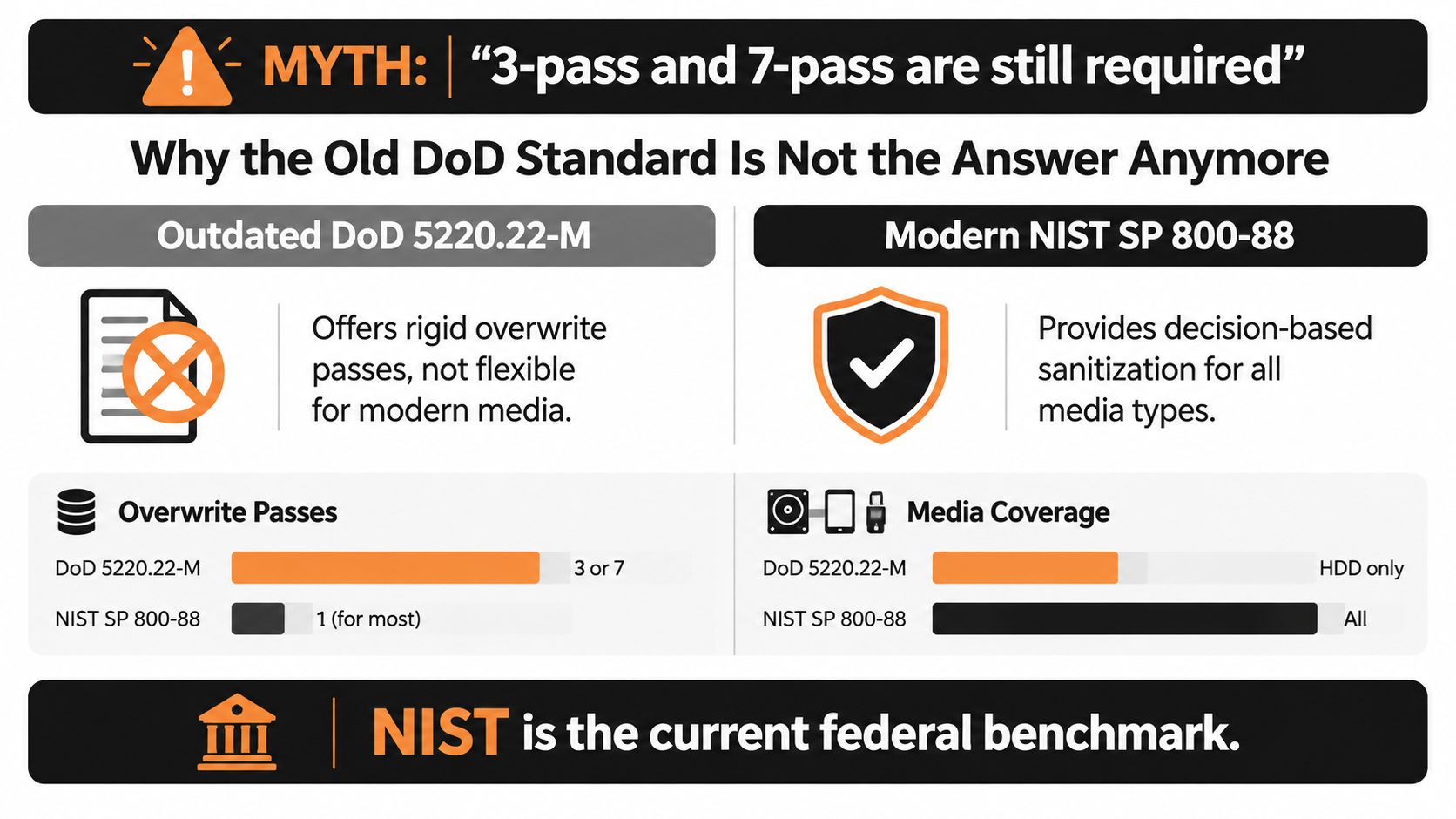
ITAD vendors still market three-pass and seven-pass overwrites as “DoD compliant,” but that phrase encourages the wrong audit question. The important issue isn't how many times software writes across visible drive addresses. It's whether the chosen sanitization method suits the media, the data, the intended disposition, and the required assurance level.
The legacy DoD 5220.22-M approach became associated with multi-pass overwriting of magnetic media. By 2007, however, the Defense Security Service Clearing and Sanitization Matrix stated that overwriting was no longer acceptable for sanitizing magnetic media, leaving degaussing or physical destruction as acceptable methods. The historical DoD matrix explains why a familiar wipe recipe shouldn't be treated as the current federal benchmark.
The compliance risk behind legacy shorthand
The old language creates false confidence in two ways. First, it can make a policy appear precise while saying nothing about failed drives, controller behavior, encrypted storage, or verification. Second, it invites teams to apply magnetic-disk assumptions to flash media that remaps data internally.
NIST SP 800-88 Rev. 2 organizes sanitization around Clear, Purge, and Destroy, and it recognizes that methods must be technology-aware. A reusable magnetic hard drive may support a logical sanitization method, while a failed SSD may require physical destruction because the organization can't establish that every data-bearing component was addressed.
Practical rule: Retire “DoD wipe” as a blanket policy label. Record the media type, selected NIST category, method, verification result, and final disposition.
For a plain-language explanation of how logical and physical processes differ, see Reworx Recycling's guide to what data sanitization means. The recommendation is straightforward: use current NIST decisioning, not legacy marketing language, when approving computer recycling, secure data destruction, laptop disposal, or data center decommissioning.
How We Got From DoD 5220.22-M to NIST SP 800-88
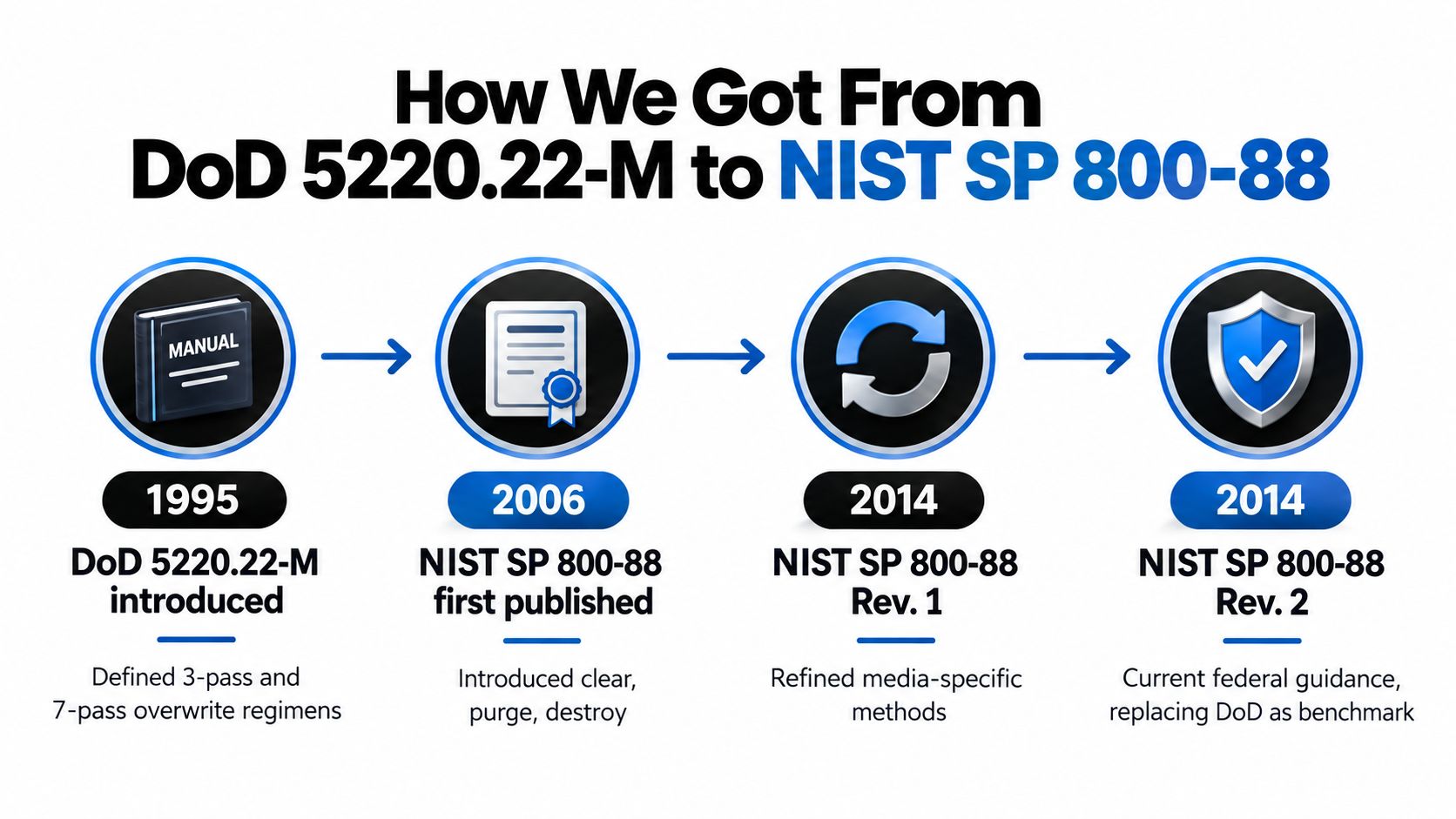
The confusion comes from a genuine historical shift. DoD 5220.22-M is commonly associated with the 1990s and with a three-pass overwrite pattern for magnetic storage. That pattern became embedded in software menus, vendor brochures, procurement language, and internal retirement checklists.
The federal position changed materially over time. The Defense Security Service matrix issued by 2007 no longer accepted overwriting for sanitizing magnetic media, identifying degaussing or physical destruction instead. That decision weakened the idea that a fixed overwrite sequence remained the universal federal answer.
NIST then developed a broader media sanitization framework. The first major revision of NIST SP 800-88 was published on December 17, 2014, and Rev. 2 later superseded Rev. 1 on September 26, 2025. The current document moves the discussion toward outcome-based sanitization and technology-specific decisioning rather than a single DoD pass count. NIST's current media sanitization publication provides the federal reference point for that transition.
Why policy documents and vendor claims diverged
Legacy terminology survived because it was easy to understand. “Three-pass DoD wipe” sounds more concrete than a decision that depends on media characteristics, reuse intent, and assurance requirements. But simplicity in a sales label can become ambiguity in an audit.
NIST SP 800-88 Rev. 2 also defers technical methods to sources such as IEEE 2883, NSA specifications, or an organization's approved standard. That structure makes the policy owner responsible for approving methods and documenting why they fit each asset class. Reworx Recycling's data destruction process can support organizations that need a documented operational workflow, but the governing policy should still identify the applicable NIST category and verification requirement.
The historical lesson is clear. DoD 5220.22-M matters as background, especially when reviewing old contracts or vendor records. It shouldn't remain the operative benchmark for a modern ITAD program.
What Sanitization Actually Means Under NIST SP 800-88 Rev. 2
NIST defines sanitization as a process that makes access to target data infeasible for a given level of effort. That definition changes how teams should plan disposal. The question isn't whether a device received a familiar pattern of writes. The question is whether the selected control produces an acceptable outcome for the medium and risk.
Clear
Clear uses logical techniques intended to protect against ordinary access attempts while the media remains usable. Depending on the device and manufacturer support, that can include an approved overwrite, factory reset, ATA Secure Erase, or an NVMe Format command.
Clear fits situations where the organization intends to reuse the device and the risk profile permits logical sanitization. It must still be executed with approved tools, recorded against the asset, and verified. A factory reset alone shouldn't become an automatic answer for every device, particularly when the organization can't confirm how the reset handles protected areas or encryption keys.
Purge
Purge applies a stronger process designed to resist more advanced recovery efforts while preserving the possibility of reuse or release. Cryptographic erase, supported block erase commands, and degaussing for suitable magnetic media can fall into this category.
Cryptographic erase depends on the drive's encryption architecture and key management. A compliance officer should require evidence that the relevant keys were destroyed and that the device's implementation supports the claimed result. Degaussing also depends on media type and equipment capability, so it isn't a universal solution for flash storage.
Destroy
Destroy makes the media unusable through physical methods such as shredding, disintegration, pulverization, incineration, or melting. NIST identifies physical destruction as the appropriate path when media can't be reliably sanitized for reuse, including failed or damaged storage.
| Sanitization Level | Techniques | Resists | Best For |
|---|---|---|---|
| Clear | Logical overwrite, factory reset, approved device commands | Routine access attempts | Suitable media intended for reuse |
| Purge | Cryptographic erase, supported block erase, degaussing | More advanced recovery efforts | Release or reuse where stronger assurance is required |
| Destroy | Shredding, disintegration, pulverization, incineration, melting | Recovery from the eliminated medium | Failed, damaged, or non-reusable media |
Use Reworx Recycling's data sanitization methods as a practical reference when translating the three NIST categories into an internal procedure. The method should follow the risk decision, not drive it.
Why SSDs and Modern Flash Break the Old Wipe Recipe
A three-pass overwrite assumes that the operating system can address the places where data exists. That assumption generally fits the visible block model of a magnetic hard disk better than it fits flash storage.
SSDs, NVMe drives, M.2 modules, eMMC devices, and embedded flash use controllers that manage data placement. Wear-leveling distributes writes across physical cells, while the flash translation layer maps host-visible logical block addresses to changing physical locations. Over-provisioned space, retired cells, bad blocks, controller caches, and TRIM behavior can leave storage outside the address range a wiping application sees.
The visible disk isn't the whole device
A software tool may report that it overwrote every addressable logical block, yet the controller may have moved earlier data elsewhere. The host can't necessarily force a conventional overwrite through every remapped cell. That makes repeated passes a poor substitute for a method designed for the device's architecture.
| Attribute | Magnetic HDD | SSD / NVMe / eMMC |
|---|---|---|
| Data placement | Host-visible sectors generally correspond more closely to physical locations | Controller maps logical addresses to physical flash cells |
| Overwrite assumption | More closely aligned with the media model | Can miss remapped or reserved areas |
| Relevant concerns | Bad sectors and magnetic remanence | Wear-leveling, over-provisioning, TRIM, retired cells, caches |
| Preferred decision | Approved Clear or Purge, degaussing, or Destroy as appropriate | Supported cryptographic or device purge, otherwise Destroy |
| Reuse risk | Depends on verification and disposition | Requires architecture-aware validation |
NIST's current framework is the reason compliance teams should stop treating the legacy pass count as the answer for flash. If a drive is healthy and its manufacturer-supported sanitization command can be validated, a purge path may be appropriate. If the drive is damaged, inaccessible, or unverifiable, physical destruction is the defensible choice.
For a service-oriented explanation of physical elimination and related controls, review what data destruction involves. The key decision is simple: don't certify a flash device based only on a successful progress bar.
Matching Each Media Type to the Right Sanitization Method
A practical ITAD program assigns the lowest-cost method that meets the required assurance level. That doesn't mean choosing the cheapest action for every device. It means avoiding unnecessary destruction of reusable equipment while refusing to reuse media that can't be validated.
Spinning hard drives
For healthy magnetic hard drives intended for reuse, an approved device command or logical Clear method may be suitable when the organization can verify completion. A Purge decision may use degaussing where the equipment is rated for the media, or cryptographic erase where the drive's encryption design supports it. Shredding remains the right route for failed, damaged, or high-risk drives.
SATA and NVMe solid-state drives
SSD and NVMe workflows should begin with controller-aware methods. Use a supported cryptographic erase, vendor command, or other approved Purge technique when the implementation and verification evidence are available. If the device won't respond, has failed cells, or lacks reliable verification, send it to physical destruction rather than forcing it through a legacy overwrite queue.
Tape, mobile devices, and damaged media
LTO and other magnetic tapes require equipment matched to their coercivity for degaussing. Shredding or incineration may be appropriate when reuse isn't planned. Mobile phones and tablets can receive a manufacturer-assisted reset or an MDM-driven remote wipe when the organization controls the device and can verify the result, but damaged units should go directly to destruction.
| Media Type | Clear (Reuse) | Purge (Release) | Destroy (End of Life) |
|---|---|---|---|
| Magnetic HDD | Approved logical sanitization | Degaussing or approved cryptographic method | Shredding or disintegration |
| SATA or NVMe SSD | Manufacturer-supported command where validated | Cryptographic erase or approved purge control | Physical destruction |
| LTO or magnetic tape | Approved logical process where supported | Rated degaussing | Shredding or incineration |
| Mobile device or tablet | Verified manufacturer reset | MDM-assisted or cryptographic erase | Physical destruction for damaged units |
| Failed or contaminated media | Not appropriate | Not appropriate unless validated | Shredding, disintegration, or incineration |
For hard drives that can't be released safely, organizations can review secure hard drive disposal as part of their vendor evaluation. Keep the media class and disposition decision visible in the work order.
Choosing Between Clear, Purge, and Destroy in Practice
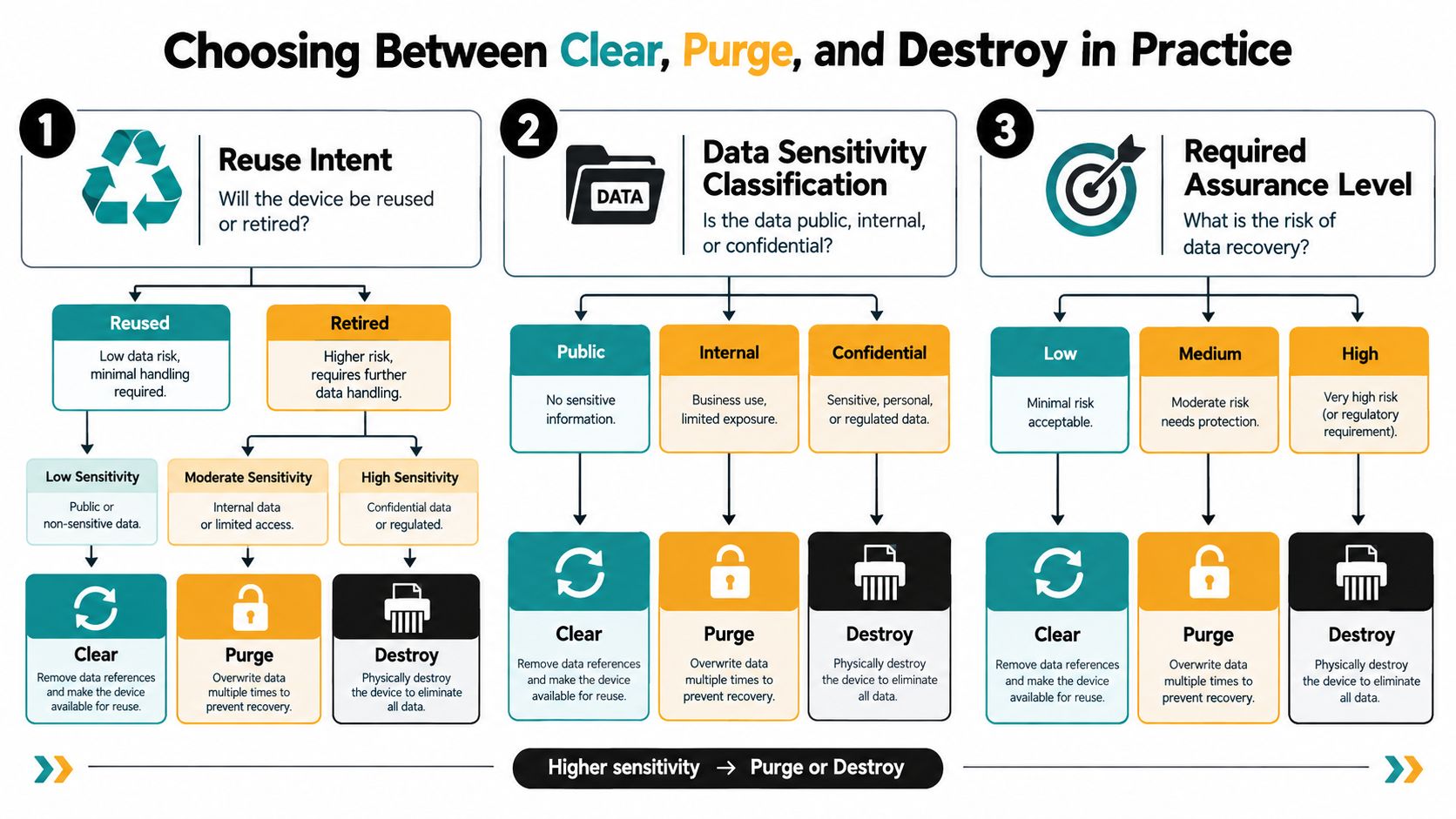
Compliance officers don't need a complicated scoring model. They need three inputs recorded consistently: reuse intent, data sensitivity classification, and required assurance level.
Start with disposition. If the asset will be reused internally, Clear may be appropriate for supported media and lower-risk data. If the asset will leave organizational control but remains technically reusable, Purge is usually the stronger choice. If the medium is failed, damaged, contaminated, or not intended for reuse, Destroy removes the validation problem.
Next, classify the data. Public or low-sensitivity content doesn't create the same exposure as personal information, financial records, regulated health information, student records, or defense-related material. The classification should follow the data that was stored, not the purchase price or age of the equipment.
Finally, document the assurance target. A reissued corporate laptop with supported encryption may receive Clear through cryptographic erase. A leased SSD leaving the organization may require Purge through a validated vendor command. A failed drive containing personally identifiable information should go to Destroy through shredding.
Record the decision per asset
A policy template can't replace an asset-level decision. The record should identify the media type, selected category, approved method, operator, verification outcome, and final disposition. A “three-pass complete” status is not enough if the inventory contains both magnetic disks and flash devices.
The certificate should tell an auditor why this method was selected, not merely that a technician clicked “start.”
Reworx Recycling can be evaluated as an execution partner for organizations that need documented secure data destruction, physical equipment handling, and responsible downstream recycling. The decision remains yours, but the evidence must follow the asset from intake through release or destruction.
Building an Audit-Ready Chain of Custody
A defensible record begins when media leaves production, not when a wipe utility starts. The staging area, transport container, destruction floor, and certificate system all form part of the control environment.
Five evidentiary anchors
- Unique asset tagging: Record serial numbers, asset identifiers, media type, owner, and disposition decision before movement.
- Dual-signature handoffs: Require the releasing employee and receiving technician or carrier to sign each transfer.
- Sealed transport: Use secured containers with serialized tamper seals and document seal condition at receipt.
- Time-stamped execution: Tie sanitization or destruction events to technician credentials, equipment, and work-order records.
- Verification output: Preserve command results, device status, inspection records, or destruction confirmation linked to the same asset identifier.
A gap in staging documentation can undermine otherwise valid work. If the certificate proves destruction but the organization can't show who controlled the drive between removal and processing, the chain remains vulnerable to audit questions.
For teams formalizing handoffs, this chain of custody guide offers useful context on maintaining an evidentiary trail.
Certificate fields that should not be optional
Certificates for HIPAA, FISMA, or SOX review should include serial numbers, the NIST SP 800-88 Rev. 2 sanitization category, method code, technician ID, execution time, verification result, final disposition, and vendor or facility identification. Attach supporting logs rather than relying on a summary certificate that omits the underlying evidence.
Set retention according to the organization's legal, contractual, and regulatory obligations. The record should remain understandable years after decommissioning, including when a reviewer wasn't involved in the original project. Store certificates with immutable access controls, searchable asset identifiers, and an export format that can survive a subpoena or investigation.
Regulatory and Compliance Obligations That Rely on These Standards
Sanitization obligations usually arise from several overlapping duties rather than one universal destruction law. The control owner should identify what data was stored, which rule applies, and whether the device will remain under organizational control.
HIPAA Security Rule 164.310(d)(1) is relevant when electronic protected health information resides on devices being removed from service. GLBA Safeguards Rule item 9 addresses customer information and the need for secure disposal practices. FERPA matters when donated or retired school equipment contains student records. SOX creates retention and control concerns for financial reporting data on reassigned laptops and other corporate systems.
State breach notification statutes also matter. Inadequate sanitization can turn a preventable disposal failure into a reportable incident when protected information remains recoverable. PCI DSS v4.0 Requirement 9.4 can serve as a useful external anchor for merchants and other organizations evaluating storage protection, including cryptographic erase for SSDs. Defense contractors should map applicable CMMC Level 2 requirements, including control MP.L2-3.8.6, which names NIST SP 800-88 as a reference.
| Regulation | Triggering Asset | Expected Sanitization Level |
|---|---|---|
| HIPAA Security Rule 164.310(d)(1) | Devices containing ePHI | Purge or Destroy based on risk and verification |
| GLBA Safeguards Rule item 9 | Retired systems containing customer information | Validated Purge or Destroy |
| FERPA | Donated or reassigned systems containing student records | Purge or Destroy before release |
| SOX | Laptops and systems with financial reporting data | Documented Clear, Purge, or Destroy |
| PCI DSS v4.0 Requirement 9.4 | Payment-related storage and retired systems | Approved sanitization, with cryptographic erase where applicable |
| CMMC Level 2 MP.L2-3.8.6 | Defense contractor media | NIST-aligned sanitization and evidence |
Organizations building a broader governance model can also consult data compliance with digna platform for context on organizing compliance obligations. Don't claim that one certificate satisfies every rule. Map the record to the data type and control framework under review.
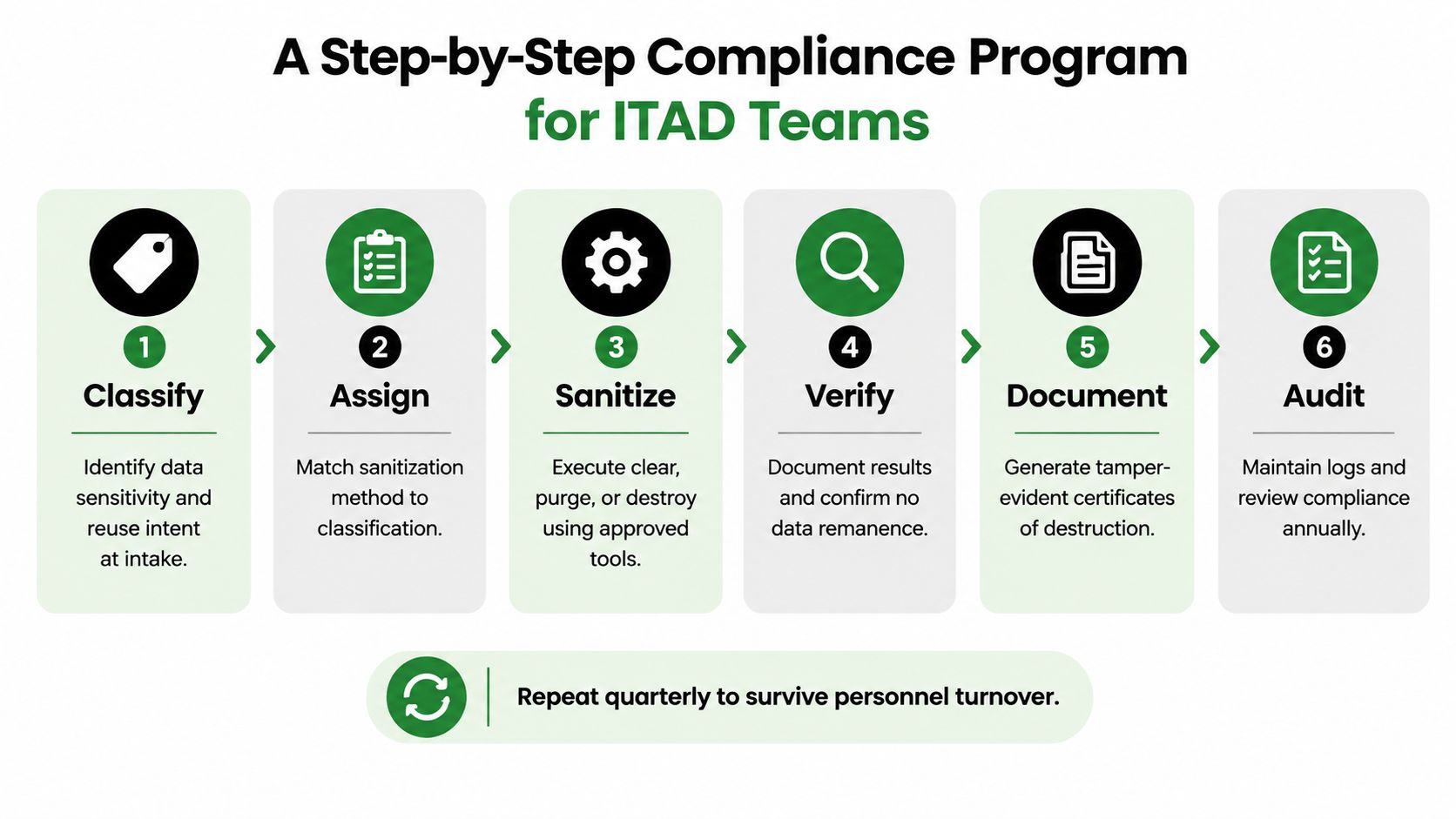
A Step-by-Step Compliance Program for ITAD Teams
A strong program survives staff turnover because the process lives in policy, training, systems, and evidence. Use this operating model for corporate donation programs, office cleanout projects, facility cleanout work, and large data center decommissioning.
- Classify at intake. Record data sensitivity, media type, ownership, condition, and reuse intent before equipment enters staging.
- Assign the NIST category. Select Clear, Purge, or Destroy and document the reason for the decision.
- Sanitize in a controlled environment. Separate reusable assets from destruction inventory. Use approved commands and tools, especially for encrypted SSDs and NVMe media.
- Capture custody evidence. Use dual signatures, serialized seals, transfer timestamps, and named technicians.
- Generate per-asset certificates. Include method codes, credentials, serial numbers, execution details, verification results, and final disposition.
- Audit the program. Review a random 3% sample quarterly, reconcile the sample with the certificate inventory, and investigate missing or inconsistent evidence. The NIST SP 800-88 Rev. 2 publication should remain the policy reference for the framework.
Policy artifacts and review triggers
Keep a written sanitization procedure, technician training records, approved-tool documentation, vendor risk assessments, and an incident response runbook for failed verification. Require downstream ITAD partners to explain their custody controls, destruction methods, certificate fields, and recycling channels.
Review the procedure when a new media class enters inventory, a vendor changes its processing method, a verification failure occurs, or a relevant regulatory requirement changes. Annual review is useful, but it shouldn't be the only trigger for an update.
Pulling It Together as a Program-Level Framework
NIST SP 800-88 Rev. 2 works best as an operating framework rather than a disposal checklist. Inventory teams identify the asset and data risk. IT selects Clear, Purge, or Destroy based on media architecture and reuse intent. Technicians execute the approved method, verification staff review the result, and compliance stores the certificate with the custody record.
The handoffs matter as much as the technical action. Internal IT, facilities, security, sustainability, and the ITAD vendor should use the same asset identifier and disposition vocabulary. That alignment supports secure data destruction while allowing reusable equipment to move into computer recycling, donation-based recycling, or community technology programs.
Reworx Recycling fits into that execution layer as a provider of electronics recycling, IT equipment disposal, hard drive shredding, and documented equipment destruction. Its role should be evaluated against the organization's approved NIST method, custody requirements, certificate fields, and downstream recycling expectations.
Track practical program indicators, including verification sample results, certificate completeness, unresolved custody gaps, failed sanitization events, and incident-free disposal. Those measures show whether the process works beyond a vendor's claim that a wipe completed.
Frequently Asked Questions About DoD Data Destruction Standards
Is DoD 5220.22-M still the federal benchmark?
No. It remains a legacy reference associated with magnetic-media overwriting. NIST SP 800-88 Rev. 2 is the current federal media sanitization framework.
What should we do when an SSD fails overwrite?
Don't repeat the pass count. Use a validated Purge method supported by the device, or choose Destroy when the drive is damaged, inaccessible, or unverifiable.
What evidence will auditors expect?
Provide the asset serial number, NIST category, method code, technician identity, timestamps, custody records, verification result, and final disposition.
Does physical destruction automatically satisfy HIPAA or GLBA?
Not automatically. Destruction can be appropriate, but the organization still needs documented custody, approved procedures, verification or inspection evidence, and records tied to the applicable data.
Partnering With Reworx Recycling for Compliant Destruction
Reworx Recycling can serve as the operational layer for a NIST-aligned ITAD program, including secure hard drive shredding, equipment destruction, chain-of-custody records, formal certificates, and responsible downstream electronics recycling. That model supports businesses managing laptop disposal, office cleanout, medical equipment disposal, laboratory equipment disposal, product destruction, and data center decommissioning while preserving reuse and donation opportunities where appropriate.
IT managers and compliance officers should replace legacy DoD pass-count language with documented media-aware decisions, then select vendors that can execute and evidence those decisions.
Visit Reworx Recycling to discuss secure data destruction, business pickups, equipment donations, and compliant IT equipment disposal. Ask the team to help map your drives and devices to Clear, Purge, or Destroy while keeping chain-of-custody documentation and responsible recycling in the same workflow.