That back room with retired laptops, dead monitors, old VoIP phones, and a few mystery servers isn’t just wasted space. For most Atlanta businesses, it’s a mix of unresolved data risk, deferred operational work, and overlooked asset value.
I’ve seen the same pattern across growing offices, healthcare practices, logistics firms, and multi-site operations around metro Atlanta. The technology refresh gets approved, new equipment lands, and the old equipment sits because nobody wants to make the wrong disposal call. IT worries about drives. Facilities wants the space back. Finance wants a clean answer on cost. Legal wants documentation. Sustainability wants a defensible story.
Responsible Electronics Recycling for Atlanta Businesses starts there. Not with a truck pickup, but with a management decision about risk, accountability, and value recovery.
Beyond the Storage Closet A Strategic View of E-Waste
A storage closet full of old electronics usually tells the same story. The company grew, equipment was replaced in waves, and nobody owned end-of-life decisions across IT, facilities, legal, and finance. The result is predictable. Usable space disappears, asset records drift out of date, and old devices remain in circulation internally long after they should’ve been retired.
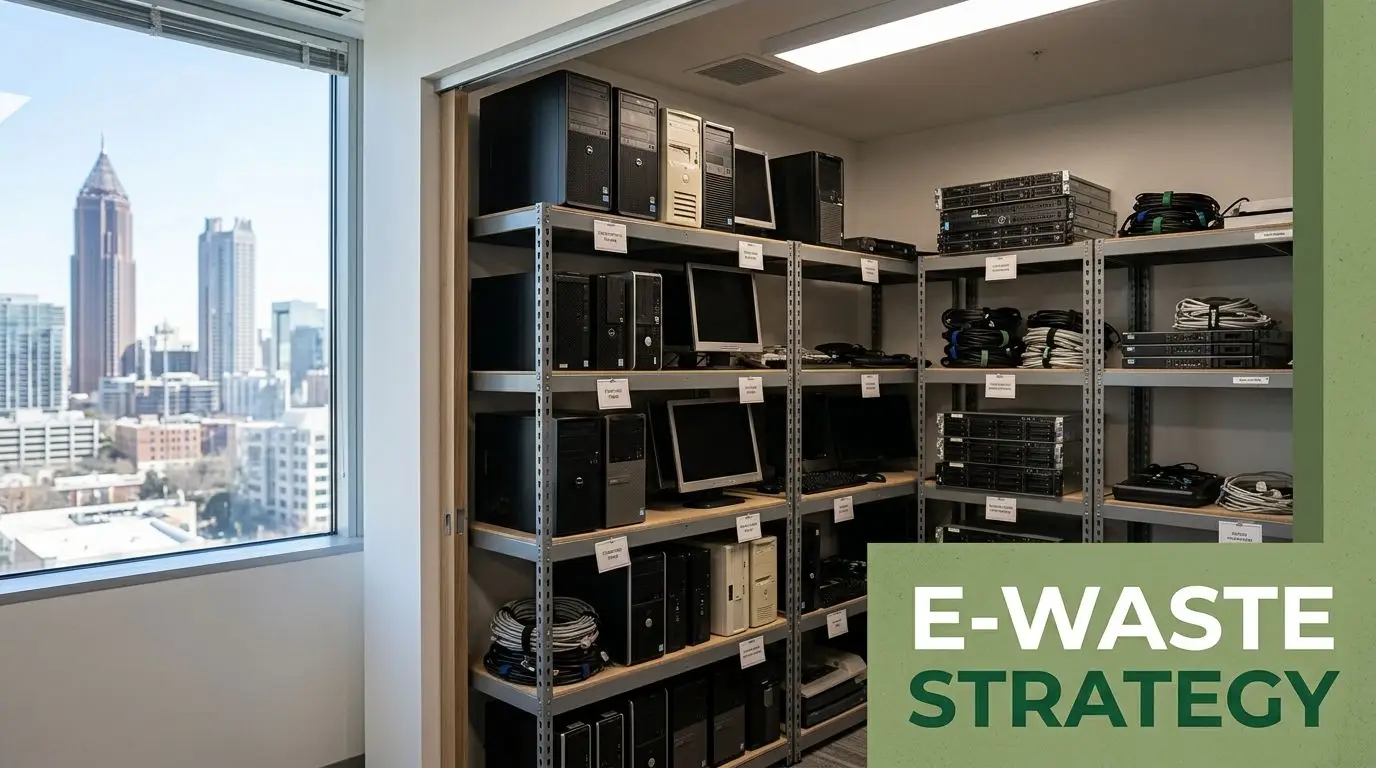
Atlanta businesses feel this pressure more than many markets because the local economy mixes fast-moving office technology with regulated industries. Financial services, healthcare, education, professional services, and logistics all generate steady streams of retired devices. That means electronics recycling isn’t a side task. It’s part of operating responsibly.
The scale of the problem is large enough that a casual approach no longer makes sense. The world generated 62 million tonnes of e-waste in 2022, with a projection of 82 million tonnes by 2030, yet only 22.3% was properly collected and recycled in 2022, according to this overview of the global e-waste crisis and electronics recycling trends.
Why this becomes a business issue fast
Once equipment reaches end of life, three questions matter immediately:
- Where is the data risk: A device that still exists but hasn’t been formally sanitized is still part of your exposure.
- Who owns the chain of custody: If nobody can document movement from office to final disposition, accountability is weak.
- What value is still in the equipment: Some assets belong in a resale, redeployment, or donation stream instead of bulk scrap.
Those questions change the conversation from “How do we get rid of this stuff?” to “How do we manage retired technology correctly?”
Old equipment rarely creates one big problem at once. It creates several smaller problems that cross departments, then compounds because no single team owns the full lifecycle.
A well-run IT asset disposition program also changes the social value of retired equipment. Some devices should be recycled for material recovery. Others can support community use after proper data handling and refurbishment. That’s where donation-based recycling stands apart from a simple haul-away model. It links responsible disposal with digital inclusion and community impact, which is worth understanding if your leadership team cares about both compliance and corporate citizenship.
For a useful overview of the environmental stakes behind this work, review Reworx’s discussion of the environmental impact of electronic waste.
What works and what doesn’t
What works is treating e-waste as an operational discipline. That means policy, inventory, approved vendors, documented destruction, and reporting.
What doesn’t work is waiting until an office cleanout, relocation, merger, or audit forces action. Reactive disposal nearly always reduces control, lowers recovery value, and increases the chance that something important gets missed.
Building the Business Case for Stakeholder Buy-In
Most programs fail before pickup day. They fail when the proposal sounds like housekeeping instead of business risk management. If you want budget, executive attention, and cross-functional cooperation, frame electronics recycling as a governance issue with financial implications.

The reporting environment already supports that argument. In 2019, the world generated 53.6 million metric tons of e-waste and only 17.4% was formally recycled. Modern sustainability reporting also requires concrete metrics such as total pounds diverted from landfills and certificates of data destruction, as described in this review of e-waste statistics and corporate reporting expectations.
Start with the three arguments leadership will hear
For most Atlanta organizations, the strongest case rests on three pillars.
Risk mitigation
If devices leave your control without a secure process, the exposure isn’t theoretical. Retired laptops, storage media, mobile devices, and printers can all carry sensitive information. Legal and compliance teams understand this quickly once you translate recycling into chain of custody, media sanitization, and documentation.
Bring the issue to leadership in plain terms:
- Data exposure risk: Retired devices can still contain employee, customer, financial, or patient data.
- Environmental compliance risk: Improper handling can create hazardous waste issues.
- Audit risk: If a regulator, client, or internal auditor asks for proof, undocumented disposal is a weak answer.
Cost control
A mature program isn’t only about avoiding loss. It also improves process efficiency. Storage space gets reclaimed. Internal labor drops when there’s a repeatable pickup and disposition process. Equipment with remaining utility can move into remarketing, donation, or redeployment instead of sitting idle.
Reputation and CSR value
Leadership teams increasingly care about whether disposal practices align with stated ESG or community commitments. Donation-based recycling can support a stronger community impact narrative when it’s backed by proper data destruction and clear disposition rules.
Practical rule: Don’t ask the CFO to fund “green recycling.” Ask for approval to reduce liability, improve documentation, and recover value from retired assets.
Tailor the message by stakeholder
A single slide deck rarely works across departments. The message needs to shift depending on who’s in the room.
| Stakeholder | What they care about | What to emphasize |
|---|---|---|
| CEO or COO | Operational control, reputation | A formal ITAD process reduces unmanaged risk and supports public sustainability commitments |
| CFO | Cost, recovery, budget discipline | Asset resale, reduced storage burden, avoided disposal mistakes, cleaner lifecycle management |
| General counsel | Exposure, defensibility | Certificates, chain of custody, documented handling, approved vendors |
| CIO or IT director | Security, workload, asset control | Inventory accuracy, sanitization standards, clear retirement workflow |
| Sustainability lead | Reporting, diversion, reuse | Pounds diverted, donation pathways, auditable outcomes |
If you need a plain-language explainer to help internal stakeholders understand why this matters, Reworx has a useful page on the benefits of e-waste recycling.
The argument that usually lands
The most effective business case is balanced. It doesn’t rely on fear alone, and it doesn’t oversell recycling as profit. It says this:
- Retired electronics create real security and compliance obligations.
- A formal process improves operational control.
- Some assets retain value through refurbishment, buyback, or donation.
- Better documentation strengthens both audits and sustainability reporting.
That combination gets traction because every department can see its role in the outcome.
Designing Your ITAD Program Logistics and Team Roles
Once leadership is aligned, the work becomes operational. At this stage, many companies either build a durable process or create confusion that follows every future refresh cycle. Good ITAD logistics are simple on paper and disciplined in execution.
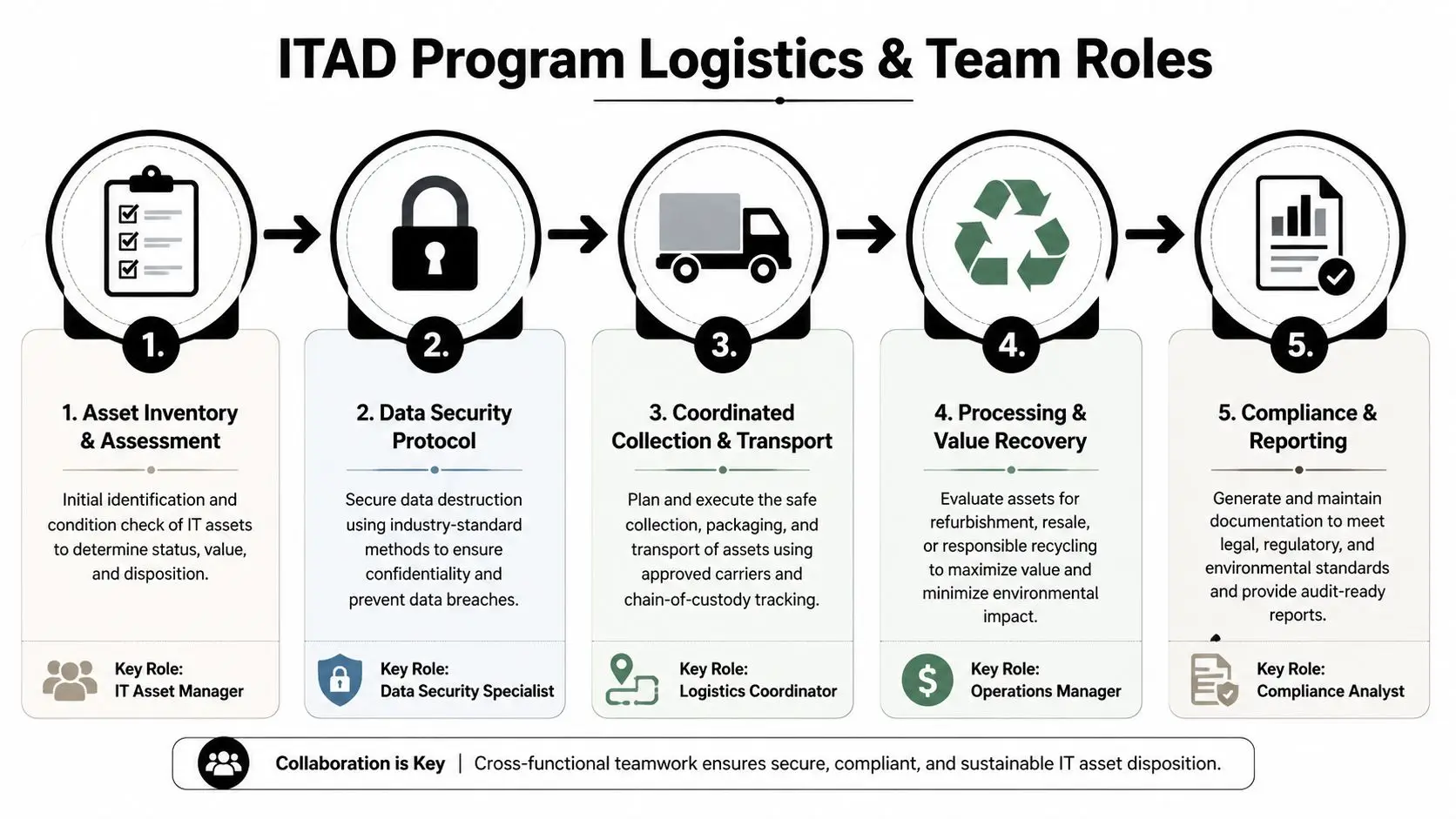
Distributed work makes this harder. For companies with remote teams or multiple offices, e-waste management depends on a reverse logistics plan with decentralized collection points and coordination between IT asset systems and final disposition workflows, especially for organizations operating across multiple Southeastern states, as outlined in this guide to environmentally responsible electronics recycling in Atlanta.
Build the program around chain of custody
The first mistake companies make is scheduling pickup before they know what they have. Start with an inventory that’s practical, not perfect. You need enough detail to control risk and sort assets by next action.
A useful inventory usually includes:
- Asset identity: Serial number, asset tag, device type, manufacturer, model
- Condition notes: Working, damaged, incomplete, obsolete, unknown
- Location data: Office, floor, department, storage room, remote employee
- Disposition path: Reuse, resale evaluation, donation evaluation, recycling, destruction
That inventory does two jobs. It establishes accountability, and it helps you separate high-risk media-bearing equipment from low-risk peripheral items.
Assign actual owners, not vague departments
Programs stall when responsibility is assigned to “IT” or “operations” as a whole. Name people.
A clean role split often looks like this:
| Role | Primary responsibility |
|---|---|
| IT lead | Confirms asset status, identifies data-bearing devices, approves sanitization path |
| Facilities lead | Manages internal staging area, pickup access, loading instructions |
| Procurement or finance | Reviews any buyback, resale, or donation documentation |
| Compliance or legal contact | Reviews documentation requirements and retention expectations |
| Program owner | Coordinates timelines, vendor communication, and internal updates |
The best program owner isn’t always the most senior person. It’s the person who can keep inventory, logistics, and documentation moving across departments.
Create a retirement workflow that people can follow
A written workflow matters more than a long policy document. Keep it short enough that site managers, office admins, and IT support staff can use it without interpretation.
A practical workflow often follows this sequence:
- Identify retired assets through refresh projects, office cleanouts, decommissions, or staff offboarding.
- Record them in a central inventory file or asset platform.
- Separate data-bearing equipment from accessories and low-risk items.
- Move items to a controlled staging area with limited access.
- Schedule pickup or transfer only after the inventory is reviewed.
- Collect final documentation and store it where audit teams can find it later.
For organizations formalizing this process, Reworx provides a planning resource on how to implement an IT asset disposition strategy.
Solve for Atlanta realities
Atlanta operations rarely sit in one neat location. You may have a headquarters in Buckhead, a warehouse in South Fulton, a clinic network across the metro, or hybrid staff with equipment at home. Your logistics model has to reflect that.
What tends to work:
- Centralized office collection days: Best for HQ environments with regular refresh cycles
- Regional consolidation: Better for multi-site companies that want fewer pickups and cleaner records
- Remote employee return kits or mail-back coordination: Useful for offboarding and hybrid fleets
- Loading dock or ground-floor staging: Reduces disruption and pickup friction on service day
What tends to fail:
- Asking each department to handle disposal independently
- Mixing live assets and retired assets in the same room
- Letting remote staff self-dispose without a formal return path
- Treating decommissioning as a one-time event instead of a repeating business process
Train employees on the basics
Employees don’t need an ITAD education. They need a short set of instructions that answer three questions: what belongs in the program, where it goes, and who approves movement.
A short internal message should cover accepted items, prohibited items, handling expectations for drives and laptops, and the point of contact. That alone prevents a lot of avoidable disorder.
Ensuring Secure Data Destruction and Regulatory Compliance
When companies talk casually about “recycling old computers,” they often skip the most important issue. Disposal is secondary. Data destruction is primary. If that sequence gets reversed, the entire program is flawed.
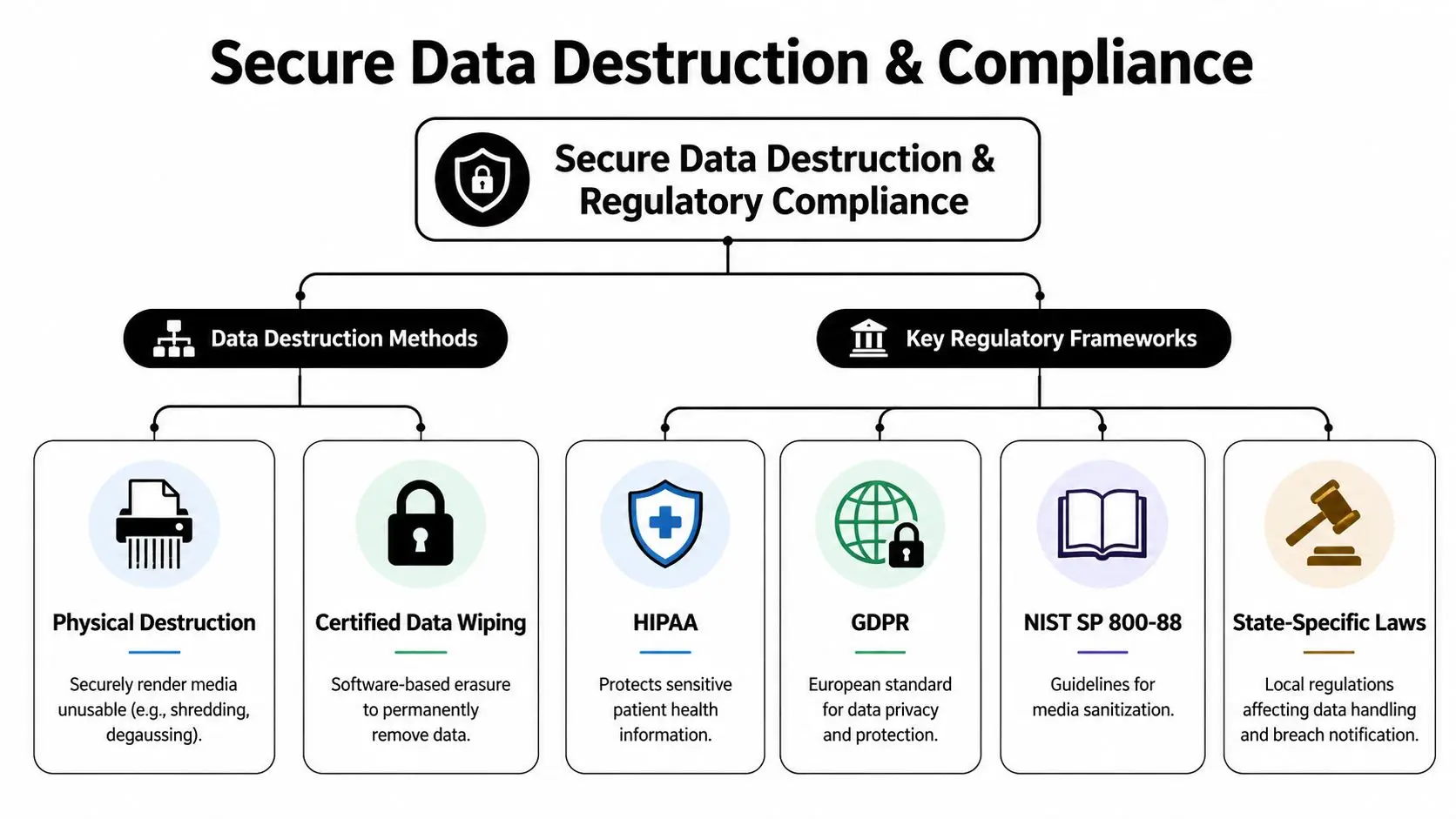
R2v3 certified facilities guarantee zero-landfill policies and achieve over 95% material recovery rates. Their process includes secure data destruction aligned with NIST standards, detailed disassembly, and downstream accountability, which helps reduce exposure to EPA fines that can reach up to $50K per violation under RCRA, according to this summary of responsible electronics recycling standards and controls.
Match the destruction method to the media and the risk
Not every asset should follow the same sanitization path. The right method depends on device type, condition, reuse potential, and the sensitivity of the information involved.
Three common approaches matter most:
| Method | Best fit | Main consideration |
|---|---|---|
| Certified data wiping | Devices that may be reused, remarketed, or donated | Requires a verified process and complete recordkeeping |
| Degaussing | Certain magnetic media | Useful in limited cases, but not the answer for every modern device type |
| Physical shredding | Drives or media that should never re-enter use | Strong choice when destruction is required for risk or policy reasons |
For many Atlanta businesses, the decision isn’t technical. It’s policy-based. Are you willing to allow sanitized reuse for some categories of equipment, or do you require destruction for all media-bearing devices? Highly regulated organizations often choose more restrictive rules. Others segment by business unit or data classification.
Documentation is what proves diligence
A process only protects you if you can show it happened. That means chain-of-custody records, itemized inventory where appropriate, and a certificate confirming data destruction.
Those records matter in several scenarios:
- Client questionnaires asking how retired devices are handled
- Internal audits reviewing information security controls
- Regulatory reviews in healthcare, finance, education, and public sector contexts
- Board or ESG reporting that requires hard evidence rather than good intentions
If your vendor can destroy media but can’t produce clear documentation, you still have a governance problem.
A useful standard for Atlanta organizations is to require documentation that is easy to reconcile with your own asset records. If the certificate or report doesn’t map cleanly to your inventory, your team will spend unnecessary time trying to close the gap.
Compliance isn’t one regulation. It’s a stack of obligations
End-of-life equipment touches multiple compliance layers at once. A healthcare group may think first about HIPAA. A financial firm may focus on GLBA. A larger enterprise may also have contractual data handling obligations, internal security policy requirements, and environmental responsibilities under waste rules.
That’s why vendor certification matters so much. Certification doesn’t replace your own due diligence, but it raises the baseline. It indicates that the recycler operates under audited controls, follows defined downstream processes, and can support more defensible handling.
If you’re evaluating secure media handling options in metro Atlanta, Reworx outlines its data destruction services in Atlanta for businesses.
What not to accept from a vendor
Be cautious when a recycler gives broad assurances without detail. Weak answers usually sound like this:
- “We wipe everything.”
- “We’re environmentally friendly.”
- “We handle compliance.”
- “You don’t need to worry about the downstream side.”
None of those statements are enough on their own. Ask what standard they follow, what records you’ll receive, who handles downstream materials, and whether data-bearing assets are segregated from general recycling streams.
Choosing Your Atlanta Electronics Recycling Partner
Vendor selection is where strategy becomes real. A strong internal process can still fail if the recycler is sloppy, undocumented, or opaque about downstream handling. The wrong partner creates exposure you won’t see until there’s an audit, an incident, or a hard question from leadership.
The core issue is certification and accountability. Partnering with uncertified recyclers can create data breach exposure and hazardous waste compliance problems. Certified R2 and e-Stewards providers go through rigorous audits and maintain downstream accountability, which materially improves the reliability of the process, as discussed in Reworx’s article on e-waste recycling in Atlanta.
What separates a strategic partner from a scrap hauler
A scrap hauler removes items from your site. A strategic ITAD partner manages control points. That includes intake, media handling, disposition routing, reporting, and exception management.
Look for evidence in how they answer questions, not just what badges they display on a website.
Good signs include clear explanations of chain of custody, specific documentation examples, a defined escalation path for unusual assets, and transparency about downstream vendors.
Bad signs include vague references to “green disposal,” no clear media policy, no itemized reporting capability, or pressure to move quickly without inventory discipline.
Vendor Vetting Checklist
| Category | Question to Ask | Why It Matters |
|---|---|---|
| Certification | Are you currently certified under R2, e-Stewards, or another recognized standard? | Certification indicates audited controls and more disciplined processing |
| Data destruction | What sanitization methods do you use for laptops, servers, drives, and mobile devices? | You need the method to match device type and policy requirements |
| Documentation | What records will we receive after pickup and destruction? | Audit readiness depends on usable proof |
| Chain of custody | How do you track assets from pickup through final disposition? | Reduces risk of loss, mix-ups, and undocumented handling |
| Downstream accountability | Who receives commodities or residual materials after processing? | Transparency matters for environmental compliance and brand protection |
| Value recovery | How do you assess items for resale, reuse, or donation? | Determines whether you recover value or default to low-value scrap |
| Logistics | Can you support multi-site pickups, remote staff returns, or staged cleanouts? | Operational fit matters as much as environmental claims |
| Exceptions | How do you handle damaged devices, unknown media, or specialty equipment? | Edge cases are where process weaknesses show up |
Compare commercial recycling and social enterprise recycling
A standard commercial recycler may be a fit if your priorities are speed, commodity processing, and straightforward bulk removal. That model can work well for low-complexity loads when documentation and data handling are still solid.
A social enterprise model adds another lens. It asks whether some retired assets can support community benefit after secure processing. That can matter for companies with active CSR programs, corporate donation goals, or digital inclusion commitments.
One option Atlanta companies often consider is Reworx Recycling, which combines electronics recycling, secure data handling, and donation-based pathways as part of its operating model. The key question isn’t whether that mission sounds good. It’s whether the provider can document process control, sanitization, and final disposition with the same rigor you’d expect from any ITAD vendor.
Choose the partner whose documentation would still make sense to your legal team six months after the pickup, when nobody remembers the details.
Questions worth asking in the final interview
Before you sign, ask for a sample certificate, a sample reporting package, and a clear explanation of how devices move from intake to final outcome. If the vendor hesitates, keep looking.
Also ask how they separate reusable assets from destruction-only material. That answer usually tells you whether they’re managing lifecycle value or just moving everything into a generic recycling stream.
Maximizing ROI Through Buybacks and Smart Cost Management
A disciplined ITAD program shouldn’t be measured only by disposal cost. It should be measured by total business outcome. That includes recovered value, avoided risk, reclaimed space, cleaner reporting, and a lower administrative burden on IT and facilities.
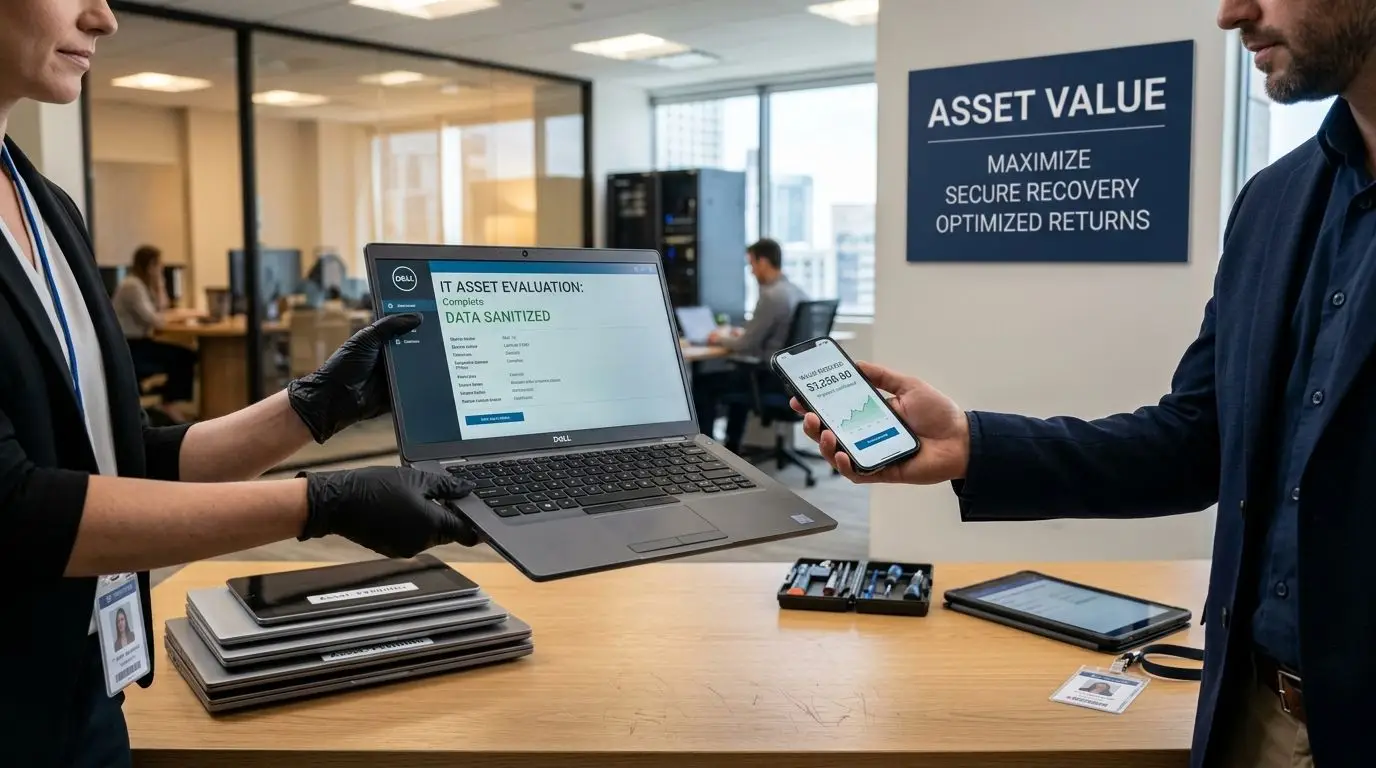
Many Atlanta businesses can access free recycling services, but the stronger financial result comes from identifying assets suitable for refurbishment and resale, using donation pathways where appropriate, and avoiding the hidden costs tied to improper disposal, as explained in this review of electronics recycling cost and value considerations.
Focus first on asset triage
Not every retired device belongs in the same bucket. The fastest way to lose value is to treat all electronics as scrap.
Use a simple triage model:
- Reuse or redeploy: Equipment that still fits an internal need
- Buyback or resale evaluation: Newer laptops, servers, networking gear, and business-class devices in workable condition
- Donation candidate: Devices with community usefulness after secure sanitization and any needed refurbishment
- Commodity recycling: Obsolete, damaged, incomplete, or nonfunctional items with no practical second life
Here, inventory quality directly affects ROI. If your list is incomplete or inaccurate, valuable items get buried inside mixed loads.
Understand where value really comes from
Buyback discussions often go sideways because teams expect every old device to have cash value. In practice, value is selective. Business-class laptops, recent network hardware, and certain server equipment usually merit closer review. Very old, damaged, or incomplete items often don’t.
The financial upside can also come from places that aren’t immediate cash:
| Value source | How it helps |
|---|---|
| Resale or buyback | Offsets handling and processing costs on eligible equipment |
| Donation pathways | May support tax treatment for qualifying donations |
| Free pickup eligibility | Reduces logistics expense for consolidated business loads |
| Avoided internal labor | Saves IT and facilities time otherwise spent storing and sorting assets |
| Avoided penalties and breach costs | Reduces downside tied to poor disposal practices |
If your organization wants to explore resale pathways, Reworx has a page describing equipment buyback programs for offices.
Use cost discipline, not just price shopping
The cheapest quoted pickup isn’t always the lowest-cost program. Look at the full workflow.
A better cost strategy usually includes:
- Consolidate loads before scheduling service. Small ad hoc pickups create more friction and administrative overhead.
- Stage assets in an accessible area. Ground-floor or dock-level pickup usually reduces handling issues.
- Separate high-value assets early. Don’t let potentially reusable laptops travel in the same unmanaged pile as broken peripherals.
- Clarify fees for specialty items. Medical devices, batteries, or unusual equipment may need different handling.
- Plan around refresh cycles. Programmatic pickups beat emergency cleanouts.
The biggest ROI gain usually isn’t squeezing a lower disposal fee. It’s preventing good assets from being treated like low-grade scrap.
Think in lifecycle terms
Finance teams often respond well when ITAD is presented as lifecycle management rather than disposal. You purchased the asset, used it in operations, depreciated it, and now you’re deciding how much control and value you’ll preserve at end of life.
That framing creates better decisions. It helps procurement, IT, and sustainability work from the same playbook instead of handing the issue off at the end.
Your Launch Kit Sample Checklists and Communication Templates
Execution improves when the company uses short, repeatable tools instead of rewriting the process every time. The launch kit below is designed for an Atlanta office cleanout, technology refresh, or recurring electronics recycling program.
Internal announcement template
Use a short employee message like this:
We’re launching a formal electronics recycling and IT equipment disposal process for retired company devices and approved peripherals. If your team has old laptops, monitors, docking stations, phones, or other business electronics, place them only in the designated collection area and do not leave items in hallways or common spaces. Devices that may contain data must be routed through the approved IT process before pickup. Contact [internal owner name] with questions about accepted items, timing, or special handling.
That message works because it does three things. It defines the program, tells people where to put equipment, and stops informal disposal behavior.
Office cleanout checklist
For an office cleanout or floor-by-floor sweep, use a checklist that’s easy to assign:
- Confirm scope: Identify which rooms, departments, or storage areas are included.
- Freeze movement: Tell staff not to relocate retired equipment without approval.
- Review inventory method: Decide what gets serialized and what can be counted by category.
- Separate media-bearing assets: Laptops, desktops, servers, copiers, and drives should not be mixed casually with accessories.
- Prepare the staging area: Use a secure, clearly labeled location with limited access.
- Coordinate building logistics: Reserve dock access, freight elevator time, or after-hours entry if needed.
- Assign day-of roles: One person manages the vendor, another reconciles the inventory, and another handles internal questions.
- Collect final records: Store certificates, manifests, and reporting in your compliance folder.
If your project overlaps with a relocation or large internal restack, outside planning resources can help. Some of the same coordination principles used in expert office move strategies also apply to electronics removal, especially around sequencing, labeling, and site access.
Corporate e-waste drive template
For a broader employee or community-facing event, keep the scope controlled. State whether the event is company-only or public-facing, define accepted categories, publish cutoff dates, and make data handling rules explicit. If the event includes donation-eligible equipment, say so clearly and separate that stream operationally from scrap recycling.
A simple planning format looks like this:
| Item | Decision to make |
|---|---|
| Event scope | Internal only or community-facing |
| Accepted equipment | Business IT only, or wider electronics categories |
| Data handling rule | Which items require IT review before release |
| Staging plan | Where items will be received and secured |
| Reporting output | What leadership wants documented after the event |
The companies that run these efforts well keep communication short, make ownership obvious, and avoid last-minute improvisation.
If your team is ready to turn old equipment into a controlled, documented, and more useful process, review the resources from Reworx Recycling. It’s a practical starting point for planning pickups, secure data destruction, donation-based recycling, and a more disciplined IT asset disposition program for Atlanta operations.