When your business retires old laptops, servers, or even specialized medical equipment, what actually happens to all the sensitive data left on them? This is the exact question NAID AAA Certification was created to answer. Think of it as the gold standard for secure data destruction, ensuring any IT Asset Disposition (ITAD) vendor you hire is following the absolute strictest protocols for handling and destroying your confidential information.
Understanding the Core Value of NAID AAA Certification
For any IT manager, business owner, or corporate sustainability leader, managing end-of-life electronics is a massive responsibility. Just wiping a hard drive or handing old computers over to a random recycler leaves a significant security gap. This is where NAID AAA Certification comes in, providing a critical layer of real-world assurance for your IT equipment disposal strategy.
Don't mistake it for a simple membership plaque on a wall. It’s an ongoing, tough-as-nails audit process—almost like a financial audit, but for your data's security.
This certification goes way beyond just promises. It offers tangible, verifiable proof that a partner like Reworx Recycling adheres to the highest industry benchmarks for protecting your information. As a social enterprise focused on donation-based recycling, we understand that secure data destruction is the first critical step in a responsible ITAD process. The entire system is designed to eliminate risk at every single step of the IT disposal journey.
What Does Certification Truly Guarantee?
Choosing a certified partner means you’re handing your assets to a provider whose entire operation has been put under a microscope. The auditors are meticulous, focusing on key areas that matter most:
- Employee Vetting: Every single employee with access to your confidential materials has to pass extensive, three-level background screenings. This is all about preventing internal threats before they can even start.
- Secure Chain of Custody: From the moment that equipment leaves your office during a facility cleanout, its movement is tracked and documented. There are no blind spots, ensuring no device ever goes missing.
- Operational Security: The physical facility itself is a fortress. We’re talking 24/7 surveillance, strict access controls, and other measures designed to keep unauthorized people out.
- Verified Destruction Processes: The certification validates the exact methods used for destruction. Whether it’s physically shredding hard drives into tiny pieces for product destruction or using sophisticated software for secure data erasure on SSDs, the process is proven to work.
Developed by the National Association for Information Destruction (NAID) and now managed by i-SIGMA, this certification isn’t a one-and-done deal. It’s maintained through both scheduled and random unannounced inspections. That’s the key part. Auditors show up unannounced to verify compliance across more than 20 critical operational and security areas, from employee training records to insurance coverage. This ensures standards are being met every single day, not just on a planned inspection day.
This rigorous process transforms a vendor's claim of being "secure" into a verifiable fact, giving your business a defensible audit trail. Taking the time to understand the various e-waste certification standards is one of the most important things you can do to make an informed decision.
Inside the Rigorous NAID AAA Audit Process
Getting a NAID AAA Certification isn't as simple as just paying a fee and getting a sticker. It’s a demanding process that requires passing a tough, multi-faceted audit that constantly stress-tests a vendor's entire security system for data center decommissioning, medical equipment disposal, and all other forms of ITAD.
Think of it as a surprise pop quiz for data protection. Auditors can, and often do, show up completely unannounced to make sure a vendor is compliant at all times—not just on a scheduled inspection day.
It’s this unannounced audit that really gives the certification its teeth. It forces vendors to stay in a perpetual state of readiness. The processes they use on any given Tuesday have to be just as secure as the ones they promise in their marketing materials.
The Pillars of a NAID AAA Audit
When the auditors arrive, they don't just glance at paperwork. They get their hands dirty, physically inspecting facilities and digging into procedures from top to bottom. They focus on several key pillars to verify unwavering compliance. These aren't just suggestions; they are non-negotiable requirements for earning and keeping the certification.
- Physical and Operational Security: This covers everything from the building's perimeter security and alarm systems to 24/7 video surveillance. They'll also check the specific access controls that keep unauthorized people out of sensitive areas.
- Employee Vetting: Every single employee with access to confidential material has to go through rigorous, recurring background checks. Auditors make sure these checks are up-to-date and that all hiring rules are strictly followed.
- Chain of Custody: From the exact moment your assets are picked up, a secure and unbroken chain of custody must be documented. Auditors will pore over these logs to ensure there are zero gaps where a device could get lost or compromised.
- Destruction Process Verification: The actual equipment used for destruction is inspected, whether it’s a massive industrial shredder for hard drives or sophisticated software for data erasure. Auditors confirm it’s calibrated correctly and can destroy media to the required specifications.
This visualization shows the straightforward but rigorous path from vendor application to achieving certified status.
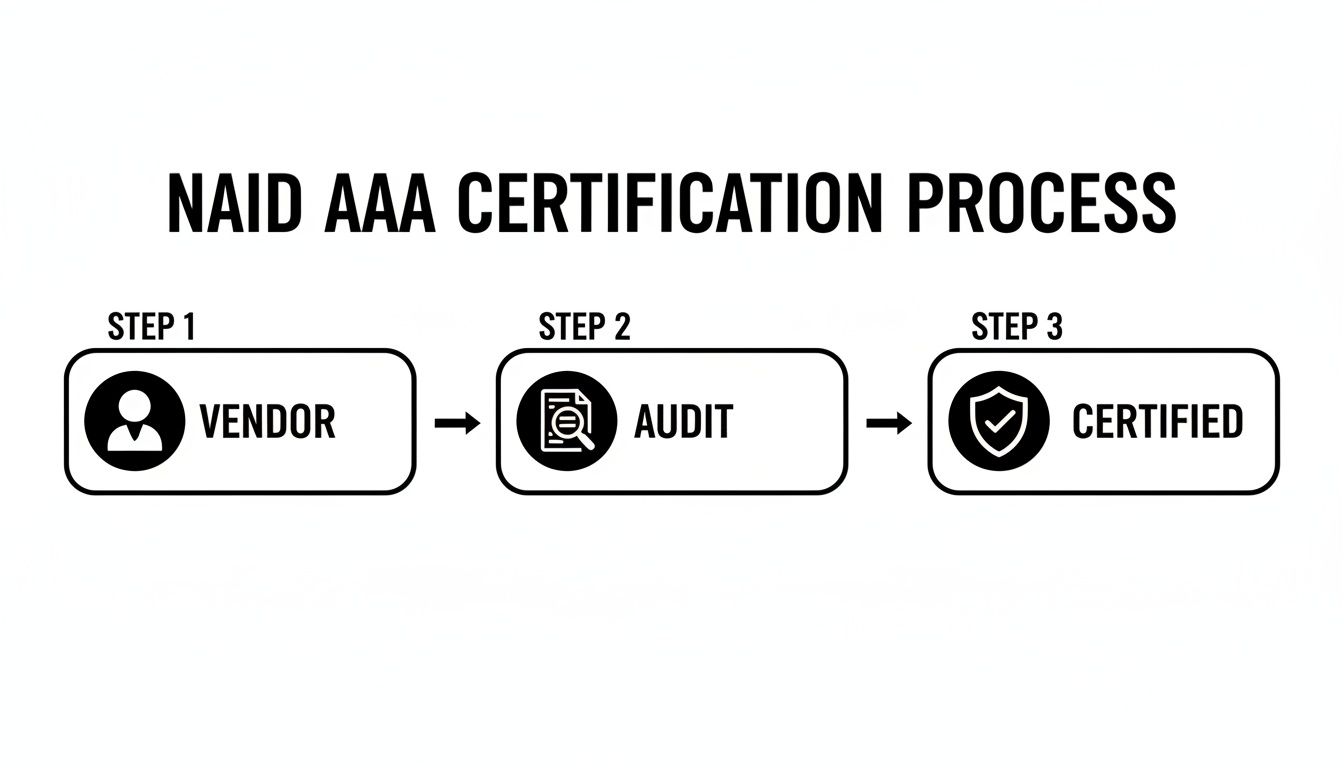
As you can see, the audit is the critical gatekeeper, making sure only those who meet the highest standards earn the final shield of certification.
To give you a clearer picture, here's a breakdown of the core areas that get put under the microscope during an audit.
Key Areas Scrutinized in a NAID AAA Audit
This table breaks down the core operational and security domains that are rigorously inspected during a NAID AAA certification audit, providing clarity on the comprehensive nature of the standard.
| Audit Domain | Description of Scrutiny |
|---|---|
| Facility Security | Inspectors walk the entire facility, checking for secure perimeters, access control systems, alarm monitoring, and comprehensive video surveillance coverage. |
| Personnel Screening | Auditors verify that every employee with access to sensitive materials has undergone a thorough, recurring background check, including criminal record and drug screenings. |
| Chain of Custody | The entire process is reviewed, from secure collection containers and transport vehicles to the detailed logs that track assets from the client's door to final destruction. |
| Destruction Equipment | The physical shredders, degaussers, or erasure software are inspected to ensure they meet particle size requirements and function correctly according to manufacturer specs. |
| Insurance & Liability | Auditors confirm the vendor carries the required levels of professional liability insurance to protect clients in the event of a data breach. |
| Training & Policies | Employee training records and written security policies are reviewed to ensure they are current, comprehensive, and consistently enforced. |
This intense level of scrutiny is precisely why NAID AAA Certification has become the most recognized standard in the world for secure data destruction. It's not a one-and-done deal.
Certified Protection Professionals (CPPs) are the ones scrutinizing everything from information destruction procedures to employee training and liability insurance. If a vendor has repeat violations, they risk getting kicked out of the program entirely.
For companies like Reworx Recycling, living up to these standards is just how we operate. It proves our commitment to operational excellence and gives our clients the verifiable proof they need. Before sending your assets our way, you can get them ready by learning more from our guide on IT inventory audits. This constant state of audit-readiness is what truly separates certified providers from everyone else.
Connecting Certification to Your Regulatory Compliance
If your business handles any kind of sensitive data, you know that compliance isn't just a good idea—it's the law. This is where partnering with a NAID AAA certified vendor becomes one of your most powerful risk management tools, drawing a direct line between how you dispose of old IT assets and your legal obligations.
Think about regulations like the Health Insurance Portability and Accountability Act (HIPAA) or the Fair and Accurate Credit Transactions Act (FACTA). These laws don't just ask you to protect information; they demand it through every stage of its life, especially at disposal. Simply tossing old hard drives in a bin isn't just a bad idea; it's a direct violation.
Working with a NAID AAA certified partner gives you the documented proof of due diligence that regulators look for. It’s tangible evidence that you took verifiable, audited steps to secure data, which is a game-changer during an audit or in the aftermath of a potential breach.
From Simple Receipt to Legal Defense
When a NAID AAA certified vendor destroys your assets, they issue a Certificate of Destruction. This isn’t just a piece of paper or a receipt for services. It's a legally defensible record that becomes a cornerstone of your compliance audit trail.
The certificate is a formal transfer of liability for that data from your company to the destruction vendor. It acts as your ironclad proof that you fulfilled your duty of care, shielding your company from hefty fines and the reputational fallout of a breach.
For instance, a healthcare provider facing a HIPAA audit can present this certificate as hard evidence that patient data from decommissioned medical equipment was properly destroyed. Suddenly, that certification goes from a "nice-to-have" to an absolutely essential part of your compliance strategy. Understanding how NAID AAA helps prevent a business data breach is key to seeing its full value for your regulatory efforts.
Meeting Industry-Specific Mandates
Every industry has its own unique compliance hurdles, and NAID AAA certification provides a solid framework to clear them. The standard's stringent requirements are built to align with the data protection clauses baked into major regulations.
- Healthcare (HIPAA): This law demands the secure disposal of Protected Health Information (PHI). NAID AAA's audited and documented destruction processes deliver exactly the proof you need.
- Finance (FACTA/GLBA): These acts mandate the protection of consumer financial data. The secure chain of custody and employee screening at the heart of the certification help you meet these strict rules.
- Education (FERPA): This protects the privacy of student education records. A certified partner guarantees that old school computers and servers are sanitized in a fully compliant way.
By choosing a partner who lives and breathes these standards, you're not just reacting to regulations—you're proactively embedding them into your ITAD program. At Reworx Recycling, our processes are designed to meet these high benchmarks, ensuring our partners get the documentation they need to prove compliance without a second thought. You can see more about our commitment in our overview of data security and e-waste recycling. This focus is what makes NAID AAA a critical tool for any IT or compliance leader.
How NAID AAA Differs From Other Industry Standards
In the world of IT equipment disposal, you'll often hear about certifications like R2 (Responsible Recycling) and e-Stewards. So, how does NAID AAA fit into the picture? It’s important to see them not as competitors, but as specialists with different—and highly complementary—missions.
Think of it like this: R2 and e-Stewards are the general practitioners for your IT asset disposal program. They give a comprehensive check-up, making sure a vendor handles the broad environmental, health, and safety side of sustainable recycling. Their main job is to ensure responsible materials management and keep e-waste out of landfills, a goal supported by credible sources like the EPA e-waste pages.
NAID AAA, on the other hand, is the cardiologist—a highly focused specialist. Its one and only concern is the lifeblood of your business: your data. It doesn't get into the weeds of environmental compliance; instead, it intensely scrutinizes every single step of the data destruction process, from employee background checks to the final particle size of a shredded hard drive.
Complementary Roles for Complete Assurance
A vendor holding only an R2 or e-Stewards certification has proven their commitment to being environmentally responsible. That's a great start. But it doesn't automatically mean their data security processes have survived the rigorous, unannounced audits that define NAID AAA.
Conversely, a vendor with only NAID AAA has proven their data security is top-tier, but that credential says nothing about their downstream recycling practices. The absolute gold standard is a partner who holds both. This dual certification shows a total commitment to protecting your company from every angle—both environmental liability and data breach risks. You can dig deeper into what makes for a strong electronics recycling certification over on our blog.
The industry itself has recognized this powerful synergy. In a landmark move, the Basel Action Network (BAN) adopted NAID AAA Certification as a mandatory requirement for all e-Stewards Certified Recyclers. The goal was to create a single, unified standard for the industry. This move combines rigorous environmental protocols with unmatched data security auditing—a philosophy Reworx Recycling champions wholeheartedly.
A Broader Look at Auditing Standards
While NAID AAA is hyper-focused on the specific process of secure data destruction, it helps to see it in the context of other well-known business standards. For instance, many global companies are familiar with ISO 9001, which also relies on comprehensive audits. Understanding the ISO 9001 audit requirements can clarify how different certifications use structured verification to ensure quality management and system integrity, just as NAID AAA does for data security.
How to Vet Your ITAD Vendor's Security Claims
Trusting a vendor’s security claims without checking them out is a huge business risk. The good news is that doing your homework on a potential ITAD partner is a pretty straightforward process that cuts right through the marketing fluff and gets you to the facts. The single most reliable step you can take is to verify their NAID AAA certification status yourself.
You don't have to take a salesperson's word for it. The International Secure Information Governance & Management Association (i-SIGMA), the group that manages NAID, keeps a public directory of every certified provider. A quick search on their official website will confirm if a vendor's certification is active and what it actually covers—like plant-based shredding versus mobile destruction—and for which specific types of media.
Asking the Right Questions
Once you've confirmed their status, it's time to dig a little deeper. A truly transparent partner will welcome your questions about their process.
A vendor’s willingness to openly discuss their security protocols is often as important as the certification itself. It reflects a culture of accountability and a genuine commitment to protecting your assets, which are core principles at Reworx Recycling.
Instead of just asking, "Are you certified?" use the questions in the table below to get into the nitty-gritty details.
Essential Questions for Your Potential ITAD Vendor
Here’s a checklist of critical questions to ask a potential electronics recycling or data destruction partner. These will help you make sure they meet the high security standards you expect, similar to those required for NAID AAA.
| Question Category | Specific Question to Ask | Why It Matters |
|---|---|---|
| Certification Scope | Is your NAID AAA certification for plant-based operations, mobile services, or both? | This makes sure their certification actually matches the service you need. If they're certified for in-house shredding but you need them to come to you, there's a mismatch. |
| Media Types | Does your certification specifically cover the destruction of solid-state drives (SSDs) and other flash media? | SSDs and traditional hard drives require completely different destruction methods. A generic certification might not cover the newer tech you're getting rid of. |
| Employee Screening | Can you describe your employee background check and drug screening process? | This speaks volumes about their internal security. The people handling your sensitive data need to be thoroughly vetted, no exceptions. |
| Chain of Custody | What does your documented chain of custody look like from pickup to final destruction? Can I see a sample Certificate of Destruction? | A rock-solid, unbroken chain of custody is non-negotiable. You need proof of a secure, documented trail for every single asset. |
Asking these targeted questions will give you the confidence to choose a partner who not only claims to be secure but can actually prove it every step of the way. Learning about the key factors for choosing an e-waste recycling partner can also give you a broader framework for making the right call.
Achieve Compliant and Responsible ITAD with Reworx
Choosing the right partner for your IT Asset Disposition (ITAD) is where security, compliance, and corporate responsibility all intersect. We've spent this guide exploring why NAID AAA certification is the gold standard for secure data destruction—it’s the benchmark that truly matters for everything from simple computer recycling to a full-scale data center decommissioning.
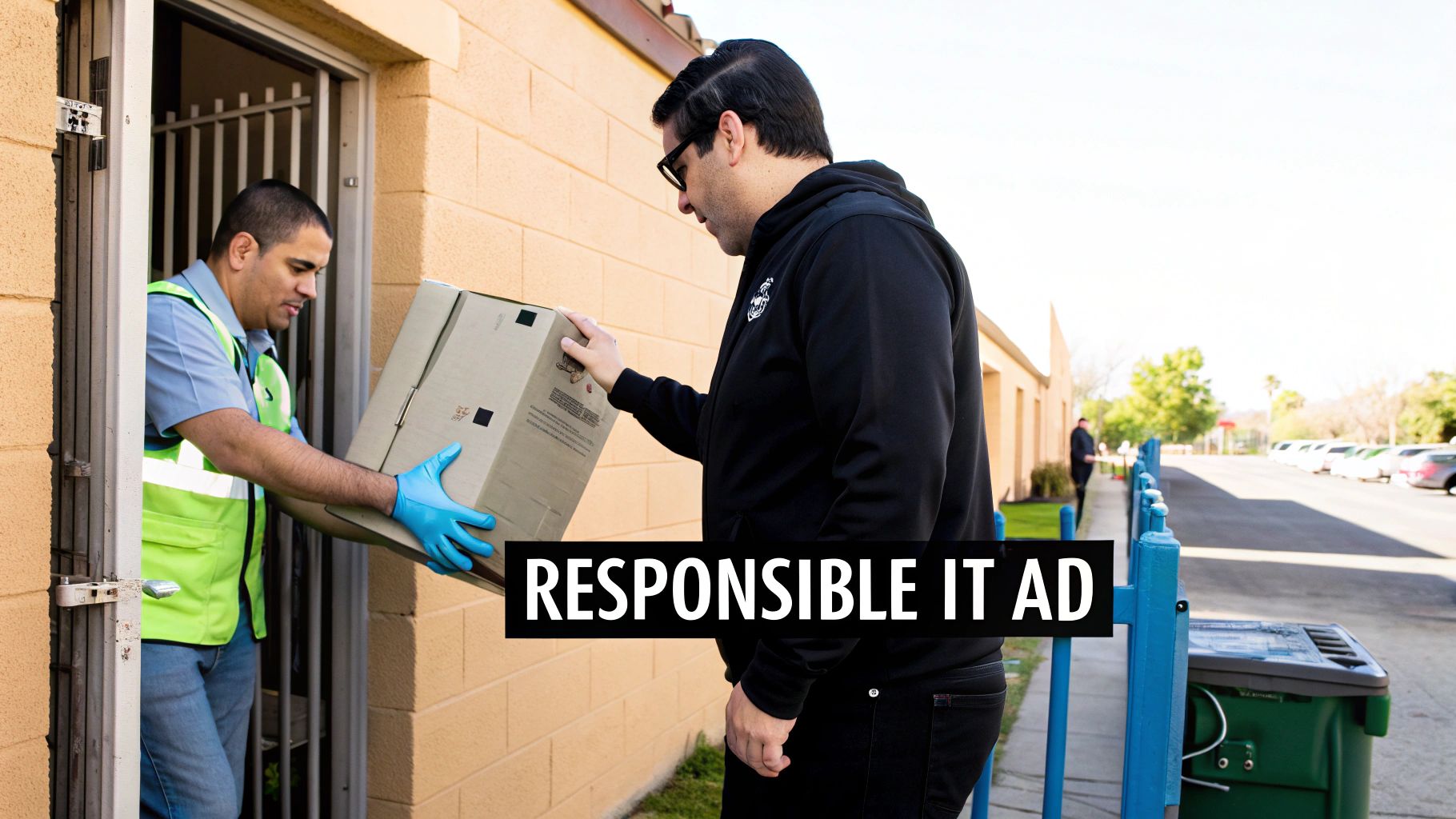
Here at Reworx Recycling, our processes are built from the ground up to meet these strict benchmarks. This isn’t just about checking a box; it’s about giving your organization total peace of mind, knowing every piece of sensitive data is handled with audited, verifiable precision. We deliver the secure chain of custody and detailed documentation you need to satisfy even the most demanding regulatory requirements.
More Than Security—It’s a Social Mission
But our commitment doesn't stop at data security. As a donation-based social enterprise, we tie our rigorous ITAD processes directly to a powerful community mission. The very same equipment we securely process also creates life-changing opportunities.
By partnering with Reworx, your choice does more than protect your organization from a data breach. It becomes an engine for positive social impact, directly supporting digital inclusion and workforce development programs.
This dual focus transforms a routine operational task into a meaningful act of corporate citizenship. Your retired assets don't just disappear. They are first managed responsibly to protect your data, then repurposed through corporate donation programs to empower others. It’s a seamless blend of risk management and community investment.
This approach ensures your electronics are handled with the highest standards of security while also creating a tangible, positive legacy. You’re not just closing a chapter on old technology; you’re helping to write a new one for someone in our community.
Ready to implement an ITAD strategy that delivers both top-tier security and measurable social good? Partner with Reworx Recycling for your next office cleanout or equipment upgrade.
Contact Reworx Recycling today to schedule a secure pickup and turn your retired IT assets into a force for good.
Got Questions About NAID AAA Certification? We've Got Answers.
When you're digging into data destruction, a lot of questions come up. It's a complex world, but getting the details right is non-negotiable. Here are some clear, straightforward answers to the questions we hear most often about NAID AAA certification.
Does NAID AAA Certification Cover Solid State Drives (SSDs)?
Yes, and this is a big one. The NAID AAA certification standard absolutely includes specific rules for securely destroying all kinds of electronic media, and that definitely means modern Solid State Drives (SSDs).
An auditor verifies that a vendor has the right machinery and proven processes to completely destroy SSDs. This is so important because you can't destroy an SSD the same way you destroy an old spinning hard drive (HDD). It requires a different approach, usually shredding the drive into much smaller pieces to make absolutely sure every single memory chip is physically obliterated. When you're checking out a potential partner, always ask if their certification specifically covers the types of media your company uses.
What’s the Difference Between NAID Membership and Certification?
This is a critical distinction and a common point of confusion. Seeing the NAID logo is a good start, but membership and certification are worlds apart.
- NAID Membership: This just means a company pays dues to be part of the professional organization, i-SIGMA. It’s like joining a club. It says nothing about their security, processes, or whether they've ever been audited.
- NAID AAA Certification: This is the real deal. It means the company has passed a demanding, ongoing audit process. We're talking scheduled and surprise inspections that validate everything from their hiring practices to their destruction methods, ensuring they meet the highest industry standards.
For true security and compliance you can stand behind, you should only work with a vendor that holds an active NAID AAA Certification. Membership alone isn't enough.
How Does a Certificate of Destruction Actually Protect My Business?
Think of a Certificate of Destruction (CoD) from a NAID AAA certified provider as more than just a receipt—it's your legal shield. It’s a formal document that serves as undeniable proof that your company’s assets were destroyed securely and by the book.
This certificate builds a complete, defensible audit trail from your office to final destruction. Most importantly, it formally transfers the liability for that data from your shoulders to the destruction vendor. If a regulator ever comes knocking or you face a legal challenge, that CoD is your proof of due diligence and compliance with data privacy laws like HIPAA or FACTA. It’s a detailed, legally sound record that can protect your business from massive financial and reputational hits.
At Reworx Recycling, our entire process is built to align with these tough standards, giving you total security and peace of mind. Partner with us, and you can be confident your old IT assets are handled responsibly, securely, and in a way that helps our community. Check out our services and find more insights on our recycling blog.