Your loading dock has a half-dozen old laptops, a rack of retired network gear, maybe a few battery packs, and someone in facilities just asked whether the cleanup crew needs different PPE from the IT team. That's where worker protection standards stop being a legal phrase and start becoming a practical question: who is exposed, to what, and which rules apply?
For IT managers and recycling teams, the confusion is usually not about whether safety matters. It's about overlap. A decommissioning project can touch OSHA workplace rules, EPA pesticide-related protections in some environments, and ITAD controls for data handling, all in the same week. Reworx Recycling works in that space every day, where electronics recycling, secure data destruction, and facility cleanout planning have to fit into one workable process.
Defining Worker Protection Standards
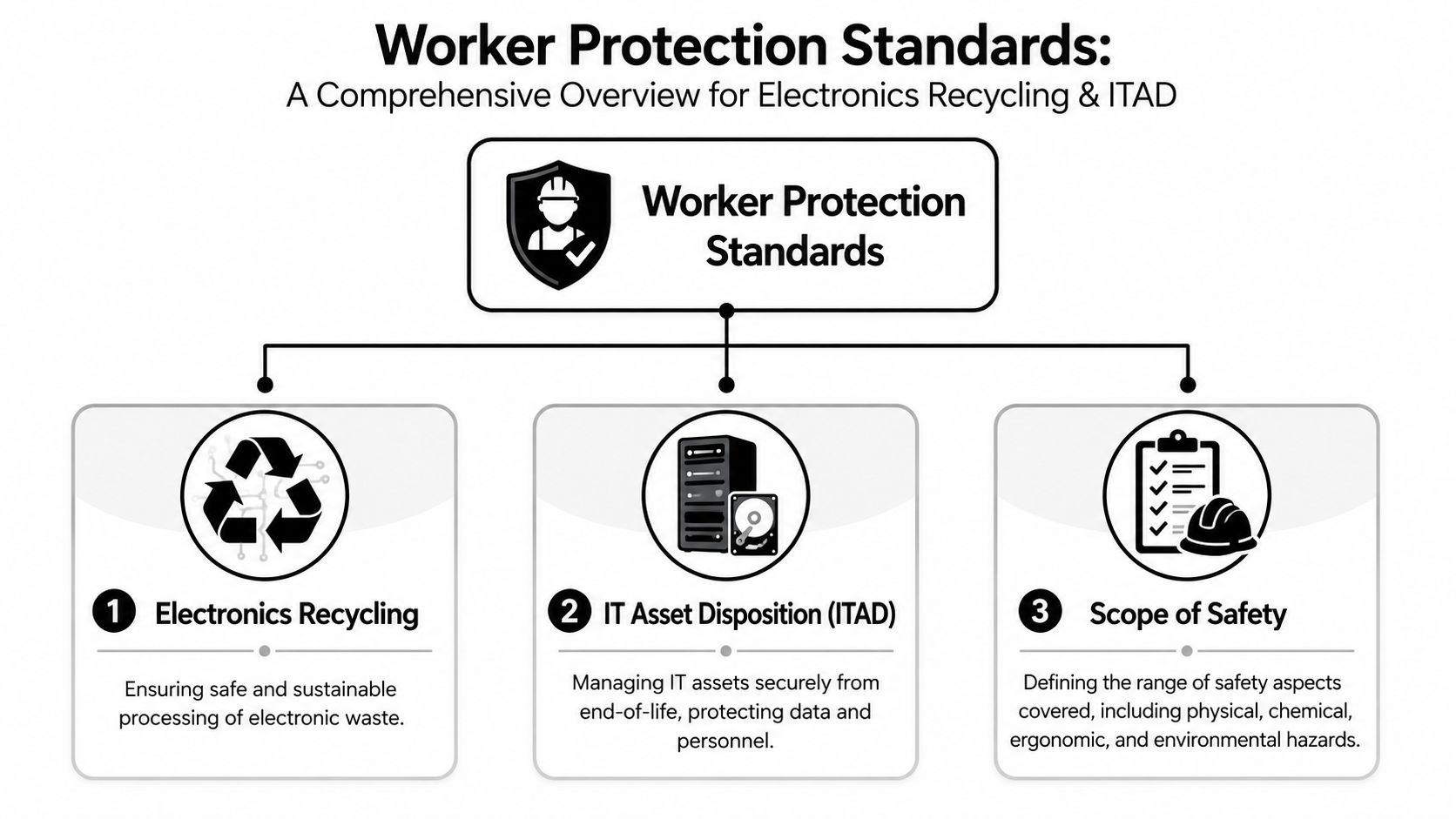
A recycling crew does not work from one rulebook. A warehouse technician lifting server cabinets, a grounds team clearing an outdoor area, and a handler sorting e-waste with damaged batteries can each face different protections. That is why worker protection standards is a practical umbrella term, not a single regulation.
A project can also shift between legal duties quickly. A facility may need OSHA rules for lifting, walking surfaces, and machine safety, then need EPA-related controls if pesticide-treated areas are part of the site, then need ITAD procedures for secure handling of retired equipment. If workers are also asking about injury coverage, a resource like California workers' comp for businesses helps separate insurance questions from workplace protection duties.
Start with the simple version
The term works like a checklist of requirements that keep workers from getting hurt, poisoned, overexposed, or left without help. In one setting, the issue may be falls from ladders or loading docks. In another, it may be chemical exposure, decontamination, warning signs, or emergency response.
OSHA's long-term safety record shows why formal standards matter. OSHA reports that worker deaths in the U.S. fell from about 38 per day in 1970 to 15 per day in 2023, while injuries and illnesses dropped from 10.9 incidents per 100 workers in 1972 to 2.4 per 100 workers in 2023 OSHA common stats. Those numbers do not mean the job is safe by default. They show that written standards, enforcement, and training changed outcomes over time.
Why mixed operations get confused
Electronics recycling sites often mix office cleanouts, pallet moves, palletized scrap, and occasional chemical handling. A crew may assume one standard covers everything, but OSHA's fall-protection rules focus on edges, ladders, and fixed-ladder systems, while EPA's Agricultural Worker Protection Standard centers on restricted-entry intervals, PPE, training, and decontamination OSHA overview of fall protection and WPS differences. When a workplace blends physical and chemical hazards, that distinction matters.
Practical rule: start by asking what the worker is touching, breathing, lifting, or entering. The answer usually points to the right standard.
For mixed-hazard operations, the first compliance question should be, “Which protection system applies here, and who is responsible for it?” That frame helps IT asset disposition teams, recycling yards, and facility cleanouts sort overlapping duties before work starts, especially when vendor staff and in-house staff work side by side. If a site also handles universal waste, the procedures in Reworx Recycling's universal waste guidance help connect storage, handling, and worker protection into one process.
Navigating Key Regulations and Industry Guidelines
A server-room decommissioning crew and a grounds team can work on the same property and still answer to different rules. That is where confusion starts. One group may be handling access control, lifting, and equipment removal. The other may be dealing with pesticide-treated areas, restricted access, and decontamination steps.
What each framework covers
OSHA general industry rules set the baseline for most facilities work. They address daily hazards such as walking surfaces, machine safety, and fall risks. EPA's Agricultural Worker Protection Standard follows a different model. It was originally issued in 1992 and revised in 2015, and EPA says it protects more than 2 million agricultural workers and pesticide handlers across more than 600,000 agricultural establishments EPA WPS overview. The required safeguards include annual pesticide safety training, decontamination supplies, emergency medical assistance, restricted-entry intervals, warning signs, and PPE rules.
That model fits pesticide exposure control, not an electronics recycling floor. WPS is built to prevent poisonings after treatment. OSHA fall rules are built to address physical hazards such as edges and ladders. On campuses, parks, sites with grounds crews, or municipal facilities, the first question should be which task is happening in front of the worker, because that determines which rule set applies.
Contractor-heavy work needs special attention
Outsourced work adds another layer. The Economic Policy Institute notes that weak enforcement, weak retaliation protection, and contractor-heavy workforces can undermine standards, especially where temporary agencies, subcontractors, or misclassification are involved. In practice, the host employer still has to know what protections are in place before the job starts.
If you are buying services for a facility cleanout or recycling program, ask for proof of the safety system, not just a price sheet. That means training records, hazard controls, and clear responsibility lines, not only a proposal. For teams sorting insurance and liability questions, California workers' comp for businesses is a practical reference when vendor labor and host-site exposure overlap.
Environmental certifications overview also helps procurement teams separate environmental controls from worker-safety controls. The two often travel together, but they answer different questions. One focuses on how materials are managed. The other focuses on how people stay protected while that work happens.
Identifying Hazards in Electronics Recycling
Most hazards in e-recycling are easy to miss because they look routine. A person carrying a broken desktop case sees scrap metal. A data center team sees retired equipment. A technician opening a damaged device may be the first person to notice a swollen battery, a cracked board, or residue that shouldn't be there.
Physical, chemical, and ergonomic risks
Physical hazards usually show up first. Sharp edges, crushed fingers, dropped monitors, and awkward lifts can happen during pallet moves, rack teardown, or office cleanout. Data center decommissioning adds its own strain because servers are dense, repetitive to move, and often awkward to stage for removal.
Chemical risks are less visible. Damaged components can involve lead, mercury, solvents, or battery-related exposure concerns. That's where battery labeling and segregation matter, especially if a site handles lithium-ion packs or damaged units. A practical external reference on battery safety is the guide to proper battery disposal, which is helpful context for teams that want to treat battery handling as a separate workflow, not an afterthought.
A hazard isn't “minor” just because it happens during normal operations. Repetition is what makes it expensive.
Map the workflow, not just the pile
The easiest way to find hidden risk is to walk the process in order. Intake, staging, dismantling, sorting, packing, and outbound pickup each create different exposures. A facility cleanout may lean toward lifting and trip hazards. A lab equipment disposal job may add residue, unknown contents, or stricter handling rules. A laptop disposal stream may look simple until a damaged battery shows up in the batch.
The internal label for battery handling also matters in practice. For teams that move mixed consumer devices or bulk returns, the UN 3481 labeling guidance is a useful anchor for keeping battery-related shipments and storage organized in the right lane.
The point is not to overcomplicate the job. It's to rank the risks by what's most likely to hurt someone and what would be hardest to control after the fact. That's the most reliable way to decide what PPE, training, or engineering control comes next.
Implementing PPE and Engineering Controls
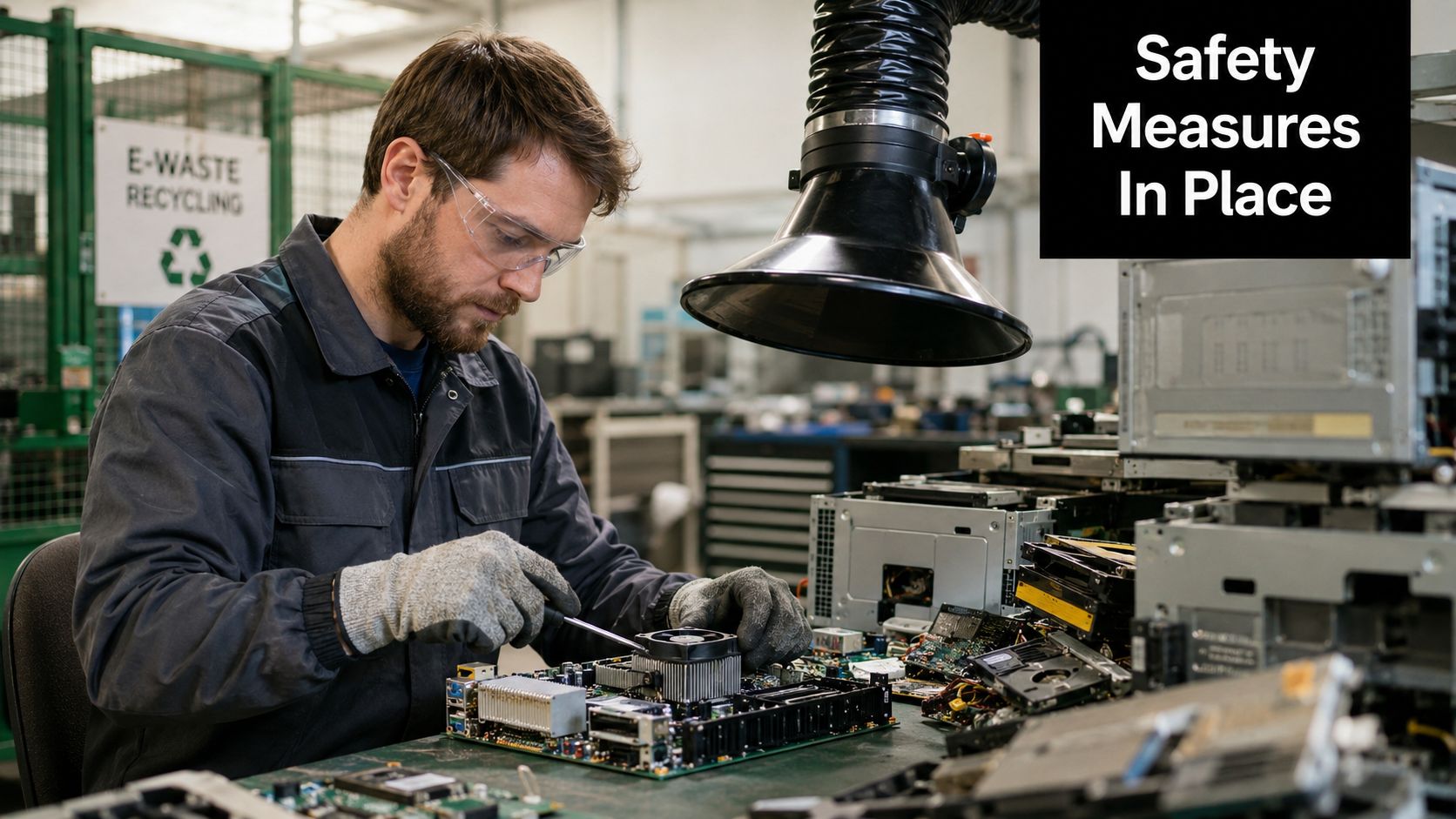
A recycling floor can look orderly and still hide serious risk. A sharp edge, a dust cloud, or a damaged battery can turn a normal task into an injury if the controls are chosen in the wrong order. That is why PPE comes after the work area has been designed to reduce exposure first, then protect the worker from what remains. A glove helps, but it does not solve a knife-edge problem by itself.
Match the control to the hazard
For lifting and moving, carts, lift tables, dollies, and clear travel paths reduce the chance that workers have to improvise with awkward loads. That matters in electronics recycling because a safe route for a boxed monitor is not the same as a safe route for a loose server chassis or a mixed pallet from an ITAD pickup. For sharp objects, cut-resistant gloves and covered bins help reduce hand injuries during sorting and dismantling. For dust, fumes, or unknown residues, local exhaust ventilation and designated containment areas do more than a mask alone can do.
The easiest way to choose the right control is to ask what kind of harm the task can create, then remove as much of that harm as possible at the source. If a workstation keeps producing debris, the problem is not only the PPE selection. It may be the layout, the tool choice, or the way material is fed into the process.
Engineering controls also need routine checks. Guards, vents, and lift equipment wear out, drift out of alignment, or get bypassed when a crew is busy. If supervisors do not inspect those controls on a schedule, the safest plan on paper can become the riskiest habit on the floor.
Build the PPE kit by task
Some jobs need a single layer of protection, while others need several. A sorting line may call for gloves and eye protection. A dismantling area may need face shields, cut-resistant sleeves, and task-specific footwear. A site that handles battery incidents needs an isolation and response procedure, not just a larger glove order.
The same idea shows up in other worker protection programs. EPA's WPS overview shows how specific protections are written when exposure is part of the job. The lesson for electronics recycling is straightforward. High-risk work needs controls that match the task, the material, and the person doing the work, not a generic rule that treats every station the same.
For IT managers and recycling teams building procurement checklists, Reworx Recycling's training and education resources can help connect job-specific controls with worker instruction in a real operation. For a related example of how organizations package repeatable instruction and track attendance, learn about HR compliance with VideoLearningAI.
Establishing Training and Documentation Systems
Safety programs fail when training lives in someone's memory instead of in a record. A strong system makes it easy to prove who was trained, what they were trained on, and when the refresher happened. That matters during an audit, after an incident, and when a contractor rotates onto the site.
Build training around the job, not a generic slideshow
A recycling training program should separate the forklift operator, the data destruction technician, the truck loader, and the supervisor. Each role sees different hazards. A good curriculum covers PPE use, incident reporting, battery handling, site traffic, emergency contacts, and the exact steps for stopping work when something looks wrong.
Annual refreshers should be short enough for completion and detailed enough that they remember the workflow. Video modules can help, especially for distributed teams or mixed contractor groups. For a practical outside reference on HR-style training delivery, VideoLearningAI's compliance training resource is a useful comparison point for how organizations package repeatable instruction without losing track of attendance.
Keep records where you can find them fast
EPA's WPS recordkeeping shows the value of disciplined document control. Employers must keep pesticide application information and safety data sheets on site before entry, display them for 30 days after the restricted-entry interval expires, and retain them for 2 years EPA WPS comparison chart. Even if your operation isn't agricultural, the logic is transferable, because exposed workers need timely information and supervisors need a paper trail.
Use a simple structure for records:
- Training log: who attended, what was covered, and who led it.
- Incident report: what happened, where, who responded, and what was changed.
- Inspection checklist: equipment, PPE, storage, housekeeping, and emergency supplies.
- Corrective action note: what got fixed and who verified it.
For operations that want a reusable framework, the compliance checklist template gives teams a practical way to organize records without improvising from scratch.
Creating an Implementation Checklist
The cleanest way to run a recycling or ITAD safety program is to turn the rules into tasks. That means assigning an owner, a deadline, and a proof point for each item. Without that structure, safety work gets absorbed into “we'll handle it later,” and later never arrives.
A usable checklist for mixed-hazard sites
- Map the hazards first. Walk each workflow, from intake to outbound shipment, and note physical, chemical, and ergonomic exposures.
- Assign the rule set. Decide whether the task falls under OSHA general industry controls, EPA pesticide protections, or site-specific customer requirements.
- Match controls to tasks. Choose carts, guards, ventilation, signage, PPE, and emergency tools based on the actual work.
- Train by role. Separate handlers, supervisors, drivers, and technicians so the instruction matches what they do.
- Document everything. Keep attendance, inspection notes, incident reports, and corrective actions in one system.
- Review contractor coverage. Make sure subcontractors understand site rules before work starts and know who to call during an incident.
- Recheck after a change. New equipment, a new vendor, or a new cleanout plan can change the hazard profile immediately.
Make the checklist auditable
Every task should leave behind evidence. A signed briefing, a dated inspection, a photograph of proper storage, or a corrected work order is much stronger than a verbal update. For IT managers, this is the difference between a clean audit trail and a scramble after something goes wrong.
This is also where Reworx Recycling's process-oriented approach fits naturally into a business workflow, especially for organizations that need electronics recycling, office cleanout support, or secure data destruction alongside broader compliance planning. The checklist isn't just about avoiding violations. It helps the team run the job the same way every time.
Pursuing Audits and Certifications
Certification programs are not the same as law, but they can help a team prove that it takes safety, environmental handling, and downstream accountability seriously. In electronics recycling, R2 and e-Stewards are the two names procurement teams usually compare first. They're related, but they don't feel identical in practice.
R2 and e-Stewards in plain English
R2 is often used by organizations that want a broad, operational framework for responsible electronics reuse and recycling. e-Stewards is often chosen by organizations that want a strong emphasis on downstream responsibility and environmental controls. Both can support corporate sustainability goals, but the audit path, vendor expectations, and documentation style can differ.
For teams that have never been through an audit, the practical challenge is usually not the standard itself. It's evidence. Auditors want to see that procedures exist, workers follow them, and exceptions are handled consistently. If you've already built hazard maps, training records, and corrective action logs, you're in a much stronger position.
Audit Certification Comparison
| Aspect | R2 | e-Stewards |
|---|---|---|
| Primary focus | Responsible electronics recycling and reuse systems | Strong environmental accountability and downstream controls |
| Audit style | Operational procedures and documented management systems | Certification framework with a strong emphasis on certified downstream handling |
| Common value to buyers | Helps demonstrate organized ITAD and recycling practices | Helps demonstrate strict environmental stewardship expectations |
| Best fit | Teams that want a broad responsible recycling framework | Teams that want a more stringent environmental branding position |
Certification works best when the facility already runs clean. The audit just proves it.
If your organization is weighing certification, start with the customer ask, the contract language, and the type of material you handle. That's usually more useful than chasing the loudest acronym.
Applying Best Practices for SMBs and Enterprises
A small recycler and a large ITAD program can follow the same worker protection principles without using the same playbook. The difference is scale and structure. A 10-person crew needs a simple system that people can remember on a busy floor, while a national operation needs tighter controls across sites, vendors, and contractor teams. Both need clear ownership, contractor oversight, and a way to learn from near misses before they turn into injuries.
What SMBs should prioritize
Smaller operations work best with a lean program. Start with a site map, a task-based hazard list, and short written procedures for incoming devices, damaged batteries, and emergency reporting. If a small crew cannot explain the process in a few minutes, the process is probably too complicated for daily use.
Reworx Recycling is one option businesses sometimes look at when they want electronics recycling tied to donation-based recycling, data destruction, and pickup coordination in one workflow. For a buyer, the value is the structure, not the slogan. One organized process is easier to train, easier to inspect, and easier to correct than three disconnected vendors.
What enterprises need to control
Larger organizations usually struggle with consistency across sites and vendors. A stack of policy pages does not solve that problem. Tighter contractor oversight, clearer service-level language, and regular reviews of incident trends do. The concern raised in EPI workplace standards analysis matters here because contractor-heavy workforces still create exposure for the host company, which means the host needs a clear safety system even when the work is outsourced.
Continuous improvement should work like a maintenance cycle:
- Review near misses quickly.
- Update equipment lists after each project.
- Re-brief vendors before major cleanouts.
- Keep one owner for each corrective action.
- Compare field practice to the written procedure every quarter.
That approach helps worker safety, ITAD controls, and sustainability goals support each other instead of competing for attention. When the procedure matches the work, the program is easier to run and easier to defend.