Your storage room is probably telling the story already. Retired laptops are stacked in bins. A few rack servers from a recent refresh are still sitting on pallets. Networking gear that “might be useful later” has turned into a dust-covered backlog that nobody wants to touch because the next step isn't simple.
That's where many IT managers get stuck. Selling surplus gear sounds attractive, but generic resale channels often create more work than value. You have to identify what still has market demand, wipe devices correctly, document condition, answer buyer questions, manage pickups, and still make sure non-sellable equipment goes through proper electronics recycling and IT equipment disposal.
A refurbished equipment marketplace can help, but only if you treat it as one part of a broader IT asset disposition process. For business owners, sustainability leaders, and facilities teams, the core decision isn't just “where can I sell this?” It's “how do I move equipment securely, recover value where possible, support sustainable recycling, and avoid creating a compliance mess?”
Why Enterprises Turn to Refurbished Equipment Marketplaces
A common scene in mid-sized companies looks like this: finance wants costs down, sustainability wants better reporting, and IT wants the old equipment out of the building before the next deployment wave arrives. The result is a practical problem, not an abstract one. Surplus gear takes up space, creates inventory confusion, and raises risk if drives haven't been processed properly.
Many teams start with manual methods. They call local buyers, test auction sites, or wait for an internal department to reuse equipment. That approach can work for a handful of devices. It breaks down fast when the list includes laptops, monitors, switches, servers, docking stations, and a few specialized devices from a facility cleanout or office cleanout.
The pressure behind this shift is larger than any one company. Globally the electronics waste stream generates approximately 62 million tons annually, a volume that has surged by 82% since 2010 and is projected to reach 82 million tons by 2030, according to global e-waste figures compiled by Business Waste.
Practical rule: If equipment is sitting in storage because no one owns the next step, you don't have an inventory issue. You have a workflow issue.
A dedicated refurbished equipment marketplace gives enterprises a more structured route. Instead of treating every device as a one-off resale project, the organization can sort gear into categories: reusable, remarketable, donation-ready, and end-of-life recycling. That's much closer to how mature ITAD programs operate.
For IT managers who need a clearer framework for retired PCs and similar assets, this strategic guide to refurbished PC computer planning is a useful companion read. It helps translate the broad idea of refurbishment into operational decisions.
What enterprises really buy when they use these channels isn't just a marketplace listing. They buy structure. They buy process. They buy a better way to align value recovery with secure data destruction, laptop disposal, computer recycling, and sustainability goals.
Understanding Refurbished Equipment Marketplaces
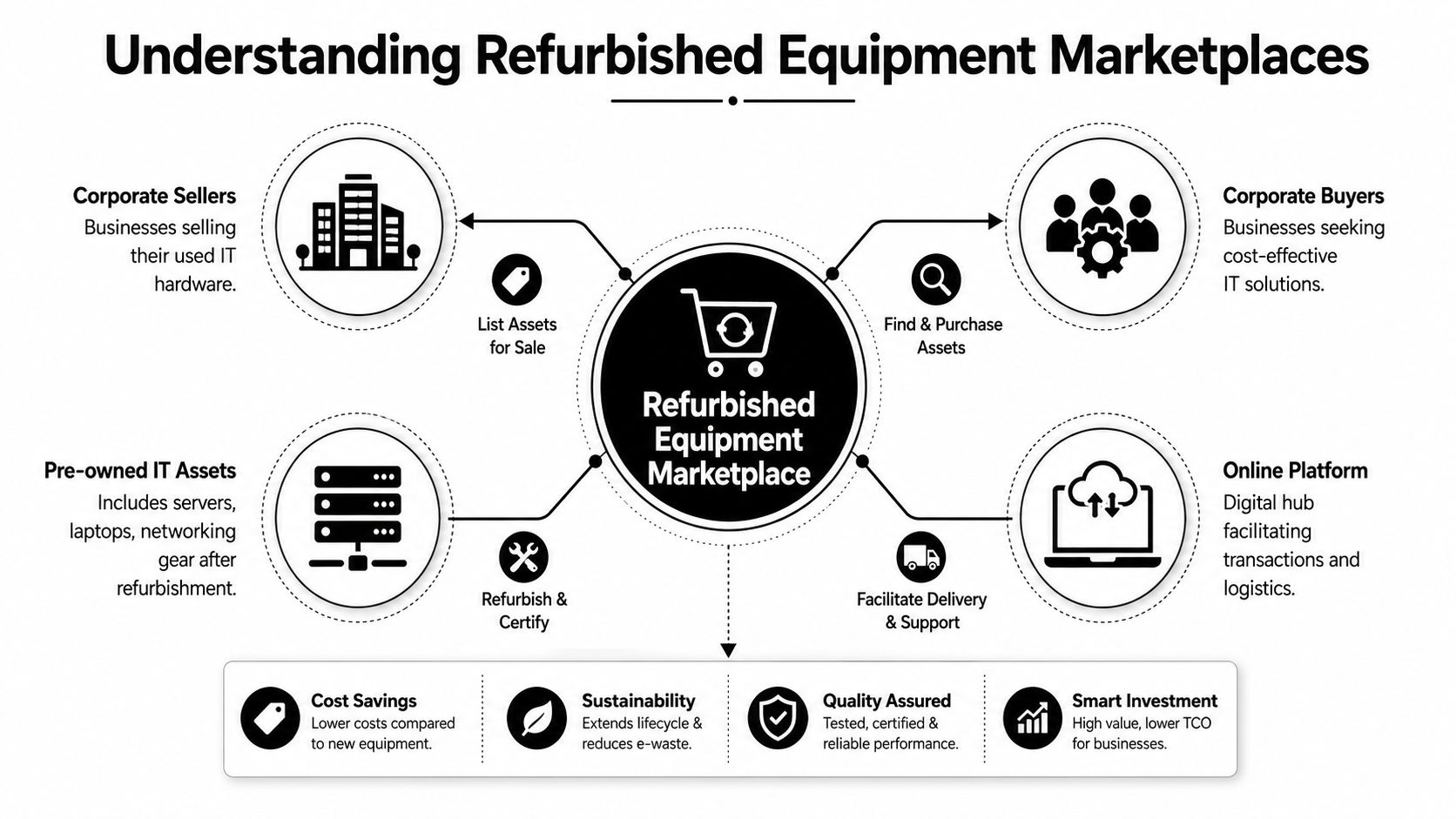
A refurbished equipment marketplace is best understood as a managed exchange for pre-owned hardware. It connects organizations that have surplus IT assets with organizations that want lower-cost equipment, but it adds rules around testing, grading, security, logistics, and post-sale expectations.
That's what separates it from a generic classifieds site or a simple online auction.
The easiest way to think about it
A generic resale site is like a flea market. A refurbished equipment marketplace is closer to a regulated exchange. Sellers don't just post “used laptops.” They usually have to describe condition in a standardized way, provide device details, and follow operational rules that make buyers more comfortable purchasing in volume.
That structure matters because the market is large and growing. The global refurbished electronics market was valued at $68.3 billion in 2025 and is projected to reach $185.6 billion by 2034, expanding at a CAGR of 11.7% from 2026 to 2034, according to DataIntelo's refurbished electronics market analysis.
For corporate buyers, that growth signals something important. Refurbishment is no longer a niche corner of secondary commerce. It's part of mainstream technology sourcing.
What flows through the marketplace
The inventory usually includes familiar business assets:
- End-user devices like Dell Latitude laptops, Lenovo ThinkPad systems, and Apple MacBook fleets
- Infrastructure hardware such as servers, switches, and storage gear from data center decommissioning projects
- Peripheral and office equipment tied to workplace refreshes, relocations, and facility cleanout efforts
- Specialized equipment that may connect with laboratory equipment disposal or medical equipment disposal workflows, depending on the marketplace and compliance requirements
Not every asset belongs there. Broken, obsolete, or unsupported equipment often belongs in electronics recycling or product destruction channels instead.
Why the controls matter
The most credible marketplaces reduce uncertainty. They define grading criteria, require data sanitization records, clarify who handles shipping, and set expectations around returns or warranties. Without those controls, “refurbished” can mean anything from fully tested and documented to “it powers on.”
That's why marketplace evaluation should always sit beside value recovery planning. If you're trying to estimate what old equipment may still be worth before choosing a route, this money for old electronics resource helps frame the decision in operational terms.
A strong marketplace doesn't just help you sell gear. It makes the condition, custody, and destination of that gear easier to defend internally.
For corporate sustainability leaders, that matters just as much as price. Reuse, donation-based recycling, IT asset disposition (ITAD), and secure retirement only work when the chain of handling is clear.
Evaluating Benefits and Risk Factors
Corporate demand dominates this space for a reason. Corporate offices represent the dominant end-user segment in the refurbished electronics market, holding a 42% market share in 2025 driven by IT managers seeking to reduce capital expenditures while meeting sustainability mandates, according to Transparency Market Research on refurbished electronics.
That headline makes sense when you look at the decision from both sides of the transaction.

Where the upside is real
Sellers use these marketplaces to clear storage, recover some value, and move retired assets through a more repeatable channel. Buyers use them to source devices without paying new-equipment pricing. Sustainability teams like them because extending equipment life can support circular economy goals more effectively than immediate disposal.
A simple example helps. If your company replaces a large laptop fleet, some devices may still be suitable for another business unit, a secondary buyer, or a corporate donation program. Others may only be useful for component harvest or computer recycling. A marketplace helps separate those paths instead of forcing a single all-or-nothing decision.
Benefits usually show up in four areas:
| Focus area | Why it matters |
|---|---|
| Value recovery | Resalable assets may offset part of refresh or decommissioning costs |
| Operational speed | Standardized intake and resale channels reduce ad hoc handling |
| Sustainability | Reuse can support sustainable recycling goals by extending device life |
| Procurement flexibility | Buyers can source tested hardware for lower-priority workloads |
Where teams get burned
The biggest risk isn't that a device won't sell. It's that companies confuse a listing platform with a compliant end-of-life program.
Problems usually come from weak grading, vague data handling, or poor logistics coordination. A laptop marked “good condition” may arrive with poor battery life. A server may be sold before chain-of-custody records are complete. A shipment may be delayed because the seller didn't palletize or serialize equipment correctly. In more sensitive environments, that can spill into legal, privacy, or customer trust concerns.
If the marketplace can't explain its grading logic, data handling standards, and exception process, treat it as a lead source, not a true disposition partner.
There's also a strategic lesson from large online channels. Companies evaluating resale options often compare specialized marketplaces with broad consumer platforms. That comparison should include brand control, margin pressure, and channel conflict. This overview of Amazon profitability and brand risks from Online Brand Growth is helpful because it shows how marketplace visibility can come with trade-offs that aren't obvious at first.
A balanced decision lens
Use a refurbished equipment marketplace when the platform improves confidence, documentation, and throughput. Don't use it just because it promises exposure. Exposure without process creates more tickets, more disputes, and more leftover equipment.
That's especially true in workflows involving secure data destruction, laptop disposal, office cleanout projects, or product destruction. In those settings, value recovery is only one goal. The stronger goal is controlled movement from active use to final destination.
Setting Your Marketplace Evaluation Checklist
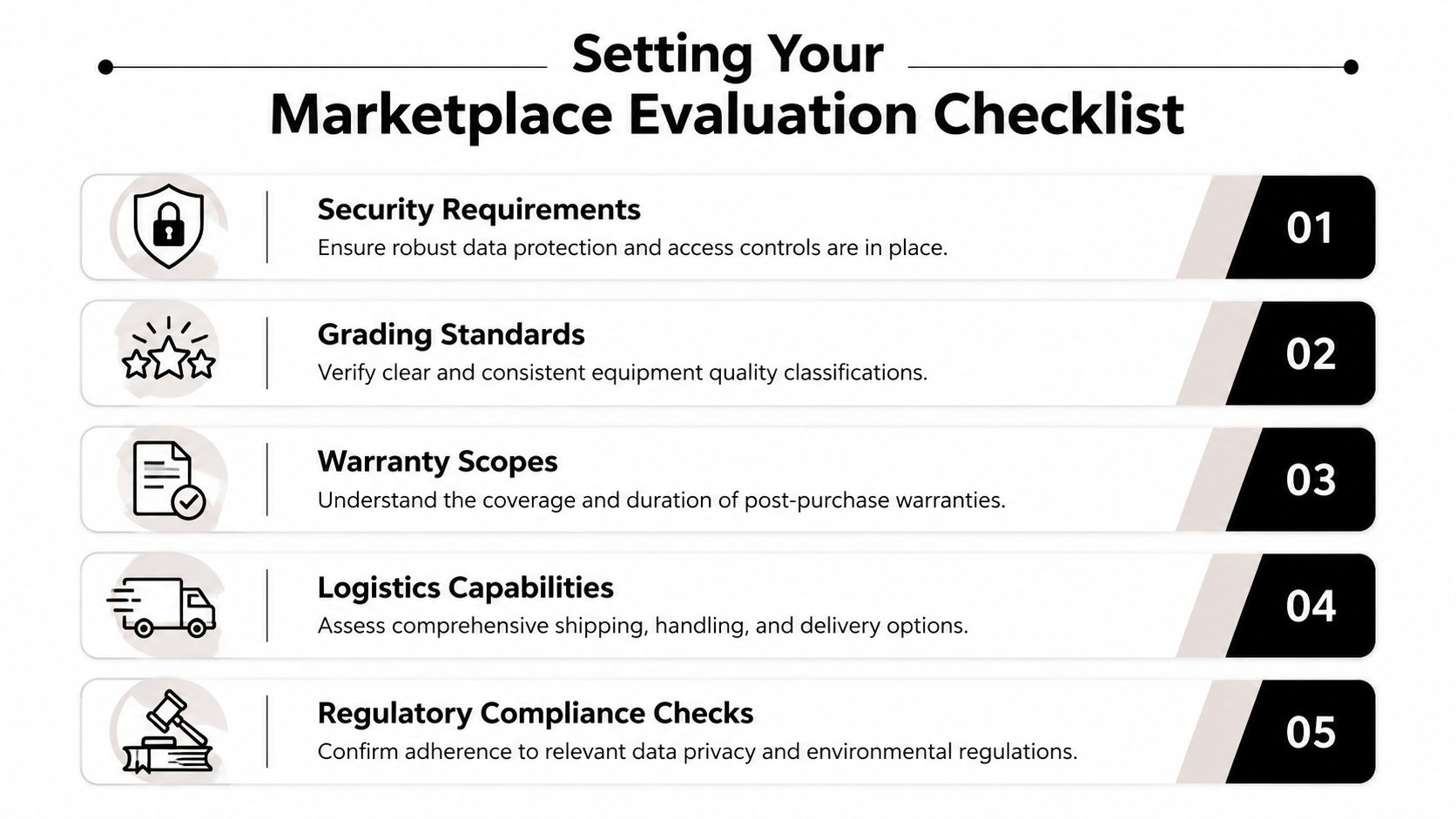
Rather than seeking a longer vendor list, what's often required is a more effective filter. When evaluating a refurbished equipment marketplace, use a checklist that forces every provider to answer the same operational questions.
Start with quality and security controls
One technical benchmark matters immediately. Authoritative grading standards mandate a minimum 80% battery capacity for portable devices and require certified data sanitization and cosmetic assessments, ensuring reliability and buyer confidence, as outlined in this review of grading standards and testing protocols.
That single requirement clears up a common confusion. “Refurbished” doesn't just mean cleaned up. It should mean measured against defined acceptance criteria.
Ask every marketplace these questions:
- Battery and hardware testing: How do you test laptops, tablets, and mobile devices? Do you document battery health, screen condition, keyboard function, and port performance?
- Data sanitization: What proof do you provide that drives were wiped, shredded, or otherwise processed through secure data destruction?
- Grading language: Are grades standardized and auditable, or are they based on seller opinion?
A practical framework for comparing service providers is this vendor selection criteria guide. It's useful when procurement, IT, compliance, and sustainability all need a shared scorecard.
Then examine the operating model
Marketplaces often look similar on the homepage. They differ in the hidden mechanics.
Review these areas carefully:
Warranty scope
Does the platform define what happens when equipment fails, arrives damaged, or doesn't match the listing? Short, vague warranty language usually signals weak control over refurbishment quality.Logistics capability
Who supplies boxes, pallets, labels, and pickup coordination? This matters in data center decommissioning, laboratory equipment disposal, and large office cleanout events where handling mistakes can delay the entire project.Regulatory fit
Can the provider support your privacy obligations, internal audit trail, and environmental reporting expectations? That question matters more than website polish.Seller onboarding discipline
If anyone can list high-value devices with minimal checks, buyer confidence drops. Strong onboarding often means fewer headaches later.
Checklist habit: Score each provider on evidence, not promises. If a claim can't be backed by a sample report, process document, or service definition, mark it as unverified.
For teams that want a broader digital lens on evaluation methods, Next Point Digital marketplace insights offer a useful perspective on how to test marketplace strength beyond surface-level features.
The goal isn't to find a perfect platform. It's to find one that makes your internal controls stronger, not weaker.
Best Practices for Selling Surplus IT Assets
Selling surplus hardware goes better when you treat it like a mini decommissioning project, not an afterthought. The teams that struggle most are usually the ones that start listing devices before they've sorted condition, ownership, accessories, and data status.
Audit first and sort aggressively
Begin with a physical and logical inventory review. Pull serial numbers, model names, processor type, memory, storage, accessory status, and power condition. Separate assets into clear groups such as resale candidates, donation candidates, parts-only units, and electronics recycling material.
This sorting step matters because a mixed pallet creates confusion fast. A buyer interested in tested Lenovo ThinkPad laptops may have no interest in a box of random docking stations, failed tablets, and unsupported VoIP phones. Clean lots sell more smoothly because the buyer understands what they're getting.
A practical sorting model looks like this:
- Resale-ready if the device is functional, supportable, and documented
- Donation-ready if it has practical use but lower resale appeal
- Recycle-only if it's obsolete, broken, incomplete, or unsafe to redeploy
- Destroy-only if product destruction or physical media destruction is required
Build a listing like a technical handoff
A strong listing reads less like marketing and more like an engineering handoff. Include exact model numbers, CPU generation, RAM, storage type, battery notes where relevant, installed operating system status, cosmetic grade, and whether chargers or rails are included.
Don't hide flaws. State them clearly. If a batch has mixed cosmetic condition, say so. If BIOS locks were removed, mention it. If a server lot excludes drives because secure data destruction already occurred, put that in the first lines of the listing.
Buyers don't punish honest listings. They punish surprises.
Photos matter too. Show screens powered on when possible. Photograph ports, labels, and included accessories. For networking gear and servers, clear front-and-rear images reduce repetitive buyer questions.
Price with channel discipline
Many IT teams guess at pricing based on a quick marketplace search. That's risky because asking prices don't tell you what sells. Instead, use channel logic. Premium, fully documented units can support tighter pricing. Mixed-condition lots, incomplete systems, or aging models usually need a faster-clearance mindset.
That doesn't mean racing to the bottom. It means knowing your objective. If your priority is to empty space before a facility cleanout deadline, pricing should support speed. If your priority is maximum recovery on a short list of current-generation devices, hold firmer.
For teams thinking about broader marketplace control, this resource on eBay MAP enforcement best practices from Market Edge is useful because it highlights how pricing governance and channel rules affect perceived value.
Prepare for pickup, questions, and exceptions
Most disputes happen after the sale, not before it. Avoid that by documenting chain of custody, packaging methods, and shipment contents before anything leaves the building. For a data center decommissioning project, note whether rails, faceplates, caddies, and power supplies are included. For laptop lots, confirm charger counts and packaging standards.
Use a simple readiness checklist before release:
- Serial validation: Confirm listed serials match physical inventory
- Data status: Verify wipe, shred, or drive removal status is complete
- Accessory count: Match chargers, docks, rails, and cables to the listing
- Packaging plan: Use pallets, anti-static protection, or device cartons appropriate to the equipment
- Escalation owner: Assign one person to answer buyer questions and handle discrepancies
If you're comparing resale with structured recovery paths, this guide to equipment buyback programs for offices helps frame where buyback fits relative to donation-based recycling and traditional disposal.
Keep unsold inventory moving
Some assets won't sell. Plan for that before listing starts. Create a timed decision point so unsold inventory moves into computer recycling, IT equipment disposal, or corporate donation programs instead of drifting back into storage.
That final step is what separates a good resale effort from a mature lifecycle program. The point isn't to list everything. The point is to move every asset to the right next destination.
Integrating Marketplaces with ITAD and Recycling
A refurbished equipment marketplace works best when it sits inside a larger ITAD workflow. If you treat resale as the whole program, you'll strand low-value assets and create bottlenecks around data handling. If you treat resale as one branch in a broader process, you can recover value without slowing down final disposition.

The broader need for that integrated approach is clear. The United States achieved a 38.5% recycling rate for selected consumer electronics in 2018, significantly below other materials, highlighting the need for specialized ITAD and refurbishment marketplaces, according to E-Cycling Central's review of U.S. e-waste recovery.
A workable hybrid workflow
A simple enterprise model often follows this sequence:
Audit assets internally
Identify what's reusable, remarketable, regulated, or ready for recycling.Complete secure data destruction
Wipe, remove, or physically destroy storage media based on policy and asset type.Route resale-eligible gear to marketplace channels
This includes tested laptops, supported servers, networking gear, and selected peripherals.Send non-sellable assets to ITAD and electronics recycling
Broken monitors, unsupported devices, damaged batteries, and obsolete accessories shouldn't clog resale queues.Document every destination
Sustainability reporting, internal audit reviews, and procurement follow-up all depend on clear records.
Where this matters most
The value of integration becomes obvious during larger events:
- Data center decommissioning often produces a mix of resale-grade servers, reusable rails, and end-of-life power or storage components.
- Office cleanout projects create a broader mix that may include laptops, monitors, phones, printers, and miscellaneous electronics that need different endpoints.
- Medical equipment disposal and laboratory equipment disposal require even tighter routing because condition, compliance, and intended reuse must be handled carefully.
A marketplace should be a valve in the process, not the whole pipeline.
That's why IT leaders often pair resale channels with formal IT asset disposition (ITAD) planning. This comprehensive guide to global IT asset disposition ITAD is useful if you're trying to connect resale, secure data destruction, sustainable recycling, and governance into one operating model.
When the workflow is designed well, assets don't pile up waiting for a perfect buyer. They move. Some go to resale. Some go to social enterprise recycling or donation-based recycling. Some go directly to compliant destruction. The important thing is that none of them lose custody or purpose along the way.
Leveraging Reworx Recycling Services
Not every organization needs to build its retirement strategy around a marketplace. In many cases, a donation-based recycling and ITAD partner is the more practical choice, especially when your priority is secure handling, community impact, and getting equipment out of the building without managing dozens of item-level sales decisions.
That's where Reworx Recycling stands out. As a social enterprise recycling provider, Reworx Recycling supports businesses that need responsible electronics recycling, computer recycling, laptop disposal, secure data destruction, and broader IT equipment disposal. That model is especially useful when your retired equipment includes a mix of resale-grade devices, donation candidates, and end-of-life hardware that belongs in sustainable recycling streams.
When direct service beats marketplace complexity
A marketplace is strongest when you have well-documented, clearly sellable equipment and the time to manage listings, exceptions, and logistics. Reworx Recycling is stronger when the project is broader and more operationally messy.
Examples include:
- Office cleanout and facility cleanout work where the priority is fast, organized removal
- Corporate donation programs where community benefit matters alongside environmental responsibility
- Product destruction and secure data destruction needs where control matters more than resale upside
- Mixed loads that combine reusable laptops, dead printers, old networking gear, and miscellaneous peripherals
A practical blended model
Many organizations will get the best result from a hybrid approach. Sell the equipment that clearly fits a refurbished equipment marketplace. Send the rest through a partner that can manage pickup, data handling, donation-based recycling, and environmentally responsible downstream processing.
That blended approach reduces internal labor. It also supports a mission-focused outcome. Reworx Recycling emphasizes responsible reuse, digital inclusion, and community support through technology donations and workforce development. For sustainability leaders, that can make the retirement process easier to explain internally because the outcome isn't just waste diversion. It's operational cleanup paired with social impact.
For companies that don't want old equipment lingering in back rooms while teams debate resale options, that clarity has real value.
Conclusion and Next Steps
A refurbished equipment marketplace can be a strong tool for corporate IT sales, but it works best when you evaluate it like an operational partner, not just a website. The key questions are straightforward. Can it support reliable grading? Can it fit your secure data destruction process? Can it move equipment quickly without leaving low-value assets behind? And can it plug into your broader IT asset disposition, electronics recycling, and sustainability workflow?
If you're planning a refresh, office move, data center decommissioning, or facility cleanout, start with an asset inventory and a routing decision. Separate what can be remarketed, what should be donated, and what belongs in compliant recycling or product destruction. Then compare partners against a real checklist.
The best programs don't chase resale alone. They create a complete path from use to reuse to responsible retirement.
If your business needs a practical partner for electronics recycling, donation-based recycling, secure data destruction, laptop disposal, medical equipment disposal, office cleanout support, or broader IT asset disposition, Reworx Recycling can help you donate old equipment, schedule a pickup, or build a responsible end-of-life program that supports both sustainability goals and community impact.