For most businesses, the storage closet crammed with old computers, servers, and monitors represents a logistical headache and a potential data security risk. It's often viewed as a sunk cost, already written off the books. But what if that pile of outdated tech isn’t just e-waste, but a hidden revenue stream?
For businesses in Georgia, particularly in bustling economic hubs like Atlanta, getting money for old electronics is a strategic financial move. The key is to partner with a certified IT Asset Disposition (ITAD) provider like Reworx Recycling. This simple shift in perspective can transform surplus technology from a liability into a valuable asset, supporting your bottom line and corporate sustainability goals.
Maximizing Returns from Retired IT Assets
The concept is rooted in the circular economy. High-quality business equipment, even after a few years of service, retains significant value. Key components like processors, RAM, and enterprise-level hard drives are in constant demand on the secondary market. A specialist in IT equipment disposal knows how to assess, securely refurbish, and resell these assets, sharing the profits directly with your business. This process, often part of data center decommissioning or a routine office cleanout, turns an operational cost into a revenue-generating activity.
The Booming Market for Used IT Equipment
This isn't a niche opportunity; it's a massive, growing global market. The worldwide electronics recycling market was valued at an impressive USD 43.2 billion in 2025 and is projected to skyrocket to USD 147.9 billion by 2035. That’s a staggering growth of over 242%.
What's driving this? PCs and laptops are the biggest players, making up 45% of the market because they're packed with valuable materials like gold, silver, and copper. For any business, this trend is a clear signal: your old IT gear is a commodity, not just trash. Suddenly, IT asset disposition becomes a strategic financial move instead of just another expense.
Beyond the Buyback: The Full Financial Upside
The financial benefits of a structured ITAD program extend far beyond the direct payment for your hardware. Consider the total value proposition:
- Cost Avoidance: You completely sidestep the costs of storage, transportation, and potential disposal fees for items that lack resale value.
- Risk Mitigation: Professional, secure data destruction is integral to the process, protecting your company from devastating and expensive data breaches, regulatory fines, and reputational damage.
- Resource Optimization: Your IT and facilities teams are freed from managing outdated hardware, allowing them to focus on core business objectives.
To maximize this value, an accurate inventory is essential. Many businesses use robust systems like asset management software to track equipment, identify assets ready for retirement, and capture their value before further depreciation.
Revenue Potential of Common Business Electronics
Not all electronics are created equal, and their value can vary widely based on age, condition, and brand. Even older gear can have valuable components. Here’s a look at what businesses can typically expect from common electronics in their inventory.
| Device Category | Factors Affecting Value | Typical Revenue Potential |
|---|---|---|
| Laptops & Desktops | Age (under 5 years is best), processor (i5/i7+), RAM, cosmetic condition. | $50 – $400+ per unit, especially for brands like Dell, HP, and Apple. |
| Servers | Processor generation, amount and type of RAM, storage capacity, form factor. | $100 – $2,000+ depending on specs. Even non-working units have value. |
| Networking Gear | Brand (Cisco, Juniper), model number, port count, and speed. | $50 – $1,500+ for switches, routers, and firewalls. |
| Smartphones & Tablets | Model, carrier lock status, screen condition, storage capacity. | $30 – $500+ per device. Bulk lots are highly desirable. |
| Monitors & Peripherals | Size, resolution, and brand. Generally lower value but can add up in bulk. | $5 – $50 per unit. Often included as part of a larger lot. |
As you can see, the numbers can add up quickly, especially during a large-scale technology refresh involving dozens or even hundreds of devices.
The Importance of a Strategic ITAD Partner
To effectively tap into this revenue, businesses need a partner that understands the entire IT asset lifecycle. A company like Reworx Recycling, a social enterprise specializing in donation-based recycling, offers a complete solution. We provide expert valuation for assets with resale potential and ensure everything else is recycled responsibly and ethically. Our services are crucial for projects like laboratory equipment disposal or facility cleanouts, where specialized handling is required.
By viewing retired technology as an asset instead of waste, your business can open a new revenue channel, strengthen data security, and achieve sustainability goals simultaneously. The key is finding a partner who can manage the entire process, from pickup to payment.
This integrated approach guarantees you not only get paid for valuable equipment but also receive certified data destruction and compliant recycling for the entire lot. It turns a complex operational challenge into a simple, profitable solution. You can learn more by reading our complete guide on maximizing value through IT asset disposition.
Preparing Your Electronics for a High-Value Return
To secure top dollar for your retired electronics, a methodical approach is essential. Simply piling old devices in a storage room will not maximize your return. A strategic plan protects your company's sensitive data, streamlines the process for your team, and ensures you receive the best possible offer from your ITAD partner.
The first and most critical step is creating a detailed asset inventory. This is more than a simple headcount; it's a comprehensive audit of every asset slated for disposition. Think of it as building a professional profile for your electronics—the more specific and accurate it is, the better the offers you'll receive.
Create a Detailed Asset Inventory
Submitting a vague list like "50 laptops" to a potential partner will inevitably result in a low, generic offer. In contrast, a detailed inventory specifying models, processors, and condition allows a partner to provide a precise, competitive quote from the outset.
For each device, document the following:
- Asset Type: Desktop, Laptop, Server, Switch, etc.
- Brand and Model: Be specific, e.g., Dell Latitude 7420 or Cisco Catalyst 9300.
- Key Specs: Note the CPU (e.g., Intel Core i7-1185G7), RAM (e.g., 16GB), and storage (e.g., 512GB SSD).
- Serial Number: This is mandatory for tracking and verification.
- Cosmetic Condition: Grade them honestly (e.g., A-Grade: like new, B-Grade: minor scuffs, C-Grade: heavy wear).
This may seem tedious, but the payoff is substantial. We recently assisted a mid-sized marketing firm with an office cleanout. They initially received a bulk offer for their "old computers." After we helped them create a detailed spreadsheet highlighting the high-end specs of their graphic design workstations, they increased their final buyback offer by over 20%.
The process is straightforward when broken down into clear steps.
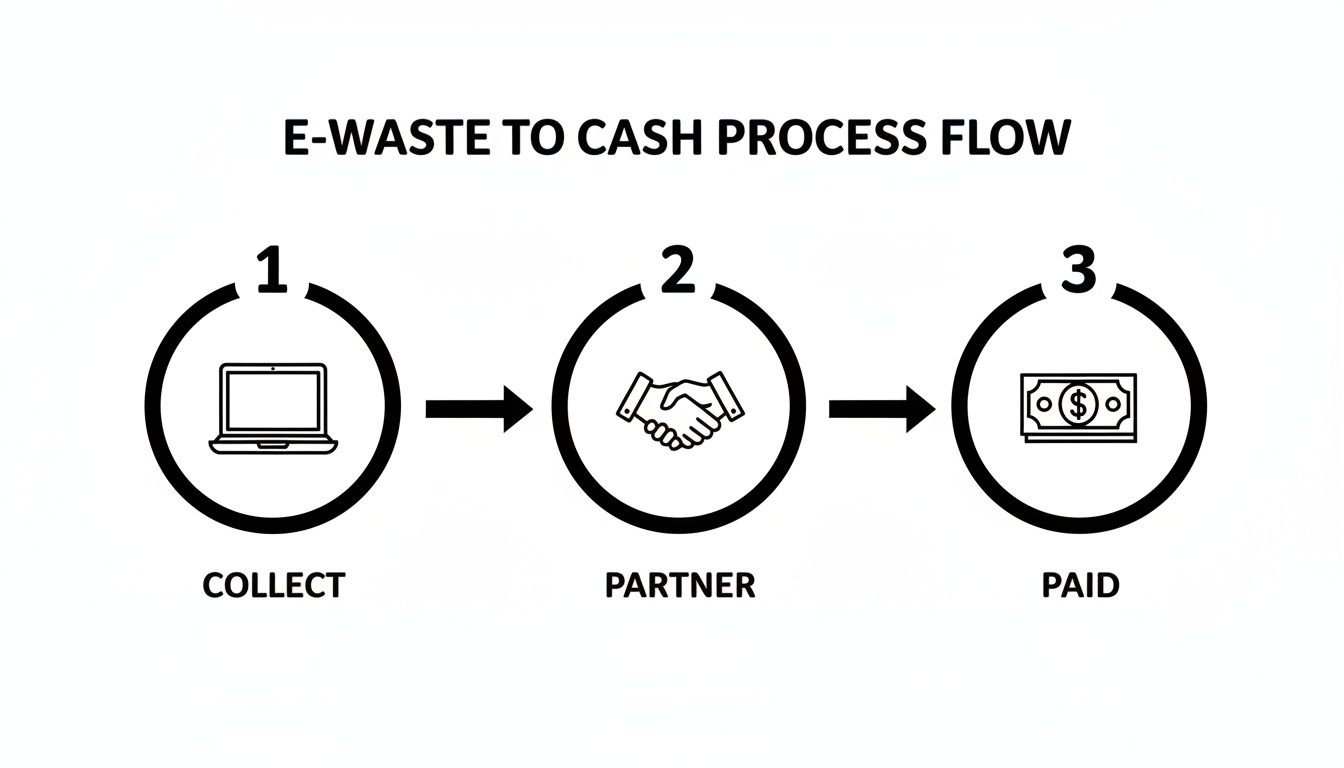
This systematic approach—collecting assets, finding the right partner, and getting paid—is the clearest path to converting old technology into tangible revenue.
Ensuring Secure Data Destruction
With the inventory complete, the next critical phase is managing the data residing on these devices. A data breach from a supposedly "retired" asset is a catastrophic—and entirely avoidable—risk. Understanding your secure data destruction options is a legal and financial necessity.
There are three primary methods for data sanitization:
- Data Wiping: Specialized software overwrites every sector of a hard drive multiple times, rendering the original data irrecoverable. This method complies with standards like NIST 800-88 and is ideal for drives intended for reuse.
- Degaussing: A powerful magnetic field is applied to magnetic storage media (like traditional hard drives and tapes), instantly destroying all data and rendering the drive inoperable.
- Physical Destruction: This is the most secure, brute-force method. The hard drive is physically shredded or crushed into small pieces, providing absolute certainty that the data is gone forever. This is often required for highly sensitive information and is a key component of product destruction services.
For any business, receiving a Certificate of Data Destruction from your ITAD partner is non-negotiable. This document is your official record, proving compliance and protecting your company from future liability.
Sort and Stage for Pickup
With your inventory and data security plan in place, the final step is logistics. This involves segregating your assets and preparing them for evaluation and transport.
First, consolidate all equipment in a secure, easily accessible location. This simplifies the pickup and audit process for your ITAD partner, saving time and potentially reducing logistical fees.
Next, perform a preliminary sort of the devices into two main categories: high-value assets with resale potential and low-value or non-functional items destined for sustainable recycling. While your partner will audit every item, this initial sort helps manage expectations and gives them a clearer scope of the project.
Finally, assess the physical condition beyond a simple grade. Ensure laptops include their power adapters, as this small detail significantly increases their resale value. A quick wipe-down of heavy dust or grime can also be beneficial. While your partner handles deep cleaning, presenting the equipment in good condition signals proper maintenance and can positively influence your final offer.
For more detailed guidance, see our guide on how to prepare your company's electronics for recycling. This preparation is your leverage in turning used tech into a valuable, marketable asset.
How to Accurately Value Your Used Tech
Leaving money on the table is one of the most common mistakes businesses make during an IT asset refresh. It’s easy to underestimate the residual value of old hardware, leading many to accept lowball bulk offers simply to clear out space.
Demystifying the valuation process is key to unlocking the financial potential hidden in your storage closet. The process isn't as opaque as it might seem. With the right approach, you can get a surprisingly clear picture of what your used tech is worth before you even contact a partner. That knowledge is your leverage, ensuring you get a fair market price for your assets.
Researching Secondary Market Prices
Your first move should be to research the current secondary market. Platforms like eBay are treasure troves of real-world data, showing what individual components and complete systems are actually selling for.
A pro tip for businesses: use the "Sold Items" filter. This reveals what buyers have recently paid for equipment with specs similar to yours. Analyzing active listings is less useful; the final sale price is the only metric that truly matters. This quick research provides a powerful baseline for your most valuable items.
Understanding Key Value Drivers
While a market check is a great start, a professional valuation goes much deeper. An experienced ITAD partner like Reworx Recycling considers several critical factors that influence the final offer for your electronics.
- Age and Generation: Technology depreciates rapidly. A three-year-old server is inherently more valuable than a seven-year-old one, primarily due to its processor generation and compatibility with current systems.
- Condition: Both cosmetic and functional conditions are crucial. A-grade units (no visible wear) command a premium, while C-grade devices with scratches or dents will have a lower value.
- Brand and Model: Enterprise-grade equipment from brands like Dell, HP, Lenovo, and Cisco retains its value far better than generic or consumer-grade hardware.
- Component Value: This is where significant value is often overlooked. Sometimes, the parts are worth more than the whole system. Enterprise-grade CPUs and high-capacity RAM can be highly sought after, even if the server they came from is considered obsolete. A detailed, itemized valuation will capture this.
The global e-waste challenge underscores the importance of this process. With e-waste hitting 62 million tonnes in 2022—an 82% increase since 2010—the logic is undeniable. Responsibly managing old electronics through a donation-based recycling model is a smart business move that minimizes risk, recovers value, and boosts sustainability credentials. You can dig into the specifics in the latest global e-waste report.
Case Study: A University’s Data Center Decommissioning
Let’s look at a real-world example. A large state university was undergoing a major data center decommissioning. Their initial plan was to accept a flat, bulk offer from a local scrapper for the entire lot of servers, switches, and storage arrays. The offer was convenient but felt suspiciously low.
Before signing, their IT director decided to get a second opinion from a certified ITAD partner. Instead of a lump sum, this partner provided a detailed, itemized valuation report. It broke down the value of every single server, highlighting the high market price for their specific enterprise-grade CPUs and RAM modules.
The difference was staggering. The itemized offer came in nearly 40% higher than the initial bulk quote. By understanding the true component-level value of their assets, the university secured a massive return that was immediately reinvested into its technology budget.
This case perfectly illustrates why a detailed valuation from a specialist is non-negotiable for any large-scale IT disposal project. It's the only way to ensure you capture every last dollar of residual value from your old electronics.
Choosing the Right Partner for Maximum Return
When seeking to get money for old electronics, the single most critical decision is your choice of partner. The right ITAD specialist will maximize your financial return, eliminate data security risks, and streamline the entire process. The wrong choice could lead to lost revenue, significant liability, and a compliance nightmare.
This isn't just about finding the highest bidder. It’s about partnering with a true IT Asset Disposition (ITAD) specialist with the expertise to handle every step—from secure logistics and computer recycling to certified data destruction. Understanding the different types of buyers is key to protecting your business.
Comparing Your Buyback Options
Businesses have several channels for selling used corporate electronics, each offering a different mix of convenience, security, and potential return. The best fit depends on your company's priorities and risk tolerance.
Comparing Electronics Buyback Options for Businesses
Viewing your options side-by-side clarifies the decision. While direct selling might seem lucrative, it places the entire burden of risk and logistics on your team. For any business disposing of more than a few devices, a certified ITAD partner is the only option that effectively balances value and security.
| Disposal Channel | Potential Return | Data Security | Convenience | Best For |
|---|---|---|---|---|
| Direct-to-Consumer Marketplaces | Potentially High | None. Your responsibility entirely. | Very Low | Individuals or micro-businesses selling one or two high-value items. |
| Local Scrap Dealers | Very Low | Minimal to None. Often unreliable. | Low | Bulk disposal of non-functional, low-value scrap metal. Not for data-bearing devices. |
| Uncertified Recyclers | Low to Moderate | Questionable. No verifiable standards. | Moderate | Low-risk, non-data-bearing assets, but still a compliance gamble. |
| Certified ITAD Providers | High | Guaranteed & Certified. Adheres to strict industry standards. | Very High | Any business that values data security, compliance, and maximizing returns. |
The DIY approach forces you to manage everything from data wiping to shipping, which is impractical and unsafe at a business scale. A certified ITAD provider is equipped to handle the entire process, providing peace of mind alongside a fair financial return.
Non-Negotiable Criteria for Selecting a Partner
When vetting potential ITAD partners, several criteria should be absolute deal-breakers. These standards separate true professionals from risky operators and are your best defense against future problems.
- Industry Certifications: The partner must hold an R2 (Responsible Recycling) or e-Stewards certification. These are the gold standards, proving adherence to strict environmental and data security protocols.
- Ironclad Data Destruction Guarantees: They must provide secure data destruction meeting NIST 800-88 guidelines. Inquire about on-site or off-site shredding and confirm you will receive a serialized Certificate of Data Destruction. This is your legal proof of compliance.
- Transparent Reporting: A reputable firm will provide a clear, detailed report showing every asset received, its condition, its final disposition (resold or recycled), and the value recovered. This is essential for your accounting and audit trails.
- Comprehensive Logistics: Your partner should manage the entire chain-of-custody, from a secure, GPS-tracked pickup at your location to final processing. This end-to-end service ensures no asset is lost or unaccounted for.
The goal is to find a partner, not just a buyer. A true partner manages your risk as carefully as they manage your assets, ensuring that every step of the process is documented, secure, and compliant.
For a deeper dive, check out our guide on the key factors for choosing an e-waste recycling partner.
Sharp Questions to Ask Potential Partners
Before signing any agreement, ask direct questions. Their answers will reveal the quality and integrity of their operation.
- Can you provide a sample Certificate of Data Destruction? A legitimate provider will have one readily available. Ensure it lists serial numbers and the exact method of destruction.
- What is your process for handling our non-valuable e-waste? This is a critical question. A true ITAD partner offers sustainable recycling for all equipment, not just cherry-picking valuable items and leaving you to dispose of the rest.
- Are you R2 or e-Stewards certified? Don't just take their word for it. Ask for their certification number and verify it on the official R2 or e-Stewards website.
- How do you ensure chain-of-custody during transport? They should describe a secure process with sealed trucks, trained staff, and detailed tracking from your door to their facility.
- What does your audit and reporting process look like? They should explain how they test, grade, and value each item, and show you a sample of their final settlement report.
Choosing a partner like Reworx Recycling means you’re working with a social enterprise that not only meets these stringent criteria but also reinvests in the community through corporate donation programs. This ensures you get the maximum financial return for your electronics while also making a positive social and environmental impact.
Negotiating Your Offer and Finalizing the Deal
You've inventoried your assets and selected a certified ITAD partner. Now, it's time to finalize the deal. This is where your upfront preparation pays dividends, placing you in a strong position to secure the best possible financial return. This isn't about aggressive haggling; it's about ensuring the final agreement reflects the true market value of your equipment while fully protecting your business.
Your detailed asset list is your most powerful negotiating tool. It shifts the conversation from vague guesswork to a discussion based on verifiable facts. With that spreadsheet in hand, you can command a fair price and confidently navigate the terms of the deal.
Leveraging Your Asset List in Negotiations
The initial offer from a partner is almost always based on the information you provide. If your inventory list is comprehensive—with models, specs, and condition notes—that first quote should be accurate. However, there are always points to clarify and refine.
Use your secondary market research to benchmark their offer. If you notice a significant discrepancy on high-value items, such as a rack of recent-generation enterprise servers, don't hesitate to inquire. A transparent partner will readily explain their pricing, which typically accounts for bulk resale values, testing labor, and refurbishment costs.
Key points for discussion often include:
- Logistics and Shipping Costs: Clarify who is responsible for pickup costs. Will this be deducted from your final payout, or is it included in their service? This can be a significant expense, especially for large-scale data center decommissioning or office cleanouts.
- Payment Timelines: Request a clear payment schedule. The industry standard is often payment within 30-45 days after the final equipment audit is completed. Ensure this is explicitly stated in the agreement.
- Contingencies for Failed Equipment: Understand the process for items that fail functionality tests. The initial offer assumes all equipment is in working order. Confirm how the final payout will be adjusted based on audit results and insist on receiving a detailed report.
Reading the Fine Print of the Agreement
Before signing, meticulously review every line of the contract. This document, often a Statement of Work (SOW) or Master Services Agreement (MSA), outlines the entire scope of the project and serves as your primary legal protection.
Focus on the clauses covering data destruction and liability. The agreement must explicitly state that your partner assumes all responsibility for the data on your devices upon taking possession. It must also guarantee a serialized Certificate of Data Destruction upon completion—this is non-negotiable for compliance and risk management.
The agreement solidifies the chain-of-custody, providing a transparent, documented trail for every asset from your facility to its final disposition. Partners like Reworx Recycling provide this level of detailed reporting, giving your business complete peace of mind and an auditable record of responsible disposal.
The sheer scale of the e-waste market shows why this level of diligence matters. Electronic waste recycling is a massive industry, projected to hit USD 80.8 billion in 2025 and rocket toward USD 251.9 billion by 2034. With U.S. businesses alone generating nearly 7 million metric tons of e-waste each year and recycling only about 15% of it, billions in recoverable value are being thrown away.
Securing Terms for an Ongoing Partnership
If your company regularly retires IT assets, think beyond a one-off transaction. This is an ideal opportunity to negotiate terms for a long-term partnership. You may be able to lock in preferential rates, secure priority scheduling for pickups, or establish a streamlined process for future disposals.
Building this relationship reduces future administrative work and creates a reliable extension of your IT team. By formalizing the partnership, you transition from a simple cash-for-electronics transaction to a strategic, ongoing IT asset disposition program.
Common Questions About Selling Old Electronics
When retiring old IT gear, business owners, IT managers, and sustainability leaders face numerous questions. Getting clear answers is crucial for making informed decisions that protect your company's data, finances, and reputation. Here are the most common questions we encounter from our business clients.
What Kind of Electronics Can We Actually Get Money For?
The best returns come from functional, relatively recent business-grade equipment. This includes enterprise laptops (Dell Latitudes, Lenovo ThinkPads), desktops, servers, and networking gear from brands like Cisco. Value is primarily determined by age, condition, and current market demand. This applies to a wide range of assets, from standard office IT to specialized medical equipment disposal.
Consumer-grade electronics, printers, and broken items typically have no resale value. However, they are not worthless. These items should be managed through a sustainable recycling program, like the one offered by Reworx Recycling, to ensure valuable materials are recovered and returned to the circular economy.
How Can We Be 100 Percent Certain Our Data Is Destroyed?
The only way to guarantee data security is to partner with a certified ITAD provider that offers secure data destruction services. Look for companies that adhere to rigorous standards like NIST 800-88.
A reputable vendor will give you options, from multi-pass data wiping software to physically shredding the hard drives, either at your site or theirs. The key is to always demand a formal Certificate of Data Destruction for your records. This is your legal proof that you did your due diligence and it protects you from liability down the road.
This certificate is not a formality; it is your definitive proof that sensitive company and client data has been permanently eliminated.
Is It Worth the Effort to Sell Just a Few Devices?
It depends on the assets. If you are disposing of a few high-end servers or recent MacBooks, a buyback program can yield a worthwhile return. However, for a small batch of older, low-value items, the administrative effort may not justify the payout.
In such cases, a corporate donation program, like the one offered by Reworx Recycling, is an excellent alternative. It provides a potential tax benefit, ensures responsible handling of the equipment, and supports community initiatives through our social enterprise mission.
What Happens to Equipment That Has No Resale Value?
This is a critical distinction: a true ITAD partner manages all of your retired electronics, not just the valuable items. Anything without resale value is sent to a certified facility for responsible de-manufacturing as part of a comprehensive electronics recycling process.
Materials are carefully sorted:
- Plastics are shredded and sorted for use in new manufacturing.
- Metals like aluminum, steel, and copper are smelted and refined for reuse.
- Circuit boards undergo a specialized process to recover precious metals like gold and silver.
Partnering with a certified, social enterprise recycler ensures these materials are managed in an environmentally sound manner, keeping hazardous e-waste out of landfills and helping your company achieve its sustainability targets. If you have more questions, you can dive into our complete FAQ section. For general information on managing valuables, you might also find these frequently asked questions useful.
Ready to transform your old electronics from a liability into a valuable asset? The team at Reworx Recycling is here to help Atlanta-area businesses implement secure and profitable ITAD solutions. We offer transparent buyback programs, donation-based recycling, and certified data destruction tailored for corporate needs. Contact us today to schedule a pickup or request a quote, and discover how our social enterprise model can benefit your bottom line and our community.