Your storage room is probably telling you something.
There's the row of retired laptops from the last refresh. A stack of monitors nobody wants to claim. A few servers waiting for data center decommissioning approval. Maybe some networking gear with unclear resale value, plus a nagging question about secure data destruction, compliance, and whether any of this equipment still has life left in it.
That's where circular economy business models stop being theory and start becoming useful. For an IT manager, facilities lead, or sustainability director, the issue isn't abstract. It's operational. You need a system for electronics recycling, IT equipment disposal, computer recycling, and IT asset disposition (ITAD) that protects data, controls cost, and keeps working equipment in circulation when possible.
A circular approach does exactly that. Instead of treating retired technology as waste, it treats each asset as something to be evaluated for reuse, refurbishment, repair, remarketing, donation-based recycling, or final material recovery. For organizations managing office cleanout projects, facility cleanout events, laboratory equipment disposal, medical equipment disposal, laptop disposal, or product destruction, that shift changes both the economics and the impact of end-of-life decisions.
Beyond the Bin The Shift to a Circular Economy
The old model is simple. Buy equipment, use it, replace it, haul it away. That linear pattern works fast, but it also hides value. It assumes the only decision at end of life is disposal, when the smarter question is whether the asset can be extended, redeployed, refurbished, donated, or broken down responsibly for materials recovery.
The European Parliament's definition of the circular economy is useful because it's concrete, not academic. It describes circularity as a production and consumption model involving sharing, leasing, reusing, repairing, refurbishing, and recycling existing materials and products as long as possible, with the goal of extending product life cycles and reducing waste to a minimum, as outlined in the European Parliament's circular economy overview.
What this means for IT teams
For technology-heavy organizations, circularity starts with a basic change in mindset. A retired laptop isn't automatically e-waste. A decommissioned server isn't automatically scrap. An outdated workstation might still be useful after data sanitization, component replacement, or refurbishment.
That matters because IT assets sit at the intersection of several business pressures:
- Security pressure means devices must leave your environment with verified data handling.
- Financial pressure means procurement teams want to recover value where they can.
- Sustainability pressure means leadership wants fewer assets sent to landfill or low-value disposal streams.
- Operational pressure means nobody wants old hardware clogging closets, labs, branch offices, or warehouse shelves.
Old equipment becomes expensive when no one owns the decision about what happens next.
A circular system gives that decision a structure. Some assets move into reuse. Some go into repair or refurbishment. Some support corporate donation programs and digital inclusion. Others go to sustainable recycling because they're at end of life.
Why the shift matters now
The gap between theory and practice is usually execution. Many businesses already support recycling in principle. Fewer have a practical model for sorting retired IT by condition, data risk, and recovery potential. That's where circular thinking helps. It turns “get rid of it” into a managed workflow.
If you want a practical introduction to how this applies specifically to technology, Reworx has a short resource on embracing the circular economy in electronics and IT workflows.
For teams handling IT asset turnover, the opportunity lies in this: the best electronics recycling program doesn't begin with shredding or scrapping. It begins with preserving as much product value as possible before recycling becomes necessary.
Understanding the Hierarchy of Circular Business Models
The circular hierarchy is a ranking system for value retention. It answers a practical question: what should happen to an IT asset first if you want to protect value, reduce waste, and stay in control of compliance?
For an IT manager, that matters because a retired laptop is not just scrap. It may still contain usable hardware, recoverable market value, licensed components, and sensitive data. Circular business models help you decide whether that device should stay in service, move to a second user, be broken down for parts, or go to recycling only after better options are ruled out.
According to Ramboll's explanation of circular business model hierarchy, the order is product-as-a-service first, then product life and use extension, and then resource recovery. That order reflects how much of the original product you keep intact.
A vehicle analogy helps here. Leasing keeps the manufacturer or provider connected to the asset and gives them a reason to maintain it well. Keeping the same vehicle running through repairs and replacement parts preserves more value than scrapping it early. Selling it only for metal is still useful, but much of the product's labor, design, and function has already been lost.
IT equipment follows the same logic. A working server that can be redeployed holds more value than one shredded for commodity materials. A repairable laptop usually deserves closer inspection before it is sent to a recycler.
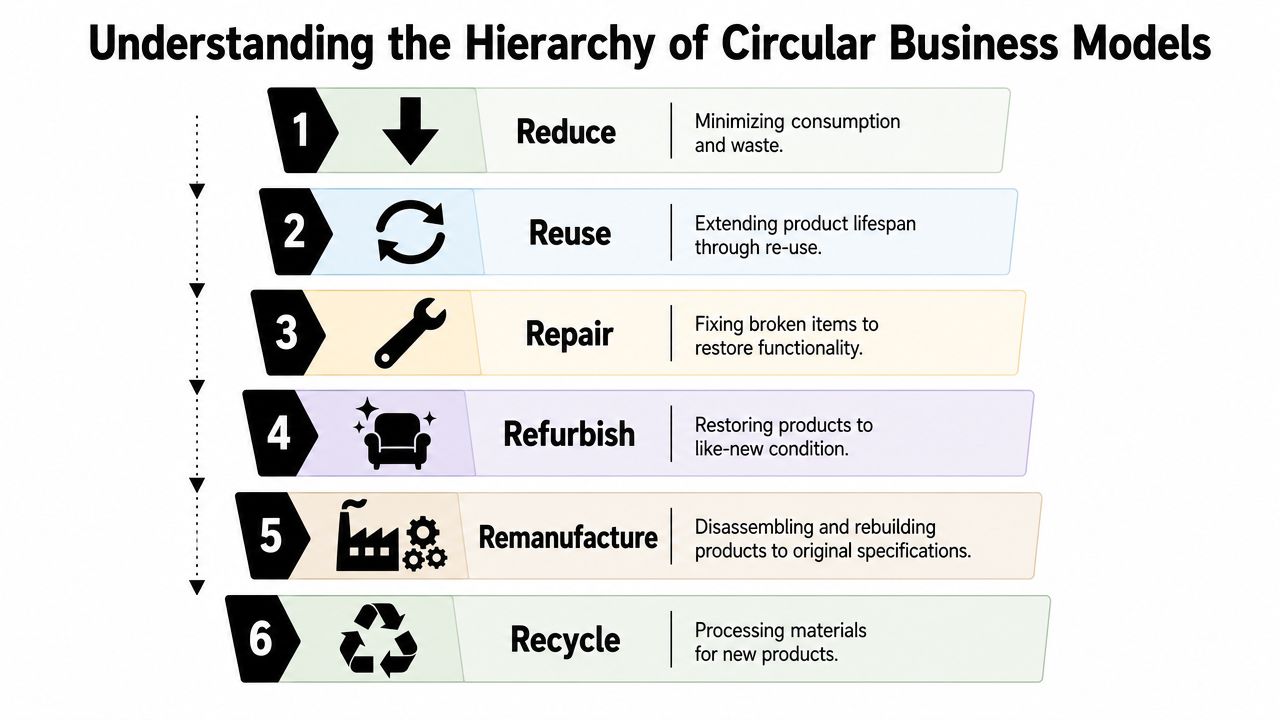
The hierarchy in practical IT terms
In day-to-day ITAD work, the hierarchy becomes a triage system.
| Model level | What it looks like in IT | Main goal |
|---|---|---|
| Product-as-a-service | Leased devices, managed print, device subscriptions | Keep ownership with provider and improve lifecycle performance |
| Life extension | Repair, redeployment, refurbishment, resale | Get more use from the same hardware |
| Resource recovery | Parts harvesting, material recycling, product destruction where needed | Recover remaining value safely when reuse no longer fits |
Teams often get stuck at this point, so it helps to clear up a few common misunderstandings.
- Recycling still has a place. It is the right path for failed, obsolete, or damaged equipment that cannot be reused safely or economically.
- Reuse is broader than donation. It can include internal reassignment, resale, refurbishment, or channeling equipment into approved social impact programs after data sanitization.
- A lease is only part of the story. It supports circularity when return logistics, maintenance, refurbishment, and next-life use are built into the program.
A good rule is simple. If a device can still serve a user safely, meet performance needs, and pass data security requirements, destroying it too early usually means value was lost unnecessarily.
That is why circular theory matters in ITAD. It gives your team a decision order. First ask whether the asset can remain in service. Then ask whether it can be repaired, refurbished, or reassigned. Only after those options fail should material recovery become the main outcome.
For retired IT assets, the hierarchy also intersects with governance. A reuse option only works if chain of custody is documented, data destruction is verified, and downstream handling meets your environmental standards. A recycling option is lower on the hierarchy, but it may still be the right decision for a damaged storage device, unsupported networking gear, or equipment with no safe second-life path.
Reworx has a useful guide to how circular economy principles apply to IT asset management if you want to connect these model levels to real ITAD decisions around security, reuse, and e-waste handling.
Four Key Circular Models for Managing IT Assets
Most organizations don't need one circular model. They need a mix of them. A laptop fleet, a batch of decommissioned servers, and a pallet of broken peripherals shouldn't all go down the same path.
Product as a service
The Product as a Service, or PaaS, model changes incentives at the ownership level. As described in Nordic Innovation's work on Product as a Service, the provider retains ownership of the asset, which encourages durable design and efficient maintenance across the product lifecycle.
For IT managers, this often shows up in leased laptops, managed device fleets, print programs, or subscription hardware. The benefit is that lifecycle responsibility doesn't disappear after deployment. The provider has a reason to design for maintenance, upgrades, and return logistics.
This model fits best when:
- Refresh cycles are predictable and you want structured returns.
- Support requirements are ongoing and tied to uptime.
- You want fewer stranded assets at the end of each contract term.
Reuse and refurbishment
Many businesses can recover the most obvious practical value. For example, a three-year-old business laptop may be outdated for engineering workloads but perfectly suitable for administrative use, training labs, nonprofit donation, or secondary markets after secure wiping and refurbishment.
Reuse and refurbishment are strong options for:
- Corporate donation programs that support community technology access
- Office cleanout projects where mixed-condition devices need sorting
- Laptop disposal decisions where some units still have useful life
- School and university turnover where older devices can move into less demanding roles
The hard part isn't the concept. It's the process: triage, grading, sanitization, component replacement, and logistics.
Repair and remanufacturing
Repair keeps products in service. Remanufacturing goes deeper by disassembling, rebuilding, and restoring equipment closer to original working condition. In IT, the line between the two can blur, but the goal is the same: extend useful life rather than replacing equipment too soon.
This works well for higher-value assets such as servers, industrial electronics, certain networking equipment, and specialized devices used in laboratories or healthcare settings. It can also support medical equipment disposal and laboratory equipment disposal workflows when some equipment categories require careful evaluation before final disposition.
A device doesn't need to be current to be useful. It needs to be secure, functional, and appropriate for the next user.
Resource recovery and recycling
Recycling matters most when equipment is obsolete, physically damaged, nonfunctional, nonrepairable, or not worth remarketing after compliant data handling. This is the point where secure product destruction, component harvesting, and material recovery become the right choice.
That includes:
- Broken peripherals and accessories
- Failed hard drives requiring physical destruction
- Damaged servers from data center decommissioning
- Devices with no practical reuse market
- Mixed scrap from facility cleanout events
For many businesses, the operational question isn't which single model to adopt. It's how to route each asset type correctly. If you're building that kind of workflow, Reworx provides asset recovery services for evaluating reuse, remarketing, and recycling paths.
The strongest circular ITAD program isn't sentimental about equipment. It's selective. It preserves value where possible and recovers materials responsibly when it isn't.
The Business Case for a Circular ITAD Strategy
Circular ITAD isn't just an environmental story. It's a cost, risk, and operations story.
In electronics, PwC reports that implementing a circular economy strategy yields an estimated average of 12% cost savings and a 10% reduction in CO2e emissions, driven largely by circular inputs, remanufacturing, and Product as a Service. That's a strong signal for organizations that manage large device fleets or recurring refresh cycles.
Where value shows up in practice
The business case usually appears in four places.
First, procurement and replacement costs can improve when organizations extend asset life, redeploy equipment internally, or recover value from remarketable devices.
Second, ESG and reporting goals become easier to support when fewer assets move straight to disposal and more go through documented reuse, refurbishment, and sustainable recycling channels.
Third, supply chain resilience improves when businesses recover components and materials instead of relying entirely on virgin inputs. This matters more when replacement lead times are unstable.
Fourth, social impact becomes measurable when eligible equipment is prepared for donation rather than discarded. That's where donation-based recycling and social enterprise recycling can align IT operations with community benefit.
Why this matters for surplus electronics
There's also a broader market signal behind this shift. A circular economy market analysis states that the global circular economy market reached USD 553 billion in 2023, with recycling as the largest segment and Product-as-a-Service as the second-largest segment. That mix matters. It shows that recycling remains foundational, but higher-value service and reuse models are expanding.
For an IT manager, that translates into a simple question: are you treating every retired device like scrap, or are you using a structured process to separate reuse candidates from true end-of-life material?
The cheapest disposal decision on paper can become the most expensive one if it destroys recoverable value or creates avoidable compliance risk.
Organizations that want to connect circular outcomes with practical ITAD planning can review ways to maximize ROI and sustainability in global ITAD services.
Your Roadmap to Implementing Circular E-Waste Management
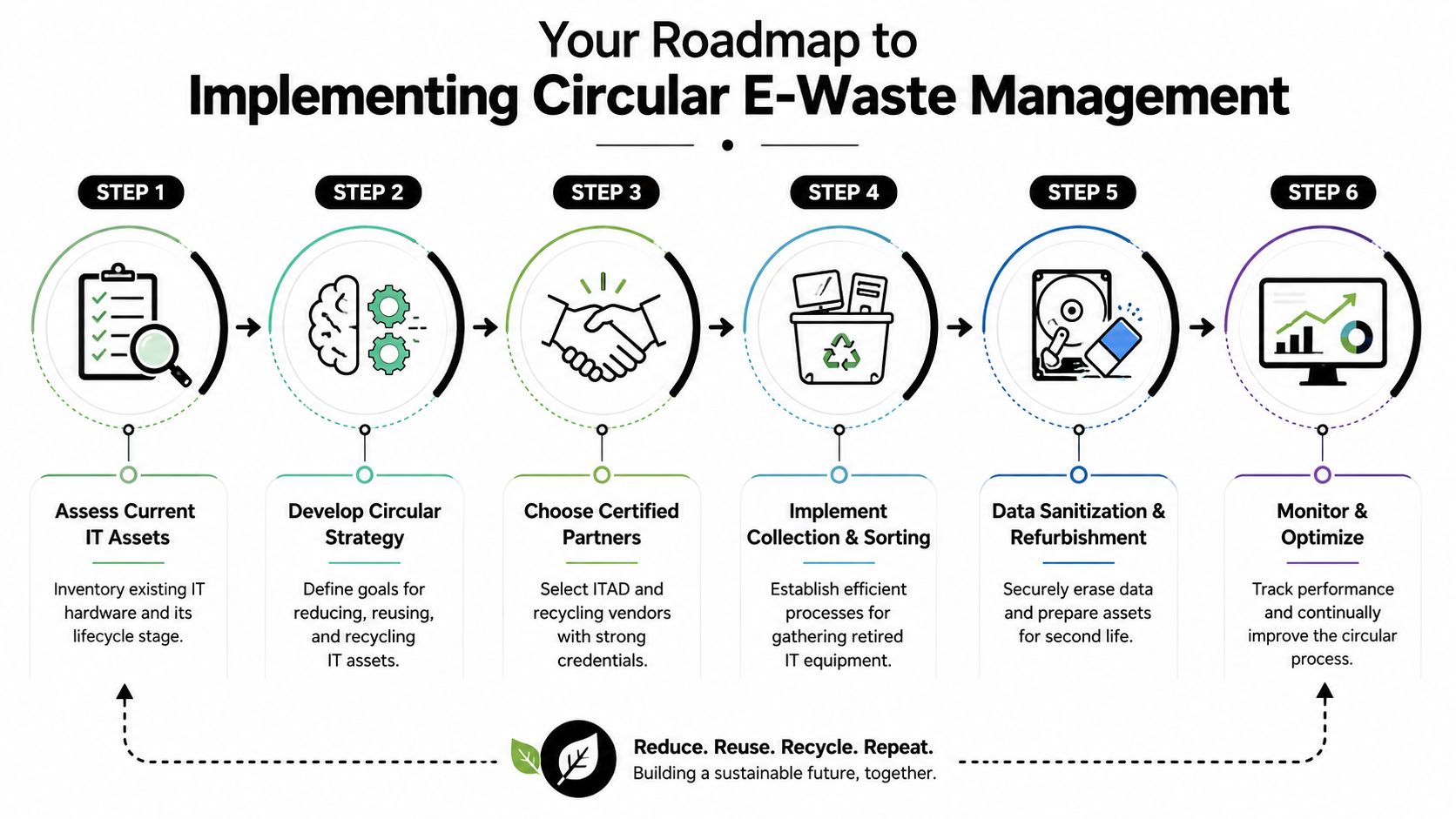
A regional office closes. Two storage rooms fill up with laptops, monitors, docking stations, phones, and loose hard drives. Facilities wants the space back. IT wants proof that no device with data leaves uncontrolled. Procurement needs to know which leased assets cannot be touched. Sustainability wants to keep usable equipment out of the scrap stream. A circular e-waste program gives those teams one shared process instead of a last-minute cleanup.
Start with asset visibility
Circular ITAD begins with a clear asset picture. If you cannot see what is retiring, you cannot route it correctly.
Use a working inventory that captures:
- Asset type such as laptop, server, monitor, switch, phone, printer, lab device, or medical device
- Condition such as working, repairable, damaged, or obsolete
- Data status including whether storage media is present
- Ownership and lease status so assets under contract are handled correctly
- Likely path such as redeploy, refurbish, donate, resell, recycle, or destroy
Start where volume is highest. For many organizations, laptops, desktops, monitors, and storage devices reveal process gaps first because they move through refresh cycles more often than specialized equipment.
Set decision rules before collection starts
The practical mistake is waiting until collection day to decide what each item is. By then, devices are mixed together, labels are inconsistent, and chain of custody is harder to prove.
A decision matrix fixes that. It works like a triage desk in a hospital. Each asset is assessed once, then sent down the right path based on condition, data risk, and business value.
For example:
- Working business laptops go to approved data sanitization and testing for reuse or refurbishment
- Servers from a decommissioning project move under documented custody with staged evaluation
- Failed drives and damaged storage media go directly to secure destruction
- Broken peripherals and low-value equipment go to electronics recycling
- Usable surplus equipment may be prepared for donation or resale, depending on policy
For a broader view of how collection and recovery systems are structured, Business Model Analyst's waste strategies provide useful background.
Build an operational flow people can actually follow
A policy on paper is not enough. The process has to work for the technician clearing a closet, the office manager packing devices, and the compliance lead reviewing records a month later.
Keep the flow simple:
- Collection and segregation happen near the point of retirement so assets do not sit in unsecured areas
- Data handling follows documented methods for sanitization, shredding, or physical destruction based on device type
- Testing and grading separate reuse candidates from equipment that has reached end of life
- Logistics and documentation cover pickup timing, packing instructions, serial tracking, and custody records
Many ITAD programs often stall. IT, facilities, procurement, legal, and sustainability may all touch the same batch of equipment, but no one owns the handoff. A short written workflow with named approvals prevents that drift. Teams that want a practical starting point can use this ITAD compliance checklist template to define roles, records, and control points before the first pickup.
Choose a partner that supports the full chain
Plenty of vendors can haul away old electronics. Fewer can handle secure data destruction, refurbishment triage, remarketing, donation, decommissioning, and final recycling within one controlled process.
That difference matters because circularity in IT is only useful if it stands up to audit. Reworx Recycling supports donation, pickup, secure hard drive shredding, equipment decommissioning, and related ITAD services for organizations that need both responsible recovery and documented control.
Measure outcomes that change next quarter's decisions
Good metrics do more than fill out a sustainability report. They show whether your process is protecting data, preserving value, and reducing waste.
Track items such as:
- Disposition mix across reuse, donation, resale, recycling, and destruction
- Documentation quality for serial tracking, pickup records, and destruction certificates
- Time in storage between retirement and final disposition
- Exceptions such as unidentified devices, missing drives, or items collected outside policy
The goal is a repeatable operating system for retired IT assets. Once that system is in place, circular economy theory becomes a set of practical decisions your team can make with confidence.
Ensuring Governance and Compliance in Your ITAD Program
Circularity fails quickly if governance is weak. That's especially true for organizations handling regulated data, public sector equipment, healthcare systems, legal records, financial devices, or anything tied to audit obligations.
One policy analysis found that 67% of EU municipalities delay circular IT transitions because of uncertainty over data destruction liability, as noted in this Eionet report on circular business models. The lesson is broader than Europe. If your team can't prove compliant data handling, circular ITAD will stall.
A practical governance checklist
Use this as a screening tool for any ITAD or computer recycling provider:
- Documented data standards such as alignment with internal policy, NIST 800-88 expectations, or sector-specific privacy controls
- Chain of custody records from pickup through final processing
- Certificates and audit evidence for secure data destruction and product destruction
- Clear separation of reuse and destruction streams so no device leaves without approved handling
- Packaging and transport procedures that reduce breakage, tampering risk, and confusion during office cleanout or facility cleanout projects
For teams shipping equipment between sites before final processing, even packaging choices matter. Using transit materials with lower environmental impact can support the overall program, and resources such as Storage & Removal Boxes Ltd biodegradable packaging are useful examples when you're reviewing how to pack devices more responsibly.
Compliance in ITAD isn't just about what gets destroyed. It's about what gets documented.
If you need a starting point for vendor review and internal controls, this ITAD compliance checklist template can help structure the right questions.
Partnering with Reworx for a Circular Future
The strongest ITAD programs don't treat retired equipment as a cleanup problem. They treat it as a managed business process. That means choosing the right circular path for each asset, protecting data, documenting every handoff, and making room for reuse, refurbishment, donation, and responsible recycling where each one fits.
For business owners, IT managers, and sustainability leaders, that approach supports several goals at once. It improves control over electronics recycling and computer recycling decisions. It makes IT equipment disposal less reactive. It also creates room for social impact through donation-based recycling and digital inclusion, rather than sending every asset straight to a low-value end.

If your organization is planning a refresh, an office cleanout, a facility cleanout, a data center decommissioning project, or a review of secure data destruction and IT asset disposition policies, a circular lens gives you a better way to decide what happens next.
If you're ready to turn surplus electronics into a more secure, sustainable, and community-minded ITAD program, explore Reworx Recycling. You can use that next step to evaluate donation options, schedule a pickup, review secure data destruction practices, or build a more reliable plan for retired business equipment.