An EPA battery-collection tip sheet describes an analysis identifying 245 lithium-battery fires at 64 waste-management facilities. For an organization retiring equipment, prevention starts before pickup, when receiving staff decide whether a device belongs on an ordinary electronics pallet or in a separate recalled-battery workflow.
Recalled lithium battery disposal services should address that intake decision, not just provide a destination. For businesses, schools, and public agencies in Smyrna, Georgia, the practical challenge is coordinating facilities staff, IT asset owners, a qualified transporter, and the receiving processor before anyone moves the load.
Why Recalled Lithium Batteries Need Their Own Workflow
A U.S. Consumer Product Safety Commission staff report identified 73 recalls involving lithium-ion battery-powered products between 2012 and 2019, covering 4,967,453 recalled products; earlier agency records included cell phones, chargers, laptops, and hoverboards, while CPSC also reported more than 165 hoverboard or scooter fire incidents across 38 states, causing over $3 million in property damage.
Those product categories matter because recalled batteries don't necessarily arrive as loose cells with warning labels. They can remain inside equipment stored for a future office cleanout, donation drive, or technology refresh. An asset marked obsolete hasn't necessarily been checked against a recall notice.
The mixed-pallet problem
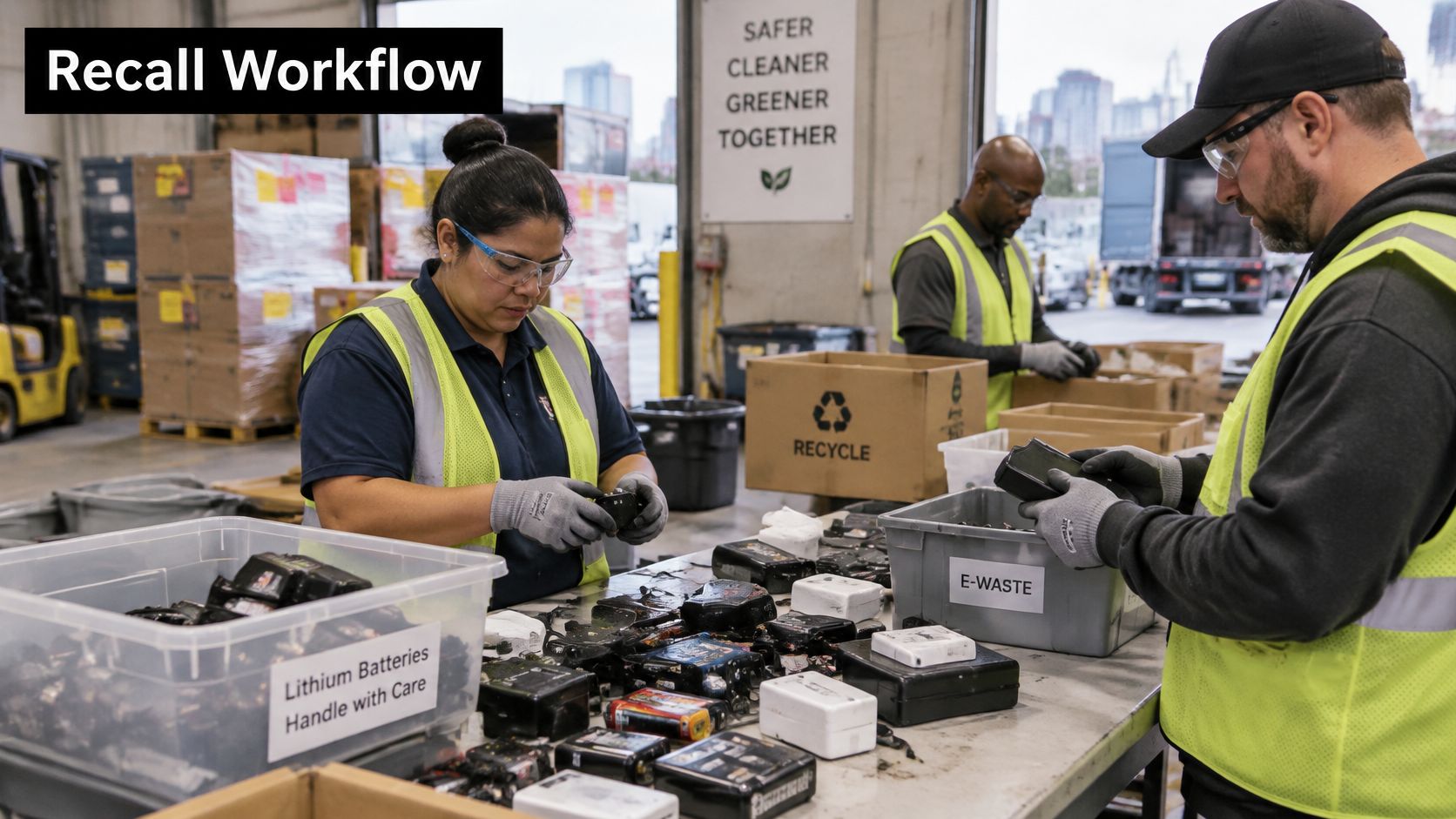
Say a school district clears a storage room containing laptops, chargers, and hoverboards. Staff inventory the laptops for computer recycling, stack everything together, and book collection. Without a recall check, a hazardous unit can enter a load intended for routine processing.
The failure happens before the recycler receives anything. Staff have already lost the distinction between ordinary retired equipment and batteries requiring a separate route.
Practical rule: Treat recall status as an intake field, not a question someone answers after the pallet is wrapped.
A usable disposal program needs a condition sort, controlled staging, shipment-specific packaging, vendor verification, and records connecting intake to final disposition. Manufacturer instructions also belong in that process because recall remedies and return arrangements aren't interchangeable. The receiving dock needs clear authority to hold questionable equipment rather than meet a collection deadline at the expense of safe handling.
Sorting Recalled Batteries by Condition Before Pickup
Recalled lithium batteries aren't trash or curbside recyclables. The EPA battery-collection report states that most discarded lithium-ion and lithium-primary batteries are likely hazardous waste because of ignitability and reactivity, associated with hazardous-waste codes D001 and D003. It recommends that businesses consider the federal universal-waste framework and warns that damaged, defective, or recalled batteries present increased fire risk.
Appearance alone doesn't establish safety. An intact recalled pack still requires a recall-specific route, while a swollen pack requires additional precautions even if staff haven't located its model number.
Handling and destination by battery condition
The following controls are for trained personnel. They aren't permission to touch, bag, or move a battery that's actively heating or venting.
| Condition | Warning signs | Required handling | Destination |
|---|---|---|---|
| Intact recalled battery | No swelling, leakage, heat, or odor | Tape exposed terminals, keep the label legible, bag each unit individually | Qualified battery recycler or manufacturer-directed processor |
| Swollen or deformed battery | Bulging case, misshapen device, warped casing | Nonflammable containment with suitable cushioning or mineral-based suppressant, isolated from other units | Hazmat-trained handling and approved shipment |
| Leaking or smelling battery | Electrolyte residue, chemical odor | Ventilated quarantine area, PPE, no compaction or mixed loading | Specialist downstream facility after assessment |
| Hot, smoking, or fire-damaged battery | Heat, smoke, exposed conductors | Stop handling, follow the site fire plan, notify the fire marshal and first responders | Emergency response first, then specialist disposal |
Don't pry open a swollen laptop to improve the inventory record. Record the visible device identifiers and let qualified personnel determine whether battery removal is appropriate. Likewise, terminal tape and individual bags are preparation controls for suitable intact units, not complete transport packaging.
Check the generator category
Businesses generating fewer than 100 kilograms, about 220 pounds, of lithium batteries and other hazardous waste per month may qualify as very small quantity generators, subject to reduced but still applicable requirements, according to the EPA report linked above. Assess the applicable total, not just the weight of batteries collected by IT.
Larger organizations need formal accumulation controls and recordkeeping, but smaller offices don't receive an exemption from safe handling. Use a lithium battery recycling service discussion to confirm accepted conditions before arranging collection.
Finally, retrieve the manufacturer's recall notice. A clean exterior doesn't override instructions identifying a battery as unsafe.
How to Run Intake, Segregation, and Storage
Assign an intake owner before employees begin unloading equipment. That person needs authority to stop sorting, reject an unidentified container, and request specialist help. A recall workflow fails when everyone assumes the next department will inspect the battery.
Establish the receiving sequence
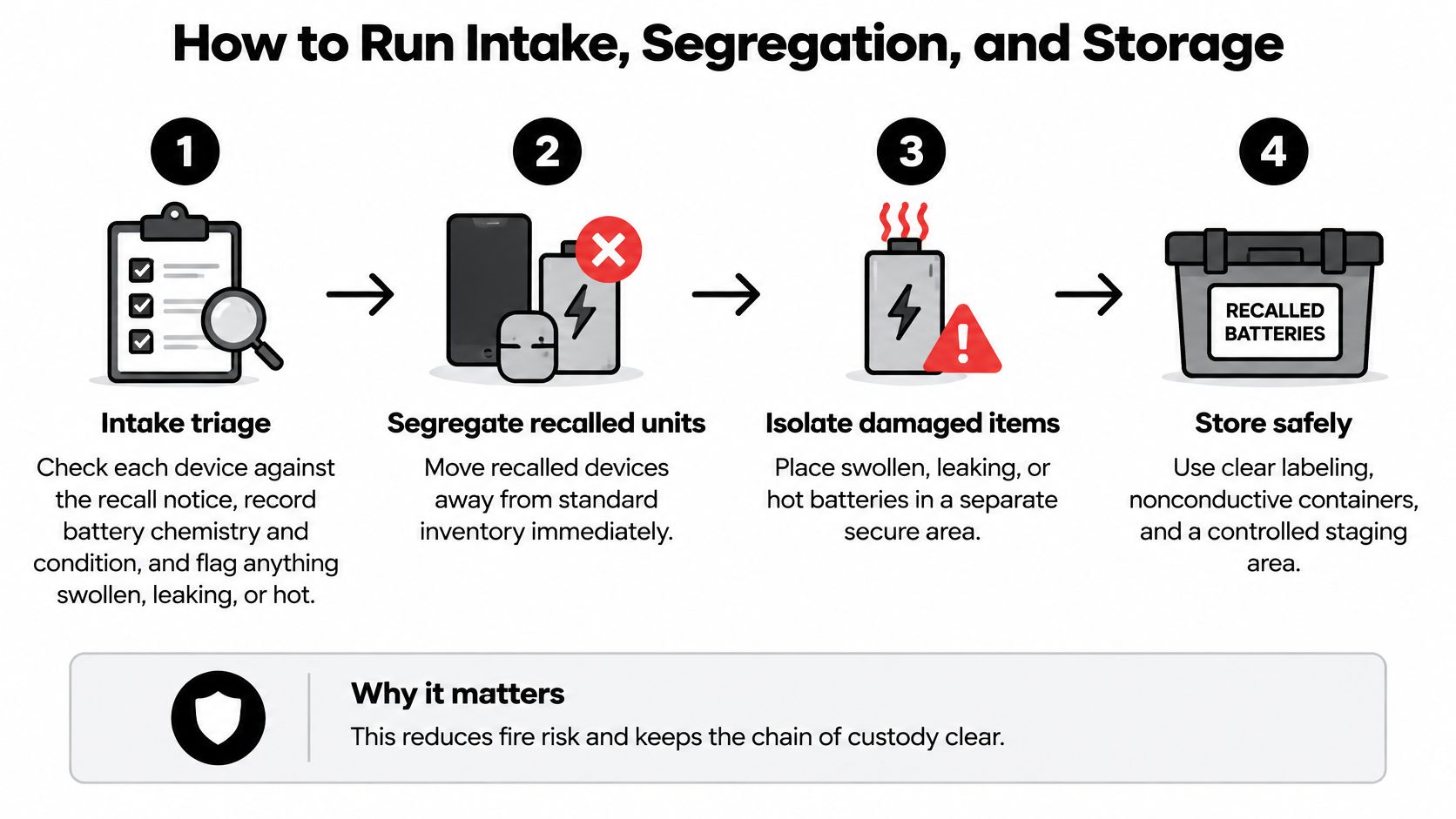
Identify before unloading into bulk containers. Match device models and available battery identifiers against manufacturer or CPSC recall notices. Record chemistry, device-contained versus loose configuration, and visible condition. Don't substitute a model-family guess for a confirmed identifier.
Separate the disposal routes immediately. Move recalled equipment out of standard inventory and flag its location in the asset system. The common mistake is placing a hold label on a device while leaving it physically inside a general e-waste bin.
Escalate compromised equipment. Use the condition matrix to determine who may handle the unit. A receiving employee shouldn't carry a hot battery across the building to reach the designated storage area.
Control the staging area. Use a dedicated, ventilated location with appropriate fire detection, suppression equipment, PPE, and restricted employee access. Keep lithium batteries apart from other chemistries, and document visual and thermal inspections under the site procedure.
Match collection timing to site capacity. Review generator status, applicable accumulation requirements, available approved containment, and the expected collection date. Brief the fire marshal on the storage plan before quantities build up.
The practical distinction is between temporary storage controls and transport-ready packaging. A secure staging container doesn't automatically meet shipment requirements.
Prepare the handoff while equipment is still onsite
PHMSA's battery transportation advisory describes a sequence that includes confirming condition, selecting trained shipping personnel, packaging and marking the batteries, and documenting their movement to an appropriate processor. Build those responsibilities into the collection work order rather than leaving them for the driver.
A pickup appointment isn't a packaging plan. Name the party supplying containers, the person preparing packages, and the carrier accepting them.
For a Smyrna facility cleanout, this can mean scheduling an assessment before the main loading crew arrives. That adds a planning step, but it avoids having employees improvise containment beside an open truck.
Never let an overdue pickup erase the distinction between intact recalled units and physically damaged ones. If the holding area reaches its approved capacity, stop adding material and arrange specialist direction.
Packing, Labeling, and Shipping Recalled Batteries
Recalled batteries can't travel on commercial aircraft. The PHMSA lithium-battery recycling safety advisory restricts damaged, defective, or recalled batteries to highway, rail, or vessel transport and specifies individual packaging, protective cushioning, and appropriate specification outer packaging.
A manufacturer-issued return label isn't proof that a damaged battery is acceptable for shipment. Carrier approval must match the actual battery condition, not the condition assumed when someone generated the label.
Packaging and marking rules for recalled lithium batteries
The PHMSA advisory linked above provides the basis for these requirements, including one DDR cell or battery per outer package and Packing Group I performance requirements.
| Requirement | Required rule | Common mistake |
|---|---|---|
| Transport mode | Highway, rail, or vessel only; forbidden on commercial aircraft | Sending recalled units by air or through an unverified standard parcel service |
| Inner packaging | Each battery enclosed in its own nonmetallic inner package | Several batteries placed loose in a box |
| Cushioning | Absorbent, electrically nonconductive, noncombustible material around each battery | Ordinary foam without verified suitability, or conductive metal packing |
| Outer packaging | Specification outer package meeting Packing Group I performance requirements | Reused cardboard boxes or ordinary shipping cartons |
| Units per outer package | One DDR cell or battery per outer package | Consolidating recalled batteries to reduce freight cost |
| Marking | Package marked to identify contents as damaged or defective lithium batteries, label kept visible | Obscured label or no marking |
| Segregation | DDR batteries packed separately from other batteries | Recalled units mixed with intact batteries on a pallet |
The unit limit and performance standard in this table come from the same PHMSA advisory. Have the trained shipper confirm the complete package configuration before purchase; a strong-looking carton isn't evidence of compliance.
When a routine return becomes the wrong shipment
Consider a swollen laptop whose manufacturer supplied a return label before learning about the swelling. An employee puts the device in its original carton and sends it to outbound shipping. The administrative paperwork looks complete, but the package and carrier acceptance haven't been evaluated for its actual condition.
Stop that shipment. Notify the manufacturer and hazmat shipping provider, describe the damage, and obtain a suitable return or recycling arrangement.
A UN 3481 labeling reference can help staff understand battery-in-equipment terminology, but a familiar battery label isn't a substitute for DDR-specific packaging and marking.
For release, the work order should identify the approved carrier, package preparer, package IDs, destination, and receiving contact. Keep recalled packages on a separately identified pallet rather than blending them into ordinary battery freight. Freight savings should come from planned collection routes and predictable scheduling, not unauthorized package consolidation.
Choosing a Certified Recycler and What to Ask
A technology-refresh pallet can contain recalled batteries among ordinary electronics. At intake, keep those units out of compactors, conveyors, and standard e-waste loads. Compare recyclers by their written acceptance conditions before comparing prices. A provider that advertises electronics recycling may accept ordinary laptops but not recalled battery packs. Certification is useful screening information, but it does not establish that a particular site, carrier, or package configuration can handle your shipment.
Recalled lithium-ion batteries must follow applicable local and state procedures. Confirm the requirements with the local hazardous-waste authority, especially when a company operates in multiple municipalities. Approval for one office does not automatically cover another location.
Disposal routes for recalled lithium batteries
| Route | Suitable for recalled units | Key condition |
|---|---|---|
| Manufacturer return program | Only if the manufacturer directs the return | Recall instructions may not cover damaged units or bulk volumes |
| Municipal household hazardous-waste facility | Yes, once the facility confirms acceptance | Confirm commercial-generator eligibility, accepted conditions, and local volume limits |
| Certified battery recycler with pickup | Yes | Must provide or arrange DDR-compliant packing and hazmat shipping |
| General e-waste recycler | No, not through its ordinary mixed stream | Recalled units require a separate, expressly accepted pathway |
A municipal facility serving residents may not be authorized or willing to accept commercially generated material. Ask about eligibility, battery condition, and volume before arranging delivery. If the facility declines, select another route rather than placing the batteries in a general e-waste load.
Questions that expose service gaps
Use these questions when discussing a battery recycling service:
- Acceptance scope: Which recalled chemistries, device configurations, and damage conditions will you accept?
- Shipping responsibility: Who supplies compliant packaging, prepares the shipment, and confirms carrier acceptance?
- Downstream destination: Which facility receives the batteries, and what happens if it rejects a package?
- Evidence: Will you provide custody records and documentation of final disposition?
- Project coordination: Can collection cover multiple sites while keeping battery and IT asset disposition records separate?
Ask whether intact equipment can be evaluated for donation or buyback without entering the recalled-battery stream. For medical equipment disposal or laboratory equipment disposal, disclose any separate contamination concerns before requesting a quote.
Buying advice: Compare written scopes, not just pickup prices. A lower quote that excludes packaging or specialist handling does not cover the same work.
Request separate line items for travel, collection frequency, packaging, hazmat handling, unit or pallet charges, and secure data destruction. This helps compare manufacturer return, municipal drop-off, and specialist pickup on the services included. Donation or resale potential does not remove the need to arrange appropriate handling for recalled batteries.
Chain of Custody, Documentation, and Reporting
Make the disposal work order the single source of truth. It should connect each asset to its battery condition, shipping package, custody transfers, receiving facility, and any required media sanitization. Separate spreadsheets with incompatible identifiers create avoidable reconciliation problems.
The NIST SP 800-88r2 FAQ calls for aligning data classification with acceptable clear, purge, and destroy methods and retaining evidence such as sanitization certificates. Translate that into work-order fields for the asset, media type, confidentiality classification, approved method, responsible party, and completion evidence.
Records to keep for each disposal shipment
| Record | What to capture | Why it matters |
|---|---|---|
| Asset and battery ID | Device serial, battery identifier, quantity | Links each battery to its recall and shipment |
| Recall reference | Manufacturer recall notice and model number | Shows why the unit was routed as recalled |
| Condition at intake | Intact, swollen, leaking, or fire-damaged, with photo when safe | Justifies the handling method used |
| Package and marking | Package ID, marking confirmation, required unit separation | Supports verification of transport preparation |
| Carrier and manifest | Carrier name, ground transport mode, pickup date | Establishes chain of custody |
| Disposal certificate | Receiving facility name and final disposition | Documents receipt and processing |
| Sanitization certificate | Data classification, method used, completion evidence | Supports the organization's NIST-aligned sanitization program |
Documentation supports an audit; it doesn't independently prove that every handling action complied with the rules. Review the underlying records for missing signatures, unexplained quantity changes, and destination substitutions.
Close both the battery and data records
A recalled laptop creates distinct battery-safety and information-security obligations. Don't power up an unsafe device merely to run a routine wiping tool. Have the responsible IT and safety personnel agree on an appropriate route before equipment leaves organizational control.
NIST's FAQ recognizes cryptographic erase for encrypted media and directs other techniques toward IEEE 2883, NSA specifications, or an approved organizational standard. Physical product destruction may be appropriate when the organization requires recovery to be infeasible, but battery isolation must precede destructive equipment processing.
Use a chain-of-custody documentation process to reconcile intake quantities against shipments, receipts, and unresolved holds. Retain the supporting file for audits, and prepare an annual sustainability summary that distinguishes recycling, destruction, and donation outcomes. Don't report equipment as donated or processed until completion evidence supports that status.
Confirm Local Rules and Book a Compliant Pickup
Before booking a truck, confirm which rules apply and what the receiving facility will accept. For a Smyrna office, school, or other Georgia organization, assign a staff member to obtain local instructions and save them with the project records.
- Retrieve the recall notices. Match affected models to the equipment inventory, then hold questionable units out of the main cleanout.
- Confirm local acceptance. Ask the municipal hazardous-waste contact about commercial material. If household services do not accept it, request an appropriate alternative.
- Compare written proposals. Give qualified providers the same condition inventory, packaging responsibilities, and documentation requirements so their proposals can be compared.
- Coordinate collection. Arrange battery handling alongside IT equipment disposition, keeping recalled batteries separate from standard e-waste and maintaining custody records.
Use this universal-waste planning reference to prepare questions, then confirm the final requirements with local authorities and the receiving facility. A mixed refresh pallet deserves particular attention at intake: identify recalled units before they enter compactors, conveyors, or ordinary e-waste loads.
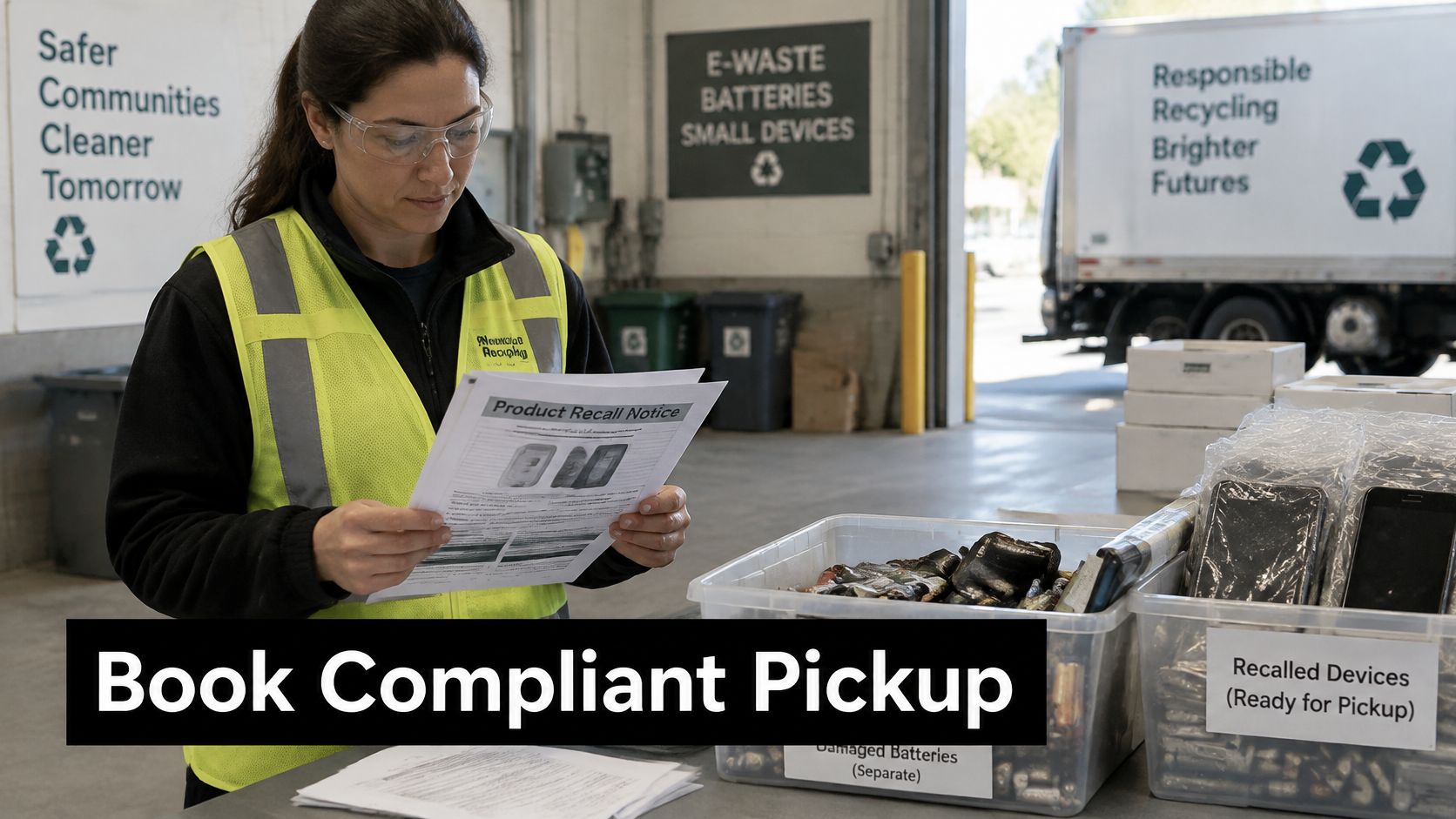
Keep intact, non-recalled equipment separate for any reuse route the organization has arranged. Recalled batteries should not be passed along with equipment intended for reuse, and local acceptance conditions determine the compliant collection plan.
Reworx Recycling offers free customer drop-off, business pickups, IT asset management, equipment buyback, and secure data destruction for equipment without recalled batteries. Contact the team through its site to schedule a pickup for that equipment.