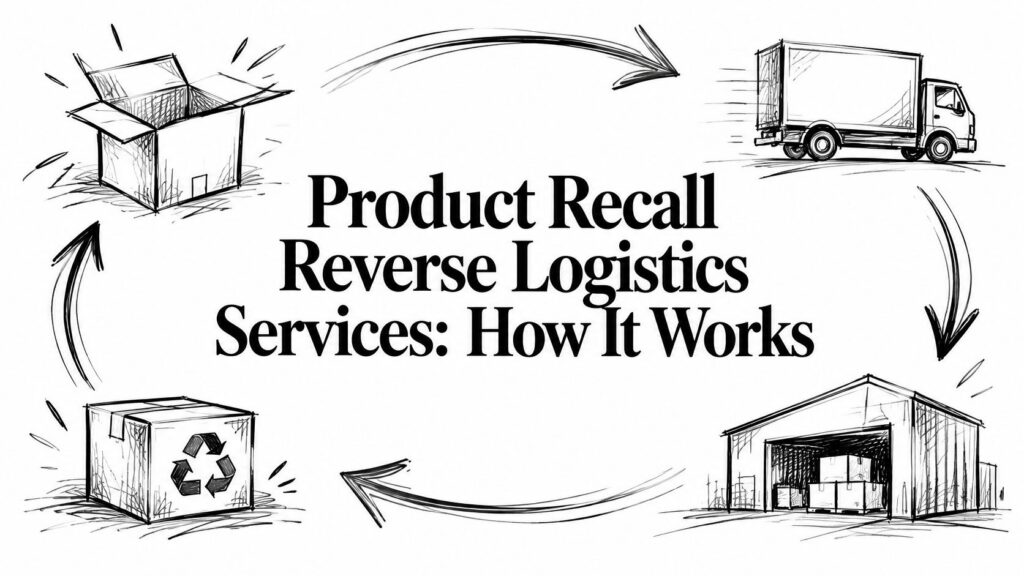
In 2024, 3,232 U.S. recalls across five major industries affected 680.87 million units, according to Sedgwick's 2025 U.S. Recall Index as reported by Risk & Insurance. That scale changes how you should think about manufacturer product recall destruction. It's not a disposal event at the end of a recall. It's a traceability and evidence problem that starts the moment the first unit comes back through your door.
A recycler can prove what arrived, what was counted, and what left as residue. A recycler can't prove that your distributors returned everything, that a missing serial number was never sold, or that destruction was the remedy your regulator approved. I'd separate those responsibilities on paper before any truck is booked. Keep proof of product destruction and proof of data destruction as two different documents, signed by two different owners, and you'll avoid the most common audit failure in electronics recalls.
Decide Whether a Recalled Unit Gets Destroyed at All
Don't start with a shredder quote. Start with the decision order your recall owner can defend later.
Run Four Checks in Order
- Confirm the committed remedy. Read the recall notice and the corrective action you agreed to. Is it repair, replacement, refund, return, or destruction? A warehouse manager doesn't get to upgrade a repair remedy to destruction because floor space is tight.
- Sort by hazard. Separate safety-critical defects from isolated component faults and from cosmetic or labeling problems. A swollen battery, a faulty charger, and a wrong-language manual don't belong in the same disposition bucket.
- Flag stored data. Mark any unit with a drive, flash chip, removable card, or memory on a control board. That unit has a privacy problem even if the product defect is harmless.
- Pick the route that matches those answers. Use the table below, and record who approved the route for each lot.
State this plainly to every site holding stock. Recalled units must never go to donation, employee giveaways, outlet resale, or salvage, even when they still power on. A working laptop with a recalled battery is still a recalled laptop.
| Route | Best fit | Proof you need | Watch-out |
|---|---|---|---|
| Return to manufacturer for repair or replacement | Isolated defect the firm's remedy covers | Consignee acknowledgment and return count | Returned units must be re-verified, not assumed fixed |
| Rework or component harvesting | Defect confined to one part, approved by the recall owner | Parts log linked to serial numbers | Harvested parts can re-enter stock if not controlled |
| Certified material recycling | Non-hazardous units with no data or sanitized storage | Recycler certificate with downstream destination | A recycled claim can stop at the first processor |
| Controlled destruction | Safety-critical or unverifiable units | Witnessed destruction certificate with counts | Costs more than recycling and loses material value |
| Data-bearing destruction | Units with drives, flash memory, or stored personal data | Media-level destruction certificate | Needs its own proof, separate from product destruction |
Accept the Trade-off in Writing
Destruction is one outcome among several, not the default. Under FDA recall guidance for food industry leaders, recalled food can be reprocessed, reworked, diverted to a safe use, or destroyed, rather than assuming destruction is always necessary. Electronics teams should apply the same logic within their own approved remedies.
Destruction can lower recall-liability exposure while raising environmental and supply-chain cost. You lose recoverable metals, working displays, and scarce components, and you pay for witnessed processing. The right choice depends on defect type, product identity, embedded data, and jurisdiction, plus your ability to document every downstream step.
That's also the direction regulators are moving. A policy shift takes effect on July 19, 2026, when the EU Ecodesign for Sustainable Products framework prohibits destruction of certain unsold consumer products, with derogations requiring documentation and priority for recycling. Recalled units aren't unsold inventory, but expect reviewers to ask why safer recovery wasn't possible.
For electronics, I'd use this hierarchy and log every exception. Start with verified segregation and firmware remediation, then approved repair or component harvesting for isolated defects, then certified material recycling, and reserve shredding for units whose safety, authentication, or data risk can't be controlled. Build that flow into your reverse logistics and returns process so receiving teams aren't inventing routes lot by lot.
How to Intake and Quarantine Recalled Units
Quarantine is where most traceability failures begin. A unit that enters the wrong bin on day one rarely gets clean paperwork later.
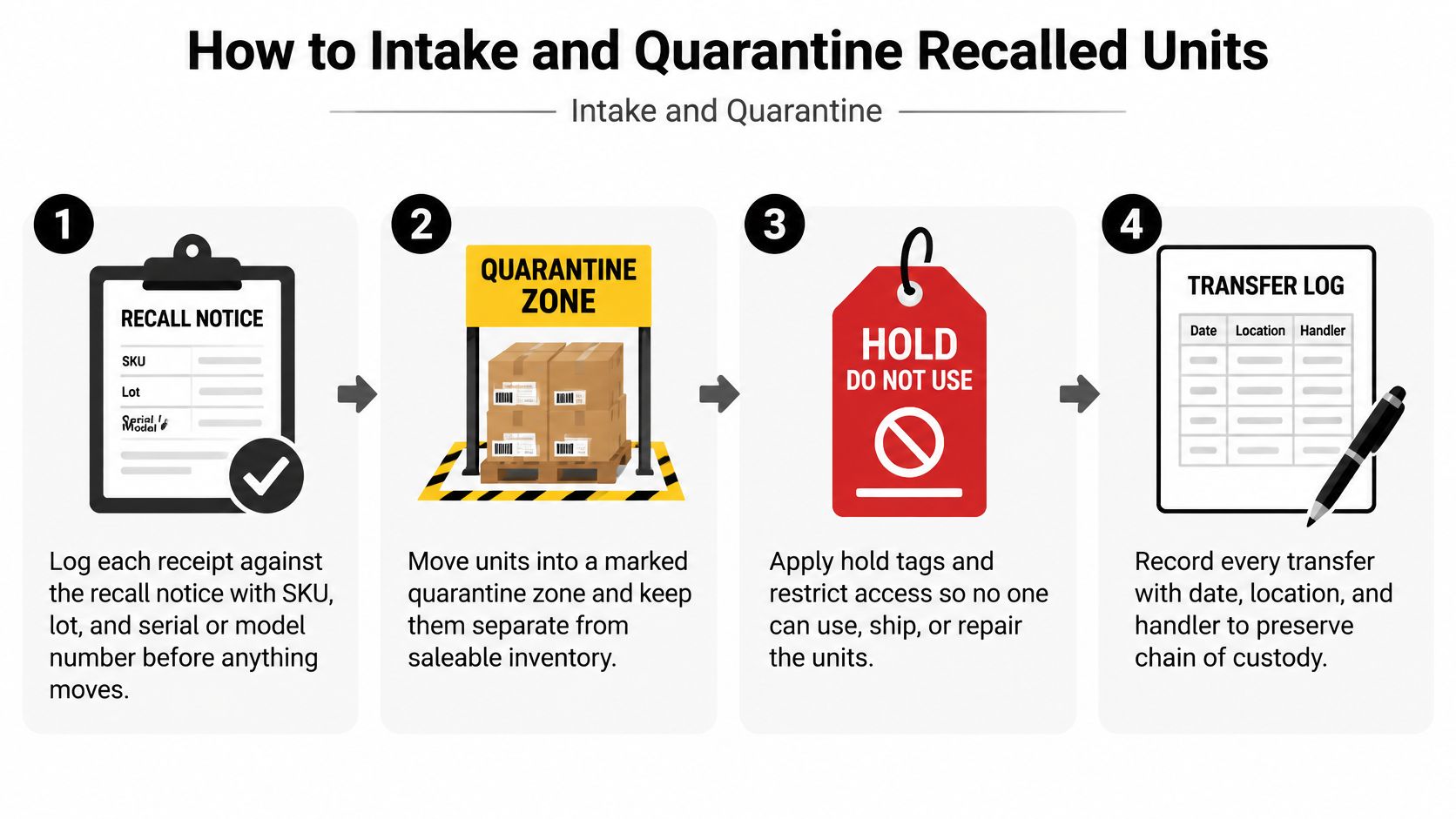
The CPSC Recall Handbook sets the baseline. You need approval before destruction, the agency may witness the process or require written verification, and recalled products should stay quarantined and segregated from other returns throughout the distribution chain. Products must not be commingled with ordinary goods or sent to salvage, and boxes or pallets should be clearly marked.
Numbered Intake Routine
- Log before you move anything. Record each receipt against the recall notice with SKU, lot, and serial or model number at the dock. The usual slip is unloading first and counting later, after two shipments have already merged.
- Use a marked quarantine zone. Give it locked or badge-controlled access, separate from returns, saleable stock, refurb benches, and scrap. If a receiver can reclassify a returned laptop as refurbishable to clear floor space, your control doesn't exist.
- Tag every container. Put the recall ID, hold date, count, and a Do Not Sell or Salvage label on every pallet, box, and cart. A tag on the outer pallet wrap isn't enough once someone breaks the pallet down.
- Stop commingling. Never combine a recalled lot with a second lot, even for the same model. A mixed pallet holding two lots forces you to treat the entire pallet as unverified.
- Photograph each pallet on arrival. Capture seals, labels, visible damage, and count mismatches while the driver is still there. Note crushed cartons and opened boxes in the log, because damaged units still belong in the reconciliation.
- Name one release authority. Only the named recall owner can sign a unit out of quarantine. Supervisors, sales staff, and service technicians don't get informal exceptions.
Practical rule: If a unit can't be tied to a recall ID at receiving, hold it as recalled until the recall owner proves otherwise. Guessing the other way creates resale risk.
Battery Holds and Third Parties
Put lithium batteries, power banks, and devices with swollen or damaged cells in a separate battery hold area away from general quarantine. Keep terminals protected, keep damaged cells isolated in appropriate containers, and brief the shift on fire response. Don't stack suspect battery devices in gaylords like ordinary computer recycling.
If a third-party destruction vendor will handle the units, send written instructions before pickup. State the recall ID, approved disposition, prohibited routes, counting method, and certificate requirements. Monitor the contractor afterward instead of assuming the goods were destroyed because an invoice says so.
Use a consistent intake log header at every site.
| Recall ID | Date received | Receiving employee | Lot | Serial range | Count | Condition | Custody handoff |
|---|---|---|---|---|---|---|---|
| As shown on notice | Date and time | Printed name and signature | Lot or batch | Start and end, or attached scan file | Countable units | Sealed, opened, damaged | Next holder and signature |
That single header prevents arguments later. Everyone counts the same thing, in the same order, with the same handoff record.
Verify Every Unit and Build the Audit Trail
Measure success as controlled disposition, not tonnage destroyed. Weight tells you a truck was heavy. It doesn't tell you serial number 8841 reached an approved outcome.
The FDA recall procedures guide points to effectiveness checks for every recall. Status reporting should include notification dates and methods, customers notified, responses, returned or otherwise accounted-for quantities, and nonresponders. Termination depends on reasonable assurance that affected product has been removed and properly disposed of commensurate with hazard, not on a single destruction event.
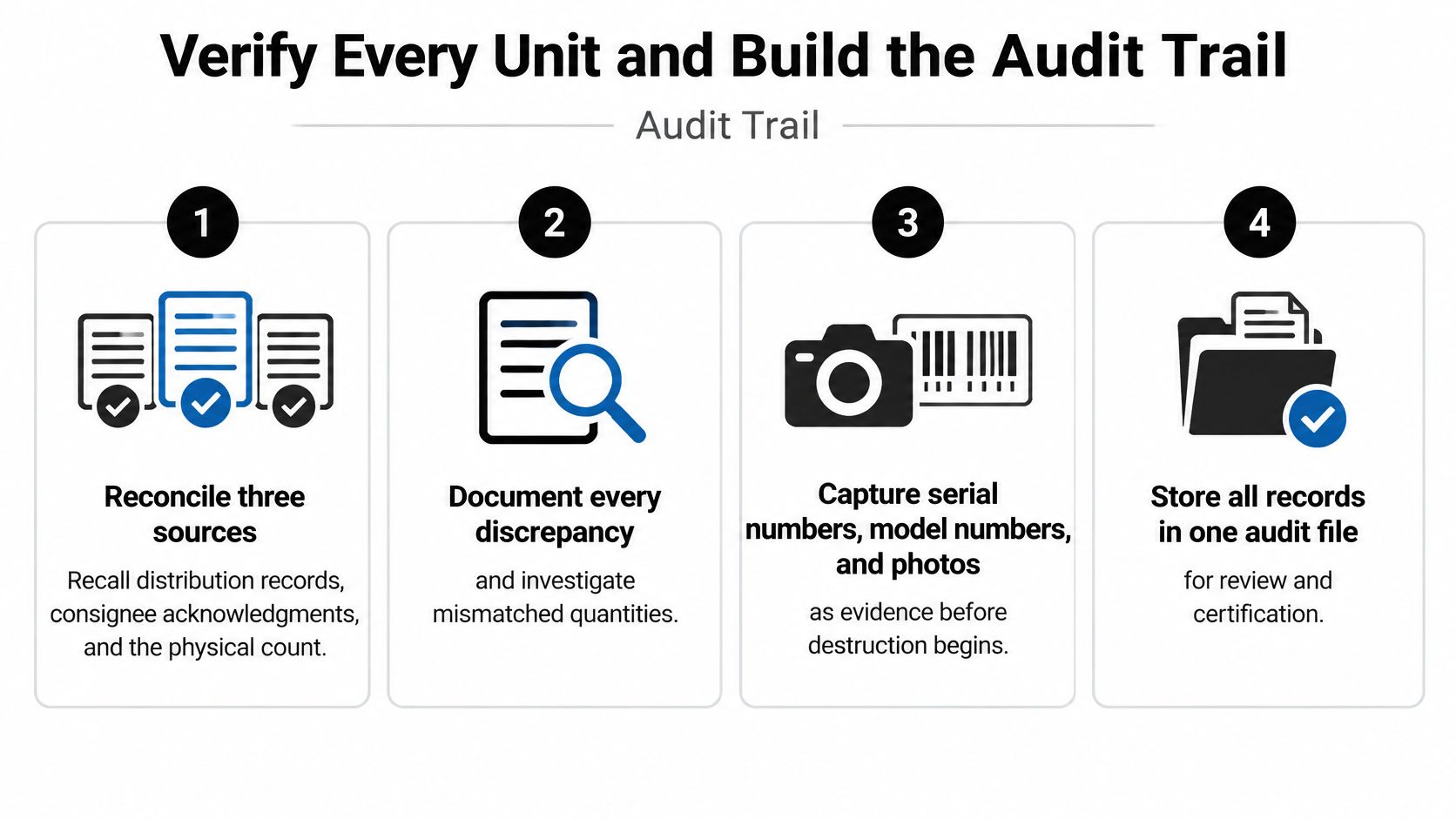
Reconcile Three Sources
Compare distribution records, consignee acknowledgments, and the physical count before destruction starts. Document every nonresponder and every unit returned, repaired in place, destroyed locally, or otherwise accounted for. Don't let field teams report percentages when the recall owner needs countable units.
Hold the work to four benchmarks.
- 100% identity match: Required for high-risk serialized products.
- 100% documented disposition: Required for every consignee in the recall depth.
- Zero unexplained inventory variance: Every gap gets an investigation note.
- Zero units released to resale or salvage: No exceptions for working units.
Run custody like a sequence of signed handoffs. Seal transport containers, record seal numbers, and have each receiver sign for count and condition. Give any vendor written instructions, name a witness at the destruction site, and capture photos or video where the recall plan requires it. Teams that want a broader model for evidence files can compare their approach with ABCO Security Services Australia's documentation guide, then adapt the structure to their own regulator and retention rules.
Pitfalls That Break Closeout
Destroying a mixed lot before the count closes is the fastest way to lose the audit trail. Accepting aggregate weight instead of countable units creates the same problem. So does leaving rejected or damaged units out of the reconciliation because they're messy to scan.
Don't issue a certificate before a discrepancy is investigated. A certificate signed over an open variance doesn't close the recall. It creates a false record that your quality team will have to explain.
Pick any serial number at random. If you can't trace it from recall notice to signed certificate without asking someone for help, the file isn't ready to close.
Assemble one closeout package with the recall notice, consignee acknowledgments, custody log, destruction log, witness or photo evidence, certificate, and final variance review. Store logs in write-once or access-controlled form so counts cannot be altered without detection. Link each serial number to its notice and disposition record, and align the file structure with your chain of custody documentation so sites do not file evidence under different names.
Keep product-destruction proof and data-destruction proof separate. The person who witnessed shredding signs for product destruction. The operator who sanitized or destroyed media signs for data destruction. One combined certificate with one signature hides who controlled each risk.
Medical Device Records Run Longer
For devices, the FDA page on recalls, corrections and removals explains that a removal means physically moving a device from its point of use to another location for repair, modification, adjustment, relabeling, destruction, or inspection. Under 21 CFR 806, manufacturers and importers must report a correction or removal when it addresses a health risk or a legal violation that could present a health risk. Even when reporting isn't required, records must identify the device, model or catalog number, lot or serial number, reason, corrective steps, and justification for nonreporting.
| Record | Must include | Retention |
|---|---|---|
| Destruction certificate | Recall ID, product model, serial or lot, quantity, date, method, employee and witness names | Period set by recall policy and applicable regulator |
| Chain-of-custody log | Each handoff with date, signer, seal numbers, and condition | Same as the destruction certificate |
| Reconciliation report | Units distributed, returned, destroyed, nonresponders, and variances | Same as the destruction certificate |
| Medical device removal record | Device, model or catalog number, lot or serial, reason, corrective steps, nonreporting justification | Two years beyond expected device life, including after the firm stops making it |
| Data-destruction certificate | Media type, serial numbers, method, tool or facility, operator, and verification | Per the enterprise sanitization policy and data classification |
That retention point matters. Device removal records must be kept for two years beyond the device's expected life, including if the manufacturer no longer makes or imports it.
Matching Destruction Methods to Storage Media
Deletion isn't destruction. A factory reset isn't proof. For recalled connected devices, both leave you guessing about recoverable data.
The NIST SP 800-88 Rev. 2 FAQ organizes sanitization into clear, purge, and destroy, and says programs should align the organization's confidentiality classification with an acceptable method and retain evidence. Physical destruction must permanently disable the device and make recovery infeasible even to a state-of-the-art laboratory. High-powered degaussing applies to magnetic media, while melting or smelting is needed for other media types such as solid-state drives.
Method by Media Type
| Media type | Method | Evidence to keep |
|---|---|---|
| Magnetic hard drives | Purge by degaussing where approved, then shred | Serial list, degausser or shredder log, witness signature |
| Solid-state drives and flash memory | Destroy by shredding or melting or smelting | Serial list, destruction certificate, residue photo |
| Removable cards and USB media | Destroy by shredding | Count by lot, shred certificate |
| Optical discs and printed manifests | Destroy by shredding | Count, destruction date, witness initials |
| Embedded memory on control boards | Destroy with the assembly | Assembly serial, board count, certificate |
| Devices returned for repair only | Clear, then verify | Sanitization record, retest result |
Use clear only when the device stays under your control for approved repair and retest. Use purge when an approved tool can address the media type and verification can prove the result. Use destroy when the recall requires permanent withdrawal, the media can't be verified, or the data classification doesn't allow reuse.
Practical Traps on the Bench
Inventory media types before the destruction date. A product line can switch from a removable hard drive to soldered flash mid-recall, and your quote, tooling, and certificate language will be wrong if nobody checks. Open sample units from each lot and photograph the storage layout.
Embedded memory on control boards gets missed most often. Say a recalled medical monitor has no removable drive. It may still store patient identifiers, Wi-Fi credentials, or service logs on the board. Destroy that memory with the assembly and list it as its own line item. Don't bury it inside a general electronics recycling weight.
Set particle size in written policy when you shred media. Record the equipment used, the operator, the serial list processed, and any failed or unreadable serials. If a serial label is destroyed before scanning, you've created a variance that no certificate can fix.
Keep the serial list tied to the method for each batch. A certificate that says drives were shredded doesn't help if half the batch was degaussed and the list doesn't say which half. Match your workflow to documented data sanitization methods and make the vendor use the same method names your policy uses.
Define those legal and technical requirements before pickup. Once they're written, a qualified partner can provide secure data destruction for recalled IT equipment and route residual materials into downstream sustainable recycling. Without written requirements, you're buying shredding by the pound and calling it compliance.
Hazardous Waste and WEEE Rules for Recalled Electronics
A recall plan answers what happens to the product. Waste law answers what happens to everything inside it. Batteries, lamps, boards, and shredding residue don't stop being regulated because the recall owner signed a destruction certificate.
Use Europe as the benchmark if you sell there. The EU Your Europe page on WEEE responsibilities states that manufacturers, distributors, and sellers must register with national authorities in each country where they distribute products, regularly report quantities placed on the market, and organize or finance collection, treatment, recycling, and recovery. Records must cover collection, recovery, and treatment, and the framework sets minimum recovery and recycling targets for categories including IT and telecommunications equipment and medical devices.
That means an internal write-off isn't enough for European markets. Preserve product identification, quantities, treatment routes, and final outcomes after units leave customers or distributors. A finance adjustment doesn't prove lawful treatment.
U.S. Handling Decisions
For U.S. operations, separate the problem components before transport. Lithium batteries from laptops and power banks need separate handling and transport through a qualified recycler. Cathode-ray tube monitors and mercury-containing lamps are regulated separately from ordinary IT equipment disposal. State e-waste rules differ, so check the state environmental agency before shipping across state lines.
I'd run this sequence for every recalled electronics lot.
- Remove and segregate batteries. Separate intact, damaged, and swollen cells, and pack them for the transport method your recycler specifies.
- Confirm permits and downstream names. Ask the destination recycler to name its downstream facilities and show the permits that cover your material types.
- Require a residue statement. Get written confirmation that shredding residuals go to certified recovery facilities, not landfill or unpermitted export.
Those steps fit inside broader universal waste handling for batteries, lamps, and similar streams, but the recall ID must stay attached until disposition closes.
Watch recycling claims that stop at the first processor. A certificate saying material was received for recycling doesn't prove metals were recovered, plastics were treated lawfully, or residue stayed out of export channels. Ask where each fraction goes.
Report recovery. Quantify metal and plastic recovery by weight from downstream records, and don't overstate diversion from landfill. If batteries, boards, or contaminated residue required disposal, say so in the sustainability report. Corporate sustainability leaders lose credibility when a recall file shows disposal and a public report claims full diversion.
Choose a Destruction Partner and Schedule the Pickup
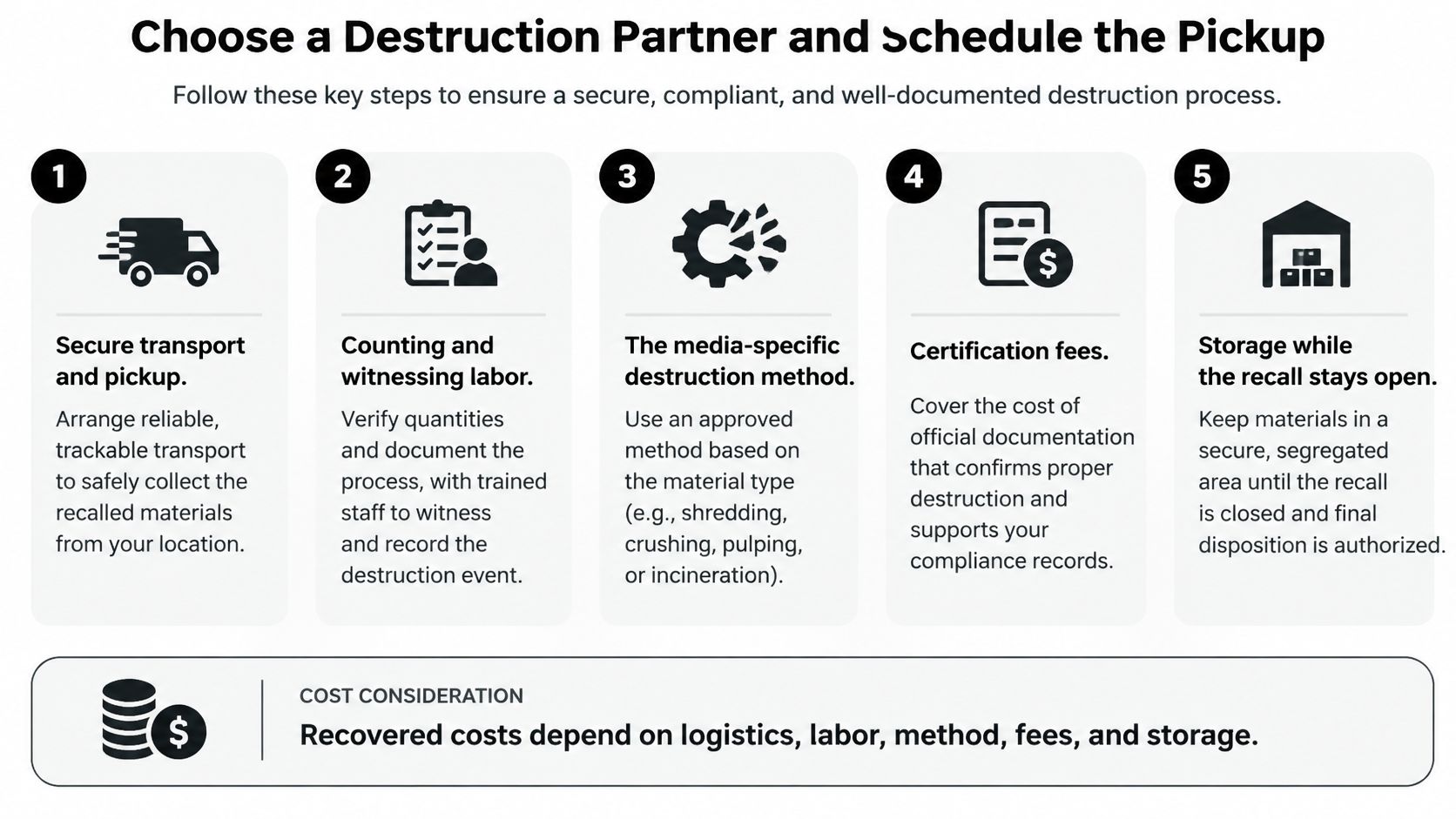
Price the whole control system, not just the shredding hour. Your cost drivers are secure transport and pickup, counting and witnessing labor, the media-specific destruction method, certification fees, and storage while the recall stays open. Long reconciliations cost money because quarantined stock sits under lock while nonresponders are chased.
Recovered metals and approved components can offset part of that cost, but only after reconciliation and written approval. Never offset cost by selling units intact. The moment a vendor suggests reselling working recalled units to reduce your bill, end the conversation.
The FDA recall procedures document calls for a destruction memo or certificate stating the date, quantity, and destruction method, and may require advance notice so the agency can witness destruction or review proposed reconditioning. Build your vendor requirements around that evidence model.
Vendor Checklist and Red Flags
- Licensed or certified facility: Can name downstream routes for each material fraction.
- Written destruction instruction letter: Accepted and signed before pickup.
- Witnessed destruction on request: Available for your staff or regulator where required.
- Certificate naming serial numbers: Not just weight, pallet count, or a generic product category.
- Sealed or tracked transport: Seal numbers recorded at loading and verified at arrival.
- NIST-aligned data destruction: Methods matched to magnetic, flash, and embedded media.
- Liability and insurance terms: Clear in the service agreement, with audit rights.
Apply consistent vendor selection criteria across sites so one warehouse doesn't hire a scrap hauler while another hires a certified ITAD provider.
Red flags are easy to spot. A vendor offers donation for recalled goods. Pricing is by weight with no unit counts. Downstream recyclers aren't named. Certificates are issued before processing. Any one of those should pause the pickup.
Recycled is not automatically the same as destroyed. A material recovery certificate can prove waste processing while failing to prove the defective unit could never re-enter commerce.
Set the boundary clearly. Reworx Recycling can support product destruction, secure data destruction, electronics recycling, and business pickup steps within a recall workflow. It doesn't make the recall owner's regulatory determination, approve a remedy, or decide whether destruction is legally required. Those decisions stay with the manufacturer and its regulator.
Keep ordinary corporate donation programs physically and administratively separate from recalled stock. Donated working equipment can support digital inclusion and workforce development, but recalled units don't belong in that stream. When your recall owner has approved the disposition, schedule the pickup with the serial list, seal plan, witness plan, and certificate format agreed in advance.
If you're holding quarantined laptops, servers, medical devices, or other recalled electronics, Reworx Recycling can help you plan secure pickup, product destruction, media-level data destruction, and auditable downstream electronics recycling around your approved recall remedy. Contact the team to discuss a recall partnership, request a data destruction quote, or schedule a business pickup that keeps recalled stock separate from equipment eligible for donation.