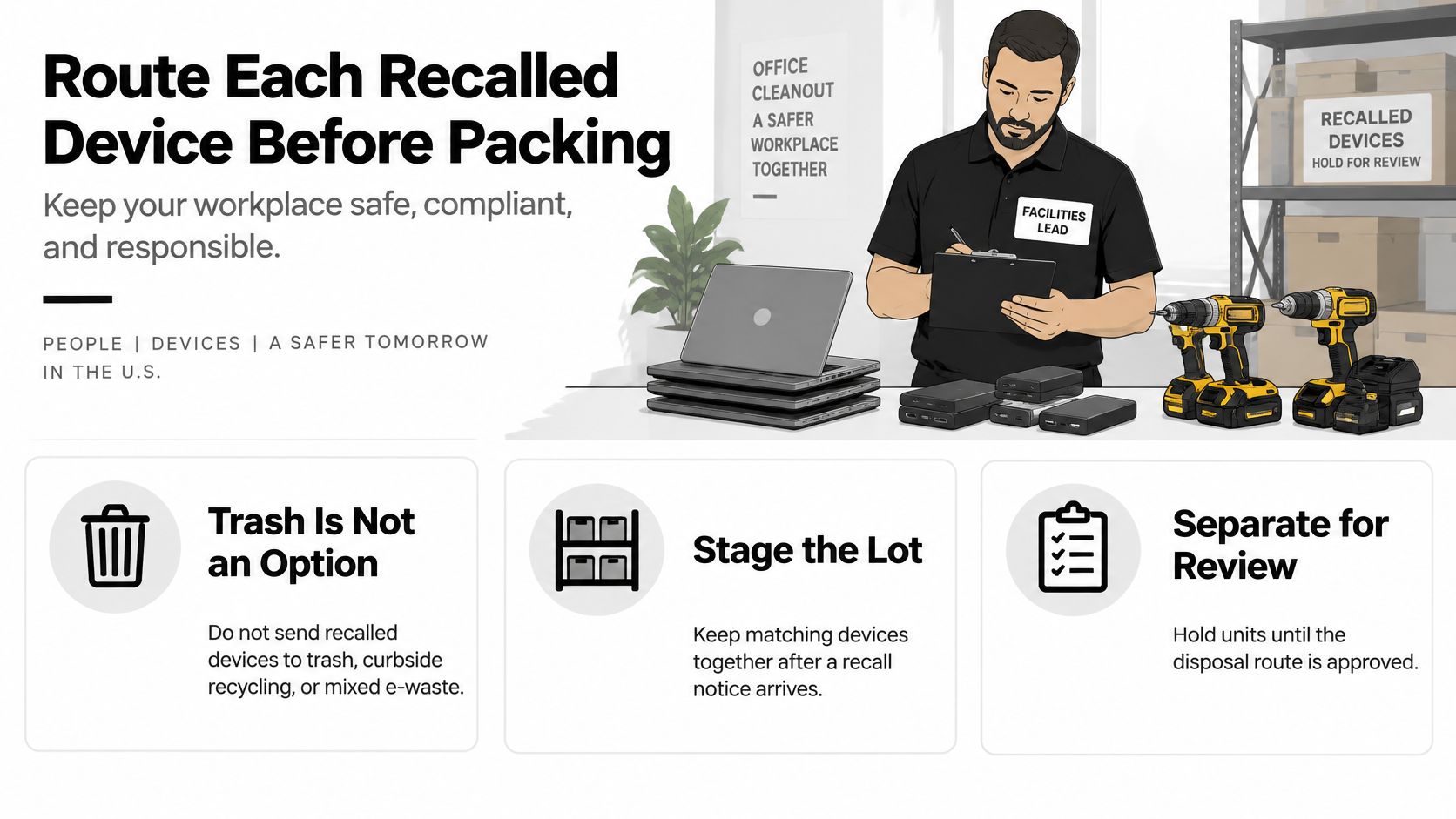
“Recycle it responsibly” is incomplete advice when a device has been recalled. A facilities lead may have matching laptops, power banks, and cordless tools staged for an office cleanout when a recall notice arrives. Sending those units to trash, curbside recycling, a retail battery box, or the ordinary electronics cage is unsafe.
Battery-powered device recall disposal starts with a routing decision, not a pickup request. For businesses in Smyrna, Georgia, that means separating the affected equipment, confirming who can accept it, and coordinating battery safety with data security before anyone packs a box.
Route Each Recalled Device Before Packing
First destination by device condition
Think of the recall notice as a boarding pass with no destination printed on it: it tells you the device has to travel, but not where it can land. The rows below match each device condition to the first place it should go. Condition decides the route, not the service your organization already has on contract.
| Situation | Correct first destination | Do not use | Transport limit | Record before movement |
|---|---|---|---|---|
| Recalled device intact and cool | HHW program or qualified processor after written acceptance | Trash, curbside, retail battery box, ordinary ITAD cage | Highway, rail, or vessel only if classified damaged, defective, or recalled; no commercial air | Model, serial, recall notice, quantity, condition |
| Swollen, hot, leaking, or physically damaged | Supervised isolation, then a permitted hazardous-waste or specialized handler | Employee vehicles and mixed consolidation | No air; do not tender until the receiver authorizes the unit | Time of observation, photos taken safely, condition notes |
| Ordinary used lithium battery, not recalled | Battery collection, electronics recycler, or universal-waste handler | Mixed trash | Terminal protection required; air rules differ from recalled units | Chemistry and count |
| Host device stores business or patient data | Document sanitization, then follow the battery route | Treating recycling as proof of data destruction | Don't charge or open the case to reach storage | Media type, method, and certificate requirement |
| Bulk recall lot at one site | Segregated storage apart from non-recalled assets | One mixed gaylord or pallet | No multi-unit inner packs for damaged, defective, or recalled batteries | Chain of custody and written receiving authorization |
The reason for this separation is concrete. An EPA review of lithium-ion battery fires identified more than 240 fires at 64 waste and recycling facilities between 2013 and 2020, involving batteries commonly found in phones, tablets, laptops, hoverboards, and electronic cigarettes. Ordinary collection points were never designed to absorb that kind of risk.
An intact case doesn't establish that a recalled battery is safe for normal collection. The recall identifies a defect that may not be visible from the outside, so an apparently undamaged power bank still needs a confirmed destination. An ordinary used battery works the opposite way: reaching the end of its useful life doesn't make it recalled, and it follows the third row, not the first.
The host device's name doesn't determine the disposal route. A laptop can belong in a specialized battery channel even when the rest of an office's computer recycling goes to its usual IT equipment disposal provider.
When the usual recycler says no
The CPSC recall notice for Belkin portable power banks and wireless charging stands instructs owners to stop using the affected products and directs them away from trash, curbside recycling, and ordinary disposal channels. That pattern holds across lithium-ion recalls: the documented fire risk is exactly what standard collection points are not built to handle.
A refusal from your regular recycler is a routing problem, not permission to try a less supervised collection point. Call the local household hazardous-waste program, explain that the material comes from a business, and ask whether it accepts that specific recalled product. Household programs may restrict eligibility by source, so a program's name alone is not evidence that your commercial lot qualifies.
If the HHW program declines, ask the municipality for instructions and contact a specialized processor. Keep the lot under controlled storage while that decision is pending. Don't send an employee around town with rejected batteries in a trunk.
Routing rule: A collection point that accepts ordinary batteries hasn't necessarily agreed to accept recalled batteries.
For a hot, smoking, hissing, or actively venting device, stop routine intake and follow the site's emergency response plan. Keep people away and contact emergency responders as appropriate. Employees shouldn't carry an actively failing device through an occupied building to reach the designated storage area.
Assign ownership before equipment changes hands
Across schools, clinics, and corporate sites, IT asset disposition (ITAD), facilities, and environmental health and safety should share the work without leaving accountability unclear. IT identifies assets and data-bearing media. Facilities controls access and staging, while environmental health and safety coordinates hazard assessment, storage, and qualified handlers. Three teams, one chain of custody.
For a Smyrna clinic, that might mean separating recalled tablets from eligible desktop equipment during a medical equipment disposal project. For an office refresh, it means keeping recalled power banks out of a pallet of monitors intended for donation-based recycling. A data center decommissioning project needs the same distinction when handheld service equipment or battery-containing accessories appear in the inventory.
Equipment records also help staff find the manufacturer's remedy instructions. For background on maintaining those records, Modern Lyfe explains warranty registration, although registration doesn't replace a recall check or receiving authorization.
Use the lithium battery recycling guidance to frame questions about chemistry, condition, and acceptance before requesting service. Pick a routing row before packaging anything.
How to Quarantine Inspect and Record Each Unit
Verify the recall before releasing stock
A quarantine that starts from a rumor is wasted effort. Begin with the manufacturer's notice and the CPSC recall listings, then compare model numbers, serial ranges, and identifying photographs unit by unit. A forwarded email claiming that every laptop in the fleet is affected says nothing about the units sitting in your cage. Record the notice identifier in the lot file and keep that file open until the final handoff.
Any unit whose recall status can't be confirmed follows the same controlled intake sequence as a confirmed one, and that treatment ends only when the manufacturer or the local HHW program gives written direction otherwise. Before any recalled unit leaves controlled storage, check the CPSC recall listings and consult the HHW program directly. A recalled lithium-ion device is not an ordinary used battery. The standard electronics drop-off or retail battery box may refuse it, or worse, accept it into a waste stream that was never set up to manage its risk.
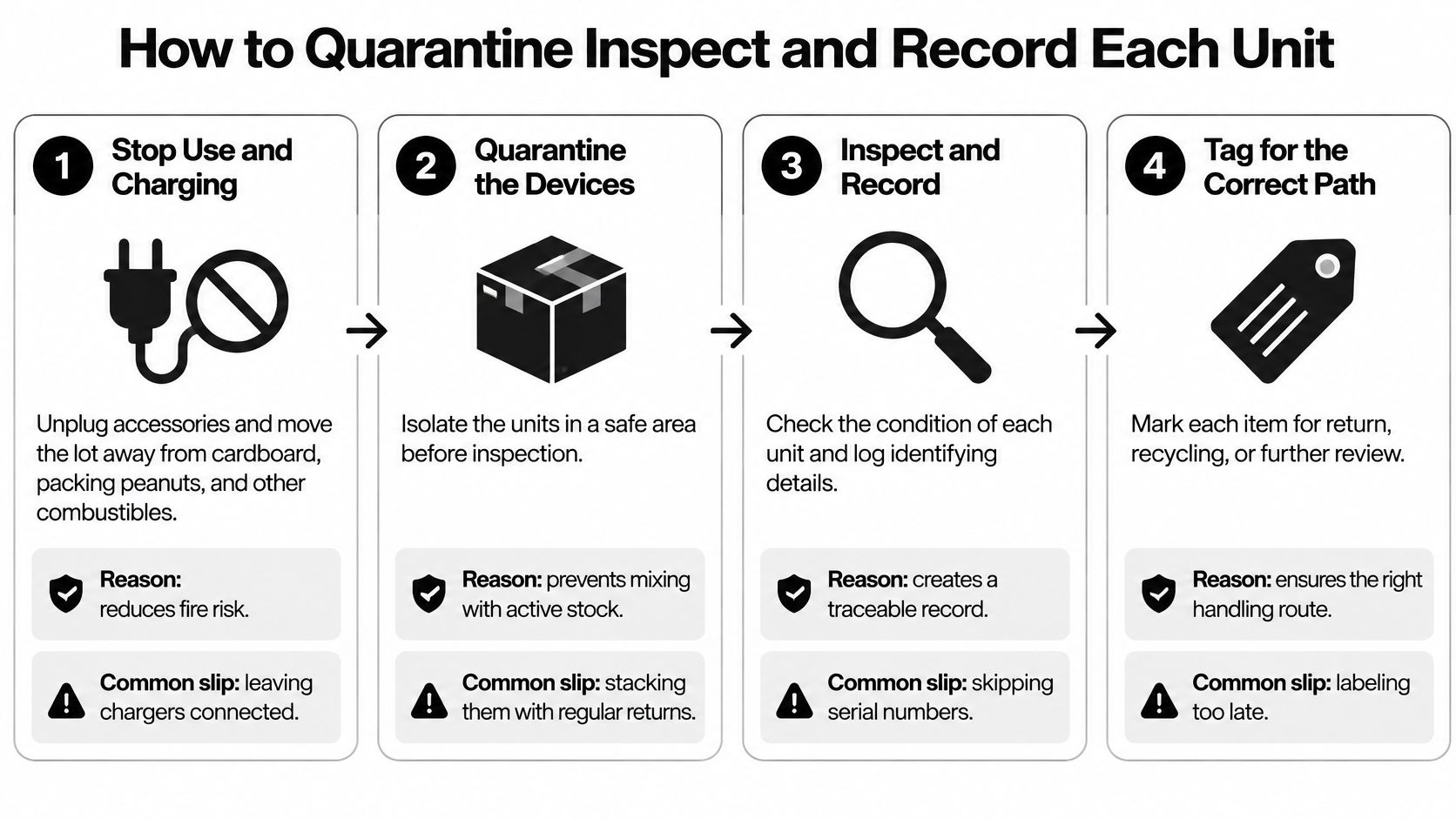
Use a controlled intake sequence
Quarantine works like an isolation ward. The goal is to keep a potential problem contained, observable, and away from anything it could spread to, while a paper trail records who saw it and when.
Stop use and charging. Disconnect charging equipment and accessories when safe to do so, and pull the lot away from cardboard, packing peanuts, and other assets. Staff waiting on a refund or replacement will happily leave a recalled unit charging on a desk for weeks. This step ends that habit on day one.
Quarantine the equipment. A designated, supervised area needs climate control, ventilation, and floor space to inspect units without stacking them. An unattended returns shelf fails both tests: nobody watches it, and someone will eventually walk off with a device that looks perfectly usable.
Inspect visually without disturbing the battery. Check for swelling, leakage, case damage, and signs of overheating. If you notice an unusual odor, record it rather than moving closer to investigate. Never puncture, crush, open, charge, or attempt battery removal just to complete an inspection.
Prevent terminal contact where safely accessible. Nonconductive tape over exposed terminals, or individual bags for suitable loose batteries under the handler's instructions, keeps contacts from finding each other inside a shared container. Don't open an assembled device to reach hidden terminals, and don't treat bagging as containment for a battery that is already swelling or venting.
Record each unit's identity and custody. Manufacturer, model, serial number, recall notice identifier, condition, quantity, and the person taking custody all go into the record. An entry that reads "miscellaneous laptops" can't be reconciled against a recall notice or a receiver's acceptance later, which makes the whole quarantine unauditable.
Separate recalled batteries from ordinary stock and monitor them. Segregated storage is a starting condition, not a finish line. Set a documented visual and thermal inspection schedule, carried out by trained personnel with appropriate equipment, so a unit that begins swelling in week three gets noticed in week three.
Contact the receiver before scheduling transport. Send the condition inventory and get three things back in writing: acceptance of the specific units, packaging instructions, and confirmation of commercial eligibility. A phone call produces none of those, and it leaves the shipping team guessing.
Release only against authorization. Match the outgoing lot against the accepted inventory and log each custody handoff. A look-alike model that was never reviewed can't substitute for an accepted unit.
The EPA's lithium-ion battery recycling FAQs point in the same direction: employee training, damage prevention, appropriate storage, and separate management of damaged, defective, or recalled batteries. They also explain that universal-waste shipments must reach an eligible destination even when a hazardous-waste manifest isn't required, which is why "accepted in writing" carries more weight than "we've always sent batteries there."
If the receiver hasn't accepted the item in writing, it's still your hazard.
Everyone who passes the storage cage needs the briefing, including temporary workers, custodians, and loading staff. They should recognize the hold tag at a glance, know who can authorize a move, and know when to stop handling a unit and escalate.
An IT equipment audit supplies the inventory foundation, but a recall file needs more than an asset spreadsheet. Keep the notice, condition observations, inspection log, training records, receiving acceptance, custody entries, shipping documents, and final-disposition evidence in one place. A regulator or insurer reconstructing the incident months later should find the whole story in a single file.
Sanitize Stored Data Without Disturbing the Battery
A recycled chassis isn't evidence that its stored information is gone. A recalled laptop can present a battery hazard and a confidentiality risk at the same time, and resolving either problem doesn't resolve the other.
The NIST media sanitization guidelines define sanitization as making access to target data infeasible for a specified level of effort and identify clear, purge, and destroy as sanitization methods. The appropriate decision concerns the storage media, not whether the surrounding device reaches a recycler.
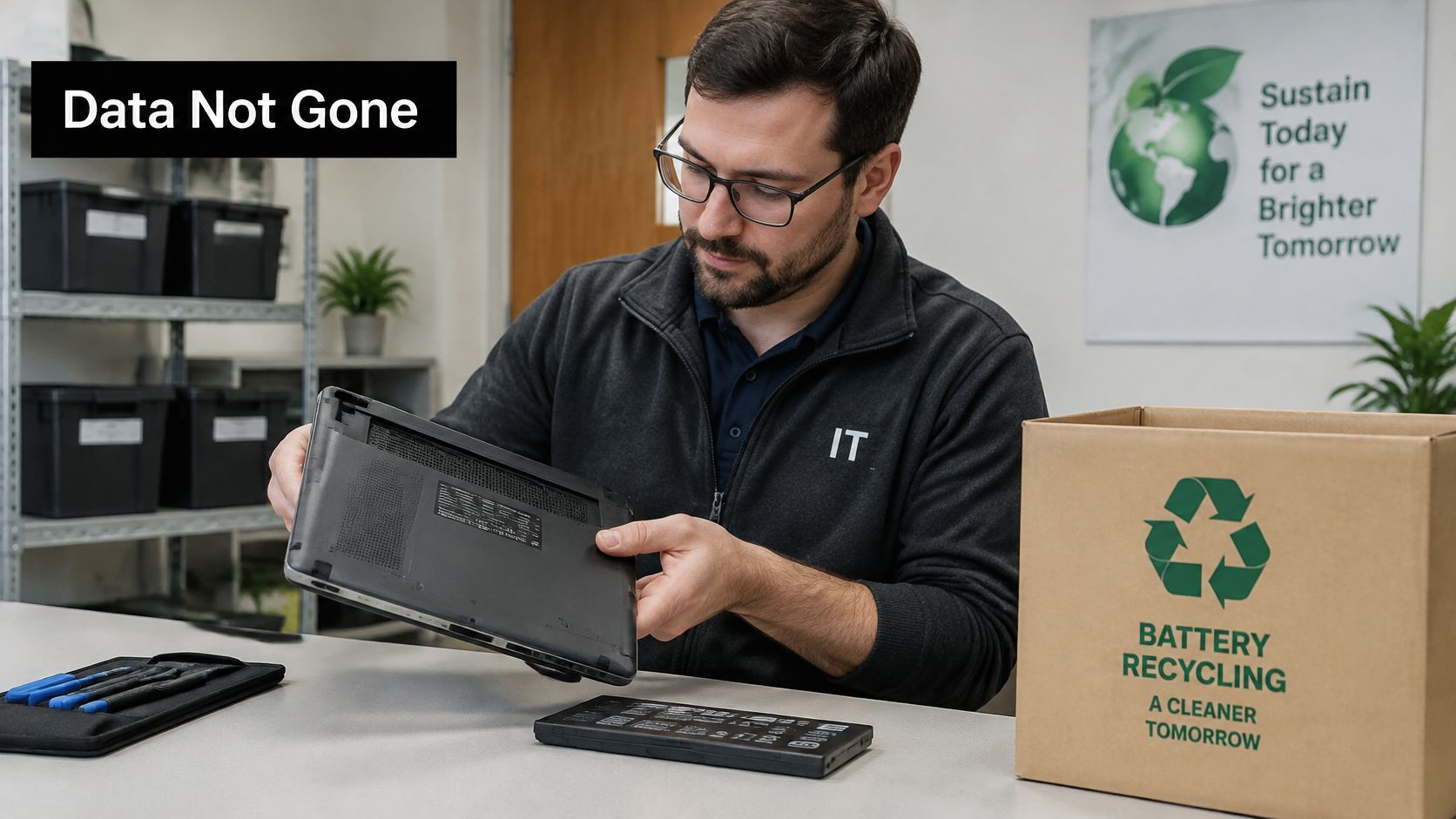
When powering on isn't an option
Clear and purge may require access that the recall handling restrictions don't permit. A technician shouldn't charge a recalled tablet to run a wipe utility or open a swollen laptop to connect its SSD to another computer.
Destroy may be the practical corporate choice when safe electronic sanitization isn't available. That means arranging physical destruction of the media through an authorized process, not putting the complete battery-containing device into a shredder. Hard drives, SSDs, and removable media need a method that makes recovery infeasible while the battery remains under its separate safety controls.
Consider a clinic retiring a recalled tablet used for patient intake. Asking a receptionist to log in and delete files doesn't establish sanitization, and booting the device may conflict with stop-use instructions. The IT custodian should instead document the access limitation and arrange a qualified handling sequence that preserves battery safety before media destruction.
Embedded storage needs an explicit decision
Medical equipment, badge scanners, and laboratory handhelds may contain embedded storage that isn't accessible like a desktop drive. During laboratory equipment disposal, the organization should identify these devices before pickup rather than discovering them after the lot has entered processing.
The manufacturer may require a recalled unit to stay assembled. In that case, secure data destruction has to work around that restriction, with the receiver explaining how authorized battery handling and subsequent media destruction will be coordinated.
Record the following in the sanitization plan:
- Media identification: Identify hard drives, SSDs, removable cards, and embedded storage, including inaccessible components.
- Chosen method: State clear, purge, or destroy and explain why the selected method is compatible with the recall restrictions.
- Named custodian: Assign responsibility for holding the device and approving its transfer.
- Verification evidence: Require a certificate identifying serial numbers or a witnessed bulk count linked to the controlled inventory.
For accessible, safely separated drives, secure hard-drive shredding can provide the data control. Review the available data sanitization methods with the provider rather than assuming every storage technology requires identical processing.
Data-security checkpoint: A whole-device destruction promise isn't evidence that the processor safely managed the cells.
Keep the sanitization certificate and battery acceptance linked in the same project file. Acceptance travels with the shipment; the completed sanitization certificate joins the record when the authorized work is finished.
Confirm Acceptance Then Book the Handoff
Written acceptance is the release gate before packing or tendering the lot. A service appointment, price estimate, or manufacturer refund approval doesn't establish that the receiving facility has reviewed the actual equipment.
Send a concise intake package that allows the receiver to make an informed decision. Include these documents rather than asking whether it generally accepts electronics:
- Recall notice: Include the manufacturer's remedy instructions and the notice identifier.
- Serial and quantity log: Identify the actual assets proposed for transfer.
- Condition notes: Flag swollen, leaking, crushed, or otherwise damaged units separately.
- Sanitization plan: Identify drives or embedded storage that can't be accessed safely.
Turn approval into usable instructions
Ask for written acceptance identifying the material, receiving location, approved transport arrangement, packaging responsibility, and any conditions that would invalidate approval. Also agree on the final-disposition statement the receiver will provide after processing. Don't ask for a completed disposal certificate before disposal occurs.
A battery recycling service intake discussion should establish whether the provider can accept the specific lot or whether a specialized hazardous-waste destination is needed. If conditions change before collection, such as a previously cool unit developing swelling, send an updated condition report for review.
For internal coordination, use a short note like this: The affected equipment is identified in the attached recall inventory and quarantined in the designated controlled area. Only named, trained personnel may handle it; commercial air shipment and ordinary battery collection boxes are off limits. The assigned custodian will release the accepted inventory under the receiver's written instructions.
Keep the remedy separate from the shipping decision
Coordinate with the manufacturer about replacement, repair, return, or disposal instructions. If a refund process asks for photographs or proof of ownership, obtain them without charging, opening, or damaging the device.
Keep unaffected surplus outside the recall file once staff have verified its eligibility. That separation allows ordinary corporate donation programs to proceed without accidentally transferring recalled equipment into reuse.
Nothing moves until the receiver has said yes in writing.
Package and Move Lots Only After Acceptance
Use 100% package conformity as the pass-fail audit benchmark for batteries classified as damaged, defective, or recalled under the applicable PHMSA lithium-battery recycling safety advisory. Its packaging pattern requires individual nonmetallic inner packaging, complete enclosure, specified cushioning, and a Packing Group I performance outer package. One shared inner package or exposed terminal fails the entire shipment.
Highway, rail, or vessel are the permitted modes; commercial air transport is prohibited. Have the qualified shipper confirm the applicable classification and configuration, especially when the battery remains installed in equipment.
Packaging controls for recalled lithium batteries
| Control | Ordinary used lithium battery | Damaged, defective, or recalled |
|---|---|---|
| Inner package | Terminals protected against short circuits | One battery per nonmetallic inner package, fully enclosed |
| Cushioning | Protection from damage in transport | Noncombustible, electrically nonconductive, absorbent cushioning |
| Outer package | Package suitable for the applicable lithium-battery provisions | One inner package per Packing Group I performance outer package |
| Marking | Applicable lithium-battery marks | Outer package marked damaged or defective and identified by battery type |
| Mode | Rules set by size, chemistry, and state of charge | Highway, rail, or vessel only; commercial air prohibited |
| Consolidation | Compatible undamaged units may ship under their own rules | No combining recalled batteries in one inner package |
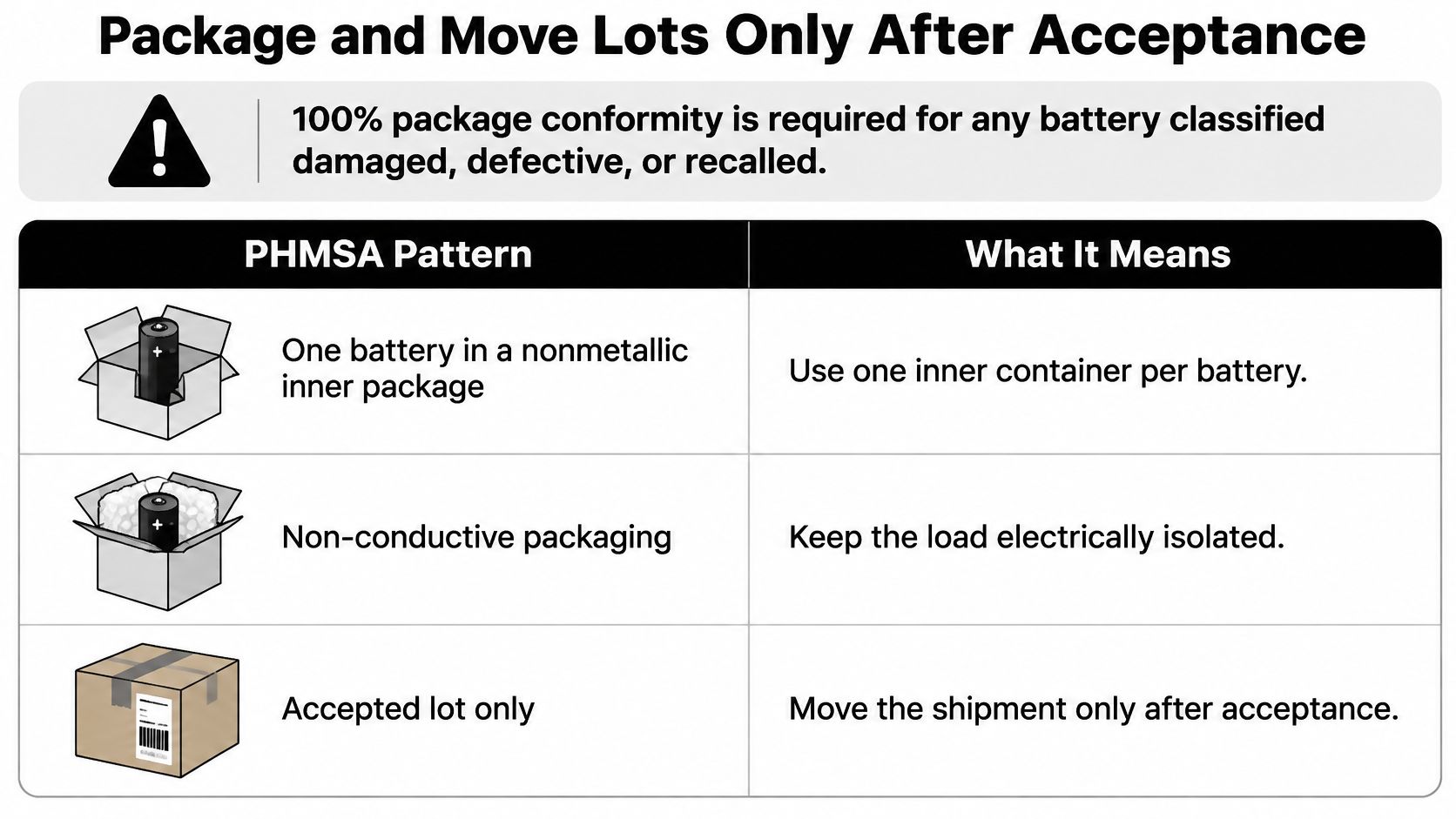
A shipment fails the audit if staff combine batteries, allow metal-to-terminal contact, omit the specified cushioning, create an air waybill, or substitute a retail drop box for the authorized receiver. A UN 3481 label explanation helps staff read battery-containing equipment markings; a correct label alone does not establish compliant packaging.
Match the handoff to the accepted lot
A confirmed municipal or recycler drop-off can work for a small quantity of intact units when the facility has approved commercial acceptance and the transport arrangements are settled. Employees should not improvise packaging or assume that a short drive removes shipping obligations.
Business pickup suits pallet-scale recalls, medical or laboratory fleets, and lots requiring controlled segregation through product destruction. The Smyrna-based ITAD partner can coordinate business pickup or customer drop-off only for material it is authorized to receive. That authorization check comes first. A recycler's pickup schedule never substitutes for a hazardous-waste routing decision.
Ordinary, non-recalled equipment follows normal freight planning, and for e-mobility devices in that category Punk Ride LLC's guide can help businesses compare electric scooter shipping costs. Cost comparison belongs after hazardous-material eligibility is settled, because a recalled lot that fails the audit cannot legally enter ordinary freight channels at any price.
Before tender, the shipper signs a checklist confirming:
- Classification: The documented condition matches the shipping classification.
- Packaging: Every package meets the applicable inner, cushioning, outer, and marking requirements.
- Carrier and route: The carrier accepts the shipment and the planned mode is permitted.
- Emergency coordination: Required emergency contact information is available.
- Receiving authorization: Written acceptance matches the inventory being released.
The EPA lithium-ion battery recycling guidance provides the public baseline for understanding battery hazards and qualified recycling channels. Sustainable recycling means choosing an eligible destination before pursuing material recovery.
Reworx Recycling provides free customer drop-off, business pickups, secure hard-drive shredding with data destruction, and equipment buyback for surplus hardware. Visit Reworx Recycling to request a pickup for accepted pallet-scale or non-hazardous lots, plan an office recycling program, or arrange secure data destruction for retired assets. Keep recalled units in the controlled area, and schedule their movement only after the authorized receiver confirms acceptance in writing.