41 million consumer-product units were covered by voluntary recalls in a single year, yet the hardest question for most businesses isn't where those units go. It's whether you can prove none of them came back. Recalled inventory destruction services exist for that proof. If you're holding defective laptops, returned electronics, or warehouse stock under a recall notice, a cheap pickup receipt won't satisfy a manufacturer, auditor, or insurer. You need segregation, reconciliation, the right destruction method, and a file that ties every unit to a final disposition.
What Recalled Inventory Destruction Covers
The Consumer Product Safety Commission annual performance report states that the agency negotiated and implemented 333 voluntary recalls during fiscal year 2024, covering 41 million consumer-product units. 166 of the 333 recalls, almost 50%, were handled through its Fast-Track program. The report compares this with 308 voluntary recalls involving 97 million units in fiscal year 2023, so unit volume swings sharply depending on the size of individual incidents.
Say a retailer must pull 4,000 identical units from stores, a warehouse, and customer returns. The operational problem isn't finding a truck. It's proving that all 4,000 were identified, isolated, and prevented from re-entering commerce through resale, donation, liquidation, or an accidental return to available stock.
What the Service Actually Includes
Recalled inventory destruction is controlled removal, identification, segregation, destruction or sanitization, and documented disposition. Ordinary IT equipment disposal produces a receipt. Recall destruction has to produce auditable evidence that the prescribed remedy was completed for the specific units on the recall list.
Manufacturers, distributors, retailers, schools, government agencies, and IT departments all need that distinction. So do facilities teams running an office cleanout or facility cleanout where recalled stock is mixed with acceptable equipment.
A provider should make three promises in writing:
- No re-entry: Units cannot be resold, donated, or salvaged.
- Full reconciliation: Every unit is counted against the recall list.
- Tied certification: The final certificate references the original inventory.
Can you name the recall notice, quantity, custody transfers, and destruction date for every unit? If you can't, your gap is documentation, not logistics.
That self-test is where I'd start. It tells you quickly whether you're buying product destruction or just electronics recycling with a different label.
How a Recall Destruction Job Runs, Stage by Stage
The CPSC Regulated Products Handbook requires recalling firms to quarantine and segregate recalled products throughout the distribution chain, including when a third party handles destruction. Treat the job as a controlled disposition process, not waste removal.
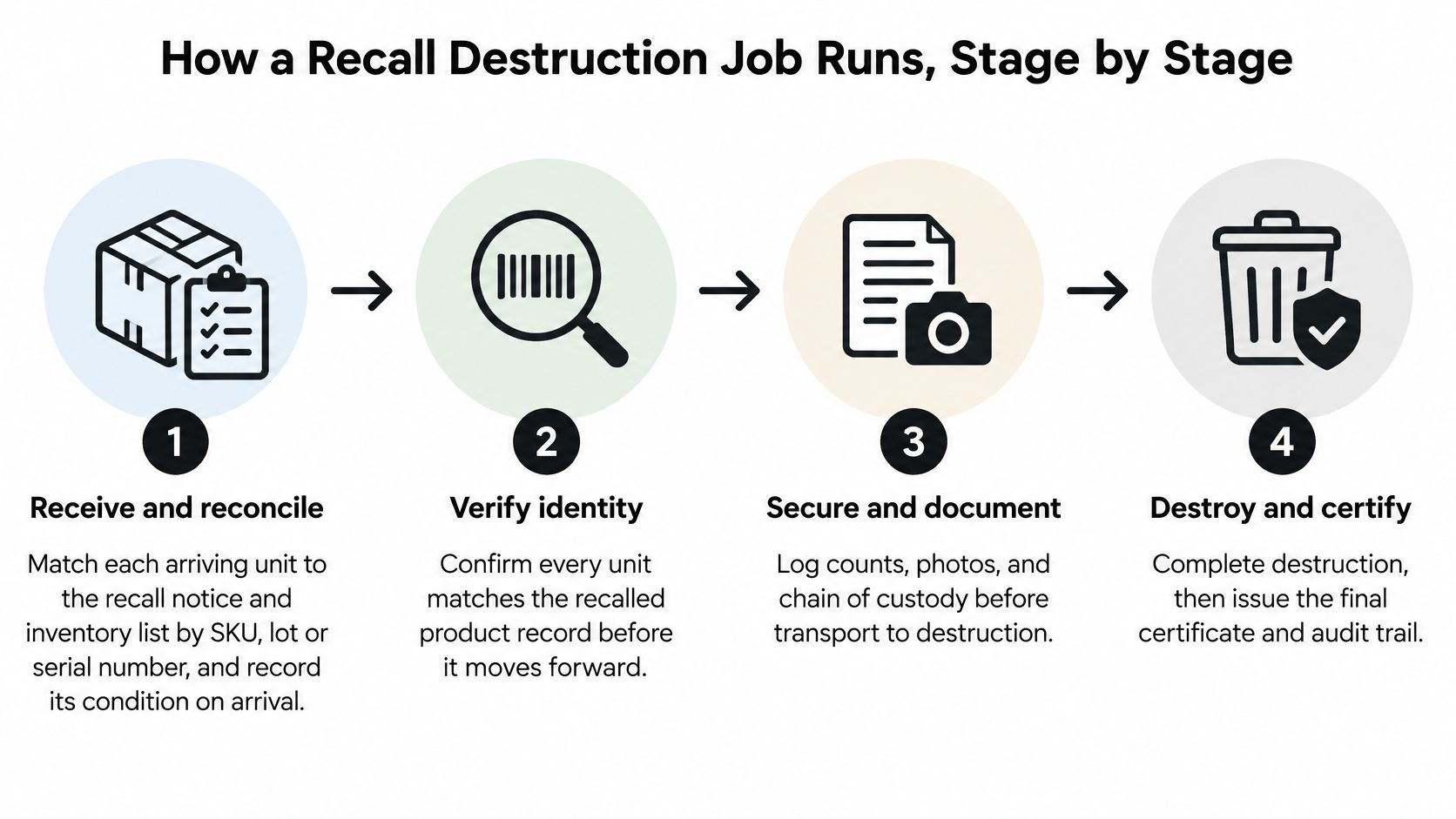
The Eight Stages
- Receive and reconcile: Match each arriving unit to the recall notice by SKU, lot, or serial number, and record condition on arrival. A mismatch found at certification can't be traced back reliably.
- Quarantine and segregate: Assign a unique recall lot and store it in a locked, labelled area. Mixed pallets are the most common route back into commerce.
- Instruct in writing: Every box, pallet, and transfer carries written instructions naming the material and explicitly prohibiting commingling or salvage.
- Photograph labels: Capture identifying labels before processing, so the file shows what was destroyed.
- Split by hazard: Pull lithium-ion batteries and other regulated fractions for separate routing before intact devices move forward.
- Destroy securely: Sanitize or shred data-bearing devices by the method selected for that disposition.
- Route downstream: Send fractions only to authorized recyclers, logging each custody transfer with names and dates.
- Certify and update: Issue the certificate only after the destroyed count matches the original list, then update the inventory system.
In our workflow, step two in overall handling is Data Destruction & Recycling, where our team handles secure data destruction and responsible recycling of your electronic assets. The third step, Certification & Reporting, provides detailed reports and a Certificate of Destruction. That order matters. Certification is an outcome of reconciliation, not a form signed at pickup.
A Worked Example
Say a school district recalls 240 laptops with swollen batteries. Staff lock the laptops in a labelled room and block the asset tags in the inventory system. Technicians remove batteries for separate hazardous routing, photograph serial labels, then sanitize and shred the drives. The certificate isn't issued until 240 received units reconcile to 240 destroyed units.
Practical rule: Check for a named witness and a reconciled count before anyone signs the certificate. Those two slips weaken recall files more often than the destruction method does.
CPSC may also require advance notification, photographic evidence, or an agency witness, so confirm those requirements before processing starts. It's much harder to recreate evidence after units are shredded.
Regulatory Rules That Apply to Each Product Type
A recalled product can fall under several rules at once. A shipment of laptops, for example, may involve consumer-product requirements, data disposal obligations, and electronics waste rules. Match each control to the product, the data it holds, and where each resulting fraction will go.
| Authority | Applies to | Destruction control required |
|---|---|---|
| CPSC | Consumer products under recall | Quarantine and segregate through the distribution chain, provide written instructions that prohibit commingling or salvage, and retain a destruction certificate |
| FDA | Regulated products such as drugs, devices, and food | Submit a proposed method where applicable, notify the FDA district recall contact before destruction, and keep destruction records |
| FTC Disposal Rule | Media holding consumer information | Take reasonable measures to prevent access during disposal, and conduct due diligence and monitoring of the provider |
| EPA and GSA federal property rules | Federal electronics declared excess | Sanitize media, remove removable storage, and retain records of units sent for reuse or recycling |
| Basel Convention e-waste amendments | Cross-border shipments of e-waste | Obtain prior informed consent from exporting, importing, and transit countries before shipment |
For regulated products, FDA recall guidance says firms should submit a proposed destruction method when applicable and notify their FDA district recall contact before destruction. Confirm the required method before processing. Landfill or crushing may not address every product hazard.
If devices contain consumer information, the FTC guidance on the Disposal Rule calls for reasonable measures to prevent unauthorized access during disposal, along with due diligence on the provider. This applies to businesses and organizations holding returned devices with stored credentials.
Federal owners have separate requirements. The EPA federal electronics disposal guidance directs agencies to sanitize media, remove disks, CDs, DVDs, and USB drives, and keep records of units or weight sent for reuse or recycling. Universal-waste requirements may also apply to particular fractions. Check the universal waste handling guidance when identifying which materials need separate handling.
For cross-border shipments, the Basel Convention e-waste amendments FAQ states that the amendments took effect on January 1, 2025, making covered transboundary e-waste shipments subject to prior informed consent. Describing a shipment as recyclable equipment does not remove that requirement. Check the destination and transit route before booking transport.
Four Checks Before You Authorize Destruction
- Identify the product category and the recalling authority.
- Identify data-bearing media, including embedded storage.
- Identify destination and transit countries for every fraction.
- Get destruction instructions in writing from the recall coordinator.
A low quote can omit separate handling, data controls, or records needed to document the final disposition. Compare the proposed work and its documentation together, especially where battery hazards or non-resale requirements affect the route.
Handling Lithium-Ion Batteries Before Destruction
A recalled lithium-ion device needs a different path from ordinary computer recycling. Keep it out of household trash, curbside recycling, and standard battery-collection boxes. Battery hazards, handling requirements, and proof that recalled stock will not be resold all affect the job's cost and documentation.
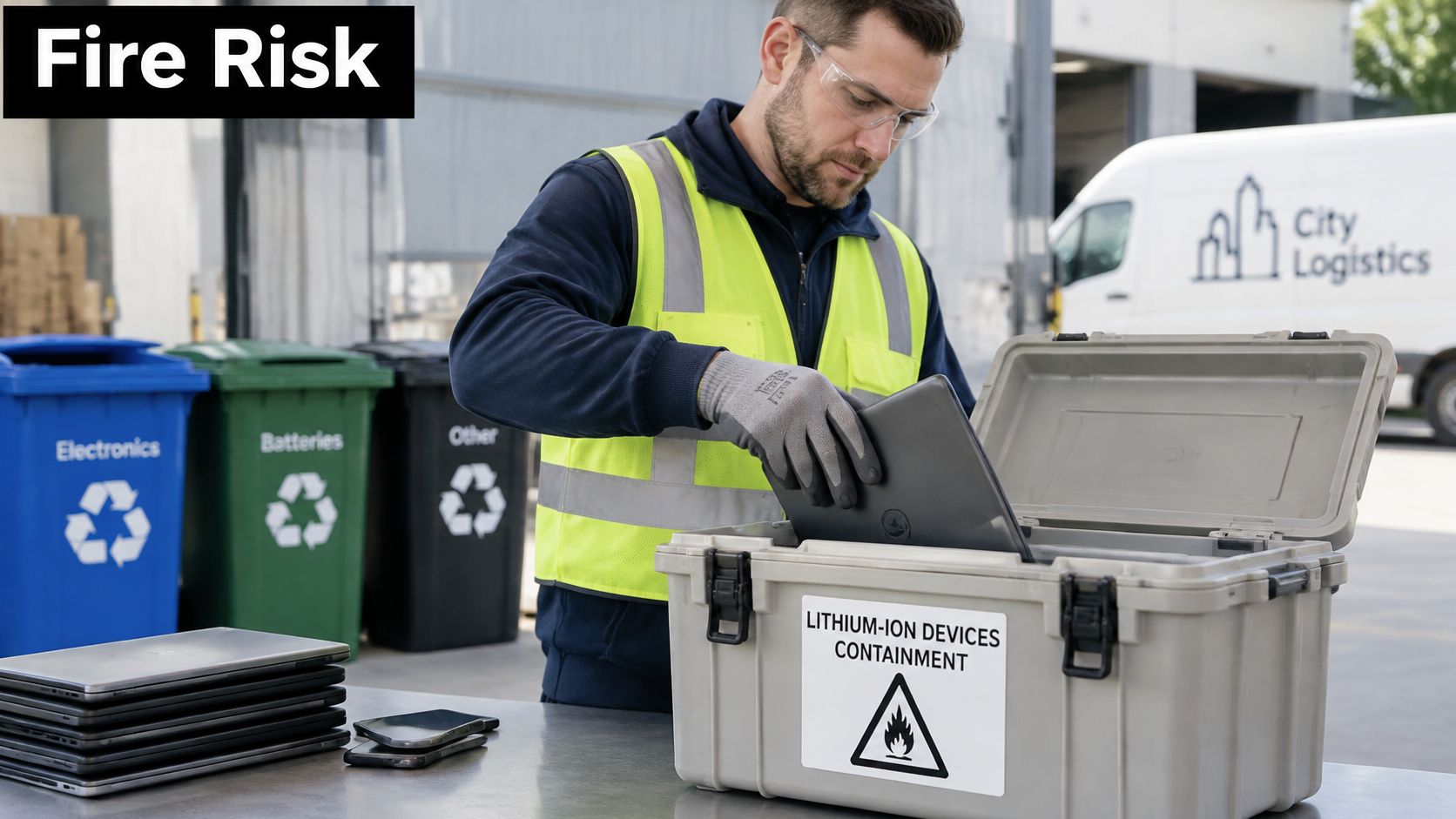
For damaged batteries, fire prevention, isolation, and confirmed routing come before material recovery. Recycling remains appropriate for eligible fractions, but the receiving facility and handling method should be settled before pickup. See the lithium battery recycling guidance when assessing routing options.
Intact Versus Damaged
Intact devices with undamaged batteries may follow the normal destruction workflow, with batteries removed or managed as the receiving recycler directs. Swollen, cracked, hot, smoking, or otherwise unstable batteries need separate handling immediately.
- Isolate damaged units: Use a non-combustible container and keep it away from heat and other stock.
- Don't stack or compress: Pressure on a swollen cell can increase risk during storage and transport.
- Confirm acceptance first: Contact the intended household-hazardous-waste facility in advance. Acceptance varies.
- Record the classification: Mark each lot as intact, damaged, or swollen on the manifest.
Keep the handoff clear: the manifest should match the lot being collected, and the receiving facility should be confirmed before the truck is loaded. A low quote can fail the job if it leaves battery handling, transport, or final disposition unclear. Ask what the price covers and what records you will receive to show the recalled inventory was not resold.
A battery incident can create worker-safety, facility, insurance, and environmental concerns for the business storing or shipping the units. Before pickup, confirm that batteries are separated, the container is non-combustible, the receiving facility is confirmed, and the classification is recorded. If any answer is no, hold the load.
Choosing a Sanitization and Destruction Method
A factory reset or file deletion does not establish that data was sanitized, so do not record either as destruction. The NIST media sanitization guideline defines three outcomes, clear, purge, and destroy. Choose the outcome according to the device's intended disposition, then record both the method and the final destination.
| Disposition | NIST outcome | Record to keep |
|---|---|---|
| Internal reuse only, with no outside transfer | Clear | Method and device list, including the intended internal reuse |
| Reuse, resale or donation, where permitted | Purge | Method, date, device serial numbers and disposition outcome |
| Scrap or permanent retirement | Destroy | Destruction method, quantity and certificate |
| Recall-prohibited resale | Destroy, including physical destruction of identifying components | Recall lot, photographs and certificate tied to the inventory list |
Clear uses standard device commands or rewriting for user-accessible storage. It protects against simple, non-invasive recovery, making it appropriate for devices that remain within the organization and under its control. Record the device list and the selected outcome so the internal handoff is clear.
Purge uses a method intended to make data recovery infeasible while potentially preserving the media for reuse. Use it when resale, donation or other transfer is allowed and the device will leave the organization. A recall restriction can rule out those destinations regardless of the sanitization method, so confirm the permitted disposition before assigning an outcome.
Destroy makes the media unable to store data afterward. For recalled stock that cannot be resold or donated, physical destruction may be required; sanitization alone does not make prohibited stock eligible for transfer. Align the destruction record with the inventory and its final disposition.
Physical Methods for Recalled Drives
Reworx Recycling offers hard drive shredding as part of its secure data destruction services. Its IT equipment decommissioning services use hard drive shredding and degaussing to address data retrieval risk. Shredding suits drives assigned the destroy outcome. Degaussing applies to magnetic media when selected for the sanitization workflow.
The trade-off is between preserving a device for an allowed reuse route and permanently removing it from circulation. A low-cost quote that names only “data destroyed” may leave the method, device range or final disposition unclear. Specify the outcome and method for each lot, and require the certificate to identify them. Tie the record to the relevant serial range or inventory list, so the handoff can be checked against the stock designated for destruction.
Records That Prove Recalled Stock Was Destroyed
A destruction job is only as defensible as its records. Months after pickup, a manufacturer, regulator, insurer, or public-records request may ask what happened to specific units. Your team needs a file that answers from documented handoffs, not memory.
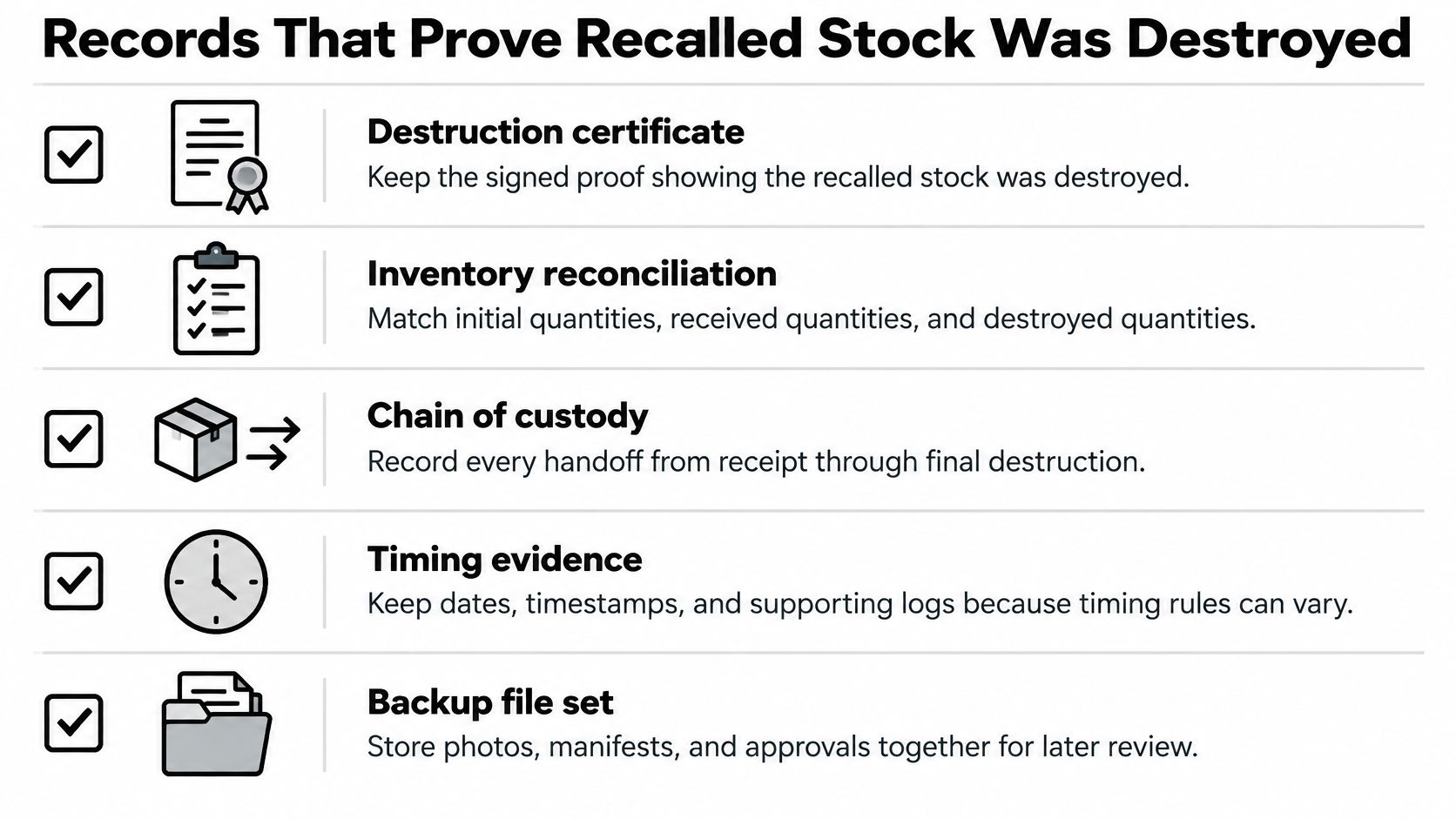
Timing rules vary by product and jurisdiction. Egyptian medicines-recall guidance requires recalled quantities to have a destruction date no later than three months after the recall notice, unless a justified extension is approved. Keep the applicable recall notice and any approved extension with the destruction record.
Fields a Defensible File Holds
- Identity: SKU or serial number, product description, and recall notice reference.
- Quantity and condition: Count received, condition on arrival, and count destroyed.
- Custody: Each transfer, with the people and organizations involved and the dates.
- Hazard classification: Battery condition and other regulated fractions.
- Method and endpoint: Destruction method, destruction date, and downstream facility.
- Proof: Photographs, any required witness record, and the signed certificate.
Reconcile the destroyed count against the inventory record before closing the file. Explain any discrepancy in writing. A certificate without matching quantities or a clear disposition can leave the chain of custody unresolved. The certificate requirements guide outlines what to look for in the final document. Reworx Recycling provides a certificate of destruction for every task fulfilled, serving as documentation for audits and legal matters.
A low-cost quote that produces a weak certificate isn't cheaper. It leaves you unable to prove unsafe products didn't re-enter commerce.
Keep photographs, manifests, downstream records, and certificates together in one recall file. Record device counts and destruction methods, not data contents. That keeps the file useful to schools, agencies, and enterprise IT teams without exposing confidential information. Judge the price alongside the documentation and handling records: recalled electronics require evidence of non-resale, and battery hazards and sanitization methods should be documented alongside the destruction event.
Vendor Checks Before You Sign a Destruction Contract
A quote should be judged alongside the records it produces. Recalled electronics carry battery and resale risks, so confirm how the provider protects hazardous items and documents that products did not return to commerce. Ask for evidence, not assurances.
- Certificate detail: Does the provider issue a certificate for each job naming the quantity, method, date, and witness?
- Reconciliation: How are received units matched to your manifest, and how are discrepancies recorded?
- Battery routing: How are swollen or damaged batteries stored, packaged, and routed?
- Custody and photos: Who handles each transfer, and are identifying labels photographed before processing?
- Downstream sites: Which recycler receives each fraction, by name?
- Cross-border review: For international processing, who completes the prior informed consent and classification review?
- Environmental ranking: How does the provider choose between reuse, donation, buyback, and recycling where the recall allows options?
Use vendor selection criteria to score bidders against the same questions. Request the count or weight sent to each stream, so sustainability reporting can be checked against the custody record. Any landfill or incineration should be documented as a last resort for fractions that cannot be recovered.
What We Can Cover
Reworx Recycling lists IT Asset Disposition, IT Asset Management, Recycling Consultation, Hard Drive Shredding, Equipment Decommission, Equipment Buyback, Electronics Recycling, and Recycle By Mail. Its corporate e-waste management and IT asset disposition (ITAD) services are customized for each business customer, including data center decommissioning. Ask the provider to confirm in writing that the proposed scope covers your recalled stock and its required handling.
Document-or-no rule: If a provider cannot answer a question with a document, treat the answer as no.
Price the Job and Book a Recall Pickup
Compare quotes only after defining the same scope: unit counts, pickup sites, data-bearing media, battery condition, and the records required at closeout. A low quote can cost more if it excludes reconciliation, hazardous-material handling, or proof that recalled units were destroyed rather than resold.
| Factor | Effect on cost | What to request in the quote |
|---|---|---|
| Volume and unit count | Larger loads spread labor and transport | Per-unit and per-load rates |
| Data-bearing media | Hard drives add shredding or degaussing time | Itemized media count and destruction method |
| Battery and hazardous handling | Separate packaging and routing raise cost | Written hazardous-routing plan and its cost |
| Location and pickup | Remote sites and split pickups add transport | Pickup window and any site-visit fee |
| Documentation depth | Full custody records and reconciliation add labor | Sample certificate and report format |
| Downstream recovery | Buyback or recycling value can offset cost | Buyback offer or recycling credit |
For a retailer with 4,000 units across several pickup sites, ask each provider to price the same scope, including how a swollen battery will be handled. A quote that lists per-load rates, reconciliation labor, and a sample certificate is easier to compare. If those items are missing, the lower figure may reflect a narrower job, not better value. Reworx's pricing transparency information describes its approach to itemizing services.
Reworx offers pickup services for businesses. Its data center decommissioning covers dismantling, transportation, and repurposing of retired assets. Before booking, confirm the recall notice and lot list, separate batteries, approve the destruction method for each disposition, and review a sample certificate. Then schedule pickup.
Equipment outside the recall may qualify for Reworx electronics recycling or equipment buyback. Keep recalled stock distinct from any equipment approved for recovery, and request records that reconcile each group to its final disposition.
Send Reworx the recall notice, unit list, and battery condition to scope a documented destruction pickup with reconciliation and certification. For recalled or retired stock, business pickup is available; equipment buyback can also be considered for eligible surplus hardware. Start with Reworx Recycling to plan an electronics recycling, ITAD, or secure data destruction job.