You finish a refresh of employee laptops, clear a storage room full of retired monitors and docks, and finally get the old gear off the floor. Then the invoice lands. The pickup charge is higher than expected. There's a separate line for data destruction. Another for sorting. Another for materials that apparently needed “special handling.” Nobody mentioned asset recovery, and nobody can explain why some devices generated a fee while others had resale value.
That's the moment most companies realize pricing transparency in IT asset disposition isn't a nice-to-have. It's a control issue. It affects budget accuracy, audit readiness, vendor risk, and the credibility of your sustainability reporting.
For IT managers, facilities leaders, and sustainability teams, opaque pricing creates two problems at once. First, it makes disposal costs unpredictable. Second, it hides whether your vendor is extracting value from reusable equipment or charging to remove it. In a category as operationally sensitive as electronics recycling, that's a bad place to be.
The End-of-Life Invoice Shock
An office cleanout usually starts with good intentions. A business upgrades hardware, retires old assets, and wants a clean, secure handoff. The vendor quote sounds simple enough. Pickup, processing, maybe secure data destruction. Then the final bill shows up with language that wasn't in the sales conversation.

That shock happens because many ITAD quotes are framed around removal, not around the full chain of custody. Once a vendor touches your equipment, they control the sort, the downstream path, the data-bearing devices, and the accounting logic used to classify fees and credits. If that logic isn't clear up front, the invoice becomes a negotiation after the work is already done.
Why this hits budgets so hard
The finance problem is obvious. The operational problem is worse. A vague invoice usually signals a vague process, and vague processes are where chain-of-custody disputes, missing destruction records, and undocumented downstream handling tend to surface.
The scale of the disposal challenge matters too. The United States generates approximately 6.9 million tons of e-waste annually, yet only 15% was formally collected and recycled as of 2019, meaning 85% of discarded electronics bypass licensed recycling facilities according to this e-waste overview.
Practical rule: If the invoice is confusing, the downstream process probably is too.
Teams that manage recurring pickups often reduce these surprises by tightening the logistics side before the first pallet leaves the building. If your internal handoff between IT, facilities, and field operations is messy, tools such as scheduling solutions for sales and service teams can help standardize appointments, routing, and service records before vendor billing gets involved.
What a smarter review looks like
A disciplined buyer doesn't wait for the final invoice to understand the pricing model. They ask for a sample settlement statement, a description of how data-bearing devices are billed, and a clear explanation of when assets generate cost versus recovery value. That's the same mindset behind this guide to maximizing value in IT asset disposition. Removal is only one part of the transaction. The primary question is whether the vendor can explain the economics in advance.
What Pricing Transparency Means in Electronics Recycling
In ITAD, pricing transparency means more than posting a rate card. It means the vendor shows you how charges, credits, handling decisions, and documentation fit together before equipment moves. You should know what you're paying for, what might change the price, what can be resold, and what proof you'll receive at the end.
That sounds basic. In practice, many vendors still package disposal as a black box. They quote a pickup, then treat sorting, data destruction, battery handling, deinstallation, or reporting as exceptions. A transparent vendor does the opposite. They define the scope in a way that leaves less room for reinterpretation later.
The economics behind the quote
There's a reason this category gets murky. Proper electronics recycling costs more than dumping. In e-waste recycling, the cost differential between recycling and landfilling ranges from $450–$1,000 per metric ton for recycling versus $150–$250 for landfilling, creating direct pressure for regulated and transparent pricing models, as noted by the Baker Institute analysis of the e-waste recycling cost gap.
A serious ITAD partner shouldn't hide that reality. Safe handling, hazardous material controls, serialized processing, and secure data destruction all add cost. When a quote looks suspiciously cheap, the buyer should ask which part of the process has been excluded, outsourced, or pushed into a surcharge.
What should be visible before pickup
A transparent scope usually includes these elements:
- Logistics terms for pickup windows, palletization expectations, access constraints, and any on-site labor assumptions.
- Data services that specify whether drives are wiped, shredded, or both, and what certificate or report follows.
- Processing logic that distinguishes remarketable devices from scrap, low-grade peripherals, batteries, and specialty items.
- Settlement terms that explain whether resale value comes back through buyback, rebate, credit, or revenue share.
The vendor should be able to explain why a given item is a cost center, a neutral item, or a recovery item without resorting to vague “market conditions” language.
What buyers should expect in writing
The best test is simple. Ask whether the vendor can put the financial model in plain language. If they can't explain billing in a way your IT lead, controller, and sustainability manager all understand, it isn't transparent.
A useful baseline is understanding what IT asset disposition includes operationally. Once you see ITAD as a chain of logistics, security, resale, recycling, and reporting, it becomes easier to spot where opaque pricing usually creeps in.
The Hidden Costs of Opaque ITAD Pricing
Low quotes win attention because buyers are busy. A per-pound rate or “free pickup” promise sounds efficient when a server room has to be cleared fast. The trouble starts when the quote was designed to get assets in the truck, not to define accountability.
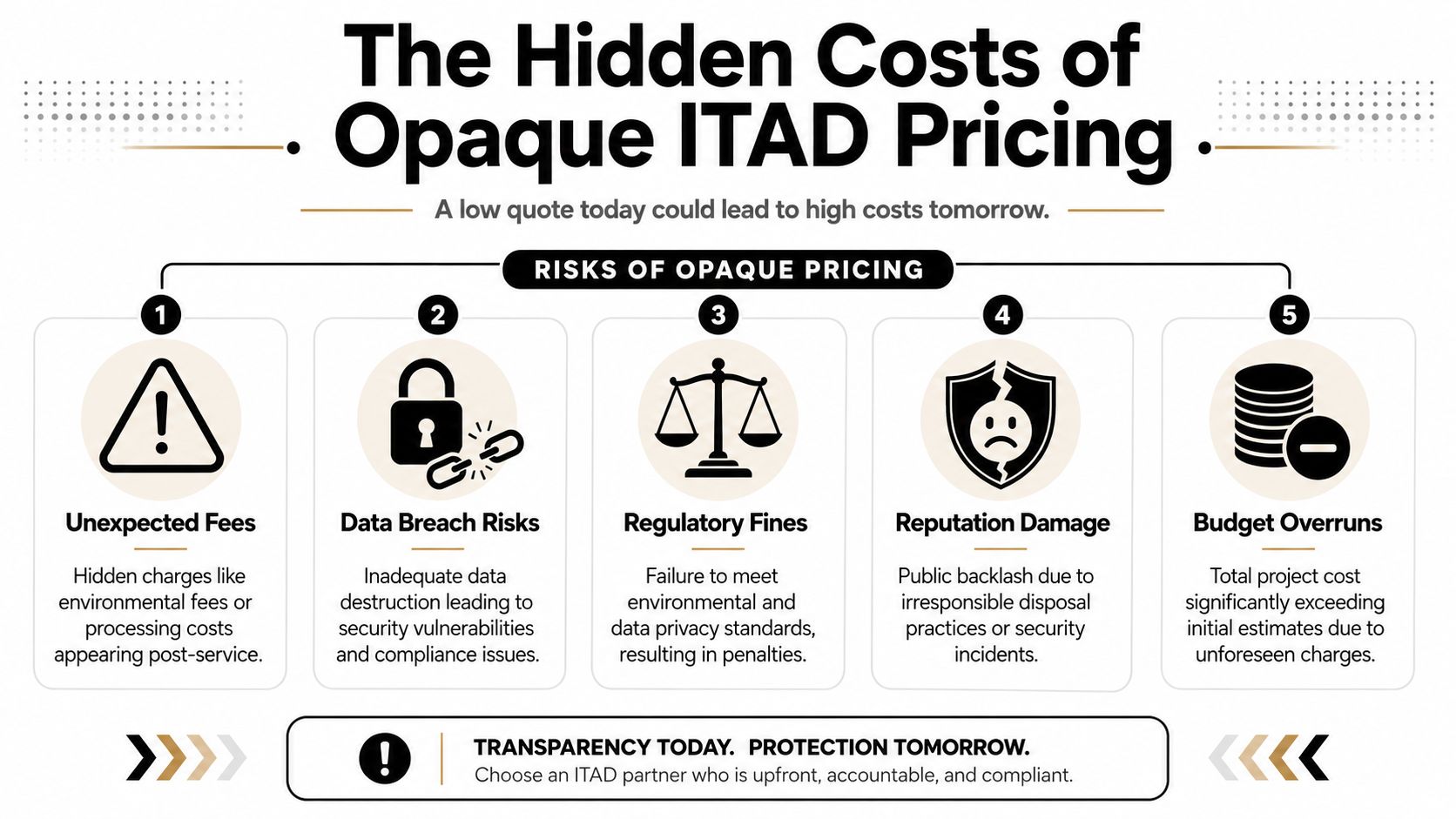
Opaque ITAD pricing creates costs that don't appear on the first page of the proposal. Some hit your AP ledger. Others hit legal, security, and brand teams later.
Where the damage usually shows up
Here's what experienced buyers watch for first:
- Unexpected invoice lines that appear after pickup. These often include sorting fees, environmental handling charges, packaging exceptions, or separate billing for data-bearing devices.
- Weak documentation that leaves you with no clear asset trail, incomplete serial reporting, or unclear downstream disposition.
- Misaligned incentives when the vendor earns more by treating reusable equipment as scrap instead of maximizing remarketing value.
Those are billing issues. The larger risks sit behind them.
The risks that matter beyond finance
Data-bearing equipment is the clearest example. If a vendor is vague about destruction methods, chain of custody, or certificates, you're not buying flexibility. You're accepting uncertainty around one of the most sensitive stages of the project.
Environmental liability is similar. If a vendor can't explain where equipment goes after pickup, you can't verify whether downstream partners handled it responsibly. That uncertainty becomes a governance problem fast.
Opaque pricing is often a symptom of opaque operations. Buyers should treat it as an early warning sign, not a paperwork inconvenience.
Reputation risk belongs in the same conversation. Sustainability leaders increasingly need defensible records for disposal claims, donation-based recycling programs, and corporate social responsibility reporting. A low quote doesn't help if the vendor leaves you with no verifiable audit trail.
The supply-chain side matters too. If a provider can't show how materials and devices move through its downstream network, you're relying on trust where documentation should exist. That's why procurement teams should review supply chain transparency practices in recycling operations before they compare only the top-line price.
Decoding Common ITAD Pricing Models
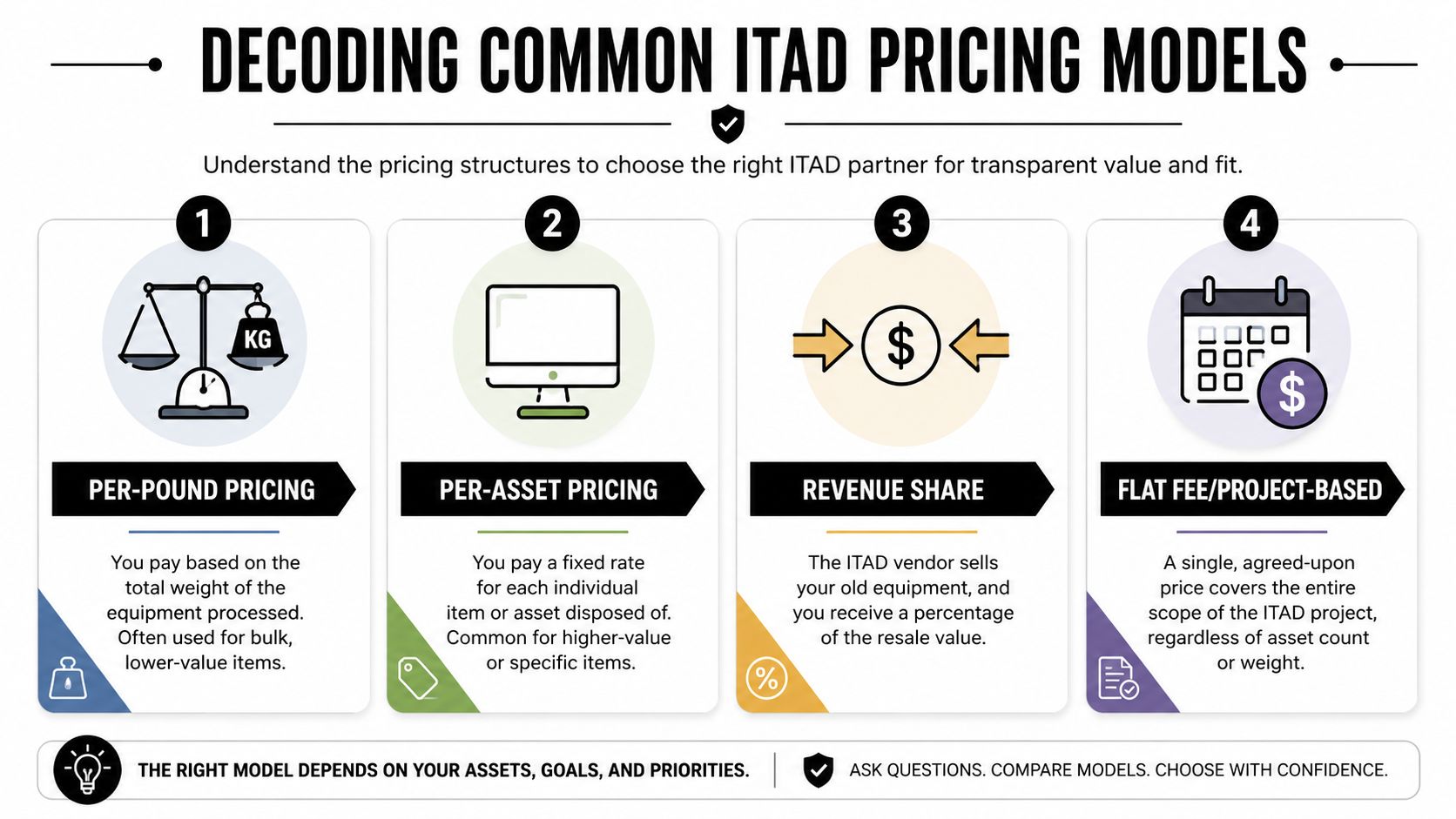
Not every pricing model is bad. The issue is fit and disclosure. A transparent vendor can use several different structures responsibly. The key is knowing what each model encourages, what it tends to hide, and which asset mix it suits best.
Side-by-side comparison
| Model | Best fit | Where it works | Where it can go wrong |
|---|---|---|---|
| Per-pound | Bulk scrap, mixed low-value loads | Simple for warehouse cleanouts and commodity-heavy streams | Reusable assets can get buried inside a scrap-weight quote |
| Per-asset | Predictable device categories | Clear for laptops, monitors, servers, printers, and medical equipment disposal streams | Odd accessories and mixed conditions can create add-ons |
| Flat fee | Office cleanout, facility cleanout, data center decommissioning | Easy budgeting when scope is tightly defined | Scope gaps become change orders if assumptions weren't written clearly |
| Revenue share | Reusable business equipment with resale potential | Aligns vendor incentives with value recovery | Weak reporting can hide how resale values were calculated |
Per-pound pricing
This model is common when the load is heavy, mixed, and not expected to have much resale value. Think broken peripherals, obsolete hardware, cabling, or low-grade scrap from a facility cleanout.
The advantage is speed. The weakness is visibility. A pallet of reusable laptops and a pallet of dead accessories can both disappear into one weight-based charge if the vendor doesn't sort and report carefully.
Per-asset pricing
Per-item pricing is usually easier to audit. A buyer sees one charge for each laptop disposal, monitor, server, or hard drive destruction event. It works well when the asset list is known in advance and the scope is standardized.
This model tends to break down when there's a lot of nonstandard equipment, loose accessories, or unclear condition grading. If the vendor's quote says “standard units only,” ask what falls outside standard.
Flat-fee projects
For office closures, relocations, or data center decommissioning, a flat project fee can be the cleanest option. Finance gets a single project number. Operations get less administrative friction.
But flat fees only stay clean when the assumptions are precise. Access limitations, stair carries, de-racking, after-hours labor, packaging requirements, and on-site shred requests all need to be written into scope.
Revenue share and value recovery
This is the model many buyers underestimate. With value recovery, the vendor tests, grades, refurbishes, and resells viable assets. The client receives a defined share of the proceeds or a rebate against service costs.
Transparent pricing in e-waste is strengthened by long-term recovery contracts and value-recovery rebates, which stabilize cashflows for recyclers and protect them from volatile commodity prices, creating a direct link between pricing clarity and supply chain resilience, according to this pricing and policy tool on recycled materials markets.
Field advice: If your devices still have useful life, ask to see the grading criteria and settlement methodology before accepting a scrap-only quote.
That's where a broader value based pricing strategy becomes relevant. In ITAD, price shouldn't reflect only labor and removal. It should also reflect the recoverable value, reporting quality, risk reduction, and service outcomes the vendor can document.
Case Studies Transparent vs Opaque Vendors
Two vendors can remove the same equipment and leave the customer with very different outcomes.
The first scenario is familiar. A regional office manager needs old desktops, monitors, and networking gear gone before a lease turnover. The chosen vendor offers a low quote, speaks confidently about electronics recycling, and promises to “handle everything.” After pickup, the invoice expands. Batteries triggered extra handling. Drives required a separate security fee. Several reusable machines were grouped into a generic scrap category. No one provides a clear serial-level report, and the business has little to show for its IT equipment disposal except a confusing bill.
What goes wrong with the opaque vendor
The biggest loss isn't just the extra charge. It's the missing proof. The company can't confirm which assets were destroyed, which were recycled, and which might have had remarketing potential. Procurement sees invoice creep. Security sees a documentation gap. Sustainability sees a reporting problem.
That reporting problem matters more than many buyers realize. Without standardized tracking and data ecosystems, green premiums for recycling are difficult to realize or communicate, leaving recyclers vulnerable to volatile commodity prices and making long-term contracts harder to secure, according to BCG's analysis of the e-waste recycling opportunity.
What the transparent vendor does differently
A stronger process starts earlier. The IT director receives an itemized proposal that separates pickup, secure data destruction, processing assumptions, and potential value recovery for recent-model equipment. After collection, the vendor provides a settlement statement, asset-level reporting, and destruction documentation tied to the agreed scope.
One factual example in the market is Reworx Recycling, which states that recycling eligible electronic equipment is offered at no cost for most items, with clear exceptions for TVs, copiers, and CRT monitors. That kind of up-front boundary-setting is what buyers should look for in donation-based recycling, computer recycling, and broader IT asset disposition company evaluations.
The practical difference is simple. One vendor turns the transaction into a post-service dispute. The other turns it into an auditable program that can support secure data destruction records, asset recovery rebates, and credible CSR language.
Your Vendor Evaluation Checklist for Transparency
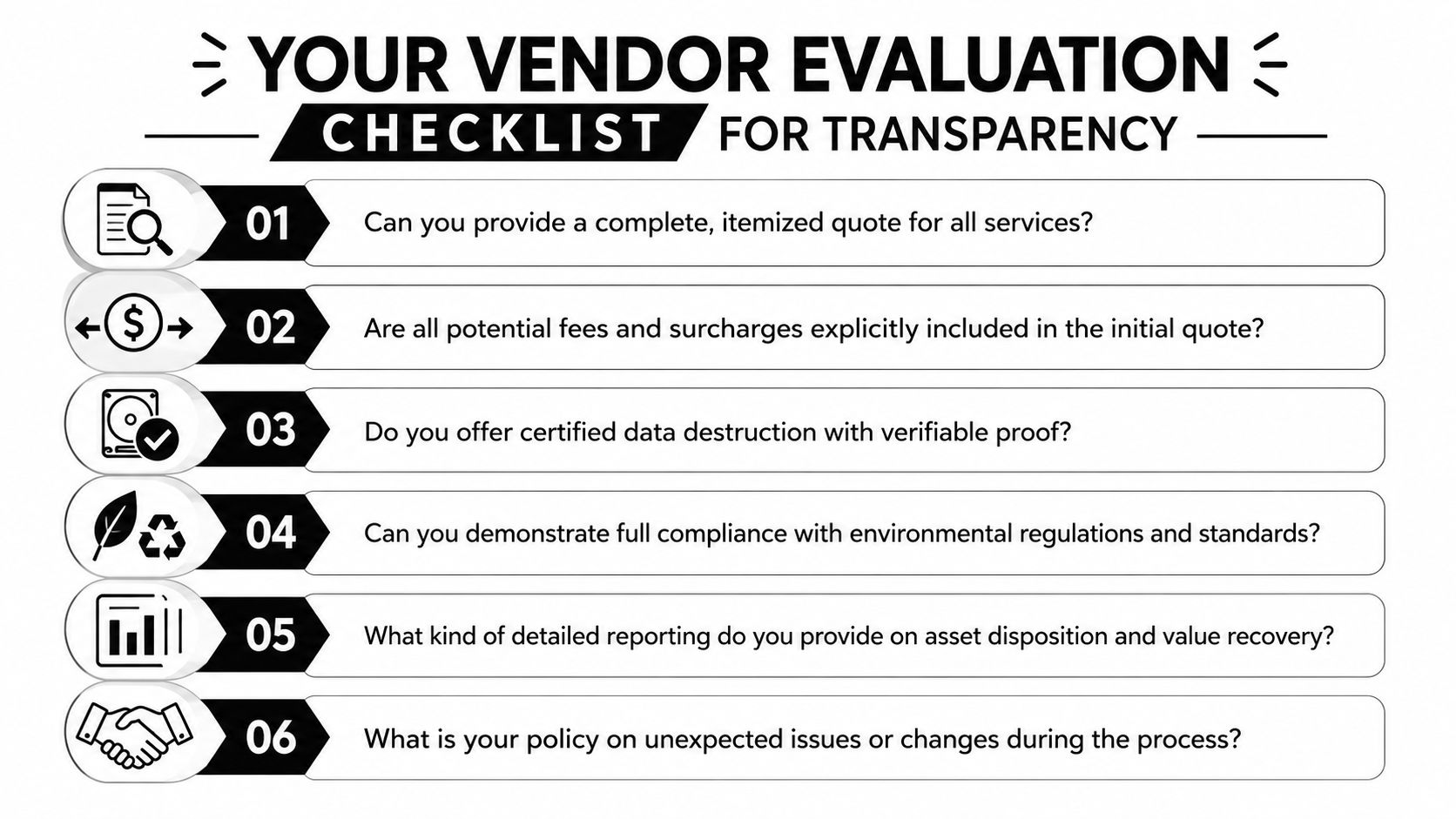
Most bad ITAD deals can be avoided before pickup. You don't need a perfect contract. You need the right questions, asked in the right order, with enough insistence to separate polished sales language from actual operating discipline.
Ask for the paperwork first
Start by requesting documents, not promises.
- Itemized quote sample. Ask for a sample invoice that shows pickup, processing, secure data destruction, product destruction, and any conditional charges.
- Settlement example. If the vendor offers buyback or revenue sharing, ask for a sample asset recovery statement showing how value is calculated.
- Reporting package. Request examples of certificates, serial reports, and downstream disposition summaries.
A transparent vendor won't act offended by this. They'll have the paperwork ready.
Pressure-test the exceptions
Hidden costs usually live in these aspects. Don't ask only “what's included?” Ask what causes the number to change.
- What triggers surcharges? Get specifics on batteries, CRTs, copiers, loose loads, non-palletized equipment, after-hours work, and access limitations.
- How do you classify assets? Ask when an item is treated as scrap, when it qualifies for refurbishment, and who decides.
- What happens if the onsite count changes? Good vendors have a process for scope changes. Weak vendors improvise.
If a vendor says “we'll work it out afterward,” expect pricing conflict afterward.
Verify security and downstream control
For laptop disposal, server retirement, and medical equipment disposal, chain of custody matters as much as price.
- Data destruction method. Ask whether the vendor wipes, shreds, or offers both. Then ask what documentation you'll receive.
- Downstream partners. Ask whether the vendor owns the process or uses subcontractors, and whether you can review the asset trail.
- Facility access. Ask whether you can tour the operation or review process documentation for office cleanout and data center decommissioning projects.
Evaluate value recovery discipline
A vendor that talks about sustainability but can't explain remarketing economics is leaving money on the table.
Look for these signs:
| Question | Strong answer | Weak answer |
|---|---|---|
| How is resale value determined? | Clear grading logic and settlement timing | “It depends on the market” |
| How are nonworking units handled? | Defined path for scrap, parts, or destruction | Vague answer about mixed loads |
| What reporting supports CSR claims? | Asset-level or batch-level documentation | General recycling certificate only |
Use local and mission-fit criteria too
For businesses in Georgia, local service coverage matters for pickup timing, chain of custody, and recurring electronics recycling programs. Companies in healthcare, logistics, education, and multi-site office environments should ask whether the vendor routinely handles laboratory equipment disposal, facility cleanout projects, and secure data destruction under documented procedures.
Mission alignment matters too, especially for firms that want donation-based recycling and corporate donation programs to support digital inclusion or workforce development. Social enterprise recycling can add value, but only if the pricing and reporting stay clear enough for finance and compliance to trust.
A practical screening tool is to compare your shortlist against a documented set of vendor selection criteria for ITAD and recycling services. Buyers who do that tend to catch the soft spots early: unclear surcharges, weak reporting, vague recovery models, and overreliance on low headline pricing.
If you're reviewing electronics recycling, computer recycling, or IT asset disposition vendors and want a cleaner way to assess pricing transparency, Reworx Recycling is one resource to consider. Businesses can use its educational materials to compare donation-based recycling options, evaluate secure data destruction requirements, plan office cleanout or facility cleanout projects, and ask sharper questions before scheduling a pickup or donating old equipment.