The common advice to collect every recalled device and destroy it skips the decision that matters most: what remedy did the manufacturer authorize? Sending a repairable laptop to a shredder can be as wrong as donating an unsafe device. A recall isn't permission to treat every affected asset as scrap.
For Atlanta businesses, Georgia school districts, and healthcare organizations, recalled device collection and destruction needs a controlled workflow, not just a truck reservation. The operations team must connect each affected serial number to an approved outcome, protect any stored information, and retain evidence that the work happened.
Choose the Remedy Before You Collect
Destruction is not the default recall remedy. In the five-year CPSC recall-remedy dataset described in the electronics end-of-life document, refunds accounted for 1,107 remedies, or 54.6%; repairs for 534, or 26.3%; replacements for 343, or 16.9%; and disposal for just 23, or 1.1%.
Disposal also doesn't automatically mean industrial shredding. CPSC defines it as throwing a product out or recycling it, although some notices require the consumer to make the product unusable first, such as cutting an electrical cord and retaining photographic proof. Follow the actual notice rather than borrowing a destruction method from another recall.
Medical-device terminology creates another potential misunderstanding. The FDA's medical-device recall guidance explains that removal can mean moving a device for repair, modification, adjustment, relabeling, destruction, or inspection, while medical-device recalls generally proceed voluntarily under 21 CFR Part 7. Moving equipment out of a treatment room isn't automatically a scrap order.
Confirm the identity and instructions
Before arranging pickup, have the asset owner compare the notice against the physical inventory. Check the recall classification or CPSC notice, manufacturer, model, unique device identifier where applicable, and affected lot or serial-number range.
Then obtain the manufacturer's written remedy. Record whether the organization must stop use, return the device, arrange an authorized correction, or make it unusable. If the directions don't clearly address your equipment configuration, hold the unit and resolve the question before releasing it.
Recall disposition matrix
Use this matrix to assign an operational route, not to override the recall notice.
| Situation | Right action | Do not | Proof to keep |
|---|---|---|---|
| Refund, repair, or replacement is the approved remedy | Quarantine and follow the return or correction instructions | Scrap or recycle as ordinary e-waste | Notice, serial list, quantities sent back |
| Notice says make the product unusable before disposal | Disable it as instructed and photograph the result | Toss it intact into a mixed cleanout | Photos, date, model, quantity |
| Medical device may be corrected | Remove it for inspection, repair, relabeling, or adjustment | Treat removal as destruction | Where it was removed and the final correction |
| No safe repair, return, or reuse | Arrange approved destruction with no salvage | Commingle with unrelated returns | Required witness record, affidavit, or certificate tied to serials |
| Lithium battery is swollen or damaged | Isolate from normal stock and use a controlled shipping path | Pack it with intact units | Condition note and carrier paperwork |
| Government device with no approved reuse | Follow the applicable abandonment or destruction process and use a certified recycler | Default to landfill or an uncertified broker | Declaration plus recycler certificate |
For an Atlanta hospital, that may mean separate destinations for diagnostic devices awaiting correction and equipment authorized for destruction. A Georgia school district might return recalled chargers while retaining unaffected computers. A corporate IT team should distinguish affected laptop serials from otherwise identical machines.
Practical rule: Assign the remedy before assigning the pallet.
Scrapping correctable units creates unnecessary replacement delays and waste. Sending a unit into ordinary recycling when it must first be rendered unusable creates a different problem: someone may recover and reissue the very product the recall was intended to control.
How to Collect and Quarantine Recalled Devices
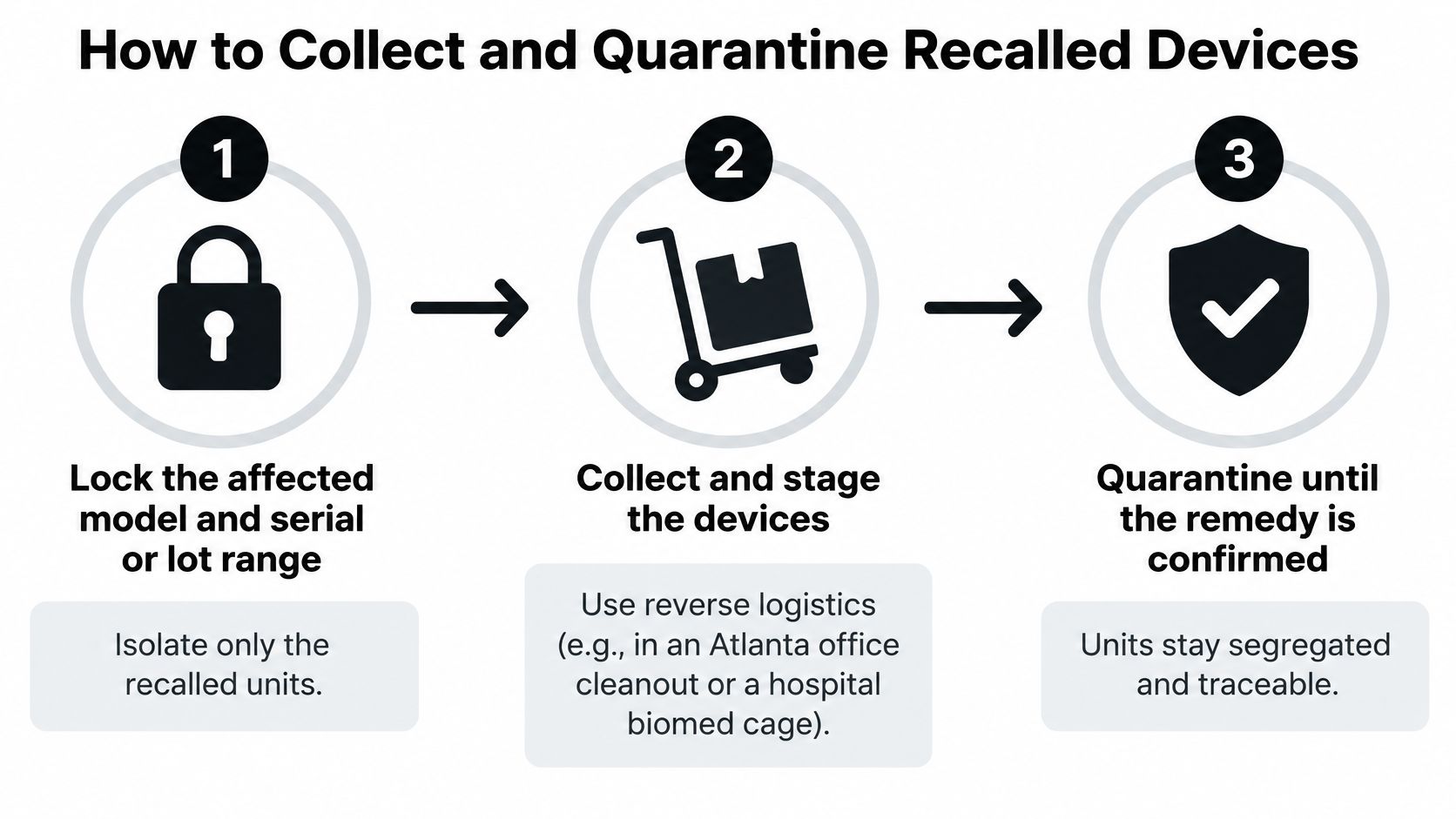
A recall rarely fails at destruction. It fails earlier, at collection, when affected units stay in service because nobody built a complete list of where they live. An Atlanta office cleanout can uncover recalled equipment in desk drawers, storage cabinets, and employee loaner pools. A hospital may find the same model spread across clinical departments and a biomedical engineering cage. Treat collection as reverse logistics, with a defined route back from every point of use.
Control the intake
Lock the affected range. Build the working list from the notice's model, serial, or lot criteria. Include spares, loaners, remote-user equipment, and items already marked for retirement. Tag matches without assuming every device carrying the same brand is affected.
Stop use and segregate. Put recalled units in a restricted, labeled area separate from deployable assets, sale inventory, and ordinary electronics recycling. Apply the same hold at branch offices and any downstream locations that possess affected units.
Communicate the hazard and remedy. Give users a short notice explaining which equipment to stop using, where to place it, and whom to contact. The CPSC's Regulated Products Handbook requires recalling firms to quarantine and segregate recalled products and notify CPSC staff before destruction, disposal, or recycling.
Provide a controlled return path. Use a locked cage, an approved prepaid return label, or a coordinated collection appointment. An open hallway pile invites missing equipment, accidental reuse, and unrelated items entering the batch.
Scan at receipt. Capture the serial number, originating location, asset owner, and observed condition. Flag duplicate scans instead of counting the same device twice. Where a label is unreadable, assign a temporary identifier and retain supporting photographs. Serial-level records are what later prove a specific unit was contained, because a count of boxes on a pallet does not.
Separate unsafe units. Place visibly damaged or swollen battery-containing devices in a separately identified hold for qualified assessment. Don't ask staff to pry out embedded batteries or test a suspected defect by charging the device.
Reconcile the missing equipment
Compare receipts with exposure. Reconcile collected devices against units sold or issued, the estimated in-use inventory, and outstanding identifiers. The CPSC report on recall-notification effectivenessRecallNotificationEffectiveness.pdf) found that only about 25% of consumers believed to be using recalled products contacted the firm, and many affected units are never returned at all. A busy collection cage does not establish containment; a reconciled serial list does.
Maintain an exception list. Review missing serials weekly against a closure threshold set by the recall owner. Give each unresolved item a responsible person and next action, such as contacting a remote employee or checking a transfer record.
Use an existing asset-management system if it can retain serial-level status and attachments. Teams evaluating service-management tooling can explore Freshservice subscription plans as part of that purchasing assessment. Software selection should never delay quarantine: a spreadsheet with owner, serial, status, and evidence columns holds the line until a tool is chosen.
Reworx Recycling's preparation process starts with customers gathering unwanted electronics and noting devices that contain sensitive data. Put that flag on the intake sheet before transportation planning, and use the IT asset disposal request form to communicate the batch scope.
Destroy Data and Confirm the Media Is Gone
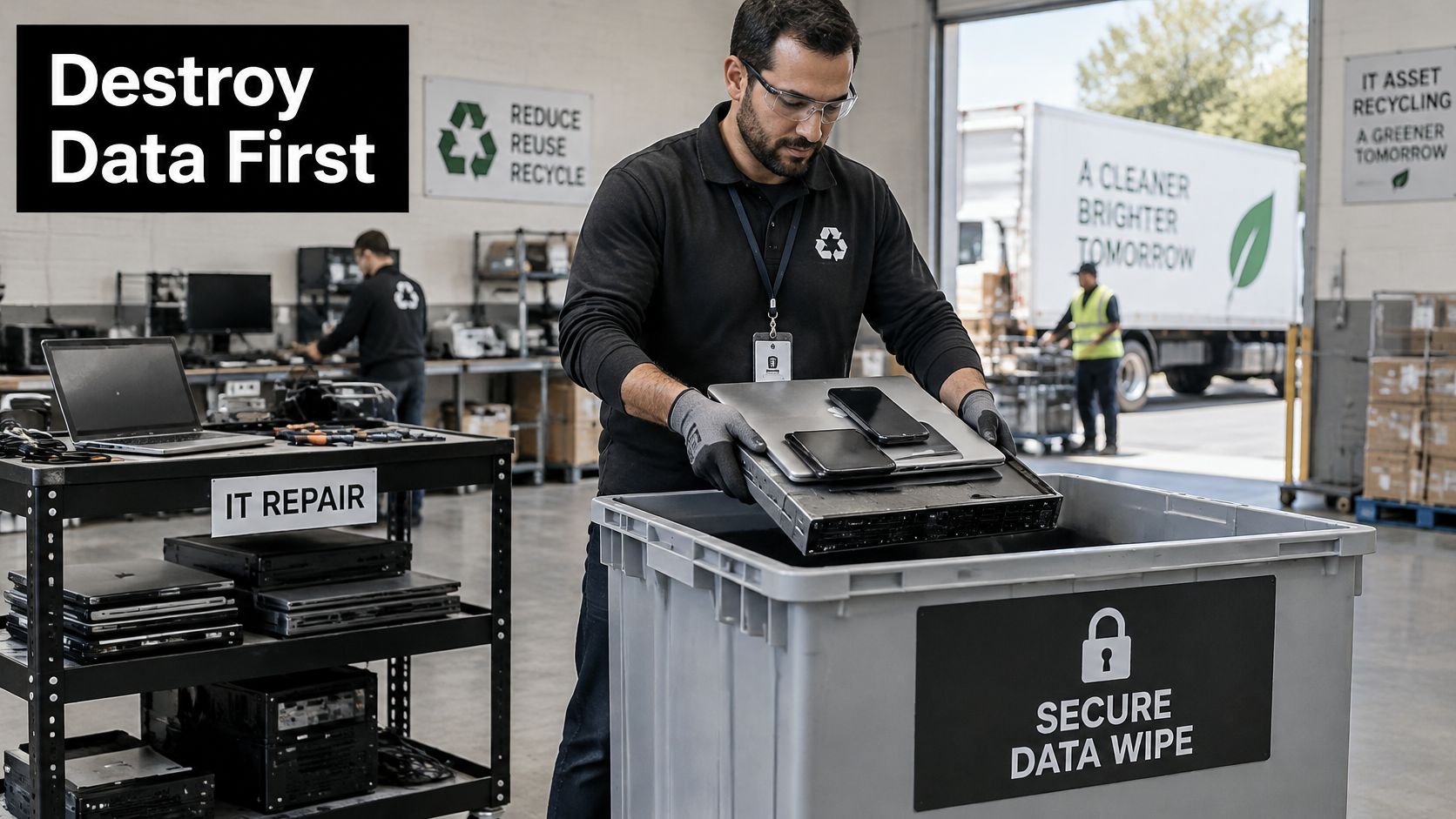
Product destruction and secure data destruction solve different problems. Making a recalled laptop unusable doesn't necessarily erase its storage. Erasing a drive doesn't resolve the laptop's safety defect.
A device returning for authorized repair may need its original storage configuration preserved, subject to your privacy and security requirements. Don't remove or shred media just because the asset appears on a recall list. Have the asset owner, information-security lead, and manufacturer agree on the permitted handling first.
Match the method to the media
For ordinary unwanted federal electronics, the EPA's certified electronics recycler guidance prioritizes redeployment, refurbishment, and repair before recycling, with incineration or landfill least preferred; it recommends R2 or e-Stewards certified recyclers and addresses downstream control and data destruction. Federal property entering recycling also requires the applicable abandonment or destruction declaration.
A safety recall can block otherwise desirable reuse. Working hardware isn't eligible for refurbishment merely because it powers on.
| Media condition and permitted destination | Appropriate approach | Verification to retain |
|---|---|---|
| Intact storage approved for continued use or refurbishment | Verified logical sanitization using a method suitable for the media | Storage serial, method, completion result, date, operator |
| Intact storage in a device approved for recycling | Verified sanitization or physical destruction according to the agreed security scope | Per-device result and final processing route |
| Failed storage or a drive that cannot complete sanitization | Physical destruction through a controlled process | Failed-wipe exception and destruction result tied to the serial |
| Equipment required to be rendered unusable | Product destruction plus the required treatment of any storage | Separate evidence addressing product safety and stored information |
Degaussing applies to magnetic media, not solid-state drives. It isn't a substitute for SSD shredding. Likewise, a factory reset isn't sufficient evidence by itself that a storage device completed the organization's approved sanitization method.
Resolve failures without losing traceability
Create an exception whenever a wipe fails. Keep the drive's identifier attached to its parent device record, then move it to the approved destruction route. The operator shouldn't close the task merely because the sanitization tool started successfully.
If business information must be recovered before authorized destruction, establish that decision before processing begins. MDrepairs' resource on recovering data from a failed hard drive can help frame that separate recovery discussion, but recovery work must not override quarantine or manufacturer restrictions.
Reworx Recycling's process securely wipes or shreds data-bearing devices to protect customer information. Our explanation of data sanitization helps distinguish erasure from physical media destruction.
A successful data treatment needs a recorded result, not just a selected method.
Many simple appliances and power tools have no storage media. Don't invent a data-destruction task for those assets. Retain their product-disposition evidence instead.
Set Destruction Vendor Terms That Hold Up
A vendor's willingness to collect equipment doesn't establish that its contract covers a recall. IT managers and sustainability leaders need a statement of work that preserves the approved disposition from collection through final processing.
Use current R2 or e-Stewards certification at the processing site as a procurement requirement for electronics recycling. Verify the site itself, not just a logo on a proposal. Certification doesn't authorize a vendor to disregard a manufacturer's no-reuse direction.
Destruction contract clauses
| Clause | What good looks like | Walk away if |
|---|---|---|
| Certifications | Current R2 or e-Stewards at the processing site | An uncertified broker with no site named |
| Identification | Serial or UDI manifest in and out | Weight-only or mixed-lot receipt |
| Salvage ban | No commingling and no resale of recalled units | Permission to sort for parts or donation |
| Verification | Witness, photos, or affidavit as the notice requires | A generic recycling receipt |
| Data method | Wipe or shred named per storage device | The word destroyed with no method |
| Downstream | Named facility for batteries, media, and scrap | An unnamed subcontractor |
Add insurance requirements appropriate to the work, the right to audit the load, and a stop-work procedure for unexpected equipment or unsafe conditions. State who can authorize a routing change. A driver or warehouse sorter shouldn't be able to substitute salvage for destruction.
The contract should also identify the recalling party of record. Outsourcing physical work doesn't transfer that role to a hauler. If your organization is a consignee rather than the recalling firm, name your internal coordinator and preserve the manufacturer's authority over the remedy.
Apply the test before signing
Say an Atlanta clinic has recalled diagnostic devices awaiting witnessed destruction. A junk-removal ticket that promises only equipment removal doesn't satisfy that scope, even if the contractor can arrive sooner.
Reworx Recycling is based in Smyrna and works with organizations on IT asset disposition planning and reporting. Our contract negotiation guidance can help structure the commercial discussion, while the customer first confirms the manufacturer's authorized remedy.
Attach the recall notice and serial list to the agreement. That prevents a recalled-device batch from being described merely as an office cleanout or facility cleanout, labels that omit the restrictions the processing team needs.
Control the Shipment and the Dock
Shipping day is a controlled handoff, not permission to clear the warehouse at any cost. The recalling firm remains responsible for the outcome, including what a third-party processor does after the truck leaves.
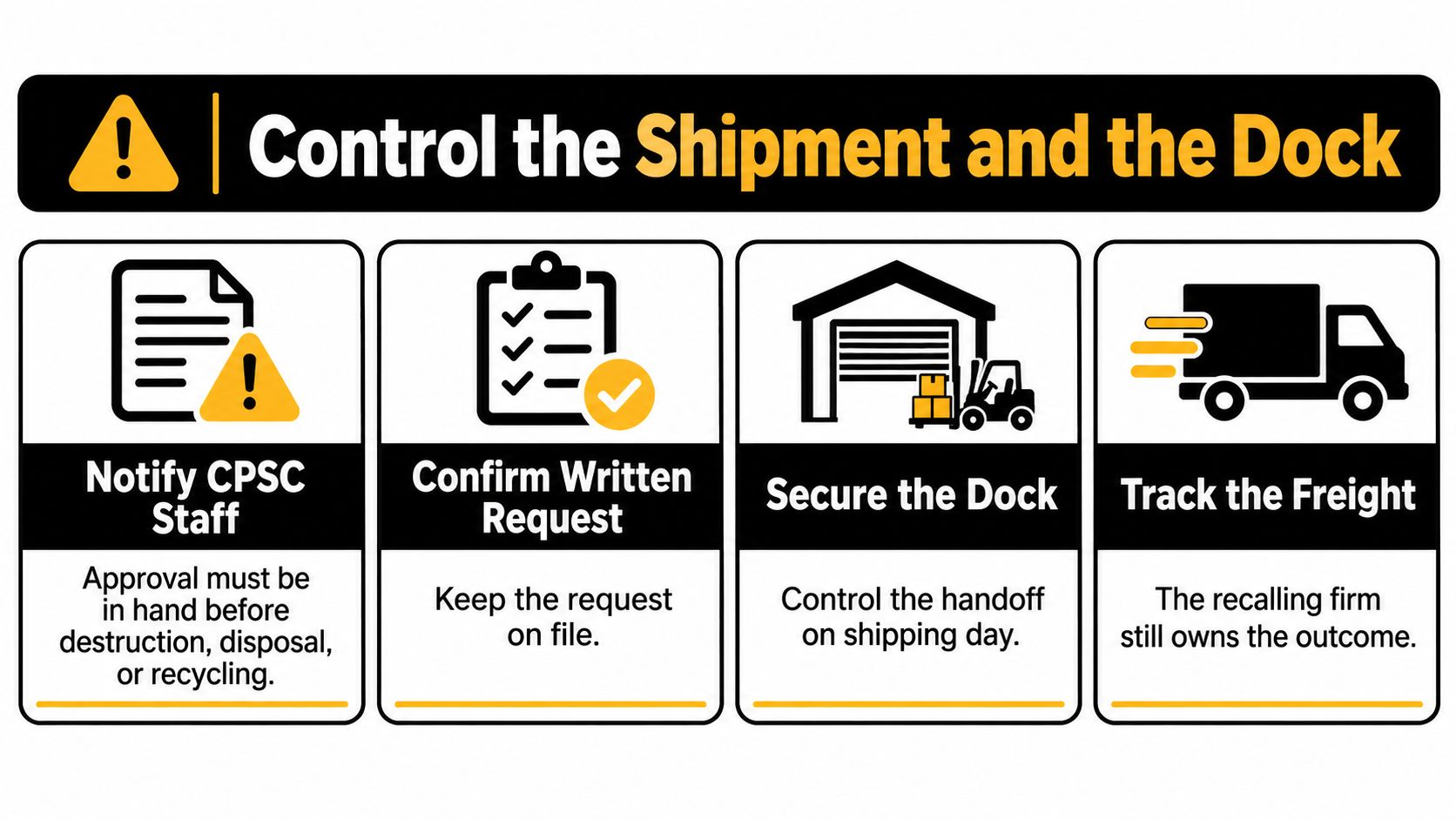
The CPSC Recall Handbook calls for advance approval before destruction so an investigator can witness the work or arrange another verification method; its off-site instructions address shipment identification, segregation, no salvage, and clear box and pallet markings. Build those requirements into the dispatch packet.
Release only the approved shipment
Confirm regulatory coordination. For a CPSC recall, verify notification and applicable approval before destruction, disposal, or recycling. Keep the written request and the agreed witnessing or verification arrangements available to the dispatch lead.
Identify the freight in writing. Give the carrier and receiving facility the shipment identifier, container list, and explicit prohibition on mixing or salvage. Mark every box and pallet as recalled so a receiving worker doesn't have to infer its status.
Stage in a marked hold. At the Atlanta office or Georgia warehouse, keep the approved shipment separate from general computer recycling containers. Don't let space pressure move it into a mixed electronics gaylord.
Route battery exceptions separately. Keep swollen or damaged lithium batteries out of the intact-device shipment. Record condition and use the packaging, carrier, and receiving arrangements approved for that material. An actively heating or smoking unit requires the site emergency response, not routine loading.
Block competing destinations. Remove recalled identifiers from donation drives, buyback lists, and redeployment queues. When the remedy requires manufacturer return, use that channel rather than substituting a convenient local recycling appointment.
Supervise the handoff. Have a named employee observe loading and confirm the actual containers against the dispatch list. Stop the transfer if an unmarked box appears or a driver proposes combining the batch with unrelated returns.
Give the dock lead authority to stop
The shipping coordinator needs a clear contact for acceptance questions and permission to reject an unapproved change. Record container discrepancies before departure rather than relying on someone to correct the paperwork later.
Use the electronics packing guidance for general preparation, but apply recall-specific and carrier instructions where they impose additional controls. Ordinary packing advice doesn't establish acceptance for damaged or recalled batteries.
Dock check: If staff can't identify the container, its destination, and its restrictions, it shouldn't leave the hold.
Retain the dispatch copy and receiving confirmation together. Unmarked boxes and mixed pallets are preventable handoff failures, not harmless paperwork shortcuts.
Build the Chain of Custody for Closeout
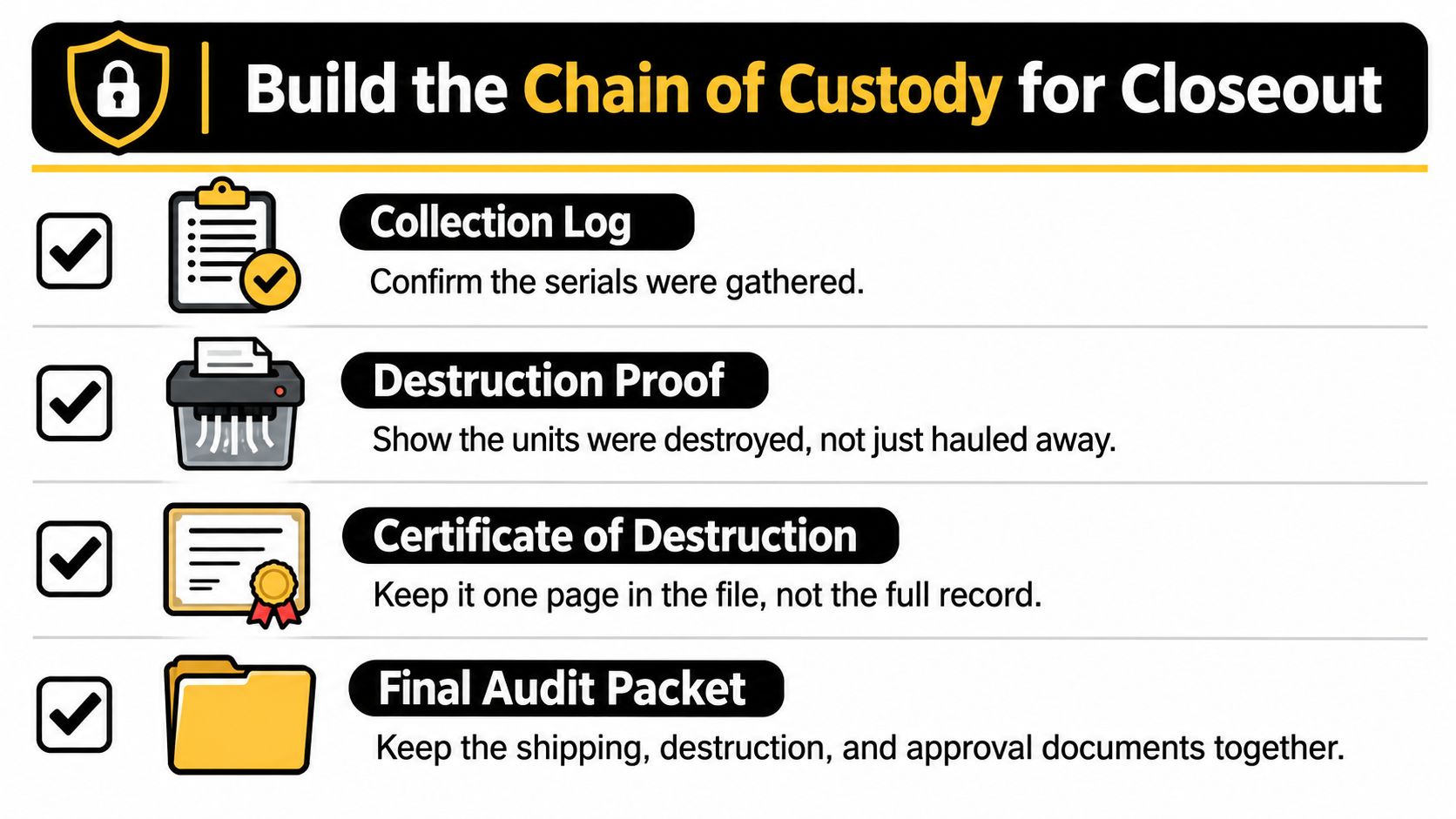
An auditor's central question is straightforward: what proves these specific devices reached their authorized disposition? A collection receipt proves a transfer. A certificate of destruction documents processing. Neither establishes the complete result unless it connects to the affected inventory.
The FDA's early-alert and recall information describes status information that can include quantities on hand, consignee or user responses, numbers returned or corrected, quantities accounted for, and effectiveness-check results; disposition evidence may include witnessed destruction or written verification. FDA also states that manufacturers and importers must retain relevant records for two years beyond the device's expected life.
Build the record around the identifier
The master manifest should contain the serial or UDI, model, originating site, receipt scan time, and quantity. Add each custody transfer, the responsible custodian, any data-treatment method, destruction date and location, and downstream facility.
For equipment containing batteries, regulated substances, or sharps, name the treatment route and receiving facility. A field marked recycled doesn't explain where those materials went or who accepted them.
Recall closeout records
| Record | Must show | Fails review when |
|---|---|---|
| Serial manifest | Model, serial or UDI, site, and receipt time | Only a pallet weight or piece count |
| Custody log | Every handoff, date, and custodian | A gap between pickup and the destruction site |
| Data worksheet | Wipe or shred method per storage serial | Drives marked destroyed with no method |
| Disposition proof | Date, location, quantity, and required witness record, affidavit, or photos | A certificate that does not match the manifest |
| Effectiveness tally | On-hand, returned, corrected, accounted for, still open | Success claimed because inbound volume slowed |
| Exception list | Missing serials and the next action | Open serials dropped to force closure |
| Retention note | Where the file lives and how long it is kept | Records discarded when the truck leaves |
Consider a hypothetical file containing a certificate for 200 laptops destroyed, while the quarantine register contains 214 serials. Without an exception list explaining the difference, the certificate leaves the missing units unresolved. They might have been returned to the manufacturer, rejected at intake, or never collected, but the reviewer shouldn't have to guess.
A stronger file connects every affected identifier to a result and preserves supporting documents. If a processor reports a quantity discrepancy, keep the original entries and document the correction rather than editing the inventory to match.
Assign ownership of the final file
Reworx Recycling's Certification & Reporting step provides detailed reports and a Certificate of Destruction. Attach that certificate to the serial reconciliation instead of filing it alone; our chain-of-custody documentation guidance supports that recordkeeping approach.
An MSP coordinating work across customer sites may need linked tickets, asset records, and attachments. Vight's explanation of how MSP PSA software works provides context for evaluating that administrative workflow, but the recall owner still decides whether the evidence is complete.
Keep unresolved serials on the open list until they are returned, corrected, destroyed, or documented as lost under the firm's procedure. An internal exception entry doesn't independently authorize regulatory recall termination.
Book Pickup or Keep the Unit in Quarantine
A pickup booked too early can do more damage than no pickup at all. If the truck arrives before the manufacturer approves the destination, the load either sits on the dock or gets routed into an ordinary recycling stream, and recalled units lose their special handling the moment they leave your control.
Book transportation only when the manufacturer's remedy permits the proposed destination and the receiving facility has accepted the material. Your dispatch request should include the recall notice, the serial count, battery-condition exceptions, and a clear note identifying devices with storage media. If any of those elements is missing, the unit stays in quarantine until the gap closes.
For Atlanta businesses, schools, and public agencies, that preparation makes IT equipment disposal easier to coordinate without sacrificing recall control. It applies equally to laptop disposal, data center decommissioning, medical equipment disposal, and laboratory equipment disposal, although each stream needs its own acceptance assessment.
Separate the community opportunity
Equipment still awaiting repair, replacement, or refund stays in quarantine rather than joining the recycling load. Unaffected, usable equipment can follow a separate donation route, allowing corporate donation programs to operate without putting recalled assets back into circulation.
Reworx Recycling accepts donated electronics, and that donation stock has to stay physically and administratively separate from restricted recalled equipment. Mixing the two creates the same problem as a missed serial: a device the recall still controls can leave the building tagged as a donation.
For your next collection request, prepare:
- The authorized route. Include the written remedy and any required verification.
- The actual inventory. Identify staged assets and unresolved exceptions separately.
- The site details. Name the coordinator, collection location, and access restrictions.
Sustainable recycling means preserving correctable equipment where permitted and directing destruction residues to appropriate recovery and treatment facilities. A landfill-diversion goal never justifies putting an unsafe device back into use.
Reworx Recycling offers electronics donation, business pickups, free data destruction, and responsible recycling to help organizations retire equipment responsibly. Visit Reworx Recycling to plan a pickup or drop-off, bringing the recall notice, serial inventory, and storage-media flags so the team can assess the authorized route. Donation inquiries should cover only equipment already cleared of recall restrictions.