Your organization is upgrading its technology. Old laptops are stacked in a storage room, retired servers are still sitting in a rack, and monitors from the last office refresh are taking up valuable floor space. At that moment, teams often focus on logistics. They find a recycler, ask about pickup, and move on.
That's where risk starts.
In IT asset disposition, the contract matters as much as the vendor. A weak agreement can leave you exposed to unclear chain of custody, vague data destruction obligations, disputed reverse logistics charges, and environmental compliance problems that become your problem after the truck leaves. The U.S. generated about 6.9 million metric tons of e-waste in 2019, and only 15.3% was formally recycled, according to the EPA figure cited here. That gap is one reason businesses need tighter controls around electronics recycling, IT equipment disposal, and sustainable recycling programs.
These contract negotiation tips are built for B2B buyers handling electronics recycling, computer recycling, laptop disposal, office cleanout work, data center decommissioning, and broader IT asset disposition (ITAD). They're especially relevant if you're balancing data security, compliance, cost recovery, and ESG goals at the same time.
If you're evaluating a partner like Reworx Recycling, a donation-based recycling and social enterprise recycling provider, negotiate the agreement with the same discipline you'd use for any security-sensitive vendor. The right contract protects your organization, supports community impact through corporate donation programs, and offers you recourse if service slips.
1. Establish Clear Scope of Work and Service Level Agreements
A vague ITAD contract usually sounds fine until the first missed pickup or missing certificate. “Electronics recycling services as needed” is not a usable scope. You need exact service definitions for what the vendor will collect, how they'll transport it, how they'll process it, and what documentation they owe you afterward.
Use the actual work environment as your baseline. A hospital retiring imaging workstations, a school district clearing classroom devices, and a manufacturer planning a facility cleanout all need different SLAs. If the contract treats those jobs as interchangeable, the disputes are predictable.

Put operational details in writing
Start with pickup windows, packaging rules, accepted asset categories, site access procedures, and reporting deadlines. If you run periodic office cleanout or computer recycling events, define who labels pallets, who counts serialized assets, and when title transfers.
For data-bearing devices, don't leave the destruction method implied. The National Institute of Standards and Technology says organizations must verify complete sanitization before disposal or donation, using methods such as “clear” or “purge” followed by verification, as summarized in this NIST sanitization discussion. That belongs in the contract, not just in a sales deck.
- Define service categories clearly: Separate standard pickup, emergency pickup, data center decommissioning, product destruction, and laboratory equipment disposal.
- Set document deadlines: Require pickup confirmation, chain-of-custody records, recycling certificates, and serialized reports on a fixed timetable.
- Spell out exceptions: State what happens if the vendor encounters damaged batteries, unlisted medical devices, or mixed loads during a facility cleanout.
Practical rule: If a service failure would create legal, budget, or audit pain, it needs a written SLA.
Quarterly review language also helps. It gives both sides a formal point to address recurring issues before they become reasons to terminate.
2. Negotiate Data Security and Compliance Clauses Upfront
Most buyers talk about data security. Fewer negotiate it with enough precision to transfer risk properly. In IT equipment disposal, that's a mistake.
The most under-negotiated issue in electronics recycling contracts is liability for failed data destruction. One verified data point captures the gap: a 2024 Identity Theft Resource Center report found that 60% of data breaches originate from unsecured IT assets during disposal, while 75% of small business recycling contracts lack explicit data destruction clauses with defined liability caps. Those facts should change how you negotiate this section.
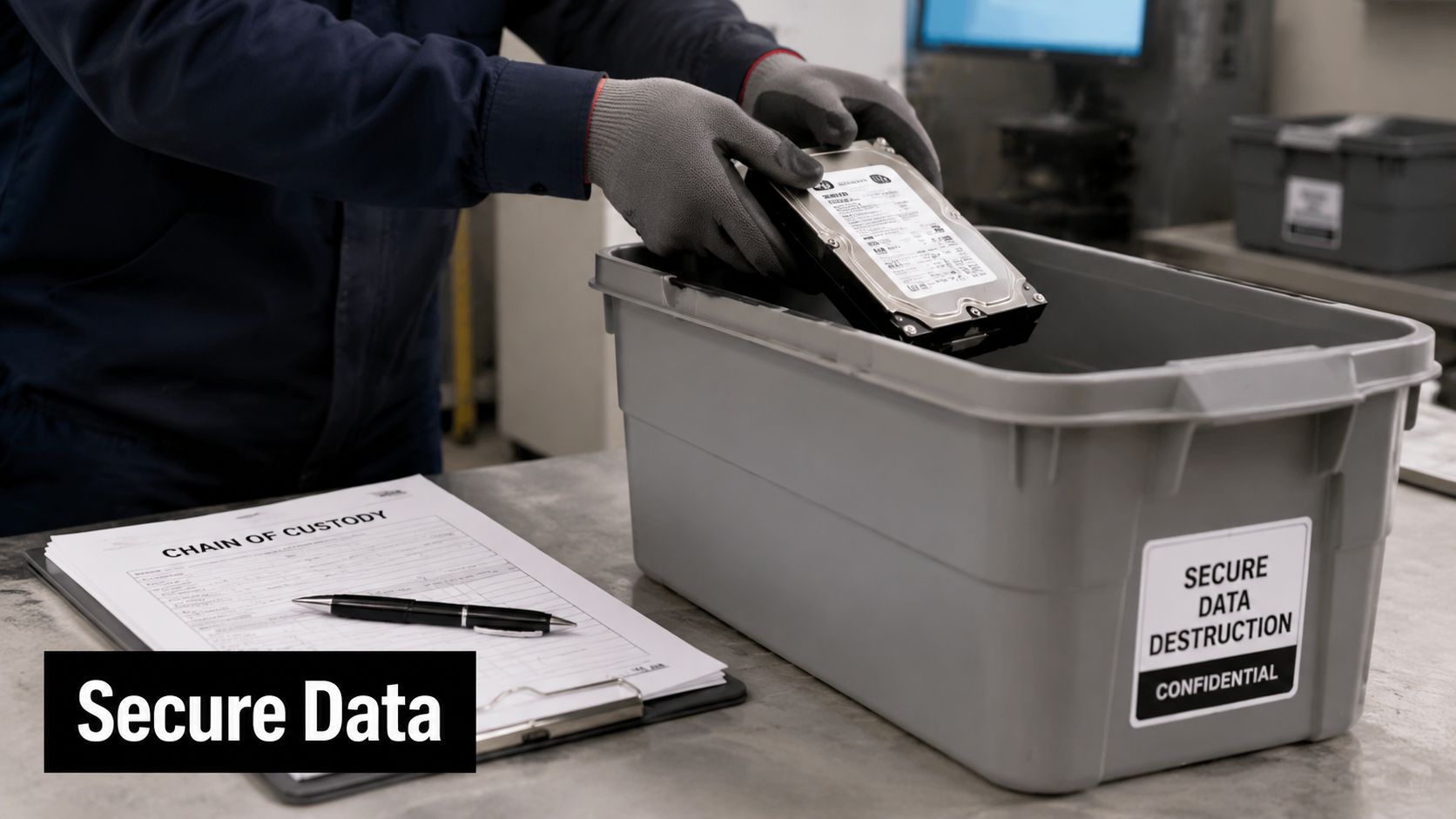
Treat data destruction as a contract condition
Write data destruction into the agreement as a condition of service, not a side promise. If you're handling laptops from HR, finance, legal, or healthcare operations, require the vendor to specify the sanitization method, chain of custody, certificate format, and who bears liability if media is mishandled.
A strong clause usually includes audit rights, indemnification for breach-related claims caused by the vendor, and the right to reject subcontracting without approval. If a recycler says secure data destruction is “standard practice,” ask to see the exact language.
Use a recognized benchmark when you negotiate. Reworx highlights secure processing through its NAID AAA certification information, and that kind of evidence is far more useful than general assurances.
Clauses worth fighting for
- Require named standards: Reference NIST 800-88 and specify whether assets will be wiped, shredded, or otherwise destroyed based on device type.
- Demand serialized proof: Certificates should identify the asset or media, the destruction date, and the method used.
- Reserve audit rights: You need the ability to inspect processes or review independent audits if the asset mix is sensitive.
- Address indemnification directly: If their process fails and your data is exposed, the contract should say who pays.
If the contract doesn't say exactly how data is destroyed and who is liable when it isn't, you're still carrying the risk.
3. Implement Flexible Pricing Models and Volume Incentives
Bad pricing terms don't always look expensive on day one. They become expensive when your volume changes, when reverse logistics gets messy, or when the vendor starts billing around the edges.
That's common in ITAD. A 2025 study by the Basel Action Network found that 40% of ITAD contracts fail to clearly define reverse logistics costs, leading to hidden fees that can erode buyback profits by up to 30%. For any company expecting value recovery from retired hardware, those terms matter as much as the recycling rate.
Price the whole workflow, not just the pickup
If you only negotiate a pickup fee, you haven't finished the pricing discussion. Ask for separate visibility into transportation, on-site labor, palletization, drive shredding, serialized reporting, downstream handling, and buyback calculations for reusable equipment.
This matters in donation-based recycling models too. If a social enterprise recycling partner such as Reworx Recycling is helping with corporate donation programs, your contract should distinguish donated equipment streams from scrap streams and from resale-eligible streams. Otherwise, “recycling” can become a catchall label that hides where the value went.
- Use tiered pricing: One rate for small recurring pickups, another for bulk office cleanout work, and another for data center decommissioning.
- Negotiate buyback logic: Define how enterprise servers, networking gear, laptops, and components are valued, and when credits are applied.
- Control reverse logistics: State who pays for trucks, packing, fuel surcharges, and extra site visits.
- Bundle where it helps: Computer recycling, secure data destruction, and reporting often cost less when negotiated together.
A rigid flat-rate contract can work if your volume is stable and your asset mix is simple. Most business environments aren't that neat. Flexible pricing protects you when refresh cycles, facility moves, or merger activity change the flow.
4. Define Termination Clauses and Exit Strategies
A contract that's easy to start but hard to exit is usually tilted in the vendor's favor. That's especially risky in electronics recycling because performance failures can go undetected for months before they surface in an audit, a missing certificate review, or a compliance inquiry.
You want a partner, not a trap. The contract should let you leave for cause, and in many cases for convenience after an initial term, without creating operational chaos.

Plan the breakup before the kickoff
Termination language should cover notice periods, open pickups, asset records, final reporting, unresolved credits, and treatment of devices already in the vendor's possession. If the recycler loses a certification, misses material SLAs repeatedly, or mishandles chain of custody, the right to terminate should be immediate.
This matters even more in complex projects. Reworx provides a useful operational reference in its server decommissioning checklist, and that kind of workflow is exactly why exit terms should address in-progress work. If a server room has already been partially decommissioned, you need clear responsibility for remaining equipment, media, and documentation.
What good exit language includes
- Termination for cause: Cover data breaches, compliance failures, certification lapses, and repeated SLA misses.
- Termination for convenience: After an initial period, preserve your ability to switch vendors if needs change.
- Transition support: Require delivery of serialized inventories, certificates, and outstanding environmental records.
- Data handling during offboarding: State whether any retained data, labels, or records must be returned or destroyed.
Good termination clauses don't signal distrust. They force both parties to stay operationally disciplined.
5. Negotiate Insurance, Liability Limits, and Indemnification Rights
Many procurement teams get too casual. They confirm the vendor “has insurance” and move on. That isn't enough for ITAD, secure data destruction, or facility cleanout work involving high-value equipment and sensitive information.
If a truck accident destroys assets, if a subcontractor drops a pallet of drives, or if improperly handled media leads to a breach claim, the insurance and indemnity sections determine whether the problem stays with the vendor or lands back on you.
Match risk allocation to the real failure modes
General liability matters, but so does cyber liability if the vendor handles data-bearing equipment. Cargo exposure matters if the chain of custody begins at your dock and continues through multiple handoffs. If subcontractors move or process equipment, their coverage needs to be addressed too.
A practical review of understanding contractor liability policies can help non-insurance teams ask smarter questions, but your contract still needs specific language for electronics recycling and IT equipment disposal work.
Reworx also publishes guidance on best practices for risk management, and that's the right frame. Risk management in this category isn't abstract. It's tied to chain of custody, transport damage, data exposure, and downstream claims.
Push past the certificate of insurance
- Name required coverages: General liability, cyber liability, auto liability, and workers' compensation may all be relevant.
- Set indemnification boundaries: The vendor should defend and indemnify your organization for claims caused by its negligence or noncompliance.
- Address subcontractors: Don't assume their carriers or processors are covered unless the contract says so.
- Review liability caps carefully: A broad cap can gut your remedies if the worst-case event is a security failure.
The point isn't to make the vendor carry every conceivable risk. The point is to make sure the party controlling the process also carries the consequences when that process fails.
6. Secure Environmental Compliance and Certification Guarantees
A recycler's marketing language doesn't protect your organization. Certification status, auditability, and downstream controls do.
Your environmental obligations don't end when equipment leaves your site; if assets are exported improperly, processed outside stated standards, or handled through weak downstream channels, your brand and compliance posture can still take the hit.
Ask for proof, not promises
The first step is simple. Require active certification and reserve the right to verify it. Reworx explains its certification posture on its electronic recycling certification page, and that's the kind of documentation buyers should review before signing.
Also insist on environmental reporting that's usable for procurement files, ESG reporting, and internal audits. If your sustainability team needs evidence for corporate donation programs or sustainable recycling outcomes, build those report requirements into the contract.
A common mistake is treating “no landfill” or “responsible recycling” as self-explanatory. They're not. You need defined terms, approved downstream practices, and remedies if the vendor falls out of compliance.
- Tie certification to contract status: If required certification lapses, you should have review and termination rights.
- Limit uncontrolled downstream handling: The contract should say whether export is allowed and under what conditions.
- Require environmental documentation: Ask for certificates, downstream summaries, and support for audit inquiries.
- Align with internal goals: If your company tracks social enterprise recycling or donation-based recycling outcomes, state that reporting requirement up front.
Some buyers worry that these requests are excessive. They aren't. Responsible vendors expect them.
7. Include Performance Metrics and Reporting Requirements
If you can't measure the relationship, you can't manage it. That's true in every vendor contract, but it's especially true in ITAD because failures often show up as missing paperwork, slow turnaround, or unresolved inventory questions before they show up as bigger legal problems.
Reporting also creates a strong position. A vendor can disagree with your opinion. It has a harder time arguing with its own missed deadlines and incomplete logs.
Build reporting around decisions you actually make
Don't ask for reports because they sound good. Ask for reports that support audits, budgeting, sustainability tracking, and vendor reviews. IT managers need serialized asset records and certificate status. Sustainability leaders need environmental outcomes. Finance teams need billing detail tied to pickups, weights, and value recovery.
One caution is worth noting here. A 2023 negotiation study reported that 72% of B2B deal failures occur because parties fail to verify key information provided by the counterparty, according to the summary published here. In practice, that means you shouldn't accept recycler claims about processing, certifications, or turnaround times without reporting structures that let you verify them.
Reworx offers a useful benchmark for this expectation through its compliance reporting resources.
Metrics that earn their place
- Operational metrics: Pickup timeliness, missed appointments, and turnaround for data destruction certificates.
- Inventory metrics: Number of assets received, serialized exceptions, and unresolved chain-of-custody issues.
- Financial metrics: Billing by service type, buyback credits, and reverse logistics charges.
- Sustainability metrics: Electronics recycling volumes, donation streams, and material handling outcomes.
Reports should help you approve invoices, pass audits, and spot service decline early. If they don't, simplify them.
8. Negotiate Contract Duration, Renewal Terms, and Price Escalation Clauses
The best term length depends on what you're buying. If you need recurring laptop disposal, computer recycling, and periodic pickups across several offices, a longer agreement can make sense. If you're planning a one-time data center decommissioning or a short facility cleanout, too much term can lessen your advantage without adding value.
The mistake is treating duration as an administrative detail. It shapes pricing power, accountability, and your ability to respond when business conditions change.
Balance stability with leverage
Behavior matters in negotiation, and one old principle still applies. Since the early 1980s, research by Amos Tversky and Daniel Kahneman has shown that the first number mentioned often anchors the entire discussion. In contract terms, that means the first credible proposal on term length, renewal mechanics, and escalation structure can shape the final deal more than many buyers realize.
Use that to your advantage. If you know your likely asset volumes and service mix, anchor the term and renewal language first. If you don't, wait, gather the vendor's assumptions, and negotiate from there.
Another useful reminder comes from salary negotiation. Pew Research Center survey data published in 2026 reported that 66% of U.S. job candidates who actively negotiated starting salary secured a higher offer. The lesson carries over cleanly to procurement. Asking with preparation often produces better terms than passive acceptance.
Renewal language that works in real operations
- Keep initial terms realistic: Long enough for operational consistency, short enough to safeguard your advantage.
- Control renewals: Automatic renewal can work, but only with clear notice rights and performance review triggers.
- Cap escalations carefully: If the vendor wants price increases, tie them to defined conditions and review rights.
- Reopen pricing when scope shifts: A merger, office expansion, or major hardware refresh can change the economics quickly.
This is one area where disciplined contract negotiation tips pay off immediately. A good renewal clause prevents complacency. A bad one locks in avoidable cost and weak service.
8-Point Contract Negotiation Comparison
| Item | 🔄 Implementation Complexity | ⚡ Resource Requirements | ⭐ Expected Outcomes | 📊 Key Advantages | 💡 Ideal Use Cases & Tips |
|---|---|---|---|---|---|
| Establish Clear Scope of Work and Service Level Agreements (SLAs) | Medium, requires cross‑functional input and detailed drafting | Medium, legal review, ops planning, monitoring tools | High ⭐⭐⭐⭐, reduces disputes and sets measurable expectations | Prevents ambiguity; enforces accountability; simplifies enforcement | Use for data center decommissions and recurring pickups; tip: specify NIST 800‑88, pickup timelines, quarterly SLA reviews |
| Negotiate Data Security and Compliance Clauses Upfront | High, technical and legal coordination needed | High, certification verification, audits, secure destruction processes | Very High ⭐⭐⭐⭐⭐, minimizes breach risk and regulatory exposure | Legal protection; audit trail; reduces reputational risk | Ideal for healthcare, finance, and any PII environments; tip: require R2/e‑Stewards/ISO 27001 and certificates of destruction |
| Implement Flexible Pricing Models and Volume Incentives | Medium, requires pricing modeling and forecasting | Medium, procurement effort, volume tracking, reporting | Medium‑High ⭐⭐⭐⭐, lowers per‑unit costs when volumes consolidated | Cost predictability; incentivizes consolidation; buyback offsets costs | Best for organizations with periodic bulk cleanouts; tip: negotiate tiered rates and escalation caps (≤3%) |
| Define Termination Clauses and Exit Strategies | Low‑Medium, legal drafting of notice, fees, and transition steps | Low‑Medium, legal review, transition planning resources | High ⭐⭐⭐⭐, protects from long‑term vendor underperformance | Prevents lock‑in; ensures data/asset continuity during exit | Use for multi‑year relationships; tip: include 30‑90 day notice, transition support, and termination‑for‑convenience after Year 1 |
| Negotiate Insurance, Liability Limits, and Indemnification Rights | High, detailed legal and risk assessment required | High, insurance verification, certificate management | High ⭐⭐⭐⭐, financial protection against loss or breaches | Clarifies financial exposure; ensures vendor accountability | Critical for high‑value assets or sensitive data; tip: require tiered coverage (e.g., $1M–$5M) and cyber liability |
| Secure Environmental Compliance and Certification Guarantees | Medium, verify certifications and audit access | Medium, certification checks, sustainability reporting | High ⭐⭐⭐⭐, ensures responsible recycling and regulatory compliance | Verifiable sustainability; avoids improper export; ESG alignment | Ideal for sustainability‑focused organizations; tip: require active R2/e‑Stewards and material diversion reports |
| Include Performance Metrics and Reporting Requirements | Medium, define KPIs and reporting cadence | Medium, vendor reporting systems and internal analysis | High ⭐⭐⭐⭐, improves transparency and vendor management | Enables data‑driven decisions; early issue detection; ESG tracking | Use for enterprise programs; tip: set response SLAs (48–72h), certification delivery windows, and monthly dashboards |
| Negotiate Contract Duration, Renewal Terms, and Price Escalation Clauses | Medium, balances commercial and operational needs | Low‑Medium, legal drafting, pricing models | Medium‑High ⭐⭐⭐⭐, provides budget predictability with limited flexibility risk | Stability and potential cost savings; renewal simplicity | Best for long‑term programs; tip: prefer 2–3 year terms, cap escalations at 3% or CPI, include renewal notice periods |
Turn Your Next Contract Into a Strategic Asset
An ITAD contract isn't just paperwork that clears procurement. It's the operating blueprint for how your organization handles risk, recovers value, documents compliance, and proves that retired equipment was managed responsibly. If the agreement is thin, every downstream issue gets harder to resolve. If the agreement is well negotiated, most issues are easier to prevent in the first place.
That's why the best contract negotiation tips in this category go beyond price. Price matters, but so do chain of custody, secure data destruction, environmental compliance, reverse logistics, reporting, insurance, and exit rights. In electronics recycling and IT equipment disposal, those terms decide whether you're buying a clean process or inheriting a future problem.
The financial downside of getting this wrong is real. Verified data states that the average cost of a data breach resulting from discarded hardware with uneliminated data exceeded $4.45 million per incident in 2023, as cited in this breach cost summary. Even without repeating statistics throughout your process, that number should inform how seriously you treat data destruction clauses, liability language, and vendor verification.
There's also a strong case for grounding negotiations in objective data. Verified data indicates that 74% of negotiated clauses generate conflict when they lack data-backed justification, and clauses anchored in benchmarks or market data see a 40% reduction in redlines and negotiation cycles. The same verified data also notes that benchmark-driven contracting has been associated with faster deal closure and strong user satisfaction in post-negotiation audits. The practical takeaway is simple. If you're negotiating pricing, buyback, SLAs, or compliance terms, support your position with standards and documentation rather than opinion.
Technology can help too, especially for organizations managing complex service agreements. Verified data notes growing adoption of AI-enhanced CLM tools and qualitative improvements in analytics-driven negotiations. For buyers with multi-site recycling programs, recurring office cleanouts, medical equipment disposal, or product destruction needs, disciplined clause review is becoming standard practice.
The right partner still matters. Reworx Recycling stands out because it combines electronics recycling, donation-based recycling, secure data destruction, and community impact through a social enterprise model. That gives businesses a way to handle IT asset disposition (ITAD), laptop disposal, data center decommissioning, and corporate donation programs with stronger environmental and social outcomes.
If you're reviewing your next vendor agreement, push for clarity, evidence, and enforceable obligations. That's how you turn a routine recycling contract into a strategic asset.
If your business is planning electronics recycling, secure data destruction, a facility cleanout, or a donation-based recycling program, Reworx Recycling can help you build a safer, more accountable process. Contact Reworx to donate old equipment, schedule a pickup, or discuss an IT equipment disposal partnership that supports compliance, sustainability, and community impact.