You probably have one right now. A closet, storage room, or back corner of a server space filled with retired laptops, aging monitors, loose hard drives, cables nobody wants to claim, and a few systems no one is comfortable throwing away.
Most companies treat that pile as an inconvenience. It's a business control problem.
An effective IT Asset Management Group gives leadership a way to track technology from purchase through deployment, support, redeployment, and final retirement. For large enterprises, that sounds familiar. For small and mid-sized businesses, it can sound too formal or too expensive. I think that's the wrong framing. If your company buys, uses, stores, reassigns, or retires technology, you already have IT asset management. The only question is whether you're managing it intentionally.
That matters because the final stage of the lifecycle carries just as much risk as the first. Secure data destruction, electronics recycling, computer recycling, laptop disposal, office cleanout planning, facility cleanout support, and broader IT asset disposition (ITAD) aren't side tasks. They're part of the operating model. For many organizations, expert partners also help bridge the staffing gap through donation-based recycling, product destruction, data center decommissioning, medical equipment disposal, laboratory equipment disposal, and corporate donation programs that align security and sustainability goals.
The Hidden Costs of Unmanaged IT Assets
A stack of old devices doesn't look expensive. It looks forgotten.
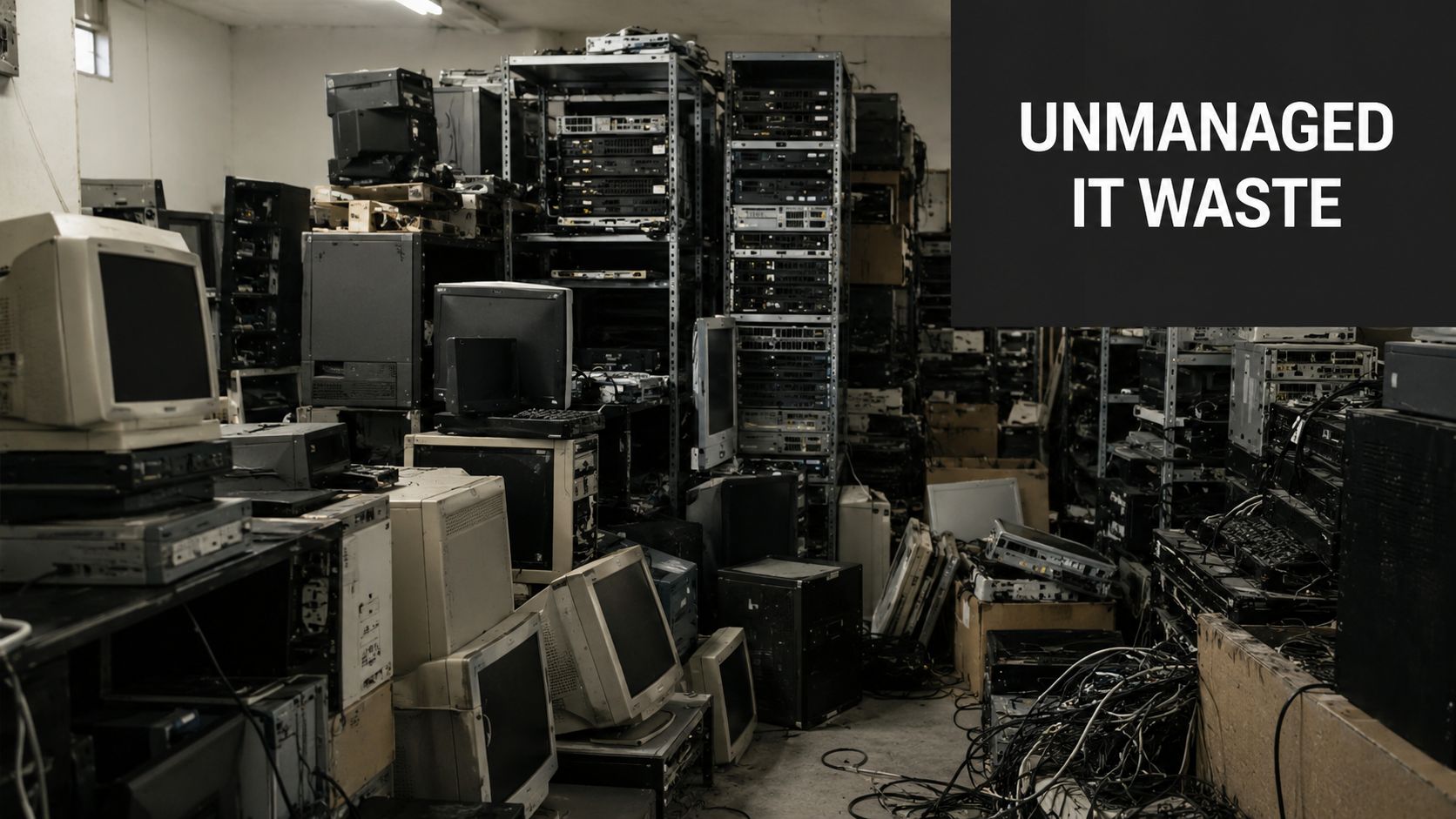
But when equipment sits outside a controlled process, your company starts paying in ways that don't always show up on a single invoice. Finance sees duplicate purchases because no one knows what's available for reuse. Security sees unknown devices holding sensitive data. Operations sees delays because employees wait for replacements while usable machines sit in storage. Sustainability leaders see regulated e-waste with no documented path to responsible recycling.
What unmanaged assets really cost
The first cost is waste. Companies buy new hardware while older, still-usable assets remain untracked.
The second cost is risk. A retired laptop with customer records is still a risk if it hasn't gone through secure data destruction. A decommissioned server is still a risk if no one can show where it went, who handled it, and how it was sanitized.
The third cost is compliance pressure. Data privacy requirements and environmental expectations don't disappear when a device leaves an employee's desk. They follow the asset through retirement.
Old equipment becomes dangerous when ownership becomes unclear.
A practical response starts with control, not cleanup. Build a process for identifying what you own, where it sits, who uses it, what data it may contain, and what happens when it reaches end of life.
Where an IT asset management group changes the picture
An IT asset management group gives this work a home. Instead of treating old hardware as junk removal, the team treats it as a governed lifecycle. That shift changes decision-making across purchasing, support, finance, audit, and disposal.
For organizations that want to recover value while keeping retirement disciplined, an asset recovery planning process helps connect reuse, resale, donation-based recycling, and final disposition into one operating workflow.
A room full of retired devices is rarely just a storage issue. It's a signal that ownership of the lifecycle has been left unfinished.
What Is an IT Asset Management Group
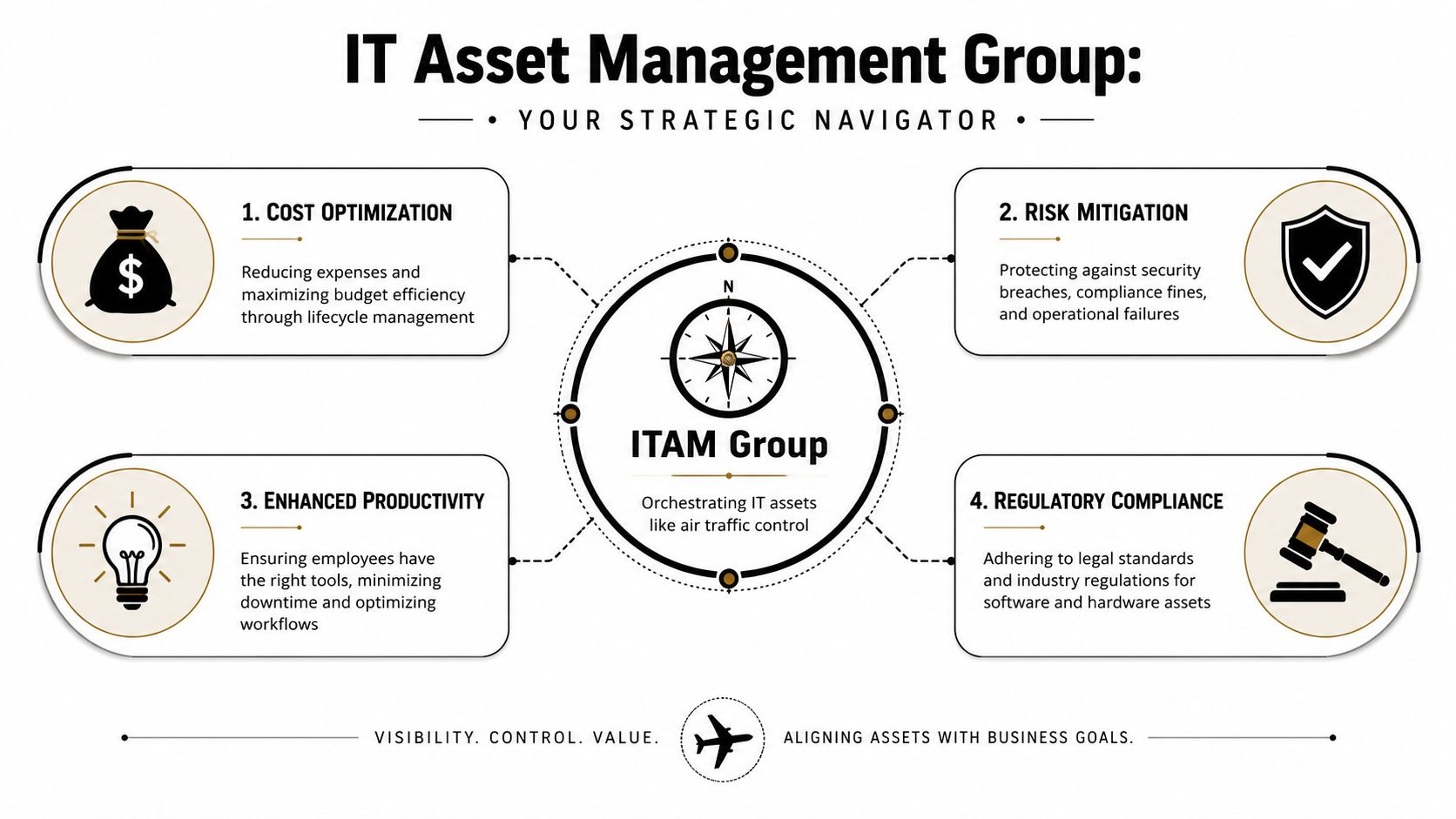
Think of an IT asset management group as air traffic control for your company's technology. Devices, software, subscriptions, and services are constantly entering, moving through, and exiting the business. Without coordination, collisions happen. Budgets drift, renewals get missed, devices vanish into storage, and disposal happens too late or with too little oversight.
The formal definition matters
IT Asset Management is standardized under ISO/IEC 19770, which defines IT assets as any hardware, software, subscriptions, or services. The framework helps organizations mitigate security risks and can reduce total cost of ownership by 15–30% through improved asset visibility, according to the ISO/IEC 19770 overview.
That definition is broader than many leaders expect. It's not just laptops and servers. It includes software entitlements, cloud-related subscriptions, mobile devices, network hardware, and service relationships that consume budget and create risk.
What the group actually does
An IT asset management group usually coordinates five business outcomes:
- Better purchasing decisions by checking existing inventory before approving new orders.
- Cleaner deployment so each asset is tagged, assigned, configured, and documented.
- Lifecycle visibility that shows warranty status, user assignment, condition, and replacement timing.
- License discipline that ties software use to actual need.
- Responsible retirement through secure data destruction, sustainable recycling, resale, or approved donation.
That's why I don't view ITAM as an admin function. It's a control function.
Practical rule: If an asset can create cost, hold data, or trigger an audit question, it belongs inside the ITAM process.
Why business leaders should care
Business leaders don't need to memorize the standard. They need to understand what the team prevents.
Without an ITAM group, departments buy around each other. Finance struggles to reconcile spending. IT spends time chasing serial numbers and user assignments. Security teams discover gaps late. Facilities teams inherit office cleanout and equipment disposal issues without clear instructions.
If you want another perspective on how organizations frame this discipline, this guide on ITAM for UK companies is a useful comparison because it shows how the same core principles apply outside a single market or company size.
A strong ITAM function turns technology from a collection of purchases into a managed portfolio.
Core Roles and Responsibilities Within the Team
If the phrase IT asset management group sounds abstract, make it concrete. Assign names, responsibilities, and handoffs. That's when the function becomes operational instead of aspirational.
The roles most organizations need
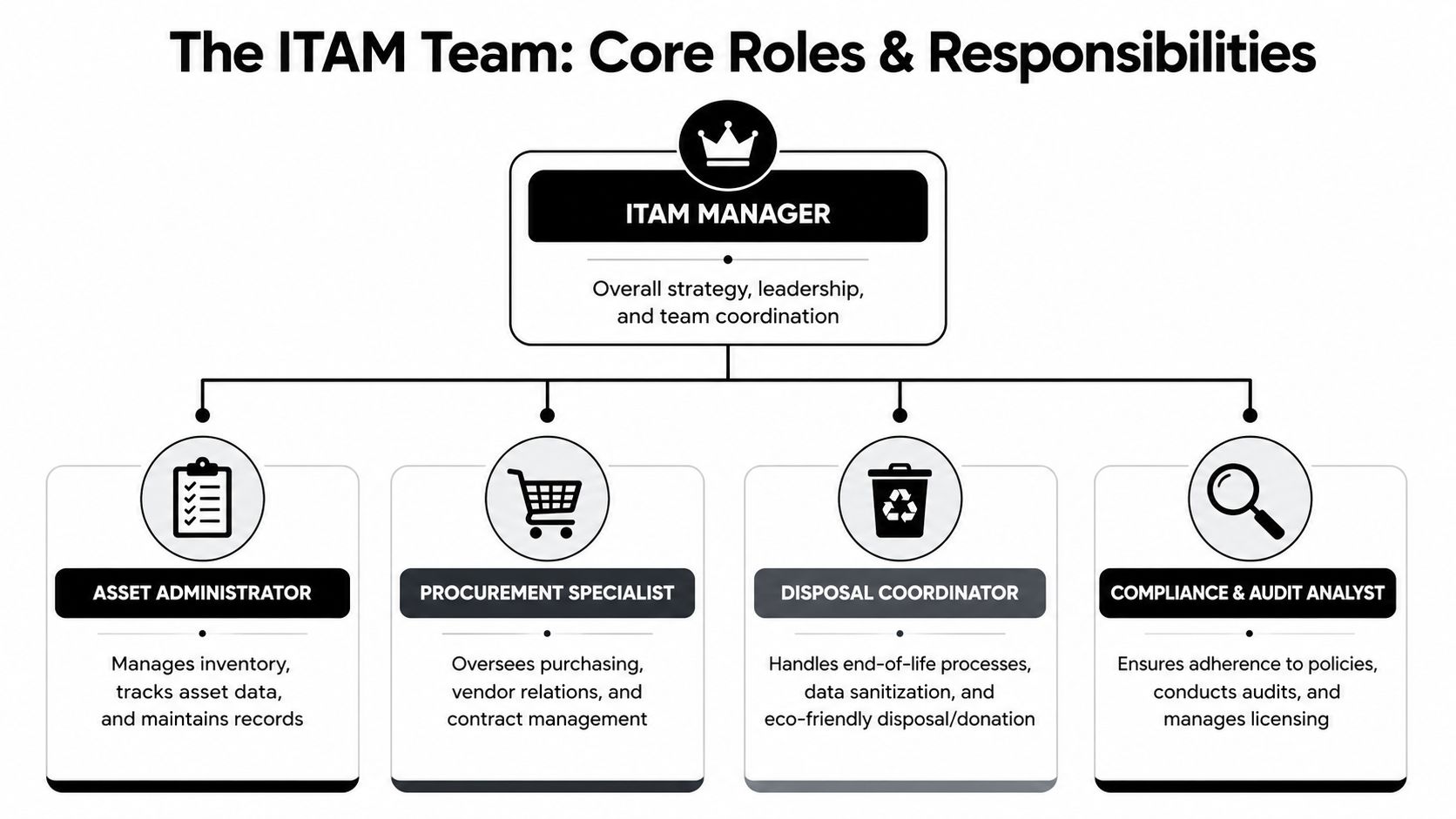
Some companies place all of this under one person. Others spread it across several teams. Either way, the work usually falls into four core responsibilities.
| Role | Primary focus | Why it matters |
|---|---|---|
| ITAM manager | Policy, governance, reporting, priorities | Keeps the lifecycle consistent |
| Asset administrator | Records, inventory, tagging, updates | Maintains trustworthy data |
| Procurement specialist | Purchasing, vendor coordination, contracts | Prevents unnecessary buying |
| Disposal and compliance lead | Retirement, chain of custody, audit support | Reduces data and environmental risk |
The titles can vary. The responsibilities can't.
How the day-to-day work breaks down
The ITAM manager sets policy. This person decides what must be tracked, who approves transfers, when assets are reviewed for refresh, and what evidence must be retained after disposition.
The asset administrator handles the recordkeeping often underestimated. They update serial numbers, assignments, locations, warranty details, and condition notes. If this work slips, every downstream decision gets weaker.
The procurement specialist connects asset demand to business need. They should know when to buy, when to reassign, and when to challenge requests because suitable hardware already exists inside the company.
The disposal coordinator or compliance analyst steps in at the highest-risk moment. They verify what data-bearing devices exist, what retirement path applies, what documentation is required, and which partner will handle the work.
When companies say they “lost track” of a device, they usually mean no one owned the record at the moment it changed hands.
Collaboration matters more than job titles
An ITAM team fails when each role works in isolation. Procurement buys without checking inventory. IT deploys without updating records. Security asks for proof after retirement instead of before it. Facilities clears a room before chain-of-custody requirements are defined.
That's why role design should include handoff rules. Who updates the record when a laptop is reassigned? Who approves laptop disposal after an employee exit? Who confirms whether a server belongs in data center decommissioning planning or standard electronics recycling?
Organizations that need a simple starting point can use role-based checklists similar to an IT manager responsibilities guide to clarify ownership before building more formal workflows.
A good team structure doesn't need to be large. It needs to be clear.
Structuring Your ITAM Function for Success
Most guidance on IT asset management assumes a mature organization with budget, staff depth, and time for formal process design. That's not how many companies operate. Most guides assume a level of organizational maturity that small and mid-sized businesses lack, creating a gap in lean ITAM adoption strategies for companies with fewer than 500 employees, as noted in this SMB-focused ITAM guide.
That gap matters because smaller organizations still face the same lifecycle problems. They just face them with fewer people.
Model one, a dedicated internal team
This model works best when the company has enough scale, hardware volume, compliance exposure, or multi-site complexity to justify specialization.
A dedicated team usually delivers the strongest consistency. Policies are easier to enforce. Inventory data tends to be cleaner. Reporting improves because one group owns the records and the retirement evidence.
The tradeoff is cost and staffing. Smaller firms may not have enough volume to keep a specialized team fully occupied year-round.
Model two, a cross-functional operating group
This is the structure I recommend most often for mid-sized companies.
Instead of hiring a full standalone department, assign ITAM responsibilities across existing leaders. Procurement manages purchasing controls. IT operations handles deployment and reassignment. Finance supports capitalization and refresh planning. Security defines data handling rules. Facilities coordinates physical removals.
That structure works if leadership agrees on three things:
- One system of record for asset status, ownership, and location
- One approval path for transfers, redeployment, and retirement
- One retirement standard for data destruction, documentation, and electronics recycling
This model fails when everyone contributes but no one leads. Appoint one owner even if the execution is shared.
Model three, an outsourced or partner-supported model
For many SMBs, outsourcing part of the function is the most practical option. Internal staff still make policy decisions, but a specialist supports inventory projects, office cleanouts, secure data destruction, facility cleanout planning, and end-of-life processing.
This approach is especially useful when the business has limited IT headcount, multiple remote offices, or irregular waves of refresh activity. It also helps when retirement is the weakest part of the lifecycle. That's common. Many teams can buy and deploy equipment. Far fewer can manage serialized pickup, chain of custody, resale evaluation, sustainable recycling, and donation routing with confidence.
The right model is the one your company can operate consistently, not the one that looks most sophisticated on paper.
A simple selection test
Use a dedicated team when asset volume and compliance pressure are high.
Use a cross-functional team when the company has disciplined managers but limited headcount.
Use external support when the business needs expertise at retirement, doesn't want to build every process internally, or needs help with secure and sustainable disposition.
The strongest ITAM functions often combine all three approaches over time.
Essential Processes from Purchase to Retirement
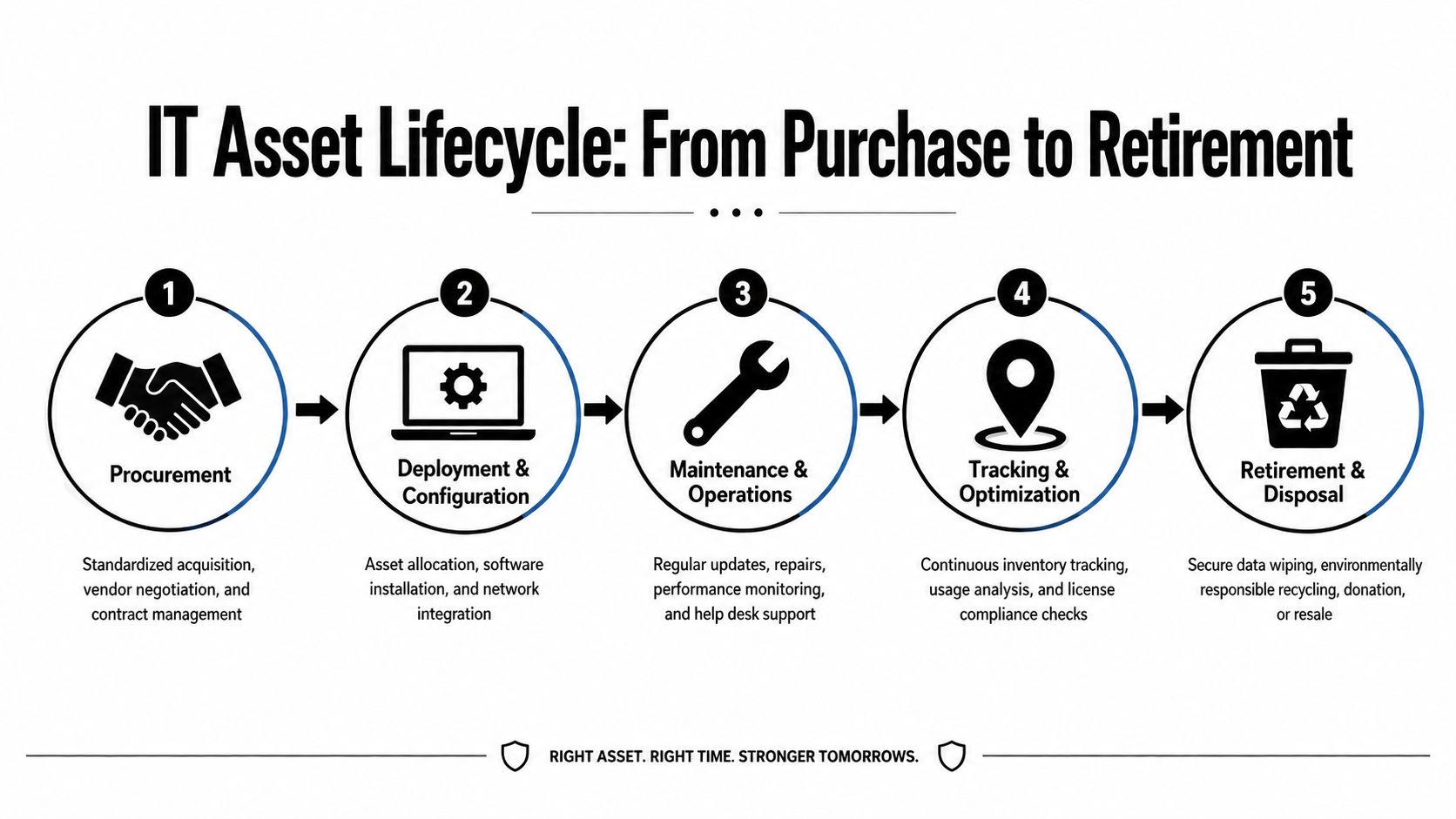
Good ITAM is process discipline. Every asset should move through the same basic lifecycle with defined checkpoints, owners, and records.
Start with controlled procurement
A clean lifecycle begins before the equipment arrives.
Purchasing should capture vendor, model, serial number, expected user or department, warranty terms, and business justification. If that sounds basic, remember how many later problems start because the company bought hardware without linking it to an owner, a cost center, or a replacement plan.
This is also the moment to decide whether an item is standard issue, shared equipment, specialty hardware, or a high-risk data-bearing device that will need stricter retirement handling later.
Tag, assign, and document early
Once equipment is received, it needs a unique asset record. That usually means barcode or RFID tagging tied to a central system. According to this ITAM process benchmark, organizations using centralized ITAM systems with RFID or barcode tracking achieve 40% faster asset discovery and a 25% reduction in software license over-purchasing by identifying unused subscriptions.
That result makes sense operationally. Teams move faster when they can find what they own. They spend less when they can see what isn't being used.
A practical inventory workflow should include:
- Asset identification with a unique tag and serial verification
- User assignment tied to a department or named custodian
- Location tracking for office, home office, branch, or storage
- Configuration notes for key software, accessories, and status
- Lifecycle state such as in stock, deployed, repair, surplus, or retired
Teams that want a starting framework can adapt an asset inventory management workflow into their own system of record.
Manage the middle of the lifecycle
The middle stage is where most waste happens.
Devices get repaired, reassigned, upgraded, loaned out, and returned. Software subscriptions continue after users leave. A monitor gets moved to a new office, but no one updates the location. A laptop returns from a terminated employee and sits unprocessed for months.
That's why mature teams review lifecycle status routinely. Not once a year. Routinely.
A device with no current user should trigger action. Reassign it, retire it, or document why it remains in storage.
Make retirement a formal process
Retirement should never start with “someone should get rid of this.” It should start with a decommissioning workflow.
For each asset, determine whether it will be reused, resold, donated, dismantled, or sent for sustainable recycling. For data-bearing devices, secure data destruction must be verified before the item leaves controlled custody. For larger projects, such as data center decommissioning or department-wide refreshes, the same rules apply at greater scale.
The final handoff is where operational maturity shows. If the company can't prove what happened to the asset, the process isn't complete.
Key Performance Indicators and Compliance
An ITAM function needs evidence that it's working. Not vague confidence. Evidence.
The right key performance indicators depend on your environment, but the best ones tie directly to business outcomes. Leadership wants to know whether the company is buying wisely, using assets fully, reducing avoidable risk, and meeting its obligations when equipment leaves service.
Metrics that show whether the process is healthy
I usually start with a short list of operational indicators:
- Inventory accuracy to show whether records match physical reality
- Asset utilization to reveal idle or underused hardware
- License alignment to identify unused subscriptions and reclaim spend
- Refresh and retirement timeliness so surplus equipment doesn't pile up
- Disposition documentation completeness to prove retirement controls were followed
None of those metrics matter if they're reported without context. If utilization is low, leadership should know whether the answer is redeployment, delayed purchasing, or retirement. If retirement is slow, leadership should know whether the bottleneck is internal approvals, storage congestion, or vendor coordination.
Compliance is part of the lifecycle, not a separate project
Many organizations still split retirement into two separate conversations. One team handles data destruction. Another handles e-waste. That model is getting harder to defend.
Many guides treat data destruction and e-waste recycling as separate endpoints, but evolving regulations require ITAM groups to provide unified proof of both data sanitization and environmental stewardship to avoid significant legal and financial penalties, according to this industry compliance discussion.
That's the right way to think about it. A retired asset isn't compliant just because the drive was destroyed. It also isn't compliant just because the material was recycled. You need documented proof of both, aligned to the same asset record.
If your records can't connect the device, the data destruction event, and the final environmental outcome, auditors will see a gap.
A good operating tool for internal review is a formal IT disposition compliance checklist that matches inventory, custody, sanitization, and recycling evidence before the file is closed.
When business leaders treat compliance as part of lifecycle governance, not as a cleanup task, the ITAM function becomes easier to defend and easier to fund.
Partnering for Secure and Sustainable IT Disposition
The last stage of the lifecycle often carries the most exposure. Devices leaving the business may still contain regulated data, internal records, credentials, or intellectual property. At the same time, the organization has to handle electronics responsibly and document what happened.
That's why many internal teams rely on specialist support for retirement, even when procurement and deployment stay in-house.
What a qualified ITAD partner should provide
A serious retirement partner should be able to support more than pickup and recycling. They should fit into the control model your IT asset management group already uses.
A benchmark IT Asset Disposition process requires serialized inventory tracking and a dual-verified chain of custody, with industry standards like R2v3 certification targeting a 97% material recovery rate through responsible recycling, according to this ITAD process benchmark.
Those points matter because they answer the practical questions leadership will ask:
- Can we trace each asset from removal to final outcome
- Can we verify how data-bearing devices were handled
- Can we show that recycling followed responsible downstream practices
- Can donation, resale, and product destruction be handled inside one managed workflow
Why this matters for SMBs in particular
SMBs usually don't need a giant internal department. They do need a dependable way to retire equipment without creating a security or environmental problem.
That's where specialist partners can add structure. Some support pickup scheduling, serialized intake, secure data destruction, buyback review, social enterprise recycling, and donation-based recycling options that connect disposition to community impact. Reworx Recycling is one example of a partner model that supports IT asset disposition, electronics recycling, secure hard drive shredding, and donation-oriented reuse while helping organizations keep end-of-life handling inside a documented process.
When you evaluate any provider, use clear vendor selection criteria for ITAD services to compare chain of custody, reporting detail, data destruction options, downstream controls, and support for sustainable recycling outcomes.
The retirement phase shouldn't depend on trust alone. It should depend on records, process, and verification.
The companies that handle ITAM well don't stop at buying efficiently. They finish the lifecycle responsibly. That's where asset control becomes risk reduction, sustainability practice, and operational discipline all at once.
If your business is planning an office refresh, laptop disposal project, computer recycling effort, or a broader IT equipment disposal program, Reworx Recycling offers resources that can help you build a safer end-of-life process. Explore their educational materials, review donation and secure data destruction options, and use them as a starting point to donate old equipment, schedule a pickup, or build a corporate donation program that supports both compliance and community impact.