An Erie company upgrades workstations, swaps aging laptops, retires a few servers, and clears a closet that has been collecting old devices for years. The upgrade feels finished until someone asks the uncomfortable question: what happens to the hardware now?
That's where many businesses get stuck. Public recycling guidance in Erie is mostly built around household drop-offs, weekend events, and basic disposal instructions. Business equipment brings a different set of problems. You're not just moving scrap. You're handling devices that may still hold employee records, customer files, saved passwords, medical information, financial data, or internal documents tied to contracts and audits.
For businesses searching for electronics recycling in Erie PA, the practical challenge isn't finding any outlet at all. It's finding a process that protects data, satisfies compliance expectations, and keeps equipment out of the wrong downstream channel.
The Hidden Risks in Your Office's Old Tech
A storage room full of retired devices looks harmless until an auditor, insurer, or customer asks where the data went and who handled the equipment after it left your office. In Erie, that question exposes a real gap. County recycling programs help residents clear out old electronics, but business equipment usually needs documented data destruction, chain of custody, and downstream accountability that household programs are not built to provide.
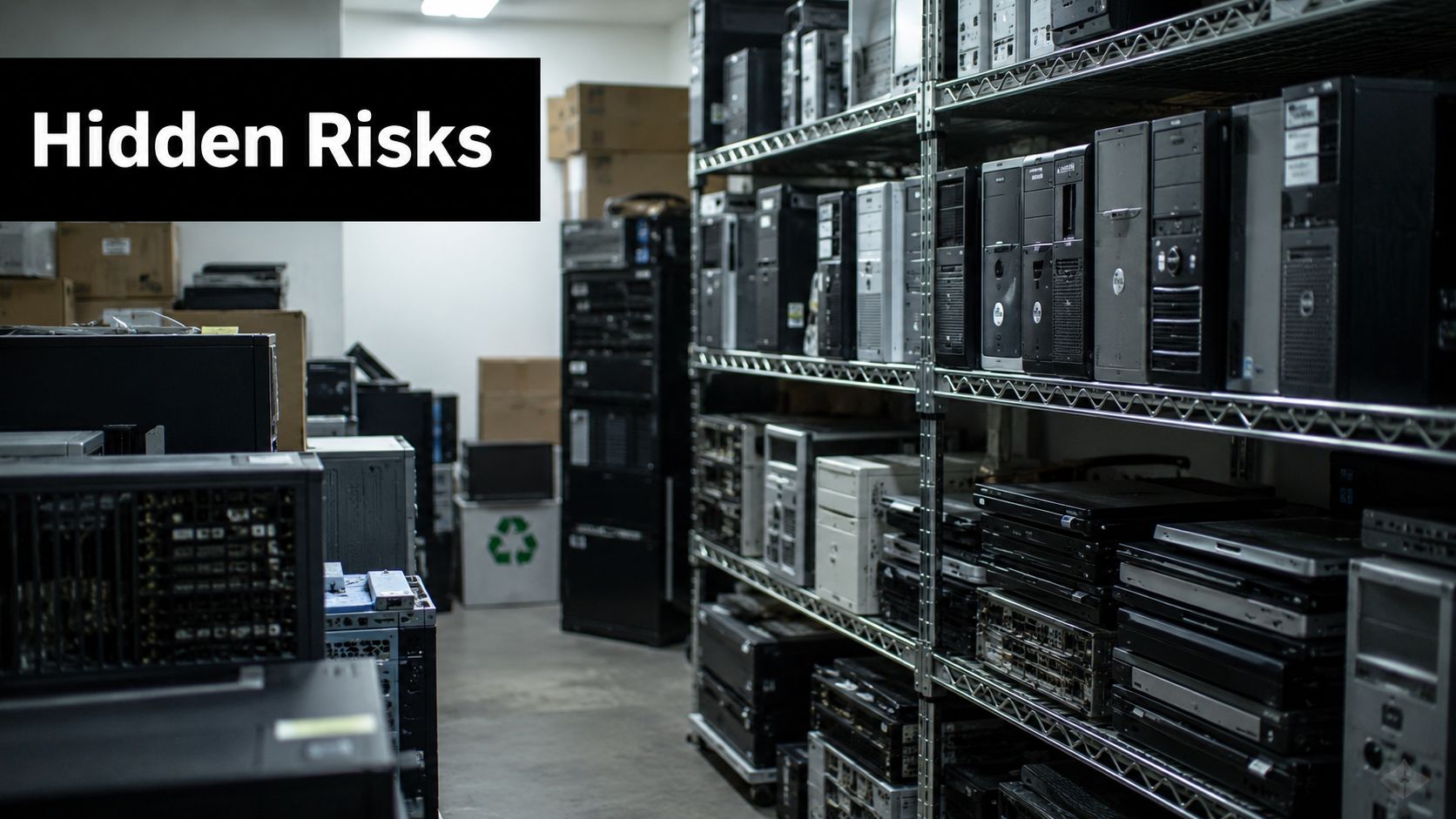
The first risk is data exposure. A retired laptop, firewall, copier, or backup device can still hold employee records, saved credentials, client files, or regulated information long after daily use stops. If those assets sit unsecured, get picked up without controls, or move through a recycler that cannot verify sanitization or destruction, the problem is no longer clutter. It is a breach investigation, a contract issue, and potentially a reportable incident.
The second risk is disposal through the wrong channel. Pennsylvania businesses cannot treat covered electronics like ordinary trash or a simple cleanup item. The practical failure I see most often is internal: someone in operations wants space back, IT is busy with the upgrade, and equipment gets handed off without a serial-level record or clear destruction instructions. That is how assets disappear into a gray area where nobody can prove what happened.
What businesses underestimate
Company leaders often focus on obvious devices such as laptops, desktops, and servers. The overlooked items create trouble just as often. Copiers, printers, VoIP phones, network gear, tablets, external drives, badge systems, and specialty equipment may store data or contain components that require responsible handling.
Monitors and older peripherals create a second layer of risk. They may not contain sensitive files, but they still need proper end-of-life processing. Businesses that want a clearer view of the environmental side should review this summary of the electronic waste impact. Environmental responsibility and data security are separate obligations, but in practice they need to be handled in the same disposal plan.
Practical rule: If a device stored company data, connected to your network, or contains regulated materials, do not let it leave the site without documented instructions and a named recipient.
What works and what fails
What works is controlled turnover. Tag the assets, keep them in a restricted area, assign ownership for the disposition project, and use a provider that can document pickup, sanitization, destruction, and final processing. For Erie businesses, that is the difference between a residential recycling option and a business-grade IT asset disposition process.
What fails is informal disposal. Free pickup with vague paperwork, staff drop-offs, one-off cleanouts, and “we wiped it” assumptions create avoidable risk. If your team needs better internal discipline before anything leaves the building, this guide on how to protect your business data is a useful starting point.
Reworx fills the gap many Erie businesses run into. County programs address public recycling access. Reworx addresses what businesses are accountable for: secure handling, documented destruction, compliant recycling, and a defensible chain of custody.
Your Pre-Disposal Data Security Checklist
Before any asset leaves your facility, lock down the data problem first. Deleting files, resetting a laptop, or sending machines to a general recycler without verification isn't enough. A business needs a repeatable procedure that someone can defend later.
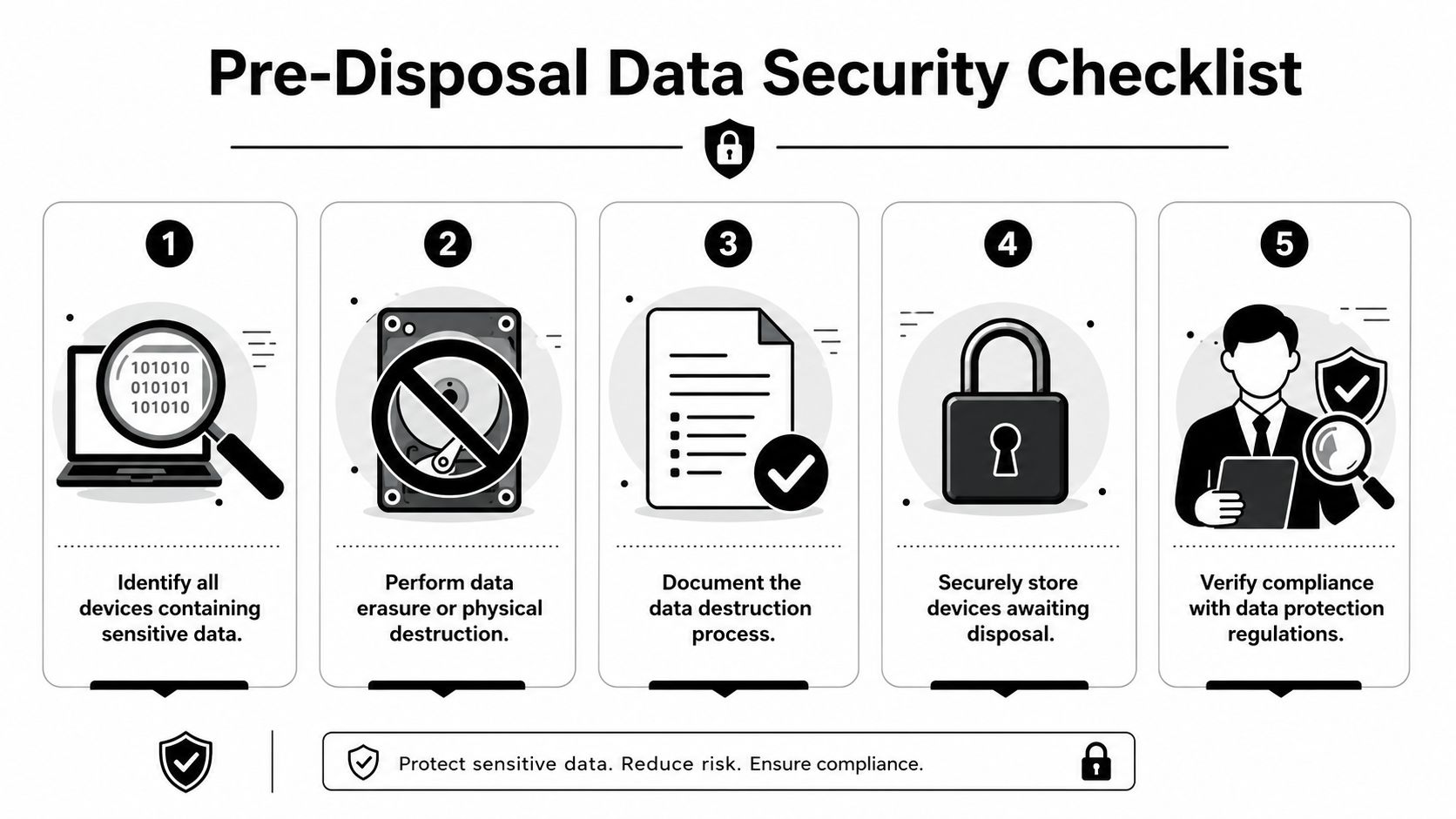
Start with an asset inventory
Build a list before anyone unplugs or moves anything. Include desktops, laptops, servers, external drives, phones, tablets, copiers, network appliances, and specialty equipment. Record model, serial number, assigned user or department, location, and whether the device stores data.
This sounds basic, but it prevents the most common business mistake in electronics recycling Erie PA projects: equipment leaving in batches with no usable record of what was removed. Once that happens, proving proper handling gets much harder.
Use a simple checklist like this:
- Tag what stores data. Mark hard drive devices, SSD-based units, mobile devices, printers, and any appliance with internal storage.
- Separate reusable from end-of-life. Some assets may be redeployed, donated, or remarketed. Others should go straight to destruction.
- Identify regulated departments. Healthcare, finance, legal, HR, and public sector teams usually require the strongest documentation.
Don't rely on formatting
A quick reset or reimage isn't a data destruction program. In Erie, certified facilities use DoD 5220.22-M protocols for data sanitization, and 34% of non-compliant recyclers fail to verify hard drive erasure, creating data breach liability, according to Advanced Technology Recycling's Erie electronics recycling page. The same source states that certified processing can achieve 98% material recovery while keeping hazardous materials contained within U.S. borders.
That single point should shape your vendor screening. You need to know whether the recycler verifies sanitization, whether the method matches the asset type, and when physical shredding is the better option.
A retired laptop isn't low risk because it's old. It's high risk if nobody can prove what happened to the drive.
For companies that want a benchmark for enterprise handling, review what a formal secure data destruction process should include.
Control custody before pickup
Even a strong destruction standard fails if devices sit unsecured for a week in a loading area. After inventory, move equipment into a locked room or caged area with limited access. Assign one internal owner. If devices are awaiting palletization, don't leave them in hallways, public docks, or shared maintenance rooms.
A practical internal checklist looks like this:
- Limit handlers. Only IT, facilities leadership, or approved staff should touch retired assets.
- Document movement. Record when equipment moves from desk to staging area and from staging area to pickup.
- Protect loose media. USB drives, backup tapes, and removed hard drives get lost faster than whole systems.
- Verify the handoff. Match pickup counts against your internal list before the truck leaves.
Match the process to the regulation
Businesses often ask whether they need wiping, shredding, or both. The answer depends on the device, the sensitivity of the data, and your retention obligations. If your organization handles protected health information, legal records, customer account data, or confidential designs, choose the method your compliance team can support in writing.
The right pre-disposal process should answer three questions clearly:
| Question | What you need |
|---|---|
| What devices left the building? | A complete asset list |
| What happened to the data? | Verified sanitization or physical destruction |
| Who handled the equipment? | A documented custody trail |
If you can't answer all three, the process isn't finished.
Navigating Erie County Recycling Options
An Erie office manager clears out a storage room and finds six laptops, two printers, a box of cords, and a few old phones. Erie County does offer a legal public outlet for some of that material. The county's Household Hazardous Waste and Electronics Collection program accepts electronics at $0.50 per pound through scheduled events with pre-registration and limited collection windows at sites such as Greene Township, Summit Township, and East Middle School, according to the Erie County recycling program page.
For households, that setup works well. For Erie businesses, it often stops short of what auditors, insurers, and compliance teams expect.
Where the public program fits
County events are built for residents with small volumes and straightforward disposal needs. A family replacing one desktop or dropping off an old monitor can register, arrive during the event window, pay by weight, and hand over the equipment.
That model is useful for community collection. It is not the same as a documented business disposition process.
Where the gap shows up for Erie businesses
The problem is not access. The problem is proof.
Public collection listings generally describe what can be dropped off and what it costs. They do not clearly promise certified hard drive shredding, serialized asset tracking, or Certificates of Data Destruction. For a business retiring office equipment, those details are often the whole job. Collection alone does not close the risk if you still cannot show what happened to the data and who handled the assets.
Pennsylvania's electronics collection program listing points to local public collection options, including Erie County events, but public programs are not presented as a substitute for business-grade data destruction records.
Decision test: If your organization may need to show an auditor, client, regulator, or cyber insurer how retired devices were processed, a public event is usually not the right final channel.
A practical comparison
| Option | Good fit | Main limitation for businesses |
|---|---|---|
| County event | Small residential loads | No clear enterprise documentation for data destruction or chain of custody |
| Informal donation route | Working devices with low data sensitivity | Acceptance rules vary, and some equipment categories are refused |
| Dedicated ITAD process | Offices, clinics, schools, manufacturers, multi-site operations | Requires scheduling and internal coordination |
Business loads are also less predictable than household loads. Erie companies are not just disposing of towers and monitors. They are retiring tablets, VoIP phones, networking gear, access control hardware, point-of-sale units, and mixed peripherals. Broad event descriptions can leave staff guessing about acceptance, preparation requirements, and whether those items will be processed in a way that supports internal policy. A location page such as business-focused electronics recycling service examples in Pennsylvania shows the level of service definition companies usually need.
Donation can help in narrow cases, but it has practical limits. Goodwill Keystone Area states on its e-waste acceptance page that it does not accept any device containing a swollen, bloated, leaking, or damaged lithium-ion battery because of fire risk. That means a routine office cleanout can stall quickly if even a few aging laptops or phones have battery damage.
For Erie businesses, the county program fills the residential gap. Certified IT asset disposition fills the business gap. Reworx sits between those two realities by giving local organizations a path that covers pickup, data destruction, and documentation instead of simple drop-off.
Reworx Professional ITAD and Pickup Services
Once a business moves beyond a few loose desktops, the disposal problem changes shape. It becomes a logistics problem, a documentation problem, and often a scheduling problem. Your IT manager needs the equipment gone. Facilities needs space back. Leadership wants risk off the books without pulling internal staff into a week of sorting and transport.
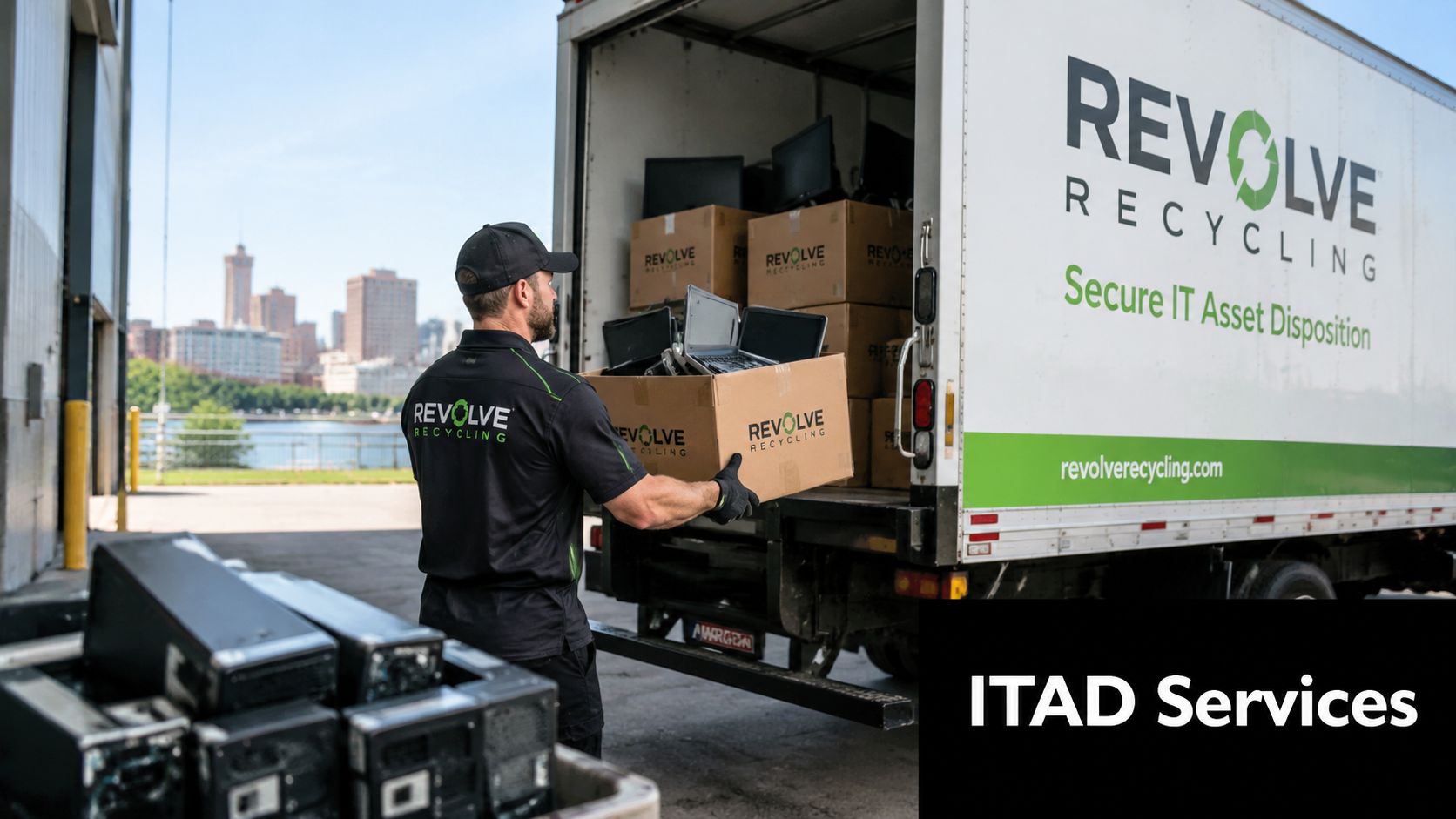
That's where IT asset disposition, or ITAD, earns its place. If you want a clean definition of the service model, this overview of IT asset disposition is useful because it frames disposal as a managed business process rather than a one-time haul-away.
What a business pickup service solves
A proper pickup model removes several failure points at once. Staff don't have to load personal vehicles. Equipment doesn't sit for weeks waiting for a public event. You can stage by department, by building, or by project type such as office cleanout, facility cleanout, or data center decommissioning.
That matters in Erie because many organizations aren't retiring only PCs anymore. As of 2026, 60% of U.S. businesses recycle smart devices annually, yet many local guides still lack clear protocols for these items, according to the Erie County convenience center reference discussing emerging device categories. The same source notes that an ITAD partner like Reworx is important for compliant disposal of IoT devices and AI hardware, which often fall outside generic collection guidance.
Assets that need more than a basic drop-off
Business recycling loads often include categories that municipal language doesn't describe well:
- Smart office equipment such as conference room systems, access control hardware, smart displays, and connected sensors.
- Medical equipment disposal needs, especially for clinics and healthcare offices that also have privacy obligations.
- Laboratory equipment disposal tied to testing, education, or industrial workflows.
- Product destruction for obsolete branded devices, returns, prototypes, or recalled inventory.
- Mixed cleanouts where monitors, docking stations, networking gear, phones, tablets, and peripherals all leave at once.
A donation-based recycling and social enterprise model can also be a strong fit when some devices still have useful life. The business benefit is practical. Reuse-eligible equipment may support community outcomes instead of going straight to commodity recovery, while non-repairable material still moves through sustainable recycling channels.
Business disposal works best when one provider can handle pickup, secure data destruction, computer recycling, and downstream reporting without forcing your staff to split loads across multiple outlets.
What to ask before you book
Not every recycler offering pickup is operating at the same standard. Ask direct questions.
- How are devices tracked from pickup onward?
- What happens to storage media?
- Can they handle laptops, servers, networking gear, and modern smart devices in the same project?
- Do they support office and facility cleanouts without requiring your staff to pre-sort everything?
- Can they align electronics recycling with donation-based recycling goals and corporate donation programs?
If the answers are vague, keep looking. In this category, vague usually means risky.
Documentation Compliance and Community Impact
Your recycling project ends when the record is complete. If a laptop disappears from the count, if a drive cannot be tied to a destruction event, or if finance asks what happened to fully depreciated assets six months later, good intentions will not help. Your business needs documentation that stands up to an audit, a customer questionnaire, or a legal hold review.
The documents that matter
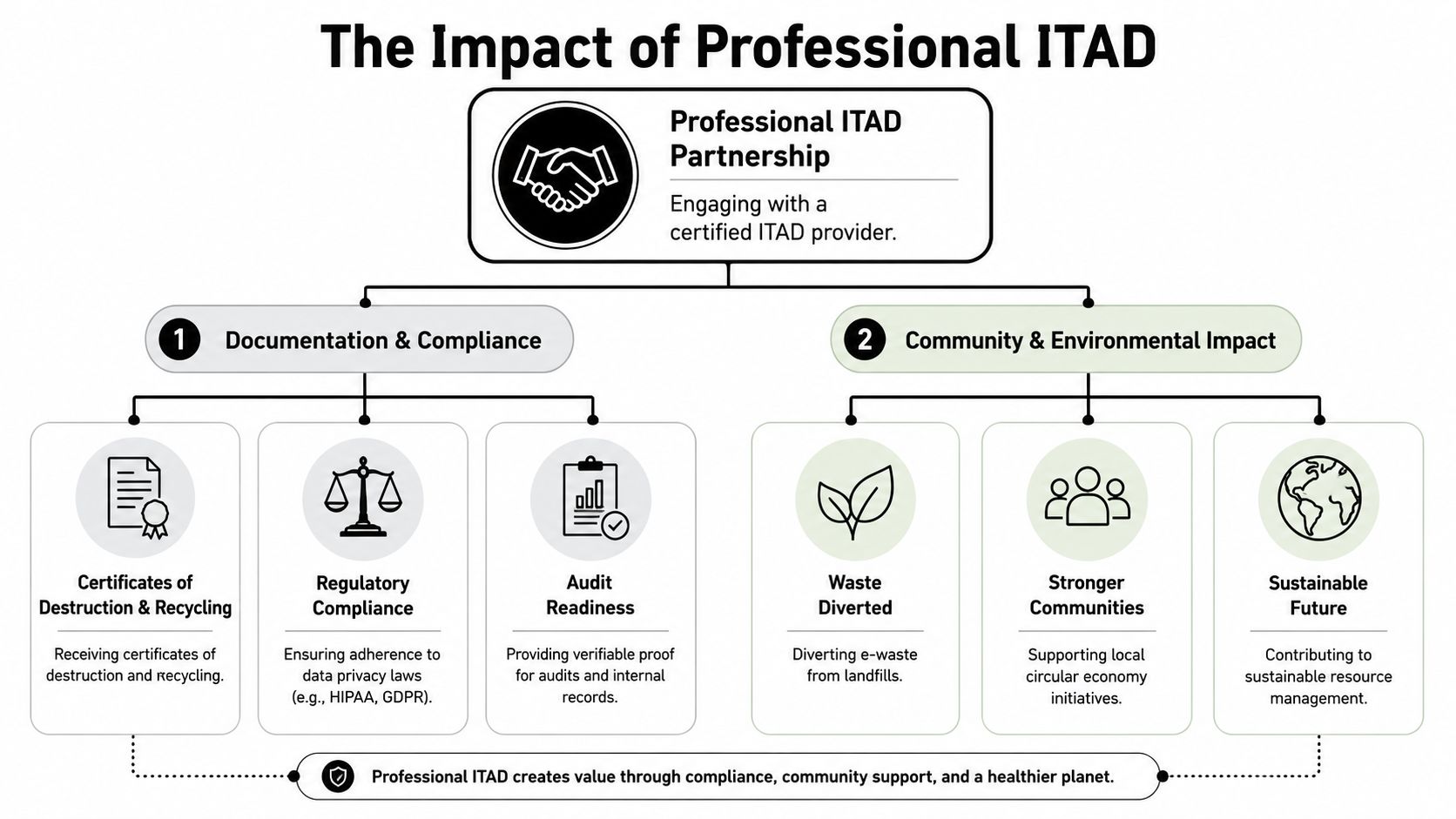
For Erie businesses, the core file usually includes an asset inventory, pickup record, chain-of-custody log, data destruction record, and a recycling or disposition summary. If the equipment held regulated data, your compliance or legal team may also require certificates tied to serial numbers, service dates, and destruction method.
Those details are what separate business IT asset disposition from a county drop-off program built mainly for household users. Public recycling options serve an important purpose, but they usually do not give a company the audit trail needed for customer contracts, cyber insurance, internal controls, or sector-specific rules.
A documented chain of custody process for business electronics recycling shows who handled the assets, when custody changed, and how the final disposition was recorded. That is the proof your team will need later, not just the receipt from pickup day.
Why the record matters after the event
Improper disposal creates two separate problems. One is the physical removal of equipment. The other is the inability to prove that removal was handled securely and lawfully.
I see companies focus on the first problem and underestimate the second. Then a vendor security review asks how retired drives were destroyed, or an internal auditor asks for serial-level reconciliation, and the file is thin. At that point, the risk is no longer theoretical. Gaps in documentation can turn a routine cleanout into a reportable issue, a contract problem, or an expensive scramble to recreate records after the fact.
Good documentation also makes cross-functional review easier. IT can confirm devices are off the books. Facilities can show where the material went. Finance can support asset retirement. Sustainability teams can report reuse and responsible recycling outcomes without guessing.
Equipment leaves once. The paperwork may be reviewed for years.
Why community impact still belongs in the process
The strongest Erie programs do more than clear storage rooms. They also decide which devices should be destroyed, which can be recycled for commodity recovery, and which still have enough useful life to support reuse.
That distinction matters for businesses trying to balance risk, cost, and community benefit. A social enterprise model can direct suitable equipment toward digital inclusion or workforce support, while damaged or obsolete material still goes through proper recycling channels. The key is order of operations. Data protection and documentation come first. Reuse decisions happen only after those controls are in place.
This is significant for sustainability leaders because the best results come from one policy that covers secure destruction, documented disposition, and credible community impact. That is the gap many Erie businesses run into. County programs help residents manage household electronics, but businesses need a provider that can bridge compliance, data security, pickup logistics, and reuse outcomes in one documented process.
Schedule Your Secure E-Waste Pickup in Erie
If your office has a room full of retired equipment, waiting won't improve the situation. The drives won't become safer. The inventory won't become easier to track. The compliance questions won't disappear on their own.
Erie's public recycling options have a place, especially for residents and simple household loads. Businesses operate under a different standard. Once devices contain company data, regulated records, or customer information, disposal has to be handled like a controlled ITAD project, not a weekend errand.
That applies whether you're managing laptop disposal, computer recycling, medical equipment disposal, data center decommissioning, or a full office cleanout. It also applies if your team is retiring newer categories such as smart devices, connected equipment, or AI hardware that don't fit neatly into older public recycling language.
The safest path is straightforward:
- Inventory the assets
- Secure the devices on-site
- Use verified data destruction
- Maintain chain of custody
- Get the documentation your business can stand behind
Businesses that treat electronics recycling as an operational control, not just a cleanup task, usually avoid the expensive mistakes. They also make it easier for IT, facilities, legal, and sustainability teams to work from the same playbook.
If your organization needs a practical partner for donation-based recycling, secure pickups, IT equipment disposal, and compliant end-of-life planning, contact Reworx Recycling to discuss your equipment, schedule a pickup, or build a repeatable recycling program that protects data while supporting community impact.