Disposal costs creep up. A hauler invoice rises, an office cleanout leaves a loading dock full of mixed material, and the next sustainability report asks for numbers nobody has tracked with confidence. Facilities teams feel it in container overflow and contamination. IT teams feel it when retired laptops, servers, and peripherals sit longer than they should because nobody wants to guess about chain of custody, reuse potential, or secure data destruction.
That's usually the moment a company realizes trash isn't just an operations issue. It's a data problem, a compliance problem, and often a missed value problem.
The scale behind that daily frustration is enormous. In 2022, the European Union generated 2,233 million tonnes of total waste, and the EPA's most recent U.S. figures show 292.4 million tons of municipal solid waste in a single year, equal to 4.9 pounds per person per day according to Eurostat waste statistics. For any business trying to control disposal spending, improve diversion, or manage end-of-life electronics, waste stream analysis has moved well beyond a nice-to-have exercise.
Beyond the Bin Turning Waste into a Business Asset
Most businesses start waste stream analysis for the wrong reason. They start because something hurts. Trash bills are rising. A landlord flags contamination. A corporate sustainability leader needs defensible diversion data. An IT manager inherits a storage room full of obsolete hardware and needs a clean path for IT equipment disposal.
That pain matters, but it's only the surface problem.
A good waste stream analysis shows what your business buys, uses badly, stores too long, throws away too early, or mixes together so carelessly that valuable material turns into disposal cost. In practice, that means your waste stream often reveals operational habits before any finance dashboard does. Repeated cardboard volume can point to purchasing inefficiencies. Excess shrink wrap may indicate supplier packaging issues. Idle electronics can expose weak asset tracking, delayed refresh planning, and avoidable data-security risk.
What managers usually miss
Teams often treat waste as one downstream bucket. It isn't. It's a record of upstream decisions.
A mixed load from an office cleanout, facility cleanout, or data center decommissioning can answer questions such as:
- Procurement fit: Are you buying materials and devices in formats the site can recover or reuse?
- Handling discipline: Are employees using the right bins, or are good recycling streams being contaminated by convenience?
- Asset lifecycle timing: Are laptops, monitors, servers, and network gear being held past their useful internal life but before their strongest recovery value?
- Risk exposure: Are medical devices, laboratory equipment, or drives with sensitive data entering general disposal channels?
Practical rule: If the material mix surprises you, your internal process map is probably incomplete.
That's why waste stream analysis works best when it's treated as business intelligence. It supports compliance, but it also helps with budgeting, vendor management, space planning, secure data destruction, and sustainable recycling strategy. The strongest programs don't stop at “what did we throw out?” They ask “why did it land there, and what should change before the next purchasing cycle?”
For companies dealing with electronics recycling, computer recycling, laptop disposal, product destruction, or corporate donation programs, that shift matters even more. Electronics carry residual value, regulated components, and reputational risk. Once those assets enter the wrong stream, options narrow quickly.
How to Plan Your First Waste Audit
A useful audit starts before a single bag is opened. If planning is loose, the data will be loose too, and weak data creates bad decisions dressed up as sustainability.

Start with business questions
Don't begin with categories. Begin with decisions.
If you run a facility, you may need to know which materials are driving hauling volume, where contamination starts, and whether a different service setup would work better. If you manage IT, the questions change. You may need to know how much aging equipment sits in storage, what portion can move through donation-based recycling, what needs secure handling, and how often refresh cycles are creating last-minute disposal pressure.
Before the audit date is set, write down the decisions the audit must support:
- Cost decisions such as container sizing, pickup frequency, labor burden, or special handling for difficult streams.
- Compliance decisions tied to regulated materials, hazardous handling, secure data destruction, and documented downstream processing.
- Asset decisions involving IT asset disposition, product destruction, reuse, redeployment, or social enterprise recycling pathways.
- Reporting decisions for internal ESG reporting, landlord requirements, procurement reviews, or board-level sustainability updates.
A solid pre-audit checklist often overlaps with an IT inventory review. Teams that want cleaner electronics recycling outcomes usually benefit from reviewing why IT inventory audits matter before recycling because disposal mistakes often begin with poor asset visibility.
Define scope before enthusiasm takes over
Many first audits fail because the scope is too broad. A company tries to capture every department, every waste stream, and every building at once. The result is confusion, rushed sorting, and data nobody trusts.
Use a narrower frame first. Pick one facility, one line of business, one floor, or one known pain point such as an office cleanout, warehouse packaging waste, or end-of-life IT equipment disposal. That smaller scope gives you a baseline you can defend.
A practical planning table helps:
| Focus area | What to define upfront | What goes wrong if you don't |
|---|---|---|
| Site scope | Building, department, dock, or project area | Data gets mixed across operations |
| Waste streams | General trash, paper, plastics, metals, organics, e-waste | Sort teams improvise categories |
| Timing | Normal operating week, not an unusual event week | Results don't reflect typical generation |
| Roles | Sort lead, safety lead, recorder, scale operator | Accountability disappears |
| Output | KPI dashboard, vendor RFP input, action plan | Audit ends as a spreadsheet only |
Build the right team and ground rules
A facilities-led audit needs operations. An IT-heavy audit needs desktop support, security, and someone who owns asset records. If medical equipment disposal or laboratory equipment disposal is in scope, include the people who understand handling restrictions before the event starts.
Get the safety rules and category definitions settled before the waste arrives. Once the bags are open, the team won't have time to debate them.
Communicate one message clearly across the business: this isn't a blame exercise. It's an operational review. Employees cooperate more when they understand the audit is there to improve systems, not to embarrass departments.
Executing the Physical Waste Sort and Collection
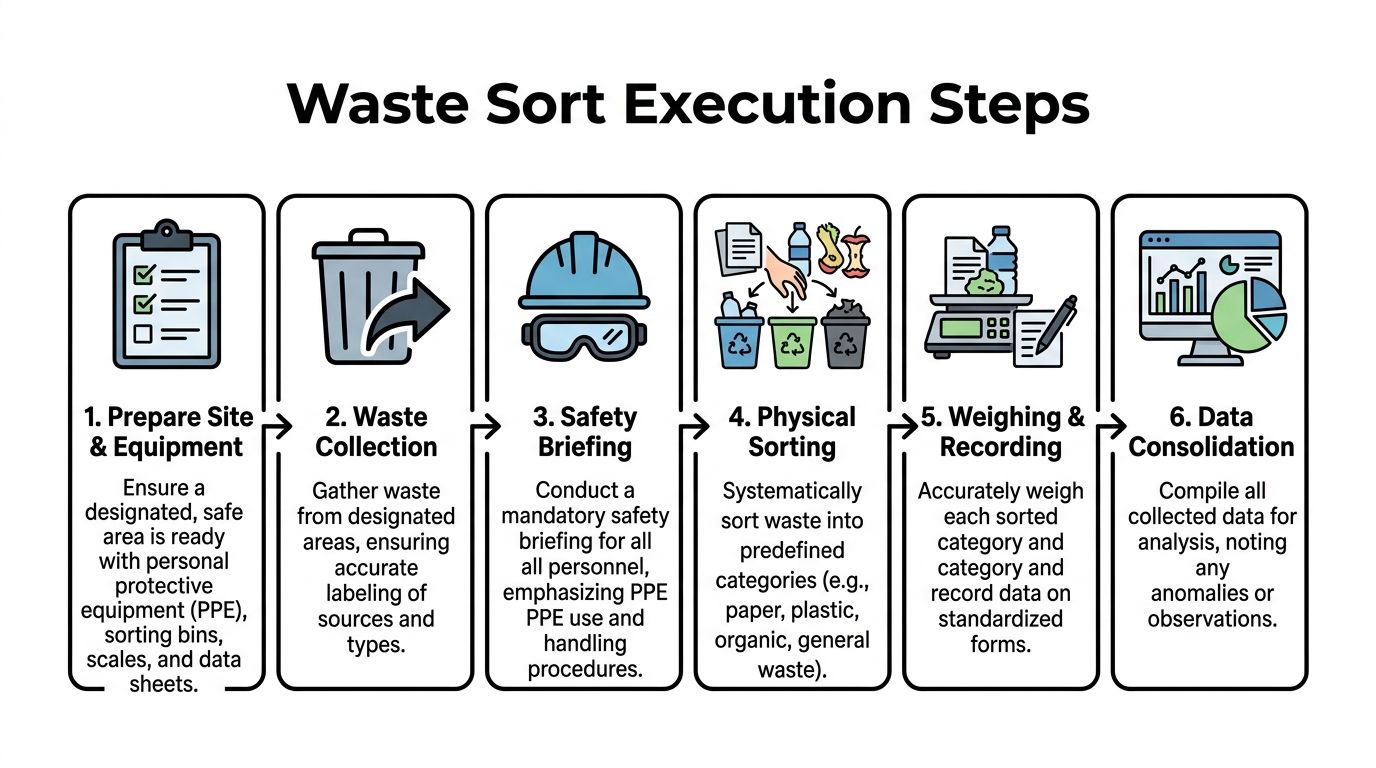
The physical sort is where many audits drift from useful to unreliable. Guesswork sneaks in fast. Someone eyeballs a bag and labels it “mostly paper.” Another person records partial weights on scrap paper. By the end of the day, everyone has worked hard and nobody has produced defensible data.
That's avoidable if the sort is run like a field operation.
Use representative samples, not convenience samples
The most important technical discipline is sample size. To achieve statistical accuracy, a waste stream analysis should physically sort samples of 200 to 300 pounds per waste category because that threshold reduces variance and provides a more reliable snapshot of the waste stream according to local government assessment guidance on waste sorts.
That matters because a light, convenient sample often overstates unusual items and understates routine material. A single bag from the break room doesn't represent the whole office. One pallet of electronics from a sudden cleanup doesn't represent normal IT asset flow. The sample has to reflect ordinary operations.
Set up the sort station like a controlled process
Use a designated area with enough room for incoming material, category bins, scales, PPE, and documentation. Tape lines on the floor if needed. Label categories in large print. Don't rely on verbal instructions once work begins.
A disciplined setup usually includes:
- PPE ready at entry: gloves, eye protection, and any site-specific protective gear
- Clearly marked containers: cardboard, mixed paper, film plastic, rigid plastic, metals, organics, landfill, and a separate stream for e-waste
- One calibrated scale: one source of truth beats multiple scales with different readings
- Data sheets or tablets: category, origin, date, handler, and notes on contamination
- Quarantine area: for batteries, drives, unknown devices, damaged electronics, and questionable items
If your team is preparing for a larger seasonal collection effort, guidance on how to prepare for summer e-waste collection events can help translate event logistics into cleaner audit execution.
Train for consistency, not speed
Fast sorting feels efficient, but consistency creates value. Two people must classify materials the same way or your categories become meaningless. That's especially important when electronics, small peripherals, cables, lab devices, and mixed metal-plastic products start appearing in the same load.
A short safety and classification briefing should cover:
- What belongs in each category. Use examples from your own site, not generic definitions only.
- How to handle unknowns. Stop and escalate. Don't improvise on regulated or data-bearing items.
- How weights are captured. Gross, tare, and net weights should be recorded the same way every time.
- What observations matter. Wet paper, food contamination, batteries in trash, and loose drives are operational findings, not side notes.
Field note: If a category keeps causing debate, your category list is too vague or your training happened too late.
Separate e-waste early
Don't let old desktops, switches, monitors, hard drives, badge readers, printers, or medical peripherals drift through the general sort. Once they're mixed with standard recyclables or trash, breakage and chain-of-custody issues increase.
For IT asset disposition work, I prefer a separate intake lane. Devices are tagged, counted, and visually screened before any decision about reuse, donation-based recycling, parts harvesting, computer recycling, or product destruction is made. That protects both value and accountability.
Analyzing Data and Calculating Key Sustainability KPIs
A finished sort gives you weights and observations. It does not give you insight automatically. The analysis step is where you decide whether the audit will support real decisions or just produce a slide for a sustainability meeting.
Build metrics that managers can act on
The strongest KPI set is short, repeatable, and tied to ownership. A facilities leader and an IT manager should both be able to look at the dashboard and know what they control next.
Useful measures often include:
- Overall diversion rate: the share of material moved away from disposal and into recycling, reuse, donation, or other approved recovery paths
- Contamination rate by stream: how often good recyclables are lost because the wrong material entered the bin
- Generation intensity: waste produced relative to occupancy, workflow, or operational footprint
- Special handling volume: e-waste, batteries, data-bearing devices, or regulated equipment requiring separate processing
- Recovery opportunity notes: assets or materials that were discarded even though a better path likely existed
A chart helps, but interpretation matters more. If cardboard is high, that may indicate a packaging issue or a healthy recovery stream. If landfill volume is high, the root cause could be poor signage, weak custodial separation, or procurement choices that leave staff with no recyclable option.
Reliability comes from method and records
Waste characterization analyses that incorporate standard deviation and 95% confidence intervals can achieve 90 to 95 percent reliability, and facilities that omit chain-of-custody records face a 60 percent higher probability of sample rejection by laboratories according to the Waste Characterization Handbook. That's the difference between a defensible audit and an expensive do-over.
For many companies, the lesson is simple. Don't separate data analysis from documentation discipline.
A practical review should ask:
| Checkpoint | What good looks like | Red flag |
|---|---|---|
| Category consistency | Same item classified the same way across sorters | Frequent re-labeling during review |
| Weight records | Clear gross and net entries | Rounded numbers with no notes |
| Source traceability | Each sample tied to origin and date | Mixed bags with no origin |
| Chain of custody | Logged movement for sensitive or lab-bound samples | Missing handoff records |
| Statistical review | Variability reviewed before conclusions | One sample used as final truth |
Turn the spreadsheet into an operating story
Executives rarely need every line item. They need the pattern. Show where value is being lost, where compliance risk sits, and where a process owner can take action within the next quarter.
For climate and reporting teams, related tools such as carbon offset calculation methods can help connect material handling decisions to broader sustainability reporting, but only if the underlying waste data is clean.
A weak audit usually fails for one of two reasons. The sample wasn't representative, or the records weren't trustworthy enough to survive scrutiny.
Use comments aggressively. If wet paper drove contamination, record it. If decommissioned equipment arrived without asset tags, record that too. Those observations often explain the numbers better than the numbers explain themselves.
Managing E-Waste and Secure Data Destruction
A cardboard problem is usually operational. An e-waste problem can become operational, environmental, legal, and reputational at the same time.
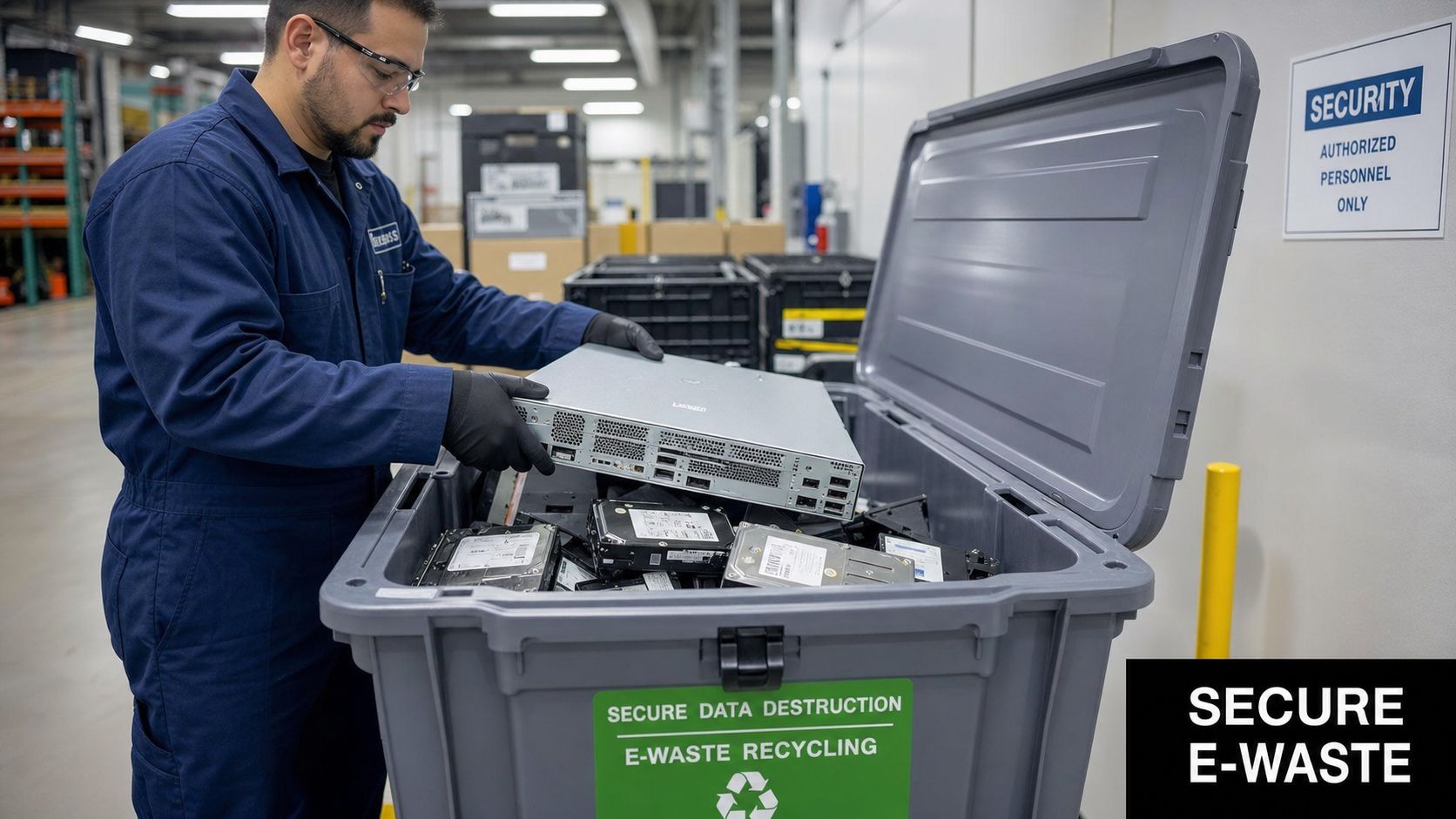
Why electronics need a separate path
The United States generates about 6.9 million tons of electronic waste annually, and only 15% of that e-waste in North America was formally collected and recycled as of 2019, meaning 85% ends up in unlicensed facilities or landfills according to e-waste facts compiled by SAMR Inc.. That single reality explains why standard recycling programs are not enough for technical assets.
Laptops, servers, networking gear, medical devices, phones, storage media, and lab electronics combine several risk factors:
- Sensitive data exposure on drives, embedded memory, or retained device settings
- Material handling concerns involving batteries, circuit boards, and other components that shouldn't enter ordinary waste channels
- Residual asset value that can be recovered through reuse, refurbishment, or responsible ITAD
- Documentation demands for internal policy, customer assurance, or regulated environments
What doesn't work
The worst approach is a casual “electronics corner” in a storage room. Equipment piles up, labels fall off, drives go missing, and nobody can answer basic questions about ownership, disposition path, or data-bearing status.
Another weak approach is mixing unlike assets in one batch. A stack of retired monitors has different handling needs than laptops. A pallet of servers from a data center decommissioning is different from miscellaneous desktop accessories after an office cleanout. Medical equipment disposal and laboratory equipment disposal add another layer because devices may require controlled handling before they can enter a recycling stream.
If you can't prove where a device went and how its data was handled, you don't have a disposal program. You have a risk pile.
What a defensible e-waste program looks like
A stronger operating model includes triage before movement:
- Identify the device class and whether the asset stores or may store data.
- Decide the path for reuse, refurbishment, donation-based recycling, parts recovery, product destruction, or materials recycling.
- Document custody from pickup through final disposition.
- Apply secure data destruction to data-bearing media before downstream release.
- Capture certificates and inventory records in a form audit, security, and procurement teams can all use.
For organizations that need a documented process, a specialist partner for secure data destruction services helps close the gap between sustainability goals and information-security requirements.
The practical point is simple. E-waste shouldn't be treated as a side stream after the main waste audit. It needs its own controls, its own decision tree, and its own accountability.
Turning Your Analysis into Action and ROI
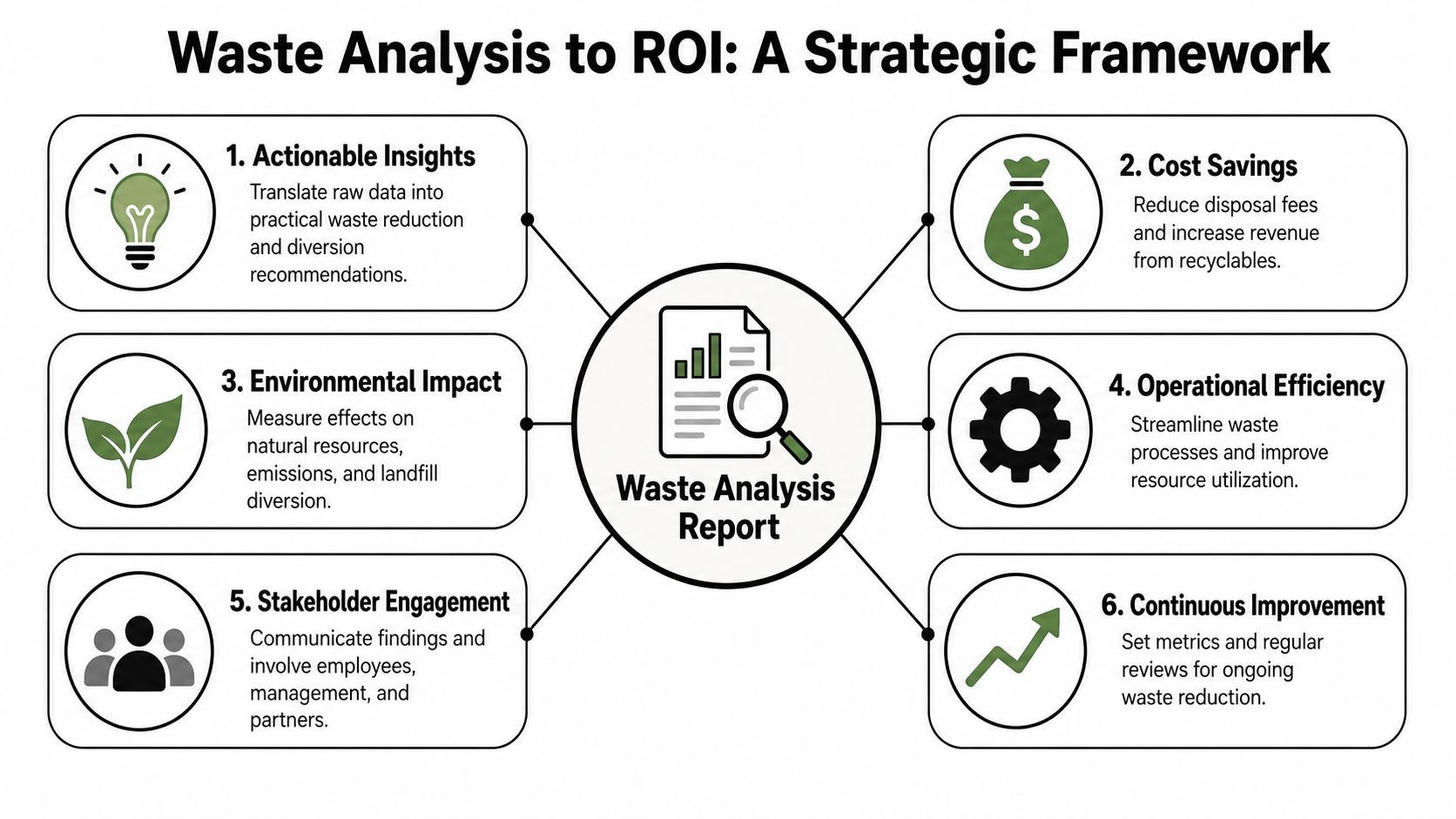
A waste audit earns its keep when it changes what the company does next. If it only confirms that bins are full, it's an expensive photo exercise.
The more useful approach is to treat the report as a forecasting tool. That's where waste stream analysis starts to influence procurement, asset lifecycle planning, storage strategy, and reverse logistics.
Move from hindsight to planning
Research on waste flow mapping highlights an emerging shift toward reverse logistics optimization, where companies use waste data to guide future purchasing and asset lifecycle decisions. The key question is how current IT asset disposition data can help predict the buyback value and reverse logistics costs of the next refresh, as discussed in research on reverse logistics and waste flow analysis.
That's a better strategic question than “how much did we throw away last quarter?”
If your audit shows repeated disposal of devices with some remaining service life, your next purchasing cycle may need fewer net-new units in certain roles. If transport costs spike because assets are stored in scattered locations and collected in small batches, your reverse logistics plan needs redesign. If product destruction is consuming items that could have moved through controlled recovery, the issue may be policy, not material condition.
Translate findings into operational plays
The best post-audit action plans are specific enough to assign to owners. They usually include a mix of quick fixes and structural changes.
Common moves include:
- Procurement resets: standardize equipment families, reduce hard-to-recycle packaging, and buy with end-of-life pathways in mind
- Bin and signage redesign: fix contamination where it starts, not after the fact
- ITAD timing changes: schedule refreshes and pickups before assets lose organization, traceability, or recovery potential
- Storage discipline: define how long retired assets can sit before they must move to disposition
- Vendor alignment: require documented downstream handling, clear service levels, and usable reporting
A team that wants to preserve more value from retired equipment should also think in terms of asset recovery solutions, because the financial side of end-of-life management improves when disposition is planned early rather than improvised late.
Treat ROI as financial and operational
Waste ROI isn't only about rebates or avoided disposal. It also shows up in labor time, floor space, reduced audit friction, cleaner reporting, lower risk in secure data destruction, and fewer emergency cleanouts before moves or refreshes.
Decision lens: Ask which recommendations reduce cost, which reduce risk, and which protect future recovery value. The strongest actions usually do at least two.
That's why mature programs connect facilities, IT, procurement, and sustainability instead of leaving each group to optimize its own corner.
Start Your Sustainable Disposal Journey Today
A serious waste stream analysis replaces assumptions with evidence. It shows where disposal costs are inflated, where process discipline breaks down, and where recoverable assets are being treated like trash. For facilities teams, that means better control over containers, contamination, and service design. For IT leaders, it means cleaner IT asset disposition, better laptop disposal practices, and less uncertainty around office cleanout or data center decommissioning projects.
It also sharpens logistics. Material movement is part of the economics, especially when bulky loads, dock constraints, or trailer selection affect pickup planning. If your operation handles high-volume loads, it helps to spend a few minutes understanding walking floor technology because trailer choice can change how efficiently certain material streams move off site.
The most practical next step is to pick one priority stream and audit it properly. For many organizations, that stream is electronics. It carries more risk than ordinary recyclables and often more recoverable value too. A disciplined program for electronics recycling, secure data destruction, and donation-based recycling doesn't just keep material out of the wrong places. It supports digital inclusion, community benefit, and stronger internal governance around end-of-life assets.
If your business is ready to retire aging devices, plan an office or facility cleanout, or build a smarter IT asset disposition program, Reworx Recycling can help you donate old equipment, schedule a pickup, and recycle responsibly through a social enterprise model that supports communities through technology donations, digital inclusion, and workforce development.