Mercer Group International Inc. in Trenton, New Jersey is a local construction and demolition recycling facility operating since 1997, not an electronics recycler or IT asset disposition specialist. It is also separate from Mercer International Inc., the global forest-products company with a $218M market cap, and that distinction matters if your business needs secure handling of retired IT equipment.
That's the surprising part. A search for one company name can point buyers toward two entirely different businesses in two different industries, neither of which should be mistaken for a specialized electronics recycling and data-destruction partner. For business owners, IT managers, and sustainability leaders, this isn't a minor naming issue. It's a due diligence problem that can send sensitive devices, compliance obligations, and vendor onboarding down the wrong path.
The confusion around Mercer Group International Inc. is useful because it reveals a broader truth about waste and recycling procurement. Vendor names often sound credible. Directory listings look authoritative until they conflict. Public search results can blur local operators, private companies, and public corporations into a single result set that hides the service differences that matter.
If your goal is electronics recycling, computer recycling, data center decommissioning, medical equipment disposal, secure data destruction, or broader IT asset disposition (ITAD), you need more than a recognizable name. You need clear evidence of scope, custody, data handling, and downstream processing. That's where a disciplined vetting framework becomes more valuable than brand familiarity.
The Mercer Mix-Up Your Business Must Understand
The core issue is simple. Mercer Group International Inc. in Trenton is not the same company as Mercer International Inc. (NASDAQ: MERC), and online results often fail to make that clear. Public references indicate that the main underserved issue is the ambiguity around the correct legal entity, with many high-volume search results sending users toward the public forest-products company instead of the local Trenton construction and demolition facility, creating friction for businesses trying to find the right waste partner (entity confusion outlined here).
Why this confusion matters in procurement
A naming mix-up can cause practical problems fast:
- Wrong service assumption means a buyer may assume a recycler handles laptops, servers, drives, or network gear when its actual specialty is unrelated.
- Wrong compliance assumption can lead teams to believe that disposal and destruction standards are covered when no electronics-specific workflow was ever confirmed.
- Wrong escalation path slows vendor approval because legal, facilities, IT, and sustainability teams end up evaluating the wrong entity.
For procurement teams, the Mercer example is a reminder that business classification matters more than search visibility. A construction debris processor, a transfer station, a pulp manufacturer, and an ITAD provider may all appear under broad recycling-related searches. Their compliance responsibilities are not interchangeable.
Practical rule: If a vendor's name is ambiguous, verify the exact legal entity, physical location, and waste stream specialization before discussing pickups, destruction certificates, or reuse programs.
The due diligence lesson hidden in the name
The fastest way to avoid this type of error is to test a vendor against the asset class you're retiring. Construction debris and end-of-life electronics trigger different handling expectations, different downstream partners, and different business risks. That's why procurement teams evaluating old laptops, servers, mobile devices, lab hardware, or office electronics should start with an ITAD-specific review standard, not with a general recycling search. A useful starting point is this explainer on what IT asset disposition involves.
The Mercer confusion isn't just about naming. It shows how easily an organization can approve a vendor that sounds relevant but doesn't suit the job.
Profiling Mercer Group International of New Jersey
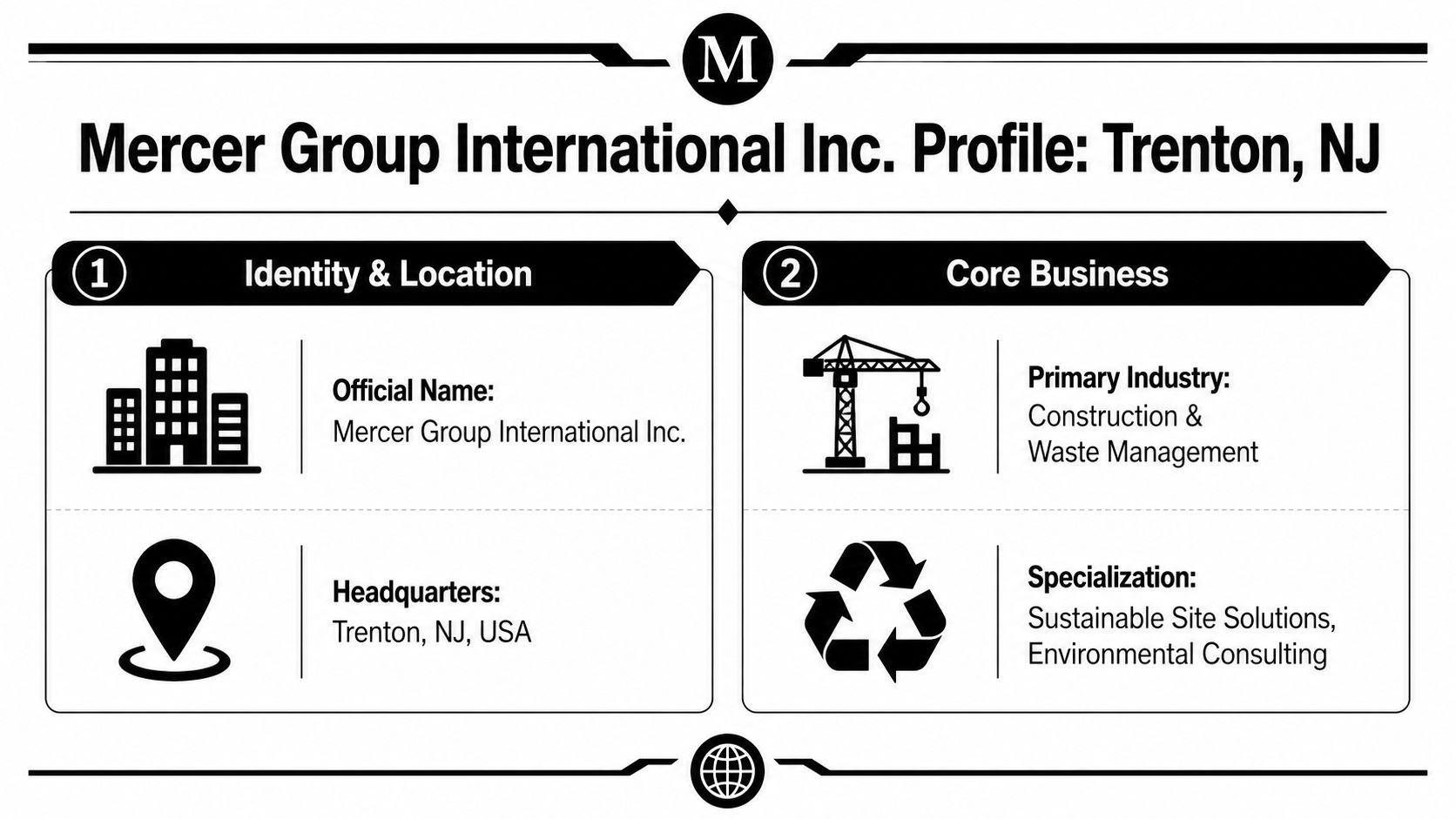
The verified profile of Mercer Group International Inc. points to a specific and narrow role in the waste ecosystem. According to the company's about page, it is a family-owned and operated Construction & Demolition Materials Recovery Facility and Transfer Station in Trenton, New Jersey, and it has operated since 1997, specializing in diverting construction and demolition debris from landfills, not electronics (company background).
What a C&D materials recovery facility actually does
A C&D MRF is built for construction and demolition streams. In practice, that means receiving mixed loads tied to building activity and separating recoverable materials such as concrete, wood, metal, and asphalt from residual waste. A transfer station function adds another role: staging and routing material to the next approved destination.
That operational profile tells you what Mercer Group International of New Jersey is designed to handle well. It also tells you what it is not designed to be.
| Business question | Evidence-based answer |
|---|---|
| Does it focus on construction debris? | Yes, that is its stated specialty |
| Does it operate as an electronics recycler? | No verified evidence supports that |
| Is it positioned as an ITAD provider? | No verified evidence supports that |
| Is secure device data destruction part of the stated profile? | No verified evidence supports that |
Why that removes it from most IT retirement projects
For a facilities team managing debris from renovation, demolition, or site cleanup, a C&D operator may be the right fit. For an IT department retiring endpoints, storage media, racks, or networking hardware, the fit changes completely. Electronics recycling requires controls around asset identification, chain of custody, data-bearing media, and downstream processing that aren't established by virtue of a company recovering material from landfill streams.
That distinction becomes even more important when buyers are working across regions. New Jersey construction waste handling and Georgia electronics compliance aren't the same procurement category. If your team is comparing providers for retired technology in the Northeast, a more relevant reference point is a vendor-specific ITAD standard such as this page on IT asset disposition in Newark, New Jersey.
A company can be legitimate in waste management and still be the wrong choice for electronics, drives, or regulated data-bearing assets.
The biggest mistake buyers make here is assuming that “recycling company” is a single service category. It isn't. Mercer Group International of New Jersey appears to be a real C&D operation. That still doesn't make it an electronics recycling or secure destruction partner.
The Other Mercer Mercer International Inc (MERC)
The second source of confusion is the public company with the similar name. Mercer International Inc. (NASDAQ: MERC) is not the Trenton waste operator. It is a global forest products firm with a $218M market cap, generating revenue from pulp and wood products across the US, Germany, and China, with no operations in electronics recycling (company profile).
Why the public-company search result is misleading
Buyers often trust public-market visibility. A listed company feels easier to validate because financial sites, stock tickers, and investor pages are easy to find. But that convenience can distort procurement decisions when the public entity has nothing to do with the service being sourced.
Mercer International Inc. is relevant to buyers of forest products and industrial materials. It is not relevant to organizations seeking:
- Laptop disposal
- Office cleanout for electronics
- Secure hard drive destruction
- Facility cleanout involving IT hardware
- Laboratory equipment disposal with data-bearing components
- Product destruction for retired electronics
A simple comparison prevents a costly misunderstanding
| Entity | Industry | Geography in evidence | Electronics recycling role |
|---|---|---|---|
| Mercer Group International Inc. | Construction and demolition recycling | Trenton, New Jersey | Not established |
| Mercer International Inc. | Forest products | US, Germany, China | None stated |
Sharper due diligence is essential. The local Mercer appears tied to construction debris recovery. The public Mercer is a forest-products manufacturer. Neither profile supports the assumption that either company is an ITAD specialist.
That matters because many businesses aren't just disposing of scrap. They're retiring devices that contain contracts, employee data, financial records, research files, patient information, or customer communications. When the asset itself carries legal and reputational exposure, “recycling” is too broad a label to guide vendor selection.
Why The Wrong Partner Creates Business Risk
A mismatch between asset type and vendor capability creates risk long before anything leaves your loading dock. If a provider isn't built for electronics recycling or secure media handling, your organization may lose control over both data and documentation.
Risk starts with asset custody
The first failure point is usually ordinary. Equipment gets boxed without serial-level tracking. Drives aren't separated from non-data-bearing peripherals. Pickup staff sign a generic receipt instead of a detailed manifest. Once that happens, the business loses visibility into what was collected, where it went, and how it was processed.
For IT teams, that's not an administrative detail. It's the foundation of defensible disposal.
- Data exposure risk rises when hard drives, SSDs, and embedded storage aren't handled under a documented destruction process.
- Compliance risk rises when records don't show what was removed, who handled it, and what final disposition occurred.
- Environmental risk rises when e-waste enters channels that weren't designed for regulated or hazardous electronic components.
Business continuity also depends on disposal planning
Technology retirement affects continuity more than many teams expect. Server removals, branch closures, relocations, and office consolidations all create disposal events that touch security, operations, and facilities at once. That's why disposal planning belongs inside broader continuity planning. For a useful outside perspective on operational resilience, this guide to BCP for Edmonton businesses is worth reviewing.
If a vendor can't explain the chain of custody for a retired server, it can't support a defensible IT exit process.
Risk management has to be documented
A competent review should ask for evidence, not assurances. That means pickup procedures, media handling steps, destruction documentation, insurance, and escalation protocols. Organizations that want a stronger internal process can also benchmark against a structured approach to risk management best practices.
The Mercer naming issue becomes risky when buyers stop at surface validation. A business might verify that a company exists and still fail to verify that it handles the right waste stream, under the right controls, with the right documentation. That gap is where avoidable incidents happen.
Anatomy of a Responsible ITAD Partner
A credible IT asset disposition partner should look materially different from a general recycler. The core test is whether the vendor can protect data, document custody, and route equipment toward responsible reuse or recycling without leaving gray areas.
Start with data destruction, not recycling
In Georgia, ITAD providers are expected to perform secure data destruction, specifically hard drive shredding or certified wiping, before recycling to protect sensitive information. That requirement should change the order of operations in your evaluation. The first question isn't “Do you recycle?” It's “How do you make the data unrecoverable, and what proof do you issue?”
A responsible provider should be able to explain:
- When wiping is used and on which devices
- When shredding is required for failed, encrypted, or policy-restricted media
- What documentation is produced after destruction
- How custody is maintained from pickup through final processing
Responsible ITAD also means operational discipline
The strongest providers don't treat retired equipment as a generic waste stream. They treat it as an inventory control and security process. That includes serialized intake, segregation of data-bearing assets, and a clear decision tree for reuse, donation, resale, or destruction.
That same mindset appears in adjacent operations work. Companies trying to tighten internal controls often look at frameworks designed to reduce inventory costs and optimize stock. The principle carries over well. You can't control retired IT if you don't know exactly what you have, where it is, and what happens next.
The social impact question belongs in vendor review
Not every device should be shredded into commodity output. For many organizations, the best environmental and community outcome comes from maximizing reuse first, then recycling the remainder through compliant downstream channels. That's especially relevant for companies building corporate donation programs, social enterprise recycling partnerships, or broader sustainable recycling initiatives.
Decision test: A mature ITAD partner should be able to explain both the security case for destruction and the business case for reuse.
A good vendor review framework should also examine how the provider communicates these choices to clients. The useful benchmark isn't a polished sales deck. It's whether the vendor has transparent vendor selection criteria that make security, compliance, environmental handling, and accountability easy to verify.
Your Vendor Evaluation Checklist
The easiest way to avoid the Mercer-type confusion is to stop evaluating names and start evaluating controls. A serious vendor checklist should force specificity.
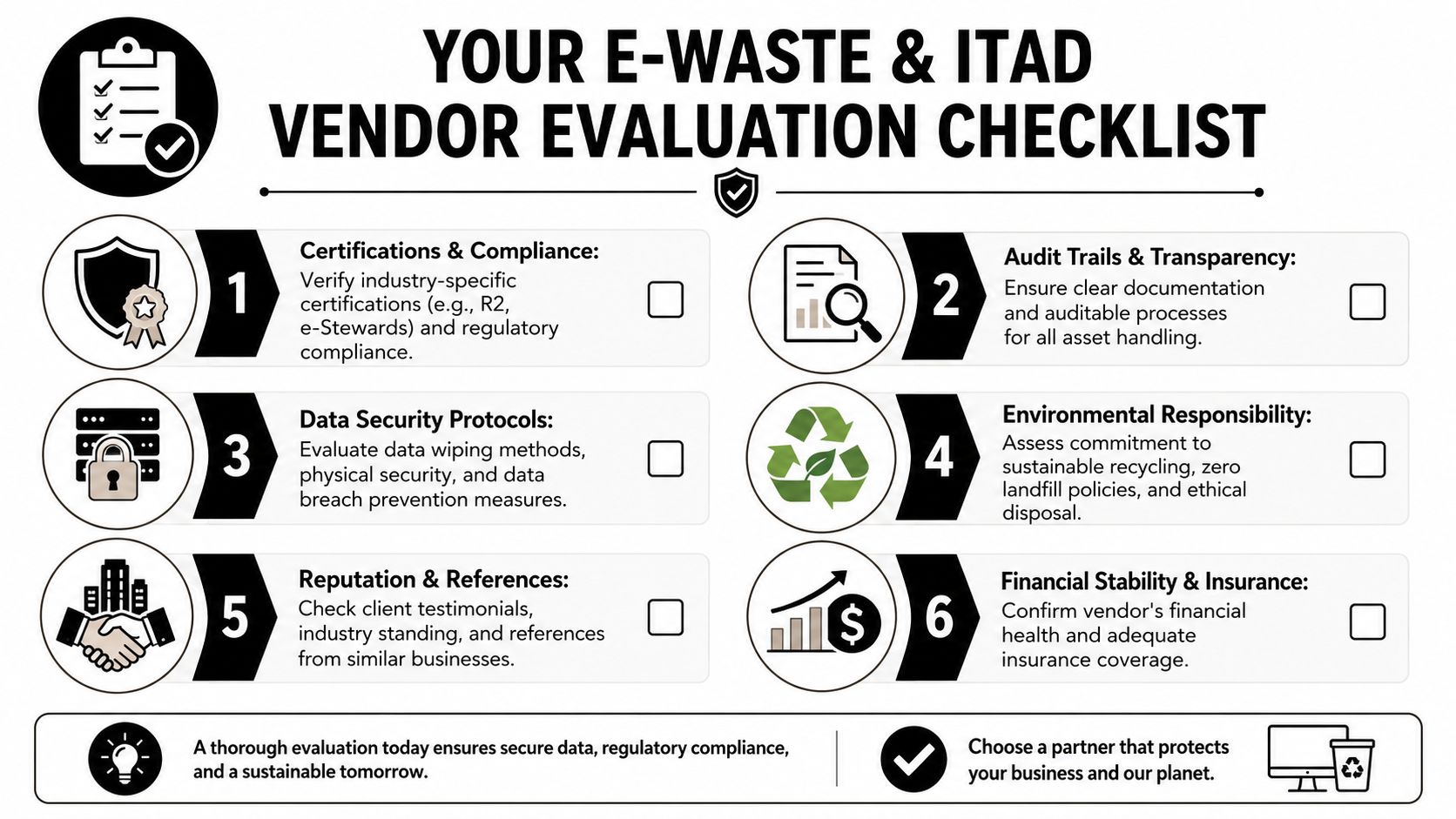
Six questions that uncover the real answer
What exact waste stream do you specialize in?
Ask the vendor to define its core business in plain terms. Construction debris, municipal solid waste, electronics recycling, and ITAD are not interchangeable categories.How do you document chain of custody?
In Georgia, electronics recyclers must follow Georgia EPD expectations that include secure chain-of-custody documentation and EPA-aligned handling protocols for e-waste (Georgia e-waste compliance context). If a vendor can't produce a documented intake and transfer process, stop there.What is your media destruction method?
Ask whether the vendor provides certified wiping, hard drive shredding, or both. Then ask which method applies to laptops, servers, arrays, copiers, and devices with embedded storage.Can you support pickup events tied to moves and consolidations?
Office relocations, closures, and facility cleanouts often compress disposal timelines. In other service industries, companies reduce risk by insisting on providers that are both accountable and operationally documented, much like businesses do when selecting licensed and insured movers. The same logic applies here.
What the answers should look like
A strong response should be direct, auditable, and boring in the best way. You want process language, not marketing language.
- Good sign: The vendor describes manifests, serialized asset logging, and documented final disposition.
- Bad sign: The vendor says it “handles all recycling” but can't explain data-bearing media controls.
- Good sign: The vendor distinguishes between reuse, donation-based recycling, commodity recovery, and destruction.
- Bad sign: The vendor treats all materials as one mixed load.
Keep the checklist in writing
This step is often skipped, and it shouldn't be. Procurement, legal, IT, and facilities teams need a shared standard so they don't each ask different questions and approve the vendor from different angles. A written review tool also helps when evaluating office cleanout, facility cleanout, computer recycling, product destruction, or medical equipment disposal vendors under time pressure.
For teams formalizing that process, this compliance checklist template is a practical way to standardize review and compare vendors consistently.
Frequently Asked Questions
Is Mercer Group International Inc. an electronics recycling company?
Based on the verified public information cited earlier, no. The New Jersey company is identified as a construction and demolition materials recovery facility and transfer station with a focus on C&D debris rather than electronics.
Is Mercer International Inc. related to the Trenton company?
The evidence supports treating them as separate entities. The public company operates in forest products and has no stated role in electronics recycling, while the Trenton business is a local waste operator in the C&D category.
Why do search results make this so hard to sort out?
Because similar company names, broad use of the word “recycling,” and uneven directory data create a false sense of relevance. A search engine may show a public corporation, a local private operator, and stale business listings side by side even when their services have nothing in common.
If I need laptop disposal or secure hard drive shredding, what should I ask first?
Ask for the vendor's exact process for chain of custody, media destruction, and final disposition documentation. If the answer stays high level or shifts into general recycling language, the provider may not be equipped for ITAD work.
The safest first question is not “What do you recycle?” It's “How do you control data-bearing assets from pickup to final disposition?”
Are all electronics accepted without cost?
Not always. In Georgia, some items such as TVs, copiers, and CRT monitors typically carry fees because of specialized processing needs, while standard eligible items like laptops, office computers, and servers may be handled at no cost under donation-based recycling models (item-specific fee context). That's why businesses should confirm acceptance terms item by item before a pickup or drop-off.
What should a business look for in a regional electronics recycling partner?
Look for a provider that can support electronics recycling, IT equipment disposal, data center decommissioning, laboratory equipment disposal, secure data destruction, and documented IT asset disposition workflows. If the business also values community benefit, ask whether the vendor supports technology donations, digital inclusion, and reuse pathways that extend equipment life where appropriate.
Does local market demand matter when selecting a provider?
It does, especially for scheduling and service availability. For example, Smyrna, Georgia has 55,663 residents and 8 verified electronics recycling centers that accept devices such as computers, phones, and TVs, which shows there is established local demand for recycling services in that market (local recycling market snapshot). But availability alone doesn't prove that a vendor is a fit for business-grade ITAD. You still need to vet controls.
If your organization needs a dependable partner for electronics recycling, donation-based recycling, IT equipment disposal, computer recycling, data center decommissioning, medical equipment disposal, laptop disposal, office cleanout, facility cleanout, laboratory equipment disposal, product destruction, secure data destruction, or broader IT asset disposition, explore Reworx Recycling. Businesses can donate old equipment, schedule a pickup, or build a responsible recycling partnership that supports environmental goals, community technology access, digital inclusion, and workforce development.