Metro Atlanta became the nation's hottest data center market in 2023, doubling data center space under construction every six months since mid-2023 and climbing from sixth to second nationally, behind only Northern Virginia (GovTech). That single shift changes how construction firms in Atlanta compete.
Projects now carry tighter schedules, denser MEP coordination, more digital oversight, and higher owner expectations around documentation, uptime, and sustainability. On many Atlanta jobs, construction technology is no longer a nice add-on. It's becoming part of the operating baseline.
That creates a second challenge most firms still underweight. Every rugged tablet, drone, sensor, BIM workstation, temporary server, and networked trailer office eventually becomes a digital asset that has to be tracked, secured, retired, and recycled responsibly. The firms that treat innovation as a full lifecycle discipline will get more value from it than firms that only focus on procurement and deployment.
Atlanta's Tech-Fueled Construction Boom
Georgia's tax policy has helped pull more digital infrastructure work into the state. The Georgia Department of Revenue outlines a sales and use tax exemption for certain high-investment data center equipment, a policy that has supported the flow of capital into facilities that demand tighter coordination, denser MEP systems, and stronger documentation standards (Georgia data center tax exemption guidance).
Metro Atlanta is feeling that shift across a broader project mix. Data centers, logistics facilities, advanced interiors, and infrastructure tied to digital operations all ask more from design teams, GCs, specialty trades, and owner reps than a conventional commercial build.
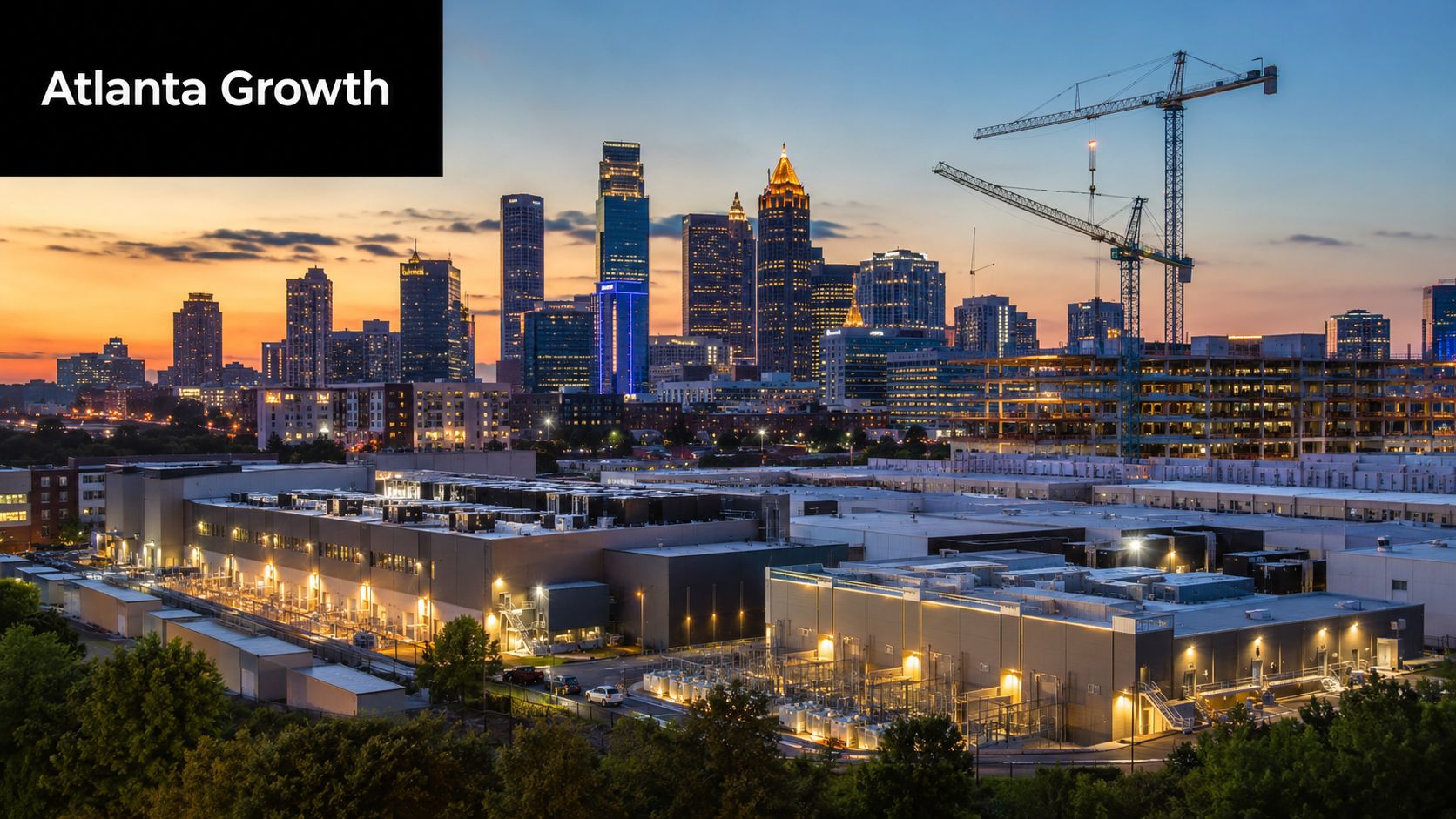
Why this boom changes field operations
On these jobs, old workflows fail early. Paper logs, disconnected spreadsheets, and manual handoffs create lag at the exact point owners and project teams need faster decisions, cleaner model control, and tighter issue tracking.
The operational pressure is obvious on the ground. More coordination meetings happen inside shared models. More closeout data is captured in platforms instead of binders. More field decisions depend on tablets, scanners, drones, mobile hotspots, smart sensors, and trailer networks staying online and assigned to the right people.
That expansion matters for another reason. Every new device added to support delivery also creates digital exhaust. Firms that want a broader view of that infrastructure shift should review Atlanta's digital economy growth and rising IT demand.
Practical rule: If a project requires more connected tools, the risk register also needs device inventory, access control, data retention, and end-of-life disposition.
What many firms still miss
A lot of coverage on Atlanta construction tech trends stops at adoption. It focuses on drones, AI-assisted planning, BIM coordination, and connected job sites.
The harder part starts after deployment. Devices break. Software changes. Temporary hardware gets reassigned without clean records. Storage media can still hold drawings, submittals, payroll data, access credentials, and owner information long after project closeout.
That is where firms lose part of the return on their tech spend. A tablet that disappears from inventory is a cost problem. A server or drive retired without proper data destruction is a security problem. A stack of outdated field devices sent to the wrong recycler becomes a compliance and sustainability problem.
The Atlanta firms getting this right treat construction technology as a lifecycle management issue, not just a procurement decision.
Why Atlanta Construction is Going Digital
McKinsey reports that large construction projects typically run about 20% longer than scheduled and up to 80% over budget (McKinsey on the construction productivity challenge). In Atlanta, where crews are working through dense schedules, complex trades, and owner pressure for cleaner reporting, those gaps push firms toward digital systems that reduce field friction and tighten decision cycles.
The driver is operational control. Firms are using software, connected equipment, and mobile workflows to shorten handoff time, improve documentation, and make fewer decisions from stale information. On fast-track work, that can mean the difference between a manageable closeout and weeks of rework, missing records, and disputed changes.
Capital markets are reinforcing that shift. JLL notes that construction technology has continued to attract investor attention as contractors and owners look for tools that improve productivity, visibility, and risk control (JLL on construction technology investment trends). Atlanta firms do not need to chase every funded category. They do need to recognize that clients, lenders, and delivery partners are getting used to digital reporting, model-based coordination, and connected jobsite operations.
Four pressures show up repeatedly in Atlanta projects:
- Labor constraints: Smaller or less experienced crews need systems that reduce duplicate entry, missed updates, and supervisor guesswork.
- Schedule compression: Data center, multifamily, healthcare, and infrastructure work all reward faster approvals and tighter trade coordination.
- Owner expectations: Clients want current progress data, photo documentation, and records that stand up after turnover.
- Sustainability and compliance: Firms are being asked to document waste, material choices, and operational practices with more precision.
There is a less discussed cost behind that shift. Every tablet, drone controller, access point, mobile workstation, and smart trailer system creates digital exhaust. Devices hold drawings, punch data, payroll records, access credentials, and owner information. If a firm buys the technology but does not control assignment, redeployment, retention, and retirement, part of the ROI leaks out through replacement cost, security exposure, and poor closeout discipline.
That is why the stronger operators treat digitization as both a production decision and an asset management decision. A connected field stack also depends on reliable local processing, temporary networks, and edge hardware. Firms assessing that footprint should review edge computing trends affecting Atlanta business infrastructure.
Integration matters too. Telematics, equipment health, and fleet workflows only produce usable value when systems can exchange clean data. For firms evaluating connected assets across jobsites, an open API for smart fleet integration can reduce manual reconciliation between field operations and back-office systems.
The Atlanta contractors getting better results are usually disciplined, not experimental for its own sake. They standardize a smaller set of tools, assign ownership, train for actual field use, and plan for what happens to the hardware and data after the project ends.
The Core Technologies Redefining the Job Site
Contractors do not get paid for owning software. They get paid for building faster, with fewer mistakes, tighter cost control, and cleaner turnover. The technologies earning their keep on Atlanta jobsites are the ones that improve execution and produce reliable records, while also adding hardware, data, and retirement obligations that firms need to plan for.
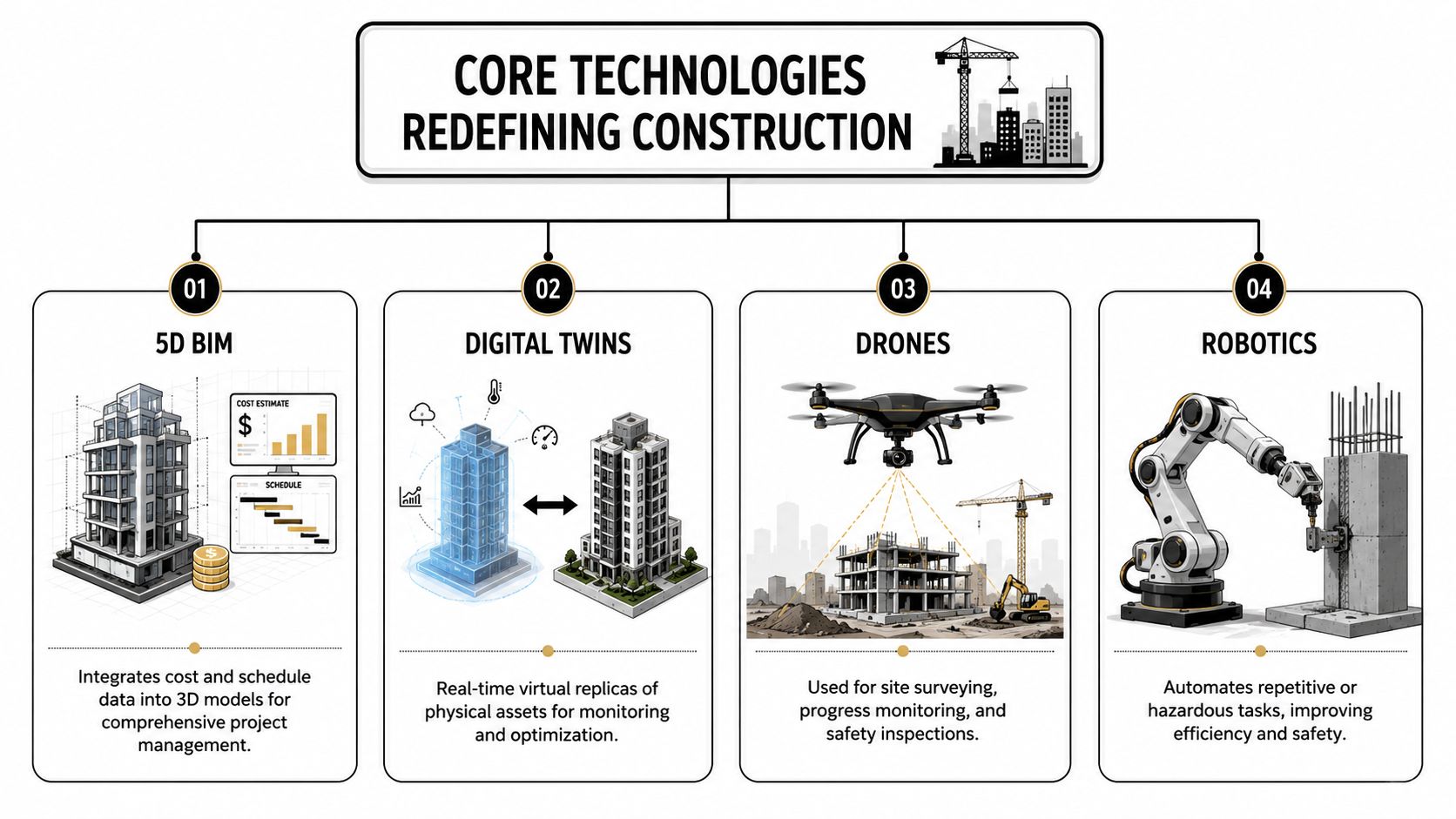
5D BIM as a decision system
5D Building Information Modeling adds schedule and cost data to the model. Intuit explains that firms use it to connect design, sequencing, and budget control in a live working environment rather than a static design package (Intuit on 5D BIM).
On Atlanta projects, that matters when procurement timing shifts, subcontractor coordination tightens, or owner changes start affecting both schedule and buyout. A current 5D model helps teams test scenarios before they become field delays. It also creates a large digital record set. If model versions, estimating files, and field-linked devices are not controlled, the same system that improves visibility can create confusion at closeout and unnecessary risk during device retirement.
Drones and robotics in daily use
Drones are now a standard field tool on many projects. PlanRadar reports that they are used in 46% of all construction projects, largely because they help teams collect information in places that are difficult or unsafe to access (PlanRadar survey summary).
That use case fits Atlanta well. High-rise façade checks, roof documentation, bridge reviews, and site logistics verification all benefit from faster visual capture. The trade-off is operational discipline. Flight logs, image storage, chain of custody, and user access need the same attention as the flight itself, especially when imagery captures neighboring properties, security layouts, or protected project data.
Robotics is more selective. It performs best where work is repetitive, safety exposure is high, and site conditions stay predictable. It loses value on jobs with frequent layout changes, inconsistent inputs, or weak operator training.
Digital twins and connected operations
A digital twin gives the project team and, in some cases, the owner a live reference point built from model data, field capture, equipment status, and operating conditions. For complex facilities, that can improve commissioning, turnover quality, and post-handover maintenance planning.
Interoperability determines whether that promise holds up in practice. Connected vehicles, equipment, sensors, and handheld devices all generate data that has to move between systems cleanly enough to support operations. If your team is integrating those systems, an open API for smart fleet integration can help connect telematics and asset data into a broader operations workflow.
The infrastructure behind those tools matters too. Stable connectivity, temporary site networks, and managed field hardware often decide whether a digital workflow works reliably or becomes another workaround. Firms expanding connected jobsites should treat telecom network installation in Atlanta as part of the production plan, not an IT afterthought.
3D printing and advanced materials
3D printing is still early for most commercial contractors, but the direction is clear. Industry analysts at Grand View Research expect continued expansion in construction 3D printing as firms test faster fabrication methods, labor-saving approaches, and more controlled material use (Grand View Research on the construction 3D printing market).
For Atlanta firms, the decision should stay grounded in field reality. Material performance in heat and humidity, inspection acceptance, crew readiness, and procurement support matter more than headline growth projections. The same applies to advanced materials. A promising product on paper can create delays if installers are unfamiliar with it or if replacement stock is hard to source locally.
A simple decision lens
| Technology | Works best when | Usually disappoints when |
|---|---|---|
| 5D BIM | The model stays current and ties directly to cost and schedule workflows | Teams use the model as a design archive only |
| Drones | You need fast visual capture, surveys, or safer inspections | No one owns flight planning, file handling, or reporting |
| Digital twins | Owner turnover and operational visibility matter | Data feeds are inconsistent and standards are unclear |
| Robotics | Tasks are repetitive and site conditions are controlled | The work environment changes faster than the system can adapt |
| 3D printing | The scope is controlled and materials, approvals, and crews are aligned | The method is adopted for novelty without field support |
The firms getting the best return from these tools are usually disciplined about selection, ownership, and end-of-life planning. On a modern jobsite, every scanner, tablet, drone, sensor, and controller improves visibility while also creating digital exhaust that has to be secured, tracked, redeployed, or retired properly.
Navigating Atlanta's Unique Adoption Challenges
Buying software and hardware is the easy part. Operational adoption is where Atlanta firms either build an edge or absorb expensive frustration.
The workforce gap is real
PwC's Atlanta-focused framing is the most useful reality check. Only 12% of Atlanta construction firms have formal reskilling programs for ConTech tools, while the city's labor shortage sits at 18% unfilled construction roles in 2025 (PwC construction trends).
That combination explains why some tech rollouts stall. Firms introduce BIM workflows, drones, robotics, or digital QA tools, but field teams haven't been trained to use them consistently. The result isn't just low adoption. It's duplicated effort, workarounds, and distrust of the system.
Technology without operator readiness doesn't create efficiency. It creates another layer of coordination work.
Atlanta's climate complicates certain innovations
Humidity and storm exposure matter more in Atlanta than many generic trend reports admit. Moisture-sensitive materials and field electronics don't behave the same way in Atlanta summer conditions as they do in controlled demos or drier markets.
That doesn't mean firms should avoid innovation. It means they should qualify it against local conditions before scaling. Mockups, storage controls, field protection, and realistic maintenance assumptions matter.
A similar lesson applies to energy and site support planning. Construction leaders evaluating temporary power, fuel continuity, or support infrastructure can use regional vendors as reference points. For example, Georgia gas solutions is relevant when teams are planning practical site energy logistics in the state.
What tends to work in practice
- Pilot on one project type: Test tools on a repeatable project environment before broad rollout.
- Train supervisors first: Foremen, superintendents, and PMs determine whether field adoption sticks.
- Define one owner per system: Shared ownership usually means no ownership.
- Set climate-specific protocols: Storage, charging, maintenance, and material handling should reflect Atlanta conditions.
The biggest mistake is assuming purchase equals implementation. It doesn't. The firms seeing durable results build process, accountability, and training around the tool from day one.
The Unseen Lifecycle of Your Digital Construction Assets
Most firms budget for acquisition. Fewer budget for retirement. That's a blind spot.
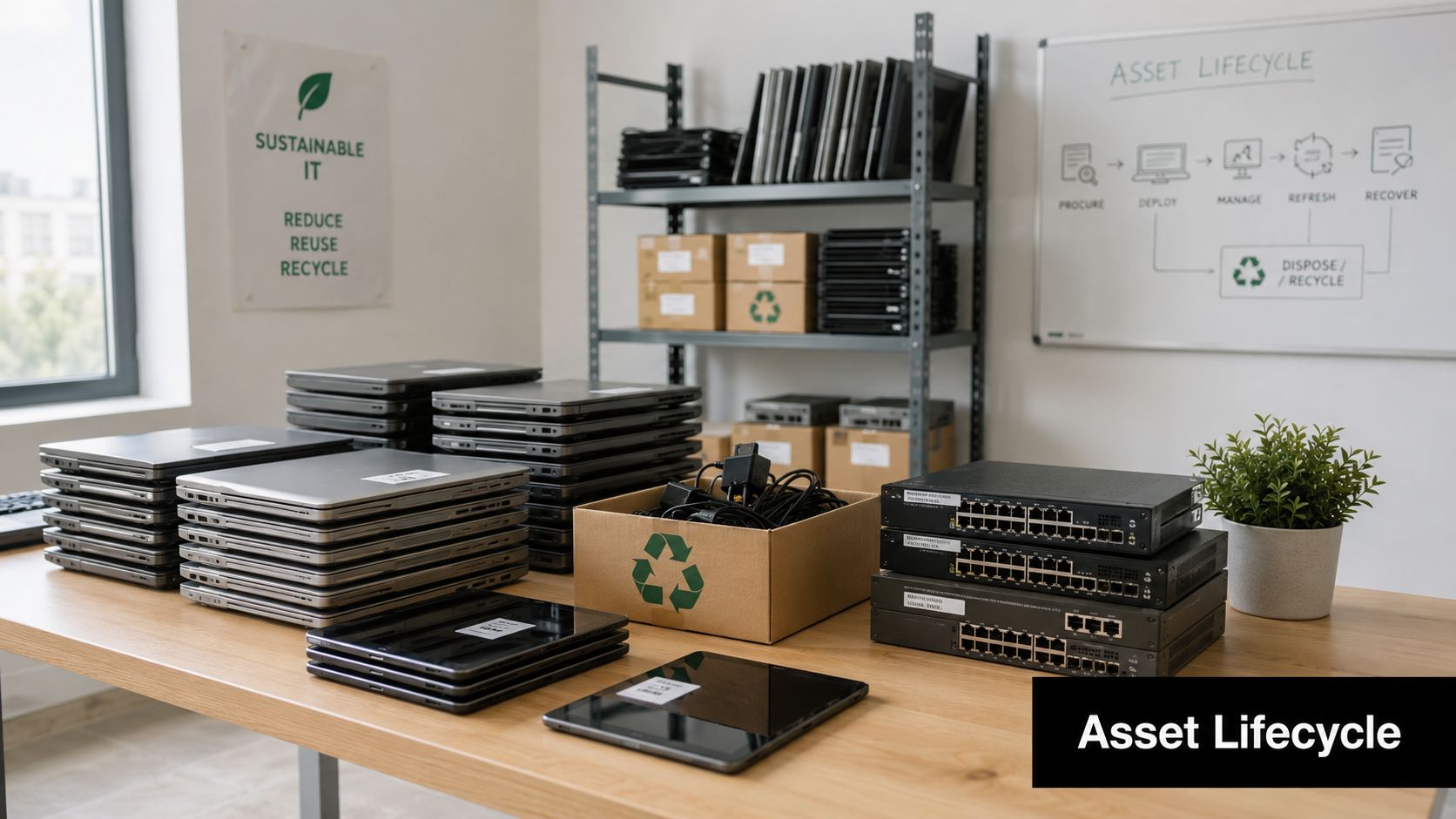
A modern construction company may deploy tablets in trailers, drones in the field, networking gear in temporary offices, sensors on active sites, and workstation upgrades for VDC teams. Those assets hold business value while they're active, but they create risk the moment they become surplus, damaged, obsolete, or untracked.
Where firms get exposed
The first risk is data security. A decommissioned laptop may still hold bid files, payroll data, building models, site imagery, or client communications. The second is environmental handling. Electronics can't be treated like standard jobsite waste. The third is asset value loss. If nobody inventories and triages equipment, reusable devices often end up sitting in closets until they're worthless.
That's why digital asset management has to extend past deployment. Procurement, assignment, maintenance, redeployment, and disposition all belong in the same chain.
Construction creates unusual device sprawl
Construction firms rarely have the clean asset environment of a centralized office-only business. Equipment moves between trailers, warehouses, project teams, vehicles, and remote staff. Some devices are shared. Some are temporary. Some are assigned informally.
That sprawl creates “digital exhaust.” Old phones, failed switches, retired access points, rugged tablets with cracked screens, and storage media from temporary site setups all accumulate. Without controls, the business loses visibility long before the device leaves the building.
A useful framework for that full process appears in the lifecycle of IT equipment from acquisition to recycling.
If you can't say where a retired device is, who last used it, and how its data will be destroyed, you don't have an end-of-life process. You have a liability.
Partnering for Responsible IT Asset Disposition
Construction firms need an IT asset disposition strategy, not just an occasional cleanup day. The objective is simple. Retire equipment in a way that protects data, supports compliance, recovers remaining value when possible, and keeps material out of landfill streams when reuse or recycling is the better path.
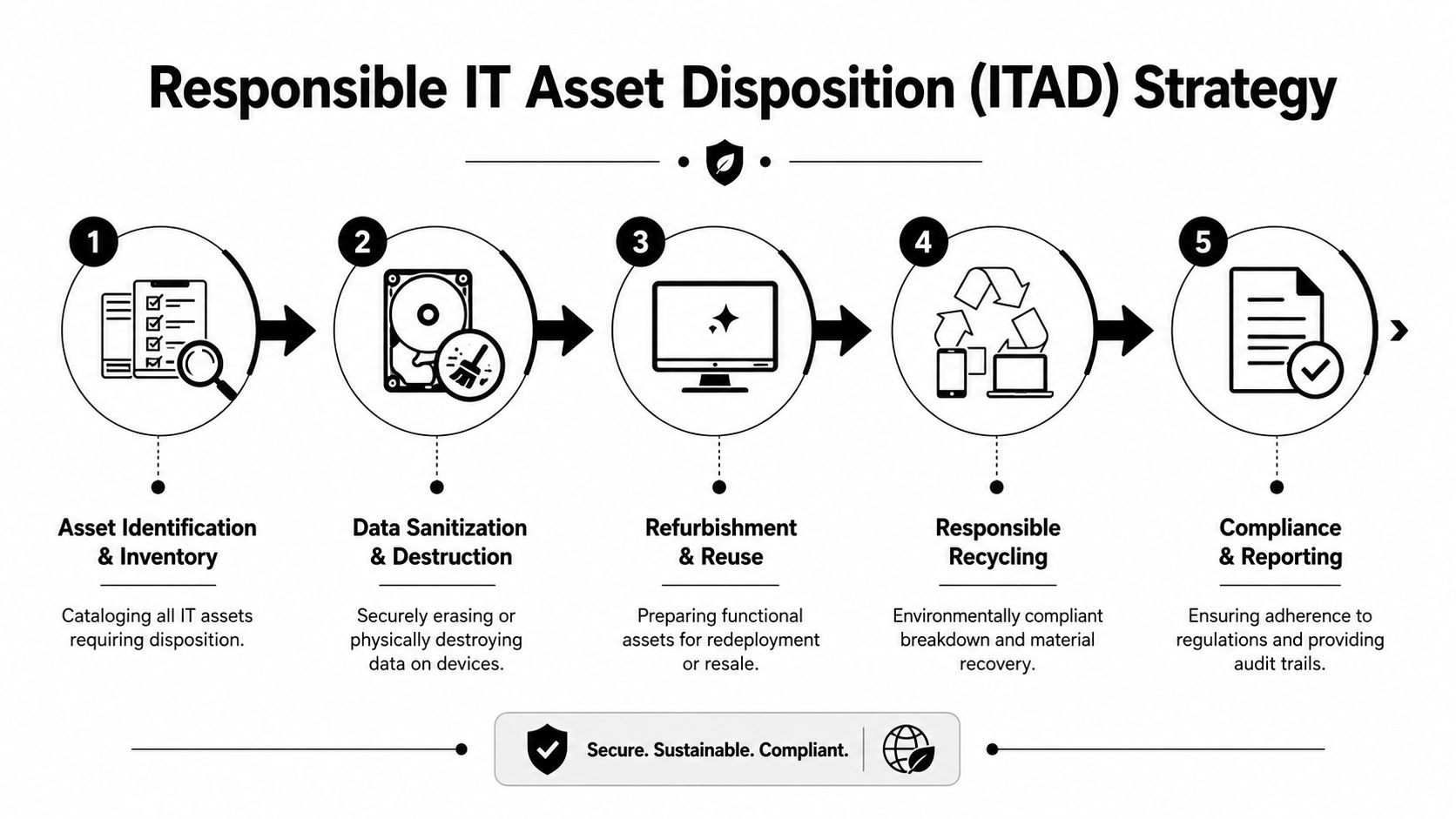
A workable framework for construction firms
Inventory what you have
Start with field tablets, laptops, access points, servers, drives, phones, network switches, monitors, and specialty electronics. Construction businesses often underestimate how much equipment is sitting in project trailers, warehouses, and satellite offices.Separate assets by risk and reuse potential
A drone controller with project data should not follow the same path as obsolete cabling. Some assets need secure data destruction first. Others may be suitable for refurbishment, redeployment, or donation-based recycling.Choose the right downstream path
The terminology used is important. Electronics recycling, computer recycling, laptop disposal, office cleanout, facility cleanout, secure data destruction, product destruction, and broader IT asset disposition (ITAD) aren't interchangeable. Match the service to the asset type and risk profile.Document the chain of custody
If your business handles client data, employee information, or regulated project environments, documentation isn't optional. You need records that show what was collected, what was sanitized or destroyed, and what was recycled or reused.
Why donation-based recycling matters
For many Atlanta organizations, end-of-life equipment still has social value if it's handled properly. Donation-based recycling and corporate donation programs can support digital inclusion and workforce development while reducing waste. That's especially relevant for firms with refresh cycles that produce functional laptops, peripherals, and office technology.
The environmental side matters too. The EPA's electronics donation and recycling guidance is a useful external reference when shaping internal policy around sustainable recycling.
What to look for in a partner
- Secure data destruction: Ask how storage media is sanitized or physically destroyed.
- Pickup logistics: Construction firms often need coordinated collection from offices, projects, and storage spaces.
- Category coverage: Many businesses need more than standard computer recycling. They may also need data center decommissioning, medical equipment disposal, or laboratory equipment disposal depending on project type and tenant improvement work.
- Reporting: Sustainability and IT leaders need defensible documentation, not vague assurances.
For Atlanta firms formalizing that process, IT asset disposition services in Atlanta for corporate IT teams is a strong reference point for what a structured local program should include.
Building a Sustainable and Innovative Future in Atlanta
Atlanta construction tech trends and innovations are reshaping how firms estimate, coordinate, build, and hand over projects. The digital shift is real, and the pressure behind it isn't going away. Data center construction, tighter schedules, labor constraints, and sustainability expectations are pushing firms toward better tools and better operating discipline.
The firms that get the strongest return won't be the ones that buy the most software or deploy the most gadgets. They'll be the ones that connect adoption to training, governance, and asset lifecycle management. That means using BIM, drones, robotics, and connected infrastructure where they solve real operational problems. It also means having a credible plan for electronics recycling, secure data destruction, and IT asset disposition when those tools reach end of life.
Innovation and sustainability belong in the same conversation. If a firm improves field visibility but loses track of retired hardware, it hasn't finished the job. If it upgrades devices but ignores donation-based recycling or sustainable recycling pathways, it leaves value and credibility on the table.
If your business is upgrading field devices, closing out a trailer office, planning a larger office cleanout, or looking for a partner for electronics recycling, secure data destruction, and IT equipment disposal, Reworx Recycling can help. Atlanta companies can donate old equipment, schedule a pickup, or build a long-term partnership that supports responsible recycling, community technology donations, digital inclusion, and workforce development.