Your team is replacing aging laptops, clearing a storage room full of monitors, and retiring networking gear before the next refresh cycle. IT is focused on data security. Facilities is focused on space. Finance wants a clean disposition trail. Sustainability wants to know whether the company is reducing harm or just moving it somewhere else.
That last question is where environmental impact assessment becomes useful.
For a business manager, an environmental impact assessment is less like a legal memo and more like a disciplined pre-decision review. It asks: What will this action change, who could be affected, what risks are easy to miss, and what should we do before the project moves ahead? In e-waste, that means looking beyond logistics and asking harder questions about toxic materials, community exposure, and whether your IT asset disposition process creates measurable environmental and social benefits.
What Is an Environmental Impact Assessment?
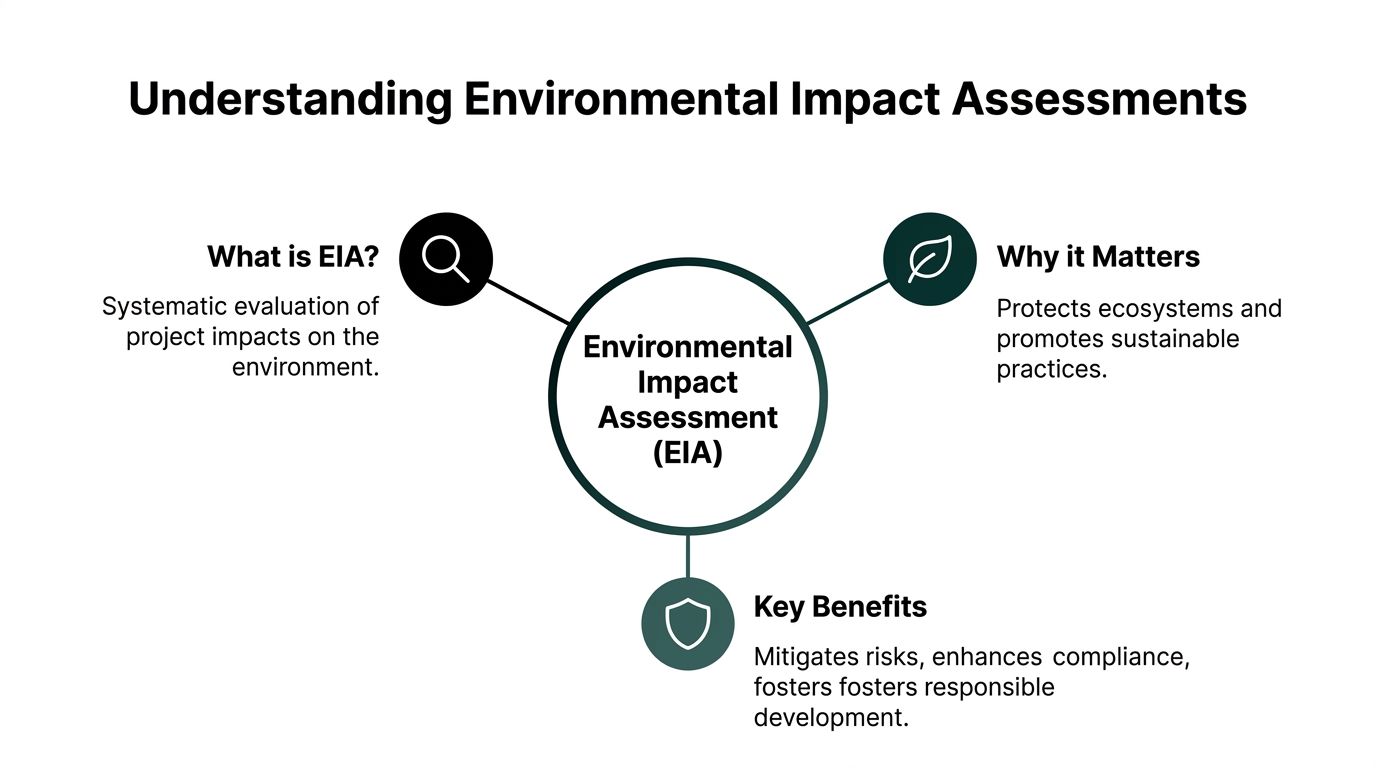
An environmental impact assessment is a structured way to evaluate what a proposed project might do to the environment and to people before decisions are locked in. If you're planning an office cleanout, a data center decommissioning effort, or a major electronics recycling program, the core idea is simple. You assess likely effects early enough to change the plan.
Think of it as a project health checkup. A physician doesn't wait until symptoms become severe to ask about baseline health, likely risks, and preventive steps. An EIA applies the same logic to a business action. It looks at current conditions, predicts likely impacts, compares options, and identifies mitigation steps before approval.
Why businesses should care
Most managers first encounter EIA as a compliance term. That framing is too narrow. In practice, EIA thinking helps companies reduce blind spots in:
- Site decisions that affect waste handling, storage, transport, and vendor selection
- Operational planning for electronics recycling, computer recycling, and medical equipment disposal
- Risk management involving hazardous materials, community concerns, and documentation gaps
- Executive reporting when leaders ask what the disposal program accomplished
The discipline has deep roots. The process was formally institutionalized in 1970, when the United States enacted the National Environmental Policy Act, or NEPA, which mandated Environmental Impact Statements for major federal actions. That milestone established the foundation for modern EIA practice now adopted by over 100 countries, as noted in this overview of why environmental impact assessments matter.
What an EIA is really asking
At a practical level, an EIA asks four business-relevant questions:
| Question | Why it matters for e-waste |
|---|---|
| What exists now? | You need a baseline for current waste streams, storage practices, and exposure risks. |
| What could change? | A new recycling contract or decommissioning project can shift material flows and liabilities. |
| What can be avoided? | Early planning can prevent unsafe handling, poor vendor choices, and weak documentation. |
| What should be measured? | If you don't define impacts up front, you can't prove improvement later. |
Practical rule: If a disposal program changes where equipment goes, how it's processed, or who may be exposed, it deserves EIA-style thinking.
That matters in electronics recycling because environmental harm isn't limited to the final moment of disposal. It can appear during collection, storage, shipment, dismantling, shredding, downstream processing, or informal handling outside licensed channels. For a business, this turns EIA from an abstract environmental concept into a working management tool.
A useful business example is a large laptop disposal project. On paper, the task looks operational. Pack assets, wipe drives, arrange pickup, close the ticket. An EIA mindset asks better questions. Are batteries stored safely? Could lead or mercury-containing devices move into weak downstream channels? Are nearby communities affected by transport, processing, or accumulation of hazardous materials? Are reuse and donation options being considered before destruction?
If you want a business-specific view of this reporting mindset, Reworx Recycling's environmental impact recycling resources show how organizations often translate disposal activity into documented environmental outcomes.
The Legal Mandates Driving EIA
Legal mandates matter because EIA isn't just a best practice. In many contexts, it's a required decision process. Even if your company isn't preparing a formal filing, the legal structure is worth understanding because regulators, procurement teams, and corporate compliance programs borrow directly from it.
In the United States, the core reference point is NEPA. For federal Environmental Impact Statements, the analysis must cover four required sections: the proposed action with purpose and need, the affected environment, a range of alternatives, and impact analysis for each alternative. That structure forces decision-makers to compare choices rather than justify a preferred option after the fact.
Why the No-Action Alternative matters
One legal feature causes confusion for non-lawyers. Under NEPA, an Environmental Impact Statement must analyze a No-Action Alternative. This is legally required to evaluate what happens if the project isn't undertaken, and it serves as the benchmark for comparing the proposed action against current conditions, as explained by the American Bar Association's overview of Environmental Impact Statements.
That isn't a technicality. It's one of the most valuable management disciplines in the entire process.
If your current disposal method is insecure, undocumented, or dependent on ad hoc hauling, the no-action option may expose more risk than changing course.
For e-waste programs, the no-action benchmark can reveal hidden costs of delay. Keeping retired devices in closets, loading docks, or off-book storage may preserve optionality for IT, but it can also prolong data exposure, universal waste handling problems, and unclear downstream accountability.
A good primer on handling regulated streams in this category is this universal waste resource, especially for teams that deal with batteries, lamps, or mixed end-of-life materials alongside IT equipment disposal.
Thresholds and screening
Different legal systems trigger EIA in different ways. Under the EU framework, some project types require mandatory assessment, while others are screened based on thresholds or case-by-case criteria. The point for business readers is straightforward. The law often distinguishes between activities that automatically require close review and activities that require a preliminary check first.
That logic maps well to internal governance. A routine pickup of obsolete keyboards doesn't carry the same implications as a facility cleanout, laboratory equipment disposal project, or product destruction program involving mixed hazardous components. Your internal review process should reflect that difference.
A practical way to think about legal mandates is to separate projects into three buckets:
- Automatically sensitive activities where the category itself signals increased risk
- Threshold-driven activities where scale, location, or cumulative effects determine review depth
- Low-risk routine actions that still need basic controls but not a full assessment process
What smart managers do with this
You don't need to run a formal EIA for every office cleanout. You do need to adopt the logic behind one. That means defining the action clearly, identifying alternatives, documenting baseline conditions, and recording why one path was selected.
The legal model rewards disciplined comparison. That same discipline helps business teams defend vendor choices, support sustainability reporting, and answer hard questions from procurement, leadership, or public stakeholders.
Inside the Environmental Impact Assessment Process
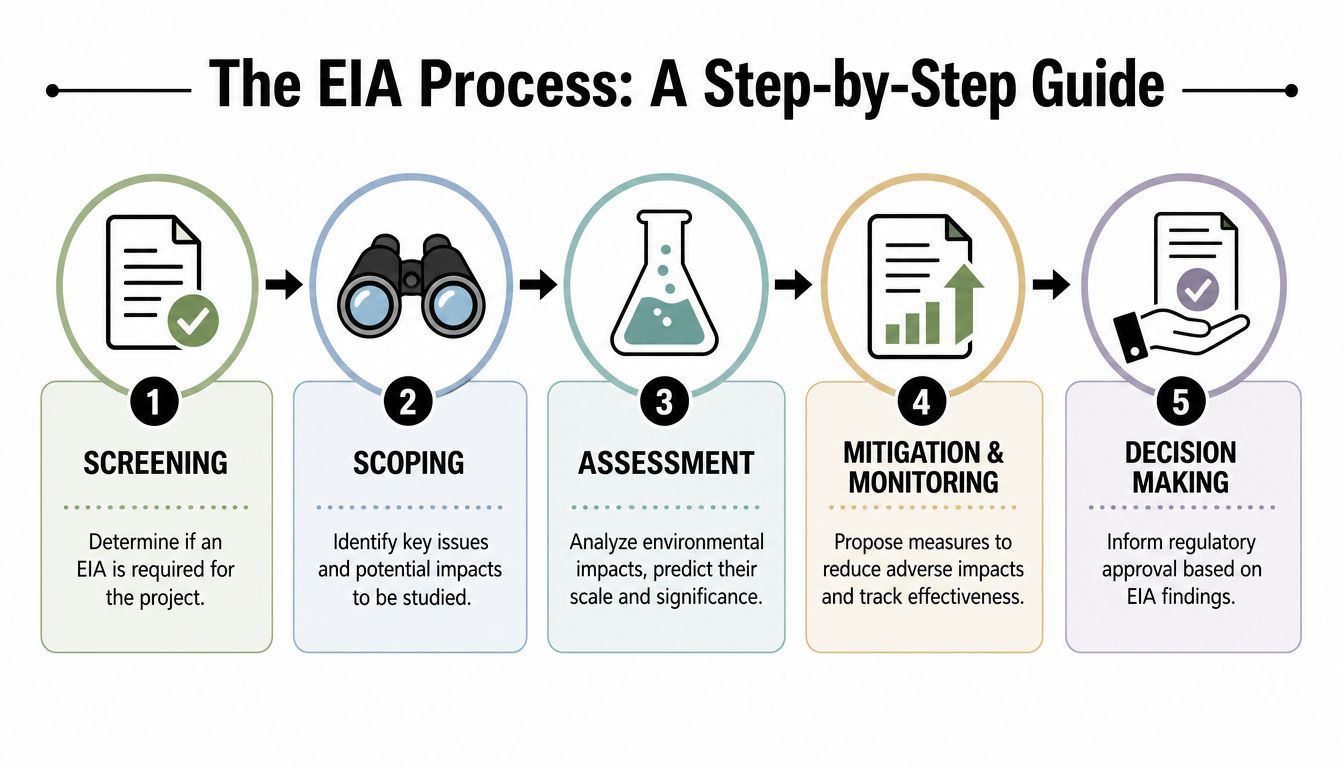
An EIA feels intimidating when it's described as a stack of documents. It becomes manageable when you treat it as a workflow. Most assessments move through a recognizable sequence: screening, scoping, impact assessment, mitigation, reporting, and follow-up review or monitoring.
The exact labels vary, but the management logic doesn't. You decide whether a review is needed, determine what matters, gather baseline information, predict effects, define controls, document the findings, and then check whether real-world outcomes match what was expected.
Screening and scoping
Screening is the first gate. It asks whether the proposed action needs formal assessment at all. In a business setting, screening might flag a large data center decommissioning effort, a warehouse purge of mixed electronics, or an ITAD project involving transport and third-party processing across multiple locations.
Scoping comes next. This step defines the boundaries of the review. What impacts matter? Which locations count? Which communities, workers, or downstream operators could be affected? What time horizon should be considered?
Scoping is where many corporate programs fall short. They define the project too narrowly. A company may scope its review around the pickup event and ignore storage, packaging, downstream sorting, export risk, or community exposure near processing sites.
Baseline data and impact analysis
A sound EIA doesn't start with predictions. It starts with the current state of things. Under the EU framework, the EIA report includes baseline data across four categories: physical, chemical, biological, and socioeconomic, as outlined in this summary of EIA guidelines under the EU directive.
For an e-waste program, those categories can be translated into business language:
| Baseline category | E-waste example |
|---|---|
| Physical | Storage areas, site layout, loading access, material volumes |
| Chemical | Existing air, water, or noise concerns around handling areas |
| Biological | Nearby habitats if processing or transfer affects land use |
| Socioeconomic | Neighboring communities, workforce conditions, local sensitivity |
From there, impact analysis asks what changes the project may cause. Not every impact is direct. Some are cumulative. Some happen off-site. Some affect people more than ecosystems first.
The strongest assessments don't just ask, "Will this create waste?" They ask, "Where will risk move, and who will carry it?"
Mitigation, reporting, and monitoring
Once impacts are identified, the next question is what to do about them. Mitigation can include changing the project design, choosing a different vendor, modifying storage methods, requiring secure data destruction, separating hazardous fractions, or prioritizing reuse before shredding.
Reporting turns the analysis into a document that decision-makers can review. In formal settings, that report may be an Environmental Impact Statement or similar filing. Inside a company, it may be a project memo, procurement appendix, or sustainability review.
A useful internal tool for teams building that discipline is an environmental and compliance checklist template. It helps convert broad EIA concepts into operational questions that procurement, IT, facilities, and sustainability can answer together.
Monitoring is the piece many organizations skip. But follow-up is where the process proves its value. The broader EIA model includes monitoring so teams can verify whether impacts stayed within predicted limits and adjust if they didn't. In business terms, that means reviewing actual disposition records, chain-of-custody documentation, vendor outputs, incident logs, and community concerns after the project begins.
A simple management lens
If you want a stripped-down version for internal use, ask:
- Should this project trigger review?
- What impacts are in scope?
- What does the current baseline look like?
- What could go wrong, directly or indirectly?
- What controls reduce that risk?
- How will we verify outcomes later?
That sequence is the core engine of environmental impact assessment. The paperwork matters, but the thinking matters more.
Applying EIA to Electronics Recycling and ITAD
EIA principles become especially useful when applied to electronics recycling, IT asset disposition (ITAD), and large-scale IT equipment disposal. These projects often look routine because they happen inside normal business operations. In reality, they combine environmental risk, data risk, logistics risk, and community impact.
The scale of the issue is large. The United States generates approximately 6.9 million tons of electronic waste annually, and only 15% of e-waste in North America was formally collected and recycled as of 2019, meaning 85% ended up somewhere other than licensed recycling facilities, according to these e-waste facts and statistics.
What impacts should be assessed
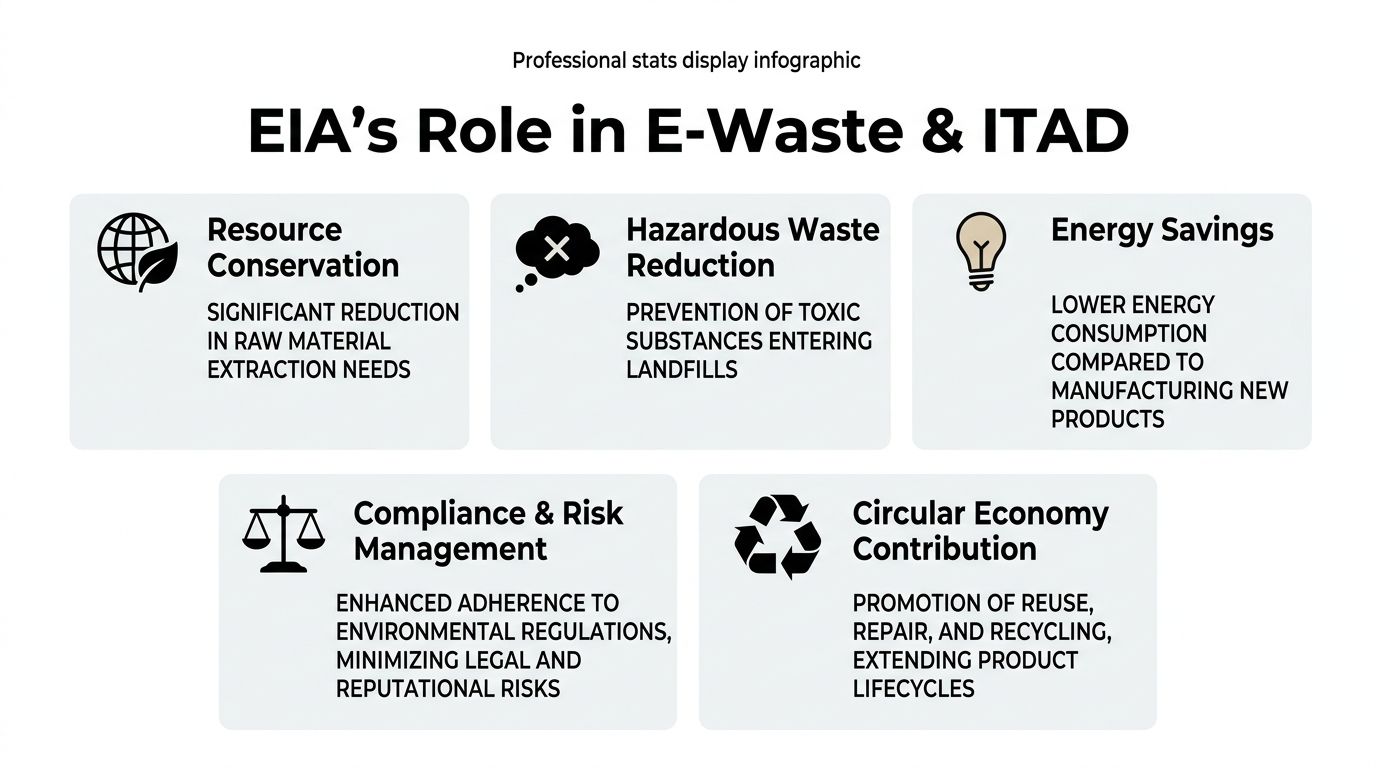
In e-waste, the obvious environmental issue is hazardous material. Devices can contain substances such as lead and mercury. If those materials are mishandled, dumped, or processed through weak downstream channels, the harm isn't theoretical. It can affect soil, water, workers, and nearby communities.
But a business-grade assessment should go further than a hazard list. It should evaluate impacts across the life of the disposition program:
- Collection and storage risks tied to batteries, breakage, and mixed material streams
- Transportation risks tied to packaging, spills, route choices, and contractor practices
- Processing risks tied to dismantling, shredding, or export to less controlled environments
- Data and governance risks tied to chain of custody and secure data destruction
- Community health risks tied to where and how materials are ultimately handled
For managers who want a consumer-facing reference on where electronics can be directed responsibly, Litter Caterpillars' comprehensive guide is a useful supplemental resource because it shows how confusing end-of-life options can be without a structured decision framework.
Why human health deserves its own line item
Many sustainability programs still treat health as a side topic under social impact. That's too weak for e-waste.
A better model is to treat human health as a primary assessment category. If your company is retiring devices that contain toxic metals, then your review should ask not only whether materials are diverted from landfill, but also whether your chosen pathway reduces exposure risk for workers and nearby residents. That includes thinking about cumulative effects, especially where processing activity overlaps with communities that already face environmental burdens.
A disposal program isn't responsible just because equipment leaves your building. It becomes responsible when the downstream path is documented, controlled, and less harmful to people.
This is also where donation-based recycling, social enterprise recycling, and corporate donation programs can change the assessment. Reuse can extend product life and reduce the need for immediate processing, but only if equipment is functional, data is securely removed, and the receiving channel is legitimate.
For businesses that want to connect these issues back to broader environmental consequences, this overview of the environmental impact of electronic waste offers a practical lens on how end-of-life decisions affect the wider waste stream.
How EIA improves ITAD decisions
An EIA-informed ITAD program changes the vendor conversation. Instead of asking only about pickup timing and certificates, you start asking:
| Standard vendor question | Better EIA-informed question |
|---|---|
| Can you remove the equipment this week? | What downstream path will each material stream follow? |
| Do you provide data destruction? | How is secure data destruction documented and verified? |
| Do you recycle everything? | What gets reused, refurbished, dismantled, or destroyed? |
| Can you handle this office cleanout? | What environmental and health controls apply across the process? |
That shift is what moves an organization from disposal to real stewardship.
Building an EIA-Informed E-Waste Program
Most organizations don't need a formal government-filed EIA for laptop disposal, office cleanouts, or facility cleanouts. They do need an internal method that borrows the discipline of one. That means treating e-waste decisions as cross-functional risk decisions, not housekeeping.
The missing piece is often human health. For entities managing e-waste containing toxic heavy metals such as lead and mercury, typical EIA literature often lacks data-driven protocols for measuring cumulative health risks in underserved and overburdened communities, which leaves a real gap for organizations trying to show that their program reduces harm, as discussed in this public health analysis of environmental justice and assessment practice.
A practical internal checklist
You can build an EIA-informed program without turning it into a bureaucracy. Start with a short operating checklist that procurement, IT, facilities, and sustainability all understand.
- Map the asset inventory first. Separate laptops, servers, networking gear, mobile devices, peripherals, batteries, and specialty items such as medical or laboratory equipment.
- Define the disposition path. Decide what will be reused, donated, remarketed, dismantled, or sent for product destruction.
- Require secure data destruction. Drive wiping and hard drive shredding shouldn't be an afterthought in ITAD.
- Review downstream controls. Ask how materials are handled after pickup, not just who collects them.
- Check community risk factors. Consider where processing occurs and whether the pathway could shift burdens onto already stressed communities.
- Document outcomes. Keep records that show what happened, why that path was chosen, and what residual risks remain.
Where companies get stuck
Many teams already do pieces of this. IT tracks devices. Facilities schedules pickups. Legal reviews contracts. Sustainability writes an annual summary. The problem is that these steps are often disconnected.
A stronger model is to use one review sheet for every major electronics recycling event. It doesn't need legal jargon. It needs clear prompts about baseline conditions, alternatives, health concerns, data security, and downstream accountability.
Small process changes matter. A pre-pickup review can catch the exact issues that create later compliance, reporting, or reputational problems.
One example of an operational partner in this space is Reworx Recycling's eco-friendly service framework, which reflects how organizations often combine pickup coordination, data destruction, and end-of-life handling into one documented workflow rather than splitting those responsibilities across disconnected vendors.
What good looks like
A mature e-waste program doesn't just remove obsolete equipment. It answers five questions with confidence:
- What were we disposing of?
- What risks did that create?
- What alternatives did we consider?
- How did we reduce harm, including health-related harm?
- What evidence do we have after the fact?
If your team can answer those clearly, you're already applying the core discipline of environmental impact assessment.
How Reworx Recycling Supports Your Sustainability Goals
Sustainability leaders rarely struggle with intent. They struggle with execution. The challenge isn't knowing that responsible electronics recycling matters. It's building a process that meets operational needs for pickup, secure data destruction, chain of custody, reuse, and documentation without creating friction for IT and facilities.
That's where a specialized service partner can help. In practical terms, the right partner should support several goals at once:
What a strong partner should help you do
- Protect data through documented secure data destruction during IT equipment disposal and decommissioning
- Support reuse and donation where equipment still has life left, which aligns with donation-based recycling and digital inclusion goals
- Manage complex projects such as office cleanouts, facility cleanouts, data center decommissioning, and mixed stream pickups
- Improve reporting so sustainability and procurement teams can explain what happened to retired assets
- Reduce environmental uncertainty by making downstream handling more visible and more consistent
That combination matters because sustainability goals aren't met by recycling alone. They depend on whether the whole program is designed to reduce risk, preserve usable equipment where appropriate, and avoid pushing hidden impacts further down the chain.
Why this matters for business reporting
An EIA-informed program gives sustainability teams better evidence. It helps answer board-level and customer-facing questions about environmental responsibility in plain language. It also gives IT managers and business owners a stronger framework for vendor evaluation.
For organizations looking for a single partner that handles electronics recycling, computer recycling, secure data destruction, pickup coordination, and donation-oriented disposition support, Reworx Recycling is one operating option within that model. The company works as a full-service electronics recycling and ITAD partner and can fit into programs where environmental responsibility, documentation, and community impact all need to be considered together.
The core value isn't just removal. It's having a process you can defend.
If your business is upgrading equipment, closing a site, or reviewing its IT asset disposition process, use environmental impact assessment as the standard. Ask what happens, who is affected, what can be prevented, and what proof you'll have after the work is done. That's how electronics recycling becomes part of a credible sustainability strategy rather than a line item at the end of a project.
If you're reviewing old devices, planning a pickup, or building a more defensible ITAD process, Reworx Recycling is a practical place to start. Businesses can donate old equipment, schedule a pickup, or explore a partnership that supports responsible electronics recycling, secure data destruction, and community-focused technology reuse.