Most advice about ITAD processing capacity starts with the wrong question. Buyers ask how many pounds a recycler can shred per hour, how many pallets fit on the dock, or how fast drives move through destruction. Those details matter, but they don't tell you what your organization practically experiences.
A facilities manager feels capacity as delay, follow-up, confusion, and risk. If your team spends days chasing certificates, reconciling inventories, clarifying chain of custody, and translating vague promises into procurement language, the vendor's advertised throughput doesn't help much. A fast shredder can still create a slow project.
That gap is why processing capacity should be treated as a total business metric, not just a plant metric. It includes physical throughput, yes, but it also includes the amount of time, attention, and decision-making effort your staff must spend to get a secure, compliant outcome. In practice, the best partner isn't always the one with the biggest machine. It's the one that removes work from your team.
What Is Processing Capacity in Electronics Recycling
Processing capacity is defined as a facility's ability to move material. In electronics recycling, that usually means how much equipment a site can receive, sort, dismantle, wipe, shred, store, and ship in a given period. That's the visible part.
But there are really two capacities at work in every ITAD project.
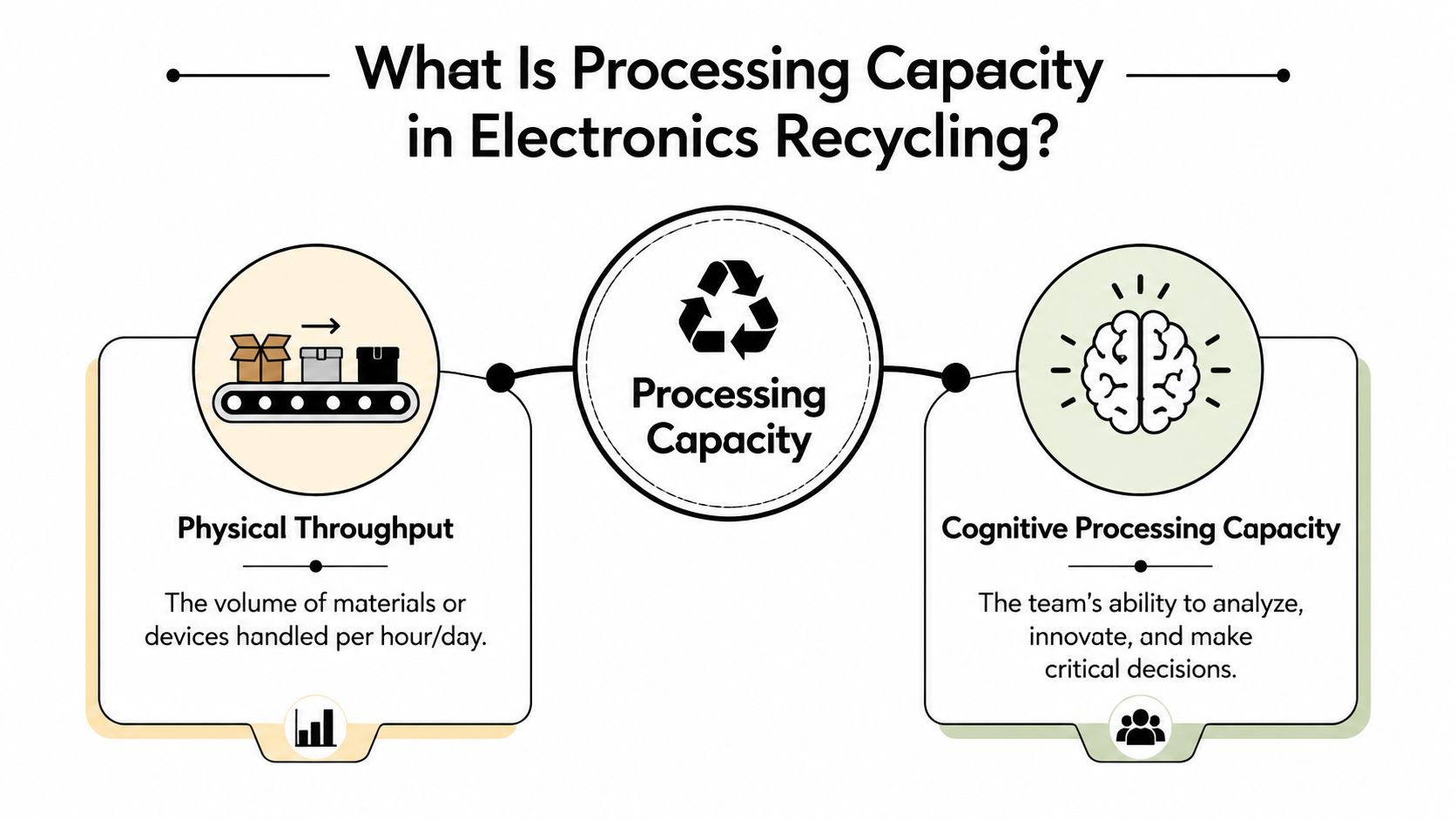
Physical throughput
This is the traditional definition. It covers the plant, the dock, the labor force, the trucks, the inventory controls, and the data destruction workflow. If a vendor handles laptop disposal, office cleanout work, medical equipment disposal, computer recycling, and product destruction, physical throughput determines whether they can absorb your load without bottlenecks.
That matters because the disposal sector is still fragmented. As of 2019, only 15% of e-waste in North America was formally collected and recycled, meaning 85% goes to unlicensed facilities or landfills, according to SAMR's summary of Statista 2024 e-waste data. If a vendor lacks disciplined processing operations, your equipment can drift into the wrong downstream path.
Cognitive processing capacity
This is the overlooked half. It reflects your team's ability to understand the vendor, verify controls, approve the project, and manage exceptions without draining internal bandwidth. In small and mid-sized organizations, the same people handling facilities, procurement, compliance, and IT equipment disposal often have other jobs too.
A recycler with messy communication can consume more value than they create. A recycler with clear documentation can return hours of focus to your staff.
Practical rule: If a vendor makes simple questions hard to answer, their real processing capacity is lower than their equipment list suggests.
Three signs you're evaluating only half the picture:
- You ask about shredder speed first: That's useful, but it doesn't tell you how inventory discrepancies, missed pickups, or reporting gaps will be handled.
- You treat compliance as paperwork at the end: In reality, compliance affects the whole chain, especially in IT asset disposition planning.
- You assume larger volume means lower risk: Sometimes it just means your devices become one more batch in a queue.
Processing capacity, then, is the combination of what the vendor can process and how much effort your team must spend to make that processing trustworthy.
Calculating Your Vendor's Physical Throughput
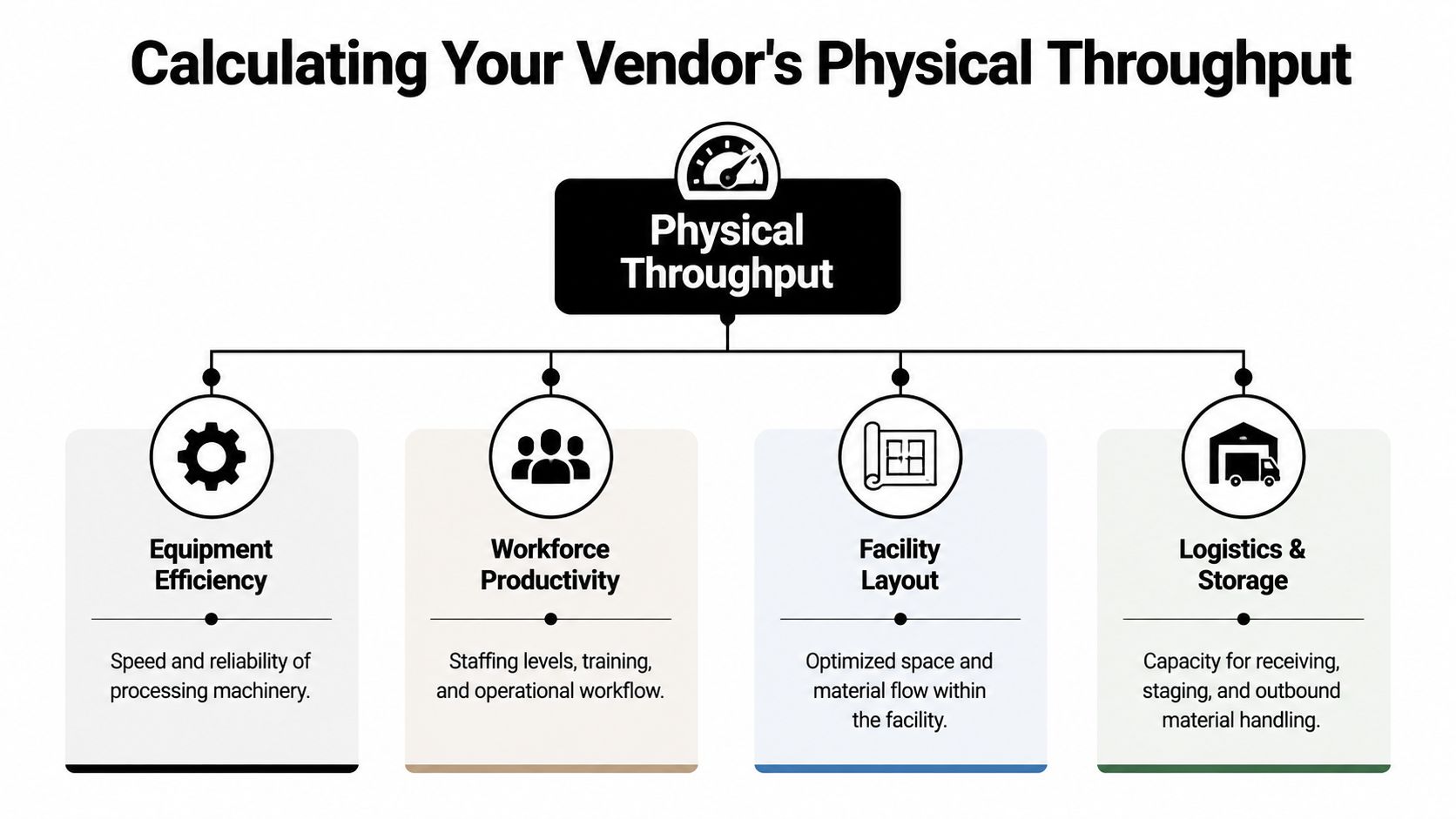
If you want a grounded view of capacity, start with the workflow rather than the sales sheet. Electronics recycling throughput comes from a chain of steps, and the chain only moves as fast as its tightest constraint. A vendor may advertise strong receiving volume but still choke at triage, wiping, storage, or outbound logistics.
Start with the flow, not the machine
Think in stages:
- Inbound receiving for pallets, loose devices, and serialized assets
- Sorting and triage for reuse, resale, recycling, or destruction
- Data handling through software wiping or physical drive shredding
- Disassembly or shredding for final material processing
- Staging and outbound movement to downstream processors or remarketing channels
If one stage lags, the rest of the line backs up. That's why the basic planning formula is simple:
Usable physical throughput = lowest sustained throughput among all required process stages
A few practical examples help.
- Laptop disposal program: The limiting step may be asset logging and drive handling, not shredder speed.
- Facility cleanout: Dock space and pallet movement may constrain the project before any shredder turns on.
- Laboratory equipment disposal: Manual disassembly and special handling can reduce effective throughput even when the plant itself is large.
Ask for sustained capacity, not peak claims
Peak output and sustained output aren't the same. Any operator can describe a short burst under ideal conditions. You need to know what they can hold over the course of an actual business pickup or multi-day office cleanout.
Useful questions include:
- Receiving capacity: How much equipment can the dock and staging area accept before congestion appears?
- Sorting capacity: How many staff members are assigned to triage mixed loads?
- Data destruction capacity: Are software wiping and physical shredding separate lanes or one shared bottleneck?
- Redundancy: What happens when one machine is down for maintenance?
A simple worksheet often reveals more than a brochure:
| Process step | What to ask | What you're looking for |
|---|---|---|
| Receiving | How do you unload and stage mixed business loads? | Orderly intake without backlog |
| Inventory | How are serialized devices logged? | Consistent tracking and reconciliation |
| Data destruction | What path handles drives, servers, and endpoints? | Clear separation of wiping and shredding workflows |
| Final processing | What equipment handles dismantling and shredding? | Capacity aligned to your asset mix |
| Logistics | How do pickups and outbound loads get scheduled? | Reliable turnaround |
One reason this matters more every year is the pace at which technology enters the waste stream. The historical growth in computing capacity shows that the per capita capacity of general-purpose computers grew at a compound annual rate of 58%, roughly doubling every 18 months. That pace is why electronics recycling, data center decommissioning, and sustainable recycling programs can't rely on loose estimates.
When newer equipment arrives faster, end-of-life planning has to become more disciplined. Capacity isn't just a plant issue. It's an infrastructure issue.
For B2B buyers, the takeaway is straightforward. Don't ask a vendor only, "How much can you process?" Ask, "At which step does your system slow down, and how do you prevent that from affecting my project?"
Beyond Tons Per Hour The Capacity That Really Matters
A lot of failed ITAD projects don't fail because the recycler lacked machinery. They fail because the client had to do too much thinking. Procurement needed one answer, legal needed another, facilities needed pickup clarity, and IT needed secure data destruction evidence. Each handoff added friction.

The hidden cost is mental load
The strongest argument for a broader capacity model is simple: the true bottleneck in e-waste management is often not the physical recycling plant capacity, but the decision-making capacity of the client, which is eroded by the complexity of choosing between opaque vendors. That framing aligns with the cognitive load research referenced here.
In plain terms, your staff pays a cognitive tax when a vendor is hard to evaluate or hard to manage. That tax shows up in familiar ways:
- Repeated clarification: Your team keeps asking what happens to drives, batteries, or mixed loads.
- Document chasing: Certificates, downstream details, and service scope arrive late or in fragments.
- Escalation fatigue: Basic scheduling or chain-of-custody questions keep moving to senior staff.
- Risk anxiety: Even after pickup, people still aren't sure whether the process was handled correctly.
Those aren't soft complaints. They're operational costs.
Good vendors process complexity for you
Manufacturing teams often use Overall Equipment Effectiveness to understand where output breaks down. If you want a clean primer on that logic, this technical OEE playbook is useful because it separates availability, performance, and quality instead of treating all output as equal. The same mindset applies in ITAD. A vendor with high apparent throughput but poor communication quality can still lower your effective outcome.
A partner's real value isn't measured only by what leaves their shredder. It's measured by how few unresolved questions remain on your side.
That means cognitive-friendly ITAD has a few traits:
| Capacity type | Low-quality experience | High-quality experience |
|---|---|---|
| Communication | Vague answers, slow follow-up | Direct answers, clear ownership |
| Compliance support | Generic claims | Specific documentation and process visibility |
| Scope control | Surprise exclusions | Plain definition of what is and isn't included |
| Downstream visibility | Black box | Transparent downstream processing practices |
| Project management | Client drives every step | Vendor reduces decisions and handoffs |
Facilities managers often focus on physical movement because that's what they can see. But in most office cleanout and computer recycling projects, visible movement isn't the scarce resource. Attention is. If your internal stakeholders spend less time debating vendor capability, the project moves faster even before the truck arrives.
Calculating Your Required ITAD Capacity for Events and Programs
Required capacity depends on the event, not just the volume. A one-time cleanout, a recurring refresh cycle, and a data center shutdown can all involve similar equipment categories while demanding very different operating models. That's why planning starts with scenario fit.
Three common planning scenarios
A facilities manager clearing one floor usually needs a partner that can receive mixed gear without slowing the building team. An IT manager running a recurring laptop disposal program needs dependable pickups and secure data destruction documentation. A decommissioning team closing out server rooms needs tighter sequencing, chain of custody, and asset visibility.
The simplest way to scope the job is to list four things before you talk to any vendor:
- Asset mix: Laptops, monitors, networking gear, servers, peripherals, or specialized devices such as medical or laboratory equipment
- Pickup pattern: One-time event, monthly collection, or phased removal
- Handling requirement: Reuse, donation-based recycling, shredding, resale screening, or product destruction
- Internal friction points: Who has to approve, track, and sign off
ITAD capacity planning scenarios
| Scenario | Device Volume Example | Key Capacity Requirement | Recommended Reworx Service |
|---|---|---|---|
| Office cleanout | Mixed endpoints, monitors, docks, and loose peripherals from a workplace move | Fast intake, flexible pickup window, clear segregation of reusable and end-of-life equipment | Office cleanout and business pickup support |
| Ongoing IT refresh | Routine laptop disposal and computer recycling from employee device replacement cycles | Consistent scheduling, serialized tracking, secure data destruction workflow | Recurring IT asset disposition support |
| Data center decommissioning | Servers, storage, racks, networking hardware, and drives leaving a controlled environment | Coordinated removal, asset accountability, on-site planning, staged logistics | Data center decommissioning and secure disposition services |
| Public sector or education program | Mixed classroom or office technology with uneven packaging and legacy hardware | Simple intake standards, transparent reporting, donation-based recycling options | Program-based pickup and donation support |
A short narrative example shows how this works. Suppose you're handling a facility cleanout after a lease change. The building team cares about clearing space on schedule. IT cares about drives and asset records. Finance may care about any reuse path. Your required capacity isn't "a lot of pounds per hour." It's a vendor that can remove mixed material cleanly, document handoff, and keep internal stakeholders from reopening basic questions.
Planning shortcut: If your team can't explain the project scope on one page, the vendor will probably inherit confusion rather than a workable job.
For recurring programs, required capacity is more about rhythm than surge. You want a partner whose scheduling and reporting discipline match your replacement cycle. For larger transitions, implementation timing becomes part of capacity because a late pickup can stall contractors, movers, or site closures. That's why it helps to review ITAD implementation timelines before locking in a disposal event.
The point isn't to create a perfect mathematical model. It's to define the operating conditions that make one vendor workable and another exhausting.
A Checklist for Vetting Your ITAD Partner's True Capacity
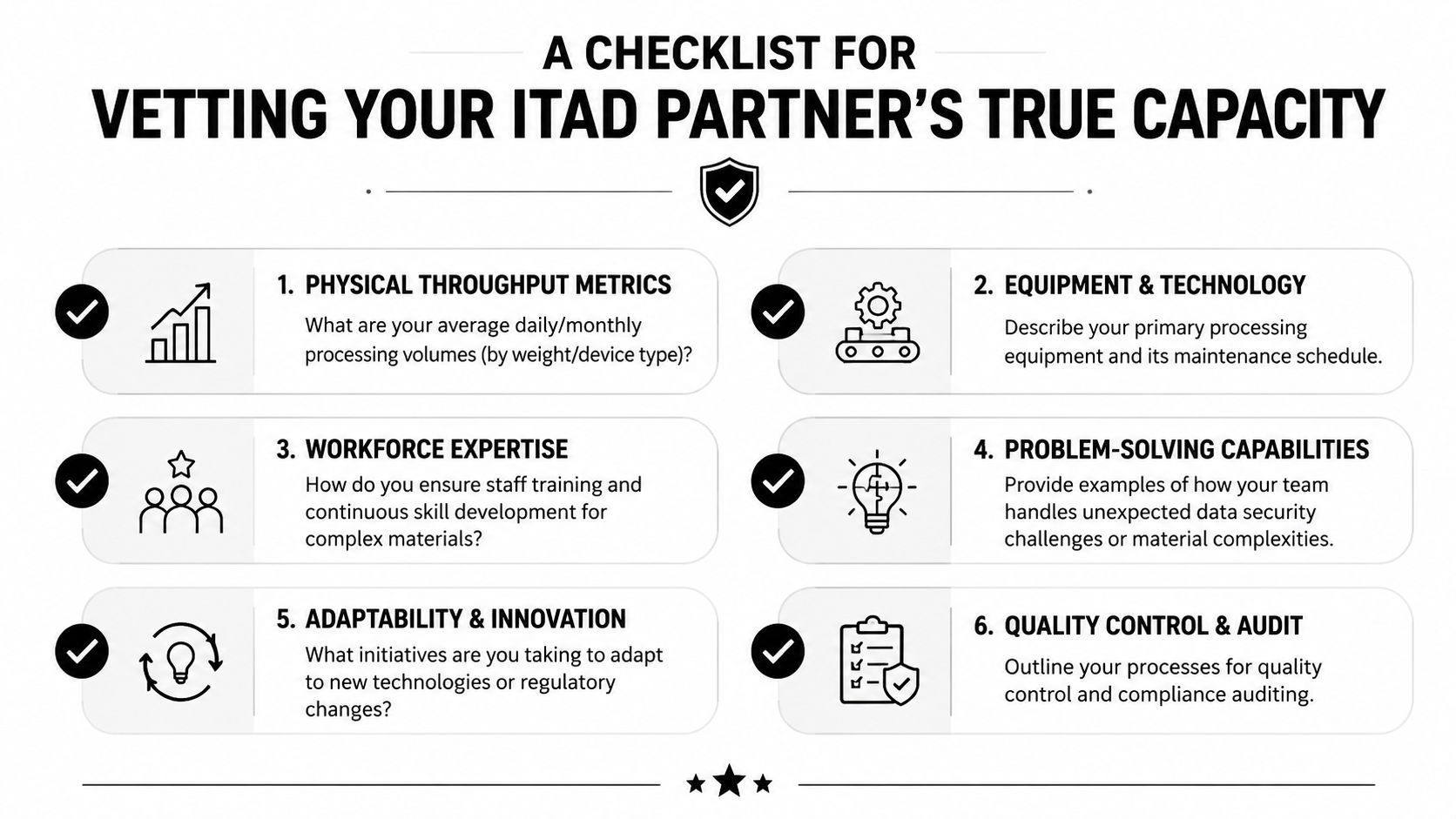
A vendor's real capacity shows up in the questions they can answer clearly. If answers come back vague, overly broad, or detached from actual workflow, assume your team will spend extra time managing the gaps later.
Questions that test physical and operational fit
Ask these in plain language. You don't need to sound technical to get useful answers.
- Daily handling reality: What are your average daily or monthly processing volumes by device type or material stream?
- Equipment resilience: What are your primary processing systems, and how do you handle maintenance or downtime?
- Mixed-load experience: How do you process shipments that include reusable devices, scrap equipment, drives, and loose accessories together?
- Storage discipline: How do you prevent staging areas from becoming an inventory blind spot?
Questions that test compliance and trust
Many buyers get too casual concerning adherence to established standards. Two major U.S. recycling standards, the e-Stewards Standard and the Responsible Recycling (R2) Practices, were established to ensure responsible e-waste handling, and asking about them is a necessary part of vetting, as summarized in this overview of electronic waste regulation and standards in the United States.
Use that baseline, then go deeper:
| Vetting area | Ask this question | Why it matters |
|---|---|---|
| Certification | Do you maintain e-Stewards, R2, or another relevant compliance framework for the services you provide? | Tests formal commitment to responsible handling |
| Data security | How do you separate software wiping, hard drive shredding, and product destruction workflows? | Reveals whether secure data destruction is operationally mature |
| Reporting | What documentation do clients receive after pickup and after final processing? | Shows how much follow-up work falls back on you |
| Exceptions | How do you handle damaged devices, unknown assets, or mislabeled pallets? | Exposes whether the vendor can manage real-world messiness |
| Communication | Who owns the project if issues arise? | Reduces internal escalation loops |
Buyers often think they need more technical detail. Usually they need fewer ambiguous answers.
Questions that test cognitive capacity
A partner can look compliant on paper and still consume your staff's week. That's why your checklist should also include management burden.
- Ownership: Who gives final answers when scope changes?
- Clarity: Can they explain the workflow without jargon?
- Transparency: Are downstream steps and exceptions visible?
- Procurement readiness: Can they provide information your sourcing team can use?
If you want a structured framework for evaluating providers, this guide to vendor selection criteria for ITAD partners is a helpful place to align facilities, IT, and procurement before you issue requests.
Partnering with Reworx for Seamless ITAD Management
The best way to think about processing capacity is this. A vendor has high capacity when they can move equipment securely, document the work cleanly, and avoid turning your internal team into project coordinators for every small issue.
That matters across electronics recycling, secure data destruction, corporate donation programs, facility cleanout work, data center decommissioning, and sustainable recycling programs. Business owners want a reliable path for retired devices. IT managers want accountable handling. Sustainability leaders want an approach that keeps useful equipment in circulation where possible and keeps end-of-life material out of the wrong channels.
Reworx Recycling fits that broader definition because the model goes beyond raw throughput. The organization operates as a donation-based recycling and social enterprise recycling partner, which means IT asset disposition isn't treated as a narrow disposal event. It connects responsible handling with community impact, digital inclusion, and practical reuse where appropriate. For teams managing computer recycling, laptop disposal, medical equipment disposal, laboratory equipment disposal, office cleanout projects, and product destruction, that combination can reduce both waste and internal friction.
The strongest ITAD relationships feel boring in the best sense. Pickups happen when expected. Documentation arrives without chasing. Questions get answered directly. Sensitive assets move through secure paths. Equipment that still has useful life can support donation-based programs instead of being treated as automatic scrap.
If you're evaluating options for IT asset disposition services, judge capacity by the full cost of getting the job done. Look at physical throughput. Then look just as hard at the time, attention, and confidence the vendor preserves for your team.
If you're ready to simplify electronics recycling, IT equipment disposal, secure data destruction, or a larger office cleanout, explore Reworx Recycling. You can donate old equipment, schedule a pickup, or partner with a team that supports responsible recycling, technology donation, digital inclusion, and workforce development.