You can see the problem from the doorway.
A shelf in the back office holds retired laptops from the last refresh. Under it sit dusty LCD monitors, a few desktop towers, a box of docking stations, and a tangle of power cords nobody wants to sort. In a Kent facility, that pile usually builds up. Warehousing teams are focused on throughput, manufacturers are focused on uptime, and office managers are trying to reclaim space without creating a security problem.
That's where electronics recycling in Kent, WA gets more complicated than is often assumed. For a business, this isn't just a hauling job. It touches data protection, environmental handling, internal accountability, and whether your organization can prove what happened to each device after it left the building.
The Hidden Challenge of Your Office Tech Pile-Up
A typical office cleanout starts with good intentions. Someone says the old laptops should go to a recycling event, or the facilities team volunteers to run monitors over to a local drop-off site. That sounds efficient until the questions start. Which devices still hold data? Which assets need to be tracked by serial number? Which items are even accepted under the free programs available to residents?

For Kent businesses, the storage-room pile usually includes more than obvious e-waste. It often mixes reusable laptops, damaged monitors, accessories, hard drives pulled from systems, and retired networking gear waiting for a decision. Once those categories get mixed together, disposal becomes an operations issue, not just a janitorial one.
What looks like clutter is really risk
An old laptop can contain employee files, saved credentials, browser history, local copies of contracts, or student and customer information. A retired desktop might still have a functional drive because the machine was replaced for age, not because it failed. A facilities manager trying to clear floor space can accidentally inherit a data-governance problem that belongs in IT, legal, or compliance.
Practical rule: If your team can't identify who owned the device, what data sat on it, and how it will leave the site, it isn't ready for disposal.
That's why experienced ITAD planning treats the pile-up as an asset recovery workflow. First, sort equipment by type and condition. Next, separate anything with storage media from simple accessories and cables. Then decide what should be remarketed, donated, physically destroyed, or recycled as scrap.
Kent businesses need more than a drop-off mindset
The local reality is straightforward. Kent-area companies need a process that protects data, documents disposition, and keeps unusable equipment out of the landfill. Free public options can help residents with a few eligible items, but they rarely match the needs of a business moving through a technology refresh, facility cleanout, or decommissioning project.
If your organization is looking at computer recycling, laptop disposal, secure data destruction, or a broader IT equipment disposal plan, the right answer usually starts with process discipline. It ends with a partner that can handle chain of custody, documented outcomes, and reuse opportunities that turn old hardware into something useful for the community.
Navigating Electronics Recycling Rules in Kent and King County
A Kent office cleanout rarely produces a neat stack of covered devices. It usually includes laptops, old LCD monitors, docking stations, label printers, phones, cords, and a few mystery boxes from the server room. That matters because Washington's public electronics program covers a defined list of products, not every item your business wants gone.
What the state program actually covers
Washington's E-Cycle WA program is built around specific device categories, including computers, laptops, monitors, and televisions, as described by the Washington Department of Ecology's E-Cycle WA program page. For a resident dropping off a few household items, that can work well. For a business managing a refresh or site closure, the limits show up fast.
The common problem is mixed inventory.
A facilities or IT manager may start with the assumption that anything electronic belongs in the same recycling stream. In practice, office loads often include accessories and equipment that fall outside the state program or need separate handling. Printers are a common example. So are loose peripherals, telecom gear, and non-covered accessories that accumulate over years of moves and upgrades.
What this means for a Kent company
The rule set is simple. The job is not.
Covered devices may fit a public program. A full business disposition project usually does not. Once your team is dealing with multiple device classes, internal asset tags, storage media, or pickup logistics, the question shifts from “Can this be recycled?” to “Can this be documented, segregated, and moved offsite correctly?”
That distinction is where businesses get into trouble. Kent and King County offer legitimate recycling outlets, but those programs were not designed as a business ITAD workflow. They are waste diversion programs first. Your organization still has to account for excluded items, ownership records, and downstream handling.
Washington also bars certain electronics from the garbage, which means “just throw it in the dumpster” is not an option. The Washington Utilities and Transportation Commission's guidance on electronics disposal rules makes that baseline clear. For businesses, though, legal disposal is only the starting line.
Public recycling solves one problem, not the whole one
Free local recycling has value. It keeps covered devices out of the landfill and gives residents a practical outlet. But businesses should treat those programs carefully, because they can create a false sense of compliance. If a public option accepts part of your load, that does not mean it fits your recordkeeping, security, or chain-of-custody requirements.
That is why many Kent organizations review computer recycling options for organizations before approving pickup or drop-off decisions. It is also smart to coordinate ITAD planning with your security team or MSP. If cyber risk is part of the conversation, protect your business with Wisely.
The Data Security Blind Spot in Free Recycling Programs
The biggest mistake businesses make with electronics recycling in Kent, WA isn't environmental. It's assuming that “recycled” means “secured.”
Municipal collection events and free public programs are built to divert eligible electronics from the waste stream. That's valuable. But for a business, diversion is only one part of the job. The harder requirement is proving that data on retired devices was handled in a defensible way.
Free recycling doesn't equal secure disposition
Kent's public recycling events are useful for residents, but they often don't include certified data destruction aligned with NIST 800-88 expectations. That gap matters because 60% of retired electronics still contain sensitive data, and Kent businesses using free events can expose themselves to breach risk if they treat those services like a complete disposition solution, as noted on the City of Kent recycling collection events page.
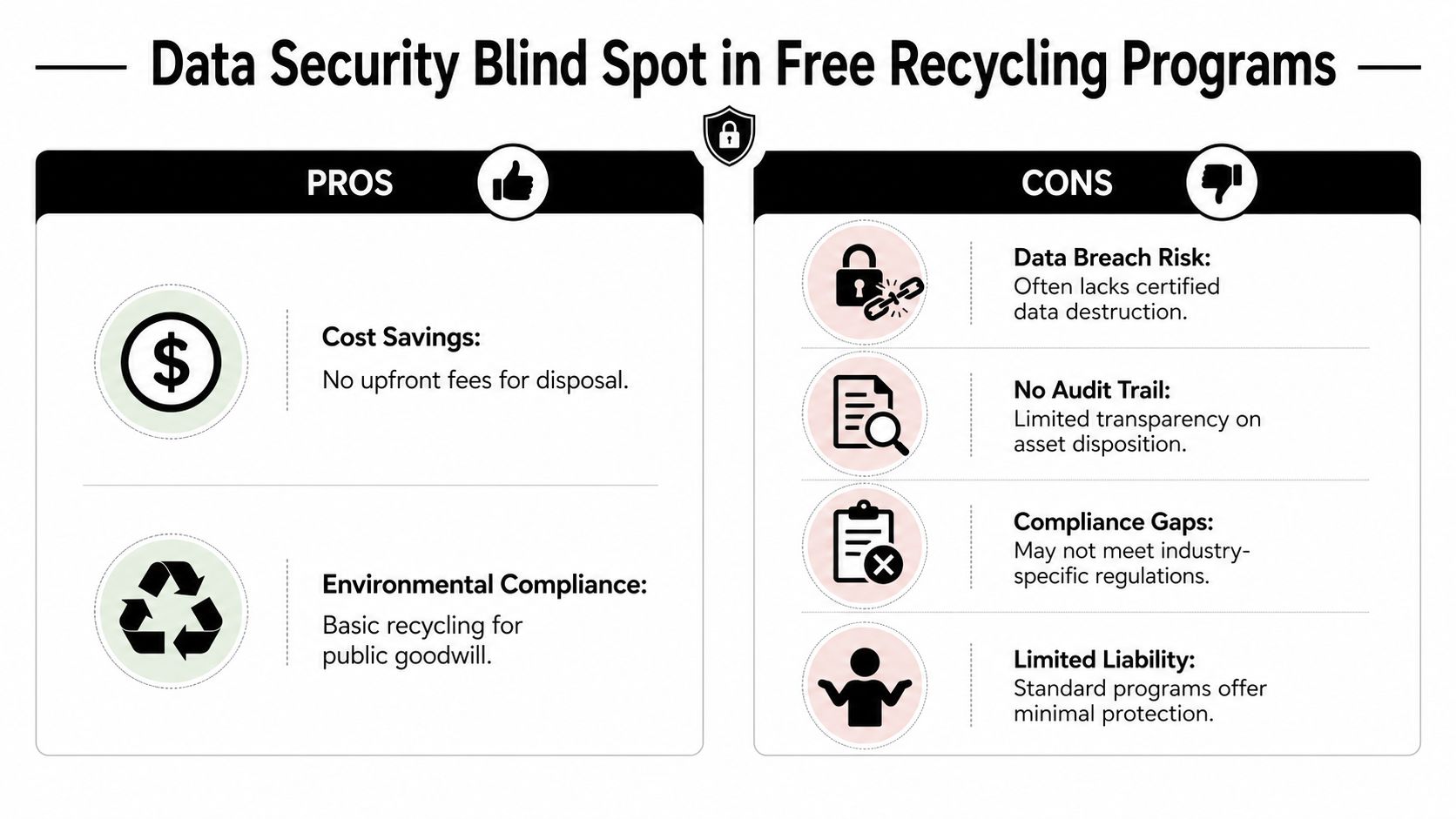
A public drop-off worker may be handling materials responsibly. That still doesn't give your business an audit trail, serialized device tracking, or formal proof of erasure or destruction. If you manage HR records, customer files, financial systems, school devices, or healthcare-adjacent information, that absence of documentation is a major blind spot.
Free disposal solves a hauling problem. It doesn't automatically solve a records-retention, privacy, or security problem.
Where businesses get exposed
The risk usually shows up in ordinary moments:
- A laptop goes out without review. No one confirms whether the drive was wiped, removed, or destroyed.
- Devices move in bulk. Equipment gets packed on carts or pallets, but nobody documents serial numbers or ownership.
- The handoff is informal. A staff member drops items off after work, and the company loses visibility from that point forward.
Those aren't dramatic failures. They're normal shortcuts taken during busy weeks.
Security leaders often treat offboarding and device retirement as part of the broader cyber posture, which is why it can help to protect your business with Wisely when you're reviewing how physical asset disposal fits into your wider risk controls.
What a secure standard looks like
A business-ready process should answer three questions clearly:
| Need | Public event | Professional ITAD workflow |
|---|---|---|
| Data handling proof | Limited or unclear | Documented |
| Asset-level tracking | Usually minimal | Expected |
| Chain of custody | Informal | Controlled |
If your organization can't produce documentation showing what happened to each storage-bearing asset, you're depending on trust where you should be depending on process. Teams that need formal handling typically start with secure data destruction services rather than a general recycling event.
A Business Blueprint for Secure IT Asset Disposition
Office cleanouts go sideways when disposal starts with hauling instead of control. In Kent, the better approach is to treat retired devices like any other regulated business asset. Build the process before pickup is scheduled, especially if your team is tempted to use a free public recycling option that was never designed to give a business the records, security controls, or accountability it may need later.
State disposal rules already push businesses away from the trash route, as noted earlier. The larger issue for most organizations is proving what happened after equipment left the office.

Start with inventory, not trucks
A defensible ITAD project begins with an asset list. Record the asset tag, serial number, device type, department, user status, and whether the item contains internal storage. If the inventory is weak at the start, every downstream record gets weaker too.
For teams dealing with faded tags, duplicate numbers, or inconsistent naming, practical guidance on durable asset labelling strategies can improve tracking before disposition starts.
Choose the data outcome first
Businesses often focus on where the hardware is going and leave data handling for later. That order causes problems.
Set the destruction method based on the asset's risk profile. Reusable laptops and desktops may be suitable for certified wiping if remarketing or redeployment is part of the plan. Failed drives, regulated data, and equipment from finance, HR, or healthcare workflows often justify physical destruction instead. Loose drives, backup media, and pulled SSDs need their own count and custody record, not a place in a mixed box of accessories.
Reuse and data destruction are related, but they are separate decisions. A recycler can recover material value and still leave your documentation incomplete. A proper ITAD process closes both gaps.
Control custody on pickup day
Pickup day is where good plans get tested. Stage equipment in a limited-access area. Match the floor count to the inventory list before loading. Assign one person to sign off on exceptions, such as missing devices, damaged tags, or units that show up after the list was finalized.
For multi-site offices, warehouse admin spaces, or refresh projects spread across departments, that discipline matters. Once devices leave without reconciliation, the company is left explaining the gap instead of preventing it.
Finish with records that stand up to review
A business-grade closeout should produce a complete paper trail. That usually includes pickup documentation, itemized reconciliation, confirmation of data destruction where applicable, and reporting on what was reused, remarketed, or recycled.
That documentation is where a professional ITAD partner separates itself from a public drop-off program. It also helps explain why Kent businesses that care about compliance, security, and local impact often formalize the process with an IT asset disposition strategy and work with a social enterprise partner such as Reworx, rather than treating each cleanout as a one-time recycling errand.
Choosing Your Recycling Partner in Kent
Kent businesses usually have three choices when old equipment starts piling up. They can use a free public option, hire a standard commercial recycler, or work with a partner that handles ITAD with a stronger focus on documentation, reuse, and social impact. The right choice depends on volume, sensitivity, and what your organization needs to prove after the equipment is gone.
Option comparison for real business use
For businesses using E-Cycle WA, the program has a hard limit of five flat-screen TVs, monitors, computers, or laptops per donor, per day at authorized collection sites, according to the E-Cycle Washington program rules. That cap alone makes the free route a poor fit for most office upgrades and bulk laptop disposal projects.

Here's how the options usually stack up:
| Path | Best for | Main limitation |
|---|---|---|
| Free public drop-off | Small quantity of eligible covered devices | Volume limits, narrow item coverage, limited documentation |
| Standard recycler | Bulk material removal | Security and reporting quality can vary |
| Social enterprise ITAD partner | Businesses that want security, compliance support, and community benefit | Requires a more deliberate vendor review |
What to ask before signing anything
Vendor selection shouldn't stop at “Do you recycle electronics?” Ask harder questions.
- How do you track assets? You want a clear answer on serial-level handling and transfer records.
- What happens to storage media? If the answer is vague, keep looking.
- Can you document outcomes? A business needs more than a pickup receipt.
- Do you prioritize reuse where appropriate? Sustainable recycling should include responsible reuse, not only breakdown for scrap.
Legal and compliance teams often use a structured review to compare third-party controls. If you need a framework for that conversation, By Design Law's vendor security help is a useful reference point for evaluating risk in outside service providers.
The cheapest recycling option is rarely the lowest-risk option. For a business, the better question is whether the provider can stand behind the process in writing.
Why the social enterprise model stands out
A standard recycler can remove equipment. A stronger partner can also help convert retired hardware into measurable community value through donation-based recycling, digital inclusion support, and more thoughtful reuse pathways. That matters for sustainability leaders who want their IT equipment disposal program to do more than clear space.
It also matters for procurement teams. Strong vendor selection criteria for electronics recycling and ITAD should weigh data controls, environmental practices, reporting discipline, pickup capability, and whether the partner's mission supports your organization's broader CSR goals.
Turn Your E-Waste Into a Community Asset
The best Kent recycling decisions don't end with a loading dock. They end with a documented outcome your IT team, facilities staff, and leadership can all defend.
A smart electronics recycling plan protects data, keeps covered devices out of the trash stream, and gives your team a repeatable way to handle office cleanouts, laptop disposal, product destruction, and other end-of-life equipment decisions. For businesses, that's the difference between “we got rid of it” and “we managed it properly.”
There's also a bigger opportunity. When a disposition program prioritizes repairable or reusable equipment, old devices can support digital inclusion, community technology access, and workforce development rather than going straight into the shred pile. That's where donation-based recycling and social enterprise recycling become more than sustainability language. They become a practical extension of your company's community impact.
If you're reviewing corporate donation programs or deciding which devices are still suitable for reuse, it helps to start with a clear process for how to donate a laptop responsibly. The same discipline that protects your organization also makes those donations more credible and more useful.
For Kent-area business owners, IT managers, sustainability directors, schools, and public agencies, the message is simple. Treat retired electronics like assets until the final record says otherwise. That approach lowers risk, improves accountability, and creates better outcomes for both your organization and the community.
If your organization needs a practical partner for electronics recycling, IT equipment disposal, secure data destruction, office cleanouts, or corporate donation programs, Reworx Recycling is worth a closer look. Their donation-based, social enterprise model helps businesses retire old equipment responsibly while supporting communities through technology access, digital inclusion, and workforce development. Reach out to schedule a pickup, plan a secure ITAD project, or build a recycling program that does more than remove clutter.