A lot of Atlanta businesses are in the same spot right now. The IT closet is full of retired laptops, a few swollen phone batteries are sitting in a box nobody wants to touch, and a server refresh or office cleanout is about to add even more material to the pile.
That buildup isn't just an operations nuisance. It creates fire risk, compliance risk, and avoidable confusion for the people who have to move equipment out of service without disrupting business. Lithium battery disposal works best when it's treated as part of a formal end-of-life program for electronics recycling, IT equipment disposal, secure data destruction, and facility transitions.
The Growing Challenge of End-of-Life Lithium Batteries
Lithium batteries show up across nearly every business function. IT teams manage them in laptops, tablets, phones, scanners, and backup devices. Facilities teams run into them in access control hardware, alarms, tools, and powered carts. Operations managers find them buried inside handheld equipment, medical devices, and specialized lab gear that no longer powers on but still contains stored energy.
That matters because disposal decisions usually happen late. Equipment gets set aside first, then revisited months later during a move, data center decommissioning project, or year-end asset review. By then, labels may be hard to read, some packs may be damaged, and nobody is fully sure what can go into a standard electronics recycling stream.
The environmental stakes are high. An estimated 70% of hazardous waste in landfills already comes from e-waste, and global lithium-ion battery energy capacity is projected to rise from 218 GW·h in 2019 to over 2,500 GW·h by 2030 according to this battery recycling analysis. For businesses, that means lithium battery disposal is becoming a core part of environmental compliance rather than a side task.
A workable program starts with identification. Before anyone packs, ships, or schedules pickup, staff need to know which devices contain lithium-ion cells, which batteries are removable, and which units show warning signs such as swelling, cracking, heat damage, or leakage.
Practical rule: If your team can't identify the battery chemistry and condition, it shouldn't move the item into a generic recycling bin.
Atlanta firms in logistics, healthcare, professional services, higher education, and technology all face this same issue at different scales. The companies that handle it well usually build battery management into their broader sustainability process instead of treating it as a one-off cleanup task. A good starting point is understanding the broader impact of e-waste on the environment and then translating that awareness into an on-site handling standard.
Identifying and Classifying Your Business Batteries
The fastest way to create problems is to treat all batteries as if they're the same. They aren't. For business programs, the first job is classification. That means separating lithium-ion batteries from nickel-cadmium, lead-acid, alkaline, and mixed electronic scrap before any office cleanout, computer recycling, or IT asset disposition project moves forward.

What to look for in real equipment
Most business teams can identify loose laptop batteries. The harder part is spotting batteries hidden inside assets that don't look battery-powered at first glance.
Common examples include:
- Corporate laptops and tablets with internal pouch cells marked "Li-ion" or "Li-Poly."
- Smartphones and handheld scanners used in warehouses, field service, and healthcare settings.
- UPS modules and backup devices in network closets and data center environments.
- Medical and laboratory equipment with embedded backup batteries that stay in the unit even after decommissioning.
- Cordless tools and building systems gear used by maintenance teams.
If the label says Li-ion, Lithium-Ion, Li-Poly, or Lithium Polymer, treat it as part of your lithium battery disposal stream. If there is no visible label because the battery is internal, classify the device before dismantling it. Guessing is where incidents start.
Why condition matters as much as chemistry
Classification isn't just about chemistry. It's also about condition. An intact battery and a swollen battery don't belong in the same handling flow. The same applies to leaking, dented, punctured, heat-damaged, or recalled units.
Businesses often make three mistakes here:
- They mix damaged batteries with intact batteries in one tote.
- They leave batteries inside retired equipment without checking whether the item contains an embedded pack.
- They hand off mixed material to general cleanout crews who aren't prepared for battery hazards.
Those shortcuts raise fire exposure and create confusion for downstream recycling and transportation.
A clean inventory beats a fast cleanup. If you sort batteries by chemistry, condition, and device type at the start, every later step gets easier.
For Atlanta companies managing laptop disposal, medical equipment disposal, laboratory equipment disposal, or broader ITAD projects, classification should be documented in the same asset review used for secure data destruction and product destruction decisions. If your team already uses a universal waste management process, add a battery-specific screen to it rather than creating a separate standalone workflow.
A useful internal rule is simple: intact batteries, damaged batteries, and battery-containing devices should be staged separately. That single change usually eliminates most of the preventable mistakes I see during facility cleanouts and electronics recycling prep.
Safe On-Site Handling and Storage Protocols
A typical failure starts with a routine cleanout. Staff pull retired laptops, loose phone batteries, and a few swollen packs from a maintenance cabinet, then set everything in one corner until pickup day. That is often where the fire risk begins, not at the recycler.
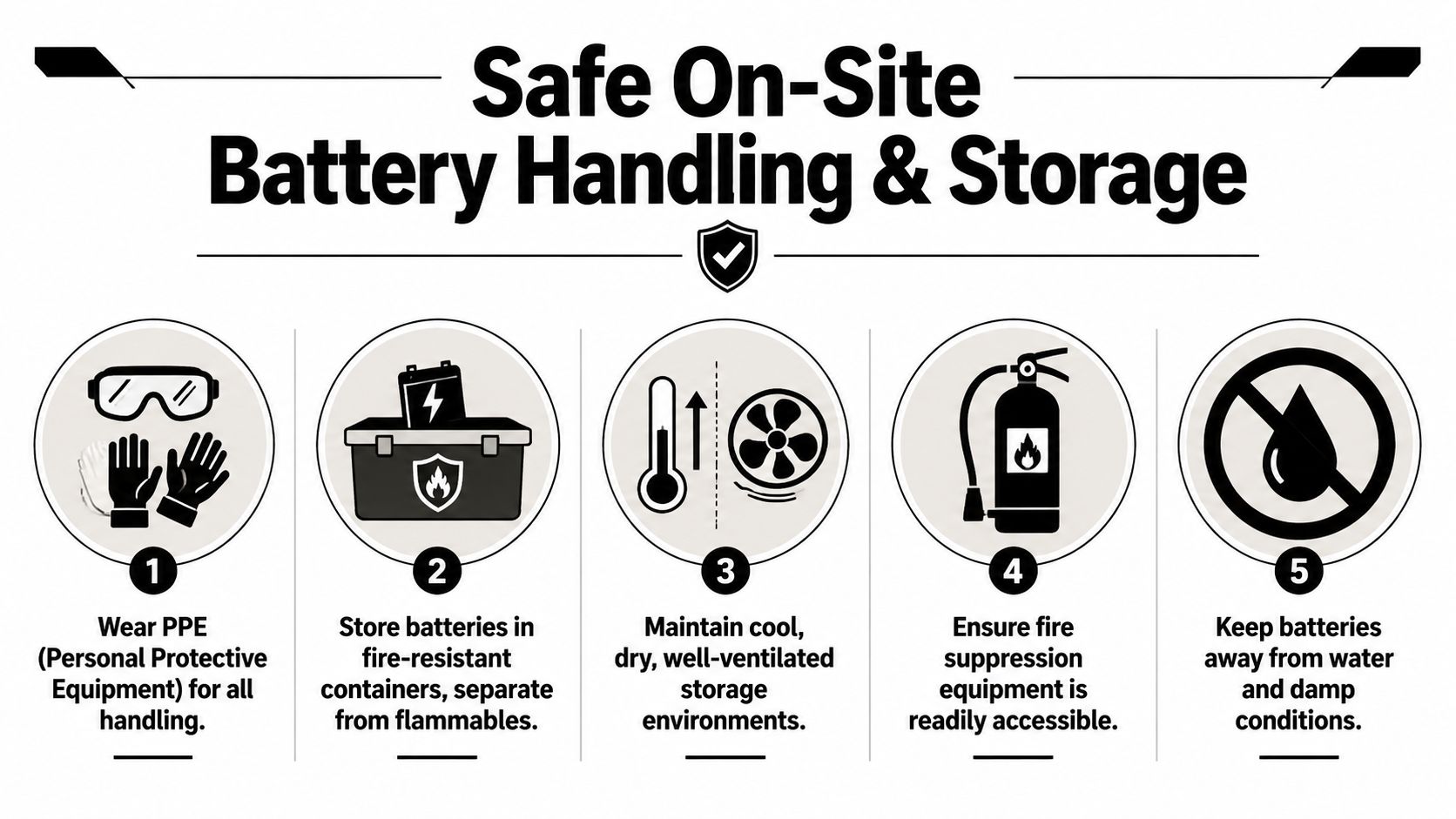
For businesses managing bulk quantities, the goal is simple. Build a staging process that a warehouse associate, facilities technician, or ITAD contractor can follow correctly every time. Good storage controls reduce fire exposure, prevent transportation delays, and make downstream recycling easier to document.
What your storage area needs
EPA advises businesses handling used lithium-ion batteries to protect terminals from short circuits by taping them with non-conductive tape or placing each battery in its own bag, and to keep damaged batteries in non-flammable material for interim storage, as described on the EPA page for used lithium-ion batteries.
That guidance should be written into site procedures, posted in the accumulation area, and reinforced in staff training.
A storage setup that holds up in the field usually includes:
- Non-conductive containers for loose cells and small battery packs
- Separate, clearly marked containers for damaged, defective, recalled, or swollen batteries
- Physical clearance from combustibles such as corrugate, paper files, wood pallets, aerosols, and cleaning supplies
- Restricted access so only trained employees or approved vendors handle the material
- An incident plan at the point of storage covering overheating, venting, smoke, and evacuation steps
- A documented inspection routine so someone checks container condition, labels, and battery volume before the area gets overloaded
The last point matters more than many companies expect. Storage areas fail slowly. A tote fills up, one swollen pack gets dropped into the wrong bin, labels fall off, and no one notices until the pickup team refuses the load.
What works on the floor
The safest battery room is usually the least interesting one. Terminals are covered. Containers stay closed. Intact units and damaged units never mix. One person owns inspections.
These are the storage choices I recommend most often for business sites handling IT refreshes, facility cleanouts, and recurring electronics recycling volumes:
| Storage choice | Result |
|---|---|
| Plastic tote with separated, taped intact batteries | Suitable for temporary accumulation |
| Non-flammable container with sand or kitty litter for damaged batteries | Suitable as an interim control until specialist pickup |
| Mixed e-waste gaylord with loose batteries dropped inside | Unacceptable fire and sorting risk |
| Cardboard box near shipping materials | Poor control and poor fire separation |
| Open shelf holding recalled or swollen batteries | High-risk condition that should be corrected immediately |
Bulk programs need one more rule. Do not let volume dictate storage decisions. If a site is generating more batteries than the approved accumulation area can hold safely, increase pickup frequency or add a second controlled area. Overflowing containers create the same problems as poor training.
The compliance point that affects storage decisions
Storage procedures should reflect the fact that hazard classification does not disappear just because the batteries are waiting for shipment. A battery may be managed under a more practical collection framework before shipment to a qualified downstream facility, but the fire hazard, packaging expectations, and downstream waste responsibilities still shape what you should do on site.
That becomes more important if your vendor plans to process batteries beyond simple collection. EPA's recent memo on shredded lithium battery material explains that black mass sent for metals recovery is generally a solid waste and may also be a hazardous waste, depending on the material and conditions, as discussed by K&L Gates in its review of EPA's black mass memorandum. For a business generator, the practical takeaway is clear. Choose a recycler or ITAD partner that can explain the downstream path, not just the pickup date.
If your company manages several battery chemistries in one program, keep the workflow unified but the containers separate. Lithium batteries should not be handled as if they present the same storage and transportation profile as nickel-cadmium or lead-acid units. This nickel-cadmium battery disposal guidance is a useful reference for building chemistry-specific controls inside one battery management program.
I advise clients to treat the battery area like any other controlled hazard point in the facility. Post the rules. Train the people who touch the material. Audit the setup after the first large cleanout. If you use a social enterprise partner such as Reworx, that discipline does more than support compliance. It helps keep hazardous material out of the wrong waste stream while supporting responsible local jobs and community reinvestment.
Navigating Disposal Regulations and Compliance
A compliance problem usually shows up after a cleanout, not before. The IT team has a gaylord full of retired laptops, facilities has loose batteries from UPS units, and someone finds a swollen pack in a desk drawer. At that point, the question is no longer whether the batteries are recyclable. The question is whether your company can show that it identified the material correctly, managed it safely on site, and sent it through a legal downstream channel.
The rule that drives the program
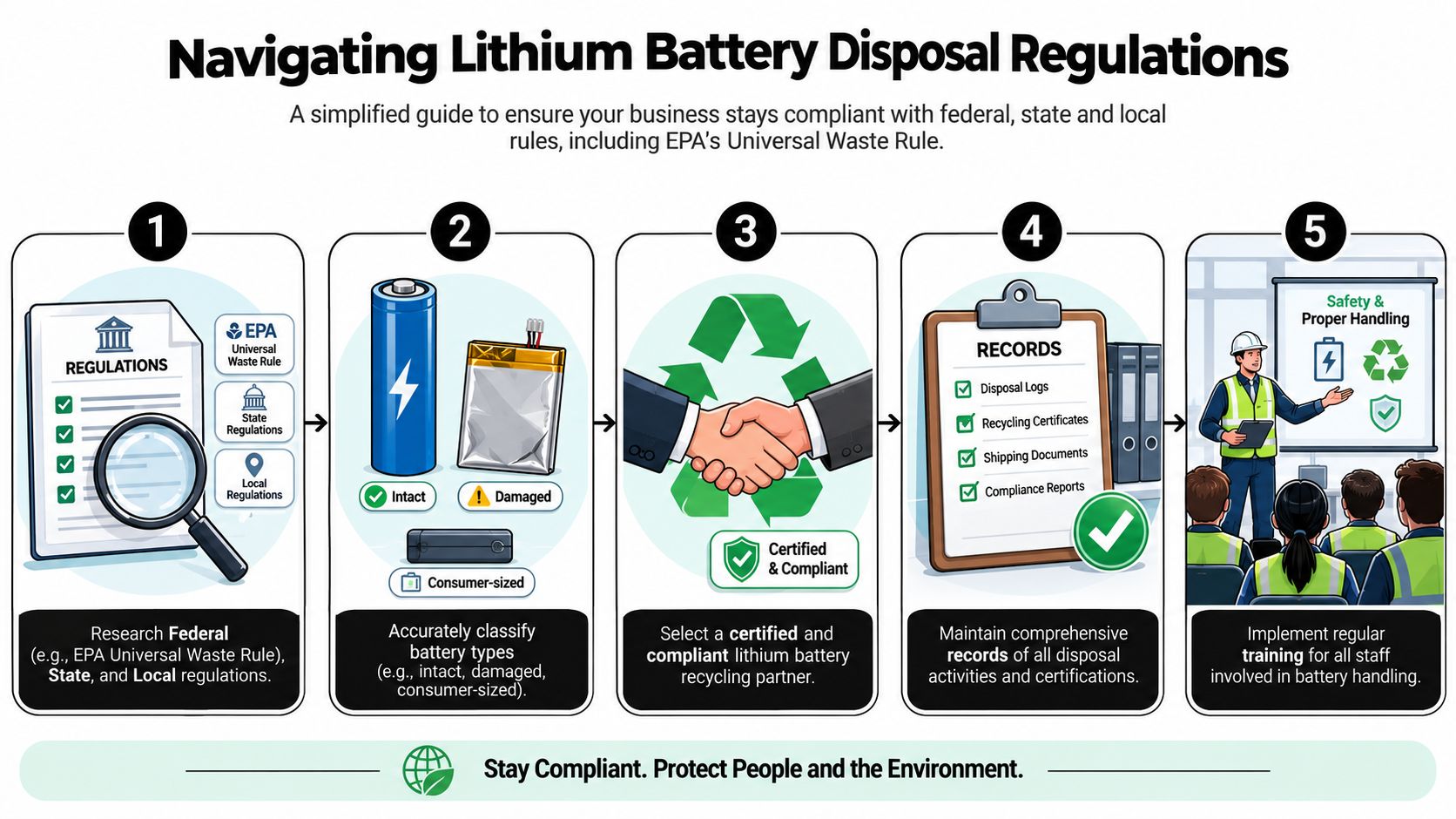
For many businesses, end of life lithium batteries can be managed under the universal waste framework during accumulation and shipment, but that does not reduce the duty to handle them as a regulated waste stream. EPA's universal waste page is a good starting point for the federal structure. In practice, companies still need written procedures, employee training, container controls, and a recycler or ITAD partner that can explain what happens after pickup.
State rules matter too. Georgia facilities should confirm whether any state-specific management requirements, fire code expectations, or local authority guidance affect battery accumulation areas, labeling, or storage time. I advise clients not to rely on a generic national policy when they are storing bulk quantities at one site.
What compliance looks like on the ground
The companies that stay out of trouble use a repeatable workflow and assign ownership.
Identify the waste stream early
Flag battery-containing assets during refresh projects, relocations, office closures, and decommissions. Do not wait until equipment reaches the loading dock to decide whether batteries are present.Separate by chemistry and condition
Intact lithium-ion batteries, damaged units, and battery-containing devices should not be thrown into one collection path. Damaged, defective, or recalled batteries need tighter controls and often a different packaging and shipping setup.Label containers clearly
Container markings need to be readable by internal staff, transport personnel, and emergency responders. Many sites use professional warning labels to keep accumulation areas consistent and reduce handling mistakes.Maintain records that match the workflow
Keep training logs, internal transfer records, pickup documentation, and certificates tied to the actual material moved. If your counts and descriptions do not match the shipment, that gap becomes a compliance problem.Check the downstream vendor
Ask how the material is processed, whether batteries stay segregated, and how hazardous fractions are managed at the destination facility. Collection is only the first step.
This matters most when your site handles bulk volumes. A few loose batteries in a branch office are manageable. Pallets of mixed devices from a hospital upgrade, school district refresh, or warehouse closure create a different risk profile and need tighter control.
Why disposal and ITAD should sit in one program
Battery disposal breaks down when it is handled outside the ITAD process. Real retirement projects mix devices, storage media, chargers, embedded batteries, and loose cells in the same event. If one vendor handles data-bearing assets and another handles batteries with no shared inventory or chain of custody, gaps open up fast.
A better model ties battery review to asset tagging, data destruction decisions, pickup scheduling, and final disposition. That is especially true for laptops, tablets, phones, network gear, medical devices, and UPS equipment, where the battery risk and the data risk often sit in the same asset.
For companies building that process, Reworx offers a battery recycling service for business electronics and battery-bearing equipment that fits inside a broader ITAD workflow. That structure supports compliance, reduces the chance of batteries being missed during cleanouts, and channels reusable value into a social enterprise model that supports local jobs and community reinvestment.
Preparing Batteries for Transport and Secure ITAD
Once batteries leave your site, transportation rules take over. Many otherwise careful companies make avoidable mistakes. They pack damaged batteries like ordinary returns, use the wrong labels, or assume a mail-in option is acceptable for every condition category.
Comparing the common disposal routes
Not every disposal route fits every business need.
| Option | Where it fits | Limits |
|---|---|---|
| Mail-in program | Small volumes of intact batteries and simple remote sites | Less suitable when assets include damaged units or mixed IT loads |
| Municipal or household hazardous waste channel | Households and occasional small quantities | Usually not designed for ongoing business programs |
| General electronics pickup | Works for standard electronics streams | Can fall apart if the provider isn't prepared for batteries |
| Specialized recycler with ITAD capability | Best for bulk business loads, embedded batteries, and chain-of-custody needs | Requires upfront process coordination |
For Atlanta firms handling office cleanouts, computer recycling, medical equipment disposal, or facility-wide refreshes, a specialized recycler usually makes the most operational sense because batteries rarely appear alone. They show up inside equipment that also contains drives, tags, proprietary components, and regulated data.
One local option is Reworx Recycling's UN 3481 label resource, which is useful when teams are preparing battery-containing devices for compliant transport as part of a larger IT equipment disposal workflow.
The transport rule that changes everything for damaged batteries
Transportation rules become much stricter once a battery is damaged, defective, or recalled. DDR lithium batteries are forbidden from air transport and must move by ground with specific non-metallic inner packaging and Class 9 hazard labeling, according to the PHMSA lithium battery recycling safety advisory.
That single rule affects how businesses handle faulty laptops, recalled devices, swollen phones, and compromised packs pulled from warehouse or field equipment. If your team uses overnight shipping by default for returns, that habit needs an exception process.
Practical shipping prep usually includes:
- Condition review before packing so DDR units are separated from intact batteries.
- Non-metallic inner packaging for damaged batteries.
- Correct external hazard communication using compliant Class 9 labeling.
- Clear package-level warnings so carriers and receivers know what they're handling.
If your shipping room needs a reference point for hazard communication, a catalog of professional warning labels can help staff understand the kind of visual labeling system that belongs in a controlled battery packing process.
If a battery is swollen or leaking, stop thinking like a shipper and start thinking like an incident-prevention manager.
How this ties into secure data destruction
Transport prep also has to match your ITAD process. If a laptop contains sensitive data and an internal battery, the battery issue can't be separated from the data issue. The device needs a retirement path that addresses both.
That's why the strongest programs combine:
- Secure data destruction
- Laptop disposal and computer recycling
- Battery segregation
- Pickup scheduling and chain-of-custody records
- Donation screening for reusable equipment
That integrated approach is especially important during data center decommissioning, branch consolidations, mergers, and corporate donation programs where large numbers of assets leave the building quickly.
Your Partner for Responsible Recycling in Atlanta
A responsible lithium battery disposal program does three jobs at once. It reduces fire risk on-site, keeps the business inside the rules that govern hazardous and universal waste handling, and moves retired equipment into a more sustainable end-of-life channel.
Atlanta businesses have an advantage here because they can build local systems instead of relying on distant, fragmented disposal chains. That matters operationally. It also matters environmentally. China accounted for about 80% of the world's 340 GWh of battery recycling capacity in 2023, while Europe and the United States are expected to expand their share by 2030, according to Statista's lithium-ion battery recycling market overview. In practice, using regional recycling infrastructure helps businesses strengthen a local circular economy instead of pushing material farther across the map than necessary.
What a mature program looks like
The companies that handle this well usually have five habits in place:
- They identify batteries before assets move during office cleanouts, laptop disposal, and data center decommissioning.
- They separate damaged units immediately instead of letting them sit in mixed electronics bins.
- They train shipping, IT, and facilities staff together because battery handling breaks down when each group assumes another team owns the issue.
- They connect battery disposal to ITAD so secure data destruction and electronics recycling happen in one coordinated process.
- They choose partners that can support donation-based recycling and community outcomes, not just material removal.
Why the social enterprise model matters
There's a practical business case for working with a donation-based recycling partner, but there's also a community case. When equipment is evaluated for reuse before recycling, more organizations can support digital inclusion, workforce development, and corporate donation programs while still maintaining a disciplined compliance framework for non-reusable assets and hazardous components.
That combination is valuable for sustainability leaders because it turns disposal into something more useful than a cost center. It becomes part of ESG reporting, local community investment, and responsible asset retirement.
For Atlanta organizations looking to align sustainable recycling with operational control, advancing sustainability with Reworx Recycling's battery recycling solutions is a practical example of how battery management can fit into a wider electronics recycling and social enterprise recycling strategy.
The strongest disposal programs don't end with removal. They create a repeatable system for safety, compliance, recovery, and community benefit.
Businesses in metro Atlanta that manage warehouses, clinics, offices, schools, labs, and distributed field equipment don't need a generic battery drop-off answer. They need a process that can handle bulk quantities, embedded batteries, damaged units, secure data destruction requirements, and the realities of day-to-day operations.
If you're building that process now, start with a site review, define who owns classification and staging, and set one approved path for pickup and downstream handling. That's how lithium battery disposal becomes manageable.
Atlanta businesses can turn battery disposal, electronics recycling, IT equipment disposal, and corporate donation programs into one controlled process by partnering with Reworx Recycling. If your team is planning a pickup, a facility cleanout, a laptop disposal project, or a broader ITAD transition, contact Reworx to discuss safe collection, secure data destruction, and responsible reuse and recycling options.