Cybercrime is projected to reach USD 10.5 trillion by 2025 according to IBM's analysis of C-suite concerns. That number should end the old debate about whether cybersecurity belongs in the server room or the boardroom. It belongs in the boardroom, next to liquidity, legal exposure, supply chain resilience, and capital allocation.
Most executives still approach cyber risk as if it were a specialist function. That's a mistake. In practice, the CEO, CFO, board chair, and senior leadership team sit at the center of the risk map. Attackers know where authority sits. They know who can approve wire transfers, influence disclosures, override controls, and access sensitive plans.
That's why cybersecurity for executives starts with a blunt reality. You are both the strategist and the target. Your decisions shape enterprise resilience, and your personal exposure can create business exposure. If you want a useful lens on external exposure beyond internal dashboards, this guide to dark web monitoring for businesses offers a practical way to think about leaked credentials and public-facing risk signals.
Executives also need to understand the legal and operational consequences that follow an incident. A breach isn't just a technical event. It triggers disclosure decisions, customer communications, contract issues, and state-level obligations. That's why board members should keep a working grasp of state data breach laws as part of governance, not just after something goes wrong.
Cybersecurity Is a Business Leadership Imperative
Cybersecurity belongs in the same category as credit risk and operational risk because it can shut down revenue, distort financial reporting, and damage enterprise value. IBM notes that CEOs and board members are targeted in 43% of business email compromise attacks, yet only 10% of organizations assess executive cyber-awareness in the same analysis linked above. That gap is management failure. If leaders are a primary target, leader-specific testing and preparation should be standard.
Why the board should care
Financial leaders already understand the logic. You don't manage treasury risk by waiting for a cash crisis. You build controls, reporting, escalation paths, and rehearsed responses. Cybersecurity needs the same discipline.
A cyber program without executive engagement usually produces the wrong outcomes:
- Security becomes reactive. Teams spend heavily after incidents instead of reducing exposure beforehand.
- Reporting stays too technical. The board gets attack counts, not business risk.
- Leadership becomes the weak link. Senior people often bypass controls for convenience, then become the ideal entry point.
Practical rule: If a risk can interrupt operations, move money, expose regulated data, or damage market confidence, it's a board issue.
Why executives are part of the attack surface
Attackers rarely need to break every control. They need one believable opening. A senior executive's account, device, or home environment can provide that opening because it combines authority, visibility, and urgency. A fake payment request from a finance clerk may be questioned. A fake request that appears to come from the CEO at the end of a quarter often won't.
That's why cybersecurity for executives isn't about turning directors into engineers. It's about forcing better decisions. Ask whether leadership gets simulations designed for them. Ask whether high-risk approvals require stronger authentication. Ask whether the company has tested how quickly it can detect executive account abuse.
If those answers are vague, the governance is weak.
Understanding the Modern Threat Landscape
The most dangerous attacks against executives don't look dramatic. They look routine. A calendar invite. A text from a known contact. A request to review a contract. A message that appears to come from legal, the bank, or the CEO.
Verizon reports that 99% of executives have their personal information on over three dozen data broker websites, and 40% of these profiles include the executive's home network IP address, enabling highly targeted whaling and eavesdropping attacks in its guide to executive cybersecurity protection. That's the core issue. Attackers don't guess. They assemble.
Whaling is just fraud aimed at authority
“Whaling” is a targeted attack aimed at senior leaders. “Business Email Compromise” is usually the monetization layer. The attacker studies the executive, impersonates a trusted person or context, then pushes for a payment, credential, document, or exception.
The sequence is simple:
- Profile the executive through public records, social media, and broker data.
- Exploit trust with a believable scenario tied to urgency or confidentiality.
- Convert access into business impact through payment fraud, account compromise, or lateral movement.
This is why executive exposure isn't a private matter. It's an enterprise issue.
Your digital footprint is corporate risk
Many boards still separate “personal cybersecurity” from “company cybersecurity.” That distinction doesn't hold up for senior leaders. If an attacker can map your habits, family details, routines, and online presence, they can build better pretexts. If they can target your personal accounts or devices, they can increase the odds of reaching your business environment.
A useful way to think about it is this: your public footprint is reconnaissance material.
| Executive exposure | Business consequence |
|---|---|
| Publicly available personal details | More convincing impersonation and social engineering |
| Home environment visibility | Better targeting for surveillance or credential theft |
| Unvetted personal device habits | Greater chance of account compromise |
| Overexposed social profiles | Easier timing of attacks around travel, earnings, or deals |
For many organizations, the fastest way to reduce this risk is to tighten executive-specific controls and improve data breach prevention practices around identity, access, and end-user behavior.
Attackers don't target executives because they're famous. They target them because authority shortens the path to money and data.
What leadership should stop doing
Executives create avoidable exposure when they:
- Approve exceptions casually for convenience
- Use personal channels for sensitive business communications
- Delegate security decisions blindly without understanding the business tradeoff
- Assume public information is harmless because it's already “out there”
None of that is harmless. In cybersecurity for executives, small habits change the attack economics. That's the point.
Building a Framework for Cybersecurity Governance
Strong governance makes cybersecurity boring in the best possible way. It creates routine oversight, clear ownership, and disciplined escalation. Weak governance creates theatrical presentations, vague accountability, and surprise losses.
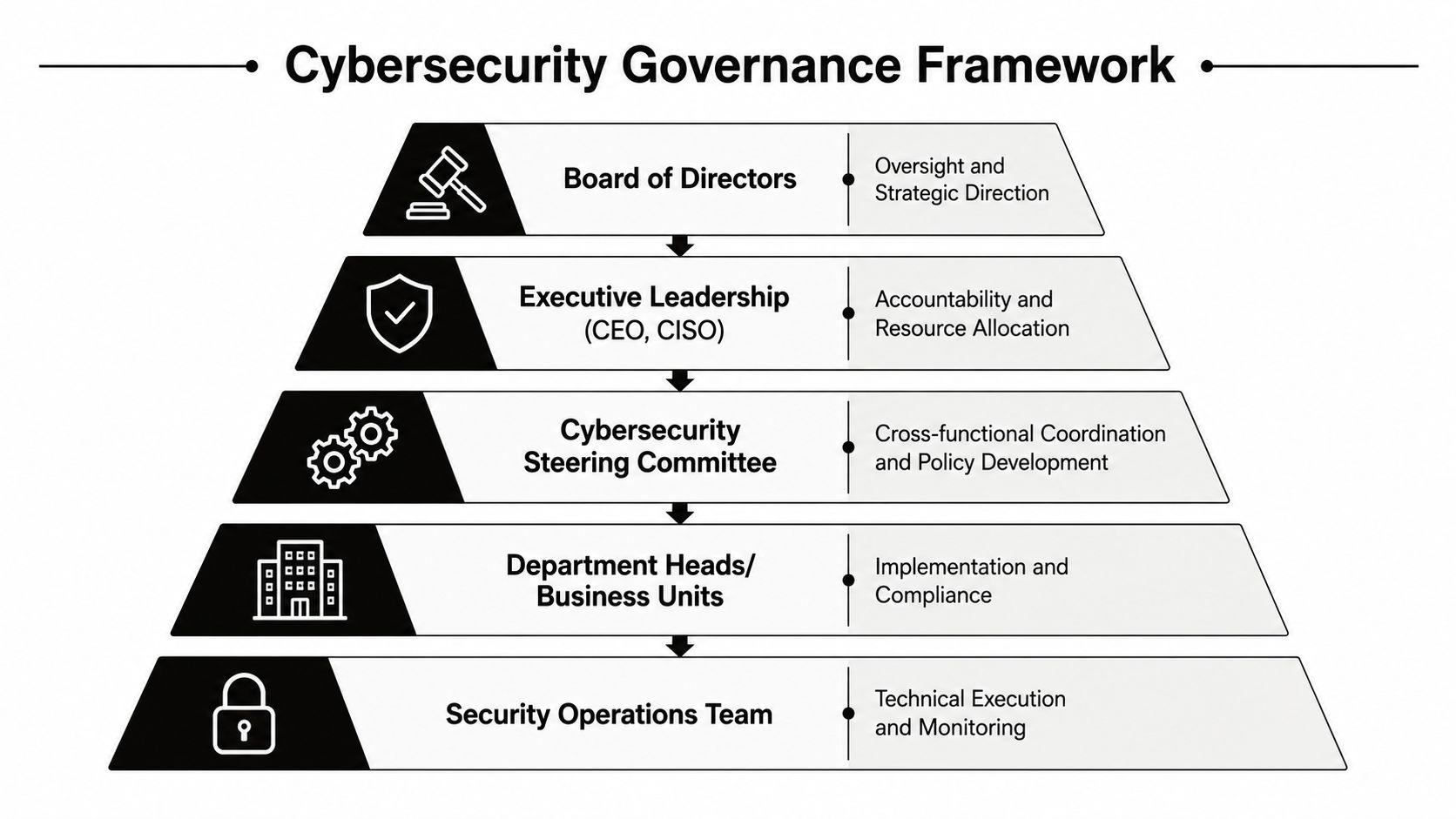
A practical governance model should mirror financial governance. The board sets risk appetite and demands credible reporting. Management allocates resources and makes tradeoff decisions. The CISO runs the program, escalates material issues, and shows whether controls are reducing risk.
Define who owns what
If everyone “supports” cybersecurity, nobody owns it. Write down responsibilities. Put them in committee charters and board materials. Revisit them after incidents and major business changes.
Here's the split that works:
- Board of directors owns oversight, challenge, and risk appetite.
- CEO and executive team own enterprise alignment, funding, and enforcement.
- CISO owns program execution, measurement, and escalation.
- Business leaders own compliance inside their functions.
- Operations teams own implementation, monitoring, and response.
That structure sounds obvious. Many companies still don't enforce it.
Put cybersecurity on a cadence
Annual reviews are governance theater. Cyber risk changes too fast for that. Leadership needs a recurring cadence for risk review, incident readiness, major control gaps, and third-party exposure.
Use a steering committee with representatives from security, finance, legal, operations, procurement, HR, and communications. Make it a decision body, not a discussion forum.
A strong agenda includes:
- Material risks that need executive decisions
- Control failures that affect business resilience
- Open exceptions that increase exposure
- Incident readiness including communications and legal posture
- Third-party and lifecycle risk including retired asset handling and documentation
Because governance breaks down when records are inconsistent, leaders should also pay attention to addressing security documentation challenges. Bad documentation slows response, obscures accountability, and weakens audit readiness.
Good governance doesn't eliminate incidents. It prevents confusion about authority when minutes matter.
Demand evidence, not reassurance
Boards often hear one of two unhelpful messages: “We're secure” or “The threat is growing.” Neither helps. Ask for evidence of process discipline, exception management, and traceable custody for devices and data-bearing assets. Even routine operational controls should be documented with the same seriousness as financial controls, especially when handling retired equipment and regulated information. That's where chain of custody documentation becomes a governance topic, not just an operational one.
If the CISO can't show who accepted a risk, when it was reviewed, and what changed, the organization isn't governing cyber risk. It's narrating it.
Making Strategic Investments in Cyber Resilience
Most cybersecurity budgeting is still too political, too reactive, or too arbitrary. Some firms peg it to the IT budget. Others fund whatever was painful in the last incident. Neither approach is serious.
Security spending should follow business exposure. If a system supports revenue recognition, customer trust, regulated data, or operational continuity, protect it accordingly. If a proposed control doesn't reduce a material risk, challenge it.
Stop treating the budget as a fixed percentage exercise
A mature executive team asks different questions:
- What business process fails if this control is absent?
- What loss scenario becomes less likely or less severe if we fund this?
- What is the residual risk if we delay?
- Are we reducing concentration risk, not just adding tools?
That's how capital allocation works in every other risk domain. Cybersecurity for executives should be no different.
Invest where resilience changes outcomes
The strongest investments usually improve one of four things:
- Identity protection for privileged and high-risk users
- Detection and response so incidents are contained earlier
- Operational resilience so the business can keep running
- Lifecycle control so old systems and retired hardware don't become liabilities
The last category gets ignored too often. Retired devices, decommissioned servers, and old laptops can create unnecessary risk if vendor standards are weak or disposal practices are informal. That's why procurement and risk teams should define vendor selection criteria that cover security controls, handling procedures, and accountability across the full asset lifecycle.
Security investments need business language
A good CISO doesn't ask for budget because “threats are increasing.” A good CISO ties spending to business outcomes. Better resilience. Lower interruption risk. Faster containment. Stronger assurance for customers, regulators, and insurers.
Boards should insist on that translation. If a budget request can't be connected to an identified business risk, it's not ready.
Translating Security Metrics for the Boardroom
Boards don't need more dashboards. They need fewer metrics and better ones. Attack volume, malware counts, and generic threat summaries may interest the security team, but they don't help directors make decisions.
The board should ask a harder question: what is our probable loss exposure, what is changing it, and are we improving our ability to detect and contain incidents?
Use financial framing, not technical clutter
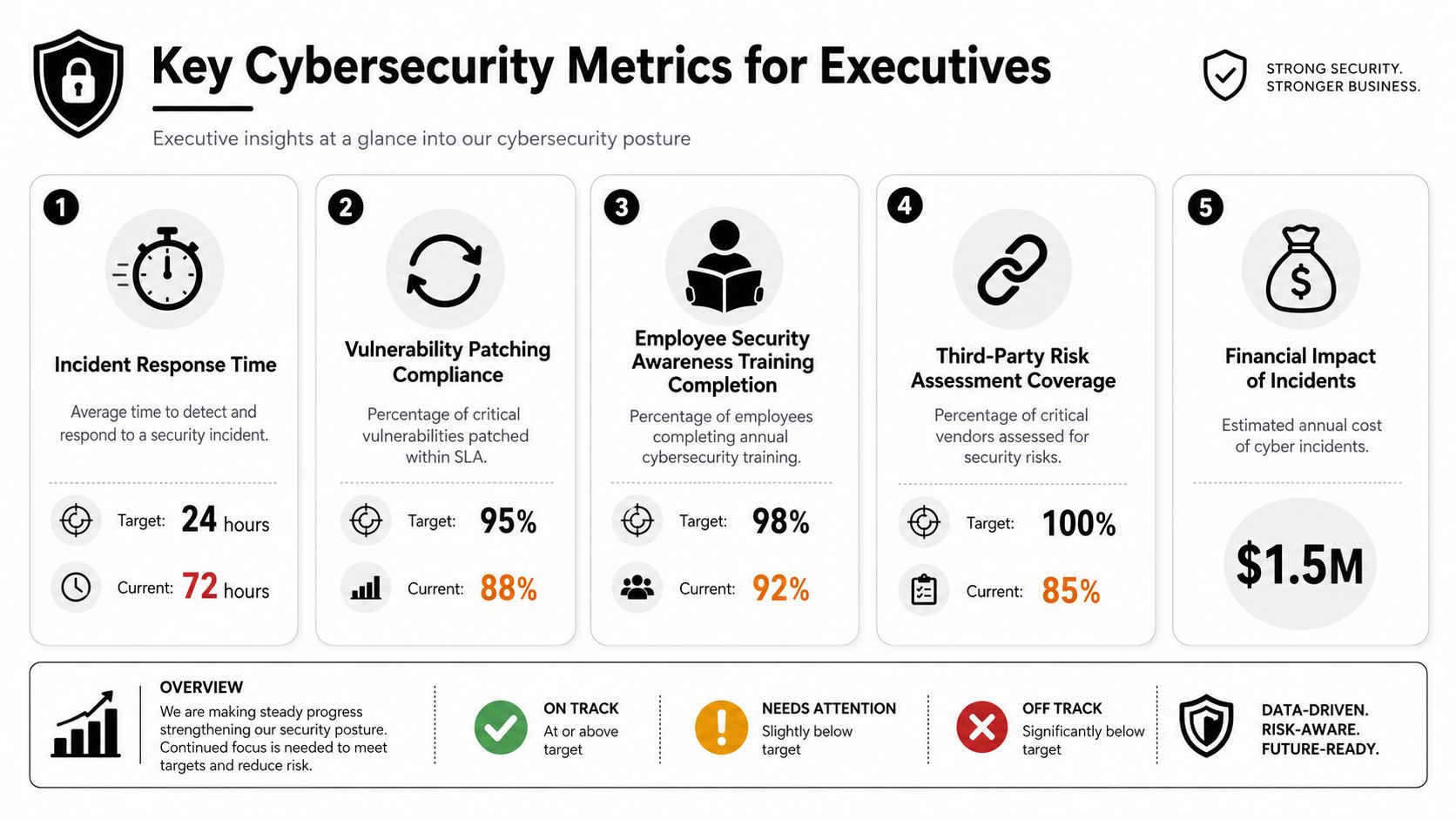
CyberSaint makes the right point in its discussion of board metrics: executives must insist on financial metrics like Annualized Loss Expectancy and Return on Security Investment, and the FAIR model breaks down risk into loss frequency and magnitude to produce a monetary value in its guide to cybersecurity metrics for the board. That framing matters because boards already know how to compare monetary risk across business categories.
When the CISO says a control improves “visibility,” that's not enough. Translate it. Does it reduce outage risk on a critical process? Does it reduce fraud exposure? Does it lower the likely financial impact of a credential-based attack?
The metrics that deserve board attention
A board-ready dashboard should show trends, exceptions, and business consequence. Not noise.
| Metric | Why it matters in business terms |
|---|---|
| Annualized Loss Expectancy | Estimates the financial value of risk exposure |
| Return on Security Investment | Shows whether spending is reducing meaningful risk |
| Mean Time to Detect | Indicates how long threats can operate before discovery |
| Mean Time to Respond | Indicates how quickly the business can contain damage |
| Privileged Access Review Rate | Shows whether high-risk access is being challenged and reduced |
SecurityScorecard highlights the importance of Privileged Access Review Rate, plus Mean Time to Detect and Mean Time to Respond, in its discussion of security KPIs for executive oversight in this cybersecurity metrics overview. Those measures tell leaders whether the company is limiting blast radius and responding with discipline.
The right metric changes a board conversation from “How many attacks did we block?” to “How much loss exposure are we carrying, and is it going down?”
What to reject in board materials
Directors should push back on reports that are heavy on activity and light on meaning. Challenge any dashboard that:
- Counts alerts without context
- Highlights tool deployment instead of risk reduction
- Omits trends across quarters
- Hides unresolved exceptions
- Avoids financial interpretation
A board packet should read like risk management, not product telemetry.
Leading Through Crisis and Managing Third-Party Risk
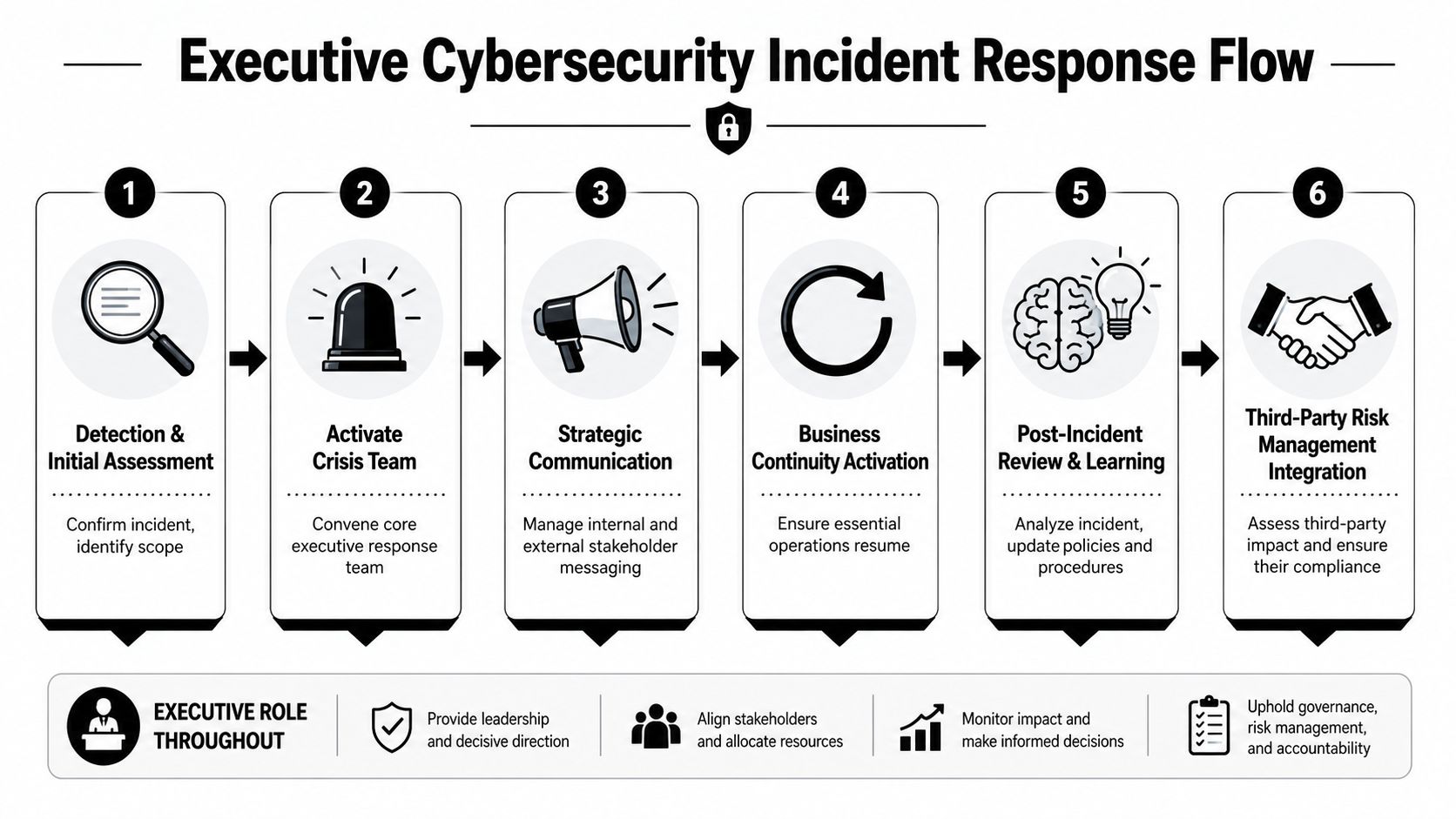
A breach tests leadership fast. The technical team investigates. The executive team decides how the company communicates, what operations get prioritized, when counsel gets involved, and how much risk the business can absorb while systems are constrained.
That sequence should already be rehearsed before the incident starts.
What the executive team must do in the first phase
When a serious incident surfaces, leadership should focus on five decisions:
Confirm command structure
Who is making operational calls, who approves external communications, and who updates the board?Protect continuity
Which systems and processes must stay live for the business to function?Control the message
Employees, customers, regulators, and partners shouldn't hear competing stories.Preserve evidence and legal posture
Counsel should be engaged early enough to guide obligations and records.Contain vendor spillover
Third parties may be part of the cause, impact, or recovery path.
Third-party risk is not procurement paperwork
Many incidents become worse because the affected company depended on a vendor it never fully assessed. Shared platforms, outsourced operations, disposal providers, cloud services, and software suppliers all shape exposure.
For leaders who want a plain-English view of vendor dependency and concentration issues, understanding digital supply chain threats is a useful companion to internal risk reviews.
Third-party oversight should answer basic questions:
- Which vendors are mission-critical
- What data or system access they hold
- How quickly they must notify you of incidents
- What recovery commitments they owe
- How they handle retired equipment and media
That last point matters more than many boards realize. End-of-life handling is part of cyber risk, not just facilities management. Contract terms should define notification duties, documentation, handling standards, and performance expectations through clear service-level agreements.
A vendor with weak controls can create the same business loss as an internal control failure. The customer still suffers the interruption, the disclosure burden, and the reputational damage.
The final stage of risk management
Executives often focus on live systems and ignore retired ones. That's a gap. Old laptops, storage devices, lab gear, medical equipment, and decommissioned infrastructure can still expose sensitive information if they aren't handled correctly. Cybersecurity for executives must include secure IT asset disposition because unmanaged disposal is a delayed breach risk.
Leadership should treat asset retirement like records retention or treasury access. It needs policy, accountability, and proof.
Your Executive Cybersecurity Action Checklist
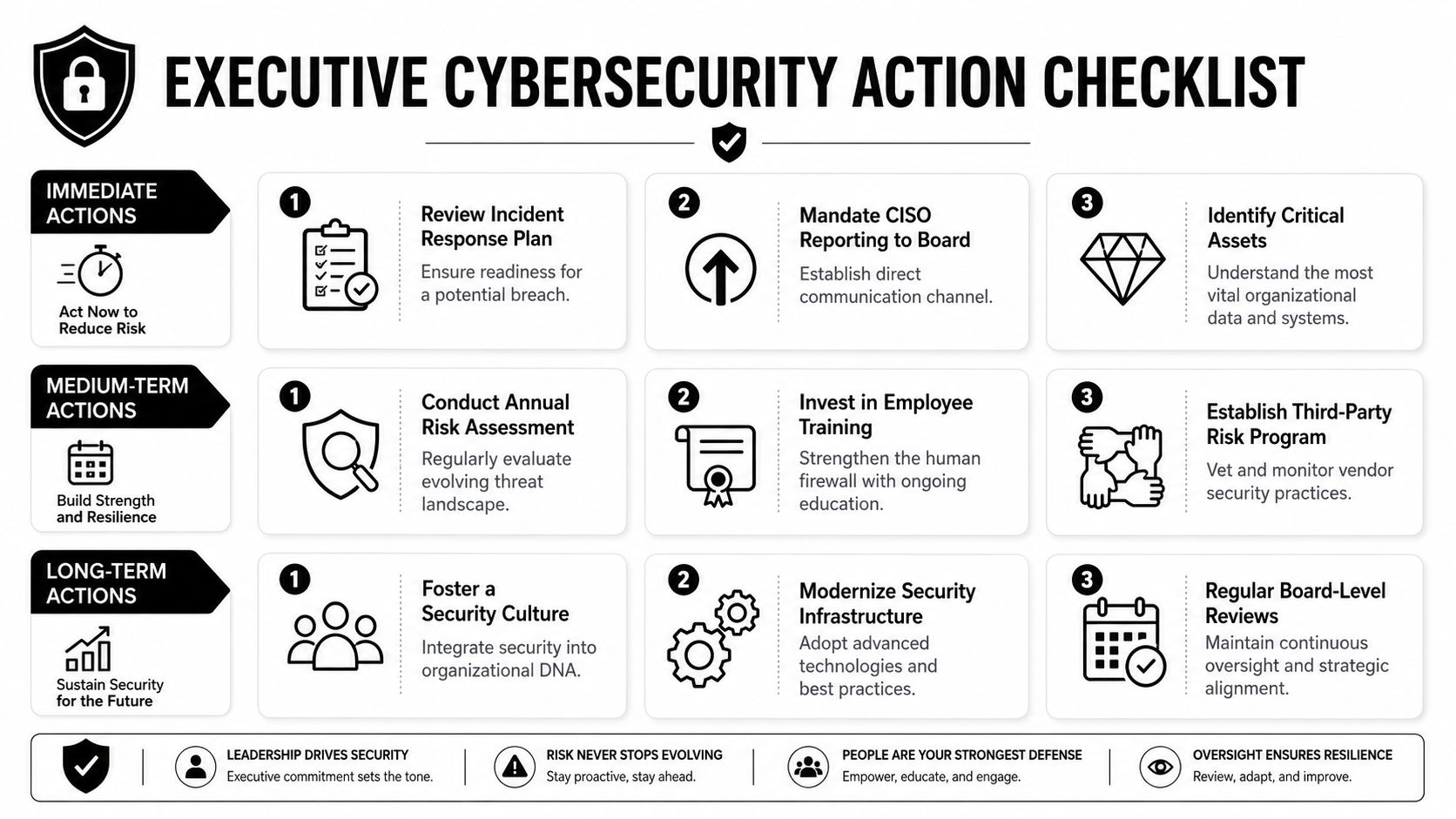
The board doesn't need another awareness session. It needs action. Use the checklist below to tighten personal exposure, improve governance, and make the company harder to disrupt.
Immediate moves
Take these actions now, not next quarter.
- Review your own exposure. Ask security or a trusted external partner to assess your public digital footprint, high-risk accounts, and impersonation exposure.
- Require a direct CISO briefing. Not a filtered summary. You want current top risks, unresolved exceptions, and the company's readiness to handle executive-targeted compromise.
- Revisit the incident response plan. Confirm who makes legal, communications, and continuity decisions if key systems or executive accounts are affected.
- Identify crown-jewel assets. If leadership can't name the systems and data that would create the largest business loss, budget and governance discussions will stay vague.
Medium-term changes
Build these into the operating rhythm.
- Run executive-specific simulations. Generic phishing training isn't enough for senior leaders. Test scenarios that mirror payment approval, board communications, deal activity, and confidential legal requests.
- Review privileged access aggressively. Reduce unnecessary authority, especially where administrative rights have accumulated over time.
- Tie cyber reporting to enterprise risk management. Make sure cyber appears in the same discussion framework as financial and operational exposures.
- Examine third-party controls at the end of the asset lifecycle. Disposal, decommissioning, and data-bearing equipment handling should be reviewed with the same scrutiny as active infrastructure.
Long-term commitments
These are the choices that shape resilience over time.
- Build a security culture from the top. Executives set the norm. If leaders bypass controls, the rest of the company will too.
- Modernize where legacy risk persists. Unsupported systems, informal processes, and unclear ownership create silent exposure.
- Make cyber part of every strategic transaction. M&A, major outsourcing, site closures, and technology refreshes all change the risk profile.
- Treat secure disposal as governance, not cleanup. Hardware retirement should be planned, documented, and contractually controlled.
A final point matters outside cybersecurity but sits close to it. Organizations retire more technology every year, and the operational burden keeps rising. In 2022, the world generated 62 million tonnes of e-waste, averaging 7.8 kg per person, and that volume is projected to grow to 82 million tonnes by 2030, a 33% increase, according to global e-waste statistics summarized here. The same end-of-life process also carries recoverable value. Research published via ScienceDirect notes the recyclable resources in global e-waste reached approximately $57 billion USD in 2022 in this analysis of e-waste resource value. Boards should see the implication clearly: asset retirement affects security, compliance, sustainability, and value recovery at the same time.
Cybersecurity for executives comes down to discipline. Know your exposure. Fund the right controls. Demand business-grade reporting. Rehearse crisis decisions. And stop treating retired technology like yesterday's problem.
If your organization needs a partner for secure, responsible technology retirement, Reworx Recycling can help with electronics recycling, donation-based recycling, IT equipment disposal, computer recycling, laptop disposal, office cleanout support, secure data destruction, IT asset disposition (ITAD), and data center decommissioning services. Businesses can donate old equipment, schedule a pickup, or explore a partnership that supports sustainable recycling, community technology donations, digital inclusion, and workforce development.